
Table of Contents
Some links on The Justifiable are affiliate links, meaning we may earn a small commission at no extra cost to you. Read full disclaimer.
Awin pricing and fees explained can feel more confusing than it should be, especially when you are trying to figure out whether Awin is actually cheap, truly free, or quietly taking money from your commissions.
I’ve noticed that a lot of affiliates mix up publisher costs with advertiser costs, and that is where most of the confusion starts.
This guide breaks the whole thing down in plain English, so you can understand what Awin charges affiliates, what it charges brands, when you get paid, what thresholds matter, and where the real costs usually show up in practice.
What Awin Pricing Really Means For Affiliates
When people search for Awin pricing, they are often seeing brand-side pricing pages and assuming those same charges apply to affiliates. They do not.
As an affiliate, your cost structure is much lighter than an advertiser’s, but there are still a few details you need to understand.
What Affiliates Usually Get Wrong About “Awin Fees”
The biggest misunderstanding is simple: Awin has separate economics for advertisers and publishers. Advertisers pay platform fees and tracking fees to run programs on the network.
Publishers, which is Awin’s term for affiliates, generally do not pay those ongoing network charges just to participate. Awin’s affiliate-partner pricing page says affiliates can start “for free” with no setup fees or hidden charges, while older Awin onboarding material still explains that publishers may be asked for a refundable $5 deposit during sign-up to verify account details.
That is why you will see two different claims floating around online, and both can sound true without proper context.
In practical terms, I would treat Awin as low-cost for affiliates, not as a platform with meaningful recurring publisher fees. You are not paying a monthly software bill to stay in the network the way advertisers do.
Your real “price” as an affiliate is more about setup friction, payment thresholds, advertiser approval, and the usual affiliate risks like delayed validation or reversed commissions.
That distinction matters because it changes the decision you make. If you are an affiliate choosing whether to join, the question is not “Can I afford Awin?” The better question is “Can I earn enough inside Awin to make the effort worth it?”
In my experience, that is a much smarter way to look at network pricing.
The Difference Between Publisher Fees And Advertiser Fees
Awin’s official advertiser pricing in the US starts with an Access plan at $49 per month plus a 3.5% tracking fee on transactions, while the Accelerate plan starts at $99 per month plus a 2.5% tracking fee.
On top of that, the advertiser also sets the commission paid to the affiliate. So when a merchant says “Awin is expensive,” they are usually talking about their own platform costs, not yours as a publisher.
Here is the clean way to think about it:
- Affiliate side: Usually no recurring monthly platform fee, but there may be a refundable sign-up deposit depending on the sign-up flow and territory.
- Advertiser side: Monthly platform fee, tracking fee, and affiliate commissions.
- Shared reality: Your earnings still depend on the advertiser’s commission structure, validation rules, and payment timing.
This is why two people can describe Awin in opposite ways and both feel right. A brand owner may see a stack of costs. An affiliate may see a mostly free network with lots of brands and only a small entry hurdle.
Awin’s own materials position its publisher side as free to start and its advertiser side as fee-based, which supports that split.
Is Awin Free For Affiliates Or Not?
The honest answer is: mostly yes, but with an asterisk. Awin’s current affiliate-partner pricing page says publishers can start for free with no setup fees and no hidden charges.
However, Awin’s own step-by-step publisher guide states that a $5 deposit is required at sign-up, that the deposit acts as a security measure to verify your bank details, and that it is returned with your first commission payment once you hit the payout threshold, or refunded if your application is declined or you close the account before first payment.
I think the best way to explain this is:
- You should not expect a recurring affiliate membership fee.
- You may still encounter a refundable verification deposit during onboarding.
- The bigger cost is opportunity cost: time spent getting approved, joining programs, and waiting for commissions to clear.
That is an important nuance because some reviews make the $5 sound like a permanent charge, which is misleading, and others say Awin is completely free with no mention of the deposit history or territory differences, which can also mislead.
From what I’ve seen, the safest takeaway is that affiliates are not paying ongoing network pricing in the way advertisers are, but they should still be prepared for verification-related friction during signup.
The Actual Costs You May Face As An Awin Affiliate
Now let’s get into the costs that matter in real life.
Even when a network is technically free to join, there are still financial mechanics that affect cash flow and how quickly your earnings become usable income.
The Refundable Sign-Up Deposit
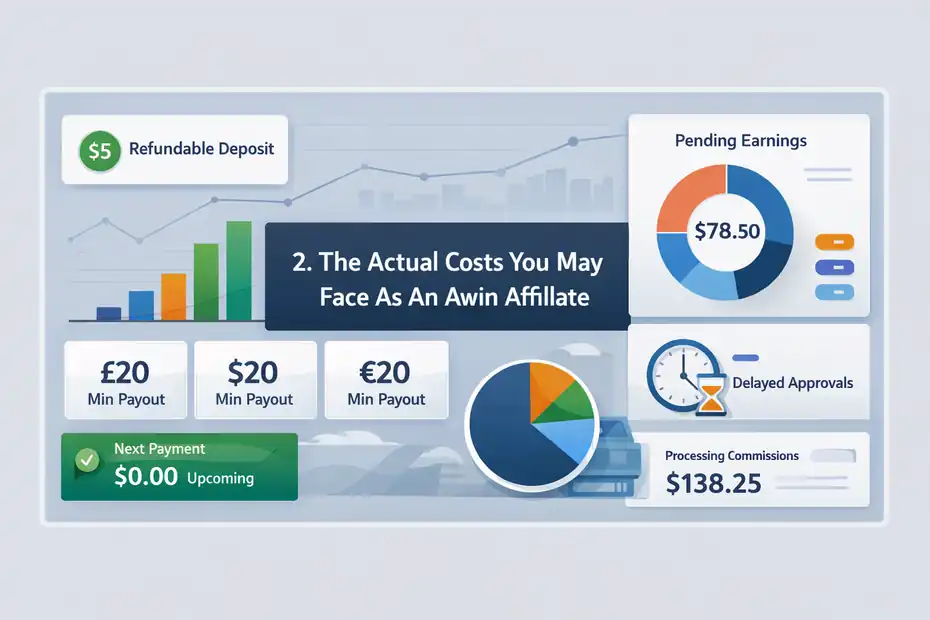
The most talked-about affiliate-side cost on Awin is the refundable $5 deposit mentioned in Awin’s publisher onboarding guide. Awin explains this as a security measure tied to bank-detail verification and willingness to join the network, not as a permanent fee.
The same guide says the amount remains visible in your account and is repaid in your first commission payment once you meet the payment threshold. It also says the deposit is refunded if your application is declined or if you close the account before that first commission payment.
That matters for beginners because psychologically it changes how the platform feels. A fully free signup feels casual. A refundable deposit feels more selective. In my opinion, that is not necessarily a bad thing.
It likely reduces low-quality or spam signups, which can help keep the network cleaner for advertisers and serious affiliates.
Still, I would not ignore the user experience issue. If you are a brand-new affiliate with no site, no traffic, and no content yet, even a small deposit can feel annoying because it comes before proof of earnings. For an established content creator or media site, it is basically irrelevant.
The lesson is simple: Do not judge Awin’s true affiliate cost by the deposit alone. Judge it by how quickly you can get into quality programs and convert traffic.
Payment Thresholds And Why They Matter More Than The Deposit
For most affiliates, the payment threshold matters more than the sign-up deposit because it directly affects cash flow. Awin says publishers must set a minimum payment threshold, and the network minimums are £20 for GBP, €20 for EUR, and $20 for USD.
For other currencies, the threshold is the equivalent of $20. If you do not set your own threshold, Awin applies a default one, and those defaults can be much higher depending on currency.
Here is why this matters. Imagine you join Awin, make a few early sales, and earn $14 in confirmed commission. That sounds encouraging, but it does not pay out yet. The balance rolls over until you hit the threshold by the cutoff date. Awin says balances that do not meet the threshold simply carry into the next cycle.
For smaller affiliates, this creates a hidden waiting period. It is not a fee, but it feels like one because your money is stuck in the system longer than you expected.
I always suggest treating thresholds as part of your cash-flow planning, especially if you are comparing networks.A network with a low payout threshold can feel friendlier to newer affiliates because it gets you to your first real payout faster.
The Hidden Cost Of Delayed Validation
A lot of people search for pricing when the real frustration is delayed validation. Technically, Awin is not charging you for this. But when commissions sit in pending or confirmed status for a long time, your effective earnings feel slower and less reliable.
Awin’s payment documentation explains that publishers only get paid on approved and cleared transactions, and payment timing depends on whether the advertiser has paid Awin and whether the threshold has been met.
Payments are processed twice per month, but that does not mean every tracked sale becomes cash twice per month. There is still a validation chain behind the scenes.
This is where I think many new affiliates misread “bi-monthly payments” as “fast payments.” They are not the same thing. Fast payment frequency is nice, but it only helps after commissions are approved and the advertiser-side funding process is complete
If you promote merchants with slow validation habits, your income timeline stretches out no matter how good the headline payout schedule sounds.
So when you think about Awin fees, include time as part of the cost. In affiliate marketing, delayed cash is a real business expense even if it never appears on an invoice.
How Awin Payments Work Step By Step
Understanding the payment process helps you avoid most early confusion.
Once you see how tracked sales move through the system, the fee conversation becomes much easier to understand.
From Click To Cleared Commission
Awin’s payment process follows a path that is pretty standard for affiliate networks, but beginners often miss a couple of stages. First, a click is tracked. Then a transaction is recorded. After that, the advertiser reviews it and either approves or declines it.
Only after the transaction is approved and the advertiser-side payment process is completed does that commission move toward payout. Awin’s documentation distinguishes between commission sitting in the account and commission ready for the next payment run.
That means the money in your dashboard is not all equal. Some of it is just tracked activity. Some is confirmed but not yet payable. Some is in the “next payment” bucket. If you have ever stared at affiliate dashboards wondering why your balance and your payout amount do not match, this is usually the reason.
I recommend checking these stages before assuming there is a fee problem. In many cases, the issue is not that money was taken from you. It is that the sale has not reached the payout-ready stage yet.
That distinction sounds small, but it saves a lot of unnecessary panic when you are starting out.
When Awin Pays Publishers
Awin says payments are processed twice per month. To be included, your balance must reach the threshold by either the 15th or the last day of the month.
If you miss it, the amount rolls into the next cycle. Awin also notes that publishers can change payment threshold and frequency in the platform.
Older Awin payment materials describe payment days around the 1st and 15th, with funds taking several days to reach a bank account depending on the method and banking system.
In plain language, here is the rhythm:
- Cutoff: Hit your threshold by the deadline.
- Processing: Awin includes eligible cleared commissions in the next payment batch.
- Arrival: Bank processing can add extra days after release.
For planning purposes, I suggest thinking in “earning windows” rather than fixed paydays. That mindset is more realistic. It helps you avoid building your content or ad spend around an overly optimistic expectation that every approved sale will land instantly.
Why Your Dashboard Total And Payout Total Can Look Different
This is one of the most common sources of confusion, and it is usually not a pricing issue at all. Your dashboard may show overall commissions, confirmed commissions, and next payment amounts that do not match.
Awin’s own payment explanations say the “next payment” amount is fixed once published and only includes what is due for that cycle, while other tracked or confirmed commissions may still be waiting on advertiser payment or timing cutoffs.
A quick example makes this easier. Let’s say you have:
- $62 total recorded commissions
- $28 cleared and eligible
- $34 still awaiting some combination of validation or funding
Your visible account value is still $62, but your next actual payout may only be $28 if that is the amount that cleared in time and met the rules for release.
I believe this is where many affiliates wrongly conclude that Awin is “taking fees” from them. Sometimes a deduction may exist through payment rails or banking, but very often the gap is just timing.
That is why it is smart to read the payout status fields carefully before assuming the network skimmed your earnings.
What Awin Charges Advertisers And Why Affiliates Should Still Care
Even though this article is for affiliates, advertiser pricing still matters because it shapes your commission rates, merchant behavior, and the quality of offers you see in the network.
Awin’s Current Advertiser Pricing Structure
Awin’s official US pricing page shows Access at $49 per month with a 3.5% transaction tracking fee, while Accelerate starts at $99 per month with a 2.5% transaction tracking fee. The advertiser also sets the commission they pay the partner.
Awin’s FAQ further explains that tracking fees can be calculated in different ways depending on the business model: either as a percentage of sales revenue or as a percentage of publisher commission where no transaction value exists.
That means a merchant’s true cost is usually made up of three layers:
| Cost Element | What It Means |
|---|---|
| Monthly Platform Fee | Recurring fee for access to Awin tools and program management |
| Tracking Fee | Awin’s override, often a percentage of sale value or commission value |
| Affiliate Commission | What you, the publisher, actually earn |
This matters because brands do not set commission rates in a vacuum. If their network costs are higher, they may set more conservative affiliate commissions, stricter approval criteria, or tighter payout rules.
So while you do not personally pay these advertiser fees, they still influence what lands in your wallet.
How Merchant Costs Affect Your Commission Potential
Let me put this in a realistic scenario. Imagine two ecommerce brands each sell a $100 product. Brand A runs on a lean affiliate stack and is happy paying 10% commission.
Brand B is more cautious and is paying a platform fee, tracking fee, internal account-management costs, and stricter margin targets. Brand B may only offer 4% to 6%.
On Awin’s own example for a $100 sale, a 6% commission gives the partner $6, while the platform’s tracking fee may add another $3.50 under Access pricing.
That example is brand-side math, but it shows why some merchants squeeze commissions lower than affiliates would like.
This is why I always advise affiliates not to judge a program only by the network name. Two Awin advertisers can feel completely different because the merchant’s margins, commercial goals, and tolerance for acquisition costs are different.
Network pricing creates the framework, but merchant strategy determines the opportunity.
Why Some Awin Programs Feel Better Than Others
Awin itself is a marketplace, not one uniform commission engine. The network connects a very large set of partners and brands. Its publisher pricing page says affiliates can access 30,000+ brands, while Awin also highlights its global scale and strong transaction volume.
That scale is helpful, but it also means variance. You will find programs with:
- generous commissions and smooth approvals
- average commissions but strong conversion rates
- high headline percentages but poor validation discipline
- low rates that only make sense if average order value is high
In other words, Awin pricing is not one number for affiliates. It is a platform environment where each advertiser creates a different earnings profile.
In my experience, the affiliates who do best on Awin are the ones who evaluate programs like business partnerships, not like coupon codes.
How To Estimate What You Can Really Earn On Awin
Once you understand the fee structure, the next step is translating that into realistic earnings.
This is where a lot of glossy affiliate reviews fall apart, because they talk about commissions without talking about math.
A Simple Earnings Formula You Can Use
The easiest formula is:
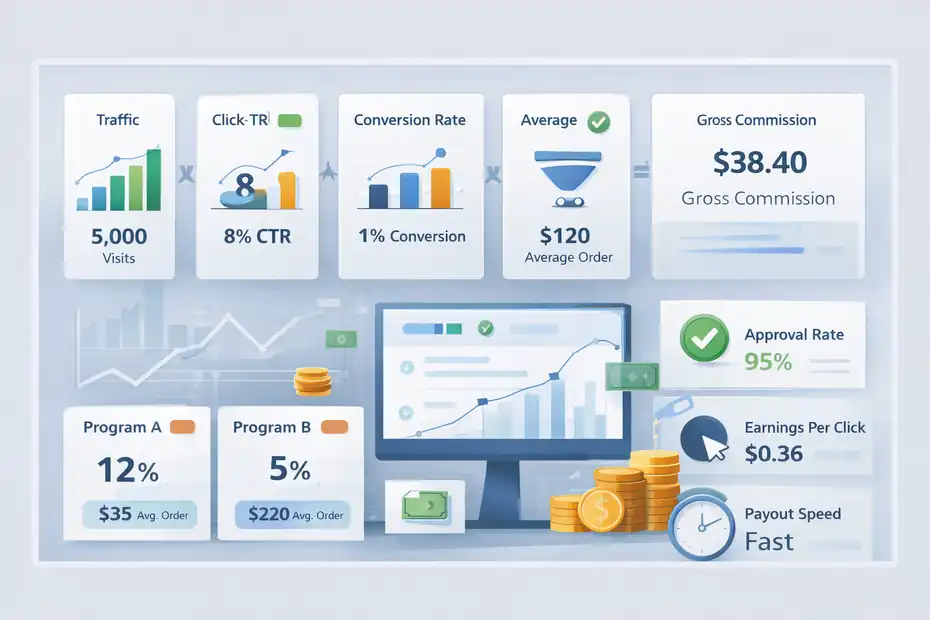
Traffic × Click-through rate × Conversion rate × Average order value × Commission rate = gross commission potential
Then you mentally subtract friction like reversals, delays, low approval rates, and threshold timing.
Awin’s own educational content says affiliate marketing conversion rates around 0.5% to 1% are considered average as a general guideline, though performance varies widely by niche and setup. That is not a guarantee, but it is a useful starting benchmark.
Imagine you publish a product roundup that gets 5,000 visits per month. If 8% of readers click through, that is 400 clicks. If 1% convert, that becomes 4 sales. At a $120 average order value and 8% commission, that is $38.40 in gross commissions before any reversals or delays.
That may not sound huge, but now imagine you create 30 pages with similar economics. Suddenly the math gets more interesting. This is why I think Awin works best when you approach it as a content system, not a one-link side hustle.
The Metrics That Matter More Than Headline Commission Rates
A 12% commission sounds great until you realize the advertiser converts badly or declines too many transactions. A 4% commission can outperform it if the brand converts well and has a high order value.
I suggest watching these metrics closely:
- Approval rate: Are sales being validated consistently?
- Average order value: Small commissions on bigger carts can still win.
- Earnings per click: A quieter but often more useful metric than raw commission rate.
- Payout speed: Slow clearing affects how aggressively you can reinvest.
This is where hands-on judgment matters. Beginners often chase the highest visible percentage. More experienced affiliates chase reliable economics.
I would take a lower commission from a strong-converting merchant over a flashy rate from a messy program almost every time.
A Small-Scale Scenario That Shows The Difference
Imagine you are running a niche home-office blog.
- Program A pays 12% commission on a $35 average order value.
- Program B pays 5% commission on a $220 average order value.
At first glance, Program A looks better. But one sale on Program A gives you $4.20. One sale on Program B gives you $11. If Program B also converts better because the brand is stronger, the “lower-paying” program can beat the higher-percentage program without much effort.
That is why Awin pricing and fees explained should never stop at “What does Awin charge?” The better question is “What does this merchant economics setup mean for my actual earnings?” That is the number that pays your bills.
Common Mistakes Affiliates Make When Evaluating Awin Fees
This is the part where small misunderstandings create expensive decisions.
Most fee confusion comes from bad assumptions, not bad math.
Mistake 1: Confusing Network Fees With Commission Cuts
Awin’s advertiser materials make clear that tracking fees are charged to the advertiser as part of program operation. Those are not the same thing as the commission due to the publisher.
If an advertiser is paying Awin a tracking fee, that does not automatically mean your agreed commission was reduced after the fact.
The confusion happens because advertisers often talk publicly about “Awin fees,” and affiliates read that discussion without realizing it is a different side of the marketplace. I’ve seen this happen a lot in affiliate communities.
Someone hears that Awin takes 3.5%, then assumes the network is clipping 3.5% from affiliate earnings on every sale. That is not what Awin’s official advertiser pricing examples describe.
Always separate these questions:
- What did the merchant agree to pay me?
- What does the merchant pay Awin?
- What is pending versus cleared in my account?
That one habit will clear up most pricing confusion.
Mistake 2: Ignoring Threshold And Timing Friction
A low network fee means very little if your commissions take forever to become spendable cash. Awin’s payment rules around thresholds, approval, and payment cycles are easy to understand once you read them, but a lot of affiliates skip that step.
I recommend thinking about three clocks at once:
- Validation clock: How quickly the advertiser approves transactions.
- Threshold clock: When your cleared balance crosses minimum payout.
- Banking clock: How long your selected payment method takes after release.
Miss any one of those, and your “monthly income” becomes much lumpier than expected. That is not always a red flag. It is just operational reality.
But if you ignore it, you can make bad business decisions, especially if you are using paid traffic or outsourcing content.
Mistake 3: Joining Too Many Weak Programs Too Early
Because Awin has access to a huge number of brands, beginners sometimes overapply, collect a pile of mediocre programs, and then wonder why earnings feel thin. That is not a fee issue, but it creates the same feeling: lots of effort, not enough money.
Awin’s own getting-started advice tells publishers not to apply everywhere at once and instead focus on something they know and can do well. I agree with that. A smaller portfolio of well-matched advertisers nearly always beats a giant list of random approvals.
In practice, five strong merchants can outperform twenty average ones because your content becomes tighter, your links make more sense, and your conversion path improves.
I believe this is one of the most underrated “pricing” insights in affiliate marketing: the right merchant mix is often more important than the network itself.
Is Awin Worth It For Different Types Of Affiliates?
By now, the mechanics should be clear. The real decision is whether Awin matches your business model.
Best Fit: Content Sites, Media Publishers, And Niche Creators
Awin is a strong fit for affiliates who want access to a broad marketplace of brands and who are willing to manage relationships program by program.
Its publisher-facing pages emphasize free access to a large pool of advertisers, reporting tools, and partnership opportunities across different publisher types.
If you run a content site, product review blog, editorial publication, newsletter, or creator-led recommendation business, Awin can work well because you can test multiple merchants inside one network environment.
The biggest advantage is optionality. You do not have to build your business around a single direct affiliate program.
I especially like Awin for affiliates who already understand buyer intent. When you know how to create “best,” “review,” “comparison,” and “alternative” content that converts, a network like Awin gives you plenty of room to optimize merchant selection.
Harder Fit: Brand-New Affiliates With No Audience Yet
Awin is not impossible for beginners, but I do not think it is the easiest starting point for someone with zero audience, zero content, and no clear niche. The platform may be low-cost, but low-cost is not the same as beginner-proof.
The challenge is not the fee structure. It is earning velocity. If you cannot produce content or traffic that converts, even a free network feels unhelpful. Then the deposit, the approvals, and the threshold all feel bigger than they really are.
For many of us, affiliate networks feel “expensive” when we are underprepared, even if the invoice says otherwise. That is why I usually suggest building a small content base first, then joining once you can point advertisers to something real.
The Real Verdict On Awin Pricing For Affiliates
My honest take is that Awin is affordable for affiliates and potentially very worthwhile, but only if you judge it by earnings quality rather than by signup messaging.
The platform’s official materials support the idea that publishers are not paying ongoing monthly fees, while thresholds and payout processes are clearly defined.
Advertiser-side costs are real, but they mostly matter to you indirectly through commission strategy and merchant behavior.
So is Awin worth it?
Yes, if you want access to a large network of brands and you are willing to choose programs carefully. No, if you are expecting instant income from random links without understanding validation, thresholds, and conversion math.
That may sound less exciting than a hype-filled answer, but it is the truth. And in affiliate marketing, boring truth usually makes more money than flashy myths.
FAQ
What is Awin pricing for affiliates?
Awin pricing for affiliates is mostly free, with no monthly platform fees required to join or stay active. Some users may encounter a small refundable sign-up deposit used for account verification, but affiliates primarily earn commissions without ongoing network costs.
Does Awin charge affiliates any hidden fees?
Awin does not charge hidden recurring fees to affiliates. However, factors like payment thresholds, transaction validation delays, and advertiser approval processes can affect when and how you receive your earnings, which sometimes feels like a cost.
What is the Awin payment threshold for affiliates?
Awin requires affiliates to reach a minimum payout threshold, typically around $20, €20, or £20 depending on currency. If your balance does not meet this amount by the cutoff date, your earnings roll over to the next payment cycle.
How often does Awin pay affiliates?
Awin pays affiliates twice per month, usually based on cutoff dates around mid-month and end-of-month. Payments only include cleared and approved commissions that meet the payout threshold, so actual timing depends on validation and advertiser payments.
Is Awin worth it for beginner affiliates?
Awin can be worth it for beginners, but it works best for those with some content or traffic already. While the platform is low-cost, success depends on choosing the right programs, understanding conversion metrics, and being patient with approvals and payouts.

I’m Juxhin, the voice behind The Justifiable.
I’ve spent 6+ years building blogs, managing affiliate campaigns, and testing the messy world of online business. Here, I cut the fluff and share the strategies that actually move the needle — so you can build income that’s sustainable, not speculative.
Related posts:
 How to Become a Better Affiliate Marketer
 5 Best Affiliate Marketing Programs: Boost Your Earnings Now!
 How to Join Awin Affiliate and Start Earning Today
 10 Digital Marketing Affiliate Marketing Hacks That Work
 The Affiliate Marketing Guide No One Told You About
 10 Best Affiliate Marketing Products That Sell Like Crazy