
Table of Contents
Some links on The Justifiable are affiliate links, meaning we may earn a small commission at no extra cost to you. Read full disclaimer.
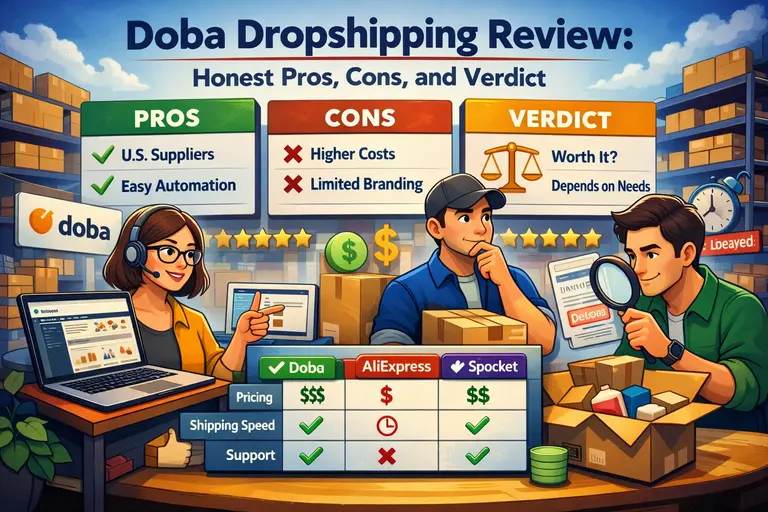
Doba pros and cons for dropshipping are worth looking at carefully before you pay for yet another sourcing platform that promises easy profits.
I have seen too many sellers jump in because a directory looks polished, only to realize later that the real question is not “Does this tool work?” but “Does this tool fit my business model?”
Doba can absolutely help some stores move faster, especially if you want supplier access, product syncing, and marketplace integrations in one place.
But it also has tradeoffs, and those tradeoffs matter a lot once margins get tight.
What Doba Actually Is And Why People Consider It
If you are new to dropshipping, this is the first thing to get straight. Doba is not a magic supplier.
It is a sourcing and automation platform that sits between you and a network of suppliers, then helps you list products, sync inventory, and route orders.
What Doba Does In Plain English
Think of Doba as a product directory plus workflow layer. Instead of manually hunting for separate wholesalers, checking whether they support dropshipping, formatting product feeds, and updating stock yourself, you use Doba to browse products, push them into your store, and keep certain data synced.
The company highlights AI-assisted product research, store-building features, order syncing, and real-time inventory and price monitoring. It also promotes integrations with major selling channels such as Shopify, Amazon, eBay, Walmart, Wix, and WooCommerce.
For many beginners, that sounds ideal because the hardest part of early dropshipping is usually not setting up a store. It is building a reliable supply chain without drowning in messy spreadsheets, supplier emails, and inconsistent product data. Doba tries to solve that operational mess.
Where I think people get confused is this: Doba reduces friction, but it does not remove business risk. You still need to validate products, watch margins, test offers, manage customer expectations, and deal with returns. A smoother backend does not automatically create demand.
That matters because the broader dropshipping market keeps growing, which means competition keeps growing too. Grand View Research says the global dropshipping market was valued at $365.67 billion in 2024 and projects 22.0% CAGR from 2025 to 2030.
More opportunity usually means more competition, thinner margins, and less room for lazy execution.
Why Doba Appeals To Beginners And Busy Sellers
The platform’s strongest pitch is convenience. Doba says 90% of its products are stocked in U.S. warehouses, offers a 7-day or 14-day $0.99 trial depending on plan context, and emphasizes real-time syncing plus 24/7 support.
That is attractive if you want to launch fast and avoid the slow, frustrating supplier outreach that kills momentum.
Here is the emotional side nobody talks about enough: many new sellers are not really buying software. They are buying relief. They want to feel like someone has already organized the chaos for them. Doba sells that feeling well.
I do think that convenience has real value, especially if you are juggling school, a full-time job, or another business. A platform that lets you test product categories quickly can help you get to actual store data faster. And that is important, because guessing is expensive.
But convenience platforms are also easy to overpay for. If your store only has a handful of products, limited traffic, and no proven sales yet, you may be paying for automation you do not really need.
The Biggest Pros Of Using Doba For Dropshipping
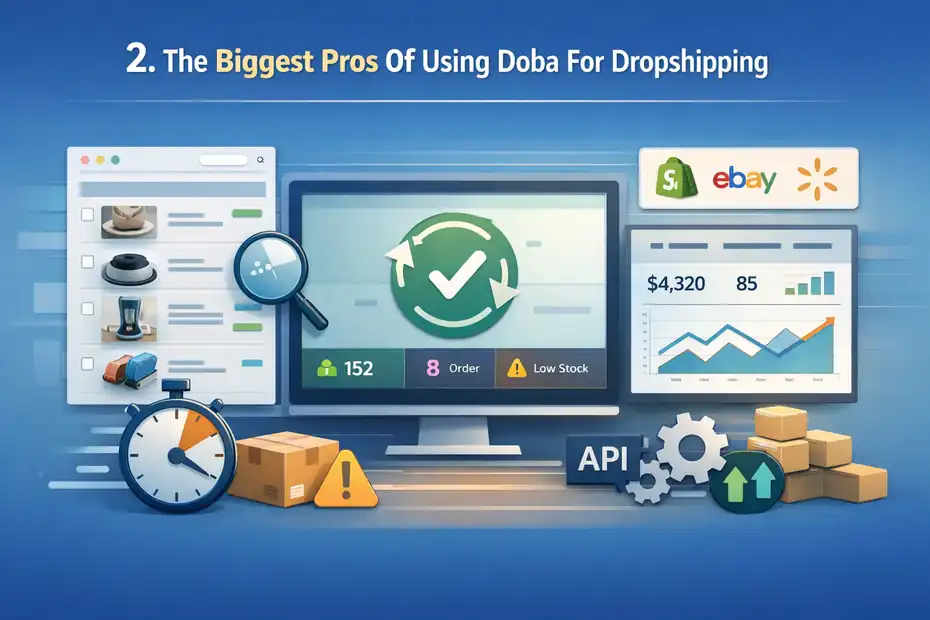
This is where Doba earns its place in the conversation. There are real advantages, and for the right seller they can save serious time.
Faster Supplier Access Without The Manual Grind
The clearest advantage is speed. Doba lets you access product catalogs without doing the classic beginner routine of searching wholesaler after wholesaler, applying for accounts, asking whether they support blind dropshipping, and figuring out their CSV formats. That alone can save days or weeks of setup time.
If you want to validate a niche quickly, speed matters more than most advice articles admit. Imagine you are testing kitchen organizers, pet accessories, and home fitness products in the same month. Doing that manually across separate suppliers is annoying. Doing it from one interface is much easier.
This is also useful for sellers who care more about execution than supplier relationship-building. Some people love negotiating directly with vendors. Others just want to list, test, kill losers, and scale winners. Doba leans toward the second style.
I believe that is one of its biggest practical strengths. It shortens the path between “I have an idea” and “I have products live in my store.” For lean validation, that is valuable.
The catch is that faster access does not mean better exclusivity. When a platform makes sourcing easier for you, it usually makes it easier for thousands of other sellers too.
Real-Time Syncing Can Prevent Dumb Inventory Mistakes
Inventory sync is one of those boring features that becomes extremely exciting the first time it saves you from overselling a product that just went out of stock. Doba says it automatically monitors inventory and pricing 24/7 and keeps product data and orders synchronized.
That matters because one of the fastest ways to destroy trust is to sell an item, take payment, and then email the customer three days later saying it is unavailable. Even if you refund them fast, the damage is done. They remember the disappointment, not the refund.
For stores with more than a tiny product catalog, some kind of sync system is not a luxury. It is basic damage control.
A realistic example: Let’s say you run a small home decor store and one lamp starts taking off from a TikTok post. If stock changes quickly and your backend does not update, you can rack up angry orders in one evening. Doba’s sync layer is supposed to reduce that risk.
I would not call any sync tool perfect, because supplier-side data quality still matters. But the principle is solid. You want fewer manual touchpoints, fewer stale listings, and fewer avoidable customer service fires.
Useful For Multi-Channel Sellers Who Hate Repetitive Work
Doba supports multiple integrations, including Shopify and several marketplaces, and its plans scale up based on store integrations, listing limits, product export limits, and automation features. The higher tiers include more listings, more inventory capacity, more downloads, API access, and account-management support.
This becomes useful when your business is not just one Shopify storefront. Maybe you also sell on eBay or Walmart. Maybe you want to test the same catalog across different channels. In that case, centralized operations become much more attractive.
Here is where I think Doba can feel “worth it” to the right person: not when you are making your first dollar, but when repetitive admin starts eating the hours you should be spending on merchandising, conversion work, and retention.
A lot of ecommerce growth problems are not glamorous. They are things like bad product data, duplicated workflows, inconsistent stock updates, and messy order routing. Doba is strongest when you feel those pains already.
If you are still at the stage where your main issue is “nobody is visiting my store,” Doba will not solve the real bottleneck.
The Biggest Cons Of Using Doba For Dropshipping
Now for the part most affiliate-style reviews soften too much. Doba has real weaknesses, and ignoring them is how people end up disappointed.
Subscription Costs Can Pressure Thin Margins
Doba’s pricing is not trivial for a beginner. Its pricing page currently shows quarterly-billed tiers including Limited at $28.66 per month, Basic at $56.99 per month, and Standard at $142.66 per month, while the Shopify App Store also shows a top-tier option at $299.99 per month.
Plan differences include listing capacity, inventory list size, monthly product downloads, AI usage, store integrations, and API access.
That is the biggest practical con in my opinion. In dropshipping, margins are often already under pressure from ad costs, payment fees, discounts, refunds, and shipping surprises. Layering a meaningful subscription on top can turn a maybe-profitable store into a definitely-unprofitable one.
Let me make that real. Suppose a product gives you $12 gross margin before overhead. If software, apps, transaction fees, and customer support costs eat a large chunk of that, you suddenly need higher volume just to stand still.
This is why I rarely recommend premium sourcing tools to absolute beginners unless they have one of two things: clear cash flow or a very focused test plan. Otherwise, the tool becomes a monthly stress machine.
Doba may save time, yes. But if you have not yet proven your store can generate steady sales, you have to ask whether time savings are worth cash burn.
Product Competition And Margin Compression Are Real
One of the quiet downsides of directory-style sourcing platforms is sameness. If a large pool of sellers can browse similar catalogs, many end up listing overlapping products. That usually leads to weak differentiation and pressure on pricing.
This is not a Doba-only problem. It is a common marketplace-access problem. But it still matters when evaluating Doba honestly.
The risk looks like this: you find a “winning” pet grooming tool, list it quickly, then discover ten other stores are pushing the same item with near-identical images and copy. At that point, your ad creative, branding, bundle strategy, and landing-page quality matter more than your access to the product.
Doba helps you source products faster. It does not guarantee unique positioning.
I suggest looking at Doba as an operations platform, not a moat. Your moat has to come from somewhere else: better niche selection, stronger creative, better offer design, faster customer support, improved bundles, smarter email flows, or superior content.
If you expect Doba to hand you hidden products nobody else can touch, that expectation will probably hurt you.
There Can Be A Learning Curve Around Shipping, Limits, And Workflow Nuances
The Shopify App Store reviews are actually helpful here because they show both praise and friction. Doba holds a 4.6 rating from 100 reviews, and Shopify’s review summary says merchants like the interface, customer service, automation, and filtering.
But recent feedback also mentions nuances around shipping-rate setup, inventory export navigation, plan-based limits, support availability, and order-payment timing.
That sounds very normal to me, not scandalous. Most platforms look simple in demos and more layered in real use. But it does mean Doba is not a “set it and forget it” toy.
The hidden frustration is usually workflow assumptions. For example, a seller may assume all plans include enough live inventory capacity, or may not realize that shipping logic needs careful setup, or may misunderstand when cash leaves their account relative to customer payments.
Those details matter because ecommerce problems are rarely caused by one giant failure. They come from ten small misunderstandings stacked together.
So yes, Doba can simplify a lot. But there is still a system to learn. If you dislike platform rules, plan caps, or operational nuance, that will bother you.
Who Doba Is Best For And Who Should Probably Skip It
This is the section I wish more reviews started with, because “good” software can still be the wrong software.
Doba Is A Better Fit For Sellers Who Value Speed Over Supplier Negotiation
Doba makes the most sense for sellers who want centralized sourcing and faster execution. That includes people launching their first serious store, operators testing many SKUs, and sellers expanding into multiple sales channels.
Its support for several integrations, automated sync, product research tools, and AI-assisted listing features all point in that direction.
If that sounds like you, Doba can reduce backend drag. You spend less time chasing suppliers and more time making decisions.
I especially see the appeal for these cases:
- Good fit: You want to validate products quickly without building supplier relationships from scratch.
- Good fit: You run a lean team and need fewer manual tasks.
- Good fit: You care about U.S.-stocked inventory and faster fulfillment positioning. Doba says 90% of products are stocked in U.S. warehouses.
- Good fit: You plan to list across multiple stores or marketplaces and want centralized management.
In my experience, tools like this feel best when your pain is operational, not strategic.
Doba Is A Poorer Fit For Ultra-Lean Beginners Or Brand-First Operators
If you are just trying to make your first sale with almost no budget, Doba may feel heavy. The subscription cost alone can create pressure before you have evidence that your niche, pricing, and traffic strategy are working.
It can also be a weaker fit for sellers who want direct, deep supplier relationships from day one. Some operators prefer negotiating custom terms, private-label paths, exclusive variants, branded inserts, or specialized shipping arrangements. A directory layer is usually less ideal for that kind of long-term brand building.
I would be cautious with Doba if your goal is one highly differentiated brand with a tight product line and a strong custom packaging experience. In that model, direct supplier sourcing often becomes more attractive as soon as you find traction.
There is also the mindset issue. Some people enjoy mastering a more manual supply chain because it gives them better economics later. Others would rather pay for convenience and move faster now. Neither approach is wrong. They are just different.
How To Evaluate Doba Before You Commit Money
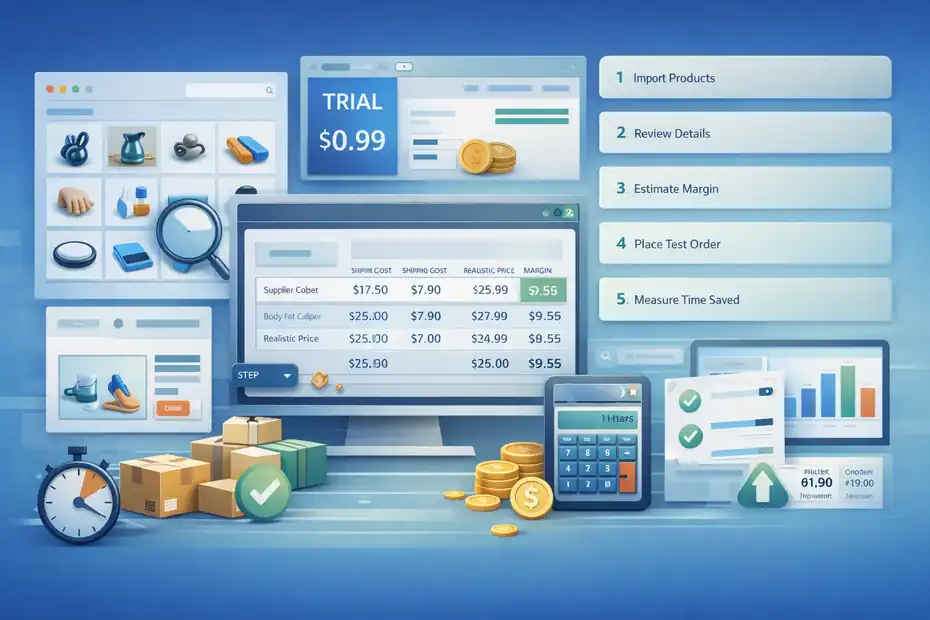
You do not need hype. You need a test process. Here is how I would evaluate Doba in a practical way.
Start With A Narrow Product Test, Not A Giant Store Build
The mistake I see often is signing up, importing dozens of products, customizing a whole storefront, and then wondering why the experiment feels messy. A better approach is smaller.
Pick one niche. Pick 10 to 20 products maximum. Then evaluate the actual store-building experience: listing quality, product data cleanliness, image consistency, shipping logic, margin room, and order workflow.
Use the low-cost trial strategically. Doba advertises trial access at $0.99, though the pricing page shows different trial windows depending on the plan context. Treat that trial as a validation sprint, not a browsing period.
Here is the framework I recommend:
- Step 1: Import a small set of products in one category only.
- Step 2: Check titles, descriptions, image quality, and variant structure manually.
- Step 3: Estimate landed margin after product cost, shipping, processing fees, and likely refund rates.
- Step 4: Place a test order if possible, or at minimum simulate the full fulfillment process.
- Step 5: Measure how much time Doba actually saves you compared with your alternative.
That last point matters. A tool is only valuable if it beats your next-best option.
Check Product Economics Before You Fall In Love With Features
The biggest rookie mistake in software evaluation is being impressed by the dashboard before checking whether the numbers work.
You need to know four things for any candidate product: supplier cost, shipping cost, realistic selling price, and return/refund risk. If the margin is weak before marketing, no amount of AI or automation will rescue it.
A simple rule I like: If the product does not leave enough gross profit to survive discounting and customer service friction, move on. Doba’s convenience can help you test products faster, but speed should help you reject bad economics faster too.
Imagine you find a product that sells for $34.99. If your landed cost plus shipping is already $24 to $27, your room is tight. Add transaction fees, occasional refunds, and content or ad spend, and that margin starts looking fragile.
I suggest making a quick spreadsheet before importing at scale. You do not need perfection. You need a reality check.
How To Use Doba Well If You Decide To Try It
If you do use Doba, there is a smart way and a sloppy way. The smart way is to treat it as infrastructure, not strategy.
Use Doba For Execution, But Build Your Edge Elsewhere
Doba can help with sourcing, syncing, and listing. That is useful. But your store still needs a reason to win.
Here is where your advantage should come from instead:
- Positioning: Sell to a specific buyer, not “everyone.”
- Offer design: Use bundles, quantity breaks, or starter kits.
- Creative: Show the product solving a visible problem.
- Landing pages: Make product pages answer objections before the customer asks.
- Retention: Use email and post-purchase flows to raise customer lifetime value.
This matters because average ecommerce conversion rates are not magically high.
Benchmarks vary by source and niche, but common 2025–2026 estimates still sit roughly around the low single digits, often about 2% overall. That means most visitors will not buy, so your merchandising and conversion work matter a lot more than just importing products.
In other words, Doba can help you operate a store. It cannot make a mediocre storefront persuasive.
I believe that mindset shift protects people from disappointment. When you stop expecting the tool to be the business, you start using it properly.
Keep Your Catalog Tight And Curated
One of the easiest traps with a broad product marketplace is overlisting. Just because you can import a lot of products does not mean you should.
A tighter catalog usually converts better because it feels intentional. Customers can understand what your store is about. Your messaging gets sharper. Your support burden stays lower. Your merchandising improves.
A practical example: A 25-product niche store with a coherent angle often feels more trustworthy than a 400-product general store that looks like a warehouse clearance site.
I would start with a focused collection, then expand only when you see product-level proof. Proof means one of three things: repeat sales, good on-site conversion behavior, or strong engagement from traffic sources.
Doba’s bigger plans raise listing and inventory limits, but that does not mean those higher limits should become your goal. Capacity is not the same as strategy.
Common Mistakes People Make With Doba
This section is really about expectations. Most “the platform failed me” stories are partly workflow problems.
Mistake One: Assuming The Platform Picks Winners For You
Doba promotes AI tools, curated selections, product analytics, and expert product research. Those features may help surface opportunities faster, and they can be genuinely useful for idea generation. But they do not replace market judgment.
A recommended product is not automatically a profitable product for your audience. That distinction matters.
For example, a high-demand item might still fail for your store because your traffic is wrong, your angle is generic, or your delivery promise is weaker than competitors. A product can be “good” in theory and still be bad in your execution context.
I advise treating platform recommendations as raw material, not answers. They can narrow the search. They cannot close the thinking gap for you.
Whenever you shortlist a product, ask:
- Question 1: Why would this specific customer buy from me?
- Question 2: Can I present this better than competing stores?
- Question 3: Does the margin survive customer-acquisition costs?
- Question 4: Will shipping speed support my promise?
Those questions are where real store-building starts.
Mistake Two: Ignoring Fulfillment Reality Until Customers Complain
A lot of new sellers obsess over imports and theme design, then barely think about delivery expectations, shipping settings, and support workflows until the first angry email hits.
That is risky. Some Shopify feedback on Doba specifically mentions nuances around shipping-rate setup and order terms, which is exactly the kind of operational detail that becomes painful when skipped.
Before you scale anything, make sure you can answer these clearly on your store:
- Shipping speed: What is the realistic delivery window?
- Stock confidence: How often does availability change?
- Return policy: What happens if the item arrives damaged or unwanted?
- Order timing: When do you pay the supplier relative to customer payment?
None of this is glamorous, but it is the difference between a store that feels trustworthy and one that leaks reputation.
I suggest writing your customer-facing policies only after you understand the backend flow. That keeps your promises grounded in reality.
Final Verdict: Is Doba Worth It For Dropshipping?
Here is my honest take: Doba is not hype, but it is also not a shortcut around business fundamentals.
The Honest Bottom Line
Doba is worth considering if you want a centralized way to source products, sync inventory, manage listings, and move faster across one or more sales channels.
Its current positioning around U.S.-stocked inventory, automation, AI-assisted product discovery, and multi-platform integrations makes it attractive for sellers who value speed and convenience.
The available public signals are fairly solid too: Doba says it has been operating since 2002, highlights 3.2 million-plus users and $6.2 billion-plus earned by its dropshippers, and its Shopify app currently shows a 4.6 rating across 100 reviews.
But the cons are just as real. Subscription costs can be meaningful, plan limits matter, learning curves still exist, and product overlap can make differentiation hard.
So my verdict is simple:
- Doba is a good operational shortcut if you already understand how to choose products, position offers, and run a store responsibly.
- Doba is a shaky first bet if you are hoping software will replace strategy or make an unvalidated business model profitable.
I would not buy it because of the word “AI.” I would buy it only if I had a clear reason that centralized sourcing and automation would save me enough time or mistakes to justify the cost.
And that, honestly, is the real answer behind most doba pros and cons for dropshipping questions. The platform can help. It just cannot save a weak business model from itself.
FAQ
What is Doba in dropshipping?
Doba is a dropshipping platform that connects online sellers with suppliers and automates product listing, inventory syncing, and order processing. It acts as a middle layer, helping store owners manage products and fulfillment without directly dealing with multiple suppliers individually.
Is Doba worth it for beginners?
Doba can be worth it for beginners who want a faster setup and simplified supplier access. However, its subscription cost may feel high if you have not validated your store or product yet. It works best when you already have a clear testing strategy.
What are the main disadvantages of Doba?
The main disadvantages of Doba include monthly subscription fees, potential product competition, and limited uniqueness in product sourcing. Some users also face a learning curve with shipping settings and plan limits, which can affect profitability and workflow efficiency.
Does Doba offer better suppliers than AliExpress?
Doba often focuses on U.S.-based suppliers, which can lead to faster shipping times compared to AliExpress. However, AliExpress may offer lower product costs. The better option depends on whether you prioritize delivery speed or higher profit margins.
Can you make money using Doba dropshipping?
Yes, you can make money using Doba if you choose profitable products, maintain strong margins, and build a solid marketing strategy. The platform simplifies operations, but success still depends on how well you position your store and attract customers.

I’m Juxhin, the voice behind The Justifiable.
I’ve spent 6+ years building blogs, managing affiliate campaigns, and testing the messy world of online business. Here, I cut the fluff and share the strategies that actually move the needle — so you can build income that’s sustainable, not speculative.
Related posts:
 The Best Way to Start Dropshipping With Little to No Money
 Salehoo Products List That Helps You Find Winning Items Fast
 Doba Review: Honest Pros, Cons, and Real Costs
 Doba Dropshipping Review: Honest Pros, Cons, and Verdict
 How to Use SaleHoo for Dropshipping and Pick Fast-Selling Items
 Spocket Vs Zendrop Which Is Better: Pros And Cons