
Table of Contents
Some links on The Justifiable are affiliate links, meaning we may earn a small commission at no extra cost to you. Read full disclaimer.
Jungle Scout review for private label beginners is a topic worth taking seriously because the wrong research tool can cost you far more than its monthly fee.
If you are trying to launch your first Amazon private label product, you probably do not need hype.
You need a realistic look at whether Jungle Scout actually helps you find profitable opportunities, avoid bad niches, and make smarter decisions with limited budget.
In this guide, I’ll walk you through what Jungle Scout does well, where it falls short, and how a beginner can use it without getting buried in data or false confidence.
What Jungle Scout Means For Private Label Beginners
If you are new to Amazon selling, the biggest question is not whether Jungle Scout is popular.
It is whether it helps you make better product decisions when you do not yet trust your instincts.
What Jungle Scout Actually Does
Jungle Scout is an Amazon product research and seller software platform built to help you estimate demand, competition, pricing, profit potential, and listing opportunities. In simple terms, it is meant to reduce guesswork when you are deciding what to sell.
For a private label beginner, that matters because the early mistakes are usually expensive. You pick a product with weak demand, or you underestimate competition, or you see high revenue and assume profit will follow.
Jungle Scout tries to solve that by showing you signals like estimated sales, sales trends, review counts, price ranges, and niche data in one place.
The reason beginners are drawn to it is obvious. Amazon does not hand you clean market research. The marketplace is crowded, fast-moving, and often misleading.
A product that looks easy from the outside can be dominated by experienced sellers with stronger branding, better supplier relationships, and more review history.
I believe the main value of Jungle Scout is not that it gives perfect answers. It gives structure. And when you are starting out, structure is often more valuable than raw information.
Why Private Label Beginners Look For A Tool Like This
Private label is a business model where you source a product, brand it as your own, improve the offer, and sell it under your brand name. That sounds simple until you realize how many decisions happen before your first order is placed.
You need to answer questions like these:
- Is there enough demand?
- Are the top listings too entrenched?
- Can I improve the product meaningfully?
- Will margins survive Amazon fees, shipping, and ads?
- Is the niche stable or just having a temporary spike?
Without a research tool, many beginners end up making decisions based on TikTok trends, YouTube screenshots, or random product ideas. That usually leads to chasing crowded categories with thin margins.
In my experience, beginners need guardrails more than they need complexity. A good tool should help you eliminate bad ideas faster. That is exactly where Jungle Scout can be useful, especially in the product discovery and early validation stages.
The Real Promise Behind The Platform
The promise is not “press a button and find a winning product.” Any tool claiming that is selling fantasy. The real promise is more practical: helping you compare products faster, estimate opportunity with fewer blind spots, and build confidence in your shortlist.
That is a more honest way to evaluate Jungle Scout. Do not ask whether it can choose your product for you. Ask whether it helps you make fewer bad choices.
If you keep that mindset, you are much more likely to get value from it.
How Jungle Scout Works In A Real Beginner Workflow
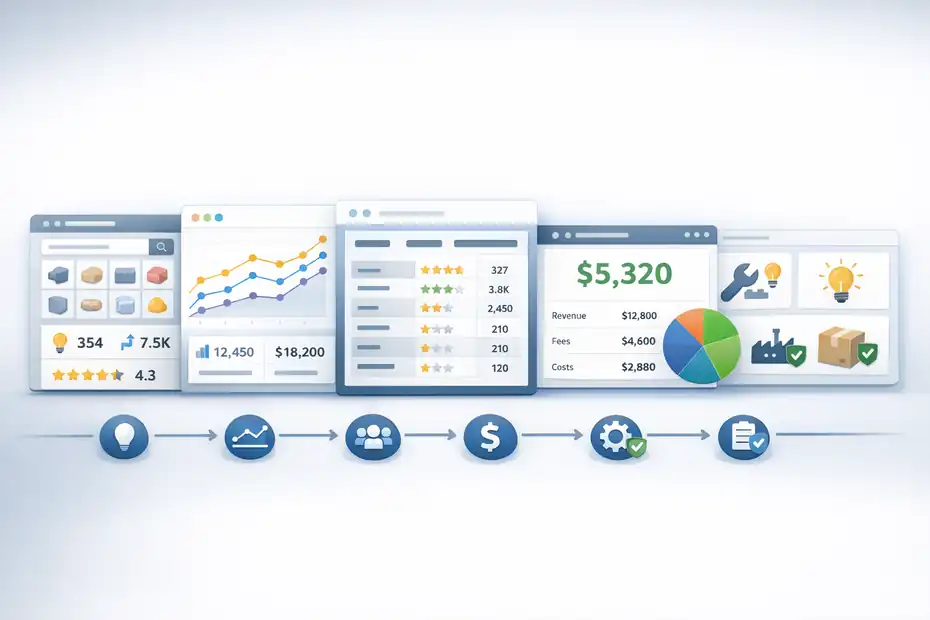
To judge any research tool fairly, you need to see how it fits into the actual process of launching a private label product.
Otherwise, it is easy to get impressed by dashboards that do not change your decisions.
The Core Workflow Most Beginners Follow
A beginner usually goes through a sequence that looks like this:
- Find possible product ideas.
- Check whether demand looks consistent.
- Review top competitors in the niche.
- Estimate profit after fees and shipping.
- Look for product improvement angles.
- Validate supplier viability.
- Build a shortlist and compare options.
Jungle Scout is strongest in the first four steps. It helps you generate ideas, sort through niche data, compare competition, and run early profit estimates. That does not mean it replaces supplier negotiation, brand strategy, product development, or launch planning. It just helps you get to those stages with better odds.
A lot of beginners fail because they do the steps out of order. They get emotionally attached to a product first, then use research tools to justify it. I suggest doing the opposite. Use the data to narrow your options before you imagine logos, packaging, or brand names.
Where The Data Comes From And Why That Matters
Jungle Scout relies on Amazon marketplace data and estimation models to predict sales, revenue, trends, and niche conditions. Since Amazon does not publicly reveal every seller’s exact unit sales, any software in this space is working with estimates.
That is important because beginners sometimes treat tool outputs as fact. They are not facts. They are informed estimates. And that difference matters when you are deciding how much cash to risk.
A smart beginner uses Jungle Scout like this: Not as a fortune teller, but as a filter. If one product appears to sell well, has moderate review counts, healthy pricing, and room for improvement, it may deserve deeper validation. If another product has unstable pricing, dominant brands, and weak margins, you cut it.
That is the real use case. Not certainty. Better probability.
Why The Workflow Matters More Than The Dashboard
I have seen beginners waste hours clicking every feature while still avoiding the hard decision-making. They collect screenshots, save dozens of product ideas, and end up with no real shortlist.
A better approach is to use Jungle Scout with a fixed workflow and a clear threshold. For example:
- Demand: Stable month-to-month movement
- Competition: Review counts low enough to enter
- Price: High enough to support margin
- Differentiation: Clear improvement angle
- Profit: Enough room after fees and ads
When you score products against those criteria, the software becomes useful. Without criteria, it becomes entertainment.
The Best Jungle Scout Features For Product Research
This is where Jungle Scout earns most of its reputation.
For private label beginners, product research is the make-or-break phase, and several features are clearly designed around that pain point.
Product Database For Filtering Ideas Fast
The Product Database is one of the most useful starting points because it lets you search Amazon products using filters like price, sales volume, review count, category, weight, and estimated revenue. Instead of browsing Amazon manually for hours, you can narrow thousands of products down to a manageable set.
This matters for beginners because manual browsing creates bias. You notice what looks trendy or familiar, not necessarily what has attractive economics. A filter-based search is more objective.
Imagine you want products priced between $25 and $60, with fewer than 200 reviews on average, decent monthly demand, and a small size tier to keep shipping simpler. That type of filter can quickly surface categories you might never have considered on your own.
The mistake many beginners make is setting filters too loosely. Then they get flooded with junk. I recommend using filters that reflect business reality, not wishful thinking. If your launch budget is limited, heavier products and low-priced items usually create more stress than opportunity.
Opportunity Finder For Niche Discovery
Opportunity Finder is built to help you identify promising keyword-based niches rather than just individual products. That distinction matters because private label success depends on entering a niche you can compete in, not just copying one listing.
This feature can help you explore what shoppers are actually searching for and how competitive those search terms appear. That gives you a wider perspective than looking at one product listing at a time.
For beginners, I think this is especially valuable because it nudges you toward market-first thinking. Instead of saying, “I want to sell a garlic press,” you start asking, “What search-driven product demand exists where buyers are active but the niche is not fully optimized?”
That shift is subtle, but powerful. It moves you closer to brand building and away from random product chasing.
Sales Analytics And Trend Visibility
One of the most dangerous beginner mistakes is choosing a product based on a temporary spike. A niche may look hot because of a seasonal moment, viral trend, or short-term shortage.
Trend visibility helps you see whether demand is stable, growing gradually, or jumping unpredictably. Stable is usually more beginner-friendly. Wild volatility looks exciting, but it can destroy your inventory planning.
I suggest beginners pay less attention to the biggest revenue screenshot and more attention to pattern consistency. A product that makes moderate but steady sales is often safer than one that swings sharply month to month.
That kind of realism saves money, especially when your first inventory order already feels risky.
How Accurate Jungle Scout Feels In Practice
Every private label beginner eventually asks the same thing: can I trust the numbers? The honest answer is yes, with caution.
Sales Estimates Are Useful, Not Perfect
Jungle Scout is best used for directional accuracy. In other words, it is strong enough to help you compare opportunities, but not precise enough to remove business risk.
If one niche shows much stronger estimated sales, healthier pricing, and lower review pressure than another, that comparison is usually useful. But if you are expecting the tool to predict your exact first-month sales after launch, you are asking too much from it.
This matters because beginners often build inventory plans around optimistic assumptions. They see estimated demand and imagine taking a big share immediately.
In reality, launch speed depends on conversion rate, ad performance, listing quality, reviews, and how differentiated your offer really is.
I believe Jungle Scout is most accurate when used as a relative decision tool. It helps answer, “Does Product A look more promising than Product B?” That is different from asking, “How many units will I definitely sell?”
What Beginners Misread Most Often
The most common misread is confusing high revenue with easy profit. A niche can show attractive sales volume but still be a bad idea if margins are squeezed by shipping costs, PPC ad spend, or aggressive competition.
Another common issue is overvaluing low review counts without checking listing quality. A niche might have weak reviews because the market itself is underperforming, not because there is easy room to enter.
Then there is the emotional trap: seeing a promising number and stopping your research too early. One good metric does not validate a product. You need multiple signs lining up.
A better question is: Does the full picture support entry? That includes pricing, reviews, differentiation, margin, trend stability, and buyer intent.
How To Use Accuracy Responsibly
Responsible use means cross-checking. If Jungle Scout says a niche looks promising, review the actual listings. Read the reviews. Look for obvious complaints. Scan image quality. Notice whether the first page is dominated by known brands or fragmented sellers.
You can also compare seasonal behavior and pricing patterns over time before committing. The deeper you go, the more you turn software estimates into business judgment.
That is the real skill private label beginners need to develop. The tool is a support system, not a substitute for thinking.
Pricing, Value, And Whether It Is Worth Paying For
Software cost matters more when you are bootstrapping your first product launch.
A beginner does not need another subscription unless it genuinely saves time, reduces mistakes, or improves decisions.
The Monthly Cost Versus The Cost Of A Bad Product
This is the simplest way I look at it: the real comparison is not Jungle Scout versus free browsing. It is Jungle Scout versus the cost of choosing the wrong product.
A bad product decision can burn through supplier deposits, shipping costs, packaging, launch ads, and months of energy. Even a small first launch can tie up a meaningful amount of cash. In that context, a research tool is cheap if it helps you reject weak ideas early.
That said, value depends on usage. If you subscribe for one month, use it intensely, build a shortlist, validate your niche, and make decisions, the ROI can be strong. If you subscribe and just browse casually, it becomes expensive procrastination.
I recommend beginners decide in advance what they want to extract from the tool.
For example: Generate 30 ideas, narrow to five, validate two deeply, and choose one launch candidate. That makes the subscription purposeful.
Who Gets The Most Value From Paid Access
The people who benefit most are usually in one of these situations:
- They are actively researching their first product now.
- They have a launch budget and need to reduce risk quickly.
- They are comparing multiple niches, not chasing one random idea.
- They want to learn how Amazon product economics really work.
The people who get the least value are usually dream-stage beginners who are not yet committed. If you are months away from taking action, you may not need paid software yet.
That is not a criticism. It is just practical. Tools are most valuable when they support a live decision.
When It Might Not Be Worth It
There are cases where Jungle Scout may not be the right spend. If your budget is so tight that software would reduce your ability to order samples, invest in better packaging, or launch ads, then you may need to prioritize.
Also, if you already have advanced research habits and a disciplined validation framework, the tool may speed things up rather than transform outcomes. For a complete beginner, though, speed plus structure can be a big advantage.
My view is simple: For active private label beginners, it is often worth testing. But it is only worth keeping if it meaningfully changes your product decisions.
Step-By-Step: How A Beginner Can Use Jungle Scout Properly
This is the section many reviews skip. They tell you what the features are, but not how to actually use them in a disciplined way.
Step 1: Set Clear Product Criteria Before You Search
Before opening any database or niche tool, define your rules. This keeps you from chasing products that look exciting but do not fit your budget or risk tolerance.
A beginner-friendly starting framework might include:
- Price range that leaves room for profit
- Moderate demand, not hype-driven spikes
- Review levels you can realistically compete with
- Lightweight or standard-size shipping profile
- Clear room for improvement through bundling, design, or positioning
This step matters more than people think. Without criteria, you will constantly move the goalposts. Every attractive screenshot will tempt you to ignore your original plan.
I suggest writing your criteria down and sticking to them until you have a good reason to change them.
Step 2: Build A Shortlist Instead Of Searching Forever
Once you start filtering products, save only the options that match your rules well enough to deserve deeper analysis. Your goal is not to find the perfect product in one sitting. Your goal is to create a shortlist.
A healthy shortlist might have five to ten candidates at first. From there, you can look more deeply at each niche, scan first-page competitors, read customer complaints, and compare pricing logic.
This is where many beginners go wrong. They think more ideas means more safety. Usually it just means more confusion. Once you have a decent shortlist, stop searching and start evaluating.
I believe the biggest private label skill is not idea generation. It is idea elimination.
Step 3: Validate Profit, Differentiation, And Real Entry Potential
After the shortlist is built, shift from market curiosity to business reality. Can you source the product at a cost that supports profit? Can you improve the listing or the product enough to matter? Can you survive initial ad costs?
This is the point where a product either becomes real or falls apart. You may find a promising niche, then realize the quality complaints are hard to solve, or the product variation options are limited, or the margin disappears once shipping is added.
That is normal. Good validation often kills ideas. That is a success, not a failure.
The win is not finding a product quickly. The win is avoiding a costly mistake before inventory is on the water.
Where Jungle Scout Helps Most During Product Validation
Product research gets the attention, but validation is where your future profit gets protected.
This is the point where you move from “interesting niche” to “can I build a real business around this?”
Using Competitor Analysis The Right Way
A beginner should not just count reviews and revenue estimates. You also need to understand what the current leaders are doing well and where they are vulnerable.
Look at the top listings and ask:
- Are the images strong or weak?
- Are the titles clear and focused?
- Do reviews reveal product flaws or shipping damage?
- Are buyers confused by sizing, materials, or usage?
- Is the listing differentiated, or are all sellers blending together?
This type of review turns research into opportunity mapping. You are no longer asking whether people buy the product. You are asking whether buyers are being served well.
In my experience, the best beginner opportunities often live in niches where demand is proven but execution is sloppy. Weak photos, unclear positioning, poor instructions, or repeated complaints can create room for a smarter brand.
Using Review Insights To Find Improvement Angles
Customer reviews are one of the best product development resources available. They tell you what buyers like, what frustrates them, and what they expected but did not get.
A private label beginner can use this information to shape packaging, inserts, size clarity, material upgrades, or even product bundles.
For example, if customers repeatedly complain that a kitchen organizer slides around in drawers, that is not just a complaint. It is a product improvement clue.
This is where Jungle Scout becomes more useful when paired with judgment. The software can lead you to the niche, but the reviews reveal how to compete.
I suggest keeping a simple note sheet with recurring complaints, desired features, and language customers use naturally. That can help with both sourcing and future listing copy.
Why Validation Should Be Slower Than Discovery
Discovery is broad. Validation should be slow and skeptical. A lot of beginners rush this stage because they are excited to move forward. That excitement is understandable, but dangerous.
You want to pressure-test the idea hard enough that surviving products become genuinely credible. A product that still looks attractive after deep validation is far more worth pursuing than one that looked flashy during the first search.
The calmer you are here, the better your launch decisions usually become.
Common Beginner Mistakes When Using Jungle Scout
The tool itself is not usually the reason beginners fail. Misuse is the bigger issue.
Mistake 1: Choosing Products Based On Revenue Screenshots
Revenue is seductive. It makes everything look possible. But revenue without margin context is incomplete, and revenue without competition context can be misleading.
A niche doing strong top-line sales may also require heavy PPC spend, expensive inventory, and a better brand than you can realistically launch right now. That does not make it bad. It just may not be beginner-friendly.
I advise newer sellers to care more about realistic entry conditions than headline revenue. A modest niche with cleaner margins and weaker competition can be a better first product than a glamorous one.
Mistake 2: Trusting Data Without Reading The Market
Some beginners become overly data-driven in the wrong way. They rely on filters and estimates but never really study the listings, the branding, the photos, or the customer sentiment.
That creates false confidence. Numbers help you narrow the market, but listings show you how the market actually feels.
A niche may look open numerically and still be hard to enter because buyers expect premium design, brand familiarity, or compliance features that are not obvious in the raw data. That is why market reading and tool data should work together.
Mistake 3: Using The Tool Without A Financial Model
Another mistake is researching products before understanding the unit economics. You do not need a complex spreadsheet at the start, but you do need a practical idea of landed cost, Amazon fees, ad spend, and target margin.
Imagine a product sells for $28. That may sound attractive until you realize manufacturing, freight, fees, and launch advertising leave little room for profit. Beginners often discover that too late.
The cleaner your financial thinking is before launch, the more valuable Jungle Scout becomes.
Advanced Tips To Get Better Results From Jungle Scout
Once you understand the basics, there are ways to use the platform more strategically.
These are the habits that separate surface-level research from sharper decision-making.
Compare Niche Patterns, Not Just Individual Products
It is easy to obsess over one product listing. A more advanced approach is to compare the whole niche structure. Look at average pricing, review concentration, listing quality, and whether one or two sellers dominate most of the demand.
This helps you avoid the trap of finding a single attractive listing in an otherwise difficult market. Private label is about entering a niche, not copying one seller.
I like to ask: Is demand spread across multiple sellers, or locked up by a few? A more fragmented niche is often friendlier for beginners because it suggests customers are willing to buy from newer brands.
Use Negative Signals As Decision Filters
Most beginners focus only on green lights. I think red flags are often more powerful. Weak margins, unstable prices, oversized shipping, trend spikes, legal concerns, or heavy review concentration should eliminate products quickly.
This saves time and protects attention. The fastest way to improve your research process is not always finding better winners. It is rejecting weak ideas sooner.
That might sound obvious, but it is not how most beginners behave. They search for reasons to say yes. Smart operators look for reasons to say no first.
Turn Research Into A Repeatable System
The real long-term value of Jungle Scout is not one product find. It is helping you build a repeatable research method. Once you learn what good markets look like, how to read listing weakness, and how to check profit realistically, you stop depending on luck.
That is when the tool becomes more than software. It becomes part of your operating process.
And honestly, that process mindset is what gives beginners the best chance to become real sellers rather than permanent researchers.
Final Verdict: Is Jungle Scout Good For Private Label Beginners?
After looking at the strengths, limits, and real-world workflow, the answer is yes, with the right expectations.
Jungle Scout is a strong option for private label beginners who need structure, product research support, and faster niche evaluation.
Who Should Use It
You should seriously consider it if you are actively planning a first Amazon private label launch and want help filtering product ideas, comparing competition, and validating early profit potential.
It is especially helpful if you tend to get overwhelmed by Amazon research or keep bouncing between random ideas. The platform can bring order to that chaos.
I would also recommend it to beginners who learn best by interacting with real market data. You will likely understand private label much faster by studying actual niches than by watching another ten hours of generic videos.
Who Should Be Careful
You should be more cautious if you are expecting the software to hand you a guaranteed winning product. It will not do that. No serious tool can.
You should also be careful if your budget is extremely tight and the subscription would prevent you from paying for samples, packaging improvements, or early launch testing. Product quality and execution still matter more than dashboards.
So yes, it is useful. But usefulness depends on discipline.
My Honest Recommendation
My honest take is that Jungle Scout is worth trying for private label beginners who are in decision mode, not just browsing mode. It is one of the better tools for turning messy Amazon research into a structured process, and that alone can save beginners from expensive mistakes.
The biggest benefit is not finding some mythical hidden winner. It is learning how to evaluate markets with more clarity and less emotion.
If you use it that way, Jungle Scout can absolutely justify itself. If you use it as a shortcut to avoid thinking, it will disappoint you. That is the real profit insight most reviews skip.
FAQ
What is Jungle Scout and how does it help private label beginners?
Jungle Scout is an Amazon product research tool that helps beginners find profitable product ideas by analyzing demand, competition, and pricing. It simplifies decision-making by providing estimated sales data and niche insights, allowing new sellers to avoid risky products and focus on opportunities with real market potential.
Is Jungle Scout accurate for product research?
Jungle Scout provides reliable estimates based on Amazon data, but it is not perfectly precise. It works best for comparing products and identifying trends rather than predicting exact sales. Beginners should use it as a guide alongside manual research like reviewing listings, pricing, and customer feedback.
How much does Jungle Scout cost and is it worth it?
Jungle Scout offers monthly subscription plans that can feel expensive for beginners, but it is often worth it if used properly. The cost is small compared to losing money on a bad product. Its value comes from helping users avoid poor product choices and save time during research.
Can beginners find winning products using Jungle Scout alone?
No, Jungle Scout cannot guarantee winning products on its own. It helps identify potential opportunities, but success depends on validation, product improvement, pricing strategy, and marketing. Beginners should combine tool data with competitor analysis and customer insights to make better decisions.
What is the best way to use Jungle Scout as a beginner?
The best approach is to set clear product criteria, build a shortlist of ideas, and validate each one carefully. Beginners should focus on demand stability, manageable competition, and profit margins. Using Jungle Scout as a filtering tool rather than a shortcut leads to better results.

I’m Juxhin, the voice behind The Justifiable.
I’ve spent 6+ years building blogs, managing affiliate campaigns, and testing the messy world of online business. Here, I cut the fluff and share the strategies that actually move the needle — so you can build income that’s sustainable, not speculative.
Related posts:
 Jungle Scout Review For New Amazon Sellers: Start Or Skip It?
 The Best Way to Dropship Without Wasting Money
 How to Launch a Dropshipping Startup From Scratch
 Dropshipping How to Start: Your Complete Beginner’s Guide
 Top Online Store Platforms for Building Income Streams
 Starting an Ecommerce Business: A Realistic Step-By-Step Guide