
Table of Contents
Some links on The Justifiable are affiliate links, meaning we may earn a small commission at no extra cost to you. Read full disclaimer.
Jungle Scout review for new Amazon sellers is a question worth asking before you spend money on yet another subscription. If you are just getting started, you do not need more dashboards.
You need clarity, better product decisions, and fewer expensive mistakes. That is where Jungle Scout can genuinely help, but only in the right situation.
In this guide, I’ll walk you through what it does, where it helps, where it falls short, and whether you should start with it now or skip it until your Amazon business has real traction.
What Jungle Scout Actually Is For New Amazon Sellers
If you are brand new, it helps to see Jungle Scout for what it really is: a research and decision-support platform, not a magic “make money on Amazon” button.
What The Tool Is Meant To Solve
New Amazon sellers usually lose money in the same few places. They choose a bad product, misread demand, underestimate fees, or write listings based on guesses instead of buyer language.
Jungle Scout is built to reduce those mistakes by giving you data around product demand, keyword opportunities, suppliers, listing optimization, and performance tracking.
Its current seller-focused product, Jungle Scout Catalyst, is positioned specifically for new and growing sellers, while the Extension is meant to help validate ideas directly on Amazon search results and product pages.
For a beginner, that matters more than fancy analytics. In practical terms, you are paying for faster validation. Instead of manually checking 100 product pages and guessing whether a niche is too crowded, you can estimate demand, scan competition, and compare similar products faster.
That does not remove risk, but it does shrink the number of blind decisions you make. In my experience, that is the real value of a tool like this.
There is another layer too. Jungle Scout is not just aimed at product research anymore. The company frames Catalyst as a broader start-and-scale platform for discovery, keywords, listing optimization, and review automation. So if you thought Jungle Scout was only for private label product hunting, that is now too narrow a view.
Who It Is Best For
Jungle Scout makes the most sense for sellers in the awkward middle stage: serious enough to invest, not experienced enough to trust instinct alone.
The company’s own pricing page says Catalyst is built for companies selling less than $5 million annually on Amazon, especially first-time and smaller established sellers. That tells you exactly who they believe the product is for.
Here is where I think it fits best:
- Best fit: You are planning a first product launch, comparing niches, and want a more structured way to validate demand.
- Good fit: You already opened Seller Central, understand basic Amazon fees, and need help deciding what to sell and how to optimize listings.
- Weak fit: You are still at the “I might sell someday” stage and have not even chosen a business model.
- Poor fit: You are arbitrage-only, flipping random deals, or you only want free tools.
A realistic example: Imagine you are considering launching a garlic press, pet grooming glove, or silicone baking mat. All three look simple. All three also have dozens or hundreds of competing listings.Without research software, many new sellers choose based on “looks easy.” With Jungle Scout, you can at least compare search demand, listing quality, seller count, and competition patterns before ordering inventory.
That is why I would call Jungle Scout a filter. It helps you reject weak ideas faster. And for a beginner, avoided mistakes are often more valuable than one great find.
How Jungle Scout Works In Practice

This is where most reviews stay too shallow. They list features but never explain how a beginner would actually use them during a real product research workflow.
The Core Workflow A New Seller Would Follow
Jungle Scout works best when you use it as a sequence, not as random tools. A sensible beginner workflow looks like this:
- Step 1: Start with product discovery to spot niches with demand and manageable competition.
- Step 2: Use keyword research to understand how buyers search and how crowded those phrases are.
- Step 3: Validate individual ASINs and competing listings with the Extension on Amazon pages.
- Step 4: Estimate profitability after Amazon fees, shipping, and ad spend.
- Step 5: Track shortlisted products instead of making a decision from one day of data.
That flow matters because Amazon product demand can look attractive on the surface but collapse once you factor in fees and saturation.
Amazon’s own fee documentation shows how referral fees and FBA-related costs can materially affect margins, and for 2026 Amazon announced additional fulfillment-fee changes in the U.S., including average increases and a fuel and logistics surcharge. That means “high revenue” does not automatically mean “good opportunity.”
What I like here is that Jungle Scout encourages a more disciplined process. You are not just chasing revenue screenshots. You are trying to answer a better question: can this product survive after costs, competition, and launch friction? That is a smarter beginner mindset.
The Main Features New Sellers Will Actually Use
Not every feature matters on day one. New Amazon sellers usually get the most value from a smaller set of tools:
- Product Database: Helps filter product opportunities by sales, reviews, category, price, and other criteria.
- Keyword Research: Helps identify buyer search terms and listing angles. Jungle Scout explicitly positions Catalyst around finding high-impact keywords.
- Extension: Lets you validate ideas directly while browsing Amazon results and listings. Jungle Scout markets the Extension for idea validation.
- Supplier Research: Useful if you move toward private label and need sourcing support. Jungle Scout’s help content references supplier-finding tools as part of the seller journey.
- Listing Optimization And Review Automation: Helpful later, especially once you are live and trying to improve conversion and social proof. Jungle Scout says Catalyst supports listing optimization and automated review requests.
I would not tell a beginner to obsess over every dashboard immediately. The smart move is to get good at three things first: idea validation, keyword interpretation, and rough profitability math. If you cannot use the software to make one cleaner product decision, the rest is noise.
What New Sellers Usually Like About Jungle Scout
There is a reason Jungle Scout keeps showing up in Amazon seller conversations.
Even with more competitors on the market now, it still solves some beginner problems really well.
It Reduces Guesswork During Product Research
The biggest advantage is emotional, not technical. Jungle Scout gives new sellers a framework. That matters because Amazon is full of confusing signals. One product looks saturated. Another looks profitable but seasonal. Another has low reviews but weak margins. A beginner can burn weeks bouncing between ideas.
Jungle Scout turns that mess into filters and checkpoints. You can compare niches by demand signals, browse competing ASINs, inspect listings, and shortlist products with a bit more logic.
The company also emphasizes historical depth and daily refresh cadence on its broader data positioning, which matters because static snapshots are not enough when a niche fluctuates.
This is where I think beginners get the most practical benefit: not from finding a hidden “winner,” but from avoiding obviously flawed products. mFor example, maybe a niche shows decent sales but top listings have thousands of reviews, aggressive bundles, and low prices. That is not an automatic no, but it is a strong warning. A tool that helps you see that before you order stock is useful.
I also think software like this helps newer sellers become less impulsive. When you can compare multiple opportunities side by side, you are less likely to choose a product because a TikTok video made it look easy.
It Covers More Than Just Product Ideas
A lot of beginners buy research tools expecting one breakthrough product. Real Amazon growth is messier than that. You also need keywords, listing structure, sourcing decisions, and performance monitoring. Jungle Scout’s seller stack now reflects that broader reality.
The company describes Catalyst as helping sellers discover, launch, and scale, with keyword research, listing optimization, review automation, and sales-related metrics in the same ecosystem.
That can be a genuine benefit because switching between five disconnected tools is annoying when you are new. Keeping more of the workflow in one place can reduce friction and help you stay consistent.
There is also a practical training angle. Jungle Scout has long invested in educational resources, and its 2025 State of the Amazon Seller report was based on nearly 1,500 entrepreneurs, brands, and businesses.
Even though that report is also marketing, it signals that the company is plugged into seller trends and speaks to a broad seller audience.
I would not buy Jungle Scout just for content. But for many beginners, a platform that combines research plus structured education is more useful than raw data alone. That lowers the learning curve, which is often the hidden cost of starting on Amazon.
Where Jungle Scout Falls Short For Beginners
No serious Jungle Scout review for new Amazon sellers should pretend the software is perfect. It is not.
Some limitations become very obvious once you move past the sales page.
It Can Feel Expensive Before You Make Any Sales
This is the first real objection, and it is fair. Jungle Scout is easier to justify when you already know you are committed. It is harder to justify when you are still testing whether Amazon is even the right business for you.
Jungle Scout’s published pricing information has shown a Starter plan at $49 per month or $348 annually on its pricing explainer, while the current pricing page emphasizes annual savings and seller-focused Catalyst plans.
The company also says standard Catalyst plans come with a 7-day money-back guarantee rather than a free trial. Refunds are not automatic and require contacting support.
For a new seller, that means the cost is not just the subscription. It is the subscription plus samples, inventory, packaging, possible trademark work, shipping, Amazon fees, and likely PPC. In other words, Jungle Scout might be one of the smaller costs in your launch, but it still adds pressure when your revenue is zero.
My opinion: If paying for the tool would make you rush into a product decision to “justify” the subscription, skip it for now. That kind of pressure leads to bad launches.
Data Estimates Are Helpful, Not Perfect
This is the second big limitation. Jungle Scout is based on estimates and modeled data, not direct access to every seller’s exact numbers. That is normal for Amazon software, but beginners sometimes forget that and treat every metric like ground truth.
Jungle Scout itself highlights how it gathers and models data, but no third-party platform can remove uncertainty from Amazon.
Here is the practical takeaway: Use Jungle Scout to compare opportunities, not to predict your future with precision. If one niche looks clearly healthier than another across multiple indicators, that is useful. If a tool says a product will sell exactly 423 units a month and produce a 31.8% margin, treat that as directional, not guaranteed.
I recommend using a “confidence stack” instead of one metric. Look for agreement across demand, review intensity, price structure, listing quality, and margin potential. When several signals line up, the estimate becomes more actionable. When they conflict, slow down.
That mindset will save you a lot of pain. The software is strongest as a decision aid. It is weakest when used like a crystal ball.
A Beginner-Friendly Setup: How To Use Jungle Scout Without Overcomplicating It
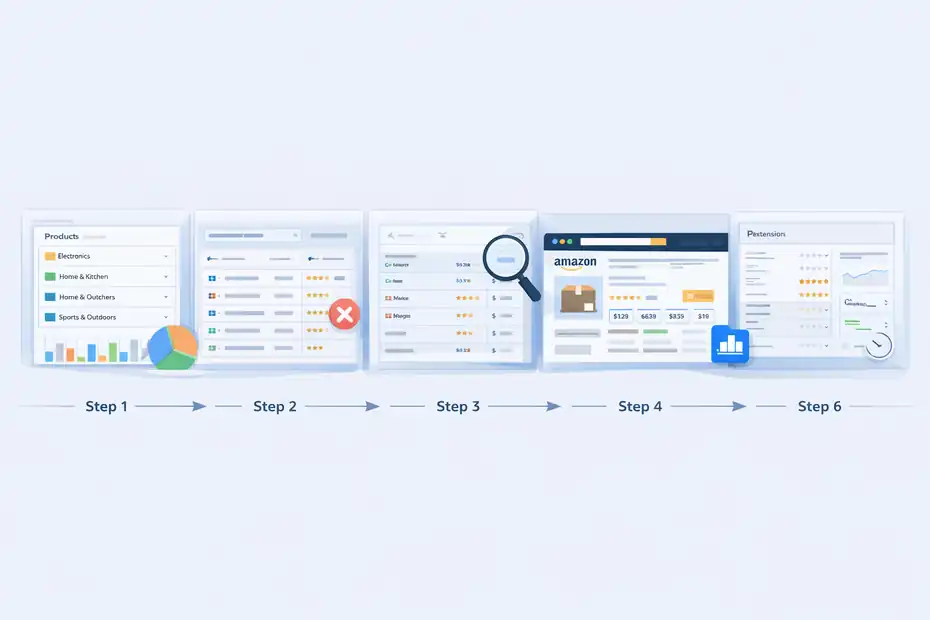
Most new sellers do not need the most advanced workflow. They need a clean routine that leads to one smart decision. Let me break that down.
Step-By-Step Product Validation Process
A simple Jungle Scout workflow for beginners can look like this:
- Step 1: Start with a broad category you understand or can learn quickly.
- Step 2: Filter for products in a price range that leaves room for profit after fees and ads.
- Step 3: Eliminate ideas dominated by giant brands or review-heavy listings.
- Step 4: Check search behavior and keyword relevance.
- Step 5: Open Amazon listings with the Extension and inspect the real search results manually.
- Step 6: Track a shortlist for at least several days before deciding.
The reason this works is that it combines software data with human judgment. Jungle Scout can surface candidates, but you still need to ask normal buyer questions.
Is the product fragile? Too seasonal? Easy to copy? Likely to attract returns? Is it a problem-solving product or a generic commodity?
Imagine you find a kitchen storage product with good estimated demand. On paper it looks great. Then you inspect the actual listings and see every winner has video, A+ Content, huge review counts, and aggressive couponing. Suddenly the “opportunity” looks much less beginner-friendly.
That is why I suggest treating Jungle Scout as your research assistant, not your final decision-maker. It narrows the field. You choose the product.
How To Judge Whether A Product Is Worth Launching
A lot of beginners ask the wrong question: “Can this product sell?” The better question is, “Can I realistically enter this niche and survive long enough to rank?”
Use a basic launch lens:
- Demand: Is there enough search and sales activity to justify entering?
- Competition: Are top results beatable, or are they stacked with dominant brands?
- Margin: Can the product handle Amazon fees, shipping, and launch ads?
- Differentiation: Can you offer a better bundle, angle, design, or use case?
- Operational Risk: Is the product simple enough to source and manage?
Amazon’s fee environment makes this margin piece especially important. Referral fees, FBA charges, and 2026 fulfillment-related changes mean thin-margin products get punished fast.
I believe this is where many new sellers misuse Jungle Scout. They get excited by revenue potential and ignore market difficulty. A product does not need to be perfect. But it should be realistic for your budget, your skill level, and your timeline.
If you are new, boring can be better. Simple, lightweight, evergreen products with room for listing improvement are often more attractive than “viral” items with brutal competition.
Jungle Scout Vs Doing Everything Manually
This is the real start-or-skip decision. Not whether Jungle Scout is “good,” but whether it is better than your alternative.
What You Can Do Without Paying For A Tool
Yes, you can research products manually. You can browse Amazon search results, read reviews, study categories, use Amazon autocomplete, check Best Sellers lists, and estimate fees with free calculators.
Jungle Scout itself also offers free tools and resources, including a profit calculator and sales estimator.
That manual approach can work, especially if:
- You are on a very tight budget.
- You are still learning the business model.
- You want to understand Amazon before buying software.
There is even an argument for doing manual research first. It trains your eye. You learn how to read a listing, notice quality gaps, and think like a buyer. That skill still matters even if you later subscribe to a tool.
The downside is speed and confidence. Manual research is slower, more fragmented, and easier to misread. You might miss obvious patterns because you are looking at too little data or checking the wrong competitors.
So yes, you can skip Jungle Scout in the earliest stage. But “skip” only makes sense if you replace it with a disciplined research process, not random guesswork.
Where Jungle Scout Beats Manual Research
Jungle Scout wins on scale, consistency, and workflow. Instead of opening dozens of tabs and trying to remember what you saw, you can filter, compare, and organize product ideas faster. The Extension also shortens the time between “this looks interesting” and “here is a better evidence-based view of the niche.”
Here is the tradeoff in plain language:
| Approach | Best For | Main Strength | Main Weakness |
|---|---|---|---|
| Manual research | Early learners, ultra-low budget sellers | Free and educational | Slow, inconsistent, easy to misjudge |
| Jungle Scout | Committed beginners and first-product launchers | Faster validation and better structure | Paid subscription, still estimate-based |
I generally recommend manual-first, software-second for people who are still unsure about Amazon. But once you are actively evaluating products and talking to suppliers, Jungle Scout usually becomes easier to justify.
At that point, saving time and avoiding one bad inventory decision can easily cover the cost.
Common Mistakes New Sellers Make With Jungle Scout
Buying software does not make someone strategic. I have seen people waste perfectly good tools because they expect the platform to do the thinking for them.
Mistake 1: Chasing High Revenue Instead Of Easy Entry
This is probably the most common beginner mistake. A niche can show strong revenue and still be terrible for a first launch. Maybe the review barrier is high. Maybe established sellers own the main keywords. Maybe ad costs are painful. Maybe price compression has already killed the margin.
Jungle Scout makes it easier to spot large markets, but that can tempt beginners toward crowded products. They think bigger market equals better chance. Often the opposite is true. A smaller, less glamorous niche with cleaner entry conditions is usually more beginner-friendly.
I suggest looking for “winnable demand,” not just “big demand.” That means enough activity to support a launch, but not so much competition that you get buried immediately.
A realistic example: A broad pet niche may look exciting, but a narrower accessory with a clear problem-solution angle might be easier to rank and differentiate. The tool can show you both. Your job is to pick the one your budget can survive.
Mistake 2: Using The Tool Once And Making A Fast Decision
Another classic beginner move is running one search session, finding a product that looks decent, and placing an order too fast. That is not research. That is subscription-fueled optimism.
Better workflow:
- Day 1: Build a shortlist.
- Day 2: Recheck top competitors manually.
- Day 3: Review fee assumptions and likely landed cost.
- Day 4+: Track movement and confirm the niche still looks healthy.
Why does this matter? Because one-day snapshots can be misleading. A product may be temporarily boosted by a coupon, seasonal event, inventory fluctuation, or ad spike. Watching a shortlist over time gives you more context.
Jungle Scout is strongest when you use it repeatedly on the same idea, not when you use it once to validate your existing bias. I know that sounds blunt, but it is true.
Is Jungle Scout Worth It For New Amazon Sellers?
This is the question behind the entire article, so let’s answer it directly.
Start Jungle Scout If These Conditions Describe You
You should probably start with Jungle Scout if most of these are true:
- You are serious about launching within the next few weeks or months.
- You already understand the basics of Amazon selling and fees.
- You are actively comparing product ideas, not just daydreaming.
- You value structure, speed, and a lower chance of choosing a weak niche.
- You can afford the subscription without forcing a rushed decision.
For this type of seller, Jungle Scout can be genuinely useful. It gives you a cleaner workflow, better data visibility, and a more systematic way to validate product opportunities.
Jungle Scout also clearly positions Catalyst for first-time and smaller sellers, offers support for multiple Amazon marketplaces, and includes a short money-back window for standard plans.
I would especially recommend it if you are moving into private label and need one ecosystem that covers research, keywords, listing help, and some supplier support. That kind of consolidation can reduce friction when you are new.
Skip Jungle Scout If These Conditions Describe You
You should probably skip it, at least for now, if these sound more like you:
- You have not decided whether you even want to sell on Amazon.
- Your launch budget is already tight enough that the subscription creates stress.
- You have not learned the basics of fees, margins, and competition yet.
- You expect the software to hand you a guaranteed winning product.
That last point matters the most. Jungle Scout does not remove business judgment. It helps you make better decisions, but it cannot protect you from bad assumptions, weak branding, poor sourcing, or lazy listing execution.
So my honest answer is this: Jungle Scout is worth it for committed beginners, but not for hesitant beginners. If you are moving, it helps. If you are still circling the parking lot, wait.
Final Verdict: Start Or Skip It?
For most serious first-time sellers, my Jungle Scout review for new Amazon sellers lands on start, but use it carefully.
The platform is built for new and growing sellers, supports a broad seller workflow, and gives you a faster, more structured way to validate products, research keywords, and prepare listings.
It also does not offer a traditional free trial, so you should go in with a plan and use the money-back window intelligently if you subscribe.
I do not think Jungle Scout is mandatory on day one. You can absolutely begin with manual research and free tools. But once you are actively narrowing product ideas and getting closer to launch, the tool becomes much easier to justify.
If I were advising a brand-new seller one-on-one, I would say this: do a little manual research first so you understand the terrain. Then use Jungle Scout when you are ready to turn curiosity into actual product selection. That is the point where it stops feeling like “extra software” and starts acting like a useful shortcut.
So, start or skip it?
Start it if you are committed, budget-aware, and ready to research seriously. Skip it if you are still uncertain, underfunded, or hoping software will replace strategy. That one distinction will save you a lot of money and a lot of frustration.
FAQ
What is Jungle Scout and how does it help new Amazon sellers?
Jungle Scout is a product research and keyword tool designed to help new Amazon sellers find profitable products, analyze competition, and estimate demand. It simplifies decision-making by turning complex marketplace data into clear insights, helping beginners avoid costly mistakes when choosing what to sell.
Is Jungle Scout worth it for beginners on Amazon?
Jungle Scout is worth it for beginners who are serious about launching a product and want to reduce guesswork. It provides structured data and tools for validation, but it is not necessary for those still learning basics or testing interest in selling on Amazon.
Can you start selling on Amazon without Jungle Scout?
Yes, you can start selling on Amazon without Jungle Scout by using manual research methods and free tools. However, this approach is slower and less structured. Jungle Scout helps speed up product validation and improves confidence when making product decisions.
How accurate is Jungle Scout for product research?
Jungle Scout provides estimated data based on algorithms and market patterns, not exact Amazon sales numbers. It is generally reliable for comparing products and trends, but should be used alongside manual checks and common sense for better decision-making.
When should a new Amazon seller start using Jungle Scout?
A new Amazon seller should start using Jungle Scout when they are ready to research and validate product ideas seriously. It is most useful when you have a budget, understand Amazon basics, and want to move toward launching your first product.

I’m Juxhin, the voice behind The Justifiable.
I’ve spent 6+ years building blogs, managing affiliate campaigns, and testing the messy world of online business. Here, I cut the fluff and share the strategies that actually move the needle — so you can build income that’s sustainable, not speculative.
Related posts:
 The Best Way to Dropship Without Wasting Money
 How to Use Helium 10 for Product Research Like a Pro
 Viral Launch Chrome Extension: The Ultimate Tool for Sellers
 15 Trending Dropshipping Products That Sell Right Now
 Dropshipping Guide: Build a Store That Actually Sells
 Starting an Ecommerce Business: A Realistic Step-By-Step Guide