
Table of Contents
Some links on The Justifiable are affiliate links, meaning we may earn a small commission at no extra cost to you. Read full disclaimer.
Can you make money with Spocket? Yes, you can, but not because the app magically turns a store into a business.
You make money with Spocket when you use it as a sourcing and fulfillment layer inside a real ecommerce system: a focused niche, solid product margins, believable branding, and traffic that converts.
Spocket’s current pitch centers on US and EU suppliers, automated fulfillment, branded invoicing, AliExpress import support, and a large product catalog, which can absolutely help.
But the hard truth is simple: The app can remove operational friction, not fix weak demand or bad offers.
What Spocket Actually Is And How People Make Money With It
Spocket is best understood as a dropshipping supplier platform, not a business model by itself.
That distinction matters because many beginners expect the tool to create profit, when in reality it mainly helps you source products, import them into a store, and automate parts of order flow.
How The Profit Model Really Works
Most people asking “can you make money with Spocket” are really asking a deeper question: can a supplier marketplace leave enough margin after ads, apps, refunds, and shipping to make the business worth it?
Here is the plain-English version of the model:
- Revenue: You sell a product on your store for more than your total landed cost.
- Landed Cost: This is the supplier price plus shipping, transaction costs, platform fees, and expected refund or replacement leakage.
- Profit: What remains after customer acquisition and overhead.
That sounds obvious, but this is where many new sellers get trapped. They look at a product that costs $18 and think selling it for $34 means a $16 profit.
In practice, you may also have payment processing fees, your ecommerce platform subscription, the Spocket subscription, possible ad spend, and occasional support costs.
If you rely on paid traffic, your margin can disappear fast unless the product has room for a healthy markup and a convincing reason to buy from you instead of a marketplace.
In my experience, Spocket makes more sense when your offer depends on faster domestic or regional shipping, cleaner packaging, and a more brandable buying experience. That is where it has a better shot than generic ultra-cheap catalog dropshipping.
Spocket’s own positioning leans heavily on US and EU suppliers, branded invoicing, supplier chat, and automated order handling, which supports that use case.
Why People Use Spocket Instead Of Generic Supplier Hunting
The strongest case for Spocket is not “easy money.” It is speed and convenience.
A beginner usually needs to solve five things at once: find products, import listings, update inventory, pass orders to suppliers, and give customers a delivery experience that feels less sketchy. Spocket tries to compress that setup.
Its pricing pages and homepage currently highlight automated dropshipping, one-click product import, order tracking, bulk checkout, chat with suppliers, branded invoicing, and multiple-store support.
That matters because operational simplicity has real financial value. Imagine you run a small home-office accessories store and you are handling 8 to 12 orders a day.
If your workflow is manual, you waste time updating stock, forwarding order details, and answering “where is my order?” emails.
If automation removes even 30 to 45 minutes a day, that is not just convenience. It gives you more time for product pages, email flows, or organic content that actually drive sales.
So yes, people can make money with Spocket. But they are not getting paid for installing an app. They are getting paid for building a store where the sourcing layer is good enough that customers do not feel like they bought from a random middleman.
The Real Pros That Can Make Spocket Profitable
Spocket is not overhyped in every way.
There are some legitimate advantages that can improve the odds of profitability, especially if you compare it with lower-trust, longer-shipping dropshipping setups.
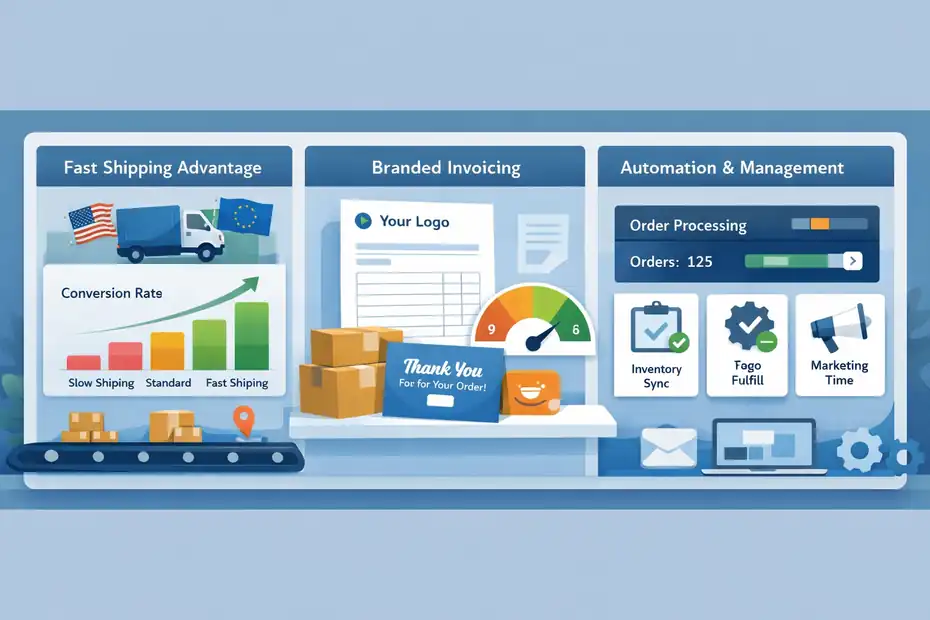
Better Shipping Positioning Can Raise Conversion Rate
One of the biggest conversion killers in ecommerce is hesitation. People hesitate when shipping looks slow, product quality looks uncertain, or the store feels too generic.
Spocket’s main angle is supplier access from the US and EU, and that is important because delivery expectations are tighter than ever. Shopify notes that average ecommerce conversion rates often sit around 2% to 3%, and conversion is heavily affected by factors like checkout friction, value clarity, and trust signals.
Faster, more believable fulfillment can support all three. Global ecommerce also keeps growing, with ecommerce accounting for 20.5% of worldwide retail sales in 2025 according to Shopify’s cited data, so buyers are not disappearing; they are simply becoming less patient and more selective.
Here is the practical implication:
- Slow delivery lowers trust: Long shipping windows make your store feel risky.
- Faster regional delivery increases impulse confidence: People are more willing to buy when the order feels close and trackable.
- Repeat purchase potential improves: Better delivery experience gives you another chance to sell.
I believe this is where Spocket has a real edge. A store does not need the cheapest item on the internet. It needs a believable reason to win. “Ships from the US” or “fast EU delivery” can be that reason in categories like home goods, beauty accessories, pet items, office products, and seasonal gifts.
Branded Invoicing And Cleaner Customer Experience Matter More Than Beginners Think
A lot of new sellers obsess over product price and ignore presentation. That is a mistake.
Spocket supports branded invoicing, which lets merchants customize the invoice customers receive. On paper, that sounds minor.
In reality, it helps reinforce the idea that the customer bought from a real store, not from a stitched-together reseller operation. Spocket’s help center also explains branded invoice controls and how suppliers can include invoices in orders.
That can help in three places:
- Trust after purchase: The order feels more brand-consistent.
- Chargeback resistance: Customers are less likely to think the transaction was unfamiliar.
- Retention: A cleaner first order experience makes a second order more likely.
Let me put this into a realistic scenario. Imagine two stores both sell a desk organizer set for roughly the same price. Store A has a generic product page, vague shipping, and no consistent post-purchase presentation.
Store B has a tighter brand, clear delivery messaging, and branded inserts or invoices. Even when the product itself is similar, Store B often earns more long-term because it feels safer.
That difference does not always show up in the first conversion report, but it often shows up in refund rates, customer support volume, and repeat purchase behavior.
Automation Helps Small Stores Act Bigger
Another real advantage is operational automation. Spocket promotes automated fulfillment, inventory syncing, bulk checkout, and order tracking across its core pages.
That matters because profit is not just about gross margin. It is also about how much chaos you remove.
A simple way to think about it:
- Manual store: Higher error risk, slower response time, more admin work.
- Automated store: Fewer order mistakes, faster handoff to suppliers, more room for marketing and CRO.
For a solo founder, that can be the difference between a side hustle that burns you out and a store that stays manageable at 50 or 100 orders a month. I would not call that glamorous, but it is real money. The less time you spend acting like a stressed-out order clerk, the more time you can spend improving the offer.
The Cons That Make Many Spocket Stores Unprofitable
This is the part people skip when they are watching flashy YouTube income screenshots. Spocket can help, but it does not remove the structural problems that make most weak dropshipping stores fail.
Subscription Cost Eats Margin Faster Than Beginners Expect
Spocket’s pricing page currently shows paid tiers including Starter at $39.99 monthly, Professional at $59.99 monthly, and Empire at $99.99 monthly on monthly billing, with lower annualized prices shown for annual plans such as Professional at $24 per month and Empire at $57 per month.
The same page also shows a 7-day trial language in the pricing cards, while the FAQ section mentions a 14-day free trial, so even the official messaging appears a bit inconsistent.
That pricing is not outrageous for a real business. But it is absolutely meaningful for a beginner store with low sales.
Let’s do a basic example:
- Store revenue in month one: $700
- Gross margin before software and ads: $210
- Spocket plan: $39.99
- Other software and platform costs: maybe another $40 to $100
- A few refunds or discounts: margin drops again
Now your “profitable” store can easily become a hobby that feels busy but pays almost nothing.
This is why I suggest treating software like payroll. Every app needs to earn its place. If Spocket helps you close faster-shipping products with better trust signals, the fee may be justified. If you are only testing random products with little differentiation, the fee turns into extra pressure.
Product Overlap And Easy-To-Copy Stores Create Price Competition
One of the biggest hidden problems in marketplace-style dropshipping is sameness. If many sellers can source similar products from the same ecosystem, your advantage gets thin very quickly.
That leads to three predictable problems:
- Price wars: Someone always undercuts.
- Ad fatigue: Similar creative floods the market.
- Weak brand memory: Your store feels replaceable.
This is where beginners get fooled by the product catalog. A large catalog is useful, and Spocket advertises a 100M+ product catalog across its pages, but a huge catalog is not the same thing as a unique offer.
I would go even further: too much choice can make new sellers worse. They keep “researching” instead of building one compelling storefront around one customer problem. The profitable move is usually not “find more products.” It is “package fewer products better.”
Platform Complaints Are A Reminder That Tools Are Never Friction-Free
You should also know that public reviews are mixed. Recent review snippets on the Shopify App Store include complaints about integration failures and poor support, and public Trustpilot pages show harsh negative reviews alongside the broader rating display.
That does not prove the platform is bad for everyone, but it does prove that real merchants do run into account, billing, or technical issues.
My takeaway is not “avoid Spocket.” It is this: Do not build a fragile business that depends on one tool working perfectly every day.
Use that mindset from day one:
- Document supplier choices: Keep notes on which products and suppliers actually perform.
- Watch fulfillment closely: Early orders are your quality-control phase.
- Test support before scaling: Ask real questions before you are desperate.
That is the grown-up version of ecommerce. Hope is not a system. Monitoring is.
What A Profitable Spocket Store Usually Looks Like
Not every niche has the same odds. The store that makes money with Spocket usually looks more curated and more brand-aware than the average “general store” template.
Choose A Niche Where Shipping Speed And Presentation Matter
The best Spocket-style niches tend to share one thing: the buyer cares about the experience, not just the lowest price online.
Strong examples include:
- Home and workspace products: Buyers care about aesthetics and gifting.
- Pet accessories: Emotional purchases often tolerate healthy margins.
- Beauty tools and lifestyle add-ons: Branding matters a lot.
- Seasonal or giftable products: Delivery speed matters more near deadlines.
Weaker fits are often highly commoditized products where shoppers comparison-shop aggressively and know marketplace prices by heart.
I suggest asking one question before adding any product: would a customer reasonably pay more here because the store feels easier, faster, or more trustworthy than a random marketplace listing? If the answer is no, the product probably is not strong enough.
A realistic benchmark mindset helps here. If a store converts near the common 2% to 3% ecommerce range Shopify mentions, you still need enough average order value and enough gross margin to cover acquisition. So a product with thin margin is dangerous even if it “gets clicks.”
Winning Stores Sell A Curated Offer, Not A Giant Catalog
This is a point I feel strongly about. Most new sellers think more products means more chances to sell. In practice, more products often means more confusion.
A profitable Spocket store usually narrows itself in one of two ways:
- Single-problem store: For example, ergonomic desk comfort.
- Single-audience store: For example, apartment pet owners or minimalist travelers.
That focus helps every layer of the business:
- Product pages feel related.
- Bundles make sense.
- Email marketing sounds coherent.
- The store looks intentional.
Imagine a niche store around “small apartment organization.” A shelf riser, cable tidy kit, under-sink organizer, and foldable laundry solution all support one identity. That is easier to market than a store selling pet bowls, yoga mats, and baby bibs together because they happened to trend on social media.
Spocket can support that model because product import and catalog access make curation faster. But curation is still your job. The money is made in the selection logic, not the import button.
Your Product Page Has To Do Heavy Lifting
Even with decent sourcing, your product page is where the sale is won or lost.
For many of us, the fix is not more apps. It is better merchandising:
- Lead with the outcome: What changes for the buyer?
- Clarify shipping: Reduce uncertainty immediately.
- Use believable images: Generic supplier visuals can hurt trust.
- Answer objections: Size, material, setup, care, returns.
A mediocre page selling a decent product will underperform a strong page selling that same product. That sounds simple, but it is one of the most expensive lessons in ecommerce.
Step-By-Step: How To Try Spocket Without Burning Money
If you want an honest answer to “can you make money with Spocket,” the best approach is not blind optimism or cynical dismissal. It is a controlled test.
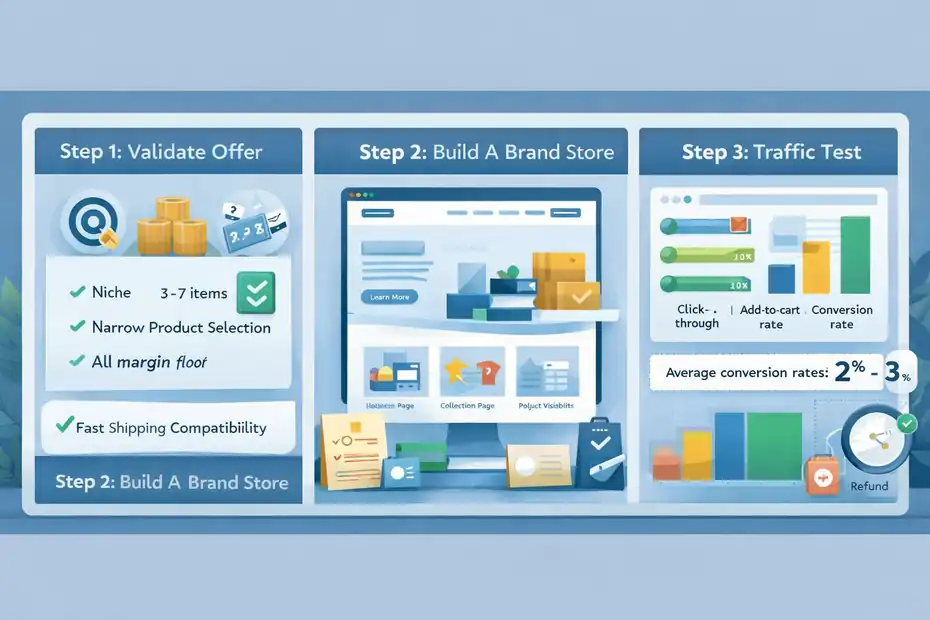
Step 1: Validate One Narrow Offer Before You Build A Full Store
Start with one angle, not 40 products.
A smart first test looks like this:
- Pick one niche: Something with emotional or practical urgency.
- Choose 3 to 7 products: Enough to create a coherent mini-collection.
- Set a margin floor: I recommend rejecting products that do not leave obvious room after fees and customer acquisition.
- Check shipping logic: If fast fulfillment is your pitch, your product mix must support it.
This is where many beginners lose money. They confuse setup activity with validation. Importing products, buying a logo, and tweaking colors can feel productive while telling you nothing about demand.
Instead, think like this: “What would convince one specific buyer to purchase this from me this week?” That question forces better product selection and better page messaging.
Step 2: Build A Store That Feels Like A Brand, Not A Product Dump
Spocket offers features like branded invoicing and supplier communication, which are helpful, but they only shine when the storefront itself feels intentional.
Your store should communicate three things fast:
- What you sell
- Why your version is worth buying
- What happens after the customer orders
A simple framework I like:
- Homepage: One promise, one audience, one reason to trust.
- Collection pages: Organized around use cases, not random categories.
- Product pages: Benefits first, details second.
- Policies: Easy to find and written in normal language.
You do not need luxury-level branding. You do need coherence. Clean copy, clear shipping info, and believable photos will beat flashy clutter almost every time.
Step 3: Run A Small, Measured Traffic Test
This part gets ignored because it is less fun than store design.
Your first goal is not scale. It is signal.
Look for these numbers:
- Click-through rate: Are people even interested in the product promise?
- Add-to-cart rate: Does the product page create intent?
- Conversion rate: Are visitors actually trusting the offer?
- Refund or support friction: Are you attracting the right buyer?
Because average ecommerce conversion rates often land around 2% to 3%, do not panic if your first test is below that. But do pay attention to where the funnel breaks. If your clicks are cheap but nobody adds to cart, the product page or pricing is weak. If people add to cart but do not buy, checkout friction, shipping surprise, or trust issues may be the problem.
That is how a serious operator tests Spocket. Not by asking whether the app is legit in theory, but by measuring whether the offer works in practice.
Common Reasons People Fail With Spocket
Most unprofitable Spocket stores fail for very ordinary reasons. The tool gets blamed, but the underlying problem is usually strategy, positioning, or economics.
Mistake 1: Selling Products With No Real Margin Buffer
This is the classic trap.
A product might look profitable until you include:
- payment fees,
- discounts,
- replacements,
- app costs,
- content creation,
- paid traffic.
If your margin is fragile before launch, it will not survive contact with real customers.
I advise setting a simple rule: if you cannot explain the path to profit on one page of notes, the product is not ready. You do not need a fancy spreadsheet. You need clarity.
Mistake 2: Choosing A Generic Store Angle
A general store can work for testing, but it is usually weak for brand-building. If your store feels like a collection of internet leftovers, customers sense it.
The fix is not more products. The fix is a stronger point of view. Build around a problem, a lifestyle, or a buyer identity.
Mistake 3: Ignoring Post-Purchase Experience
Beginners obsess over the first sale and forget that bad post-purchase experience creates refunds, chargebacks, and zero repeat revenue.
Spocket’s tracking, fulfillment automation, and branded invoicing features can help, but only if you actively use them and communicate clearly with customers.
Mistake 4: Overpaying For Software Too Early
You do not need a stack of apps to prove product-market fit. A lean setup wins early.
Spocket can be a reasonable core tool, but only if the store is actually moving toward traction. Otherwise, monthly fees quietly become your biggest guaranteed expense.
Advanced Ways To Increase Profit With Spocket
Once the basics work, profitability usually improves through optimization, not endless product hunting. This is where many stores finally become real businesses.
Raise Average Order Value Instead Of Chasing Only More Traffic
More traffic is not always the smartest next move. Sometimes the easier win is getting each buyer to spend more.
You can do that with:
- Bundles: Pair complementary products.
- Quantity offers: Buy two, save more.
- Post-purchase upsells: Relevant add-ons after checkout.
- Themed collections: Make cross-sells feel natural.
A store selling pet grooming accessories, for example, should not just sell one brush. It should sell a grooming set, storage pouch, and cleanup add-on. That is a much healthier model than relying on one low-ticket purchase.
Use Supplier And Product Data To Cut Losers Fast
Spocket’s supplier chat and catalog tools are useful, but the real advantage comes when you behave like a buyer, not a collector.
Ask practical questions:
- Can this item survive normal shipping?
- Is the quality consistent?
- Is the packaging acceptable?
- Is this likely to cause lots of support tickets?
I recommend cutting underperforming products quickly. Many sellers keep weak products live because they already did the setup work. That is sunk-cost thinking. A losing listing still costs you attention, traffic, and trust.
Build Retention So You Are Not Paying For Every Sale Twice
The stores that make real money from dropshipping are often less dependent on cold traffic over time.
That means collecting email and SMS cleanly, sending useful post-purchase communication, and creating reasons to come back. If delivery is better and the first order experience is cleaner, retention becomes much more realistic.
That is one reason Spocket’s emphasis on regional suppliers and branded invoicing matters.
A second order is where many businesses finally feel less fragile.
So, Can You Make Money With Spocket Or Is It Overhyped?
This is the honest conclusion: yes, you can make money with Spocket, but it is not easy money, and it is definitely overhyped when creators present it like a plug-and-play income machine.
Spocket is a tool that can improve sourcing, fulfillment, and store presentation through features like US and EU supplier access, automation, branded invoicing, supplier chat, and large catalog access.
Those are real advantages. But they only become profitable when paired with strong product selection, healthy margins, clear positioning, and disciplined testing.
Here is my blunt take:
- Spocket is worth considering if you want a cleaner, more brandable dropshipping setup and you are serious about building a niche store.
- Spocket is probably not worth it if you want instant profit from random products with no real customer angle.
- Spocket is overhyped when people sell the fantasy and hide the economics.
- Spocket is useful when you treat it like infrastructure, not magic.
If I were starting today, I would not ask, “Can this app make me rich?” I would ask, “Can this tool help me sell a better offer with better delivery and fewer operational headaches?” That is the better question, and it leads to better businesses.
The final answer is simple. You can make money with Spocket. Plenty of sellers likely do. But the money comes from your niche, your offer, your margins, your conversion work, and your customer experience. Spocket can support those things. It cannot replace them.
FAQ
Can you make money with Spocket as a beginner?
Yes, beginners can make money with Spocket, but only if they focus on strong product selection, clear branding, and realistic margins. The platform simplifies sourcing and fulfillment, but profit depends on your ability to attract customers and convert traffic into consistent sales.
Is Spocket better than other dropshipping platforms?
Spocket can be better for sellers targeting US and EU markets because of faster shipping and branded invoicing. However, it is not automatically superior. Its value depends on your niche, pricing strategy, and how well you build a trustworthy store experience.
How much money can you make with Spocket?
Earnings with Spocket vary widely depending on your niche, traffic strategy, and profit margins. Some stores generate a few hundred dollars monthly, while optimized stores with strong branding and repeat customers can scale into thousands in consistent monthly profit.
What are the biggest challenges of making money with Spocket?
The biggest challenges include maintaining healthy profit margins, dealing with competition selling similar products, and covering subscription costs. Many stores struggle because they rely on weak product choices or fail to build trust with customers through branding and delivery experience.
Is Spocket worth it in 2026?
Spocket is worth it in 2026 if you use it as a sourcing and automation tool within a focused ecommerce strategy. It works best for niche stores that prioritize faster shipping, better presentation, and customer experience rather than competing only on price.

I’m Juxhin, the voice behind The Justifiable.
I’ve spent 6+ years building blogs, managing affiliate campaigns, and testing the messy world of online business. Here, I cut the fluff and share the strategies that actually move the needle — so you can build income that’s sustainable, not speculative.
Related posts:
 Dropshipping Passive Income: What Works & What Fails in 2025
 The Best Way to Dropship Without Wasting Money
 How to Become a Dropshipper With No Experience
 Dropshipping How to Start: Your Complete Beginner’s Guide
 Shopify Dropshipping Guide: How to Build and Scale a Store That Sells
 Salehoo and Shopify: How to Connect Them for Profit Fast