
Table of Contents
Some links on The Justifiable are affiliate links, meaning we may earn a small commission at no extra cost to you. Read full disclaimer.
When people start comparing doba pricing plans, they’re usually stuck with one big question: which plan actually makes sense for where I am right now?
This breakdown is for beginners, growing dropshippers, and scaling sellers who want clarity without marketing fluff.
I’ll answer exactly which Doba plan fits different business stages, budgets, and goals—so you can choose confidently instead of guessing.
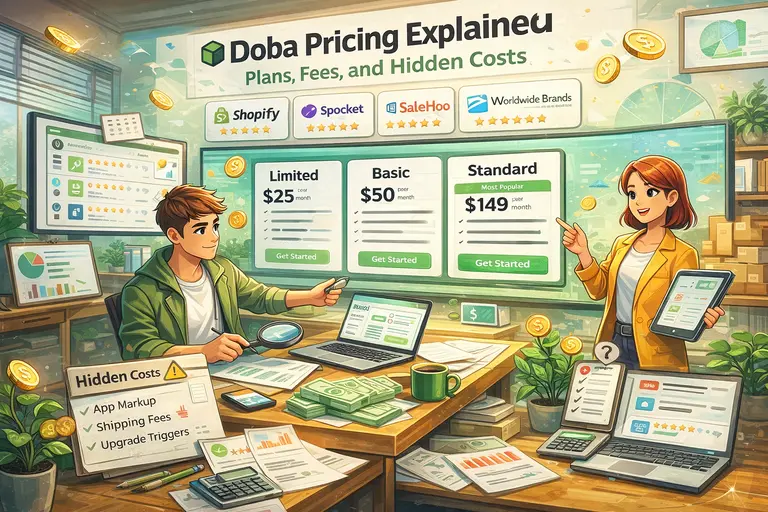
Limited Doba Pricing Plan: Best For Testing Dropshipping
The Limited option is where most people first encounter doba pricing plans, and honestly, that’s exactly what it’s designed for.
This plan is about testing, not scaling, and it shows clearly once you understand the built-in limits.
Core Features Included In The Limited Doba Plan
The Limited plan gives you access to Doba’s core platform without overwhelming you with advanced tools. Think of it as a sandbox where you can learn how Doba functions before committing real money.
You get access to Doba’s supplier marketplace, which means you can browse products, view base costs, and see shipping estimates. That alone is useful if you’re still validating whether Doba’s catalog fits your niche.
Here’s what you’re effectively working with:
- One store integration
- Basic one-click product listing
- Limited inventory list capacity
- Standard customer support
What’s missing is just as important as what’s included. You don’t get advanced automation, deep research tools, or bulk listing workflows.
From my experience, that’s a good thing early on—it forces you to slow down and understand margins instead of blindly importing products.
If you’re brand new to dropshipping or switching platforms, this plan keeps the learning curve manageable.
Product Listing Limits And Inventory Access Explained
This is where many people misunderstand the Limited tier. You’re not getting unlimited freedom, and that’s intentional.
The Limited plan caps how many products you can actively manage in your inventory list. You can browse more, but only a small subset can be saved, tracked, or listed to your store at one time.
In practice, that means you should focus on:
- Testing 5–20 products max
- Prioritizing items with consistent supplier stock
- Avoiding trend-chasing strategies that require volume
I’ve seen beginners make better decisions under these constraints. When you only have room for a handful of products, you actually look at shipping times, pricing stability, and supplier ratings instead of chasing hype.
If your goal is to upload hundreds of SKUs quickly, this plan will feel restrictive. If your goal is learning what actually sells, it’s surprisingly effective.
AI Picks Usage And Restrictions On Entry-Level Accounts
Doba’s AI Picks feature is included here, but with tight usage limits. AI Picks is Doba’s product suggestion engine—it analyzes marketplace data to surface products with higher demand potential.
On the Limited plan, you only get a small number of AI Picks per month. That forces you to use them strategically instead of refreshing recommendations endlessly.
I recommend using AI Picks only after you’ve already narrowed down a niche. Treat each suggestion like a hypothesis, not a guarantee.
Look at:
- Supplier reliability
- Shipping regions
- Price spread between cost and retail
The restriction isn’t a downside if you’re intentional. It actually prevents analysis paralysis, which is one of the biggest killers for new sellers.
Store Integrations Supported On The Limited Tier
The Limited plan supports a single store integration, typically Shopify, WooCommerce, or another supported platform. You don’t get multi-store support here.
This matters because integrations control:
- Product syncing
- Order forwarding
- Inventory updates
With one store, everything stays simpler. You learn how Doba pushes products, how orders flow, and where manual checks are still needed.
If you’re running multiple storefronts or marketplaces, this plan will feel too narrow. But for a first store or test brand, it’s exactly what you want.
Who Should Choose The Limited Doba Pricing Plan
This plan makes sense if:
- You are brand new to dropshipping
- You want to test Doba without long-term commitment
- You’re validating a niche or supplier fit
- You prefer learning before scaling
If you already have sales volume or multiple stores, skip this tier. But if you’re still asking “Is Doba right for me?”, this is the lowest-risk way to answer that question honestly.
Basic Doba Pricing Plan: Ideal For Growing Sellers
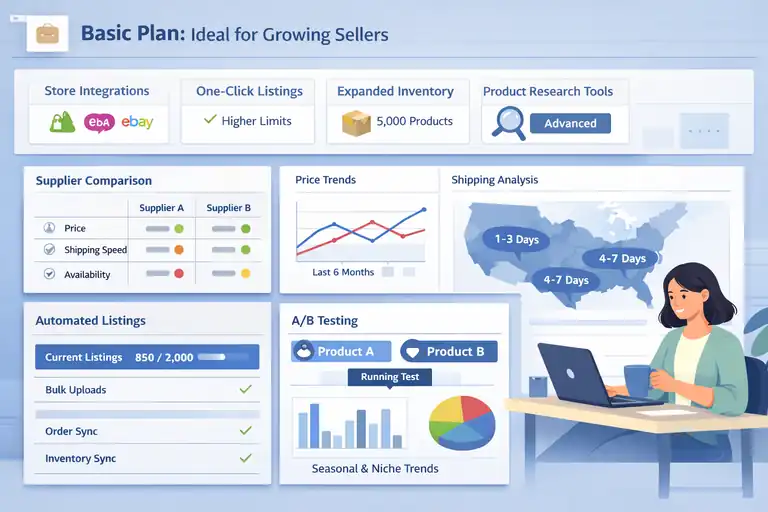
The Basic tier is where doba pricing plans start to feel like a real business tool instead of a trial environment.
This is the plan I usually suggest once someone has proven they can get traffic and at least a few sales.
Additional Tools Unlocked When Upgrading From Limited
Upgrading to Basic immediately removes some of the friction you probably felt on the Limited plan. You’re no longer forced to work in tiny batches.
You unlock:
- Multiple store integrations
- Higher one-click listing limits
- Larger inventory list capacity
- Advanced product research tools
The biggest shift here is speed. Tasks that took hours manually—like comparing products or updating listings—become much faster.
From what I’ve seen, this is the point where sellers stop “testing” and start building systems.
Product Research Capabilities Inside The Basic Plan
The Basic plan gives you access to Doba’s advanced product research tools. These go beyond simple browsing and help you compare products across suppliers.
You can evaluate:
- Price consistency across suppliers
- Shipping speed by region
- Historical availability signals
This matters because supplier volatility is one of the biggest hidden risks in dropshipping. Products that disappear or fluctuate wildly can kill ads and customer trust.
With these tools, you can build a smaller but more stable catalog, which usually leads to better conversion rates and fewer refunds.
Monthly Listing Volume And Inventory Scaling Limits
The Basic plan significantly increases how many products you can list and manage each month. You’re no longer forced to constantly remove products to test new ones.
This opens the door to:
- A/B testing product types
- Seasonal product rotation
- Niche expansion without starting over
That said, it’s still not unlimited. You need to be intentional. I recommend setting a monthly product test cap even if Doba allows more. Quality control still matters more than volume.
Automation Features That Save Time For Solo Sellers
This is where the Basic plan quietly shines. You get access to automation features that reduce repetitive work.
Examples include:
- Faster bulk listing workflows
- Automated order forwarding
- Inventory sync improvements
If you’re a solo seller, this time savings compounds fast. Even saving 30–60 minutes per day adds up to real breathing room—time you can spend on ads, content, or customer experience instead of admin tasks.
Who The Basic Doba Pricing Plan Makes Sense For
The Basic plan is a strong fit if:
- You already have a live store
- You’re getting consistent traffic or sales
- You want to test more products responsibly
- You need better research without full-scale automation
In my opinion, this is the most balanced option among doba pricing plans for early-stage growth. It gives you room to expand without pushing you into enterprise-level complexity too soon.
Standard Doba Pricing Plan: Built For Scaling Businesses
This is the highest tier in the doba pricing plans lineup, and it’s clearly designed for sellers who are already past experimentation
If the Limited and Basic plans help you learn and grow, the Standard plan is about scale, speed, and control.
Advanced Automation And High-Volume Listing Capabilities
The biggest difference you feel immediately on the Standard plan is automation depth. You’re no longer managing products one-by-one or worrying about hitting monthly ceilings too quickly.
Here’s what changes in practical terms:
- Bulk one-click listings: Upload large product batches across stores without manual cleanup.
- Auto-listing workflows: Products can be pushed faster with fewer checks.
- Expanded AI Picks usage: More product recommendations without tight caps.
This matters because speed compounds at scale. If you’re testing 50–100 products per month, manual friction slows everything down. With Standard, you can move faster without sacrificing structure.
In my experience, this is the plan where sellers stop feeling like operators and start feeling like owners.
Inventory Capacity And Order Processing At Scale
Inventory management is where scaling usually breaks. The Standard plan dramatically increases how many products you can track and actively manage.
You’re able to:
- Maintain thousands of SKUs in your inventory list
- Monitor supplier stock levels more consistently
- Process higher daily order volume without delays
Order processing also becomes smoother. With larger order caps and better system priority, fulfillment stays reliable even during traffic spikes.
I’ve seen stores hit 30–50 orders per day and struggle on lower tiers. On Standard, that same volume feels normal instead of stressful.
Data Access, API Limits, And Advanced Research Tools
This tier unlocks deeper data access, including expanded API usage. An API is essentially a direct system connection that lets your store and Doba exchange data automatically.
With higher API limits, you can:
- Sync inventory more frequently
- Reduce overselling risks
- Integrate with custom workflows or third-party tools
You also get access to Doba’s most advanced research features, which help identify products with stable supplier history and pricing consistency.
This is especially valuable if you’re running ads. According to industry benchmarks, fulfillment issues can increase refund rates by over 20%. Better data directly protects profit.
Dedicated Support And Account Management Benefits
Standard users receive priority support and, in many cases, a dedicated account manager. That’s not just a nice-to-have—it changes how problems get solved.
Instead of generic support tickets, you get:
- Faster response times
- Platform-specific guidance
- Help optimizing workflows for scale
When you’re processing hundreds of orders per month, delays cost real money. Having support that understands your account context is a quiet but powerful advantage.
Who Should Invest In The Standard Doba Pricing Plan
The Standard plan makes sense if:
- You’re running multiple stores or high-volume listings
- You rely heavily on automation and speed
- You already have consistent sales
- You want fewer operational bottlenecks
If you’re still testing product-market fit, this plan is overkill. But if your business is already moving, it’s often cheaper than losing time and customers to limitations.
Monthly Vs Quarterly Vs Annual Doba Pricing Options
Beyond features, billing cycles play a big role in how much value you get from doba pricing plans. The plan itself matters, but how you pay can quietly change the math.
Cost Differences Between Monthly And Quarterly Billing
Monthly billing offers flexibility, but it’s the most expensive way to use Doba over time. Quarterly billing usually includes a small discount, rewarding a short-term commitment.
In real terms:
- Monthly billing costs more per month
- Quarterly billing reduces average monthly cost
- Both offer easier exit than annual plans
If you’re still refining your store or niche, quarterly billing is often a smart middle ground.
Annual Pricing Discounts And Long-Term Cost Savings
Annual billing offers the biggest savings. Doba typically discounts annual plans by a noticeable percentage compared to monthly rates.
Over 12 months, this can mean:
- Hundreds of dollars saved
- Lower effective monthly cost
- Predictable operating expenses
I usually recommend annual billing only after at least 2–3 months of stable usage. Locking in too early can feel risky if you’re unsure about long-term fit.
When Short-Term Billing Makes More Sense Than Annual
Short-term billing is smarter when:
- You’re testing a new niche
- You’re unsure about traffic consistency
- You’re comparing Doba with another platform
Flexibility has value. Paying a bit more upfront can save you from paying for features you won’t use yet.
How Billing Cycles Impact Overall Doba Plan Value
The “best” Doba plan isn’t just about features—it’s about timing.
Here’s a simple way to think about it:
- Testing phase: Monthly or quarterly
- Growth phase: Quarterly with intent to scale
- Stable scale: Annual for cost efficiency
From what I’ve seen, sellers who align billing cycles with business stages feel more in control and less pressured. That alone can reduce burnout and bad decisions.
Hidden Costs And Usage Limits Inside Doba Pricing Plans
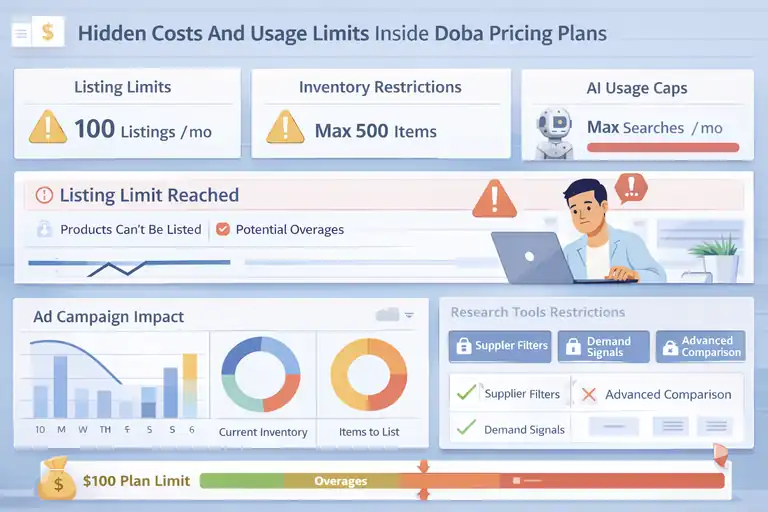
Most frustrations with doba pricing plans don’t come from the sticker price. They come from limits you only notice once your store starts moving.
This section is about surfacing those friction points early, so nothing sneaks up on you later.
One-Click Listing Caps That Affect Store Growth
One-click listings sound unlimited when you first hear the term. In reality, each Doba plan caps how many products you can push to your store within a given period.
This matters more than most sellers expect.
If you’re running ads or testing aggressively, listing speed directly impacts learning speed. Hitting a cap mid-month can stall momentum.
What I’ve seen happen in practice:
- Sellers burn through listing credits during a product test sprint
- New product ideas get delayed until the next billing cycle
- Momentum drops, especially for ad-driven stores
A simple workaround I use is batching listings weekly instead of daily. That stretches caps further and keeps testing disciplined. Still, if you’re consistently brushing against limits, it’s a signal—not a failure—that your plan may be too small for your pace.
Inventory List Limits And Product Research Restrictions
Inventory list limits control how many products you can actively track, not just browse. This includes saved items, monitored SKUs, and products ready for listing.
On lower tiers, this forces tough choices.
You might have to remove products just to research new ones. That friction slows comparison shopping across suppliers, which is where margins are often won or lost.
Product research tools are also tiered. Advanced filters, supplier comparisons, and demand signals are restricted on entry plans.
If you’re serious about margins, limited research tools can quietly cost more than an upgrade ever would.
AI Tool Usage Caps Most Sellers Overlook
Doba’s AI tools, especially AI Picks, are helpful—but capped. These caps reset monthly, and many sellers burn through them without a plan.
AI Picks surfaces product ideas based on platform data, but it’s not magic. The mistake I see is treating it like a slot machine.
A better approach:
- Use AI Picks only after narrowing a niche
- Validate suggestions manually before listing
- Track results so future picks are more intentional
When AI limits feel restrictive, it’s usually because strategy is missing, not because the tool is broken.
How Overages Can Force Unexpected Plan Upgrades
Doba doesn’t nickel-and-dime with micro-fees, but hitting limits repeatedly creates pressure. Eventually, sellers upgrade not because they want new features, but because friction becomes constant.
That’s not inherently bad—but it’s better when it’s planned.
If you’re upgrading to remove bottlenecks instead of chasing shiny tools, you’re doing it right.
Doba Pricing Plans Compared Side By Side For Clarity
When people compare doba pricing plans, they often look at price first and features second. That’s backwards. Context matters more than cost.
Feature Comparison Across Limited, Basic, And Standard
Here’s a simplified comparison to make things concrete:
| Plan | Best Use Case | Key Limits | Core Strength |
| Limited | Testing ideas | Low listings, low inventory | Low risk entry |
| Basic | Growing stores | Moderate caps | Balance of tools and cost |
| Standard | Scaling businesses | High cost | Automation and volume |
Seeing it side by side makes one thing clear: no plan is “better” universally. Each is better at a specific job.
Price-To-Feature Value Breakdown By Seller Type
Value changes depending on how you operate.
For example:
- A beginner running one store may get full value from Limited
- A seller with paid traffic usually outgrows Basic quickly
- A multi-store operator benefits most from Standard
Paying for unused capacity is wasteful. Paying too little and stalling growth is worse.
Which Plan Delivers The Best ROI At Each Stage
ROI isn’t about saving money—it’s about enabling progress.
From what I’ve seen:
- Early stage ROI comes from learning cheaply
- Mid-stage ROI comes from faster testing
- Late-stage ROI comes from automation and stability
Matching the plan to the stage keeps ROI positive even if costs rise.
Common Mistakes When Comparing Doba Pricing Plans
The biggest mistakes I see:
- Choosing the cheapest plan out of fear
- Upgrading too early without traffic
- Ignoring operational limits until they hurt
Clarity upfront prevents frustration later.
Choosing The Right Doba Pricing Plan For Your Goals
This is where everything comes together. Choosing among doba pricing plans gets easier when you anchor the decision to goals, not emotions.
Best Doba Plan For First-Time Dropshippers
If this is your first store, start small.
The Limited plan gives you enough access to learn how suppliers, listings, and fulfillment work without overwhelming you or draining your budget.
Your goal here is education, not scale.
Best Option For Sellers Managing Multiple Stores
Multiple stores introduce complexity fast.
At minimum, the Basic plan is required. In reality, most multi-store sellers end up on Standard for smoother operations and fewer limits.
Managing more than one store manually is exhausting. Tools matter here.
Best Plan For Automation-Driven Scaling Strategies
If automation is central to your strategy, skip hesitation.
The Standard plan supports:
- Higher listing volume
- Better syncing
- Less manual oversight
Automation isn’t about laziness—it’s about reducing error rates as volume increases.
Simple Decision Framework To Pick The Right Plan
Here’s a simple way to decide:
- No sales yet: Limited
- Some sales, testing ads: Basic
- Consistent sales, scaling systems: Standard
If you ever feel stuck or slowed down, that’s usually your signal—not your failure.
Frequently Asked Questions
Which Doba pricing plan is best for beginners?
The Limited plan is best for beginners because it has the lowest cost and fewer tools to manage. It’s designed for testing products, learning how Doba works, and validating a dropshipping idea without committing to advanced automation or higher monthly fees.
What is the main difference between Basic and Standard Doba pricing plans?
The main difference is scale and automation. The Basic plan supports growing stores with higher product limits and better research tools, while the Standard plan is built for high-volume sellers who need advanced automation, larger inventory capacity, and faster order processing.
Can you change or upgrade Doba pricing plans later?
Yes, you can upgrade or change Doba pricing plans at any time from your account dashboard. Most sellers start on Limited or Basic and move up once they hit product listing, automation, or inventory limits.

I’m Juxhin, the voice behind The Justifiable.
I’ve spent 6+ years building blogs, managing affiliate campaigns, and testing the messy world of online business. Here, I cut the fluff and share the strategies that actually move the needle — so you can build income that’s sustainable, not speculative.
Related posts:
 SaleHoo Review: Is It Legit or a Scam? My Honest Take
 Dropshipping Platforms Ranked: Speed, Fees, and Control
 Doba Review: Honest Pros, Cons, and Real Costs
 Doba Pricing Explained: Plans, Fees, and Hidden Costs
 Doba Website Walkthrough: Features, Limits, and Usability
 Doba Dropshipping Review: Honest Pros, Cons, and Verdict