
Table of Contents
Some links on The Justifiable are affiliate links, meaning we may earn a small commission at no extra cost to you. Read full disclaimer.
Omnisend vs Moosend comparison is not really about which platform looks better on a feature page. It is about which one helps you turn more visitors into subscribers, more subscribers into customers, and more customers into repeat buyers.
In my experience, that answer changes based on your store model.
Omnisend is built much more aggressively around ecommerce conversion flows, while Moosend gives you a leaner, lower-cost email marketing setup that can still work very well for simpler funnels.
The right pick depends on whether you need multi-channel selling power or a clean email-first system.
The Short Verdict
If you only need the fast answer, here it is: Omnisend is more likely to convert better for ecommerce brands because it combines email, SMS, and web push in one automation system, and it is tightly positioned around store behavior like products, carts, discounts, and purchase-triggered flows.
Moosend is usually the better value pick for businesses that want affordable email automation, landing pages, and forms without paying for channels they may never use.
That makes Omnisend stronger for revenue optimization, and Moosend stronger for cost efficiency.
Who Should Choose Omnisend
For a lot of online stores, Omnisend will be the better conversion platform because it is clearly designed around ecommerce actions rather than general newsletter sending.
Its feature set includes product pickers, discount codes, SMS integration, segmentation, automation, and web push workflows.
On the pricing page, Omnisend also highlights store-focused usage such as emails, contacts, SMS credits, and unlimited web push notifications, which tells you exactly where its priorities are.
I would put Omnisend at the top of your shortlist if you run Shopify, WooCommerce, or BigCommerce and want to automate revenue flows quickly.
Omnisend’s support documentation says its native ecommerce integrations include Shopify, WooCommerce, and BigCommerce, and its Shopify connection syncs customers, products, and orders automatically so you can trigger campaigns from shopping behavior.
That is the kind of setup that usually improves conversion speed because you spend less time stitching tools together and more time launching flows.
A good example is an apparel store with 2,000 subscribers and regular promotions. With Omnisend, you can build a welcome flow, abandoned cart reminders, browse abandonment, and post-purchase follow-up using email plus SMS or push.
In practice, that creates more chances to recover the sale without buying separate systems. That does not guarantee better performance for every brand, but it gives Omnisend a bigger conversion surface area.
Who Should Choose Moosend
Moosend makes more sense when your marketing engine is still email-first and you care a lot about keeping software costs controlled. Its current pricing page promotes unlimited email campaigns, automation, landing pages, forms, and SMTP access, plus a 30-day free trial with no credit card required.
A recent Moosend page also says paid plans start at $9 per month for 500 subscribers. That is a very different buying position from Omnisend’s more commerce-heavy stack.
I would especially look at Moosend if your business depends on lead generation, newsletter monetization, content funnels, simple product launches, or smaller catalog sales. Its platform pages emphasize email design, automation, segmentation, forms, landing pages, and reporting.
Those are solid conversion tools, but they are not as tightly centered on omnichannel ecommerce revenue capture as Omnisend’s product ecosystem.
A realistic example would be a coach, SaaS startup, or small education brand collecting leads through a landing page and then nurturing them with a five-email sequence. Moosend can handle that very well, and you may not feel the absence of built-in SMS at all.
In that setup, “converts better” might really mean “converts profitably enough without extra software overhead,” and Moosend can win on that definition.
What Actually Affects Conversion Rate In This Comparison
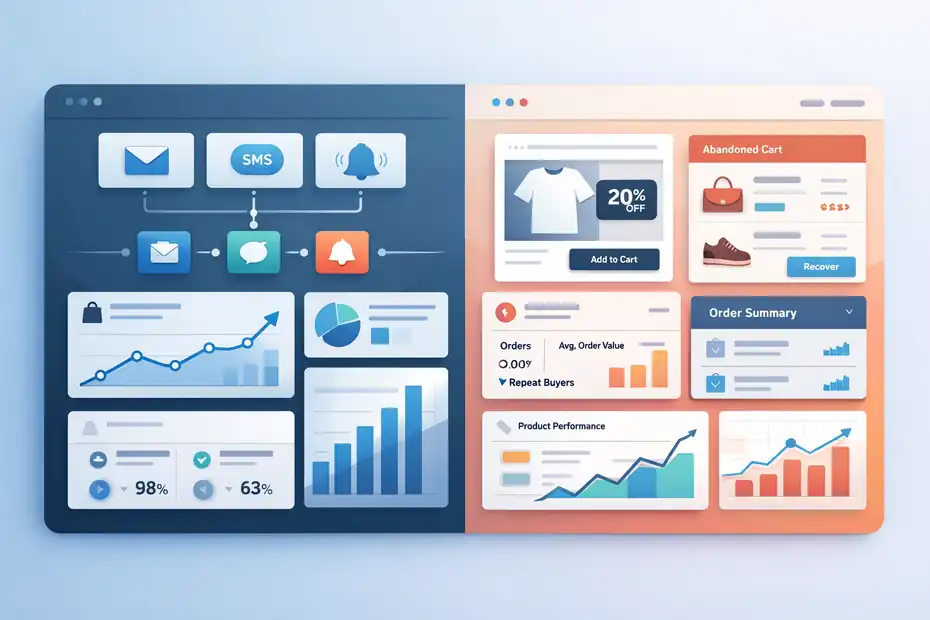
Before choosing a winner, it helps to define what “converts better” means. Some brands care about first-purchase conversion. Others care about recovered carts, repeat orders, average order value, or list growth.
A platform can look cheaper on paper and still lose you more revenue if it does not help you automate the moments that matter.
Channel Mix Matters More Than Most Buyers Expect
One of the biggest conversion differences here is channel coverage. Omnisend supports email, SMS, and web push in connected workflows. Its help and feature pages explicitly show SMS integration and push notifications as part of automation.
Moosend’s core positioning is much more centered on email marketing, automation, forms, landing pages, and reporting.
That matters because not every conversion happens in the inbox. Sometimes your cart reminder email is missed, but an SMS gets opened. Sometimes a shopper ignores both and later clicks a browser push. Omnisend gives you those extra recovery angles inside one platform.
I believe that is the strongest reason it will outperform Moosend for many stores selling physical products online. The broader the channel mix, the more likely you are to rescue intent before it disappears.
Moosend is not broken here. It is just optimized differently. If your funnel is mostly opt-in page to email sequence to sale, then email quality, segmentation, landing page speed, and campaign clarity matter more than adding SMS. In that case, Moosend’s narrower focus can actually be helpful because it keeps your workflow simpler.
Ecommerce Data Depth Usually Drives Better Revenue Automation
Omnisend leans hard into store data. Its Shopify connection documentation says it syncs customers, products, and orders automatically and enables targeted campaigns based on shopping behavior.
Its feature pages also reference product pickers and discount codes. That combination is very practical for conversion work because it helps you build messages around what people viewed, abandoned, or purchased.
Moosend also supports ecommerce integrations and specifically highlights WooCommerce use cases like abandoned cart and product recommendation emails. So this is not a case where one platform can do ecommerce and the other cannot.
The difference is emphasis. Omnisend feels like an ecommerce marketer’s default workspace. Moosend feels more like a flexible email automation platform that can connect to ecommerce.
That distinction affects outcomes. When the platform is built around revenue triggers, your team tends to launch more profitable automations earlier. When the platform is more general-purpose, you may need a bit more setup logic to reach the same point.
From what I have seen, convenience at setup often turns into better conversion later because the team actually ships the workflows.
Speed Of Execution Often Beats Feature Count
This is the part people skip. A platform does not convert better because the feature grid is longer. It converts better because you can launch high-impact campaigns quickly and maintain them without friction.
Recent user review summaries on G2 say Omnisend is widely praised for ease of use, automation, and Shopify integration, while some users want more design flexibility.
Moosend’s review summaries also lean heavily toward ease of use, quick implementation, templates, and affordability. In other words, both tools are considered accessible, but they win for slightly different reasons.
If your team needs fast launch speed with ecommerce defaults, Omnisend probably gets you to revenue faster. If your team needs low-friction newsletter and automation setup with lower entry cost, Moosend may feel smoother. The best conversion software is often the one your team actually uses consistently.
Pricing And Value: Which One Gives You More For The Money
Pricing matters because conversion software is only useful if the economics still make sense as your list grows.
A cheaper tool that limits your revenue opportunities can get expensive in disguise. A more advanced tool that lifts recovered revenue can pay for itself quickly.
Omnisend Pricing In 2026
Omnisend’s current pricing materials show a Standard plan at $16 per month and a Pro plan at $59 per month, with a starter discount on the first three months. The pricing page also shows that the Standard example includes 6,000 emails per month and 500 contacts, while Pro includes monthly SMS credits.
Omnisend also says all plans, including free, get 24/7 support, and account experts are available for brands paying at least $400 per month.
That pricing structure tells me Omnisend is not trying to be the cheapest tool in the room. It is trying to justify its cost through commerce-oriented functionality and extra channels. If you need SMS and push inside the same stack, that premium is easier to defend. If you do not need those things, the pricing can feel heavier than necessary.
For an ecommerce store doing even modest monthly revenue, one recovered cart sequence can cover the difference between these plans and a cheaper email-only option.
That is why I do not recommend judging Omnisend only by monthly price. Judge it by how much abandoned-cart, browse-recovery, and repeat-purchase revenue it helps you unlock. That is the more honest comparison.
Moosend Pricing In 2026
Moosend’s official pricing page promotes a 30-day free trial with no credit card required. It lists Pro, Moosend+, and Enterprise options, and highlights unlimited email campaigns, automation, landing pages, forms, SMTP server, and transactional emails among the available capabilities. A current Moosend source also says paid plans start at $9 per month for 500 subscribers.
Moosend also uses subscriber-based billing, and its documentation says billing is based on unique active subscribers. That can be useful if you manage multiple lists and want cleaner cost visibility. Its docs also note that archived recipients do not count toward active subscriber billing, which is a practical little detail many teams overlook.
I think Moosend’s value proposition is very clear: Get the essential email marketing stack without paying for a broader omnichannel system. For budget-conscious brands, that clarity is a strength. You know what you are paying for, and you are less likely to overbuy.
Simple Pricing Table
| Category | Omnisend | Moosend |
|---|---|---|
| Entry Pricing | Standard starts at $16/month; Pro starts at $59/month with starter discounts shown | Paid plans start at $9/month for 500 subscribers; 30-day free trial |
| Free / Trial Access | Free plan available up to 250 contacts according to comparison PDF and Omnisend materials | 30-day free trial with no credit card required |
| Core Strength | Ecommerce email, SMS, web push, store-driven automation | Affordable email automation, forms, landing pages, email-first workflows |
| Support Positioning | 24/7 live chat and email support on all plans | 24/5 email support and support resources |
| Best Fit | Ecommerce brands wanting multi-channel revenue flows | Small businesses and email-first teams wanting lower cost |
The pricing numbers and support details above come from current vendor materials and the comparison PDF indexed in search results. The “best fit” row is my interpretation based on those product positions, not a direct vendor claim.
Feature-By-Feature Comparison That Actually Matters
A long feature checklist is easy to write and not very useful to read. What matters is whether a feature helps you capture more intent, personalize faster, or reduce friction between interest and purchase.
Email Builder, Templates, And Campaign Creation
Both platforms support drag-and-drop email creation and templates. Omnisend’s feature page emphasizes customizable templates, a drag-and-drop builder, product pickers, and discount codes. Moosend highlights email design, personalization, templates, AI writer, and campaign controls geared toward opens, clicks, and revenue.
Where I think Omnisend edges ahead for stores is the product-specific layer. Product pickers and discount code elements are not just cosmetic features. They reduce the time it takes to build commerce emails that feel directly tied to buying behavior. That usually improves execution consistency, especially for small teams that do not want to manually assemble every promotion.
Moosend still looks strong for general email production. If your campaigns are mostly newsletters, launches, nurturing, or educational promotions, the difference may not be dramatic. In those cases, the editor experience and workflow simplicity may matter more than built-in store blocks.
Automation And Behavioral Flows
Automation is where most of the revenue upside lives. Omnisend offers prebuilt automations such as welcome automation and supports cart recovery, product-triggered messaging, SMS, and push inside workflows.
Moosend’s platform promotes workflow builder, automation analytics, templates, cart abandonment, and tracking.
For ecommerce, Omnisend has the stronger conversion case because it lets you stack channels in a single journey.
For example, someone can receive an abandoned cart email, then an SMS reminder, then a push message if they still do not convert. That sequence gives you more levers without extra integration work.
Moosend’s automation is still good enough for many teams, especially if your sequence logic is straightforward. Think lead magnet delivery, welcome series, webinar reminder, and sales follow-up. You do not always need multi-channel complexity to get a strong result.
But if your sales depend on buying urgency and product timing, Omnisend’s workflow depth gives it the better chance to convert.
Landing Pages, Forms, And List Growth
Moosend has a clear edge in how prominently it packages landing pages and forms as part of its value proposition. Its features and landing page pages push no-code page creation, templates, AI assistance, and subscription forms for different growth goals. That is very useful if your funnel starts with list building rather than store-event automation.
Omnisend also offers forms and AI-assisted form creation, but the overall framing is more commerce-led than lead-gen-led. On the pricing page, it highlights Forms AI and signup tools, yet these feel like supporting assets inside a broader ecommerce automation platform rather than the star of the show.
So here is the practical takeaway: if your conversion path begins with a landing page opt-in, workshop registration, lead magnet, or newsletter growth loop, Moosend deserves serious attention. If your conversion path begins with store behavior like viewed product, abandoned cart, or repeat purchase, Omnisend is usually the sharper fit.
Which Converts Better For Different Business Types
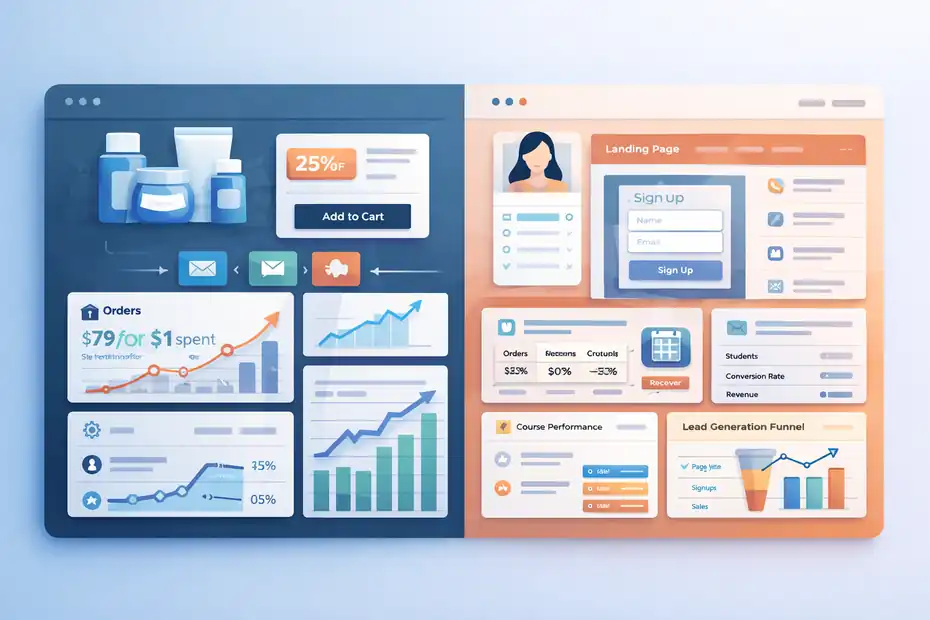
This is where the comparison gets more useful. The best platform depends less on brand size and more on buying motion.
Ecommerce Stores Selling Physical Products
For direct-to-consumer ecommerce, I would choose Omnisend most of the time. Its positioning, integrations, product blocks, discount features, SMS, and push support all point to one outcome: recovering and increasing store revenue.
Omnisend itself states a strong ecommerce ROI message on its homepage, saying brands return $79 for every $1 spent, though that is a vendor claim rather than an independent benchmark. Still, it reinforces where the product is aimed.
Imagine you sell skincare and run weekly promotions. A customer browses a bundle, adds it to cart, leaves, and never opens your email. With Omnisend, you can route follow-up through multiple channels and keep the messaging tied to actual product data.
That is exactly the kind of situation where better conversion is not theoretical. It comes from having one more chance to bring the customer back.
Moosend can still work for ecommerce, especially with WooCommerce or custom API-led setups. But for physical-product stores that want purchase-triggered marketing without extra patchwork, Omnisend has the more conversion-focused architecture.
Coaches, Creators, And Lead Generation Businesses
For creators, consultants, agencies, education brands, and other lead-driven businesses, Moosend becomes much more attractive. Its landing pages, forms, email sequences, segmentation, and lower entry pricing fit the classic “subscribe, nurture, sell” model very well.
You are less likely to need web push or built-in SMS here, and more likely to care about cost control and fast setup.
Let’s say you run a paid workshop funnel. You build a landing page, connect a signup form, send a confirmation email, deliver reminders, and then pitch an upsell after the event. That entire system fits cleanly inside Moosend’s strengths.
If your sales model does not rely on shopping-cart events, Omnisend’s extra commerce features may not raise conversion enough to justify the added spend.
This is one of those cases where “better converting” and “better business decision” are not always the same thing. Moosend may convert slightly less in theory for some scenarios, but if it costs less and gets fully implemented, it may deliver the better real-world ROI.
Small Teams Versus Scaling Brands
Small teams usually need speed, simplicity, and a fast learning curve. Both platforms score well on usability in recent review summaries. G2 review summaries describe Omnisend as intuitive and helpful for automation, especially with Shopify, while Moosend is described as affordable, intuitive, and quick to implement.
For a small ecommerce team, I still lean Omnisend because it removes more integration friction around commerce actions. For a small non-ecommerce team, I lean Moosend because the platform gives you enough to grow without pushing you into channels you may not use.
For scaling brands, the decision depends on channel strategy. If you are layering lifecycle marketing across email, SMS, and push, Omnisend has more room to grow with that strategy. If you are scaling content, newsletter, education, or B2B nurture funnels, Moosend can stay efficient longer.
Common Mistakes People Make When Comparing These Tools
A lot of bad software decisions happen because buyers compare the wrong things. They look at plan prices, skim the feature list, and ignore the actual funnel.
Mistake 1: Choosing Based On Price Alone
The cheapest plan is not the cheapest outcome. If Omnisend’s higher price lets you recover more carts or drive more repeat purchases, it may be cheaper in practice.
If you do not need its omnichannel features, then Moosend may be the smarter financial move. Price only matters in relation to your funnel.
Mistake 2: Ignoring Your Main Conversion Event
Ask yourself what action creates revenue. Is it a purchase, a booked call, a demo request, a webinar registration, or a subscription?
Omnisend is strongest when revenue comes from ecommerce events and repeat shopping behavior. Moosend is strongest when revenue comes from email nurture and lead capture.
Mistake 3: Overvaluing Features You Will Never Use
I see this all the time. People buy the broader platform, then only send one weekly newsletter. In that case, extra channels and advanced commerce triggers do not magically create returns.
You need to match platform capability to actual operational capacity. Both tools are good. The wrong fit happens when you buy for fantasy, not workflow.
How To Decide In 15 Minutes
You do not need a giant procurement process to make a smart choice. You need a clear picture of your funnel and constraints.
A Simple Decision Framework
Use Omnisend if most of these are true: you run an ecommerce store, you want email plus SMS or push, your revenue depends on abandoned cart and repeat purchase flows, and you want native integrations with platforms like Shopify or WooCommerce.
Use Moosend if most of these are true: you want lower starting cost, your funnel is email-first, landing pages and forms matter a lot, and you do not need built-in omnichannel ecommerce messaging right now.
If you are split between the two, I suggest mapping your first three automations before buying anything:
- Welcome flow
- Main conversion flow
- Post-conversion follow-up
Whichever platform lets you build those with less friction is usually your better choice. That is a simple test, but it is surprisingly accurate. The product pages and support docs make it pretty clear that Omnisend wins this test for ecommerce-driven flows, while Moosend often wins it for lean email-first funnels.
Final Answer: Which Converts Better?
In a true omnisend vs moosend comparison, Omnisend converts better for most ecommerce brands because it is built around revenue-driving store behavior and supports email, SMS, and web push inside one automation environment. That gives you more opportunities to recover abandoned intent and personalize based on product and purchase data.
Moosend converts better for some email-first businesses not because it has more firepower, but because it offers a cleaner, cheaper, easier-to-justify system for landing pages, forms, automations, and newsletters. If your business does not need omnichannel ecommerce workflows, Moosend can absolutely be the smarter conversion tool for your setup.
So my honest recommendation is this: Choose Omnisend for online stores that care about lifecycle revenue and multi-channel recovery. Choose Moosend for leaner businesses that care about cost-efficient email marketing and lead generation.
If your question is strictly “which converts better for ecommerce,” I would give Omnisend the win. If your question is “which gives better value for simpler funnels,” Moosend is very hard to ignore.
FAQ
What is the main difference between Omnisend and Moosend?
The main difference in an omnisend vs moosend comparison is focus. Omnisend is built for ecommerce with email, SMS, and push automation, while Moosend focuses on affordable email marketing, landing pages, and simple automation workflows for lead generation and newsletters.
Which platform converts better for ecommerce stores?
In most cases, Omnisend converts better for ecommerce stores because it uses product data, abandoned cart flows, and multi-channel messaging. These features allow businesses to recover lost sales and increase repeat purchases more effectively than email-only systems.
Is Moosend a good alternative to Omnisend?
Yes, Moosend is a strong alternative if you want a lower-cost email marketing platform. It works well for businesses focused on lead generation, newsletters, and simple funnels without needing advanced ecommerce automation or multi-channel campaigns.
Is Omnisend worth the higher price?
Omnisend is worth the higher price if your business relies on ecommerce sales and automation. Its ability to combine email, SMS, and push notifications often leads to higher revenue recovery, which can offset the increased monthly cost.
Which is better for beginners, Omnisend or Moosend?
Moosend is generally better for beginners because of its simpler interface and lower pricing. However, Omnisend is still beginner-friendly and may be a better starting choice if you plan to build an ecommerce-focused marketing system from day one.

I’m Juxhin, the voice behind The Justifiable.
I’ve spent 6+ years building blogs, managing affiliate campaigns, and testing the messy world of online business. Here, I cut the fluff and share the strategies that actually move the needle — so you can build income that’s sustainable, not speculative.
Related posts:
 Top 10 Email Service Providers: Powerful Tools for Businesses
 How to Integrate Aweber with ClickFunnels
 Top 5 Email Marketing Platforms: Boost Your ROI Now!
 Aweber Email Marketing: Boosting Your Business Through Effective Email
 How to Advertise Your Business: Utilizing Email Marketing Strategies
 Email Platform: 12 Proven Strategies for Higher ROI