
Table of Contents
Some links on The Justifiable are affiliate links, meaning we may earn a small commission at no extra cost to you. Read full disclaimer.
If you’re at the stage where your online store is growing faster than your website can handle, it might be time to bring in an ecommerce website developer.
I’ve seen many brands reach this tipping point—when scaling becomes more about infrastructure than marketing.
This guide is designed for brands ready to level up, offering a step-by-step look at what to expect, what to prioritize, and how to find the right developer to transform your ecommerce site into a true growth engine.
Understanding The Role Of An Ecommerce Website Developer
An ecommerce website developer is more than just a coder—they’re your brand’s digital architect.
Their role bridges strategy, design, technology, and user experience to ensure your online store not only looks great but performs effortlessly as it scales.
What An Ecommerce Website Developer Actually Does
At a high level, an ecommerce website developer designs, builds, and maintains your online store’s infrastructure. They ensure the site is fast, secure, easy to navigate, and ready to handle both small daily operations and large-scale surges during peak seasons.
Here’s what they typically manage:
- Website architecture: Building the structure of your site so it’s stable and easy to expand as your product catalog grows.
- Platform setup and customization: Whether you’re using Shopify, WooCommerce, Magento, or a custom solution, developers tailor your store’s design and features to your brand.
- Integrations: Connecting your ecommerce site to CRMs, ERPs, payment gateways, inventory tools, and marketing platforms.
- Ongoing maintenance: Fixing bugs, improving site speed, and keeping your site compliant with updates and security patches.
From my experience, the best developers think long-term. They don’t just build for today’s needs—they anticipate where your business is headed six months or two years from now.
Front-End vs. Back-End Responsibilities Explained
When you work with an ecommerce website developer, you’re usually getting a mix of front-end and back-end skills. Each side plays a unique role in building a scalable and smooth customer experience.
- Front-End Development (User-Facing Side): This covers everything shoppers see and interact with—product pages, checkout forms, navigation menus, and visuals. A good front-end developer ensures pages load quickly, look professional, and convert visitors into buyers.
- Back-End Development (Server-Side Logic): This is the behind-the-scenes engine that handles orders, payments, inventory, and data flow between systems. It’s what makes the entire ecommerce ecosystem work together seamlessly.
A simple way to think about it: front-end developers build what users see; back-end developers build what makes it all work. When your developer can handle both, you’ve got someone who truly understands how to align technology with business goals.
Why Technical Expertise Matters For Scalable Growth
As your ecommerce brand scales, technical challenges grow exponentially. A single plugin or inefficient database can slow down transactions and ruin conversion rates.
That’s why technical expertise is the difference between a website that survives and one that thrives.
Why this expertise matters:
- Performance Optimization: A skilled developer knows how to improve load times, optimize databases, and reduce server strain.
- Scalable Architecture: They build systems that handle traffic spikes—like during Black Friday—without crashing.
- Security and Compliance: From PCI DSS to GDPR, ecommerce developers ensure customer data is protected.
- Future-Proofing: Developers who understand frameworks and APIs can adapt your site to new technologies with minimal downtime.
In short, hiring a technically strong ecommerce developer means you’re not just building a website—you’re building an adaptable, revenue-generating machine.
Signs Your Brand Is Ready To Hire An Ecommerce Developer
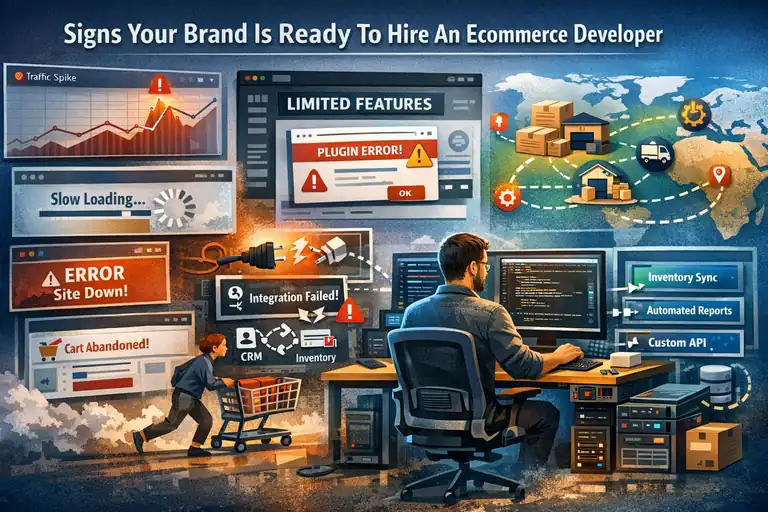
There’s a point in every brand’s journey when templates and plug-and-play solutions stop being enough.
You’ll start to feel friction—pages load slower, updates break integrations, or you spend hours fixing technical issues. That’s your signal it’s time to bring in a professional.
When Your Website Traffic Outgrows Performance Capabilities
If your analytics show increased visitors but your site starts lagging, it’s a red flag. Performance issues don’t just annoy customers—they directly impact sales and SEO.
You might notice:
- Pages taking more than 3 seconds to load (which causes up to 40% of visitors to bounce).
- Frequent downtime during sales or promotions.
- Customers abandoning carts during checkout due to slow or buggy pages.
An experienced ecommerce website developer can reconfigure your infrastructure for scalability—migrating to a stronger hosting environment, cleaning up code, and improving caching systems.
Indicators That DIY Or Template Sites Are Limiting Growth
DIY website builders like Wix or Squarespace are great starting points. But as your business grows, they can become restrictive.
Here’s how you’ll know you’ve outgrown them:
- You can’t add specific features or custom functionalities without breaking something.
- Integrating with advanced tools (like inventory management or CRMs) becomes impossible.
- Your site design or checkout flow can’t be fully optimized for conversions.
From what I’ve seen, this stage is where many brands plateau. A custom-built ecommerce site, guided by an expert developer, gives you the flexibility to innovate instead of constantly patching problems.
When Custom Integrations Become Business-Critical
Once your ecommerce operations expand—think multiple warehouses, international shipping, or subscription-based models—custom integrations become essential.
Examples include:
- Syncing real-time inventory between your store, suppliers, and marketplaces.
- Automating accounting or fulfillment processes through custom APIs.
- Personalizing shopping experiences based on customer data.
If you’re manually managing these tasks or using third-party plugins that frequently break, it’s a sign your brand needs a dedicated developer to create scalable, reliable integrations that keep operations running smoothly.
Choosing The Right Ecommerce Platform For Scalability
Before hiring a developer, you’ll need to decide which ecommerce platform aligns with your growth strategy.
Each platform offers unique strengths, and your developer’s expertise can help match the right one to your goals.
Comparing Shopify, WooCommerce, Magento, And BigCommerce
Let me break it down simply:
- Shopify: Best for brands that want fast setup, managed hosting, and reliable support. Great for scaling with apps and extensions but limited in deep customization.
- WooCommerce (on WordPress): Highly flexible, great for content-driven brands. However, it requires strong hosting and developer oversight for performance.
- Magento (Adobe Commerce): Enterprise-level power with deep customization. Perfect for large catalogs but complex to manage without a professional developer.
- BigCommerce: Strong built-in scalability features and multichannel capabilities, ideal for brands selling on multiple platforms (Amazon, eBay, social commerce).
A good ecommerce website developer can help you evaluate these options based on your product type, customer volume, and technical comfort level.
Key Technical Factors Developers Consider Before Building
When developers plan a scalable ecommerce site, they assess factors most store owners overlook:
- Database structure: Ensuring product and order data can grow without slowing down performance.
- Hosting environment: Choosing cloud-based or dedicated hosting that scales automatically.
- Site architecture: Organizing your store for SEO, usability, and future expansion.
- Code quality: Writing efficient, clean code that minimizes bugs and improves speed.
It’s not glamorous work, but these technical choices determine whether your site will still perform well after you’ve tripled your traffic.
How Platform Flexibility Impacts Long-Term Growth
The flexibility of your ecommerce platform defines how far—and how fast—you can grow. If you’re locked into rigid templates or limited APIs, even small changes can require major rebuilds.
Developers help future-proof your business by:
- Building modular systems that make it easy to add new features.
- Creating adaptable designs for mobile, marketplaces, and international sites.
- Ensuring integrations can evolve with new marketing tools and payment systems.
I always tell clients: choose a platform that can grow with you, not one you’ll outgrow. With the right developer guiding that choice, your ecommerce site becomes an evolving asset—not a recurring problem.
Essential Skills To Look For In An Ecommerce Website Developer
When you’re hiring an ecommerce website developer, it’s not just about finding someone who can write code. It’s about finding a partner who understands how technology connects with your business goals.
The best developers combine technical depth with business sense, ensuring your store runs smoothly today and scales easily tomorrow.
Understanding APIs, Custom Integrations, And Automation
APIs (Application Programming Interfaces) might sound technical, but in simple terms, they’re what let your different systems talk to each other.
A skilled developer knows how to use APIs to connect your ecommerce platform with your payment gateways, CRMs, or fulfillment software.
Here’s why this matters:
- Automation: APIs allow your website to automatically sync data between systems—like updating stock levels or processing orders without manual input.
- Customization: Instead of being stuck with default plugins, developers can build features that fit your exact workflow.
- Efficiency: Proper API integration reduces errors, saves time, and creates a smoother customer experience.
For example, I once worked with a brand that used separate systems for inventory, shipping, and sales tracking. Their developer built a single API-driven dashboard that connected all three. The result? They saved hours daily and improved order accuracy by over 30%.
If your operations are growing complex, API expertise isn’t optional—it’s essential.
UX/UI Design Expertise That Drives Conversions
A developer with UX/UI design skills brings a different level of value. UX (User Experience) focuses on how customers interact with your site, while UI (User Interface) focuses on how it looks and feels.
Why this matters for ecommerce:
- Simplified shopping experience: The fewer clicks between product discovery and checkout, the higher your conversion rate.
- Consistent branding: A good UI ensures your fonts, colors, and layouts reflect your brand personality.
- Data-informed design: UX experts use analytics and behavior tracking to optimize high-performing pages.
One quick example: A developer who knows UX principles might redesign your checkout page by removing unnecessary form fields. That single change could reduce cart abandonment by up to 20%.
The right developer doesn’t just make your website pretty—they make it profitable.
SEO And Site Speed Optimization Skills
Search visibility and speed are two sides of the same coin. You can’t rank high on Google or keep customers engaged if your site loads slowly. A technically skilled ecommerce developer knows how to build for both.
Key areas they handle:
- Clean code: Helps search engines understand your pages and improves crawl efficiency.
- Lazy loading and compression: Reduces page load times without sacrificing quality.
- Structured data: Improves how your products appear in Google Shopping results.
It’s easy to underestimate how much technical SEO impacts sales. Studies show that every extra second of load time can reduce conversions by up to 7%. That’s not a small margin—it’s revenue leaking out quietly.
When interviewing developers, ask what specific tactics they use for site speed optimization and SEO-friendly architecture. Their answers will tell you a lot about their expertise.
Knowledge Of Security, Compliance, And Payment Systems
Security might not be glamorous, but it’s non-negotiable. A trustworthy ecommerce developer builds your site with customer data protection at its core.
They should understand:
- SSL encryption: Ensures all transactions are securely processed.
- PCI DSS compliance: Required for accepting credit card payments safely.
- Data privacy regulations: Especially GDPR or CCPA, depending on your market.
- Fraud prevention tools: Like tokenization, two-factor authentication, and secure payment APIs.
I’ve seen brands suffer massive setbacks because of poor payment security. A single breach can cost thousands in lost revenue and damage trust overnight. Always choose a developer who can confidently explain how they’ll protect both your data and your customers’.
How To Collaborate Effectively With Your Developer
Once you’ve hired the right ecommerce website developer, the next challenge is working well together.
Clear communication and structured collaboration can make the difference between a smooth launch and a never-ending project.
Setting Clear KPIs, Milestones, And Timelines
Before you even start the build, you and your developer need to be aligned on what success looks like. That’s where KPIs (Key Performance Indicators) and milestones come in.
Here’s what to set upfront:
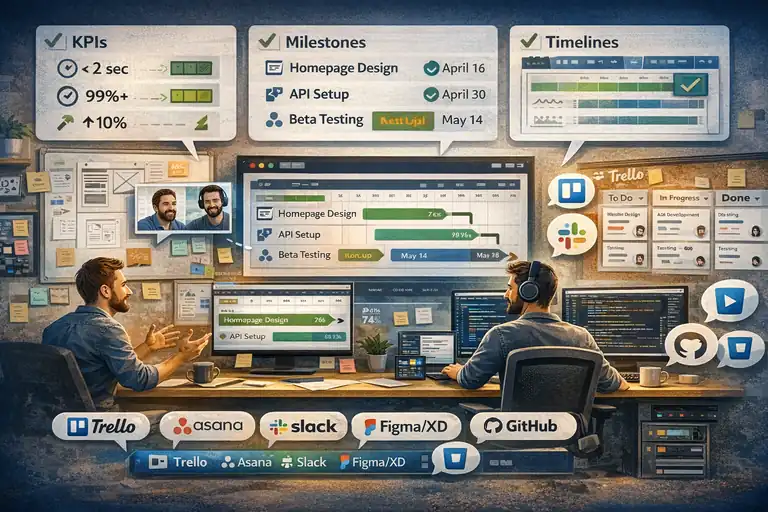
- Project milestones: Define key deliverables—like homepage completion, API setup, or beta testing.
- Measurable KPIs: Examples include site load time under 2 seconds, 99% uptime, or a 10% increase in conversion rate.
- Timelines with buffers: Projects always take longer than planned. Add realistic buffers for revisions and testing.
A simple project plan with weekly check-ins can prevent months of miscommunication. I always recommend using visual milestone trackers, like Gantt charts, to keep both sides accountable.
Communicating Design And Functionality Expectations
Your developer isn’t a mind reader—so clarity is everything. Start by showing examples of websites or features you admire. Explain why you like them.
Tips for better communication:
- Use screenshots or mockups instead of long text explanations.
- Clarify functionality: How should buttons behave? How should filters work?
- Be honest about what’s essential versus what’s nice-to-have.
When you combine your business vision with your developer’s technical expertise, you’ll find the right balance between creativity and practicality. Remember, communication isn’t just about feedback—it’s about partnership.
Tools And Systems To Keep Projects On Track
Project management tools aren’t just for large teams—they’re lifesavers for keeping everything organized.
Common tools developers use:
- Trello: For tracking progress and assigning tasks.
- Slack: For quick, real-time communication.
- Adobe XD: For design collaboration and revisions.
- GitHub: For version control, ensuring changes are tracked and reversible.
If you prefer visual updates, ask your developer to send short video walkthroughs instead of long reports. It’s faster, clearer, and helps you stay engaged without getting lost in technical jargon.
Custom Features That Help Brands Scale Faster
When your ecommerce store starts to grow, off-the-shelf templates can only take you so far.
Custom features built by an experienced ecommerce website developer can completely transform how efficiently your brand scales.
Dynamic Product Management And Inventory Systems
A dynamic inventory system allows your site to update product data in real time. It keeps pricing, availability, and SKUs perfectly synced between your online store and physical operations.
Why it matters:
- Avoids overselling or underselling products.
- Speeds up restocking and fulfillment.
- Simplifies product updates across multiple sales channels.
For example, one apparel brand I worked with integrated its POS (Point of Sale) system directly with its ecommerce site. When someone bought the last shirt in-store, it disappeared online instantly. That eliminated countless customer complaints about “out-of-stock” items.
Advanced Filtering, Search, And Personalization Tools
The better customers can find what they want, the more they buy. Advanced search and filtering features go beyond simple keyword matches—they use intelligent algorithms to improve user experience.
Examples include:
- Predictive search that suggests results as users type.
- Filters that adapt based on user behavior.
- Personalized product recommendations powered by browsing history.
These features don’t just make navigation easier—they build loyalty. A study from Epsilon found that 80% of consumers are more likely to buy from brands offering personalized experiences.
When your developer knows how to build or integrate these tools, you create a site that feels tailor-made for every customer.
Seamless Multi-Channel And Mobile Commerce Integration
Your customers aren’t just shopping on one platform anymore—they’re on Instagram, Amazon, TikTok, and mobile. A great developer ensures your store connects seamlessly across all these channels.
This involves:
- Syncing product data and inventory across platforms automatically.
- Building responsive mobile designs that convert on smaller screens.
- Integrating analytics tools to track performance across all sales points.
Think of it this way: you’re not just building a website—you’re building an ecosystem. The more cohesive your channels are, the more efficiently you can scale.
Pro Tip: When working with your ecommerce website developer, always ask how each new feature impacts speed, SEO, and security. The most scalable websites are built on a balance between innovation and performance.
Common Mistakes Brands Make When Hiring Developers
Hiring an ecommerce website developer can completely transform your brand—or set it back months if you make the wrong call. Many brands focus on speed or cost and overlook the bigger picture.
Let’s break down the mistakes I’ve seen most often and how to avoid them.
Ignoring Post-Launch Maintenance And Support
A website launch isn’t the finish line—it’s just the beginning. Yet, too many brands treat development as a one-time project and skip post-launch support.
Why this matters:
- Ecommerce sites need regular updates to stay secure and compatible with new browsers or payment tools.
- Unexpected issues (like broken integrations or slow load times) often surface weeks after launch.
- Continuous maintenance keeps your site running smoothly and prevents revenue loss.
Think of it like buying a car—you wouldn’t skip oil changes just because you drove it home from the dealer.
In my experience, the best developers offer maintenance packages that include uptime monitoring, security patches, and performance reviews.
If your developer doesn’t discuss post-launch plans upfront, that’s a red flag.
Overlooking Scalability And Future-Proofing Needs
It’s easy to design for the brand you are today—but harder to build for the brand you’ll become in a year. Many brands fail here by focusing only on immediate needs.
How this shows up:
- Choosing platforms or plugins that can’t handle large product catalogs.
- Building custom code that’s hard to update later.
- Ignoring database optimization, which leads to slow performance as traffic grows.
I’ve seen stores hit “growth ceilings” because their foundations weren’t scalable. Always ask your developer how they plan for long-term flexibility—whether that’s using modular architecture, scalable hosting, or clean API connections.
Building smart from the start saves a lot of pain later.
Choosing Cost Over Capability
There’s nothing wrong with wanting to manage costs—but hiring based purely on price often ends up costing more. Cheap development usually leads to fragile websites, broken features, and constant troubleshooting.
Watch for these warning signs:
- Quotes that are drastically lower than competitors.
- No clear breakdown of deliverables or maintenance.
- Promises that sound too good to be true (they usually are).
A skilled ecommerce website developer doesn’t just code—they bring expertise that reduces risk and maximizes ROI.
My advice: Treat development as an investment, not an expense. You’ll save more by doing it right the first time.
Cost Breakdown: What To Expect When Hiring An Ecommerce Website Developer
Understanding costs upfront helps you budget realistically and avoid unpleasant surprises. Developer pricing varies by skill level, project scope, and the platform you choose.
Average Hourly Rates And Project Pricing Models
Ecommerce developers usually charge in one of three ways: hourly, project-based, or retainer models.
Here’s a quick overview:
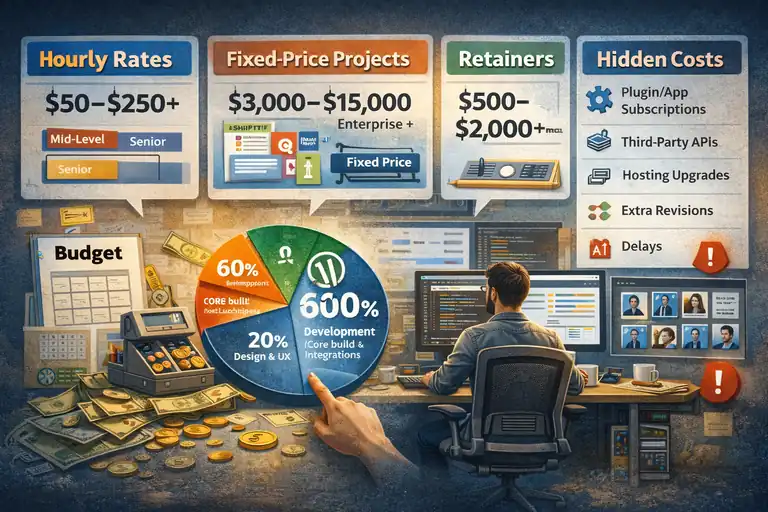
- Hourly Rates: Typically range from $50–$150 for mid-level developers, up to $250+ for senior specialists.
- Fixed-Price Projects: Ideal when your scope is clear (e.g., building a Shopify store from scratch). Expect $3,000–$15,000 for small to mid-size stores and much more for enterprise builds.
- Retainers: Ongoing monthly arrangements ($500–$2,000+) for continuous support, updates, or performance optimization.
If your store requires heavy customization, advanced integrations, or API development, plan for higher-end pricing.
Budget Planning For Custom Functionality And Integrations
Custom features—like subscription systems, loyalty programs, or real-time shipping quotes—take time and expertise.
Smart budget allocation looks like this:
- 60% for development: Core build, integrations, and testing.
- 20% for design and UX: Ensuring it looks good and converts.
- 10–15% for QA and performance testing: Catching issues before launch.
- 5–10% for post-launch support: Regular maintenance and updates.
I’ve seen too many brands spend everything on design, leaving no room for testing or long-term upkeep. It’s worth reserving a buffer of at least 10% for unexpected fixes or scope adjustments.
Hidden Costs To Watch Out For During Development
Even well-planned projects can come with surprise expenses. Knowing what to expect upfront helps avoid budget blowouts.
Common hidden costs include:
- Plugin or app subscriptions.
- Third-party API access fees.
- Hosting upgrades due to higher traffic.
- Extra design revisions or content population.
- Delays caused by unclear requirements.
The best developers will walk you through these potential extras before you sign anything. Transparency is a hallmark of a professional.
Post-Launch Optimization Strategies With Your Developer
Your ecommerce site isn’t “done” at launch—it’s ready to grow. Post-launch optimization ensures your website evolves based on data, not guesswork.
Continuous Performance Tracking And A/B Testing
Once your site is live, start tracking how real users interact with it. Developers can set up automated reports for speed, uptime, and usability.
What to test regularly:
- Product page layouts (test image size, CTA placement, or pricing format).
- Checkout flow (reduce fields or simplify steps).
- Homepage banners and featured products.
Even small tweaks—like shortening the checkout form—can lift conversion rates by double digits. I always recommend running at least one A/B test per month to identify quick wins.
Implementing Analytics For Data-Driven Improvements
Analytics is your post-launch compass. Your ecommerce website developer can integrate tools like Google Analytics 4, Hotjar, or custom dashboards to track user behavior.
Key metrics to monitor:
- Page load times and bounce rates.
- Add-to-cart and checkout conversion percentages.
- Customer journey paths and drop-off points.
With this data, your developer can recommend improvements—like optimizing image sizes, restructuring navigation, or personalizing offers based on browsing behavior.
Data-driven collaboration between you and your developer will always outperform guesswork.
Keeping Up With Platform Updates And Security Patches
Ecommerce platforms evolve constantly. Failing to apply updates can break features or open you up to security vulnerabilities.
Best practices:
- Schedule quarterly update checks with your developer.
- Test new updates in a staging environment before going live.
- Back up your site before applying major platform or plugin changes.
Think of these updates as preventative care for your business. A few hours of maintenance can save thousands in potential downtime or lost sales.
How To Future-Proof Your Ecommerce Website
Future-proofing is all about building an ecommerce site that can grow, adapt, and stay relevant—even as technology changes. A forward-thinking ecommerce website developer can make that possible.
Preparing For International Expansion And Localization
When you start selling globally, your website needs to adapt to new markets. That means multi-currency support, local languages, and region-specific compliance.
Smart localization tips:
- Use IP detection to automatically adjust language and pricing.
- Display shipping times and tax details relevant to the visitor’s region.
- Offer multiple payment options, including local gateways like Klarna.
A developer experienced in global ecommerce will build flexible frameworks for this from day one, saving you from costly rebuilds later.
Leveraging AI And Automation In Ecommerce Development
Artificial Intelligence is quietly transforming ecommerce behind the scenes. Developers now use AI for everything from personalized product recommendations to predictive analytics.
AI and automation applications include:
- Chatbots that guide customers 24/7.
- Smart inventory management that predicts demand.
- Automated retargeting campaigns for abandoned carts.
If your ecommerce developer understands how to integrate these technologies, you’ll stay ahead of competitors who are still stuck in manual mode.
Building A Scalable Tech Stack For Long-Term Growth
Your tech stack—the combination of platforms, tools, and frameworks powering your store—determines how fast you can grow without breaking things.
A scalable stack typically includes:
- A flexible ecommerce platform (Shopify Plus, Magento, or BigCommerce).
- Reliable hosting and CDN (Content Delivery Network).
- Integrations with CRMs, analytics tools, and marketing platforms.
- Automation scripts or APIs to handle repetitive tasks.
In my experience, simplicity wins. A clean, well-documented tech stack is easier to scale than a complicated one with too many plugins or dependencies.
Pro Tips From Experienced Ecommerce Website Developers
After working with dozens of developers and growing ecommerce brands, I’ve gathered a few lessons that can save you time, money, and stress.
How Developers Approach Scalability From Day One
Experienced developers build scalability into the foundation—before a single product goes live.
Their approach usually includes:
- Modular code that’s easy to expand.
- Cloud hosting for automatic scaling during traffic spikes.
- Database structures optimized for large product catalogs.
Ask your developer how they handle scalability planning. If they can explain it in simple terms, they probably know what they’re doing.
Lessons Learned From High-Growth Ecommerce Projects
One of the biggest lessons I’ve learned is that growth can break things fast. Systems that work for 1,000 orders a month might fail at 10,000.
What high-growth brands do differently:
- Test everything under simulated load before launch.
- Invest in caching and CDN optimization early.
- Maintain close communication between marketing, development, and operations teams.
These habits turn chaos into predictability as your brand scales.
Expert Advice For Maintaining A Strong Brand Experience
At the end of the day, customers don’t remember code—they remember how your site made them feel. A great developer understands this balance between tech and emotion.
To keep your brand experience consistent:
- Review your UX quarterly with your developer.
- Keep visual elements and messaging aligned across all pages.
- Test mobile experiences regularly—most ecommerce traffic now comes from phones.
The most successful ecommerce brands treat their developers as long-term partners, not contractors. When you collaborate closely, every update moves your brand forward instead of sideways.
Pro Tip: Don’t rush to build fast—build to last. The right ecommerce website developer will create a digital foundation that grows with you, adapts to market shifts, and delivers a seamless experience that keeps customers coming back.

I’m Juxhin, the voice behind The Justifiable.
I’ve spent 6+ years building blogs, managing affiliate campaigns, and testing the messy world of online business. Here, I cut the fluff and share the strategies that actually move the needle — so you can build income that’s sustainable, not speculative.
Related posts:
 How to Make Money Dropshipping: 7 Secrets to a $10K/Month
 Ecommerce Website Design Tips That Boost Conversions Fast
 Dropshipping Marketing Strategies That Actually Drive Sales
 Ecommerce Automation That Saves Time Without Breaking Sales
 Ecommerce Inventory Management Made Simple for Faster Growth
 Ecommerce Marketing Agencies That Actually Drive Sales