
Table of Contents
Some links on The Justifiable are affiliate links, meaning we may earn a small commission at no extra cost to you. Read full disclaimer.
Hello bar review for marketers sounds simple on the surface, but I think that misses the interesting part. Hello Bar is not just another popup tool you test for a week and forget.
For the right marketer, it can quietly become one of the highest-leverage conversion layers on a site, especially when you need faster list growth, cleaner campaign targeting, and a setup that does not turn into a developer project.
In this guide, I’ll walk you through what Hello Bar does well, where it falls short, who should actually use it, and the hidden wins most reviews skip.
What Hello Bar Actually Is And Why Marketers Still Care
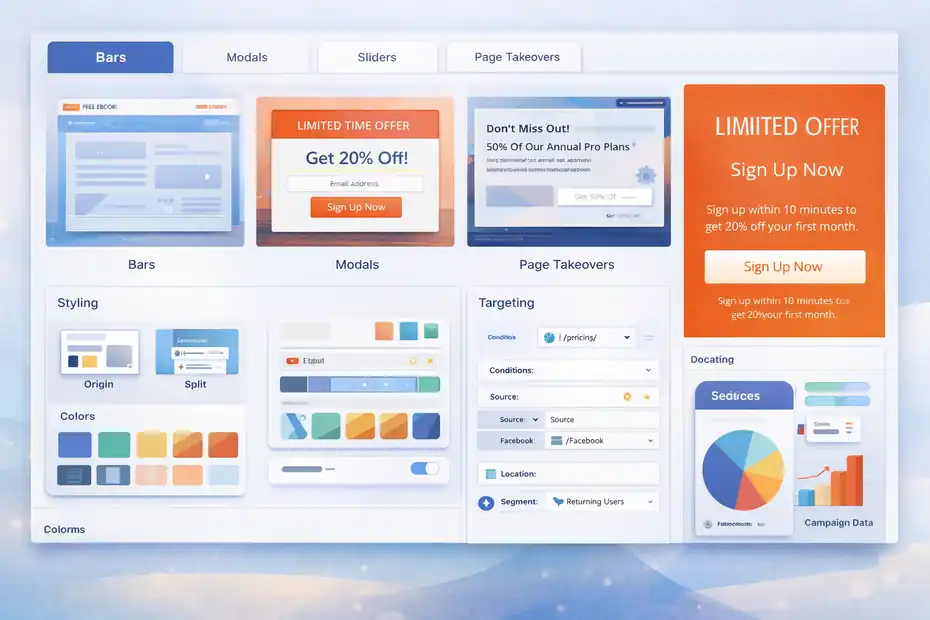
Hello Bar sits in the pop-up builder category, but that label is a little too narrow. It is really an on-site conversion tool built to help you turn anonymous website traffic into subscribers, leads, and buyers using bars, modals, alerts, sliders, and page takeovers.
The company says it has been used by over 600,000 websites, which matters because tools in this space usually live or die by adoption and ease of implementation.
What The Product Does In Plain English
If you have ever wanted to show a message at the top of a page, trigger an exit-intent offer, collect email addresses without rebuilding your site, or point readers toward one campaign fast, that is the core Hello Bar job.
It gives marketers a visual way to place conversion prompts on a site without turning every change into a ticket for a designer or developer.
What I like here is the simplicity of the use case. A lot of tools promise “customer journeys” and “personalized experiences,” but what most teams really need is this: show the right offer to the right visitor at the right moment.
Hello Bar leans directly into that. Its official feature set includes multiple display formats, built-in themes, a visual editor, design matching, and targeting based on things like location and campaign source.
For a marketer, that means you can run straightforward plays quickly. Imagine you are promoting a webinar. You can show a top bar to all blog traffic, then run a modal only on webinar-related posts, then send paid visitors to a page with a source-specific message.
That is not flashy. It is just useful.
Why It Still Gets Attention In A Crowded Market
Popup tools are everywhere, so the obvious question is why marketers still care about Hello Bar.
From what I’ve seen, the answer is not that it has the most advanced feature stack. It is that it solves the 80 percent case well: create, launch, target, test, and capture leads without adding much friction.
G2 shows Hello Bar at 4.6 out of 5 stars across 30 reviews, with reviewers repeatedly pointing to ease of use and implementation.
Capterra review summaries echo the same pattern: easy setup, strong lead capture value, and some limitations when users want deeper sophistication.
That combination matters more than marketers sometimes admit. The “best” CRO tool is not always the one with the longest enterprise checklist. It is often the one your team will actually deploy consistently across campaigns.
I also think Hello Bar benefits from being easy to understand organizationally. If you run content marketing, lead generation, small e-commerce promotions, or agency client campaigns, the tool’s purpose is obvious within five minutes.
That reduces internal resistance, which is a hidden adoption win.
The Search Intent Behind Most Hello Bar Reviews
Most people searching hello bar review for marketers are not asking, “Can this software technically show a popup?” They are really asking four things.
- Is it easy enough to launch without a complicated setup?
- Can it improve lead capture or conversions in a measurable way?
- Is it priced fairly for the traffic I have?
- Will I outgrow it too fast?
Those are the right questions. And the honest answer is that Hello Bar looks strongest when you need speed, solid targeting, and lightweight testing, but not when you want the deepest experimentation environment in the market.
The rest of this review is really about figuring out whether that tradeoff works in your favor.
Core Features That Matter Most For Marketers
The best review is not a feature dump. It is a filter.
So let me focus on the Hello Bar features that actually affect campaign performance and day-to-day usability.
Popup Types And Why Format Flexibility Matters More Than It Seems
Hello Bar includes bars, modals, alerts, sliders, and page takeovers across its plans. On paper, that may sound like a routine feature list.
In practice, format variety gives you a bigger testing surface without changing tools. A sticky bar is low-friction and great for sitewide promotions.
A modal is stronger when you need focused attention. A slider can feel lighter than a full popup. A takeover works when the offer is important enough to interrupt.
The hidden win is message-to-format matching. Many marketers underperform with popups not because their copy is bad, but because the format does not fit the moment.
A discount code in a page takeover might be too aggressive for a blog reader, while a small alert may be too weak for a demo request.
Here is how I’d think about it:
- Bar: Best for sitewide announcements, content upgrades, and evergreen email capture.
- Modal: Best for lead magnets, webinar signups, and exit-intent offers.
- Slider: Best for mid-intent nudges that should feel less disruptive.
- Page Takeover: Best for launches, limited-time campaigns, or major promotions.
That flexibility makes Hello Bar more useful than a one-format tool, especially for marketers running multiple funnels on one site.
Design And Customization Without A Design Bottleneck
Hello Bar emphasizes a visual editor, pre-built themes, and a design assistant that can detect your site’s colors, fonts, and styling. That is one of those features that sounds cosmetic until you remember how much performance depends on speed of launch.
A marketer-friendly builder matters because most campaigns do not fail from lack of ideas. They fail from lag. The team wants to launch a spring offer, a newsletter CTA, a product waitlist, or a lead magnet, but the creative queue is backed up. Tools that lower visual setup friction shorten the distance between idea and test.
I would not frame Hello Bar as a designer’s dream playground. It is not trying to be a full visual experience platform. But that is partly why it works. It gives you enough control to look on-brand without forcing weeks of tinkering.
A practical example: If you manage a B2B blog, you can launch one clean top bar for newsletter signups, one modal tied to your highest-intent guides, and one inline-like experience through embedded content strategy, all without rebuilding page templates. That is a real time saver.
Targeting, Campaign Matching, And The Quiet Power Of Relevance
This is where Hello Bar gets more interesting. Official materials highlight targeting by location as well as ad and campaign data such as source and medium. The homepage also emphasizes personalization based on pages, behaviors, and content.
For marketers, targeting is the difference between a popup tool and a revenue tool. A generic sitewide popup might convert a little. A targeted message aligned to visitor intent usually converts much better.
Imagine three visitors landing on the same website:
- A reader from Google searching an educational keyword
- A paid visitor from a Facebook ad
- A returning user reading your pricing page
Those should not all see the same message. With targeting, you can align the CTA with likely intent. Educational traffic gets a checklist. Paid traffic gets a direct offer. Pricing-page visitors get a demo or discount.
I believe this is one of Hello Bar’s hidden wins. It gives smaller teams just enough targeting power to stop broadcasting and start segmenting, without throwing them into an enterprise-level rules engine.
Pricing, Plans, And Whether Hello Bar Is Actually Worth It
Pricing is where a lot of software reviews become lazy.
So let’s look at it the way a marketer should: not “Is this cheap?” but “What do I get at my traffic level, and what performance lift would justify the cost?”
Current Hello Bar Pricing At A Glance
According to the official pricing page, Hello Bar offers four plans: Starter at $0, Growth at $29 per month billed annually, Premium at $49 per month billed annually, and Elite at $99 per month billed annually.
The official view limits listed are 5,000 on Starter, 50,000 monthly on Growth, 150,000 monthly on Premium, and 500,000 monthly on Elite. All plans list unlimited popups and unlimited subscribers.
That is a fairly approachable ladder, especially compared with tools that gate useful functionality too aggressively at entry level. The free plan is not just a teaser. It gives you a real chance to validate whether on-site capture is worth prioritizing.
Still, I would pay close attention to views. If your content gets decent traffic, view thresholds matter more than the sticker price. A tool can look inexpensive until you hit usage ceilings constantly.
Here is the practical lens I’d use:
| Plan | Best For | Main Watchout |
|---|---|---|
| Starter | New sites, side projects, validation testing | The 5,000-view cap is tight |
| Growth | Small marketing teams, blogs, lead gen sites | Good fit if traffic is growing but controlled |
| Premium | Established content sites, multi-campaign marketers | Worth it if segmentation is active |
| Elite | Higher-traffic brands, agencies, multi-property operations | Only makes sense when site traffic justifies it |
The Real ROI Question Most Marketers Should Ask
Hello Bar’s own pricing page claims users can convert 83 percent more visitors into leads, subscribers, and buyers, and it highlights a LeadQuizzes case study claiming $52,223 in revenue and a 37.96 percent lift in lead capture from Hello Bar placements.
That is vendor-provided proof, so I would treat it as directional rather than guaranteed. Still, it helps frame the math.
Let’s make the ROI tangible.
Imagine your site gets 40,000 monthly visits and your baseline email capture rate is 1.2 percent. That gives you 480 leads. If a targeted Hello Bar setup lifts that to 1.6 percent, you reach 640 leads.
That is 160 extra leads monthly. If just 5 percent of those become customers and your average customer value is $100, that is $800 in added revenue. Suddenly a $29 or $49 plan looks tiny.
That is why I do not think the right debate is “Is Hello Bar expensive?” It is “Can I build enough relevance into my campaigns to create a measurable lift?” If the answer is yes, the pricing is easy to defend.
Where Value Feels Strong And Where It Starts To Get Less Obvious
The value looks strongest for content sites, consultants, coaches, SaaS teams with lead magnets, and lean e-commerce stores that want simple capture layers without a bulky setup. It also looks solid for agencies because speed of deployment matters when you are repeating proven tactics across clients.
Where value becomes less obvious is when your team wants:
- Very advanced behavioral orchestration
- Deep experimentation frameworks
- Heavy multi-step personalization
- Broader CRO tooling beyond popups and on-site messages
That does not make Hello Bar bad. It just means the ceiling may arrive sooner for highly mature optimization teams.
My honest take is that Hello Bar is priced well for marketers who want usable leverage quickly. It is not the cheapest possible option if you barely use it. But it can be very cost-effective if you treat it as a serious conversion layer instead of decorative site clutter.
The Hidden Wins Most Reviews Miss
This is the part I care about most because software wins are often subtle. Many product pages talk about features.
Very few explain why those features matter operationally.
Hidden Win 1: It Reduces The Time Between Idea And Launch
One overlooked advantage of Hello Bar is not just ease of use. It is speed-to-market. G2 reviewers consistently describe the tool as beginner-friendly and easy to implement, and the official product positioning emphasizes no-code simplicity.
For marketers, this is huge. Campaign value decays with delay. If your content team publishes a strong guide, your paid team launches a new ad angle, or your sales team needs more qualified email capture this week, a tool that is “easy later” is not enough. You need a tool that is easy now.
I’ve seen this play out a lot. Teams overinvest in perfect systems and underinvest in rapid iteration. Hello Bar helps fix that by making it easier to get something live, learn from it, and improve it. That loop matters more than feature theater.
A realistic scenario: Your webinar registration page is converting poorly. Instead of rewriting the whole page, you launch a specific top bar across related blog posts, then test a modal with a sharper promise. You can move quickly, watch signups, and refine based on actual performance.
Hidden Win 2: It Encourages Better Offer Packaging
Most marketers blame low popup performance on design, timing, or traffic quality. Sometimes the real issue is the offer itself. Hello Bar’s simplicity pushes you to package offers more clearly because you have limited space and a visible CTA.
That pressure is healthy.
A good Hello Bar campaign forces questions like:
- What is the one action I want from this visitor?
- What promise can I make in one sentence?
- What friction can I remove from the ask?
- Is this message relevant to this page?
That makes you better at conversion strategy, not just tool usage.
For example, “Subscribe to our newsletter” is vague and weak. “Get our 7-point CRO checklist used before every launch” is specific. The tool does not write that for you, but it makes weak messaging painfully obvious. In my experience, that is a hidden benefit because it sharpens your copy discipline.
Hidden Win 3: It Fits Lean Teams Better Than Overbuilt Platforms
Some marketers really do need deeper systems. But many do not. Many just need a reliable way to collect leads, support promotions, segment messages, and connect those leads to email follow-up.
Hello Bar supports email syncing and integrations, including options like Mailchimp and webhooks, which is enough for a lot of practical marketing workflows.
That means you can build a clean operational path:
- Visitor sees targeted offer.
- Visitor submits email.
- Lead syncs to your email platform.
- Follow-up sequence starts immediately.
That is not glamorous. It is just effective.
I suggest paying attention to this if you are a solo marketer, founder-led business, content team, or small agency. Tools with smaller learning curves often generate more actual revenue because they get used consistently.
Complexity can be impressive in demos and expensive in real life.
Where Hello Bar Falls Short For Some Marketers
A useful review should not just praise. It should help you avoid a mismatch.
Advanced Marketers May Hit A Ceiling Faster Than Beginners
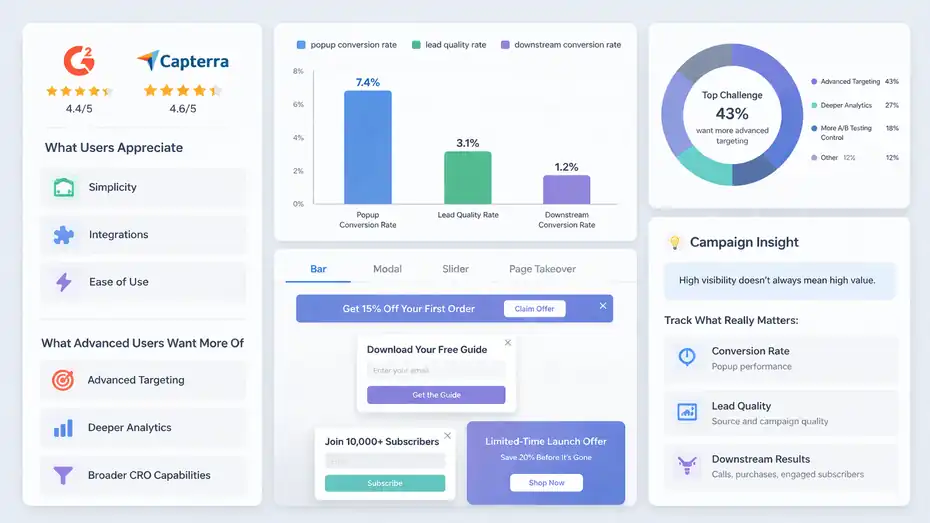
User review summaries from G2 and Capterra are pretty consistent: Hello Bar is praised for simplicity, integrations, and ease of use, but some users want more advanced targeting and deeper analytics. That pattern tells you a lot.
If your team is already running mature conversion programs, “easy” is not always enough. You may want richer segmentation logic, more detailed funnel reporting, stronger experimentation controls, or broader CRO capabilities across the full site journey.
That does not mean Hello Bar has weak targeting. It means there is a difference between useful targeting and highly advanced orchestration. If your benchmark is enterprise personalization software, you may find Hello Bar intentionally narrower.
From what I’ve seen, this is the biggest dividing line in whether a marketer loves it or outgrows it.
Analytics And Interpretation Still Depend On Your Marketing Discipline
Hello Bar can help you deploy and test messages, and official support materials confirm A/B testing is available and can automatically determine better-performing variants on qualifying plans. That is valuable. But tools do not create insight by themselves.
You still need to know what success looks like.
For many of us, the real trap is launching too many popups, reading surface-level metrics, and assuming more visibility equals more value. That can backfire fast. A popup with a high click rate but poor lead quality may look strong and perform weakly.
I recommend tracking at least three layers:
- Conversion rate on the popup itself
- Lead quality by source or campaign
- Downstream performance such as booked calls, purchases, or engaged subscribers
Without that, you are optimizing for attention, not business results.
Aggressive Use Can Damage Experience If You Lack Restraint
This is not a Hello Bar-specific problem. It is a marketer problem. But it matters here because the software makes deployment easy, and ease can tempt overuse.
If you stack a bar, a modal, a slider, and a takeover on the same visitor, you are not running a strategy. You are starting a hostage situation.
The better approach is message hierarchy. Decide what the primary action is for each page type. Then support that action with one main prompt, not five competing prompts.
For example:
- Blog post: Content upgrade or newsletter CTA
- Product page: Offer or purchase support CTA
- Pricing page: Demo or trial CTA
- Exit intent: One rescue offer, not three
Hello Bar gives you the tools. Good judgment determines whether the result feels helpful or annoying.
How To Use Hello Bar Well If You Decide To Try It
If you are going to use Hello Bar, use it like a marketer, not like someone decorating a website.
Start With One Funnel Goal, Not Ten Random Campaigns
The biggest beginner mistake is launching too many offers at once. Instead, pick one priority funnel outcome for the next 30 days. That could be newsletter growth, demo bookings, webinar signups, or cart recovery.
Then build only around that.
A simple starting framework looks like this:
- Top bar on relevant pages: Promote the core offer.
- Modal on higher-intent pages: Reinforce the offer with a stronger CTA.
- Exit-intent message: Save abandoning visitors with a lower-friction next step.
This matters because focus produces cleaner data. If you launch five unrelated campaigns at once, you will not know what is helping. If you launch one strategic offer across different placements, you can actually learn.
I believe this is the fastest path to a confident yes or no on the tool. Keep the first campaign narrow, measurable, and tied to a real business goal.
Match The Offer To The Visitor’s Intent
This is where marketers create the biggest lift. Use page context and traffic source to shape the message. Hello Bar’s targeting support around location, campaign source, medium, and on-site context gives you enough structure to do this well.
Here are three examples.
- Organic blog traffic: Offer a checklist, template, or subscriber incentive tied to the article topic.
- Paid campaign traffic: Repeat the ad promise and remove friction from the next step.
- Returning product-interest visitors: Show a trial, discount, or consultation CTA.
Notice the pattern. Relevance first. Design second.
When I see marketers complain that popups do not work, I usually find a relevance issue hiding underneath. The CTA is generic, the audience is mixed, or the message shows too early. Hello Bar can help solve that, but only if you use targeting intentionally.
Test Small Changes That Compound Over Time
Support documentation confirms Hello Bar offers A/B testing, and on paid tiers this can automatically shift exposure toward the better-converting variant. That is a meaningful optimization feature for lean teams because it reduces some manual overhead.
The key is to test focused variables, not random redesigns.
Good tests include:
- Headline promise
- CTA wording
- Timing delay
- Page-specific targeting
- Offer type
- Visual friction such as field count
For example, changing “Join Our Newsletter” to “Get Weekly SEO Wins In 5 Minutes” may beat any design tweak because the promise is clearer. Likewise, asking for email only may outperform email plus first name if the audience is cold.
Small wins stack. A 10 percent improvement in message match, a 12 percent lift in CTA clarity, and a cleaner follow-up flow can turn a mediocre popup campaign into a strong acquisition channel.
Who Hello Bar Is Best For And Who Should Skip It
A review should end with fit, because “good software” is not the same as “good for you.”
Best Fit: Marketers Who Want Fast, Practical Conversion Gains
Hello Bar is a strong fit for marketers who value speed, simplicity, and targeted lead capture. That includes content marketers, growth marketers, solo operators, consultants, course creators, small SaaS teams, and lean e-commerce brands.
Its broad format support, approachable pricing, easy implementation, and review profile all point in that direction.
It is also a nice fit for agencies that need repeatable deployments across client sites. A tool is more useful when it can be installed, explained, and iterated on without long training sessions.
I especially like it for teams that already have traffic but have not fully monetized or captured that traffic yet. In those cases, Hello Bar can act like a missing conversion layer rather than a totally new marketing channel.
Weaker Fit: Teams That Need Heavy Experimentation Depth
If your organization already has a mature CRO stack, a full testing culture, and advanced personalization needs, Hello Bar may feel too lightweight in parts. Review summaries pointing to requests for deeper targeting and analytics are the clue here.
You may still use it, but it might not become your center of gravity.
That is not a criticism. It is just a category truth. Some tools are made to be elegant and practical. Others are made to be expansive and complex. Hello Bar leans toward the first group.
Final Verdict: My Honest Hello Bar Review For Marketers
My honest take is this: Hello Bar is better than it first appears, especially for marketers who care about launch speed, message relevance, and measurable lead capture without unnecessary complexity. Its hidden wins are not flashy AI tricks or endless feature tabs.
They are operational wins: faster deployment, cleaner campaign focus, stronger offer packaging, and enough targeting to stop showing the same message to everyone.
The drawbacks are real. Advanced teams may want deeper analytics, more complex segmentation, and a wider optimization environment. But for many marketers, that tradeoff is perfectly reasonable.
So, is Hello Bar worth trying?
Yes, if you want a tool that helps you launch quickly, capture more value from existing traffic, and run smarter on-site promotions without turning your website into a development backlog. No, if you already know you need enterprise-level experimentation depth.
If I were advising a marketer with decent traffic and underperforming on-site conversion capture, I would absolutely test Hello Bar. Not because it is magic, but because it solves a real bottleneck well. And in marketing, removing bottlenecks is usually where the hidden wins live.
FAQ
What is Hello Bar and how does it help marketers?
Hello Bar is an on-site conversion tool that helps marketers capture leads, grow email lists, and promote offers using popups, bars, and targeted messages. It allows you to show the right message at the right time, improving conversion rates without needing complex development or design work.
Is Hello Bar worth it for lead generation?
Hello Bar can be worth it if your website already has traffic but low conversion rates. By adding targeted popups and offers, many marketers see measurable improvements in email signups and lead capture, making it a cost-effective tool for improving marketing ROI.
How easy is it to set up Hello Bar?
Hello Bar is designed for quick setup with no coding required. You can install it using a simple script, choose a template, customize your message, and launch campaigns within minutes, making it ideal for marketers who want fast results without technical complexity.
Does Hello Bar support A/B testing?
Yes, Hello Bar includes A/B testing features that allow marketers to test different headlines, offers, and designs. This helps identify which version performs better, so you can continuously optimize your campaigns and improve conversion rates over time.
What are the main limitations of Hello Bar?
Hello Bar is easy to use but may feel limited for advanced marketers who need deep personalization, complex automation, or detailed analytics. It works best for simple to mid-level conversion strategies rather than enterprise-level experimentation systems.

I’m Juxhin, the voice behind The Justifiable.
I’ve spent 6+ years building blogs, managing affiliate campaigns, and testing the messy world of online business. Here, I cut the fluff and share the strategies that actually move the needle — so you can build income that’s sustainable, not speculative.
Related posts:
 Should I Use SurveyMonkey For Lead Generation: Does It Convert?
 The Top 7 Signup Forms Trends of This Year: Increase Your Signups!
 Top 10 Leadpages Competitors You Need to Know!
 How to Create an Aweber Landing Page That Converts Today
 SurveyMonkey Real User Experience For Lead Generation: What To Expect
 Is SurveyMonkey Good For Email List Building: Hidden Strategy