
Table of Contents
Some links on The Justifiable are affiliate links, meaning we may earn a small commission at no extra cost to you. Read full disclaimer.
Should I use SurveyMonkey for lead generation? That’s a smart question, especially if you’re trying to capture more qualified leads without adding friction to your funnel.
SurveyMonkey can absolutely play a role in lead generation, but whether it converts well depends on how you use it, what you’re offering, and where the survey sits in your customer journey. I’ve seen surveys work extremely well when they qualify intent, personalize offers, and collect useful context.
I’ve also seen them fail when they feel like homework. Let’s break down where SurveyMonkey fits, where it struggles, and whether it deserves a place in your lead-gen strategy.
What SurveyMonkey Actually Does In A Lead Generation Funnel
SurveyMonkey is not a traditional lead generation platform first. It is a survey and feedback tool that can be adapted into a lead capture asset when you use it strategically.
That distinction matters because it shapes what you should expect from it.
What It Is Good At
SurveyMonkey works best when your goal is to collect information before or during lead capture. Instead of asking for just a name and email, you can use a survey to learn what the person wants, what problem they are facing, how urgent their need is, and whether they fit your ideal customer profile.
That makes it especially useful for businesses that need some level of qualification before a sales call, demo, quote, or recommendation.
For example, a B2B agency could use a short survey to ask about company size, monthly budget, biggest marketing challenge, and timeline. That data helps the team separate casual interest from serious buyers.
In my experience, this is where SurveyMonkey becomes valuable. It does not just collect a contact. It helps you understand the contact.
Where It Fits In The Funnel
SurveyMonkey usually performs best in the middle or bottom of the funnel, not at the very top. People who already have some interest are more willing to answer a few questions if they believe they will get something useful in return.
A few common use cases include:
- Lead qualification: Filter serious prospects before booking calls.
- Interactive lead magnets: Offer a personalized result, recommendation, or assessment.
- Post-click segmentation: Send traffic from ads or emails to different follow-up paths.
- Consultation request forms: Gather useful details before a sales conversation.
Imagine you run a financial coaching business. Instead of sending people to a generic “book a call” page, you invite them to complete a 2-minute money habits assessment.
At the end, they can enter their email to get a custom breakdown. That feels more engaging than a plain form and gives you better lead data.
What It Is Not Built To Do
SurveyMonkey is not designed to replace a full conversion-optimized landing page platform or a CRM. It can collect responses, capture contact details, and route people through logic, but it is not the strongest option for full-funnel conversion design.
That means if your goal is pure opt-in volume at the lowest cost possible, a simpler form may outperform it. Surveys add effort. Effort can improve quality, but it can also reduce total conversions.
That trade-off is really the heart of this whole question.
When SurveyMonkey Works Well For Lead Generation
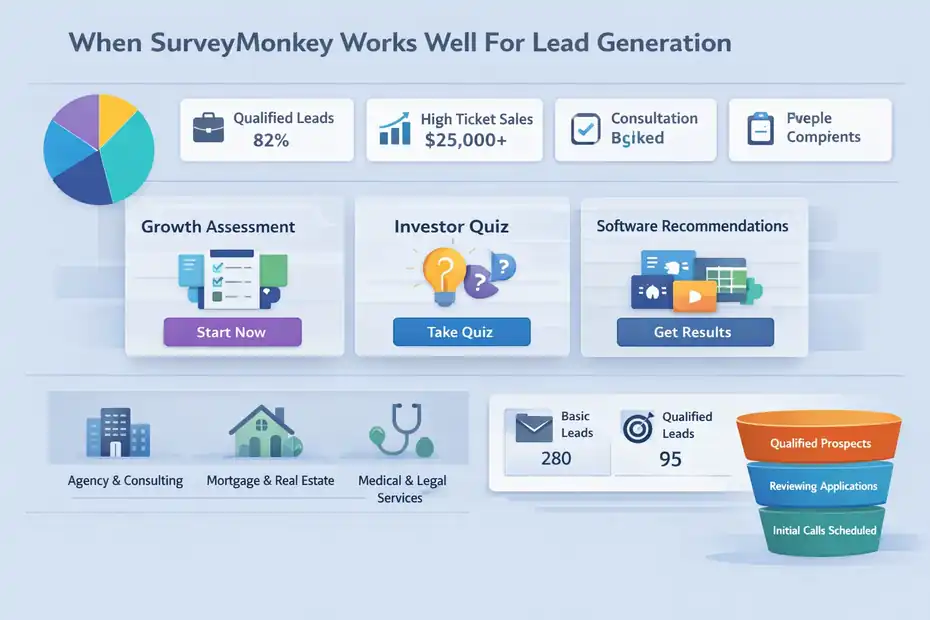
SurveyMonkey can convert well, but only in specific situations. The best results usually happen when the survey creates value for the person filling it out, not just the business collecting data.
Best-Fit Business Models
SurveyMonkey tends to work better for service businesses, consultants, agencies, coaches, SaaS companies with longer sales cycles, and any business where qualification matters. If you need context before making an offer, a survey can be incredibly useful.
For example, a web design agency does not just need leads. It needs the right leads. A survey can identify whether the prospect needs a redesign, a full build, e-commerce functionality, or CRO help. That context saves time and makes follow-up more relevant.
It can also work for higher-ticket consumer services. Think mortgage brokers, legal services, medical practices with consultation requests, education programs, or real estate advisors. In these cases, asking a few thoughtful questions can actually increase trust because it signals you take the person’s situation seriously.
Best-Fit Offers
SurveyMonkey converts better when the offer is tied to personalization. People are much more likely to answer questions if those answers lead to something tailored.
Here are the strongest examples:
- Assessments: “Find Out What’s Blocking Your Growth”
- Quizzes: “What Type Of Investor Are You?”
- Recommendations: “Get A Customized Software Stack”
- Application funnels: “See If You Qualify”
- Consultation prep: “Tell Us About Your Business Before We Talk”
I suggest thinking about the survey as a value exchange. The user gives attention and answers. You give clarity, direction, or a more relevant next step.
Why It Can Improve Lead Quality
A plain lead form often captures curiosity. A survey captures intent. That difference is huge.
Someone who answers five smart questions about their goals, budget, and current situation is showing more commitment than someone who drops an email into a popup for a generic newsletter. That does not always mean the survey generates more leads, but it often means the leads are better.
In many cases, businesses see fewer total leads but higher close rates. If your sales process is expensive or time-intensive, that can be a win.
When SurveyMonkey Hurts Conversion Rates
This is the part many businesses miss. SurveyMonkey can absolutely reduce conversion rates if you use it in the wrong place or ask too much too soon.
Too Much Friction Too Early
The biggest mistake is putting a survey in front of cold traffic with no clear payoff. Most people will not complete a multi-question form unless they already trust you or want something specific.
If someone clicks an ad and lands on a page with eight questions before they know what they are getting, your abandonment rate will likely rise fast. That is not because surveys are bad. It is because the value has not been established yet.
I believe this is the main reason people say survey funnels “do not work.” The problem is rarely the survey itself. The problem is the timing and positioning.
Asking Questions That Do Not Help The User
Another common issue is writing the survey for internal convenience instead of user relevance. Businesses ask questions because the sales team wants data, but the lead sees no reason to answer them.
For example, asking for company revenue, team size, phone number, and software stack before offering any value can feel invasive. Even if those questions matter to you, they may not feel justified to the reader.
A better sequence is to first create momentum with simple, low-resistance questions. Then move into questions that make sense based on what the person is trying to solve.
Making It Feel Like Work
Surveys fail when they look long, confusing, or repetitive. This is especially true on mobile, where every extra tap can lower completion.
Watch for these friction points:
- Too many open-ended questions: These take more effort than multiple choice.
- Weak progress cues: People want to know how far they have left.
- Poor mobile formatting: Small buttons and clutter kill completions.
- No immediate reward: If the result is vague, people leave.
If your survey feels like a job application, it will convert like one.
Mismatch Between Traffic Source And Intent
A survey may work beautifully from email traffic and poorly from paid social. Why? Intent level.
Someone from your email list already knows you. Someone from a broad awareness ad probably does not. The colder the traffic, the more carefully you need to reduce friction and increase perceived value.
That is why context matters more than tool choice.
How SurveyMonkey Compares To Standard Lead Forms
To answer whether you should use SurveyMonkey for lead generation, you need to compare it against the alternative most businesses already use: the standard lead capture form.
The Core Trade-Off: Volume Vs Qualification
A standard form is simple. Ask for name, email, maybe phone number, and let the person convert fast. That usually improves raw conversion rate because the task is easy.
A survey adds steps. That often lowers top-line conversion rate but raises the amount of information you collect and can improve downstream performance. In simple terms, you may get fewer leads, but better ones.
This matters because “conversion” is not just form completion. The real question is whether those leads become customers.
Here is a practical comparison:
| Factor | SurveyMonkey Survey Funnel | Standard Lead Form |
|---|---|---|
| Friction | Medium to high | Low |
| Lead volume | Usually lower | Usually higher |
| Lead quality data | Strong | Limited |
| Personalization potential | High | Low to medium |
| Sales team usefulness | High | Medium |
| Setup complexity | Medium | Low |
| Best for | Qualification and segmentation | Fast opt-ins |
When A Standard Form Wins
A basic form usually wins when you are offering something simple like a newsletter, a coupon, a downloadable checklist, or a webinar registration. In those cases, speed matters more than qualification.
If you are running high-volume campaigns and optimizing for cost per lead, forcing users through a survey can be a mistake. The extra friction may reduce performance without giving you enough additional value.
When A Survey Wins
A survey often wins when you need to match the lead to the right offer, sales path, or service package. It also helps when the buyer journey is more complex.
For example, if you run a software consultancy, not every lead needs the same solution. A survey can identify whether they need implementation help, migration support, training, or custom integration. That makes your follow-up sharper and more likely to convert.
I would not think of SurveyMonkey as better or worse than a form. I would think of it as a different conversion mechanism with a different purpose.
How To Use SurveyMonkey For Lead Generation The Right Way
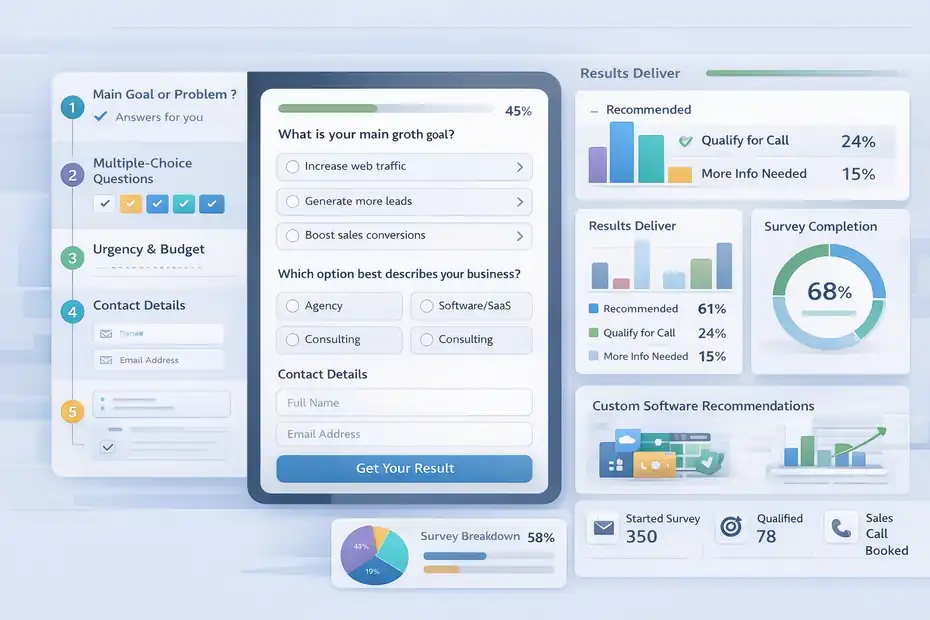
If you decide to use SurveyMonkey, the setup matters more than the brand name. A well-built survey can convert surprisingly well. A weak one will underperform even with good traffic.
Start With One Clear Outcome
Before writing a single question, define the job of the survey. Is it supposed to qualify a lead, personalize a recommendation, book consultations, segment traffic, or generate a score/result?
Everything should flow from that one goal. If you try to do too much, the survey gets bloated fast.
A useful framing is this: What decision should I be able to make after someone finishes this survey?
That question keeps the survey focused.
Keep The Question Flow Logical
The best surveys feel like a conversation. They start easy, build context, and only ask for sensitive details once the person is invested.
A strong flow might look like this:
- Step 1: Ask about the main problem or goal.
- Step 2: Narrow the situation with a few multiple-choice questions.
- Step 3: Identify urgency, budget, or fit.
- Step 4: Ask for contact details in exchange for the result or next step.
This sequencing matters because people are more likely to submit their email after they have already answered a few relevant questions.
Use Mostly Multiple-Choice Questions
Multiple-choice questions reduce effort and make completion faster. They also create cleaner data for segmentation.
Open-ended questions can still help, but use them selectively. One thoughtful “Anything else we should know?” question near the end can add depth without slowing down the whole survey.
In most cases, I recommend keeping surveys between 4 and 8 questions if lead generation is the goal. Once you push beyond that, you need a very strong incentive to maintain completion rates.
Make The Result Worth It
The survey should lead to something concrete. That might be a personalized recommendation, a score, a qualification outcome, a suggested next step, or a call booking path.
The more specific the outcome, the better the survey tends to perform.
People do not want to “submit.” They want clarity.
The Best SurveyMonkey Lead Generation Funnel Structure
A converting survey funnel is not just a list of questions. It is a sequence that builds curiosity, commitment, and relevance. This is where many businesses can improve dramatically.
Stage 1: Promise A Useful Outcome
Your landing page or intro text should explain exactly what the person gets by completing the survey. Keep it specific and outcome-focused.
For example:
- “Answer 6 quick questions to find the best CRM setup for your sales team.”
- “Take this 2-minute assessment to see whether your website is losing leads.”
- “Find out which financing option may fit your situation.”
That is far more compelling than “Please complete our survey.”
The user needs a reason to care before they start.
Stage 2: Build Momentum With Easy Questions
The first one or two questions should feel simple and relevant. They should confirm the person is in the right place while creating forward motion.
For example, if you help online stores improve conversion rates, you might start with “What platform is your store built on?” and then “What is your biggest challenge right now?” Those are easy to answer and feel directly connected to the outcome.
This technique matters because once people begin, they are more likely to continue if the next steps feel natural.
Stage 3: Qualify Without Killing Momentum
Mid-survey is where you gather the more commercially useful details. This might include team size, budget range, urgency, or service interest.
Be careful here. These questions should feel justified by the value promised at the start. If they feel random or too personal, completion drops.
One trick I like is to position these questions as part of getting a more accurate result. That makes them feel less like sales screening and more like personalization.
Stage 4: Capture Contact Details At The Right Moment
Contact information should generally come after the person has invested some effort and sees the benefit of completing the process. This is where the exchange becomes clear.
Instead of “Submit your email,” frame it around the benefit: “Enter your email to get your custom recommendation” or “See your assessment result and suggested next steps.”
That small shift can make a meaningful difference.
What Types Of Leads Convert Best Through Survey Funnels
Not every lead behaves the same way. SurveyMonkey is more effective with certain traffic sources, buyer types, and business models.
Warm Traffic Usually Performs Better
Warm traffic includes email subscribers, website visitors who already know your brand, retargeting audiences, referrals, and people coming from educational content. These users have context, which means they are more likely to tolerate a few extra steps.
For example, someone who reads a detailed blog post about fixing low-quality inbound leads may be very willing to complete a short assessment at the end of that article. The survey feels like the logical next step.
Cold traffic can still work, but it usually requires a stronger hook and a shorter survey. Without trust, patience is low.
Higher-Intent Buyers Are A Better Match
Survey funnels are especially effective when the user is evaluating a decision, not casually browsing. Someone comparing service providers, planning a purchase, or trying to solve a pressing problem is more likely to engage.
This is one reason survey funnels are often strong in B2B. Business buyers are used to filling in information if they believe it will help them get a better recommendation or faster answer.
Complex Purchases Benefit From Questions
If your offer has several possible paths, packages, or solutions, a survey can improve conversion by reducing confusion.
Imagine a digital marketing agency that offers SEO, paid ads, CRO, and email marketing. A generic contact form forces the prospect to figure out what they need. A survey can guide them. It asks about traffic levels, current channels, biggest bottleneck, and growth goal.
At the end, the agency recommends the most relevant service path.
That type of guided experience often converts better than sending everyone through the same form.
Low-Intent Freebie Seekers Are Less Ideal
If your audience mainly wants something free and fast, a survey may reduce opt-ins. A simple form is often better for that segment.
So yes, SurveyMonkey can convert. But it converts best when the lead values clarity more than convenience.
Common Mistakes That Make SurveyMonkey Underperform
Most poor results come from execution mistakes, not from the platform itself. That is actually good news, because execution is something you can fix.
Mistake 1: Treating The Survey Like A Data Grab
If every question is about helping your team instead of helping the user, the survey feels self-serving. People can sense that quickly.
A better survey feels diagnostic. It helps the user think through their situation while also giving you useful information.
Mistake 2: Asking For Contact Details Too Soon
Putting the email gate at the beginning is tempting, but it often lowers completion unless the brand is already trusted. In many cases, it works better to ask for contact details after the person has completed most of the survey and wants the outcome.
The person should feel they have earned something.
Mistake 3: Writing Vague Result Promises
“Complete the survey for more information” is weak. “Get your tailored plan in under 2 minutes” is much stronger.
Specificity increases perceived value. Perceived value increases completion.
Mistake 4: Ignoring Mobile Experience
A large share of survey traffic now happens on mobile devices. If your questions are too long, your answer choices are cluttered, or your progress is unclear, drop-off rises fast.
Always test your survey on a phone before launching it. I recommend going through it like a real user with no internal knowledge. You will often spot friction immediately.
Mistake 5: No Follow-Up System
A completed survey is only the start. If leads go nowhere after they submit, your funnel is broken.
At minimum, you need a clear next step such as an email sequence, a results page, a booking option, or a sales outreach workflow. Lead generation is not just capture. It is capture plus progression.
How To Improve Conversion Rates With SurveyMonkey
Once the basics are in place, optimization becomes the difference between an average survey and a genuinely useful lead engine.
Tighten The Offer, Not Just The Questions
Many people obsess over wording inside the survey but forget the promise outside it. Often the biggest lift comes from improving the headline, intro copy, and result framing rather than changing Question 4.
For example, “Take Our Business Survey” is flat. “Find Out Why Your Leads Are Not Converting In 2 Minutes” creates urgency and curiosity.
The offer should answer one silent question: Why should I do this now?
Reduce Cognitive Load
Every extra second of thinking increases abandonment. Use plain language, short question text, and clear answer options.
Instead of asking, “Which of the following best describes your organization’s current demand generation maturity?” ask, “How are you getting most of your leads right now?” The second version is easier to understand and just as useful.
I have found that simple language almost always outperforms clever wording in lead generation surveys.
Use Logic To Personalize The Experience
Branching logic can improve completion because it removes irrelevant questions. If a user says they are a solo consultant, they should not have to answer questions meant for large teams.
This also improves lead quality because the answers feel more tailored and useful. The survey becomes shorter for the user while the data becomes more relevant for you.
Add A Strong Completion Page
Do not waste the thank-you page. This is where you can reinforce the next step, present a tailored recommendation, invite a booking, or send the person into a relevant email sequence.
A generic “Thanks for your response” page misses an important conversion opportunity.
A better completion page might say: “Based on your answers, your biggest issue is low lead qualification. Here’s your next step: book a 15-minute strategy call to review your funnel.”
That turns a survey completion into momentum.
Metrics You Should Track Before Deciding If It Works
You cannot answer “should I use SurveyMonkey for lead generation” based on opinions alone. You need data from your own funnel. What matters is not whether a survey sounds smart, but whether it improves business outcomes.
Top-Of-Funnel Metrics
Start by tracking the basics:
- Landing page conversion rate: How many visitors start the survey?
- Survey completion rate: How many finish it?
- Lead capture rate: How many submit contact details?
- Cost per lead: If using paid traffic, what are you paying?
These numbers show whether the survey creates too much friction.
Mid-Funnel Metrics
This is where survey funnels often shine:
- Qualified lead rate: How many leads meet your standards?
- Appointment booking rate: How many book the next step?
- Sales acceptance rate: How many leads does your team actually want?
- Response speed: How quickly can you act on the data?
A standard form may generate more raw leads, but a survey may generate a higher percentage of sales-ready opportunities.
Bottom-Funnel Metrics
This is the real test:
| Metric | Why It Matters |
|---|---|
| Lead-to-call rate | Shows whether leads take the next step |
| Call-to-close rate | Measures lead quality |
| Revenue per lead | Compares true value, not just volume |
| Customer acquisition cost | Helps judge efficiency |
| Time spent on bad-fit leads | Reveals operational waste |
Let’s say a normal form brings in 100 leads and 5 customers. A survey brings in 60 leads and 8 customers. On the surface, the form “converted” more. But the survey produced more customers and likely better ROI.
That is why I suggest judging surveys by business conversion, not just opt-in rate.
SurveyMonkey Vs Other Approaches For Lead Generation
SurveyMonkey is one option, but it is not the only one. The right choice depends on your funnel goals, your traffic quality, and how much personalization you need.
When SurveyMonkey Is A Sensible Choice
SurveyMonkey makes sense when you want a familiar, easy-to-build survey experience and your lead-gen process depends on questions, branching, and qualification. It is practical for businesses that care about information quality more than raw lead volume.
It can also be a good starting point if you want to test whether a survey-based lead magnet works before investing in a more custom funnel build.
When A Dedicated Funnel Or Form Tool Makes More Sense
If your priority is direct response performance, advanced landing page testing, or deeper design control, a dedicated funnel builder or optimized lead form tool may be a better fit.
This is especially true if you want to run aggressive paid campaigns where every percentage point of landing page conversion matters. In those cases, you may want more control over layout, speed, form styling, and post-submit routing.
Practical Decision Framework
Here is the simplest way I would decide:
| Situation | Better Option |
|---|---|
| You need fast, low-friction email opt-ins | Standard form |
| You need lead qualification before sales | SurveyMonkey |
| You need personalized recommendations | SurveyMonkey |
| You need maximum landing page control | Dedicated funnel builder |
| You need simple newsletter growth | Standard form |
| You sell complex or high-ticket services | Survey-based funnel |
I believe many businesses do not need to choose one forever. You can use both. A simple form might work for top-of-funnel lead magnets, while a SurveyMonkey assessment qualifies higher-intent leads later in the journey.
That hybrid approach is often stronger than forcing one method everywhere.
12. So, Should You Use SurveyMonkey For Lead Generation?
Yes, you should use SurveyMonkey for lead generation if your business benefits from qualifying leads, personalizing follow-up, or guiding people toward the right next step.
No, you probably should not rely on it as your default lead capture method if your main goal is raw opt-in volume from cold traffic.
The Honest Answer
SurveyMonkey is not magic, and it is not automatically a conversion killer either. It is a tool that works well when the survey itself creates value.
If your audience wants clarity, diagnosis, or a tailored recommendation, a survey can convert surprisingly well and produce better downstream results than a basic form. If your audience wants speed and simplicity, a survey may create more friction than it is worth.
That is why the better question is not “Does SurveyMonkey convert?” It is “Does a survey improve this specific funnel?”
My Recommendation
I suggest using SurveyMonkey in these cases:
- Use it when: You sell a complex, high-consideration, or higher-ticket offer.
- Use it when: Lead quality matters more than lead volume.
- Use it when: You can offer a personalized result or recommendation.
- Avoid it when: You just need a quick email opt-in.
- Avoid it when: Your traffic is very cold and your offer is weak.
The Smartest Next Step
If you are unsure, test it against your current form. Send similar traffic to both versions for a few weeks. Compare not just lead count, but qualified leads, calls booked, close rate, and revenue per lead.
That will give you a real answer for your business.
And in my experience, that is where the truth usually shows up. SurveyMonkey rarely wins because it is a survey tool. It wins when the questions make your funnel smarter.
FAQ
Should I use SurveyMonkey for lead generation?
SurveyMonkey can be effective for lead generation if your goal is to qualify leads and gather useful insights. It works best when paired with a strong offer like an assessment or personalized recommendation, helping you capture more relevant and higher-intent prospects.
Does SurveyMonkey convert well for lead generation?
SurveyMonkey can convert well when used strategically in mid or bottom funnel stages. While it may reduce total lead volume due to added steps, it often increases lead quality and improves conversion rates further down the sales process.
Is SurveyMonkey better than a standard lead form?
SurveyMonkey is not always better than a standard form. It is more useful when you need to qualify or segment leads. Standard forms usually generate more leads, while surveys tend to produce fewer but more targeted and higher-quality prospects.
When should I avoid using SurveyMonkey for lead generation?
You should avoid using SurveyMonkey when targeting cold traffic or offering simple lead magnets like newsletters. In these cases, the extra steps can reduce conversions since users prefer quick and easy sign-ups with minimal effort.
How can I improve SurveyMonkey conversion rates?
To improve conversion rates, keep surveys short, use mostly multiple-choice questions, and clearly explain the benefit of completing the survey. Offering a personalized result or recommendation at the end can significantly increase completion and lead capture rates.

I’m Juxhin, the voice behind The Justifiable.
I’ve spent 6+ years building blogs, managing affiliate campaigns, and testing the messy world of online business. Here, I cut the fluff and share the strategies that actually move the needle — so you can build income that’s sustainable, not speculative.
Related posts:
 SurveyMonkey Real User Experience For Lead Generation: What To Expect
 The Top 7 Signup Forms Trends of This Year: Increase Your Signups!
 10 Secrets to Generating Leads Online & Skyrocketing Sales
 How to Build Lead Pages That Convert Like Crazy
 How to Create an Aweber Landing Page That Converts Today
 10 Similar Sites To Apollo IO Every Marketer Should Try