
Table of Contents
Some links on The Justifiable are affiliate links, meaning we may earn a small commission at no extra cost to you. Read full disclaimer.
Learning how to get customers with social commerce starts with connecting what people watch, ask, and trust to something they can confidently buy. Posting regularly can attract attention, but attention alone will not cover your costs. You need a clear offer, useful proof, and a buying path that makes sense on a phone.
This playbook shows you how to build that system, even with a small audience. You’ll learn how to reach likely buyers, turn conversations into orders, fix conversion problems, and decide which activities deserve more of your time and budget.
Build a Clear Path From Discovery to Purchase
Before planning content, decide how someone will move from encountering your business to becoming a customer. Each stage should answer a different buying question.
Choose the Buying Journey Your Product Needs
Social commerce connects product discovery, evaluation, and purchasing through social interactions. Some transactions finish inside a social platform; others continue through a direct message or your website. Your job is to make that journey coherent.
Start with the amount of explanation your offer needs. A simple kitchen accessory might sell after a convincing demonstration. A custom dining table probably needs measurements, delivery details, and a conversation before payment.
Match the buying path to that uncertainty:
- Straightforward product: Demonstration → product page → checkout.
- Product requiring selection: Comparison → sizing or compatibility help → product page.
- Customized offer: Relevant example → inquiry → scoped recommendation → payment.
These are planning models, not mandatory funnels. Customers might revisit your profile or consult someone else before ordering.
For a hypothetical storage brand, a video showing an organizer inside a shallow drawer should lead to that exact organizer and its dimensions. Sending viewers to a general homepage forces them to restart the decision.
Choose one primary journey for your initial campaign. Multiple destinations and competing instructions make it harder to identify where prospective customers lose confidence.
Define a Customer Through Their Buying Situation
“People interested in home organization” describes an audience, but it does not explain what makes someone ready to buy. A buying situation gives you a stronger foundation for customer acquisition.
Identify the moment that creates demand. Someone moving into a small apartment faces different constraints from someone reorganizing a large family kitchen. Their available space, budget, urgency, and objections will differ.
Write a working customer statement:
I help renters with shallow kitchen drawers organize everyday utensils without permanent fittings.
Then collect the language people use around that problem. Review your customer emails, public product questions, relevant discussions, and competitor reviews. Look for recurring frustrations rather than copying another seller’s positioning.
Record four details for each useful observation:
- The situation that triggered the search.
- The result the person wants.
- The alternative they already considered.
- The concern preventing a purchase.
A complaint such as “every organizer is too tall” gives you a content topic, a product-selection criterion, and a product-page requirement.
Treat this profile as a hypothesis until conversations and purchases support it. A vivid customer description is useful only when it reflects actual demand.
Select One Platform You Can Serve Consistently
Choose your initial platform where three things overlap: relevant buyers already participate, your product suits the available content formats, and your team can maintain useful conversations.
Look at buying behavior rather than headline audience size. Are people asking about fit, price, availability, or delivery beneath relevant posts? Do creators demonstrate products in situations your customers recognize? Those signals deserve investigation.
Evaluate your practical capacity too. If you can produce clear demonstrations but dislike frequent live sessions, build around recorded content. If your offer needs consultation, prioritize an environment where you can handle inquiries reliably.
Check commerce eligibility before making platform-specific features central to your plan. Meta’s commerce requirements include supported location, business representation, and trustworthiness; access is not automatic for every account.
Also verify where checkout actually happens. Shopify’s current Instagram Shopping documentation says customers complete purchases through the Shopify checkout, so older advice about universal in-app checkout can mislead your setup.
Commit to a manageable testing period on one primary platform. Expand when you understand which customer, message, and purchase path work together—not simply when another platform becomes fashionable.
Prepare an Offer That New Customers Can Trust
More exposure will magnify weaknesses in your offer. Give unfamiliar shoppers a clear reason to care, enough information to evaluate the product, and realistic expectations.
Lead With One Product and One Specific Outcome
A broad catalog can overwhelm someone who has only just discovered your business. Choose a lead product that makes your value easy to understand and creates a sensible entry point.
Evaluate candidates against practical criteria:
- Can you demonstrate the benefit clearly?
- Does it solve a recognizable problem?
- Can you explain who it fits and who should skip it?
- Is stock dependable?
- Does the margin support acquisition costs?
- Can you fulfill orders without excessive support?
For the hypothetical storage brand, a shallow-drawer organizer might be a stronger lead offer than an entire kitchen collection. Its use case is specific, and customers can assess suitability through measurements.
Build the offer around the complete decision. That includes the product, price, dimensions, delivery expectations, and any relevant support or returns information.
A bundle can help when its components solve one connected problem. Adding unrelated items merely to increase order value creates another decision for the customer.
I recommend testing clarity before discounts. Ask someone unfamiliar with your business to explain what the product does, who needs it, and what they receive. Confusion at this stage usually follows the shopper into checkout.
Work Out What You Can Spend to Acquire a Customer
Customer acquisition needs an economic boundary. Otherwise, a campaign can produce orders while quietly consuming the money required to run the business.
Estimate the contribution from an order before acquisition spending:
Net sales revenue − product cost − variable order costs = contribution before acquisition.
Use revenue after discounts and refunds, excluding taxes you collect for remittance. Variable costs can include packaging, fulfillment, payment fees, shipping subsidies, and expected return handling.
Consider a hypothetical $50 order:
| Item | Amount |
|---|---|
| Net sales revenue | $50 |
| Product cost | $18 |
| Packaging and fulfillment | $5 |
| Payment and selling fees | $3 |
| Shipping subsidy and return allowance | $6 |
| Contribution before acquisition | $18 |
Spending $18 to acquire that customer would consume the entire contribution before overhead and profit. A sustainable target needs room beneath that ceiling.
Include creator fees, gifted-product costs, commissions, and relevant production expenses when evaluating a campaign. Avoid counting the same expense twice if it already appears in your order costs.
Repeat purchases might justify higher acquisition spending later. Until you have reliable retention data, treat that future value as a possibility rather than available cash.
Assemble Proof Before Asking Strangers to Buy
New customers need evidence that connects your promise to their situation. A polished product photograph helps them recognize the item; it rarely answers every question required for a purchase.
Build a small proof collection around the main sources of uncertainty:
- A product demonstration in an ordinary setting.
- Close-ups that show material, dimensions, or construction.
- An explanation of a meaningful limitation.
- Customer feedback used with permission.
- Clear delivery and support information.
If you have no reviews yet, use transparent product evidence. Show the item next to a ruler, demonstrate assembly, or compare its dimensions with the space it needs. Do not turn your own demonstration into a supposed customer testimonial.
For an organizer, showing that a drawer closes normally can carry more decision value than several decorative lifestyle images.
Keep the evidence proportional to the claim. One customer’s experience does not establish a universal outcome. A demonstration under controlled conditions should not imply that every use case produces the same result.
Also collect the questions proof fails to answer. If several people still ask whether the item fits a particular drawer type, your next asset should resolve that gap.
Create Content That Helps People Make Buying Decisions
Effective social commerce content gives viewers a reason to recognize a problem, evaluate your solution, and take a relevant next step. Build your publishing around those decisions.
Turn Customer Questions Into Demonstration Scripts
Start each piece of content with one question a prospective customer needs answered. This keeps the product relevant and prevents your feed from becoming a sequence of disconnected promotions.
Useful questions include:
- Will this fit my situation?
- How does it work?
- What makes it different from what I already use?
- What is difficult about setup?
- When would another option suit me better?
Use a simple script: show the situation, demonstrate the product, explain the condition that matters, and give one next action.
A hypothetical organizer video could open with a drawer that will not close around a bulky tray. Show the alternative in the same drawer, display the required clearance, and direct viewers to the dimensions.
The specific limitation strengthens the demonstration. “Check your internal drawer height” is more useful than “perfect for every kitchen.”
Include captions or readable on-screen labels so the explanation remains understandable without audio. Keep important measurements visible long enough to inspect.
Avoid delaying the useful part behind a long brand introduction. Someone encountering you for the initial time needs a reason to continue watching before they need your company history.
Balance Discovery, Evaluation, and Purchase Content
Different posts serve different stages of the buying decision. A broad problem-focused video can introduce your brand, while a detailed comparison helps someone who already knows they need a solution.
Plan around three jobs:
| Content Job | Useful Format | Relevant Next Action |
|---|---|---|
| Attract suitable viewers | Recognizable problem or practical tip | View a related demonstration |
| Resolve uncertainty | Comparison, dimensions, customer question | Check fit or ask a question |
| Support a purchase | Clear offer with proof and availability | Visit the specific product page |
You do not need a rigid percentage split. Let actual customer behavior reveal which stage lacks support.
Suppose your demonstrations generate profile visits, but viewers repeatedly ask which size to choose. Another awareness video will not solve that bottleneck. A size-selection comparison might.
Likewise, publishing only detailed specifications can fail to reach people who have not recognized the problem yet. Give them a familiar situation before presenting the technical explanation.
Keep the offer consistent across the sequence. If discovery content promises a compact solution, the evaluation post and destination page should reinforce that same use case.
This continuity makes each interaction useful without requiring every post to deliver the complete sales argument.
Build a Publishing Routine You Can Maintain
A sustainable routine beats an ambitious calendar that collapses when customer support becomes busy. Start with the production capacity you can maintain alongside fulfillment and sales conversations.
One workable weekly test might include a demonstration, an objection-handling post, and a customer-question response. This is a starting workload, not an algorithm requirement.
Batch related tasks. Record several demonstrations while the product and lighting are ready, then edit and write captions in a separate session. Keep a shared list of questions so you never need to invent topics from scratch.
When manual posting becomes disruptive, Buffer can help plan and schedule content across connected social channels. Some formats or platform features require notification publishing, where you complete the post in the native app, so check support for the exact format you use.
A solo seller publishing a few posts can start with native tools and a simple calendar. Software becomes useful when coordination and consistency consume meaningful time.
Reserve time after publishing to answer relevant questions. Scheduling solves a production problem; it does not replace the conversation that helps someone choose your product.
Reach Suitable Buyers Without Depending on a Large Following
You can create useful content and still struggle to reach potential customers. Distribution should put that content into relevant conversations and partnerships, with paid reach added when the economics support it.
Participate Where Your Customers Already Ask Questions
Community participation works best when you contribute to an existing need. Look for discussions where your experience can help someone evaluate a problem, even if your product is not the immediate answer.
Read the community’s rules and recent conversations before posting. Notice which answers people appreciate and whether commercial recommendations are welcome.
For the storage example, someone asking about organizing a narrow rental kitchen might benefit from measurement advice, removable options, or a warning about clearance. Explain those considerations directly instead of dropping a store link.
If your product is relevant and promotion is permitted, make your connection clear. Keep the recommendation specific to the situation and acknowledge when another approach would work.
Avoid turning every helpful comment into a private sales pitch. Unrequested outreach can damage the credibility you are trying to establish.
Maintain a simple record of recurring questions and the language people use. Even when a conversation produces no immediate sale, it can reveal a better offer or content angle.
Measure useful outcomes such as qualified inquiries and relevant profile visits. Counting comments you posted rewards activity rather than customer acquisition.
Test Creators for Audience Fit and Useful Proof
A creator partnership should give you access to a relevant audience, credible product explanation, or reusable content. Decide which outcome you are purchasing before discussing deliverables.
Review recent posts, typical comments, audience location where available, and the creator’s ability to explain products accurately. A large following does not establish that viewers have the problem you solve.
For a practical product, a creator who regularly demonstrates small-space living may be more useful than a general lifestyle account with broader reach.
Create a focused brief covering:
- The customer situation and product use.
- Claims the creator can substantiate.
- Important limitations or fitting requirements.
- Deliverables and publication timing.
- Compensation and transparent disclosure expectations.
- Agreed rights for reuse and paid promotion.
Allow the creator to use their own voice. An overly scripted endorsement can remove the context that made their content valuable.
Use a dedicated link or code to gather directional sales evidence, while recognizing that some customers will purchase later without either.
Start with a contained test. Evaluate customer quality, usable content, and contribution after costs before committing to a larger package or ongoing arrangement.
Use Paid Promotion to Test a Defined Hypothesis
Paid distribution is most useful when you know what you are trying to learn. “Get more sales” is an objective, but it does not tell you which audience, creative, or offer deserves the budget.
Write a test hypothesis such as: “A dimensions-led demonstration will attract more suitable drawer-organizer buyers than a styling-led video.”
Keep the product, destination, and offer consistent while comparing the creative angle. If you change everything simultaneously, the result becomes difficult to interpret.
Choose the closest measurable campaign outcome to your business goal that your setup can reliably support. Cheap video views alone do not establish purchase intent.
Set a spending limit using your acquisition economics and the amount you can afford to lose while learning. Low budgets might provide directional evidence without enough purchases for a confident conclusion.
Before launch, confirm:
- The destination works on mobile.
- The advertised item is available.
- The price matches the creative.
- Purchase tracking works as intended.
- Someone can handle questions and orders.
Pause for broken links, inaccurate claims, or fulfillment problems immediately. For performance decisions, consider the usual buying delay rather than judging every campaign after a few hours.
Turn Comments and Messages Into Qualified Orders
A question is a chance to reduce uncertainty. Handle conversations as buying assistance, with a clear path to a suitable product and an easy way to decline.
Use One Call to Action That Matches Readiness
Your call to action should ask for the next useful decision. A viewer who does not understand the product needs a different invitation from someone checking whether it will arrive in time.
For discovery content, invite a closer look at the demonstration or comparison. For evaluation content, offer relevant selection help. For a purchase-focused post, point directly to the matching item.
“Message us” is often too vague. Explain what someone receives: “Send your drawer’s internal dimensions and we’ll help you check the fit.”
Only offer this service if you can provide it reliably. An unanswered invitation creates frustration at the moment someone shows interest.
Avoid stacking several competing instructions into one caption. Asking someone to follow, share, comment, subscribe, and buy makes the important action harder to identify.
A comment keyword can work when it delivers a specific resource or next step. It should not exist merely to inflate engagement.
Match the destination to the promise. If someone requests a size guide, deliver that guide before introducing additional offers. Keeping this small commitment builds confidence for the larger commitment of purchasing.
Ask Enough Questions to Recommend Accurately
A useful sales conversation discovers what matters without making someone complete an interview. Start with the question that most changes your recommendation.
For a physical product, that might be dimensions, compatibility, intended use, or delivery location. For a customized offer, it could be scope or timing.
A practical sequence is:
- Acknowledge the question directly.
- Ask for the missing detail that affects suitability.
- Recommend one relevant option and explain why.
- State any limitation the customer should consider.
- Share the purchase link when they are ready.
For the hypothetical organizer, ask for usable internal dimensions rather than the external width of the cabinet. Explain the distinction so the customer understands what to measure.
If neither size fits, say so. An unsuitable order creates avoidable returns and weakens trust.
Keep short response templates for repeated questions, but personalize the part that determines the recommendation. Customers should not have to decode a generic paragraph to find their answer.
Record unresolved objections in broad categories such as fit, delivery, price, or durability. These conversations become evidence for improving your content and product pages.
Automate Repetition While Preserving Human Help
Automation becomes useful when repeated requests delay helpful responses. Begin with a narrow task such as delivering a requested guide or routing a sizing question, then review where customers need a person.
ManyChat supports Instagram comment-triggered private replies, making it relevant for sellers who repeatedly send the same resource after a clear invitation. However, sending the initial private reply does not automatically open the 24-hour messaging window; the user needs to interact in a qualifying way.
Design the flow around the requested help:
- Confirm what the person requested.
- Provide the relevant resource.
- Offer a simple next choice.
- Make human assistance easy to request.
Do not build a long promotional sequence before checking the current messaging rules and your account’s available functionality.
Test the automation from a separate customer account. Check unexpected keywords, repeated comments, broken destinations, and the handoff to a person.
Manual replies are often better while you are still discovering customer questions. Automating too early can lock a weak script into your process and hide the objections you most need to hear.
Make Buying Easy and Follow Up With Permission
Once someone shows purchase intent, avoid introducing preventable uncertainty. Your product page, checkout, and follow-up should continue the conversation that brought them there.
Match the Destination to the Content Promise
Send customers to the product, variation, or focused collection that matches the content they just consumed. A generic homepage can work for broad brand exploration, but it often creates unnecessary work after a specific demonstration.
Place the information needed for a decision close to the product:
- What the customer receives.
- Price and relevant options.
- Dimensions or compatibility.
- Delivery expectations.
- Returns information and support access.
Use the same product language and visual cues across the post and page. Someone who watched a “shallow drawer” demonstration should immediately recognize that use case at the destination.
Open the link inside the social app on a real phone. Check whether overlays obscure the page, text is readable, and variation selection works.
Then complete a test purchase through your supported testing process or an actual order you can reconcile. Review the confirmation message too.
Avoid adding a new platform merely to solve a weak product page. Your existing ecommerce system may already support the information and checkout experience you need.
The practical objective is continuity: the page should answer the next question, rather than forcing the shopper to rediscover the product.
Offer a Useful Reason to Stay in Touch
Some interested people will not buy immediately. Give them a relevant way to continue the decision without assuming that every social interaction means permission for ongoing marketing.
Offer something connected to the purchase problem: a measuring checklist, compatibility guide, restock notification, or product-selection worksheet.
A generic prize giveaway can attract people who want the prize rather than the product. A drawer-measuring guide attracts a narrower group with a more relevant task.
Explain what someone will receive when they subscribe, and keep marketing choices clear. Do not manually add commenters or message contacts to an email list simply because you can access their details.
Match the initial follow-up to the reason they joined. Someone requesting a fitting guide should receive the guide and a practical explanation of how to use it.
For a small audience, a simple signup form and carefully written welcome message may be enough. Add complexity only when different customer needs require different follow-up.
Watch the quality of subscribers alongside the count. Relevant replies, product visits, and purchases tell you more about commercial fit than a rapidly growing list with little interest in your offer.
Build Follow-Up Around the Unfinished Decision
Effective follow-up addresses the reason someone paused. Repeating the same sales pitch with progressively larger discounts can reduce margin without resolving the underlying concern.
Separate the situations you can identify. A new subscriber may need product education. Someone who abandoned checkout may need clarification about delivery. A recent buyer needs useful ownership support.
Omnisend offers ecommerce workflows for welcome messages, abandoned carts, and post-purchase follow-up. It can help stores whose connected customer and order data support these sequences, especially when manual coordination becomes unreliable.
Start with one workflow and verify its triggers, timing, audience, and stopping conditions. A recovery message should stop when the customer purchases. Disable overlapping recovery sequences in your store system to avoid duplicate messages, as Omnisend’s setup guidance recommends.
Software cannot recover every anonymous visitor, and contact availability does not remove permission requirements. Check your store integration and applicable sending conditions before launch.
If your order volume is low, your existing email system may suffice. The strongest reason to add automation is dependable, relevant follow-up—not the prospect of sending more messages.
Diagnose Where Customer Acquisition Breaks Down
When results disappoint, locate the failing transition before changing your entire strategy. Reach, interest, trust, and checkout problems require different responses.
Fix High Views With Little Buying Interest
Large view counts can hide weak commercial relevance. A post might entertain people who cannot use your product, cannot receive delivery, or have no intention of buying.
Compare attention with downstream actions. Did viewers inspect the product, ask specific questions, or visit a relevant destination? A video with fewer views and more qualified inquiries may serve your business better.
Read the comments closely. Reactions about the joke, editing, or music suggest a different kind of attention from questions about size, materials, or availability.
Then inspect your opening message. Does it identify the customer situation, or could almost anyone find it interesting without needing the product?
For the organizer brand, a dramatic room-cleaning transformation might attract broad entertainment interest. A demonstration focused on narrow rental-kitchen drawers may attract fewer people but establish stronger relevance.
Test a more specific problem, show the product earlier where appropriate, and give a relevant next step.
Do not assume low click volume proves the product is unwanted. The call to action may be unclear, the link difficult to find, or the content better suited to an earlier buying stage.
Fix Product Interest That Does Not Become Orders
When people reach the product page but do not purchase, examine what changes between the promise and the destination.
Look for mismatched pricing, missing variants, unclear delivery costs, weak product details, and checkout problems. Ask whether the page resolves the specific concern that motivated the click.
Use support conversations to separate causes. “Too expensive” can mean the price exceeds someone’s budget, but it can also mean the difference from a cheaper alternative remains unclear. Those situations need different responses.
Ask a few suitable potential customers to attempt the buying journey while explaining what they expect. Avoid coaching them through confusing steps; the confusion is the evidence.
Change one meaningful issue at a time when traffic allows. If you alter the price, shipping offer, photographs, and checkout together, you may improve sales without knowing what helped.
Also account for the decision period. A customized product may require discussion before purchase, while a simple replacement item may sell faster.
There is no single conversion benchmark that makes every store healthy. Compare similar traffic and products over consistent periods, then judge whether contribution improves.
Fix Orders That Create Returns and Excessive Support
Acquisition quality becomes visible after the sale. If a campaign generates orders that regularly disappoint customers, its apparent success can disappear through refunds, replacements, and support work.
Review complaints according to the content or offer that attracted the buyer. Look for repeated mismatches involving dimensions, color, materials, setup effort, or delivery expectations.
A creator might show a product in a way that makes it appear larger than it is. A compressed demonstration might hide necessary assembly. A vague caption might imply that every variation includes the same accessories.
Correct the earliest misleading point, not only the support response. Update the creative, selection guidance, and destination page so future customers enter with better expectations.
Track return reasons in consistent categories, while keeping space for the customer’s own explanation. Broad labels such as “not satisfied” make it difficult to identify preventable causes.
Avoid judging every return as a marketing failure. Damage, fulfillment mistakes, and legitimate changes of mind require different action.
A campaign earns the right to scale when the customers it attracts are well served, not merely when the order count rises.
Measure Results and Scale What Produces Good Customers
Learning how to get customers with social commerce becomes easier when your reporting connects activity to customer quality and contribution. Use a small scorecard that supports decisions.
Track the Journey Without Pretending Attribution Is Perfect
Record the main transitions in your chosen buying path. For a website purchase journey, that might include relevant visits, product engagement, orders, new customers, and refunds.
Use consistent campaign labels in your links so visits remain easier to distinguish. UTM parameters are labels attached to a URL that help compatible analytics systems identify a traffic source, campaign, or creative.
Keep the labels readable and consistent. Separate organic content, creator partnerships, and paid campaigns rather than mixing everything under one social category.
Pair link data with store orders and an optional post-purchase question about discovery. Each provides a different perspective; none captures every interaction.
A customer might watch a video, receive a recommendation from a friend, and later search for your brand. The eventual purchase may appear under a channel that completed the journey rather than introduced it.
Do not add every platform’s claimed conversions together as if they represent unique orders. Reconcile overall sales against your store records.
For small businesses, a weekly spreadsheet with clear definitions can be enough. Consistent interpretation matters more than a dashboard containing dozens of metrics nobody uses.
Evaluate Acquisition Cost Alongside Contribution
Calculate customer acquisition cost using new customers, rather than total orders:
Relevant acquisition spending ÷ new customers acquired = customer acquisition cost.
Define the scope before comparing results. Paid-media acquisition cost includes different expenses from a fully loaded calculation that also includes production, creator costs, software, and allocated labor.
Consider a hypothetical campaign with $300 in ads and $100 in creator costs. If it generates 20 new customers, the campaign acquisition cost is $20. That does not include any additional costs you have excluded from the definition.
Compare that figure with contribution, not revenue alone. If each initial order contributes $18 before acquisition, the campaign loses $2 per new customer before overhead.
Maintain a compact scorecard:
| Measure | Decision It Supports |
|---|---|
| Qualified visits or inquiries | Is the audience relevant? |
| New customers | Is acquisition happening? |
| Acquisition cost | What does each customer cost? |
| Contribution after acquisition | Does the activity fund the business? |
| Refunds and repeat purchases | Are you attracting suitable customers? |
Review comparable periods and customer groups. One unusually large order can distort a small sample, while delayed returns can make recent results look stronger than they eventually become.
Scale One Proven Element at a Time
Scaling means increasing a repeatable result without damaging its economics or customer experience. Identify what is proven before increasing spending or adding channels.
You might have evidence for one product demonstration, one creator partnership, or one customer segment. Preserve that useful combination while testing a controlled expansion.
Possible next moves include reaching more of the same audience, producing another demonstration of the same benefit, or testing a complementary creator. Launching several new products across several platforms introduces too many unknowns.
Check operational capacity alongside marketing performance. Review stock, response times, fulfillment workload, and available cash before increasing acquisition.
Use this practical opening-month sequence:
- Week 1: Select the customer situation, lead offer, and buying path.
- Week 2: Publish demonstrations and answer questions manually.
- Week 3: Fix repeated objections and test one distribution method.
- Week 4: Review contribution, customer quality, and the next bottleneck.
This is a learning schedule, not a promise of profitability within a month.
Continue the test when evidence remains limited but useful. Stop or redesign it when the economics, product fit, or operational demands cannot support a sensible next step.
Build One Customer Journey You Can Repeat
You do not need a large audience or an elaborate software stack to begin. You need a specific customer problem, a credible offer, and a clear route from interest to an informed purchase.
Choose one product and one buying situation this week. Create a demonstration that answers a real question, send viewers to a matching destination, and make it easy to get help. Record what people ask, where they hesitate, and which customers ultimately keep and use the product.
Let those observations determine your next move. Improve the explanation when viewers misunderstand. Improve the buying experience when suitable shoppers stall. Increase distribution when the offer converts at a cost your margins can support.
Social commerce becomes more manageable when each cycle produces useful evidence. Build one customer journey that works reliably, then expand it while protecting the experience that made people comfortable buying from you.

I’m Juxhin, the voice behind The Justifiable.
I’ve spent 6+ years building blogs, managing affiliate campaigns, and testing the messy world of online business. Here, I cut the fluff and share the strategies that actually move the needle — so you can build income that’s sustainable, not speculative.
Related posts:
 Ecommerce Website Social Media Marketing Tips That Increase Sales Fast
 How to Start Social Commerce From Scratch: A Practical Roadmap
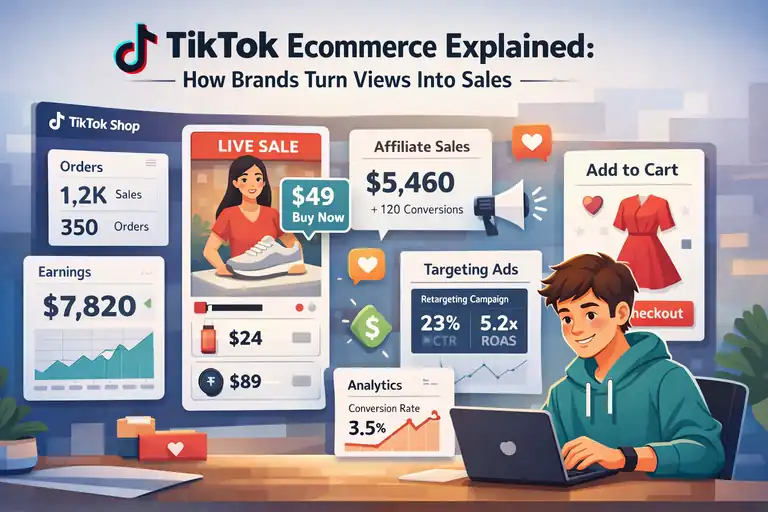 TikTok Ecommerce Explained: How Brands Turn Views Into Sales
 Best Ways to Get Customers in the Ecommerce Industry for New Stores
 How Does an Ecommerce Entrepreneur Find Customers Consistently?
 Is Social Commerce Profitable for Small Businesses? A Cost Guide