
Table of Contents
Some links on The Justifiable are affiliate links, meaning we may earn a small commission at no extra cost to you. Read full disclaimer.
Is SaleHoo worth it is one of those questions I see new sellers asking right before they pull out their credit card—or walk away entirely.
This breakdown is for beginners who want to start dropshipping or wholesale without wasting money on tools that overpromise.
I’m answering one core question here: whether SaleHoo actually delivers real value for new sellers in 2026, based on pricing, features, limitations, and realistic use cases.
What SaleHoo Is And How New Sellers Actually Use It
SaleHoo is essentially a supplier research and product discovery platform built for people who want to sell online without manufacturing products themselves.
Most new sellers use it to avoid unreliable suppliers, wasted ad spend, and the trial-and-error phase that usually burns beginners.
How SaleHoo Works As A Supplier Research Platform
At its core, SaleHoo gives you access to a large database of pre-vetted suppliers.
Instead of Googling “dropshipping suppliers” and hoping for the best, you search inside SaleHoo’s directory and filter by product type, location, minimum order quantity, and business model.
Here’s how new sellers typically use it in practice:
- Start with a product idea or niche
- Search SaleHoo’s database for suppliers selling that product
- Review supplier profiles, fees, and contact requirements
- Reach out directly to suppliers to open an account
From what I’ve seen, this saves beginners weeks of outreach. Cold-emailing random suppliers can have response rates under 10 percent.
SaleHoo suppliers are already open to working with online sellers, which dramatically increases replies.
SaleHoo’s Core Tools For Dropshipping And Wholesale Sellers
SaleHoo isn’t just a list of suppliers. It bundles several tools that support early-stage decision-making.
Key tools new sellers actually use:
- Supplier directory with over 8,000 vetted suppliers
- Product research data showing demand and competition
- Market insights tied to real sales trends
- Basic profit calculation tools
The product research tool is especially helpful if you don’t trust your instincts yet. It uses marketplace data (primarily from Amazon and Google trends) to flag products with consistent demand rather than short-lived hype.
Differences Between SaleHoo Directory And SaleHoo Dropship
This is where a lot of beginners get confused.
The SaleHoo Directory is supplier-focused. You contact suppliers manually, negotiate terms, and list products yourself. It works best for wholesale or semi-automated dropshipping.
SaleHoo Dropship is Shopify-focused. It lets you import products directly into your store and sync inventory automatically. Think of it as a lighter alternative to AliExpress-based tools, but with higher-quality suppliers.
If you want control and better margins, the directory is stronger. If you want speed and simplicity, Dropship is easier.
Who SaleHoo Is Designed For Versus Who Should Avoid It
SaleHoo works best for:
- First-time sellers who want structure
- Dropshippers avoiding AliExpress quality issues
- Wholesale beginners testing product-market fit
- Shopify users who want cleaner supplier data
It’s not ideal for:
- Advanced sellers doing custom manufacturing
- High-volume brands needing deep automation
- Sellers who want done-for-you product sourcing
If you already have supplier relationships, SaleHoo may feel redundant. But for beginners, it removes a lot of early friction.
SaleHoo Pricing Plans Explained For Beginners In 2026
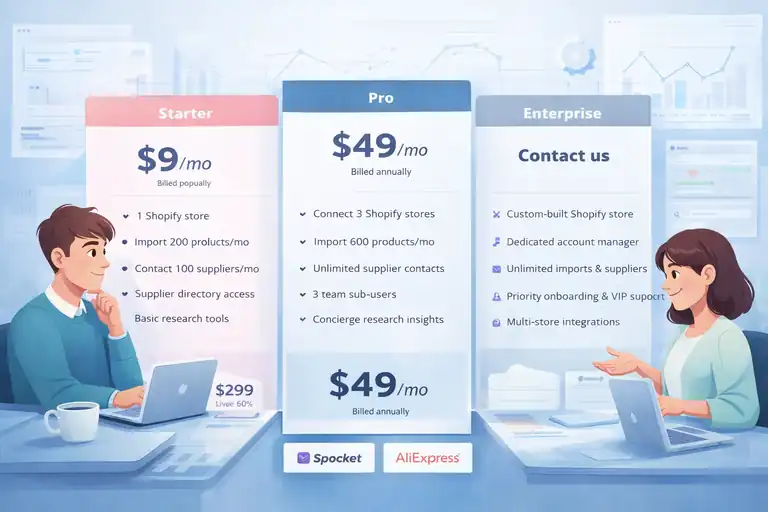
Pricing is often the deciding factor when people ask is SaleHoo worth it. On paper, the plans look simple. In reality, each tier fits a very specific stage of business.
SaleHoo Starter Plan Features And Realistic Use Cases
The Starter plan is where most beginners start, and honestly, where many should stay for a while.
What it realistically supports:
- One Shopify store
- Up to 200 product imports per month
- Contacting up to 100 suppliers monthly
- Full access to the supplier directory
- Basic product research tools
At around $9 per month when billed annually (or a $299 lifetime option), it’s affordable compared to burning money on ads with bad suppliers. I’ve seen beginners recover the cost by avoiding just one scam supplier.
This plan works well if you’re still validating ideas and learning supplier outreach.
SaleHoo Pro Plan Breakdown And Scaling Limitations
The Pro plan jumps to about $49 per month and targets sellers ready to scale.
What changes:
- Connect up to three Shopify stores
- Import up to 600 products
- Unlimited supplier contacts
- Team access with sub-users
- Concierge-style supplier research insights
This tier makes sense once you’re testing multiple niches or stores.
However, it’s not unlimited automation. You’re still managing listings and optimization manually, which can slow scaling beyond a certain point.
SaleHoo Enterprise Plan And Who It Makes Sense For
Enterprise is custom-priced and aimed at serious operators.
It includes:
- Custom-built Shopify stores
- Dedicated account managers
- Unlimited product imports
- Priority onboarding and support
- Multi-store integrations
This only makes sense if you value time over money. For most beginners, it’s overkill. In my experience, sellers jump to Enterprise too early and underuse it.
Monthly Versus Lifetime Pricing And Long-Term Cost Value
If you’re confident you’ll stick with eCommerce, the lifetime option is one of SaleHoo’s strongest value plays. Paying once and keeping access removes the mental pressure of “am I getting my money’s worth this month?”
For cautious beginners, annual billing is safer. It keeps costs low while you validate whether SaleHoo fits your workflow.
Supplier Quality And Vetting Standards Inside SaleHoo
Supplier quality is where SaleHoo tries to differentiate itself from cheaper alternatives. This is also where expectations need to be realistic.
How SaleHoo Vetts Suppliers And Why That Matters
SaleHoo manually reviews suppliers before listing them. This includes checking:
- Business registration and legitimacy
- Track record with retailers
- Product consistency and fulfillment reliability
According to SaleHoo, thousands of supplier applications are rejected each year. While that doesn’t guarantee perfection, it dramatically reduces outright scams, which are still common on open marketplaces.
Types Of Suppliers Available In The SaleHoo Directory
You’ll find several supplier categories:
- Dropshipping suppliers with no inventory holding
- Wholesale suppliers requiring bulk orders
- Manufacturers offering private labeling
- Brand-authorized distributors
Most beginners gravitate toward dropshipping suppliers, but wholesale options often offer better margins once you have proof of demand.
Dropshipping Versus Wholesale Supplier Differences
Dropshipping suppliers:
- Lower upfront risk
- Smaller margins
- Easier to start
Wholesale suppliers:
- Higher upfront costs
- Better pricing control
- More stable long-term relationships
A common beginner strategy I recommend is starting with dropshipping, then transitioning winning products to wholesale once sales are proven.
Common Supplier Issues New Users Should Expect
Even with vetting, issues still happen:
- Slow response times from suppliers
- Minimum order quantities not clearly stated
- Limited branding control
- Inconsistent shipping speeds
SaleHoo reduces risk, but it doesn’t remove the need for communication and due diligence. Treat suppliers like partners, not vending machines.
Product Research Capabilities And Market Data Accuracy
Product research is one of the biggest reasons people ask is SaleHoo worth it, especially if they’re trying to avoid guessing what might sell.
SaleHoo’s tools are designed to reduce early-stage risk, not to replace advanced analytics platforms.
How SaleHoo Identifies Winning And Trending Products
SaleHoo identifies potential winning products by analyzing marketplace demand signals rather than social hype. Most of its data is pulled from Amazon sales trends, Google search behavior, and historical performance patterns.
Here’s how this usually plays out for a beginner:
- You search a product or category inside SaleHoo
- You see demand indicators, competition levels, and price ranges
- You compare multiple products before committing to one
What I like here is the emphasis on consistency over virality. Instead of chasing TikTok trends that die in two weeks, SaleHoo tends to surface products with steady demand. That’s not exciting, but it’s how most sustainable stores are built.
From what I’ve seen, this approach helps beginners avoid the “one-hit product” trap that leads to burnout and wasted ad spend.
Limits Of SaleHoo Product Data Compared To Competitors
SaleHoo’s product data is intentionally simple, and that’s both a strength and a weakness.
What it does well:
- Clear demand indicators
- Beginner-friendly competition signals
- Easy-to-understand pricing benchmarks
Where it falls behind:
- No real-time ad data
- No Facebook or TikTok creative insights
- Limited keyword-level analytics
Compared to tools like Helium 10 or Jungle Scout, SaleHoo doesn’t go deep into listing-level metrics. But those tools also assume you already know what you’re doing. SaleHoo’s data is more about validation than optimization.
Using SaleHoo Market Insights For Beginner Validation
For beginners, validation matters more than precision.
A simple workflow I often suggest:
- Use SaleHoo to shortlist 5–10 products with steady demand
- Eliminate products with extreme price competition
- Cross-check one or two finalists on Google Trends
- Test with low-budget ads or organic traffic
This process alone can prevent the most common beginner mistake: launching a store around a product nobody wants.
Where Product Research Falls Short For Advanced Sellers
Advanced sellers usually outgrow SaleHoo’s research layer.
If you’re running multiple ad accounts, tracking creative fatigue, or optimizing conversion rates, SaleHoo won’t give you the depth you need.
It’s not built for scaling brands; it’s built for helping people get started without crashing.
Shopify Integration And Store Setup Capabilities
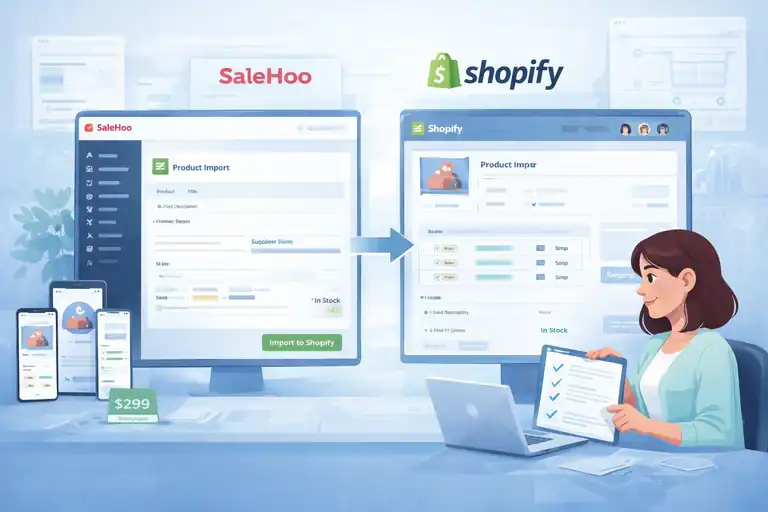
SaleHoo integrates directly with Shopify to simplify product importing and supplier syncing.
This is where convenience starts to matter more than raw data.
Connecting SaleHoo With Shopify For Product Imports
The Shopify integration allows you to import products directly into your store with basic details like:
- Product title and description
- Pricing and variants
- Supplier inventory status
For a beginner, this removes a lot of friction. You’re not copying product data manually or worrying about formatting errors. It’s not perfect, but it’s clean enough to launch faster.
Import Limits And Automation Restrictions Explained
Automation is limited by design.
Depending on your plan:
- Starter users can import up to 200 products per month
- Pro users can import up to 600 products
- Enterprise users have custom limits
Inventory syncing works, but pricing automation is basic. You’ll still need to:
- Adjust pricing strategies manually
- Optimize product descriptions
- Manage promotions inside Shopify
If you’re expecting full autopilot, this isn’t it. If you’re expecting guided simplicity, it delivers.
Multi-Store Support And Team Access Considerations
SaleHoo supports multiple Shopify stores on higher plans, which is useful if you’re testing niches.
What this enables:
- Separate stores for different product categories
- Team members accessing the same account
- Cleaner experimentation without overlap
That said, team features are functional, not advanced. Think collaboration, not enterprise-level workflow automation.
How Much Manual Work Is Still Required
This is the honest part.
You will still need to:
- Edit product pages for conversions
- Handle customer support
- Communicate with suppliers directly
- Optimize shipping expectations
SaleHoo reduces setup friction, but it doesn’t replace business ownership. In my experience, that’s a good thing. Tools that promise zero effort usually hide bigger problems later.
Education, Courses, And Community Support Value
Education is an underrated part of the is SaleHoo worth it conversation. Tools are only useful if you know how to use them without sabotaging yourself.
Dropshipping On Shopify Course Usefulness For Beginners
SaleHoo’s Dropshipping on Shopify course is clearly built for beginners.
It covers:
- Store setup basics
- Supplier communication
- Pricing fundamentals
- Order fulfillment workflows
What I appreciate is that it doesn’t oversell results. There’s no “six figures in 30 days” nonsense. It focuses on fundamentals, which is exactly what most beginners skip and later regret.
Amazon Product Launch Training And Its Practical Value
The Amazon product launch course is more niche but still useful.
It focuses on:
- Product selection for Amazon
- Listing optimization basics
- Early launch strategies
It’s not a replacement for advanced Amazon tools, but it helps beginners understand how Amazon differs from Shopify. If you’re cross-platform curious, it adds value without extra cost.
SaleHoo Seller Community And Support Accessibility
SaleHoo gives access to an active seller community and responsive support.
Support highlights:
- Live chat and email support
- Beginner-friendly responses
- Clear documentation
Community access matters more than people think. Seeing other beginners ask the same questions you’re afraid to ask quietly reduces friction and self-doubt.
Learning Gaps New Sellers Should Be Aware Of
SaleHoo doesn’t teach:
- Advanced paid ads scaling
- Conversion rate optimization at scale
- Brand-building beyond basics
That’s not a flaw; it’s a boundary. SaleHoo helps you get started without stepping on landmines. Beyond that, you’ll need specialized tools and education.
Real Pros And Cons That Affect New Seller Success
This is where the is SaleHoo worth it question gets practical. Tools don’t fail people—misaligned expectations do.
Let’s talk about what actually helps beginners move forward, and what quietly slows them down.
Advantages That Make SaleHoo Beginner-Friendly
SaleHoo shines when you’re early and unsure. It removes several high-risk steps that usually trip people up.
Key advantages I see beginners benefit from:
- Access to pre-vetted suppliers, which dramatically lowers scam risk
- Clear product demand indicators instead of hype-driven guesses
- Simple workflows that don’t require technical experience
- Predictable costs with no surprise upsells
One underrated benefit is confidence. When you’re not second-guessing every supplier email or product decision, you move faster. Speed matters early on—not to scale fast, but to learn faster.
I’ve watched new sellers stall for months because they’re afraid of making the “wrong” choice. SaleHoo doesn’t guarantee success, but it reduces fear-based paralysis.
Drawbacks That Can Slow Early Progress
SaleHoo also has limitations that aren’t always obvious upfront.
Common drawbacks include:
- Limited automation compared to newer dropshipping tools
- Manual supplier communication still required
- Product data that favors stability over trend velocity
If you’re someone who expects plug-and-play income, you’ll feel frustrated. SaleHoo requires participation. You still need to think, test, and adjust.
That said, I’d rather see a beginner slowed by learning than sped up into expensive mistakes.
Hidden Friction Points Not Obvious On Sales Pages
Here’s the honest stuff that doesn’t make it into marketing copy:
- Some suppliers respond slowly, even when vetted
- Minimum order quantities may appear late in conversations
- Branding control is limited with many dropship suppliers
None of this is unique to SaleHoo, but it surprises people who expect instant execution. Think of SaleHoo as a filtered starting line, not a finished system.
Situations Where SaleHoo Saves Time Versus Costs It
SaleHoo saves time when:
- You’re validating product ideas
- You want safer supplier outreach
- You’re learning how sourcing works
It costs time when:
- You need advanced automation
- You’re scaling paid ads aggressively
- You already have supplier relationships
Used at the right stage, it’s efficient. Used too late, it feels restrictive.
SaleHoo Compared To Other Supplier Research Tools
Comparisons matter because value is relative. SaleHoo isn’t trying to be everything, so let’s look at where it stands against common alternatives.
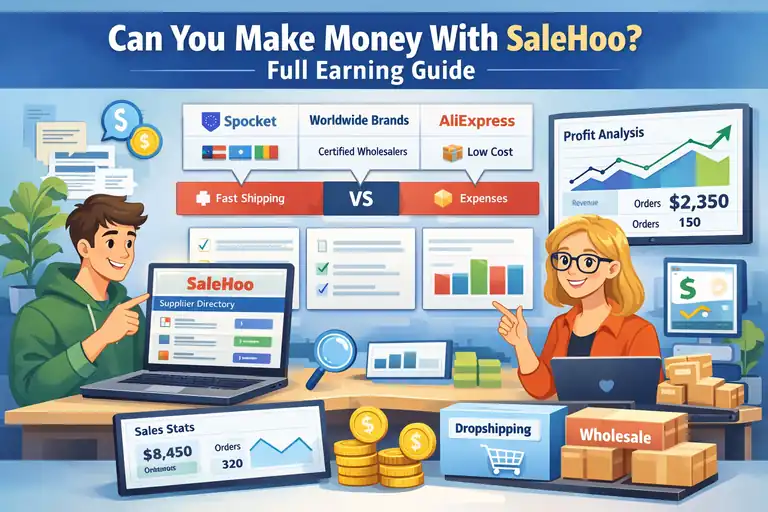
SaleHoo Versus Spocket For Dropshipping Reliability
Spocket focuses heavily on fast-shipping suppliers, mainly from the US and EU. SaleHoo focuses on supplier legitimacy and breadth.
Quick comparison:
| Feature | SaleHoo | Spocket |
| Supplier vetting | Yes | Yes |
| Shopify integration | Yes | Yes |
| Fast domestic shipping | Limited | Strong |
| Product research depth | Moderate | Light |
| Beginner learning resources | Strong | Minimal |
If shipping speed is your top priority, Spocket wins. If supplier trust and research matter more, SaleHoo feels safer.
SaleHoo Versus Zendrop For Automation And Speed
Zendrop is built for speed and automation. SaleHoo is built for decision-making.
Zendrop excels at:
- Automated order fulfillment
- Faster supplier communication
- Simplified workflows
SaleHoo excels at:
- Supplier research
- Product validation
- Long-term sourcing flexibility
Zendrop feels like driving automatic. SaleHoo feels like learning manual. One is easier early, the other teaches you more.
SaleHoo Versus AliExpress Research-Only Workflows
AliExpress is free, but expensive in other ways.
Problems beginners hit with AliExpress:
- Inconsistent product quality
- Fake reviews and inflated metrics
- High refund and dispute rates
SaleHoo doesn’t remove all risk, but it reduces chaos. For most beginners, that tradeoff is worth paying for.
When SaleHoo Is The Better Long-Term Choice
SaleHoo becomes the better option when:
- You plan to move from dropshipping to wholesale
- You want supplier relationships, not just transactions
- You value learning sourcing fundamentals
It’s less about speed and more about foundation.
Is SaleHoo Worth It For New Sellers Starting Today
Let’s answer the question directly, without hype or hedging.
Best-Case Scenarios Where SaleHoo Delivers Strong ROI
SaleHoo delivers strong value when:
- You’re starting from zero and want fewer mistakes
- You’re cautious with ad spend
- You want repeatable sourcing skills
I’ve seen beginners recoup their cost simply by avoiding one bad supplier or one failed product launch.
Common Beginner Mistakes When Using SaleHoo
Mistakes I see repeatedly:
- Treating supplier listings as guarantees
- Importing too many products too fast
- Skipping supplier conversations
- Expecting automation to replace thinking
SaleHoo works best when you use it as a guide, not a crutch.
Who Will See The Most Value From Each Pricing Tier
Starter plan fits:
- First-time sellers
- Single-store testing
- Low-risk experimentation
Pro plan fits:
- Multi-store testers
- Small teams
- Sellers validating multiple niches
Enterprise fits:
- Time-poor founders
- Managed growth scenarios
- Businesses with capital but limited bandwidth
Final Verdict Based On Goals, Budget, And Experience
So, is SaleHoo worth it?
If you’re new, cautious, and serious about learning how sourcing actually works, yes—it’s worth it. Not because it promises success, but because it helps you avoid preventable failure.
If you want speed, automation, and trend chasing, it will feel slow. But if you want a calmer, more controlled path into eCommerce, SaleHoo earns its place.
My honest take: it’s not the fastest way to start—but it’s one of the safer ones.
FAQ
Is SaleHoo Worth It For Beginners With No Experience?
Yes, SaleHoo is worth it for beginners who want a safer, more structured way to start dropshipping or wholesale. It helps reduce common early mistakes by providing vetted suppliers, basic product research, and beginner-friendly guidance, which is often more valuable than advanced automation at this stage.
Is SaleHoo Better Than Using AliExpress For Dropshipping?
For most new sellers, yes. SaleHoo offers better supplier vetting, fewer scam risks, and more reliable communication compared to AliExpress. While AliExpress is free, SaleHoo can save time and money by preventing quality issues, refunds, and supplier headaches early on.
Who Should Not Use SaleHoo?
SaleHoo is not ideal for advanced sellers who already have supplier relationships, need heavy automation, or rely on fast-moving trend products. If your focus is aggressive scaling with paid ads or fully automated fulfillment, other tools may be a better fit.

I’m Juxhin, the voice behind The Justifiable.
I’ve spent 6+ years building blogs, managing affiliate campaigns, and testing the messy world of online business. Here, I cut the fluff and share the strategies that actually move the needle — so you can build income that’s sustainable, not speculative.
Related posts:
 Is SaleHoo Legit? What Real Sellers Actually Discover
 Dropshipping Business Model Success: Tips for Long-Term Growth
 Viral Launch Chrome Extension: The Ultimate Tool for Sellers
 Start Dropshipping Today: A Simple Guide for Complete Beginners
 Salehoo Directory Free: What You Can Access Without Paying
 Can You Make Money With SaleHoo? Full Earning Guide