
Table of Contents
Some links on The Justifiable are affiliate links, meaning we may earn a small commission at no extra cost to you. Read full disclaimer.
Cross border e commerce has opened up incredible opportunities for small sellers to reach a global audience. Gone are the days when only large corporations could dominate international markets.
Today, small businesses have the tools and platforms to connect with customers from virtually anywhere, creating exciting possibilities for growth and expansion. But how exactly do small sellers go global?
It takes more than just setting up an online store. From understanding international regulations to optimizing for global buyers, there’s a lot to navigate. In this article, we’ll explore how small sellers can successfully tap into cross-border e-commerce and make their mark on the global stage.
What Is Cross-Border E-Commerce and Why Does It Matter?
Cross-border e-commerce is simply about selling online to customers who live in other countries.
For small sellers, this isn’t just a growth tactic anymore. It’s often the difference between hitting a ceiling locally and unlocking entirely new demand globally.
Understanding the Basics of Cross-Border E-Commerce
At its core, cross border e commerce means your products, payments, shipping, and customer experience cross national borders. That sounds obvious, but the details matter more than people expect.
When you sell internationally, you’re dealing with different currencies, delivery expectations, tax rules, and buyer trust signals.
A shopper in Germany may expect bank transfers, while a buyer in the U.S. expects cards and fast returns. Neither is wrong. They’re just different.
Here’s how I usually explain it to sellers:
- You’re not “adding countries”
- You’re adapting your business model market by market
Cross border e commerce works best when you think in systems. Orders, payments, shipping, and support all need to function smoothly without you manually fixing things every day. If one part breaks, customers feel it immediately.
From what I’ve seen, sellers who treat international orders as rare exceptions struggle. Sellers who design for international buyers from day one tend to scale calmly, not chaotically.
The Importance of Expanding to Global Markets
The biggest reason cross-border e-commerce matters is demand imbalance. Some products are oversaturated locally but scarce elsewhere.
I’ve worked with sellers who struggled to sell niche products domestically, then doubled revenue after discovering overseas buyers were actively searching for them. That’s not luck. It’s market mismatch.
A few practical reasons global expansion makes sense:
- Smaller countries often import instead of manufacture
- Purchasing power varies, allowing better margins
- Seasonality flips between hemispheres
According to Shopify data, international shoppers spend up to 20–30% more per order when buying cross-border, largely due to limited local alternatives. That alone can change your profit math.
Cross border e commerce also spreads risk. If one market slows down due to economic or platform changes, others can stabilize your revenue. I believe this diversification is one of the most underrated benefits for small sellers.
Key Differences Between Domestic and International E-Commerce
Domestic e-commerce is predictable. International e-commerce is negotiable. That’s the simplest way I can put it.
Key differences show up fast:
- Delivery timelines are longer and less precise
- Returns are more expensive and slower
- Trust must be earned faster
International buyers ask different questions. They care about customs fees, delivery tracking, and whether your brand feels legitimate from thousands of miles away.
One mistake I see often is assuming international customers behave the same way local ones do. They don’t. They’re more cautious, but also more loyal once trust is built.
If you respect these differences and plan for them early, cross border e commerce stops feeling risky and starts feeling structured.
Identifying the Best Markets for Your Products
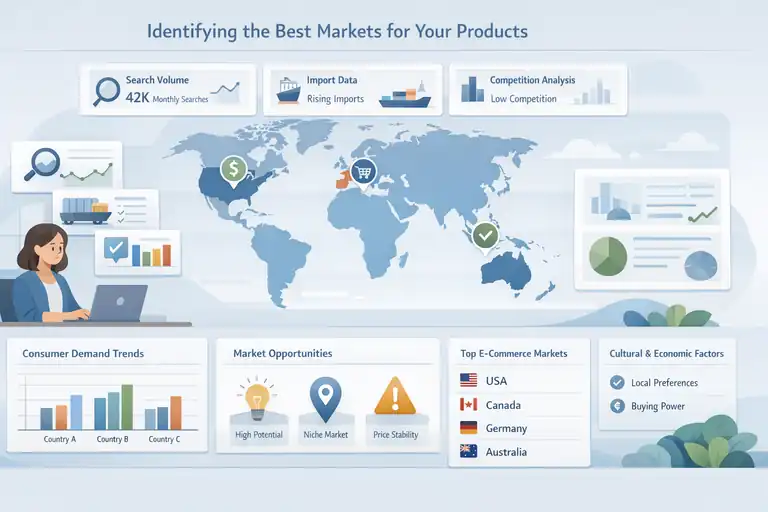
Not every product should be sold everywhere. Smart cross border e commerce starts with choosing the right markets, not the most obvious ones.
Researching Global Consumer Demand for Your Products
Demand research isn’t about guessing. It’s about observing behavior at scale.
I usually recommend starting with three signals:
- Search behavior
- Existing import activity
- Marketplace competition gaps
If people are already searching for your product in another country, that’s intent. If they’re importing similar items, that’s validation. If competition is weak or overpriced, that’s opportunity.
A practical approach:
- Look for countries where your product solves a specific problem
- Prioritize markets where local alternatives are limited
- Avoid markets where price competition is extreme
Cross border e commerce works best when you’re slightly early, not late. You don’t need massive demand. You need consistent unmet demand.
Top Global E-Commerce Markets for Small Sellers
Some markets are simply more welcoming to small international sellers. Not because they’re easier, but because buyers are already comfortable buying from abroad.
Based on what I’ve seen repeatedly:
- The United States remains strong for niche and premium goods
- Canada has high trust and lower competition than the U.S.
- Australia relies heavily on imports
- Parts of Western Europe value quality over speed
Emerging markets can be attractive, but logistics and payment friction can slow you down early. I usually suggest starting with one mature market, learning fast, then expanding.
Cross border e commerce isn’t about being global instantly. It’s about stacking wins market by market.
Tools for Identifying High-Value Markets
This is one area where tools genuinely save time and reduce guesswork.
Popular options sellers use include:
- Google Trends for regional search interest comparisons
- Marketplace analytics to see where competitors ship most
- Keyword research platforms to spot international demand gaps
The key is not the tool itself, but how you interpret the data. A spike in searches without buying power won’t help you. Moderate demand with strong purchasing habits will.
I suggest comparing at least three countries side by side before choosing one. Patterns become obvious when you zoom out.
Evaluating Cultural and Economic Differences
Culture impacts conversion more than most sellers expect.
Small details matter:
- Product imagery preferences
- Tone of copy
- Pricing psychology
For example, some markets respond better to detailed specifications, while others buy emotionally. Some trust brands with certifications. Others trust social proof.
Economic factors also shape expectations. Shipping costs that feel normal in one country feel outrageous in another.
My rule of thumb:
- If a market requires heavy education, slow down
- If a market already understands your product, move faster
Cross border e commerce rewards cultural curiosity. The more you observe instead of assume, the better your results.
Navigating Legal and Regulatory Challenges in Cross-Border E-Commerce
Legal complexity scares many small sellers away from cross-border e-commerce. That fear is understandable, but often exaggerated when broken down properly.
Understanding Customs, Duties, and Taxes in Different Countries
Customs and taxes are not random fees. They’re structured systems, even if they feel confusing at first.
Most countries charge:
- Import duties based on product category
- Value-added tax or sales tax
- Processing or handling fees
The biggest mistake sellers make is ignoring these costs in pricing. When customers are surprised with fees at delivery, trust collapses instantly.
I’ve found that transparency beats cheap pricing. Clearly stating potential fees upfront reduces refunds and angry emails later.
Start by learning:
- De minimis thresholds (tax-free limits)
- Typical duty rates for your product category
- Who is responsible for payment: you or the buyer
Once you know that, the fear drops significantly.
Complying with International E-Commerce Laws and Regulations
Every country has rules about what can be sold, how it’s labeled, and how customer data is handled.
Common areas sellers overlook:
- Product safety and labeling standards
- Consumer protection and refund rights
- Data privacy requirements
You don’t need to become a legal expert. You need awareness and boundaries. If a product category is heavily regulated, think twice before expanding there early.
From my experience, starting with low-risk product categories makes cross-border e-commerce far smoother. Complexity can come later, once revenue justifies it.
Protecting Your Business from Cross-Border Legal Risks
Risk management isn’t about eliminating risk. It’s about limiting exposure.
Practical steps that help:
- Clear terms and conditions written for international buyers
- Documented shipping and refund policies
- Accurate product descriptions to avoid disputes
Chargebacks and disputes increase when expectations aren’t managed. Most legal issues I’ve seen weren’t lawsuits. They were preventable misunderstandings.
If you communicate clearly and operate honestly, cross-border e-commerce becomes far less intimidating than it appears from the outside.
Pro tip: If you’re just starting with cross-border e-commerce, choose one product and one country. Learn deeply, fix the cracks, and only then expand. Going slow at the beginning is often the fastest path to going global.
Setting Up Global Shipping and Logistics for Your E-Commerce Business
Shipping is where cross-border e-commerce either becomes smooth and scalable or painfully stressful.
This section focuses on building a shipping setup that works internationally without draining margins or your sanity.
Choosing the Right Shipping Partners for International Delivery
Choosing shipping partners is less about speed and more about reliability and consistency. In cross-border e-commerce, a predictable 8-day delivery often beats a promised 3-day delivery that turns into 12.
From what I’ve seen, sellers run into trouble when they optimize for the cheapest option first. Cheap shipping that causes delays, lost packages, or poor tracking quickly becomes expensive through refunds and chargebacks.
When evaluating shipping partners, I suggest looking at:
- Delivery consistency across multiple regions
- End-to-end tracking availability
- Clear processes for customs clearance
A practical scenario I’ve seen work well is splitting shipping methods by order value. Lower-value orders can tolerate slower delivery, while higher-value orders justify premium shipping. This simple tiering alone can protect margins without hurting customer experience.
Another overlooked factor is how shipping partners handle exceptions. Delays happen. What matters is how fast issues are resolved and communicated.
Tips for Managing International Shipping Costs
International shipping costs feel intimidating because they stack quickly. But most sellers overpay due to poor structure, not bad rates.
Here’s how I usually break it down:
- Separate shipping cost from product cost internally
- Test flat-rate shipping instead of real-time pricing
- Build shipping buffers into product pricing
Flat-rate shipping works surprisingly well in cross-border e-commerce. Customers prefer clarity over precision. A slightly higher flat rate often converts better than variable pricing that changes at checkout.
Packaging also matters more than people think. Reducing package size by even a small amount can drop costs across thousands of orders annually. I’ve seen sellers save five figures just by redesigning packaging.
If you feel shipping costs are killing margins, don’t panic. Usually, there’s inefficiency hiding in plain sight.
Streamlining Cross-Border Logistics with Third-Party Services
As order volume grows, manual logistics stop scaling. This is where third-party logistics services come in, meaning external companies that store, pack, and ship orders for you.
The real benefit here isn’t speed. It’s mental space.
Third-party logistics can:
- Reduce handling errors
- Shorten delivery times in key regions
- Simplify returns processing
A common setup is placing inventory closer to international customers instead of shipping every order from one country. This lowers delivery times and customs friction dramatically.
That said, I don’t recommend outsourcing logistics too early. If you’re still validating demand, stay lean. Once international orders become consistent, outsourcing stops being a luxury and starts being operational insurance.
Optimizing Your Online Store for Global Audiences
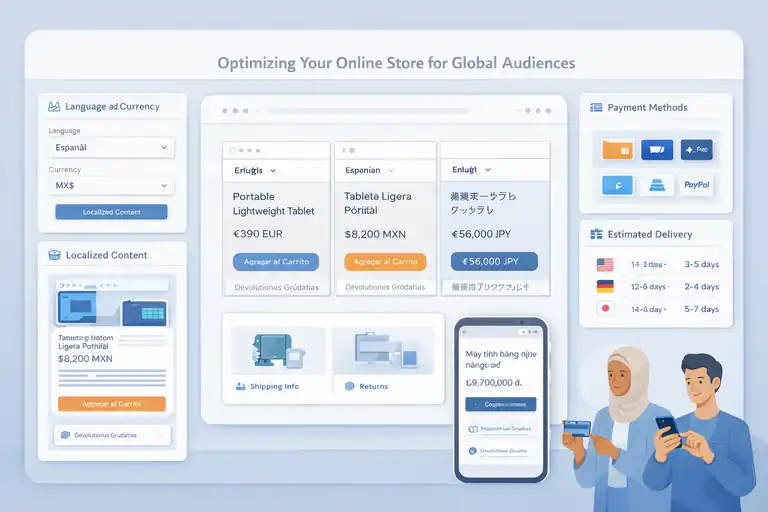
A global store isn’t just a translated version of a local one. Optimizing for international buyers means reducing friction at every decision point.
Adapting Your Website for Different Languages and Currencies
Language isn’t just words. It’s confidence.
International buyers are far more likely to purchase when pricing and content feel native. Even partial localization, like currency display and key page translations, can improve conversion rates significantly.
In practice, focus first on:
- Product pages
- Checkout pages
- Shipping and returns information
You don’t need to translate everything perfectly. Clear, simple language beats complex, poorly translated copy every time.
Currency display is equally important. Asking customers to mentally convert prices introduces hesitation. When buyers see familiar pricing formats, they move faster.
I’ve seen conversion rates increase by over 20 percent simply by showing local currency and estimated delivery times upfront.
Building Trust with International Buyers Through Payment Options
Payment trust is one of the biggest blockers in cross-border e-commerce.
International shoppers often abandon carts not because they want different payment methods, but because they fear fraud, hidden fees, or failed transactions.
What builds trust:
- Clear total cost before checkout
- Familiar payment experiences
- Transparent refund policies
From my experience, buyers are more forgiving of slower shipping than confusing payments. If payment feels risky, the sale dies immediately.
Think of payment as reassurance, not just a transaction step. Every signal that says “this is safe” increases your chances of conversion.
Ensuring a Seamless Mobile Shopping Experience for Global Shoppers
Most international shopping happens on mobile devices. This isn’t a trend. It’s the default.
Mobile optimization isn’t just responsive design. It’s about minimizing effort:
- Shorter forms
- Faster page loads
- Clear call-to-action buttons
Global shoppers often browse during commutes or short breaks. If your site loads slowly or feels cluttered, they won’t wait.
I always suggest testing your store on a mid-range phone with slower internet. If it feels frustrating to you, it’s worse for your customers.
Small improvements here compound fast in cross-border e-commerce.
Marketing Strategies for Cross-Border E-Commerce Success
Marketing internationally isn’t about shouting louder. It’s about speaking more clearly to the right audience.
Leveraging Social Media to Target Global Audiences
Social media works globally, but behavior changes by region.
What performs well in one country may flop in another due to humor, tone, or cultural context. The mistake I see often is reusing the same creative everywhere.
A better approach:
- Observe what content already performs locally
- Adapt messaging, not just language
- Focus on storytelling over promotion
Short-form content tends to travel best across borders because it requires less context. Educational or behind-the-scenes content often outperforms direct sales messaging internationally.
Utilizing Local Influencers and Partnerships to Build Credibility
Trust transfers faster through local voices.
Partnering with local creators or businesses instantly reduces skepticism. Buyers trust people who understand their culture, language, and expectations.
This doesn’t mean chasing big names. Smaller, niche creators often drive higher engagement and better conversion.
I’ve seen modest partnerships outperform paid ads simply because they felt authentic. Credibility compounds quickly when it’s borrowed locally.
Effective International SEO Techniques for Better Global Visibility
International SEO is about relevance, not volume.
Instead of chasing broad keywords, focus on:
- Country-specific search intent
- Local phrasing variations
- Product-led content
Search behavior differs across regions. The same product may be searched with different words or priorities.
A smart move is creating dedicated content for each market instead of forcing one global page to rank everywhere. It takes more effort, but the payoff is sustainable traffic.
Cross-border e-commerce grows fastest when marketing respects local context while staying operationally simple.
Best practice: Pick one international market and optimize shipping, store experience, and marketing fully for that audience before expanding. Depth beats breadth every time when going global.
Handling Customer Service Across Borders
Customer service is where cross-border e-commerce either earns long-term loyalty or quietly loses repeat buyers.
When people shop internationally, they expect a little friction, but they don’t forgive confusion or silence.
Providing Multilingual Customer Support
You don’t need to support every language perfectly to serve global customers well. What you need is clarity and empathy.
Most international buyers are comfortable reading basic English, but they want reassurance when something goes wrong. Even partial localization, like translated FAQs or order updates, can reduce support tickets dramatically.
Here’s what tends to work in practice:
- Translate your most common support questions first
- Use simple language instead of complex phrasing
- Avoid slang or region-specific expressions
I’ve seen sellers reduce refund requests simply by rewriting support replies in clearer, friendlier language. It’s not about fluency. It’s about removing uncertainty.
A real-world example: One seller selling apparel internationally noticed sizing complaints from non-English-speaking buyers. Adding a visual size guide with measurements, not just words, cut complaints almost in half.
Cross-border e-commerce customer support works best when you anticipate confusion instead of reacting to it.
Managing Time Zone Differences for Global Customer Service
Time zones are unavoidable. Ignoring them is optional.
International customers don’t expect instant replies, but they do expect acknowledgment. Even a short confirmation message can buy you time and goodwill.
Practical ways to manage time zones:
- Set clear response-time expectations on your site
- Group support replies into dedicated time blocks
- Prioritize order-related issues over general questions
I suggest framing response times in hours, not days. Saying “We reply within 24 hours” feels far more reassuring than “1–2 business days,” especially across borders.
From my experience, consistency matters more than speed. If customers know when to expect a reply, they’re far more patient.
Best Practices for Handling International Returns and Refunds
Returns are the hardest part of cross-border e-commerce, emotionally and financially.
International returns cost more, take longer, and create frustration on both sides. The goal isn’t to eliminate returns, but to control them.
Best practices that actually help:
- Make return eligibility very clear upfront
- Offer refunds without return for low-value items
- Use store credit instead of cash refunds where possible
I’ve seen sellers protect margins by refunding inexpensive items without requiring return shipping. Customers feel taken care of, and the seller avoids higher logistics costs.
Transparency is key. When buyers know exactly what to expect, they’re less likely to escalate issues.
Overcoming Common Challenges for Small Sellers in Cross-Border E-Commerce
Cross-border e-commerce comes with challenges, but most of them are operational, not existential. Once you name them clearly, they become manageable.
Dealing with Payment and Currency Issues
Currency confusion kills conversions faster than most sellers realize.
International buyers hesitate when they don’t understand final pricing or fear hidden charges. Even small surprises at checkout can lead to abandonment.
What helps reduce friction:
- Show total cost as early as possible
- Be upfront about conversion or foreign fees
- Keep pricing consistent across regions
In my experience, customers are less price-sensitive than they are trust-sensitive. If they feel misled, they leave. If they feel informed, they often proceed.
Cross-border e-commerce works best when pricing feels stable and predictable, even if it’s slightly higher.
Managing International Competition and Pricing Strategies
International competition isn’t always cheaper. It’s often just different.
Small sellers get stuck racing to the bottom when they shouldn’t. Competing on price alone is risky, especially when shipping and support costs vary by region.
Smarter pricing strategies include:
- Emphasizing product quality or uniqueness
- Bundling products to increase order value
- Adjusting pricing by market, not globally
I’ve seen sellers succeed by being premium in one country and mid-range in another. There’s nothing unethical about that. It’s market reality.
Cross-border e-commerce rewards positioning, not imitation.
Scaling Your Business While Maintaining Quality and Efficiency
Scaling internationally exposes weaknesses fast. Manual processes that worked locally start breaking under volume.
The key is simplifying before expanding.
Focus on:
- Standardizing workflows
- Reducing custom exceptions
- Documenting repeatable processes
One seller I worked with paused expansion for three months just to clean up internal processes. When they resumed, growth was smoother and less stressful.
I believe sustainable cross-border e-commerce growth isn’t about moving fast. It’s about moving deliberately.
Expert tip: If cross-border e-commerce feels overwhelming, zoom in instead of pulling back. Fix one friction point at a time. Momentum comes from progress, not perfection.

I’m Juxhin, the voice behind The Justifiable.
I’ve spent 6+ years building blogs, managing affiliate campaigns, and testing the messy world of online business. Here, I cut the fluff and share the strategies that actually move the needle — so you can build income that’s sustainable, not speculative.
Related posts:
 Headless Ecommerce Platform: Is It the Faster Way to Scale?
 Ecommerce CRM Tools That Turn Customers Into Repeat Buyers
 Online Store Website Builder That Helps You Sell Fast
 Starting an Ecommerce Business: A Realistic Step-By-Step Guide
 Salehoo Directory Free: What You Can Access Without Paying
 Why the Salehoo Wholesale Directory Helps You Scale