
Table of Contents
Some links on The Justifiable are affiliate links, meaning we may earn a small commission at no extra cost to you. Read full disclaimer.
Klaviyo vs Omnisend for Shopify is one of those comparisons that looks simple at first, then gets surprisingly expensive if you choose wrong.
I’ve seen store owners pick based on brand reputation, only to realize later they needed easier automation, better support, or a lower monthly bill. The truth is that both platforms can drive strong email and SMS revenue on Shopify, but they do it differently.
Klaviyo usually wins on depth, segmentation, and data flexibility, while Omnisend often wins on simplicity, faster setup, and value for smaller teams. The better converter depends on your store stage, margin, and marketing maturity.
What Klaviyo and Omnisend actually do for a Shopify store
Both tools sit between your Shopify customer data and your marketing channels. They help you collect subscribers, segment shoppers, trigger automations, send campaigns, and track attributed revenue.
For Shopify merchants specifically, both platforms support core ecommerce flows such as welcome sequences, abandoned cart, browse abandonment, back-in-stock, and promotional sends.
Klaviyo’s Shopify app also leans heavily into real-time data activation and broader channel coverage, while Omnisend emphasizes fast-launch automation and merchant-friendly usability.
How each platform fits into the Shopify customer journey
If you strip away the marketing jargon, both platforms do the same essential job: they help you talk to the right shopper at the right time.
A visitor joins your list through a popup, abandons a cart, buys once, or browses a collection twice. The platform sees that behavior and sends the next message automatically.
Here is where the difference starts to matter.
- Klaviyo’s approach: It is built around richer customer data and more flexible segmentation. Klaviyo highlights real-time Shopify sync, AI-powered segments, more than 350 integrations, and wider channel options including email, SMS, WhatsApp, mobile push, pop-ups, and service-oriented tools like Customer Hub and Customer Agent.
- Omnisend’s approach: It focuses on getting ecommerce automations live quickly. Omnisend’s Shopify listing emphasizes one-click abandoned cart and welcome flows, popups, spin-to-win forms, product recommendations, web push, and 160+ tested integrations.
In practice, I’d describe it like this: Klaviyo feels like a more customizable growth engine, while Omnisend feels like a faster “get revenue moving” system.
If you run a lean Shopify store with limited time, that difference matters. Imagine a founder doing everything alone. Omnisend may get them from zero to working automation faster.
But if you already care about lifecycle stages, predictive targeting, or complex customer behavior, Klaviyo usually gives you more room to grow.
Why “which one converts better” is not one universal answer
This is the part many comparison articles skip, and I think it is the most important one.
No platform converts better in a vacuum. The platform that converts better is the one your team can actually use well. A more advanced tool does not automatically produce more sales. It produces more potential.
A simple example: a small apparel brand with 2,000 contacts and no dedicated email marketer may outperform itself on Omnisend because the team launches faster, builds cleaner flows, and keeps campaigns consistent.
Meanwhile, an established beauty brand with high repeat purchase behavior and multiple product categories may unlock more revenue in Klaviyo because tighter segmentation leads to more relevant offers.
That is why you should judge both tools across three layers:
- Speed to implementation: How quickly can you launch revenue-driving automations?
- Depth of personalization: How precisely can you target by behavior, order history, and engagement?
- Operational fit: Will your team actually maintain the account well each month?
From what I’ve seen, Omnisend often wins layer one. Klaviyo often wins layer two. Layer three depends entirely on your team.
Pricing, channels, and support differences that matter in real life
This is where many Shopify merchants make the decision, and honestly, I get it. Software costs stack up fast. Both platforms offer free plans, but the economics start changing as your list grows and as you add SMS.
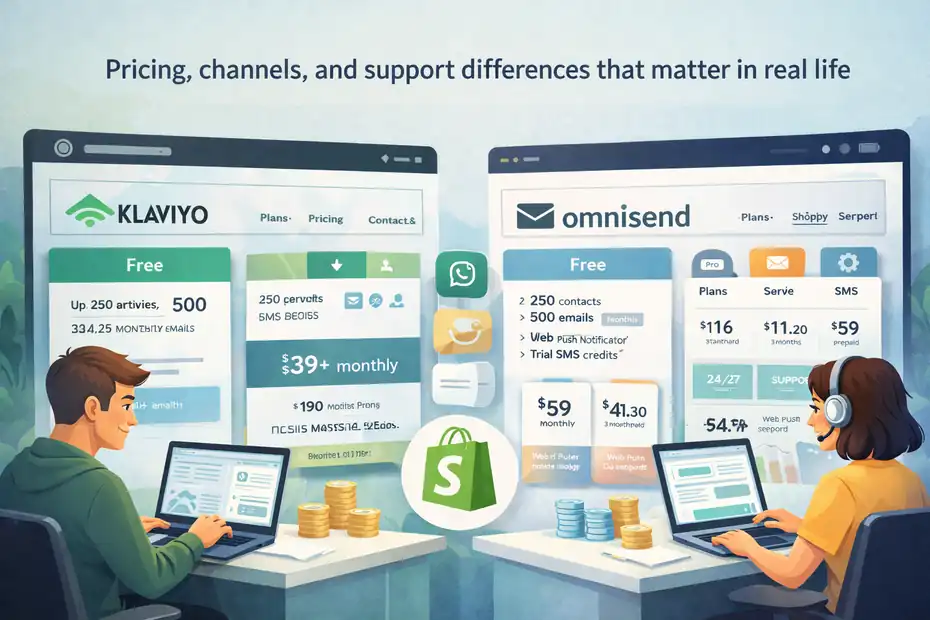
Klaviyo’s free plan includes up to 250 active profiles, 500 emails per month, and 150 mobile message credits. Omnisend’s free plan also includes 250 contacts and 500 emails per month, plus 500 web push notifications and about $1 in SMS credits to try.
Omnisend’s Standard plan is listed at $16 per month billed monthly, or $11.20 for the first 3 months when prepaid, while its Pro plan is $59 per month billed monthly, or $41.30 for the first 3 months when prepaid.
Klaviyo’s pricing page emphasizes the free tier, and official Klaviyo sources also state paid email plans start at $20 per month.
Which one is more affordable as your Shopify list grows
For early-stage stores, Omnisend usually looks friendlier on paper and in practice.
Its pricing page is unusually clear about what you get at entry level: 250 contacts, 500 emails, web push, and trial SMS credits on free, then 500 contacts and 6,000 emails on Standard, with 24/7 support available even on free.
That matters because support is not a “nice to have” when your abandoned cart flow breaks on a Friday night.
Klaviyo also gives you a useful free plan, but many merchants feel the cost ramps sooner once active profiles grow. That is partly because Klaviyo pricing is closely tied to profile count and paid email plans commonly start at $20.
Klaviyo’s own support article also explains plans are billed monthly and tied to product selections, so budgeting gets more important as you add channels and scale.
My take is simple:
- Choose Omnisend for budget efficiency if you are under pressure to launch email and SMS without adding a large software bill immediately.
- Choose Klaviyo for leverage if you know you will use advanced segmentation, broader channels, and more detailed reporting enough to justify higher spend.
A cheap platform that you outgrow in six months is not really cheap. But an expensive platform you barely use is even worse.
Channel mix, support, and ecosystem strength
On Shopify, channels matter because conversion is rarely just one email. It is usually a mix of popup capture, welcome email, cart reminder, maybe an SMS nudge, and sometimes retargeting or on-site personalization.
Klaviyo’s Shopify listing highlights email, SMS, WhatsApp, mobile push, pop-ups, AI-powered segmentation, and service tools tied to the customer journey.
It also says Klaviyo works with 350+ integrations and is used by more than 117,000 brands through its Shopify setup. That points to a wider ecosystem and more flexibility for brands with a growing stack.
Omnisend supports email, SMS, push notifications, landing pages, forms, checkout-related automations, and 160+ tested integrations. For many Shopify stores, that is more than enough. Omnisend also makes a strong support case by offering 24/7 email and live chat support even to free users.
If I had to simplify this choice:
- Klaviyo: Better for stores building a more advanced retention system.
- Omnisend: Better for stores that want a capable all-in-one ecommerce tool with lower friction.
Which one converts better for Shopify email and SMS
Here is the honest answer: Klaviyo usually has the higher ceiling for conversion rate optimization, but Omnisend often has the faster path to first wins. That distinction is huge. Klaviyo brings deeper segmentation, richer analytics, and more flexible automation logic.
Omnisend brings easier setup, strong ecommerce templates, built-in forms, and quick-launch flows that help merchants get revenue from email and SMS without a heavy learning curve.
Klaviyo also cites benchmarks showing abandoned cart automations can generate an average $3.65 revenue per recipient versus $0.11 for standard email campaigns, which reinforces how much automated relevance matters in ecommerce.
Email conversion: where Klaviyo often pulls ahead
When email conversion depends on segmentation quality, Klaviyo usually becomes the stronger tool.
Why? Because conversion does not just come from sending prettier campaigns. It comes from sending more relevant campaigns. Klaviyo is very good at building audiences around purchase history, browsing behavior, engagement level, product interest, and lifecycle timing. If you sell across multiple categories, this gets powerful quickly.
Imagine a Shopify store selling skincare. A generic campaign saying “20% off everything” may do fine. But a segmented campaign to customers who bought cleansers but not moisturizers, excluding buyers from the past 14 days and personalizing by skin concern, is a different level of targeting. That kind of precision tends to lift click rate and lower unsubscribes.
Klaviyo’s reputation in the Shopify ecosystem reflects that. Shopify review summaries repeatedly mention analytics, segmentation, and automation depth as standout strengths.
That said, advanced power only helps when you use it. If your team sends broad newsletters and basic automations, you may never touch the features that make Klaviyo worth paying more for. In that case, you are buying unused complexity.
So for email conversion, my opinion is this: Klaviyo wins when your strategy is mature enough to exploit customer data, not just broadcast promotions.
SMS and omnichannel conversion: where Omnisend can win faster
SMS usually works best when it is tightly connected to email timing, promotions, and subscriber capture. Omnisend does a good job here because it is built for ecommerce marketers who want these channels connected without building a complicated system first.
Its Shopify app listing emphasizes one-click flows, product recommendations, popups, AI-generated content, and push notifications. That combination can be enough for a growing Shopify brand to launch a practical omnichannel setup very quickly.
A founder can install it, enable capture forms, turn on abandoned cart and welcome flows, and start collecting attributable revenue in days rather than weeks.
There is also a budget argument. Omnisend’s Pro plan includes monthly bonus SMS credits equal to the plan price, which can make omnichannel sending feel more predictable for brands actively using text.
I would not say Omnisend is “better at SMS” in every technical sense. I would say it often gets more Shopify merchants to a working, profitable SMS program faster.
That is an important difference because the best automation is not the most sophisticated one. It is the one that actually goes live.
How to choose based on your store size, margin, and team
You do not need a perfect platform. You need the one that matches your current business stage without trapping your future growth. I recommend choosing based on operational reality, not feature envy.
Think about list size, catalog complexity, repeat purchase behavior, and who will actually manage the account. A one-person team and a five-person retention team should not buy software the same way.
Best fit for small stores, lean teams, and first serious automation
If you are running a smaller Shopify store, Omnisend is often the easier yes.
That is especially true if you fit most of these conditions:
- You have a small team: One founder, one marketer, or an agency with limited monthly hours.
- You want fast wins: Welcome flow, abandoned cart, browse abandonment, popups, newsletters, and simple SMS.
- You care about support: Omnisend offers 24/7 email and live chat support across plans, including free.
- You need budget control: Entry pricing is easier to understand, and the feature set is still broad enough for real ecommerce work.
Here is a realistic scenario. A Shopify jewelry store doing $20,000 a month wants to recover abandoned carts, grow the list, and send two campaigns weekly. The team does not need complex predictive segments yet.
In that case, I would usually suggest Omnisend first. The store is more likely to execute consistently, and consistency beats complexity at this stage.
I believe this is where Omnisend genuinely converts better for many merchants: not because it is magically stronger software, but because it removes friction from doing the basics well.
Best fit for scaling brands, richer segmentation, and advanced lifecycle marketing
Klaviyo becomes more compelling as soon as your Shopify store starts behaving like a real customer database instead of just a list.
It is usually the better fit when:
- You have product variety: Multiple collections, replenishment cycles, bundles, and cross-sell opportunities.
- You want lifecycle precision: Separate logic for new subscribers, first-time buyers, repeat buyers, VIPs, and at-risk customers.
- You want broader data activation: Real-time Shopify sync, wider integrations, and more advanced reporting.
- You plan to scale channels: Email, SMS, WhatsApp, mobile push, and service-led conversion experiences.
Imagine a supplement brand with replenishment windows, subscription products, and a high customer lifetime value. Sending everyone the same campaign is wasteful.
Klaviyo lets you build smarter retention paths around likely reorder dates, specific categories purchased, and engagement behavior. In that kind of business, even a small lift in repeat purchase rate can easily cover the higher software cost.
So if your store already has traction and you are ready to treat retention like a system, Klaviyo usually gives you more upside.
Common mistakes that hurt conversion no matter which platform you choose
This is where software comparisons usually become too flattering. Both Klaviyo and Omnisend can underperform badly when setup is lazy. Most poor results come from weak strategy, messy data, or half-finished automation.
The platform matters, but execution matters more. Shopify merchants often blame deliverability or pricing when the real issue is irrelevant messaging, bad timing, or no segmentation.
The setup errors that quietly kill revenue
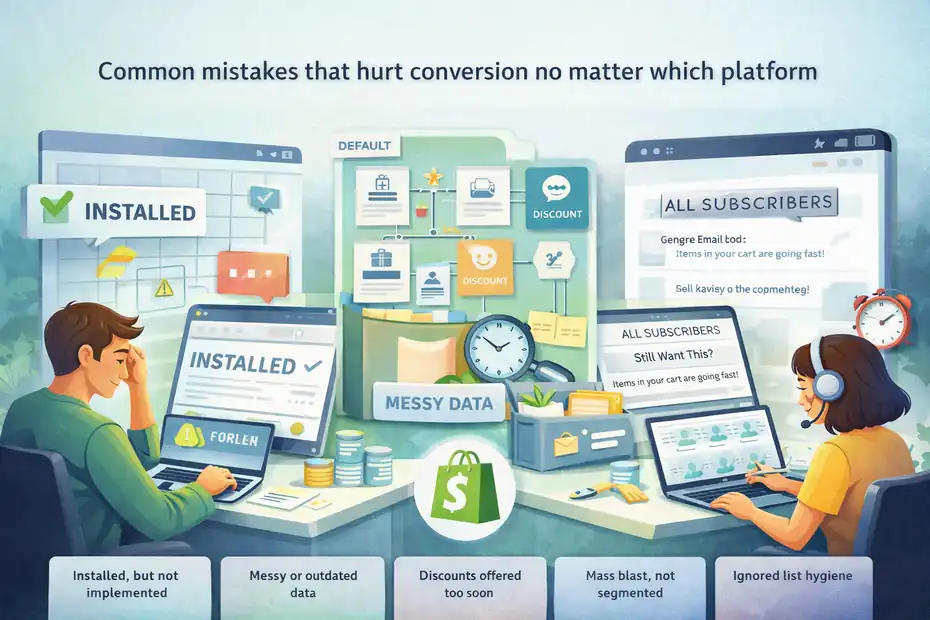
The first mistake is treating “installed” as “implemented.” Installing the app is not the same as building a revenue system.
The errors I see most often are:
- Using default flows without editing the logic: Templates are a starting point, not a strategy.
- Sending discounts too early: You train shoppers to wait instead of buy.
- Ignoring list hygiene: Engaged audiences convert better and protect deliverability.
- No product-level segmentation: A broad campaign to everyone usually underperforms a focused one.
- Weak signup forms: If your popup offer is generic, your list quality drops.
A practical example: a store launches a welcome flow with three emails, but every subscriber gets the same message regardless of what they browsed. Open rates might look decent, but conversion stays weak because the content is not tied to shopping intent.
I suggest starting with fewer flows but making them sharper. A clean welcome flow, abandoned cart sequence, and post-purchase path usually outperform a cluttered account with ten mediocre automations.
The measurement mistakes that lead to bad platform decisions
Another trap is judging the software too quickly, or by the wrong metric.
Do not decide Klaviyo vs Omnisend based only on open rate, a single campaign, or the first 30 days. That is not how ecommerce retention works. You need to compare performance at the flow, segment, and revenue level.
Track at least these numbers:
- Signup form conversion rate
- Welcome flow revenue per recipient
- Abandoned cart placed order rate
- SMS click rate and unsubscribe rate
- Campaign revenue per recipient
- 30-day repeat purchase rate from email-driven segments
Klaviyo explicitly highlights revenue attribution and built-in reporting even on free, while Omnisend emphasizes advanced reporting and combined email/SMS performance views on paid plans. Use that reporting to judge the platform fairly.
A platform is not failing you just because one campaign underperformed. Sometimes the real issue is audience fatigue, not tool quality.
Advanced optimization strategies once the basics are working
Once your core flows are live, this is where real conversion lifts start showing up. You are no longer asking, “Can this platform send emails?” You are asking, “How do I squeeze more profit from each subscriber without burning the list?”
At this level, Klaviyo usually gives more room for advanced experimentation, but Omnisend can still perform very well when the strategy is disciplined and focused.
How to increase conversion without sending more campaigns
A lot of Shopify stores try to grow revenue by increasing volume. I think that is the lazy move. Better targeting usually beats more sends.
Three optimizations matter most:
- Segment by buyer stage: New subscriber, first-time buyer, repeat buyer, VIP, and dormant customer should not get the same offer.
- Match message to buying temperature: Browse abandonment should feel lighter than cart recovery. Post-purchase cross-sell should feel helpful, not pushy.
- Test offer sequencing: Sometimes free shipping wins over percentage discounts, especially for low-AOV stores.
Klaviyo’s own benchmark content shows automated abandoned cart messages dramatically outperform standard email campaigns on revenue per recipient, which supports putting more effort into flow quality over blast frequency.
I also think many stores overuse discounts. Klaviyo’s 2025 BFCM analysis found SMS buyers often needed smaller discounts than email buyers, suggesting message channel and audience familiarity change incentive requirements.
That is useful beyond holiday sales: the more targeted the audience, the less often you need to bribe them.
How to scale from “working” to “seriously profitable”
Scaling is about turning your account from a campaign calendar into a customer engine.
Here is the progression I recommend:
- Lock down essentials: Welcome, abandoned cart, browse abandonment, post-purchase.
- Improve segmentation: Category buyers, high-intent viewers, lapsed buyers, VIPs.
- Add smarter upsell logic: Recommend complementary products, not random products.
- Refine channel timing: Use SMS for urgency and email for depth.
- Control fatigue: Suppress over-messaged segments and monitor unsubscribe spikes.
For larger brands, Klaviyo’s broader integrations and channel depth make this scaling path easier to customize. For smaller brands, Omnisend’s strength is that it lets you execute this progression without building a complicated tech stack first.
That is why I do not see this as “advanced versus beginner” software. I see it as “depth-first versus simplicity-first.”
Final verdict: Klaviyo vs Omnisend for Shopify
Klaviyo vs Omnisend for Shopify comes down to this: Klaviyo usually offers the higher conversion ceiling, while Omnisend usually offers the faster and more affordable path to getting good conversion systems live.
Choose Omnisend if you want:
- Faster setup: Especially for welcome, cart, browse, popups, push, and basic SMS.
- Better budget fit: Stronger value for smaller stores and lean teams.
- Broad support access: 24/7 email and live chat even on free.
Choose Klaviyo if you want:
- Deeper segmentation: Better for lifecycle marketing and personalized retention.
- More flexibility: Wider channel mix and 350+ integrations.
- Higher long-term upside: Especially for scaling Shopify brands with richer customer data.
My honest recommendation is this:
- If your Shopify store is early-stage or your team is lean, Omnisend is often the smarter first move.
- If your store already has traction and you are serious about retention, segmentation, and advanced automation, Klaviyo is usually the better long-term investment.
So which one converts better?
For many small and mid-sized stores, Omnisend converts better at first because it gets implemented properly. For more advanced Shopify brands, Klaviyo often converts better over time because its targeting and data depth are harder to outgrow.
FAQ
Which is better for Shopify, Klaviyo or Omnisend?
Klaviyo is better for advanced segmentation and long-term growth, while Omnisend is better for ease of use and faster setup. The right choice depends on your store size, budget, and how much time you can invest in managing email and SMS marketing.
Does Klaviyo or Omnisend have better automation for Shopify?
Klaviyo offers more advanced automation with deeper customization and targeting options. Omnisend focuses on simple, ready-to-use workflows that are easier to launch. Beginners often prefer Omnisend, while experienced marketers benefit more from Klaviyo’s flexibility.
Which platform is more affordable for Shopify stores?
Omnisend is generally more affordable, especially for small to mid-sized Shopify stores. Its pricing is simpler and includes more features at lower tiers. Klaviyo can become more expensive as your contact list grows and you use more advanced features.
Do Klaviyo and Omnisend both support SMS marketing?
Yes, both Klaviyo and Omnisend support SMS marketing alongside email. Klaviyo offers more advanced segmentation for SMS campaigns, while Omnisend makes it easier to launch combined email and SMS automation without complex setup.
Which converts better for Shopify email marketing?
Klaviyo often converts better for established stores using advanced segmentation and personalization. Omnisend can convert better for smaller stores because it is easier to implement quickly and maintain consistent campaigns and automation flows.

I’m Juxhin, the voice behind The Justifiable.
I’ve spent 6+ years building blogs, managing affiliate campaigns, and testing the messy world of online business. Here, I cut the fluff and share the strategies that actually move the needle — so you can build income that’s sustainable, not speculative.
Related posts:
 What is Getresponse: A Brief Introduction
 How Do I Create An Email Newsletter And What Should It Include?
 How to Advertise Your Business: Utilizing Email Marketing Strategies
 Top 10 Email Service Providers: Powerful Tools for Businesses
 Appscenic Product Sourcing Strategy: Find Winning Products Fast
 Can You Make Money With Spocket Or Is It Overhyped?