
Table of Contents
Some links on The Justifiable are affiliate links, meaning we may earn a small commission at no extra cost to you. Read full disclaimer.
A smart quillbot content rewriting strategy can absolutely help you move faster, but I believe most sites get this wrong from the start. They use QuillBot to swap words, publish thin rewrites, and then wonder why rankings stall.
The real win comes from using rewriting as one step inside a better SEO workflow: clarify search intent, reshape structure, improve usefulness, and add original insight before anything goes live.
That is how you turn a speed tool into a ranking asset instead of a content risk. Google’s guidance is still centered on helpful, reliable, people-first content, not on whether text was manually rewritten or AI-assisted.
What A Quillbot Content Rewriting Strategy Actually Means
A real strategy is not “paste article, click paraphrase, publish.”
It is a controlled process for improving clarity, angle, structure, and topical coverage while keeping the final page genuinely useful.
Define Rewriting As Improvement, Not Word Substitution
When people hear “content rewriting,” they often picture spinning content. That is the wrong mental model. A strong quillbot content rewriting strategy treats QuillBot like an editing assistant, not a replacement for expertise.
In practical terms, rewriting should help you do four things. First, simplify awkward or bloated sentences. Second, reshape drafts to match search intent better. Third, remove duplicate phrasing across similar pages. Fourth, speed up editing when you already have a solid original base.
I suggest thinking about QuillBot as a “draft refiner.” Its paraphrasing tool offers multiple modes for changing vocabulary, clarity, and tone, and Premium access adds more modes and settings for deeper control. QuillBot also positions the platform as a broader writing suite, not just a synonym tool.
That matters because the best ranking pages are rarely the most “rewritten.” They are the most complete, easiest to trust, and easiest to use. Rewriting only helps when it improves those outcomes.
A simple test I use is this: If the rewritten version is not more helpful than the original, it should not be published.
Understand Where Rewriting Fits In The SEO Workflow
Rewriting belongs in the middle of the content process, not at the beginning and not at the end by itself.
Here is the cleaner sequence: research the query, map the intent, create the outline, draft the answer, rewrite sections for clarity and differentiation, add proof and examples, then do an SEO and quality review.
When rewriting comes too early, you just produce cleaner fluff. When it comes too late, you may polish the wrong structure.
Imagine you run a small affiliate site in home office gear. You already published a post targeting “best standing desk for small spaces,” but it sits on page two. A smart rewrite would not only rephrase sentences.
It would tighten the intro, add dimensions buyers care about, compare legroom and cable management, answer “will it fit in a corner,” and improve headings around real objections.
That is why I believe rewriting should be tied to ranking gaps, not just writing speed. You are not changing words for the sake of freshness. You are changing the page so it solves the query better than the version currently indexed.
Why Rewritten Content Can Rank Fast And Why It Often Fails
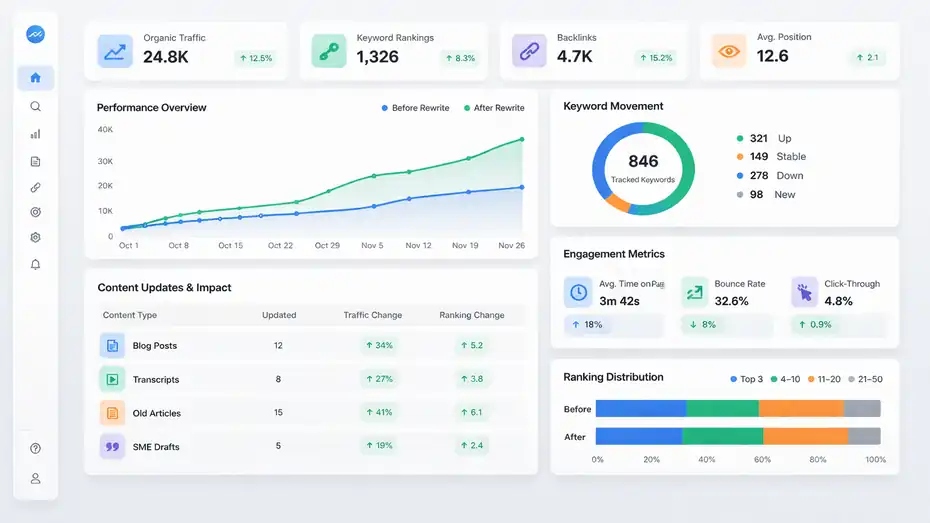
Rewritten content can move quickly because it reduces production time. But speed only helps when the page becomes more relevant, more complete, and more satisfying than what is already ranking.
Why Rewriting Sometimes Produces Faster SEO Gains
The biggest advantage of rewriting is operational speed. You do not start from a blank page, and that removes a huge amount of friction. For most content teams, the blank-page problem is more expensive than the actual editing.
If you already have underperforming articles, old blog posts, transcripts, internal notes, or subject matter expert drafts, rewriting lets you turn existing material into cleaner assets much faster than building from zero. In my experience, this is where QuillBot is strongest.
A good rewrite can also improve engagement signals indirectly. Better formatting, tighter language, stronger intros, and clearer answers usually reduce pogo-sticking, which is when people bounce back to search results because your page did not satisfy them.
Google does not publish a simple “bounce rate ranking factor” rule, but it does repeatedly emphasize satisfying people-first content and page experience.
Another reason rewritten pages can rank faster is that updates are often easier than new URL launches. If a page already has impressions, internal links, and topical relevance, a better version may gain traction more quickly than a brand-new post.
That is why content refreshes are one of the highest-leverage uses of a rewriting strategy.
Why Most Rewritten Content Fails To Rank
Most failures come from one issue: The page changes its wording but not its value.
I see this constantly. A publisher takes a competitor article, rewrites sentences, adds a few headings, and expects the page to rank. But the final result still lacks firsthand experience, original examples, useful specificity, or a better structure. It is just the same page wearing different clothes.
Google’s public guidance is very clear on the big principle here. Content should be created to help people, not mainly to manipulate rankings, and AI-generated content is not judged by the tool alone but by whether it is useful and high quality.
There is also a hidden problem many site owners miss: rewritten content often flattens expertise. A rough human draft may include actual opinions, unusual phrasing, and experience-based insight.
A careless paraphrase can strip all of that out and leave you with generic “SEO-safe” language that says nothing memorable.
So the failure pattern is simple. The more a page sounds polished but empty, the less likely it is to earn trust, links, shares, or rankings that last.
Build The Right Input Before You Rewrite Anything
QuillBot works best when the source material is already worth improving. Weak input creates weak output, just faster.
Start With Intent-Led Source Material
Before you rewrite, decide what the page actually needs to do. Is the searcher trying to learn, compare, buy, fix, or choose? If you skip this step, every rewrite becomes random.
I recommend sorting source material into three buckets.
- Bucket 1: pages with traffic but weak rankings, usually positions 8 to 20.
- Bucket 2: pages with impressions but weak clicks, which often means the intro, title, or angle is off.
- Bucket 3: pages that are useful internally but not publish-ready, such as webinar transcripts, customer support notes, founder memos, or rough SME drafts.
This matters because each bucket needs a different rewrite style. A page stuck at position 11 may need stronger entity coverage and better formatting. A low-CTR page may need a more compelling intro and clearer benefit framing. A transcript may need a complete structural rebuild.
I suggest avoiding rewrites of source material that is already thin, outdated, or copied from elsewhere. Rewriting cannot rescue bad fundamentals. It only amplifies them.
A practical filter is this: if the source does not contain original information, original structure, or a strong point of view, you need fresh research before you need paraphrasing.
Extract The Information That Actually Moves Rankings
Once you have a usable source, pull out the pieces that matter most for search performance.
You are looking for: primary question, supporting questions, missing objections, proof points, examples, definitions, and conversion moments. Those are the ingredients that make a page rank and convert.
Let me give you a simple example. Say your page is about email warm-up software. The original draft explains what warm-up is, but it does not answer the real buying questions: how long it takes, whether it helps deliverability, who should not use it, and what metrics matter.
A rewrite focused only on phrasing would miss all of that. A rewrite focused on ranking gaps would reorganize the piece around those questions.
This is why I often create a “keep, cut, add” sheet before using QuillBot. Keep the lines with unique expertise. Cut bloated filler. Add missing search-intent blocks the original never addressed.
That one habit saves a lot of time because it stops you from polishing sections that should have been deleted.
How To Use QuillBot Without Turning Your Content Generic
QuillBot is useful when you apply it selectively. The mistake is running entire articles through it without control.
Pick The Right Rewrite Mode For The Job
QuillBot’s paraphraser currently offers 10-plus modes, with free access to limited options and Premium access to a broader set, plus Compare Modes and extra settings. The platform itself says the “best” mode depends on your goal, which is exactly right.
For SEO content, I would not treat mode selection casually. Different goals need different outputs.
A simple working approach looks like this:
- Fluency mode: Use it to clean up clunky drafts and improve readability.
- Standard mode: Use it for light rewrites when the original is already decent.
- Simple mode: Use it when your article feels too dense for a general audience.
- Formal or Academic mode: Use carefully for B2B, research-heavy, or documentation-style sections.
- Creative mode: Use only in moderation for intros, hooks, or examples where you need fresher language.
In my experience, Fluency is often the safest first pass because it tends to improve readability without distorting meaning too aggressively. Creative-style outputs can be useful, but they are more likely to wander off-message or sound less grounded.
The point is not to find the “best” mode overall. The point is to match the mode to the paragraph’s job.
Rewrite At The Paragraph Level, Not The Full Article Level
This is probably the most important tactical advice in the whole article.
Do not dump 2,500 words into a rewriter and expect a ranking page to come out. Rewrite one block at a time. That gives you control over meaning, tone, and search coverage.
I usually break a draft into paragraph units with specific goals. One paragraph may need simplification. Another may need stronger commercial framing. Another may need to sound more human. Another may need to preserve exact terminology because precision matters.
Working section by section also reduces accidental drift. You are less likely to lose definitions, introduce factual mistakes, or flatten brand voice. It is slower than one-click rewriting, but still much faster than fully manual rewrites.
A practical workflow is: rewrite the paragraph, compare it with the original, restore any lost specifics, then tighten the final version manually. If the output changes the meaning even slightly, throw it out. Search performance does not improve when your content becomes less accurate.
I believe this is the difference between “AI-assisted editing” and “content spinning.” The first uses judgment. The second avoids it.
The Step-By-Step QuillBot Content Rewriting Workflow That Actually Works
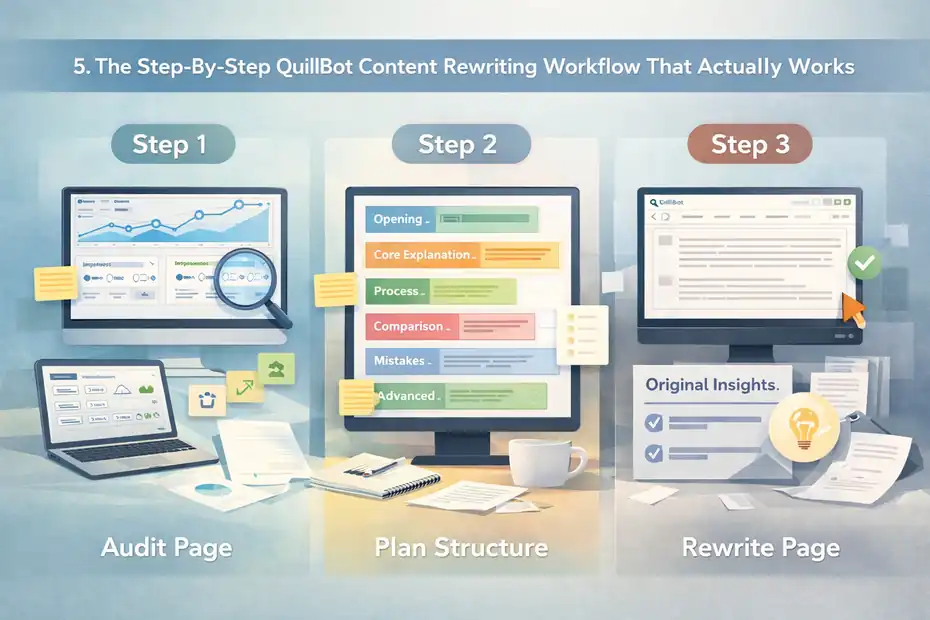
This is the part most readers need: a practical system you can repeat across pages.
Step 1: Audit The Existing Page Before Touching The Copy
Start with the page’s current performance. Look at impressions, clicks, CTR, average position, time on page, scroll depth if you track it, and conversions if the page has a business goal.
You do not need enterprise analytics to do this well. Search Console will already tell you whether the page is being seen, ignored, or half-working. That context determines the rewrite.
Here is the basic diagnostic:
- High impressions, low CTR: The title, meta description, intro, or search angle may be weak.
- Good CTR, poor rankings: The page likely lacks depth, structure, or authority signals.
- Rankings but low conversions: The content may attract the wrong intent or fail to move readers toward action.
- No traction at all: The topic, query targeting, or page quality may be off from the start.
I recommend writing down one primary goal before you edit. For example: “Improve clarity for beginners,” or “Add missing comparison content for buyers,” or “Make this article more original and less repetitive.”
That single sentence keeps the rewrite disciplined. Without it, you will end up changing lines that never mattered.
Step 2: Rebuild The Structure Before You Rephrase The Text
Most SEO problems are structural problems pretending to be wording problems.
Before you use QuillBot, look at the article’s heading flow. Does it answer the right questions in the right order? Does the page move from beginner understanding to implementation and then optimization? Does it cover objections and next steps? If not, rewrite the outline first.
I suggest using a simple structure check:
- Opening: Does it match intent fast?
- Core explanation: Does it define the concept clearly?
- Setup or process: Does it show how to do it?
- Comparison or decision block: Does it help the reader choose?
- Mistakes or troubleshooting: Does it reduce failure risk?
- Advanced optimization: Does it help the reader improve results?
Once the skeleton is fixed, then use QuillBot on individual sections to sharpen phrasing. This sequence matters. Strong structure with average prose usually beats elegant prose with weak structure.
Imagine a SaaS article titled “How To Improve Onboarding Emails.” If the original piece jumps from definitions to templates to analytics with no logical flow, no amount of paraphrasing will save it.
Rebuilding the sequence around strategy, setup, examples, testing, and optimization will do more for rankings than any synonym swap.
Step 3: Rewrite For Clarity, Then Add Original Value
After the outline is fixed, use QuillBot to improve readability and remove repetitive phrasing. Then add what QuillBot cannot create for you: lived experience, proof, and useful judgment.
This is where most content teams stop too early. They rewrite and publish. The smarter move is to treat the rewrite as your cleanup pass, not your final pass.
Add elements such as mini examples, numeric benchmarks, short case scenarios, contrarian observations, or product-specific shortcuts.
For instance, if you are writing about newsletter growth, do not just say “use a lead magnet.” Explain what happened when a creator swapped a generic PDF for a 3-email mini course and lifted signup conversion from 1.4% to 3.1%.
Even when the scenario is illustrative, the lesson becomes much more concrete.
The rewritten page should answer questions only a real operator would think to include. That is how you separate your page from ten other polished but empty articles.
My rule is simple: Every major section should contain at least one detail that would be hard to produce from surface-level scraping alone.
Optimize Rewritten Content For Rankings, Not Just Readability
A cleaner article is helpful, but ranking usually requires stronger topical completeness and search alignment too.
Add Missing Entities, Questions, And Use Cases
Once the page is readable, look for what it still does not cover. This is where semantic SEO matters.
If your page targets a topic like “CRM migration checklist,” the content should naturally mention related entities and concerns such as data mapping, duplicate fields, field validation, user permissions, pipeline stages, integrations, rollback planning, and post-migration QA.
You do not add these terms because “semantic SEO” sounds fancy. You add them because they are part of the real topic.
This is also the stage where you strengthen People Also Ask-style coverage. Ask: what else would a serious searcher need before they leave satisfied? Those subtopics often become H3 sections, quick examples, or FAQ-style blocks.
I have found that content often underperforms not because it is poorly written, but because it leaves obvious follow-up questions unanswered. Rewriting helps language. Expansion helps relevance.
One practical trick is to review your article and count how many times a reader might still need another tab. Your goal is to reduce that number.
Improve CTR And On-Page Satisfaction After The Rewrite
Fast rankings are not just about getting indexed. They are about winning the click and keeping the reader.
After rewriting the body, optimize the search-facing and engagement-facing elements. Tighten the title. Rewrite the meta description. Improve the first 150 words so the page proves relevance immediately.
Add better subheads, quick-answer boxes, short comparison lists, and in-content navigation if the piece is long.
Google’s documentation on core updates repeatedly pushes site owners toward self-assessment around usefulness and satisfaction rather than toward hacky ranking tricks.
That is why I think the best post-rewrite question is not “Did I use the keyword enough?” It is “Would a busy searcher feel relieved after landing here?”
For many pages, the answer improves when you do simple things well: answer the main question above the fold, avoid fluffy intros, reduce repeated ideas, and make scanning easy. Those are not glamorous tactics, but they move real pages.
Common Mistakes That Kill A QuillBot Content Rewriting Strategy
Most rewriting problems are predictable. That is good news, because predictable mistakes are fixable.
Mistake 1: Using Rewriting To Imitate Competitors
This is the easiest trap to fall into. You find a top-ranking article, paraphrase the structure and wording, and hope Google sees your page as fresh. Usually, it does not.
The issue is not that learning from competitors is wrong. We all do that. The issue is when imitation replaces differentiation. If your rewritten page covers the same points, in the same order, with no stronger insight or better usability, there is no real reason for it to outrank what already exists.
I recommend using competitor pages only to identify expectation gaps. What do all of them include? What do none of them explain well? What are readers probably still confused about? That is where your rewritten page should pull ahead.
A better mindset is: Do not rewrite their article, rewrite your own answer so it becomes more useful than theirs.
That shift changes everything.
Mistake 2: Letting The Tool Remove Your Expertise
This one is sneaky. The draft sounds smoother after rewriting, so you assume it got better. But in the process, it may have lost your strongest lines.
That often happens with specifics: nuanced opinions, unusual examples, exact workflows, or product caveats. These are the things that make an article feel experienced rather than assembled.
For example, a human writer might say, “I would not use the creative mode for legal or policy-heavy pages because a slightly prettier sentence is not worth introducing ambiguity.”
A generic rewrite might flatten that into “Choose the mode carefully based on your needs.” The second version is cleaner, but it is weaker.
I suggest protecting your expertise on purpose. Keep a small list of “do not rewrite” assets inside every article, such as definitions, warnings, original examples, founder quotes, hard numbers, and process steps with specific order.
That way you do not accidentally edit away the part that made the page worth reading.
Advanced Ways To Scale This Strategy Across A Site
Once the workflow works on one page, the next challenge is scaling without creating a sea of sameness.
Create Rewrite Templates By Page Type
The best way to scale is not to automate whole articles. It is to standardize decision-making.
Different page types need different rewrite templates. A blog tutorial needs a distinct flow from a product comparison page, a landing page, or a glossary entry. Once you define those patterns, QuillBot becomes much easier to use consistently.
A simple template library might include:
- Tutorial pages: problem, definition, setup, steps, mistakes, optimization, FAQ.
- Commercial investigation pages: who it is for, decision criteria, comparison, pros and cons, recommendations, buying questions.
- Refresh pages: outdated section, missing questions, weak examples, stronger intro, internal links, CTA update.
- Support-style content: symptom, cause, fix, prevention, escalation path.
This keeps your team from rewriting blindly. Instead, they know exactly what each page type is trying to achieve.
I believe this is one of the fastest ways to improve content velocity without sacrificing quality. Standardization does not make content robotic when the template controls structure and the human controls insight.
Pair Rewrites With Internal Linking And Content Refresh Cycles
A rewrite strategy works much better when it is tied to site architecture.
After improving a page, update internal links pointing into it. Add the page to relevant hub articles. Refresh anchor text where needed.
Check whether nearby articles should now reference the updated piece. Rewrites often underperform simply because no one strengthens distribution afterward.
I also recommend creating refresh cycles by content tier. For example:
- Tier 1 pages: review monthly.
- Tier 2 pages: review quarterly.
- Tier 3 pages: review twice a year.
This helps you catch decaying pages before they disappear. A page that slips from position 4 to position 9 often needs a sharper refresh than a full rewrite. A page stuck around position 15 may need expansion, stronger internal links, and a new angle.
The point is to treat rewriting as part of ongoing SEO maintenance, not a one-time rescue mission.
The Tools You Actually Need Around QuillBot
QuillBot should not be your whole workflow. It should be one part of the stack.
Where QuillBot Fits Best In A Modern Content Stack
QuillBot describes itself as a broader writing solution, and its current toolset includes paraphrasing, grammar-related help, summarization, AI detection, citation support, and other writing features. Free plans come with notable limits, while Premium expands modes, word allowances, and controls.
That said, I would keep its role narrow and strategic.
Use QuillBot for rewriting awkward paragraphs, cleaning drafts, adjusting tone, simplifying dense sections, and comparing alternate phrasings. Do not use it as your strategy engine, topic research engine, or publishing quality gate by itself.
In a sensible workflow, you still need:
- Search Console for query and CTR insights.
- Analytics for engagement and conversion behavior.
- A brief or outline document for search intent mapping.
- Human review for accuracy, originality, and brand voice.
This setup keeps the tool in its best lane. It helps you write faster, but it does not pretend to replace SEO judgment.
When Premium Is Worth It And When It Is Not
This depends on your volume and your process. QuillBot’s official upgrade pages highlight more modes, unlimited input for the paraphraser, expanded summarizer limits, and broader premium controls. The free version remains usable, but it is intentionally constrained.
I would consider Premium worthwhile in three cases. First, you refresh content regularly across multiple pages each month. Second, your writers need mode variety and compare features to move faster. Third, your workflow depends on larger text handling and repeated editing passes.
I would skip Premium if you only clean up occasional paragraphs or if your real bottleneck is not editing but research and expertise. In that case, a paid rewriter will not fix the deeper issue.
This is one of those decisions where honesty saves money. If your drafts are weak because you do not know enough about the topic, buying a better paraphrasing tier will not solve that.
Final Strategy: How To Turn Rewriting Into A Ranking Advantage
The pages that win are not the pages that rewrite the fastest. They are the pages that become more useful the fastest.
The Best Operating Rule To Follow
If I had to boil this whole guide down to one rule, it would be this: use QuillBot to improve expression, but use your SEO process to improve usefulness.
That means every rewrite should pass four checks:
- Intent check: Does this version answer the searcher’s real question more clearly?
- Originality check: Did I add something specific, experienced, or genuinely helpful?
- Structure check: Is the information easier to scan and act on?
- Trust check: Would I still publish this under my name if the tool credit disappeared?
When all four are true, rewritten content can become an asset. When they are false, the page is usually just cleaner filler.
I believe a lot of SEO frustration comes from expecting tools to create differentiation automatically. They do not. They create options. You still have to choose the stronger answer.
A Simple 7-Day Implementation Plan
Here is a practical way to start without overcomplicating it.
- Day 1: Pull 10 underperforming URLs from Search Console.
- Day 2: Group them by page type and search intent.
- Day 3: Choose 3 pages with the best upside, usually those ranking between positions 8 and 20.
- Day 4: Rebuild outlines and identify what to keep, cut, and add.
- Day 5: Use QuillBot paragraph by paragraph to improve clarity and reduce repetition.
- Day 6: Add original examples, stronger subheads, FAQs, and better internal links.
- Day 7: Update titles, intros, and meta descriptions, then republish and track results.
That is enough to prove whether your quillbot content rewriting strategy is being used as a shortcut or as a real ranking system.
And honestly, that is the whole game. Not more words. Better pages, produced faster, with enough human judgment left in them to deserve the ranking.
FAQ
What is a quillbot content rewriting strategy?
A quillbot content rewriting strategy is a structured approach to improving existing content using QuillBot for clarity, readability, and SEO alignment. Instead of simple paraphrasing, it focuses on enhancing value, matching search intent, and adding unique insights to help content rank higher on Google.
Can rewritten content rank on Google?
Yes, rewritten content can rank if it provides genuine value, better structure, and satisfies search intent more effectively than competing pages. Google prioritizes helpful, people-first content, so rewriting must improve usefulness rather than just change wording.
How do you use QuillBot for SEO content rewriting?
You use QuillBot by rewriting content at the paragraph level, selecting modes like Fluency or Standard to improve clarity. After rewriting, you should manually refine the output, add original insights, and ensure the content fully answers the target keyword.
Is QuillBot safe for SEO?
QuillBot is safe for SEO when used correctly as an editing tool, not a content spinner. Problems arise when users rely only on paraphrasing without adding value. High-quality, original, and helpful content remains essential for ranking success.
What is the biggest mistake in content rewriting?
The biggest mistake is focusing only on changing words instead of improving content value. This leads to generic, low-impact pages. Successful rewriting involves restructuring content, adding missing information, and enhancing clarity to better serve the reader.

I’m Juxhin, the voice behind The Justifiable.
I’ve spent 6+ years building blogs, managing affiliate campaigns, and testing the messy world of online business. Here, I cut the fluff and share the strategies that actually move the needle — so you can build income that’s sustainable, not speculative.
Related posts:
 AI QuillBot: The Smart Writing Assistant That Rewrites Perfectly
 How To Rewrite Blog Content Using Quillbot Like Experts
 Squirrly SEO – The Ultimate WordPress SEO Plugin for Boosting Your Website’s Rankings
 Quillbot Alternative Review: Top 5 Choices
 Best Alternative Of QuillBot That Writers Actually Use
 The QuillBot Review: Is This AI Writing Tool Worth It?