Table of Contents
Some links on The Justifiable are affiliate links, meaning we may earn a small commission at no extra cost to you. Read full disclaimer.
When people ask me how I actually learned to write blog posts for money, I always tell them it started with a simple shift: treating writing like a real skill that deserves real pay.
If you’re trying to do the same, you might be wondering how to get clients, what to charge, or how to write content people will actually pay well for.
This guide breaks it all down step by step.
Learn Proven Methods To Write Blog Posts For Money Well
When you start trying to write blog posts for money, the first big win is understanding what clients actually pay for.
This section breaks down the skills and habits that turn average content into content people happily invest in.
Identify What Makes A Blog Post Worth Paying For
High-paying clients aren’t buying words; they’re buying outcomes. I’ve learned that writers who earn well focus on creating content that solves a specific problem for the reader and meets a measurable business goal.
What clients truly pay for:
- Clear expertise: Clients want evidence you know their industry well enough to create trustworthy content.
- Search visibility: Even non-SEO clients care when a post brings organic traffic.
- Engagement: Articles that keep people on the page longer tend to convert more readers.
- Conversion insight: Even informational posts should help move a reader closer to a desired action, such as signing up, downloading, or exploring a product.
From what I’ve seen, many writers undercharge because they think they’re selling paragraphs. In reality, companies invest in content that reduces their support load, earns search rankings, or warms future buyers.
Understand How To Match Writing Style To Each Client
Every client has a “voice” they want you to match—even if they can’t articulate it clearly.
I suggest asking for 2–3 reference articles and then breaking those down into tone, sentence length, pacing, examples, and structure.
A simple way to reverse-engineer tone:
- Look at how they introduce a topic. Are they casual? Formal? Opinionated?
- Check sentence length. Some brands prefer sharp, short lines; others like narrative flow.
- Study how they use data, examples, or product mentions.
- Examine formatting patterns: subheads every few lines, bullets often, long paragraphs, etc.
The closer your writing aligns with their brand identity, the faster they trust you, and the more likely they are to offer ongoing, higher-paying work.
Learn How To Deliver Content That Drives Measurable Results
Clients pay premium rates for blog posts that perform, not just read well. I often ask a client early on: “What does success look like for this article?” Most clients answer with metrics like time on page, ranking position, or conversions.
To write with performance in mind:
- Anchor every article around a clear user intent (informational, comparison, problem-solution).
- Place answers quickly so readers don’t bounce.
- Use internal links that support user flow through the site.
- Add CTA placements that feel natural rather than forced.
A Content Marketing Institute report found that 72% of brands invest more in writers who understand their strategic goals—not just the topic. That’s a huge advantage for you.
Practice Research Strategies That Improve Content Quality
Your research depth ultimately determines your writing quality. When I write for clients, I mix first-hand examples, competitor analysis, and credible statistics so the content feels grounded and actionable.
My system for faster, higher-quality research:
- Scan top-ranking pages: Look for what competitors missed.
- Read Reddit or Quora threads: This shows real user pain points.
- Pull 1–3 fresh data points: Use Statista, industry reports, or surveys.
- Check product documentation when applicable: This ensures technical accuracy.
This extra layer of research is one of the reasons high-paying clients stay long-term—they see you put in more thought than the typical writer.
Build A Profitable Writing Niche That Clients Value More
If you want to write blog posts for money at a level that feels sustainable, specializing is one of the fastest ways to increase your rates.
Clients don’t pay generalists top-tier pricing—they pay experts.
Evaluate Which Niches Pay Writers Higher Rates
Some industries simply spend more on content because the lifetime value of a customer is higher. I believe it’s important to choose markets where content has a direct impact on revenue.
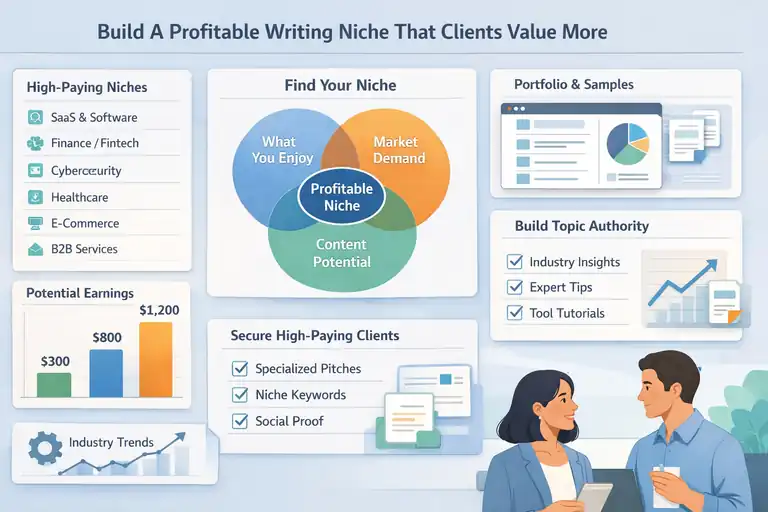
Common high-paying niches:
- Software/SaaS
- Finance and fintech
- Cybersecurity
- Healthcare
- E-commerce platforms
- B2B services
Writers in these niches often earn 2–3× more per article compared to lifestyle or travel niches. You don’t need to be an expert on day one—you just need curiosity and a willingness to keep learning.
Choose A Topic You Can Master And Monetize Long-Term
Pick a niche you can grow into, not one you burn out on. In my experience, a profitable niche sits at the intersection of:
- Something you enjoy—even mildly
- Something clients urgently need
- Something that allows ongoing content production
Instead of chasing trends, choose a field with long-term demand. For example, SaaS content has been growing for over a decade, and it’s still expanding as more products launch.
Position Yourself As A Specialist Instead Of A Generalist
Specialists get hired faster and command higher project rates because clients feel safer paying someone who deeply understands their space.
To position yourself well:
- Build a portfolio that focuses on one niche.
- Publish samples on your own site or Medium to show expertise.
- Use job proposals that mention niche-specific terminology naturally.
The more familiar you sound with the product or problem, the more you stand out.
Build Topic Authority That Attracts Premium Clients
Authority builds trust before you ever speak to a client. You can develop this by publishing educational content under your name on LinkedIn, your blog, or industry platforms.
Simple authority-building activities:
- Write short posts on recent industry changes.
- Share lessons from client work (without revealing private details).
- Break down new tools, features, or updates in plain language.
I’ve seen writers book $800–$1,200 articles simply because their public content demonstrated knowledge competitors couldn’t match.
Master High-Impact Writing Skills That Increase Pay Rates
If you want to consistently write blog posts for money at premium rates, you’ll need a few specialized writing skills that help your content stand out from cheaper writers.
Learn How To Write Engaging Introductions That Hook Readers
Your introduction decides whether readers stay or leave. Most writers overcomplicate this part, but I suggest keeping a simple structure: connect with the reader, introduce the problem, and promise the solution.
A practical intro formula:
- Start with a relatable moment
- Acknowledge the exact frustration the reader feels
- Show what the article will help them achieve
- Keep it conversational and human
A strong intro reduces bounce rate—something clients value more than they often verbalize.
Use Content Structuring Techniques That Improve Readability
Readable content performs better on every metric: time on page, scroll depth, and social shares. I’ve seen clients pay extra just because they know I deliver clean, easy-to-digest formatting.
My go-to structuring habits:
- Keep paragraphs under three lines
- Use subheads every 150–200 words
- Add mini-lists only where it enhances clarity
- Place key insights at the start of paragraphs
This structure mirrors what Google rewards: clarity, depth, and scannability.
Develop A Strong Editing Process That Elevates Your Writing
Editing is where you transform a draft from “good enough” to “client will hire me again.” I usually do three passes: clarity, connection, and correctness.
My three-pass method:
- Clarity: Remove filler, shorten sentences, tighten the flow.
- Connection: Make the tone more human and aligned with the brand.
- Correctness: Fix typos, verify numbers, check formatting consistency.
Strong editing is often what separates a $50 article writer from a $300+ one.
Adopt SEO Writing Skills Clients Are Actively Searching For
SEO skills increase your value instantly because you’re helping clients attract organic traffic. You don’t need to be an SEO expert—you just need a solid grasp of fundamentals.
Core SEO skills clients look for:
- Understanding of search intent
- Natural keyword integration
- Ability to structure content around semantic topics
- On-page optimization basics (title tags, meta descriptions, H2/H3 structure)
- Internal linking strategy
When your content starts ranking well, clients notice—and often raise your rates.
Use Proven Content Tactics That Boost Your Writing Income
When you start trying to write blog posts for money at a higher level, the turning point usually happens when you shift from “writer” to “strategic writer.”
This is where clients begin paying for your thinking, not just your typing.
Analyze Keyword Intent To Write Content Clients Truly Need
Understanding keyword intent is one of the fastest ways to make your content more valuable. I always tell writers: don’t just look at a keyword—look at what the searcher is trying to solve.
How I break down search intent quickly:
- Informational: The reader wants help understanding a topic.
- Commercial: They’re comparing options or tools.
- Transactional: They’re close to buying something.
- Navigational: They want a specific product or brand page.
If you’re using a tool like Ahrefs, you can simply enter a keyword → check the SERP overview → scan the top 3 results to see what searchers expect.
In practice, matching intent makes your articles more rankable. It also instantly positions you as someone who understands content strategy—something clients happily pay more for.
Use Storytelling Techniques That Increase Reader Engagement
Adding simple storytelling makes even technical content easier to read. I believe the best stories are short, relatable, and tied to the reader’s problem—not just thrown in for decoration.
A simple storytelling approach that works anywhere:
- Set the moment: Describe a small scenario or pain point.
- Highlight the conflict: Show what went wrong or what was confusing.
- Offer a shift: Explain the insight or technique that solved it.
For example, if I’m writing for a SaaS brand, I might share how a user struggled with onboarding until one feature simplified everything. This keeps the article human, even when it’s technical.
Story-driven content increases time on page—something many clients track in tools like Google Analytics or Hotjar.
Apply Conversion-Focused Writing To Boost Client Revenue
Conversion-friendly writing isn’t about selling harder; it’s about guiding the reader gently toward the next step. When I write conversion-focused content, I always imagine the reader asking: “Okay… so what should I do now?”
Three micro-conversion tactics that work well:
- Place CTAs right after solving a pain point.
- Use simple examples like: “Click Settings → Billing → Add Method.”
- Add a soft nudge, such as: “Try this feature with a free trial to see how it works for you.”
When content supports revenue, clients treat you as a partner rather than a task-doer. That typically means higher rates and longer contracts.
Create Repeatable Frameworks To Write Faster And Earn More
Once you create a few personal writing systems, your speed—and your income—naturally increase. I learned this the hard way after spending years reinventing every article from scratch.
My favorite writing frameworks:
- Topic outline template: Intro → Problem → Insights → Takeaways.
- SEO optimization checklist: Intent → Structure → Internal links → Meta data.
- Draft structure: Short intro → H2 sections → Short H3 paragraphs → CTA.
Building frameworks helps you finish articles quicker, which increases your hourly earnings without raising prices. It also keeps quality consistent, which clients love.
Follow Methods To Pitch And Land High-Paying Clients

If you want to write blog posts for money consistently, you’ll eventually need clients who value quality. This section shows how to attract the right ones—and keep them.
Build A Portfolio That Shows Your Best Paid-Ready Writing
A portfolio is your sales engine. You don’t need dozens of samples—five strong pieces are enough. I recommend focusing on pieces that show problem-solving, clarity, and niche knowledge.
A clean portfolio layout that works well:
- A simple home page
- A “writing samples” page with categories
- Short descriptions for each piece showing the goal of the article
- A small section explaining who you write for
You can use platforms like Contently, Clarity, or even Notion. Just keep the design minimal so the writing stands out.
Craft Outreach Messages That Actually Get Replies
Pitching doesn’t have to feel uncomfortable if you approach it like a conversation rather than a cold call. I’ve found that short emails outperform long ones every time.
A simple outreach format:
- One sentence showing you understand their business
- One sentence showing why their content matters
- One sample that proves your writing fits
- A short question asking if they’re open to new writers
Most people try to sell too fast. I suggest thinking of outreach as opening a door, not closing a deal.
Use Freelance Platforms Strategically To Win Quality Work
Platforms like Upwork, Fiverr Pro, and ClearVoice aren’t perfect, but they’re great places to build momentum. The trick is knowing how to stand out.
A few things that help:
- Apply only to jobs with clear expectations
- Answer the client’s brief directly instead of using a generic pitch
- Add one quick insight about their niche or audience
- Provide work samples that match the job description
I’ve seen writers land $150–$300 blog posts consistently by being selective instead of applying everywhere.
Leverage Referrals And Networking To Secure Higher Rates
A quiet truth about freelance writing: referrals are where the money is. When someone recommends you, price resistance disappears almost completely.
Ways to generate referrals naturally:
- Deliver early when possible
- Be easy to communicate with
- Offer small strategic suggestions
- Check in after a project with a helpful note
Most of my long-term, high-paying clients came from a single happy contact. One good relationship can change your entire writing income.
Set Strong Pricing Systems To Get Paid Well For Writing
To write blog posts for money and actually get paid well for it, you need a pricing model that feels fair to both you and the client.
This section helps you build that confidence.
Decide Whether To Charge Per Word, Per Project, Or Per Hour
Your pricing model affects how clients perceive your value. I personally prefer project-based pricing because it rewards efficiency without punishing you for being faster.
Pros and cons at a glance:
- Per word: Easy for clients to understand, but caps your income.
- Per hour: Good for editing and consulting, but requires time tracking.
- Per project: Best for long-term work, flat-rate, and premium clients.
If you’re unsure, start with project pricing but show a transparent breakdown. Clients appreciate it when expectations are clear.
Create Tiered Pricing Packages That Increase Your Earnings
Packages make your pricing easier to understand and position you as a professional. I recommend offering three tiers.
A simple pricing layout:
- Starter: One blog post + basic SEO + one revision
- Growth: Two to three posts + keyword research + content brief
- Premium: Full content package + SEO + competitor research + internal linking
Packages also encourage clients to choose more than one post per month, which stabilizes your income.
Learn To Negotiate Rates Without Undervaluing Your Work
Negotiation gets easier when you shift your mindset from “price” to “project value.” If a client pushes back, I suggest saying something like: “Here’s what your investment includes…” and list the strategic elements you offer.
You can also offer alternatives instead of lowering your price, such as reducing word count or removing one deliverable. This keeps your value intact.
Protect Your Income With Contracts, Deadlines, And Deposits
Contracts don’t just protect you legally—they make clients take your work seriously. Even a simple agreement outlining the timeline, deliverables, and payment schedule goes a long way.
A few non-negotiables I recommend:
- Always request a 30–50% deposit on new projects
- Include a revision limit
- Add late fee language (even if you don’t enforce it often)
- Specify ownership rights after final payment
These steps ensure you’re treated as a professional, not a commodity.
FAQ
How can beginners write blog posts for money without experience?
Start by choosing one niche, creating 3–5 strong sample posts, and pitching small clients. Many beginners get paid by showing clear writing, research skills, and basic SEO knowledge rather than years of experience.
How much money can you make writing blog posts?
Writers typically earn anywhere from $50 to $500+ per blog post. Rates depend on niche, SEO skills, and whether the content helps clients get traffic, leads, or sales.
What skills help you get paid more to write blog posts for money?
The most valuable skills are understanding search intent, writing clear and engaging content, basic SEO, and the ability to write posts that support a business goal like conversions or sign-ups.

I’m Juxhin, the voice behind The Justifiable.
I’ve spent 6+ years building blogs, managing affiliate campaigns, and testing the messy world of online business. Here, I cut the fluff and share the strategies that actually move the needle — so you can build income that’s sustainable, not speculative.