
Table of Contents
Some links on The Justifiable are affiliate links, meaning we may earn a small commission at no extra cost to you. Read full disclaimer.
B2B e commerce has evolved far beyond static catalogs and clunky order forms—it’s now the engine driving global supply chains and long-term partnerships between businesses.
But here’s the challenge: How do you build a B2B e commerce business that not only launches successfully but also scales fast in a competitive digital landscape?
This guide walks you through exactly how to create, optimize, and accelerate your B2B e commerce growth—from strategy to technology to ongoing performance scaling.
Understanding The Core Of Modern B2B E Commerce
B2B e commerce has transformed from basic supplier portals into dynamic ecosystems that drive efficiency, speed, and personalization. Understanding this evolution helps you make smarter strategic choices before investing in technology or marketing.
The Shift From Traditional To Digital B2B Buying Behavior
For decades, B2B transactions happened over calls, trade shows, and handshakes. Today, over 70% of B2B buyers prefer researching and purchasing online (source: McKinsey).
Buyers want self-service options, transparent pricing, and instant access to detailed product data.
I’ve seen this shift firsthand with manufacturers who moved from PDF catalogs to interactive e commerce stores—sales grew simply because customers could order 24/7 without waiting on reps.
Example: A supplier might integrate an online quote builder so buyers can configure large orders without manual input. This not only reduces friction but also shortens the sales cycle dramatically.
Key Differences Between B2B And B2C E Commerce Models
B2C focuses on emotion and convenience—think Amazon impulse purchases. B2B, on the other hand, revolves around logic, contracts, and long-term partnerships.
Here’s how they differ:
- Buying Cycle: B2B cycles are longer and often involve multiple decision-makers.
- Pricing: B2B pricing depends on contract terms, quantity, and negotiation; B2C uses fixed pricing.
- User Accounts: B2B buyers usually have account-based portals with unique permissions.
- Order Size: B2B orders often involve bulk purchasing and recurring schedules.
In short, while B2C sells products, B2B sells solutions, trust, and operational reliability.
Why Digital Transformation Is Crucial For B2B Growth
Digital transformation isn’t about replacing people—it’s about empowering them with better systems. When you digitize your B2B process, you:
- Cut manual order errors.
- Centralize data across ERP (Enterprise Resource Planning) and CRM (Customer Relationship Management) systems.
- Offer customers faster quotes and fulfillment.
I often suggest starting small—digitize your quoting system or customer portal first. Once data begins syncing automatically, it’s much easier to scale.
Common Challenges Businesses Face When Transitioning Online
Going digital sounds exciting until you hit the messy middle: integrating systems, retraining teams, and rethinking processes. Common roadblocks include:
- Legacy Systems: Old ERP software may not integrate easily with modern e commerce platforms.
- Internal Resistance: Sales teams sometimes see e commerce as competition rather than support.
- Complex Pricing Rules: Translating contract-based pricing into digital catalogs can get tricky.
The key is to treat e commerce as an evolution, not a replacement. In my experience, combining online tools with human expertise builds a much stronger sales model.
Laying The Strategic Foundation For B2B E Commerce Success
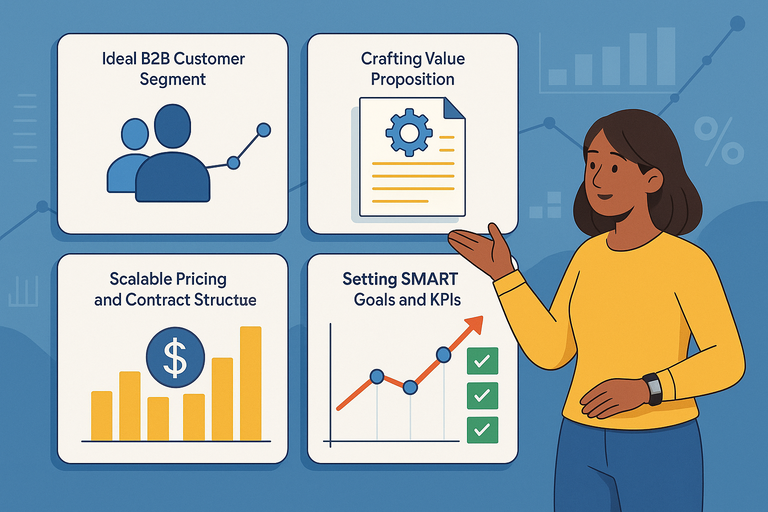
Before jumping into platforms or marketing, you need a strategy that ties everything together—from customer insights to pricing logic.
Defining Your Ideal B2B Customer Segments And Buying Journeys
You can’t market effectively if you don’t know your audience’s structure and needs. In B2B, that often means understanding decision hierarchies rather than single buyers.
Steps to define your B2B segments:
- Map roles – Identify who influences, approves, and uses your product.
- Document triggers – What initiates their buying cycle? Inventory shortages? Seasonal demand?
- Outline decision factors – Speed, customization, or after-sales support?
By mapping these journeys in your CRM, you can personalize experiences. For example, procurement managers might see bulk discount options, while technical teams see detailed specs.
Crafting A Value Proposition That Resonates With Business Buyers
Your value proposition should go beyond features—it should show ROI, efficiency, and reliability.
Ask: Why should another business choose you over their current supplier?
An effective framework:
- Outcome: What measurable result do you deliver?
- Proof: What data or client results support it?
- Ease: How effortless is it to work with you?
For instance, “We reduce procurement time by 40% through automated restock scheduling” tells a stronger story than “We sell industrial parts.”
Building A Scalable Pricing And Contract Structure
B2B pricing should adapt as you scale. Start with flexible tiers:
- Volume-Based Pricing: Discounts for higher quantities.
- Contract Pricing: Custom rates for long-term clients.
- Dynamic Pricing: Adjust based on demand or cost fluctuations.
If your e commerce system supports tiered pricing rules (Shopify Plus, Adobe Commerce, or BigCommerce), you can automate most of this. I suggest connecting your ERP so pricing updates reflect in real time across all sales channels.
Setting SMART Goals And KPIs For B2B E Commerce Growth
Without measurable goals, growth is just a guess. Use the SMART framework: Specific, Measurable, Achievable, Relevant, and Time-bound.
For example:
- Increase digital order volume by 25% in six months.
- Reduce manual quote generation time by 40%.
- Grow repeat customer rate by 15%.
Track KPIs like average order value (AOV), conversion rate, and customer lifetime value (CLV) through your analytics dashboard or CRM reports.
Choosing The Right B2B E Commerce Platform
The right platform acts as your digital backbone. It determines scalability, automation, and overall customer experience.
Evaluating Top B2B E Commerce Platforms: Shopify Plus, Magento, BigCommerce
Each platform suits a different business model:
- Shopify Plus: Ideal for speed and simplicity. Great for businesses that want out-of-the-box features and scalability without heavy IT setup. Example: UI path – Settings > Customers > Enable B2B Access Control.
- Magento (Adobe Commerce): Highly customizable and open-source. Perfect if you need deep control and complex integrations.
- BigCommerce B2B Edition: Balanced between flexibility and usability. Offers built-in support for quote management and B2B user roles.
I often recommend starting with a pilot store on one of these platforms before full migration—it reveals your operational gaps before they scale.
Key Features Every B2B Platform Must Have For Scalability
Look for these essentials before committing to a platform:
- Custom Pricing: Supports different rates per client.
- Bulk Ordering: Quick reordering tools and saved purchase lists.
- Integration-Ready: Works smoothly with ERP and CRM systems.
- Advanced Permissions: Role-based access for procurement teams.
A platform that scales should evolve with your customer needs—add new modules, automate workflows, and support multiple languages or currencies as you expand.
How To Integrate ERP, CRM, And Inventory Systems Seamlessly
Seamless integration is what turns a digital store into a business ecosystem.
Example Integration Path: ERP (e.g., SAP or NetSuite) → B2B e commerce platform → CRM (e.g., HubSpot or Salesforce).
When synced properly:
- Inventory updates automatically.
- Quotes and invoices stay consistent.
- Customer data remains unified across teams.
I recommend using middleware like Zapier to automate data flow without heavy coding.
Cost, Maintenance, And Flexibility Considerations Before You Choose
Every platform has hidden costs—transaction fees, custom development, plugins, or server maintenance.
To evaluate total cost:
- Add platform subscription + hosting + third-party app fees.
- Factor in developer support if using open-source solutions like Adobe Commmerce.
- Estimate future upgrades, as B2B needs evolve rapidly.
Shopify Plus is typically fastest to deploy; Adobe Commerce offers ultimate control but requires more resources. I believe the best choice depends on your internal tech capability and desired pace of growth.
Designing A Seamless B2B Buying Experience
A seamless B2B buying experience is about removing friction at every stage—from discovery to reordering.
In my experience, when navigation, personalization, and checkout flow work in harmony, conversion rates and customer retention naturally climb.
Optimizing Site Navigation And Product Search For Bulk Buyers
B2B buyers aren’t browsing casually; they’re on a mission to find specific SKUs fast. Optimizing navigation helps them do that without frustration.
Here’s what I recommend focusing on:
- Structured Categories: Create logical product groupings like “Industrial Fasteners > Stainless Steel > Metric Sizes.”
- Bulk Search Tools: Add multi-SKU upload fields or CSV import options so customers can add multiple items at once.
- Advanced Filters: Allow filtering by quantity, supplier, or specification (e.g., voltage, size, packaging).
- Search Autocomplete: Platforms like Shopify Plus let you enable predictive search suggestions via Settings > Search > Enable predictive search.
One of my clients in electrical wholesale saw a 22% faster checkout completion rate after introducing multi-SKU search. Bulk buyers value speed—every second saved builds trust.
Personalization Strategies That Drive Repeat Orders
B2B personalization goes beyond “Hi, John.” It’s about tailoring the catalog, pricing, and offers based on each company’s behavior and contract.
Effective personalization tactics include:
- Account-Specific Pricing: Automatically display contract rates for logged-in users.
- Smart Reordering: Show “Buy Again” buttons for frequently ordered items.
- Recommendation Algorithms: Suggest complementary products based on order history.
If you’re using Adobe Commerce or BigCommerce B2B Edition, I suggest activating Customer Groups or Price Lists to manage custom pricing dynamically.
I’ve seen this transform retention. For example, a manufacturer using dynamic recommendations lifted their reorder frequency by 18% in three months.
Streamlining The Checkout Process For Complex Orders
B2B buyers often deal with multi-location shipping, purchase orders, and tax-exempt documentation. Streamlining checkout keeps large transactions smooth.
Key optimizations to consider:
- Guest Checkout Alternatives: Offer purchase-order-based checkout for registered accounts.
- Multiple Shipping Addresses: Let users split orders between warehouses directly from the cart.
- Saved Payment Methods: Securely store corporate cards or ACH details for faster reorders.
For example, Shopify Plus’ B2B on Shopify allows creating custom checkout fields under Settings > Checkout > Additional Information. This enables smoother order flow for complex buying scenarios.
When checkout feels effortless, businesses don’t just complete the purchase—they commit to coming back.
Implementing Account Management And Self-Service Portals
Modern B2B e commerce thrives on self-service. Buyers expect full visibility into their orders, invoices, and contract pricing without calling support.
Essential self-service features include:
- Order Tracking Dashboards: Real-time visibility into fulfillment stages.
- Invoice Downloads: Automated access to billing records.
- Support Ticket Integration: Direct link to your CRM’s service system.
In BigCommerce’s B2B Edition, you can activate these tools through Settings > B2B Access > Company Accounts. It empowers users while freeing your sales reps from repetitive administrative work.
I advise viewing self-service as part of your customer relationship strategy, not just convenience—it reinforces transparency and reliability, two values B2B buyers never forget.
Creating A Scalable B2B Marketing Strategy
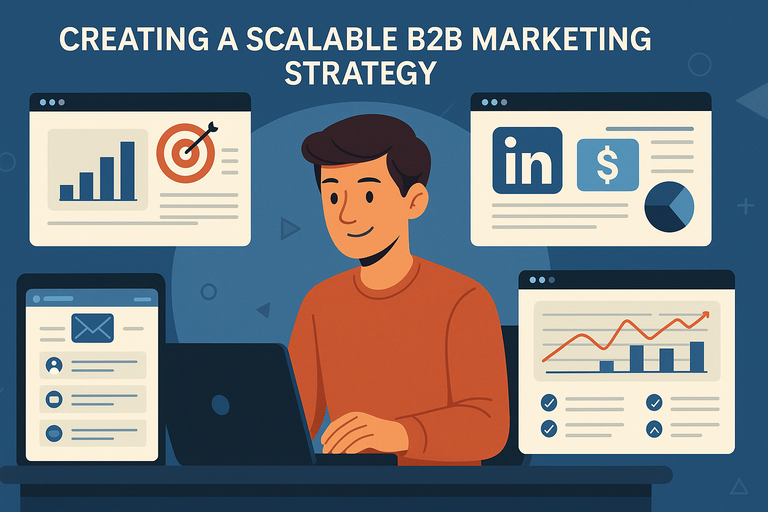
Scaling your B2B marketing requires alignment between visibility, lead quality, and conversion data. It’s less about pushing volume and more about attracting the right clients consistently.
How To Generate Qualified Leads Through Content And SEO
B2B e commerce SEO is a long-term trust builder. The goal is to educate, not just rank.
A few proven methods:
- Topic Clusters: Create interconnected guides around core themes (e.g., “Industrial Procurement Automation”).
- Schema Markup: Add structured data so search engines recognize product specs.
- Content Offers: Use gated PDFs like “2025 Procurement Trends Report” to capture leads.
From my experience, content that combines technical detail with industry insight—like ROI calculators or product comparison tables—generates more qualified leads than generic blog posts.
Leveraging LinkedIn And Paid Ads For B2B Customer Acquisition
LinkedIn remains the most effective channel for B2B targeting, especially when paired with remarketing.
Best practices for campaigns:
- Use Matched Audiences to retarget website visitors with LinkedIn Ads.
- Test Lead Gen Forms directly inside LinkedIn to simplify conversion.
- Pair paid LinkedIn ads with Google Search Ads targeting high-intent keywords.
For example, a SaaS vendor I worked with reduced cost per qualified lead by 35% after linking LinkedIn lead ads directly to a CRM workflow via HubSpot’s integration path: Marketing > Ads > Manage LinkedIn Integration.
Using Email Automation To Nurture Long Sales Cycles
B2B buyers don’t decide overnight. Automated email sequences keep your brand present without being pushy.
Tips to make automation more human:
- Segment based on job title, company size, or engagement.
- Mix educational emails with product demos or customer success stories.
- Use behavioral triggers like “opened product spec sheet” to send follow-ups.
Platforms like Klaviyo and Omnisend allow creating these journeys visually via drag-and-drop flows. I suggest keeping tone conversational—corporate doesn’t have to mean cold.
Data-Driven Marketing: Measuring What Truly Converts
It’s easy to get lost in vanity metrics. What matters is pipeline impact.
Track these key metrics:
- Lead-to-Customer Conversion Rate
- Marketing Qualified Leads (MQLs)
- Customer Acquisition Cost (CAC)
- Lifetime Value (LTV)
For transparency, connect your e commerce analytics with CRM dashboards.
For instance, linking BigCommerce to HubSpot (via native integration) lets you see which content actually drives revenue, not just clicks.
I recommend reviewing data monthly and pruning underperforming channels ruthlessly—it’s how you stay lean and scalable.
Streamlining Operations And Fulfillment For Growth
Operational efficiency is the backbone of scalable B2B e commerce. The faster you fulfill accurately, the more trust you build—and trust converts to recurring revenue.
How To Build An Efficient Supply Chain And Fulfillment Model
An efficient supply chain starts with visibility. Integrating suppliers, logistics, and inventory in one system reduces errors and improves responsiveness.
Core actions:
- Use a centralized ERP to track stock in real time.
- Automate purchase orders when stock drops below threshold.
- Diversify logistics partners to minimize regional disruptions.
I once worked with a food distributor who switched to a cloud-based WMS (Warehouse Management System) and saw a 28% reduction in delivery delays within two months. Efficiency compounds.
Automating Order Processing And Reordering Workflows
Automation keeps B2B operations running even when human teams rest.
Automation ideas that save hours:
- Auto-generate invoices after order confirmation.
- Trigger supplier restock alerts once inventory dips.
- Enable “Reorder Previous Purchase” buttons for frequent buyers.
In Shopify Plus, this can be configured through Automation > Workflows > Order Events > Create Trigger. I suggest testing every automation with sandbox data first—trust me, one wrong trigger can reorder 10,000 units unintentionally.
Managing Bulk Shipping, Returns, And Cross-Border Logistics
Shipping complexity scales with order size. Managing it well improves customer confidence and reduces friction.
Consider these steps:
- Offer real-time shipping quotes via API connections to carriers.
- Create return authorizations directly within the buyer’s account panel.
- Use multi-warehouse routing to fulfill from the nearest stock location.
Cross-border logistics often introduces tax and compliance challenges. Tools like Avalara or Zonos automate customs duties and documentation, which I highly recommend if you ship internationally.
Why Real-Time Inventory Syncing Prevents Lost Sales
Few things frustrate B2B buyers more than ordering something that’s “in stock” but isn’t. Real-time syncing prevents that.
Here’s how it helps:
- Keeps inventory data accurate across channels.
- Reduces backorders and refunds.
- Builds buyer confidence with transparency.
If your ERP (like NetSuite or Microsoft Dynamics) syncs every 15 minutes instead of daily, that alone can save thousands in lost revenue.
I advise scheduling sync intervals to match sales volume—high-volume sellers benefit from real-time updates, while smaller ones can sync hourly to reduce API load.
Building Trust And Long-Term B2B Customer Relationships
In B2B e commerce, trust isn’t a marketing slogan—it’s currency. Every transaction, message, and after-sale experience shapes whether clients see you as a partner or just another vendor.
The key to long-term relationships is consistency across communication, personalization, and support.
The Role Of Transparency And Consistent Communication
Transparency builds confidence, especially in long-term contracts where both sides depend on predictability.
What I suggest focusing on:
- Clear Pricing: Avoid hidden fees and communicate surcharges upfront. Many B2B buyers walk away after discovering unlisted delivery or handling costs.
- Real-Time Order Updates: Send automated notifications for every fulfillment stage—order confirmed, in transit, delivered.
- Honest Problem Handling: When an issue arises, address it directly. A sincere “We’re fixing it” works far better than silence.
For example, integrating your ERP (like NetSuite) with a customer-facing portal allows live inventory and shipping updates—no more vague email chains.
From what I’ve seen, consistent communication increases repeat orders because clients feel informed, not sold to.
How To Use Account-Based Marketing (ABM) For Retention
Account-Based Marketing (ABM) means targeting specific high-value accounts with tailored experiences. It’s not just for lead generation—it’s a retention powerhouse.
Here’s how you can apply ABM in B2B e commerce:
- Segment Key Accounts: Identify top 10–20% of clients generating 80% of revenue.
- Customize Content: Send personalized product updates or industry insights relevant to their business.
- Align Sales And Marketing: Use CRM tools (like HubSpot or Salesforce) to share customer data and trigger custom campaigns.
One manufacturer I advised used ABM to send quarterly performance dashboards showing how their supply reliability improved client uptime. That small gesture cut churn by nearly 30%.
Implementing Loyalty Programs For Repeat Buyers
B2B loyalty isn’t about free mugs or discount codes—it’s about relationship rewards.
Effective loyalty incentives include:
- Volume-based discounts.
- Priority fulfillment or dedicated support access.
- Exclusive previews for new product lines.
Platforms like BigCommerce let you set up customer groups to automate these perks under Settings > Customer Segmentation > Create Group.
I believe loyalty programs work best when they reward partnership behavior, not just transactions—think co-marketing opportunities or early beta access for trusted buyers.
Providing Post-Purchase Support That Builds Advocacy
After a purchase, support becomes your brand’s loudest voice.
To turn buyers into advocates:
- Offer 24/7 self-service FAQs plus human chat backup.
- Follow up with “how-to” guides or setup walkthroughs.
- Collect feedback proactively through email surveys or review prompts.
I’ve seen companies win referrals just by following up to ensure delivery satisfaction. Advocacy grows naturally when buyers feel their success matters to you personally.
Scaling B2B E Commerce With Technology And Innovation

Scaling isn’t just about adding more clients—it’s about sustaining speed and accuracy as complexity grows.
The smartest B2B operations use technology not as decoration but as infrastructure.
Leveraging AI And Machine Learning For Predictive Insights
AI helps businesses forecast demand, detect churn risks, and optimize pricing.
Practical examples:
- Predictive analytics can identify seasonal spikes, letting you restock before competitors.
- AI chatbots can handle 70% of order-related queries instantly, freeing sales reps for strategic work.
In Adobe Commerce, you can activate AI-driven recommendations via Adobe Sensei > Product Suggestions. This small feature alone can increase upsell conversions by 15–20%.
From what I’ve observed, AI becomes truly valuable when tied to real operational metrics—not just data dashboards.
How APIs And Microservices Enable Rapid Scalability
Monolithic systems slow you down as you grow. APIs (application programming interfaces) and microservices break big systems into smaller, flexible parts.
Why this matters:
- APIs let your e commerce, CRM, and logistics platforms “talk” without heavy custom coding.
- Microservices isolate key functions (like checkout or inventory) so upgrades don’t crash the whole system.
For instance, using Shopify Plus with an API middleware like MuleSoft allows seamless ERP and warehouse syncing—perfect for fast-scaling distributors. I often recommend this approach to companies expecting international expansion.
Using Data Analytics To Identify New Market Opportunities
Your e commerce analytics isn’t just a performance tool—it’s a map to future growth.
Ways to find opportunities:
- Track which SKUs or categories trend upward by region.
- Analyze abandoned carts to spot missing variants or pricing barriers.
- Compare B2B customer segments by purchase cycle length.
Connecting tools like Google Analytics 4 with your CRM gives deeper insight into buyer behavior. One of my clients identified a growing demand for “green packaging” just by studying search queries within their store.
The Role Of Automation In Reducing Operational Bottlenecks
Automation is the secret ingredient to scalability. It handles repetitive work so your team can focus on value creation.
High-impact automations include:
- Automatic invoice generation and email dispatch.
- Triggered reorders when inventory hits thresholds.
- Automated RMA (Return Merchandise Authorization) processing.
Shopify Plus’s Flow feature is perfect for this—it’s found under Automation > Workflows.
I always suggest starting small: automate one workflow, test it, then expand. Automation done thoughtfully can save hundreds of labor hours without compromising quality.
Common Mistakes To Avoid When Scaling B2B E Commerce
Even well-established B2B brands stumble when scaling too fast. Avoiding these pitfalls can save you time, money, and credibility.
Overlooking Platform Scalability And System Integration
A B2B platform that works for 50 clients may crumble under 500 if integration isn’t solid.
If you’re seeing delays in syncing or manual reconciliation, it’s a warning sign. Always check:
- Can your ERP handle real-time API calls?
- Are integrations tested for large transaction volumes?
- Does your hosting infrastructure auto-scale during spikes?
I once saw a company’s entire checkout crash during trade show season because their platform couldn’t handle simultaneous bulk orders. Integration readiness should be your first scalability audit.
Ignoring The Complexity Of B2B Buyer Decision-Making
B2B buyers aren’t single individuals—they’re committees. That means your site and content must serve multiple roles: technical evaluators, finance approvers, and procurement officers.
To address this complexity:
- Offer detailed spec sheets for engineers.
- Provide ROI calculators for finance teams.
- Include procurement-focused FAQs and payment terms.
I’ve found that sites with role-specific resources tend to convert 25–30% better on large accounts because they meet every stakeholder’s need directly.
Failing To Align Sales And Marketing Teams
Sales and marketing misalignment is a silent killer. Leads get lost, follow-ups stall, and campaigns underperform.
How to fix it:
- Define shared KPIs (like qualified leads, not vanity metrics).
- Integrate CRM and marketing platforms for unified tracking.
- Hold joint pipeline review meetings monthly.
In my experience, companies that unify these departments shorten their sales cycles by up to 20%. Collaboration always outperforms competition—especially internally.
Underinvesting In Customer Support And Post-Sale Experience
Fast growth often pushes support to the background. That’s a mistake. B2B customers judge reliability long after checkout.
Avoid this by:
- Training your support team on client history and contract terms.
- Offering multiple support channels—live chat, phone, portal.
- Tracking satisfaction metrics like NPS (Net Promoter Score).
A quick follow-up call after large deliveries often prevents churn. I’ve seen that simple human touch transform “buyers” into lifelong partners.
Future Trends Shaping B2B E Commerce Growth
B2B e commerce is evolving faster than ever. The next few years will reward businesses that embrace mobility, ethics, and automation-driven personalization.
The Rise Of Mobile And Voice-Enabled B2B Transactions
Mobile now drives nearly 50% of B2B queries (Google, 2024). Buyers expect seamless mobile UX just like consumers.
To adapt:
- Optimize mobile checkout with fewer form fields.
- Enable voice search through integrations like Algolia Voice Search API.
- Offer push notifications for account updates.
Voice commerce may seem futuristic, but companies using it for reorder confirmations are already saving hours in procurement calls.
Sustainability And Ethical Sourcing As Competitive Differentiators
Sustainability isn’t just a moral choice anymore—it’s a market demand.
What B2B buyers now ask:
- Are your materials ethically sourced?
- What’s your carbon footprint per shipment?
- Can you provide ESG (Environmental, Social, Governance) documentation?
Platforms like Shopify Planet allow automatic carbon offsetting at checkout. I advise including transparency reports directly in product pages—it strengthens credibility instantly.
How Subscription And Replenishment Models Are Redefining B2B Sales
Subscription models bring predictability to both cash flow and client retention.
Best applications:
- Consumable goods like cleaning supplies or packaging materials.
- Regular restock items with stable demand.
- SaaS-based product licensing.
Shopify Plus’s B2B on Shopify supports subscription workflows under Settings > Recurring Payments > Enable Auto-Restock. Businesses using this feature often report a 20–30% increase in repeat order frequency.
Preparing For The Next Phase Of Global B2B Digital Commerce
The next phase of B2B e commerce will combine personalization, AI, and sustainability into one connected ecosystem.
I believe the winners will be those who:
- Use data ethically and transparently.
- Combine automation with genuine human connection.
- Stay agile enough to adopt emerging technologies early.
In essence, B2B e commerce isn’t just about selling—it’s about building long-term, technology-powered relationships that scale trust as much as revenue.

I’m Juxhin, the voice behind The Justifiable.
I’ve spent 6+ years building blogs, managing affiliate campaigns, and testing the messy world of online business. Here, I cut the fluff and share the strategies that actually move the needle — so you can build income that’s sustainable, not speculative.
Related posts:
 B2B Ecommerce Platforms That Power Serious Growth
 What Is Headless Commerce and Why Does It Matter?
 Composable Commerce Explained: The Future of Online Stores
 NetSuite Ecommerce Features That Drive Serious Growth
 What Is Headless Commerce and Why It’s Transforming Ecommerce
 SAP Commerce Cloud Explained: Features, Pricing, and Value