
Table of Contents
Some links on The Justifiable are affiliate links, meaning we may earn a small commission at no extra cost to you. Read full disclaimer.
When people ask me about the best sites to sell online, they’re usually frustrated with getting likes, views, or traffic that never turns into real money.
This guide is for creators, side-hustlers, small business owners, and online sellers who want profit, not just exposure.
I’m answering one clear question here: Which platforms actually help you sell online and keep more of what you earn?
Shopify Stores Built For Full Profit Control Online
If your goal is real profit and not borrowed attention, Shopify is one of the best sites to sell online when you want control.
You’re not renting space in someone else’s marketplace—you’re building an asset you own, shape, and scale on your terms.
Why Shopify Beats Marketplaces For Long-Term Profit
Ownership changes everything: With Shopify, you own the storefront, the customer data, and the relationship. On marketplaces like Amazon or Etsy, the platform owns the buyer. That single difference compounds over time.
Profit compounds outside the first sale: In my experience, Shopify stores shine once you start doing repeat business. Email marketing, SMS, upsells, subscriptions—these are hard or impossible to control fully on marketplaces.
Example scenario: Let’s say you sell a $40 product.
- On Amazon, you might net $18–$22 after fees.
- On Shopify, you might net $30+ on the first sale.
- On the second sale to the same customer, your margin often jumps above 80% because there’s no acquisition cost.
That’s why brands thinking long-term almost always graduate to Shopify.
Fees, Margins, And Ownership Compared To Other Platforms
Shopify fees are predictable: You pay a monthly subscription plus payment processing. That’s it.
Typical cost breakdown:
- Shopify Basic: ~$39/month
- Payment processing: ~2.9% + $0.30 per transaction
Compare that to marketplaces:
- Amazon: 15% referral fee (sometimes more) + FBA fees
- Etsy: Listing, transaction, payment processing, and optional ad fees
Margin reality check: On Shopify, margins of 60–80% are common for digital products and 40–60% for physical goods. Marketplaces often squeeze that down to 20–40%.
Ownership advantage: Your store can be sold, scaled, or leveraged as a real business asset. Marketplace accounts rarely hold the same valuation.
Best Product Types That Perform Well On Shopify
Products that benefit from branding win here: Shopify works best when the product isn’t a pure commodity.
High-performing categories include:
- Branded physical products (skincare, supplements, apparel)
- Digital products (courses, templates, downloads)
- Print-on-demand with strong positioning
- Subscription-based products
- High-margin niche products with a story
What struggles: Generic items people can easily find cheaper on Amazon. If price is your only hook, Shopify will feel harder.
My rule of thumb: If you can explain why your product exists in one sentence, it probably belongs on Shopify.
Shopify Apps That Directly Increase Conversion Rates
Apps aren’t fluff when used correctly: The right Shopify apps increase average order value and conversion without more traffic.
High-impact categories:
- Upsell and cross-sell tools: Apps like ReConvert or Zipify Upsell
- Email and SMS recovery: Kit (formerly ConvertKit) or Klaviyo for abandoned carts
- Social proof: Judge.me or Loox for reviews
- Checkout optimization: One-click upsells and post-purchase offers
Simple win I see often: Adding a post-purchase upsell alone can increase revenue 10–20% without touching traffic. That’s pure profit leverage.
Etsy For High-Intent Buyers Ready To Spend Money
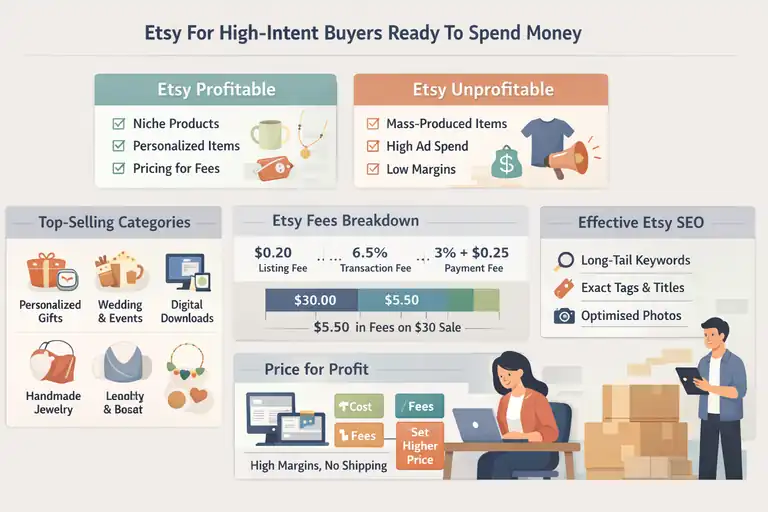
Etsy earns its place among the best sites to sell online because buyers arrive ready to buy, not browse. The intent is built in—but the platform only works when you play by its rules.
When Etsy Is Profitable Versus When It Is Not
Etsy is profitable when:
- You sell niche or personalized products
- Your items feel handmade, custom, or unique
- You price for fees instead of racing competitors
Etsy struggles when:
- You sell mass-produced items with thin margins
- You rely heavily on Etsy Ads without tracking ROI
- You treat it like a passive income machine
Quick reality check: Etsy works best as a product-first platform, not a brand-first one. People search for items, not companies.
Etsy Fees And How They Impact Net Profit Margins
Etsy’s fee stack surprises many sellers:
- Listing fee: $0.20 per item
- Transaction fee: 6.5%
- Payment processing: ~3% + $0.25
- Optional Etsy Ads: Variable, often 12–15%
Real margin example: On a $30 product:
- Total fees can hit $5–$7
- Add materials and labor, and margins can shrink fast
My advice: Price higher than you think you should. Sellers who succeed on Etsy don’t compete on price—they compete on specificity.
Product Categories That Consistently Sell On Etsy
Etsy rewards clarity and intent: Buyers know what they want.
Top-performing categories:
- Personalized gifts (names, dates, custom text)
- Wedding and event items
- Digital downloads (planners, wall art, templates)
- Handmade jewelry and decor
- Niche craft supplies
Digital products deserve special mention: Once created, they scale beautifully. Many Etsy sellers hit 70–90% margins with digital files because there’s no inventory or shipping.
Etsy SEO Tactics That Drive Buyer-Ready Traffic
Etsy SEO is simpler than Google—but unforgiving: You must match buyer intent exactly.
What actually works:
- Use long-tail keywords buyers type verbatim
- Match titles, tags, and categories precisely
- Optimize the first image for click-through, not aesthetics
- Refresh underperforming listings every 30–60 days
Personal tip: I’ve seen listings double in sales just by changing the first photo to show the end result in use. Etsy shoppers buy outcomes, not features.
Amazon Seller Central For Scalable High-Volume Sales
Amazon earns its spot among the best sites to sell online when volume and scale matter more than brand control.
It’s not the easiest platform, and it’s rarely the most forgiving, but if your product works, Amazon can move units faster than almost anywhere else.
Amazon FBA Versus FBM Profit Trade-Offs Explained
Selling on Amazon really comes down to one decision early on: FBA or FBM.
• FBA (Fulfilled by Amazon): Amazon stores, packs, ships, and handles customer service for you
• FBM (Fulfilled by Merchant): You store and ship orders yourself
Here’s the honest trade-off.
FBA usually wins on conversion. Prime badges build instant trust, and Amazon’s data shows Prime listings convert up to 30–40% better in many categories. That said, FBA fees eat into margins fast, especially for oversized or low-priced items.
FBM gives you more control and better margins on certain products, but you’ll work harder to earn buyer trust. Late shipments or slow responses hurt rankings quickly.
My rule from experience:
- Lightweight, fast-moving products usually favor FBA
- Custom, fragile, or higher-priced items often do better with FBM
Neither is “better.” The right choice depends on your cost structure, not your preference.
Fee Structure And How To Price For Real Margins
Amazon fees are where most sellers quietly lose money.
At a minimum, expect:
- Referral fee: Around 15% in most categories
- Fulfillment fee (FBA): Depends on size and weight
- Storage fees: Monthly, and higher during Q4
- Returns: Often absorbed by the seller
A common beginner mistake is pricing emotionally instead of mathematically.
Here’s a simple margin reality check I use:
- If your landed cost (product + shipping + packaging) is $10
- Amazon takes $8–$12 in combined fees
- Your price must be at least $30 to leave room for ads and profit
If the market won’t support that price, the product doesn’t work on Amazon. That’s not failure—that’s clarity.
Product Research Tools Amazon Sellers Actually Use
Amazon success starts before you ever source a product.
Tools sellers actually rely on:
- Helium 10 for keyword demand and listing optimization
- Jungle Scout for sales volume estimates
- Amazon’s own Best Seller lists for trend validation
What I look for personally:
- Consistent demand, not spikes
- Listings with weak images or poor copy
- Reviews that complain about fixable issues
If buyers are telling you what’s wrong, they’re also telling you how to win.
Winning The Buy Box Without Racing To The Bottom
The Buy Box is where most sales happen, but price alone doesn’t win it.
Amazon also looks at:
- Seller performance metrics
- Shipping speed
- Stock availability
- Customer satisfaction history
Ways to stay competitive without killing margins:
- Bundle products competitors sell separately
- Improve perceived value instead of lowering price
- Use FBM strategically when FBA fees spike
In my experience, sellers who obsess over price lose. Sellers who obsess over experience last longer.
eBay For Fast Sales And Flexible Pricing Strategies
eBay doesn’t get the respect it deserves, but it remains one of the best sites to sell online if speed and flexibility matter. It’s less polished than Amazon, but that’s exactly why opportunity still exists.
Why eBay Still Works For Profit-Driven Sellers
eBay shines where other platforms struggle.
It’s excellent for:
- One-off items
- Clearance inventory
- Used, refurbished, or open-box products
- Testing pricing without long-term commitment
Unlike Amazon, eBay buyers often expect variation. That flexibility lets you price dynamically instead of locking yourself into a race to the bottom.
I’ve seen sellers generate cash flow on eBay in days, not months. That speed matters when you’re funding inventory or validating demand.
Auction Versus Fixed Price Profit Considerations
Auctions sound exciting, but they’re rarely the most profitable option.
Use auctions when:
- Demand is proven and competitive
- The item is rare or collectible
- You want fast liquidation
Use fixed price when:
- You know your margin floor
- The product has steady demand
- You want predictable profit
A strategy I like:
- Start with a higher fixed price
- Gradually lower it every 7–10 days
- Let the market tell you where profit meets demand
Product Types That Convert Best On eBay Today
eBay buyers shop with intent, but not always brand loyalty.
High-performing categories include:
- Electronics and accessories
- Auto parts and tools
- Collectibles and trading cards
- Fashion with clear condition grading
- Refurbished or certified-used items
Transparency sells here. Detailed photos and honest descriptions often outperform polished branding.
eBay Fee Breakdown And Margin Optimization Tips
eBay fees are simpler than Amazon’s but still matter.
Typical costs:
- Final value fee: Around 13–15%
- Payment processing included
- Optional promoted listings for visibility
Margin optimization tips that work:
- Build shipping costs into item price
- Use calculated shipping for heavier items
- Reuse listings with proven conversion history
- Optimize titles for search, not creativity
One small tweak I’ve seen boost profit: listing the same item in multiple conditions or bundles. Buyers self-select, and average order value quietly rises.
WooCommerce For Sellers Wanting Cost Control
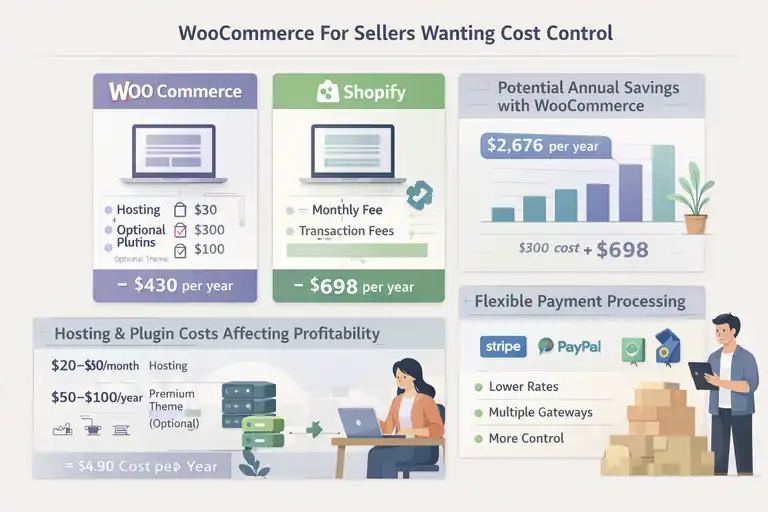
WooCommerce often flies under the radar, but for sellers who care deeply about margins, it’s one of the best sites to sell online when cost control matters more than convenience.
It’s not the easiest platform, but it rewards sellers who like flexibility and don’t mind getting their hands a little dirty.
WooCommerce Versus Shopify Profit Comparison
Here’s the honest difference, without hype.
Shopify charges you for convenience. WooCommerce charges you for infrastructure.
How the math usually plays out: With Shopify, you pay a monthly fee plus transaction costs. With WooCommerce, the software itself is free, but you pay for hosting, themes, and plugins as needed.
For small stores, Shopify often feels cheaper because everything “just works.”
For growing stores, WooCommerce usually wins on margins.
I’ve seen WooCommerce stores save thousands per year once they hit steady volume simply because:
- No mandatory monthly platform fee
- More control over payment processing
- Fewer forced app subscriptions
If you’re selling consistently and traffic is predictable, WooCommerce quietly becomes more profitable over time.
Hosting And Plugin Costs That Affect Profitability
This is where people get tripped up.
WooCommerce costs depend on choices you make, not fixed pricing.
Typical cost stack:
- Hosting: $20–$50/month for a solid managed host
- Premium theme (optional): $50–$100/year
- Plugins: Varies based on features
Where profit leaks happen:
- Installing too many plugins “just in case”
- Paying yearly licenses for features you don’t use
- Cheap hosting that slows the site and kills conversions
My personal rule: if a plugin doesn’t directly increase revenue, conversion rate, or operational efficiency, it doesn’t stay.
Best Use Cases For WooCommerce-Based Stores
WooCommerce shines when customization equals money.
It works best for:
- Content-driven stores using SEO
- Niche brands with loyal audiences
- Subscription or membership products
- Stores needing custom checkout logic
- Sellers scaling traffic through blogs or email
Where it struggles:
- Total beginners who want plug-and-play
- Sellers relying entirely on paid ads with no technical help
If you already understand your customer and traffic source, WooCommerce gives you profit leverage most platforms can’t.
Payment Gateway Choices That Reduce Transaction Fees
This is one of WooCommerce’s biggest advantages.
You’re not locked into one payment processor.
Popular options include:
- Stripe for cards and wallets
- PayPal for trust and global buyers
- Local gateways with lower regional fees
Small change, big impact: Switching from a 2.9% processor to a 2.4% option on $50,000 in annual sales saves real money. It’s not flashy, but it compounds.
I’ve always liked WooCommerce for sellers who think like operators, not influencers.
Facebook Marketplace For Local And Cash-Flow Sales
Facebook Marketplace is not glamorous, but it’s one of the fastest ways to generate cash flow.
For sellers who need momentum, it’s easily one of the best sites to sell online for quick wins and local demand.
Why Facebook Marketplace Converts Faster Than Ads
The biggest advantage here is intent.
People browsing Marketplace are already shopping. They’re not scrolling for entertainment like they are with ads.
What makes conversion faster:
- No learning curve for buyers
- Built-in trust through profiles
- Direct messaging removes friction
- Local pickup feels safer for many buyers
I’ve listed items that sold within hours with zero marketing. That kind of speed is rare online.
Products That Perform Best In Local Selling Models
Marketplace favors practical, tangible products.
Top performers include:
- Furniture and home goods
- Electronics and accessories
- Fitness equipment
- Baby and kid items
- Seasonal or bulky products
Items that struggle:
- Generic dropship-style products
- Digital goods
- Products needing long explanations
If someone can imagine picking it up today, it usually sells better.
Pricing Strategies To Avoid Lowball Buyers
Lowball offers are part of the ecosystem, but they’re manageable.
Strategies that actually help:
- Price 10–15% above your real minimum
- Add “Price firm” only when you mean it
- Respond once, not emotionally
- Bundle items to raise perceived value
One trick I use: I include pickup windows in the listing. Serious buyers respect time boundaries. Time-wasters disappear.
Scaling Beyond Local Without Losing Profit
Marketplace doesn’t have to stay local.
Ways sellers expand:
- Shipping smaller items nationwide
- Using Marketplace to test pricing
- Moving repeat buyers to direct payment
- Treating it as demand validation before scaling
I’ve seen sellers use Facebook Marketplace as a testing ground, then move winning products to Shopify or WooCommerce once demand is proven. That transition alone can double margins.
Gumroad For Digital Products With High Margins
Gumroad is one of those platforms that looks simple on the surface but quietly earns its place among the best sites to sell online for digital creators.
If your product is downloadable and your goal is margin, speed, and simplicity, Gumroad is hard to beat.
Why Gumroad Works For Creators Selling Direct
Gumroad removes friction. That’s the real advantage.
There’s no store setup maze, no theme decisions, and no plugin stack. You upload a file, set a price, and sell. That’s it.
Why this matters in practice:
- You can launch in a single afternoon
- There’s almost no technical overhead
- Buyers trust the checkout instantly
I’ve seen creators delay launches for months trying to “perfect” a store. Gumroad flips that. You ship first, refine later, and start learning from real buyers instead of assumptions.
It works especially well if:
- You already have an audience
- You sell knowledge, templates, or tools
- You want validation before building a full site
In short, Gumroad rewards momentum.
Fee Structure And Profit Takeaways Explained
Gumroad’s pricing is refreshingly transparent.
Typical fees:
- Around 10% per sale for smaller creators
- Fees decrease as volume increases
- No monthly subscription required
At first glance, 10% sounds high. But compare it honestly.
With Shopify, you might pay:
- Monthly platform fees
- App subscriptions
- Payment processing fees
On Gumroad, you pay only when you make money.
Real margin example:
- $29 digital product
- Roughly $3 in fees
- No hosting, no support costs, no delivery expenses
That leaves you with margins many physical sellers never see. I’ve always viewed Gumroad as a profit-first tool, not a branding platform.
Best Digital Products To Sell On Gumroad
Gumroad shines when the product delivers immediate value.
Top-performing categories include:
- Notion templates and spreadsheets
- Ebooks and short guides
- Design assets and code snippets
- Mini-courses and workshops
- Paid newsletters or exclusive content
Products that struggle:
- Large multi-module courses
- Highly interactive memberships
- Anything needing complex upsells
My experience says this clearly: the faster a buyer can use the product after purchase, the better it sells on Gumroad.
Traffic Strategies That Turn Views Into Sales
Gumroad doesn’t generate traffic for you. That’s both the weakness and the opportunity.
Traffic sources that convert well:
- Email lists
- X (Twitter) threads with clear CTAs
- YouTube descriptions
- Blog posts solving one specific problem
A simple strategy I like:
- Teach one useful thing publicly
- Sell the shortcut privately
- Link directly to Gumroad
Because checkout is frictionless, even small audiences can convert surprisingly well.
BigCommerce For Brands Focused On Higher Order Value
BigCommerce is built for sellers who already think like operators. It’s one of the best sites to sell online when average order value matters more than speed of setup.
BigCommerce Versus Shopify For Growing Stores
Both platforms are powerful, but they attract different sellers.
Shopify prioritizes simplicity.
BigCommerce prioritizes scalability without extra apps.
Key differences in real use:
- BigCommerce includes more native features
- Shopify relies heavily on paid apps
- BigCommerce handles complex catalogs better
For brands doing higher-volume or B2B-style sales, BigCommerce often ends up cheaper long term because fewer add-ons are required.
I’ve noticed BigCommerce fits teams better than solo creators. If you’re thinking about systems early, it’s worth a look.
Built-In Features That Reduce App Costs
This is where BigCommerce quietly saves money.
Native features include:
- Advanced product options
- Real-time shipping quotes
- Faceted search for large catalogs
- Multi-storefront capabilities
On Shopify, many of these require paid apps. Those monthly app fees add up fast and eat into margins.
Less software sprawl also means:
- Faster sites
- Fewer conflicts
- Lower maintenance stress
It’s not flashy, but it’s very profitable.
Ideal Business Models For BigCommerce Sellers
BigCommerce works best for structured businesses.
Strong use cases:
- Brands with multiple SKUs
- Wholesale or B2B sellers
- Subscription-heavy catalogs
- International stores with complex tax rules
Where it’s less ideal:
- One-product starter stores
- Sellers who want extreme design flexibility without dev help
If your business already feels like a system, BigCommerce fits naturally.
Payment And Checkout Optimizations For Profit
Checkout efficiency is where BigCommerce earns its keep.
Profit-focused advantages:
- Multiple payment gateway support
- Optimized one-page checkout
- Better handling of bulk orders
Even small checkout improvements matter. A 1% increase in conversion rate on a store doing $50,000 per month is real money, not theory.
My take: BigCommerce isn’t for everyone, but for the right seller, it quietly outperforms more popular options.
TikTok Shop For Trend-Driven Impulse Purchases
TikTok Shop is still new enough that inefficiencies exist, and that’s exactly why it belongs on any list of the best sites to sell online right now. It’s not built for careful shoppers. It’s built for impulse, emotion, and speed.
How TikTok Shop Turns Content Into Sales
TikTok Shop works because it collapses the distance between discovery and checkout.
- Someone watches a video.
- They tap the product.
- They buy without leaving the app.
That matters more than people realize.
Traditional ecommerce asks users to:
- Click an ad
- Load a website
- Trust a new brand
- Enter payment details
TikTok Shop skips most of that.
What converts especially well:
- Demonstrations, not explanations
- Before-and-after visuals
- First-use reactions
- Short, imperfect videos that feel real
In my experience, polished ads often underperform raw creator-style clips. TikTok rewards authenticity over production quality, which is refreshing and profitable if you lean into it.
Commission Structure And Profit Reality Check
TikTok Shop isn’t free money. The margins depend on math, not hype.
Typical costs include:
- Platform commission (varies by region and promo period)
- Affiliate commission if creators promote for you
- Shipping and product cost
During aggressive growth phases, TikTok has offered reduced commissions or incentives. When those exist, margins can be excellent. When they don’t, profit depends heavily on product pricing.
A simple rule I use:
- If your product can’t absorb a 20–30% total cost and still be profitable, TikTok Shop will feel stressful
- If it can, TikTok becomes a volume engine
This is not a branding-first platform. It’s a momentum platform.
Product Categories That Perform Best On TikTok Shop
Some products are almost unfairly good on TikTok.
Consistent winners include:
- Beauty and skincare tools
- Home problem-solvers
- Fitness and posture products
- Kitchen gadgets
- Affordable fashion accessories
The pattern is simple. Products that show a visible transformation in under 10 seconds sell best.
If your product needs a long explanation, TikTok will fight you. If it shows results instantly, TikTok does the selling for you.
Creator And Affiliate Leverage For Faster Growth
This is where TikTok Shop gets interesting.
You don’t need to be the face of the brand. Creators can sell for you.
How it works in practice:
- You list a product
- Creators opt in as affiliates
- They earn a commission per sale
- You only pay when sales happen
That’s performance marketing without upfront ad spend.
I’ve seen products stall completely on paid ads, then explode once 10–20 small creators started posting authentic videos. It’s messy, unpredictable, and very real.
Your Own Website With Stripe For Maximum Profit
If your priority is margin and control, nothing beats your own site powered by Stripe. Among the best sites to sell online, this is the option sellers graduate to once they’re done paying platform taxes.
Why Direct Sales Always Win On Margins
Direct sales remove the middleman.
- No marketplace commission.
- No algorithm risk.
- No sudden policy changes.
What you gain:
- Full customer data
- Full pricing control
- Full brand ownership
Yes, you work harder for traffic. But once a customer buys from you directly, future sales are dramatically cheaper.
In my experience, this is where real businesses are built. Everything else is often a stepping stone.
Stripe Fees Compared To Marketplace Commissions
Stripe is a payment processor. That just means it handles credit cards and payouts.
Typical Stripe fees:
- Around 2.9% + a small fixed amount per transaction
Compare that to:
- Amazon taking 15% or more
- Etsy stacking multiple fees
- App-based platforms charging monthly plus transaction costs
On a $100 product:
- Stripe might take under $3
- A marketplace might take $15–$30
That difference funds ads, content, or simply higher profit.
Traffic Sources That Make Direct Selling Viable
Direct sites live or die by traffic quality.
What works best:
- SEO-driven blog content
- Email lists you actually nurture
- YouTube with long-term discovery
- Retargeting ads, not cold traffic only
Direct selling struggles if you rely purely on impulse traffic. It thrives when trust is built over time.
I always tell sellers: build the audience first, then push direct sales harder. The order matters.
When A Standalone Site Makes Financial Sense
A standalone site is worth it when:
- You have repeat customers
- You sell high-margin products
- You understand your traffic source
- You want long-term brand equity
It’s less ideal when:
- You’re testing your first product
- You need instant traffic
- You don’t yet know your audience
Think of marketplaces as training wheels. Your own site is the bike.

I’m Juxhin, the voice behind The Justifiable.
I’ve spent 6+ years building blogs, managing affiliate campaigns, and testing the messy world of online business. Here, I cut the fluff and share the strategies that actually move the needle — so you can build income that’s sustainable, not speculative.
Related posts:
 Best Platform to Sell Online for Fast Growth and Low Fees
 Online Store Website Builder That Helps You Sell Fast
 Top Online Store Platforms for Building Income Streams
 Creating a Website to Sell Products That Converts Fast
 Headless Ecommerce Platform: Is It the Faster Way to Scale?
 Ecommerce CRM Tools That Turn Customers Into Repeat Buyers