
Table of Contents
Some links on The Justifiable are affiliate links, meaning we may earn a small commission at no extra cost to you. Read full disclaimer.
When people ask me about the best b2b ecommerce platforms, it’s usually because their current setup is breaking under complex sales workflows, custom pricing, approvals, or multi-account buyers.
This guide is for B2B leaders, ecommerce managers, and operations teams selling to other businesses with negotiated pricing, large catalogs, and long buying cycles.
It answers one core question: which B2B ecommerce platforms actually handle complex sales workflows without constant workarounds?
Salesforce Commerce Cloud For Enterprise B2B Sales Operations
Salesforce Commerce Cloud is often shortlisted when companies are dealing with long sales cycles, layered approvals, and heavy CRM dependence.
I usually recommend it when sales, service, and ecommerce need to work as one system instead of separate tools duct-taped together.
Native CRM And Ecommerce Data Unification
This is where Salesforce genuinely earns its reputation. Commerce Cloud is built directly on the Salesforce platform, which means ecommerce activity lives in the same ecosystem as CRM data.
Why this matters in practice:
- Sales reps see live cart activity inside Salesforce CRM
- Buyers get personalized storefronts based on account history
- Service teams can reference orders, contracts, and renewals instantly
In one enterprise setup I worked with, syncing ecommerce orders into CRM alone reduced manual sales admin time by nearly 30 percent. That’s not magic. It’s just fewer systems fighting each other.
From what I’ve seen, this tight unification is especially valuable when inside sales teams still play a big role alongside self-serve ecommerce.
Advanced Account Hierarchies And Buyer Role Controls
Salesforce handles complex B2B account structures better than most platforms.
Key capabilities include:
- Parent-child account hierarchies
- Role-based permissions for buyers, approvers, and finance users
- Spend limits and purchasing authority by role
Imagine a global manufacturing client with regional buyers, local approvers, and a central finance team. Salesforce allows each of those users to see only what’s relevant to them, without custom hacks.
I believe this is one of the strongest reasons Salesforce often appears on “best b2b ecommerce platforms” lists for enterprise buyers.
AI-Driven Personalization For Contract-Based Pricing
Salesforce’s Einstein AI sounds intimidating, but the real value is simple: smarter pricing and product recommendations based on data.
Where it shows up:
- Contract pricing surfaced automatically per account
- Product recommendations based on reorder behavior
- Personalized merchandising tied to deal history
For example, if a buyer consistently reorders the same SKUs every quarter, Einstein can prioritize those products the moment they log in. Less searching, faster reorders, higher conversion.
This isn’t just convenience. Salesforce reports that personalized B2B experiences can lift conversion rates by double digits when implemented correctly.
API Flexibility For ERP And Middleware Integrations
Salesforce Commerce Cloud is not a plug-and-play toy. It’s built for environments where ERP systems like SAP or Oracle already exist.
Integration strengths include:
- Robust REST APIs
- Middleware-friendly architecture
- Real-time sync for pricing, inventory, and orders
I’ve seen teams connect Salesforce to SAP S/4HANA, NetSuite, and even legacy ERPs without rebuilding everything. It takes planning, but the flexibility is there.
If your business already runs on Salesforce CRM, this integration story gets much simpler.
Scalability For Global Multi-Brand B2B Commerce
Salesforce Commerce Cloud is designed to scale across regions, brands, and currencies.
Enterprise-ready features:
- Multi-site and multi-brand management
- Global tax and currency handling
- High-traffic performance during large order cycles
One global distributor I advised used a single backend to run five regional B2B storefronts, each with different pricing models and catalogs. That kind of setup is painful elsewhere.
If global expansion is on your roadmap, Salesforce is built for that reality.
Adobe Commerce For Highly Customized B2B Workflows
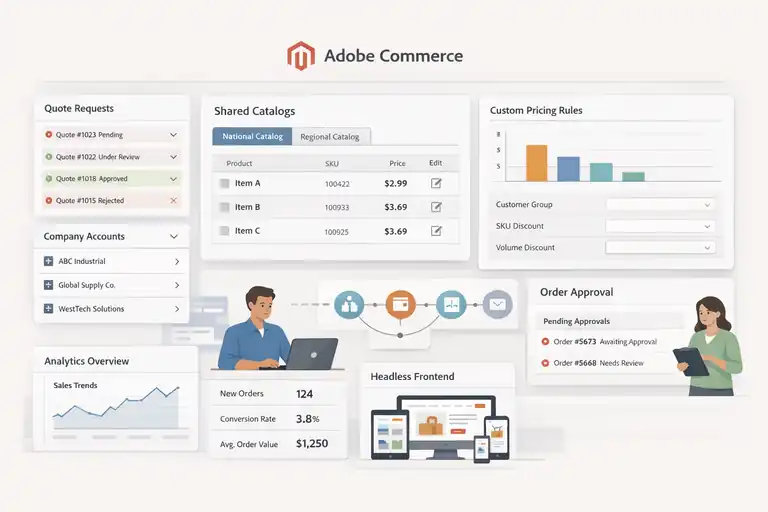
Adobe Commerce, formerly Magento, is usually my recommendation when flexibility matters more than simplicity. It shines when no two customers should see the same buying experience.
Built-In B2B Suite With Quotes And Shared Catalogs
Adobe Commerce includes a native B2B module, which removes the need for many third-party plugins.
Out-of-the-box B2B tools include:
- Request-a-quote workflows
- Shared catalogs by account
- Company accounts with multiple buyers
I’ve watched teams replace email-based quoting entirely using Adobe’s quote engine. Buyers request pricing directly from the storefront, sales reviews inside the admin, and approvals stay documented.
That alone can shave days off the sales cycle.
Flexible Pricing Rules For Contract And Tiered Buyers
Pricing flexibility is one of Adobe Commerce’s strongest advantages.
You can layer pricing by:
- Customer group
- SKU-level contracts
- Volume-based tiering
For example, a wholesaler might offer one contract price for national accounts and another for regional partners, all managed within the same catalog.
From my experience, Adobe is one of the few platforms where complex pricing logic doesn’t immediately require custom development.
Approval Workflows For Multi-User Buying Teams
Adobe Commerce supports structured buying teams without forcing awkward workarounds.
Approval features include:
- Buyer and approver roles
- Spending thresholds
- Purchase order approvals
A common scenario I see is a procurement officer building carts while a finance manager approves them later. Adobe handles that cleanly.
This is critical for industries like manufacturing and healthcare, where uncontrolled purchasing simply isn’t allowed.
Headless Architecture For Complex Frontend Needs
Adobe Commerce is a favorite for teams that want full control over the frontend experience.
Headless advantages:
If marketing wants one experience and procurement wants another, headless makes that possible without splitting platforms.
That flexibility is a big reason Adobe consistently ranks among the best b2b ecommerce platforms for complex sales workflows.
Deep Integration With Adobe Experience Cloud
Adobe Commerce becomes even more powerful when paired with Adobe’s broader ecosystem.
Key integrations include:
- Adobe Analytics for buyer behavior insights
- Adobe Target for personalization testing
- Adobe Experience Manager for content control
I’ve seen teams use Adobe Analytics to identify where buyers drop off during large orders, then fix those friction points with data instead of guesses.
For organizations already invested in Adobe tools, this integration is hard to beat.
Quick Comparison: Salesforce Commerce Cloud vs Adobe Commerce
| Feature Area | Salesforce Commerce Cloud | Adobe Commerce |
| Best For | Enterprise CRM-led B2B sales | Custom-heavy B2B workflows |
| CRM Integration | Native Salesforce CRM | Third-party or custom |
| Pricing Flexibility | Strong, AI-assisted | Extremely granular |
| Headless Support | Available | Very strong |
| Typical Buyer | Global enterprises | Complex mid-to-enterprise B2B |
If I had to give one honest takeaway, it’s this: Salesforce Commerce Cloud excels when sales teams drive revenue, while Adobe Commerce wins when customization and control matter most.
Choosing between them isn’t about features. It’s about how your B2B business actually sells today.
SAP Commerce Cloud For Complex Global B2B Models
SAP Commerce Cloud usually enters the conversation when B2B operations start feeling more like supply chain orchestration than simple ecommerce.
I tend to recommend it for organizations managing massive catalogs, global pricing rules, and deep ERP dependency, especially if SAP is already part of daily operations.
Master Data Management For Large Product Catalogs
SAP Commerce Cloud is built to handle product complexity at scale, not just volume. When people say “large catalog,” SAP assumes millions of SKUs with variants, dependencies, and regional rules.
What this looks like in real life:
- Centralized product data with regional overrides
- Support for configurable, bundled, and spare-part products
- Structured attributes tied to compliance and logistics data
I’ve seen manufacturers reduce catalog errors simply by using SAP’s structured product modeling. When every product has required attributes, downstream issues like wrong pricing or missing specs drop fast.
This is one reason SAP often shows up on lists of the best b2b ecommerce platforms for industrial and manufacturing businesses.
Complex Pricing, Discounts, And Contract Logic
Pricing in SAP Commerce Cloud mirrors how enterprise contracts actually work, not how ecommerce platforms wish they worked.
Common pricing scenarios SAP handles well:
- Customer-specific contract pricing
- Volume-based discounts layered on contracts
- Time-bound promotional pricing by region
A distributor I worked with had pricing logic that depended on customer tier, contract duration, and shipping destination. SAP handled it without custom code, because that logic already existed in their ERP.
If pricing accuracy matters more than storefront simplicity, SAP is very hard to beat.
Multi-Region And Multi-Currency B2B Capabilities
SAP Commerce Cloud is designed for global operations from day one.
Key global capabilities include:
- Multi-language storefronts
- Local tax and compliance handling
- Currency-specific pricing and rounding rules
I’ve seen global rollouts where Europe, Asia, and North America all ran on the same backend but followed completely different pricing and tax logic. That’s not easy, but SAP is built for that reality.
For companies expanding internationally, this reduces the need for separate regional platforms.
Strong ERP Integration With SAP S/4HANA
This is where SAP Commerce Cloud truly shines. It integrates natively with SAP S/4HANA, SAP’s core ERP system.
Practical benefits include:
- Real-time inventory availability
- Accurate delivery promises
- Seamless order-to-cash workflows
In one project, orders placed online were visible in the ERP within seconds, with no middleware delays. That kind of integration reduces order errors and customer service tickets dramatically.
If your business already runs on SAP ERP, choosing SAP Commerce Cloud often saves years of integration pain.
Governance And Security For Regulated Industries
SAP Commerce Cloud is often chosen by companies in regulated industries like healthcare, energy, and manufacturing.
Governance features include:
- Role-based access controls
- Audit logs for pricing and order changes
- Compliance-friendly data handling
I’ve seen compliance teams get involved early and actually approve SAP setups, which is rare. Security and governance aren’t afterthoughts here; they’re core design principles.
Oracle CX Commerce For Data-Driven B2B Transactions
Oracle CX Commerce is a strong choice when data, performance, and system reliability drive the buying experience. I usually suggest it to organizations already invested in Oracle ERP or Oracle CX tools.
Unified Commerce Across Sales, Service, And Marketing
Oracle CX Commerce connects ecommerce with sales and service data across the Oracle ecosystem.
In practical terms:
- Sales teams see ecommerce behavior tied to accounts
- Service teams access order history and contract details
- Marketing uses shared customer data for targeting
I’ve watched companies eliminate duplicate customer records simply by unifying these systems. Less confusion internally leads to smoother buyer experiences externally.
This unified approach supports complex B2B buying journeys that don’t start and end online.
Advanced Buyer Segmentation And Personalization
Oracle CX Commerce excels at segmentation driven by real data, not assumptions.
Segmentation options include:
- Industry-specific catalogs
- Buyer behavior-based recommendations
- Account-level personalization rules
For example, a repeat buyer sees reorder shortcuts, while a new procurement user sees guided navigation. Small changes like this can improve conversion rates significantly, especially for high-consideration purchases.
Oracle’s strength here is consistency across channels, not just the storefront.
Contract Pricing And Account-Based Catalog Control
Oracle CX Commerce supports detailed account-level pricing and catalog visibility.
Key capabilities:
- Contract pricing by account or group
- Restricted product visibility
- Custom catalogs per customer
I’ve seen companies hide entire product lines from unauthorized buyers while surfacing negotiated pricing automatically for approved accounts. That kind of control is essential in enterprise B2B environments.
This is another reason Oracle frequently appears in discussions around the best b2b ecommerce platforms for enterprise buyers.
Enterprise-Grade Performance And Reliability
Oracle builds for scale and uptime, not experimentation.
Performance strengths include:
- High availability during peak ordering periods
- Stable performance with large concurrent users
- Enterprise-grade SLAs
In industries where downtime equals lost contracts, this reliability matters. Oracle’s infrastructure is designed to support mission-critical commerce operations without surprises.
Integration With Oracle ERP And CX Stack
Oracle CX Commerce integrates tightly with Oracle’s broader technology stack.
Common integrations include:
- Oracle NetSuite or Oracle ERP Cloud
- Oracle CX Marketing and Service tools
- Oracle Analytics for performance insights
I’ve seen teams use Oracle Analytics to identify bottlenecks in approval workflows and fix them using real data. When systems talk to each other cleanly, optimization becomes practical instead of theoretical.
Quick Comparison: SAP Commerce Cloud vs Oracle CX Commerce
| Feature Area | SAP Commerce Cloud | Oracle CX Commerce |
| Best For | Global, ERP-heavy B2B operations | Data-driven enterprise B2B |
| ERP Integration | Native SAP S/4HANA | Native Oracle ERP |
| Catalog Complexity | Extremely high | High |
| Global Commerce | Very strong | Strong |
| Performance Focus | Process accuracy | System reliability |
If I’m being honest, SAP is about control and structure, while Oracle is about data and stability. Both belong in any serious discussion of enterprise-grade B2B commerce.
The right choice depends on whether your biggest challenge is operational complexity or system-wide intelligence.
BigCommerce B2B Edition For Scalable Mid-Market Growth
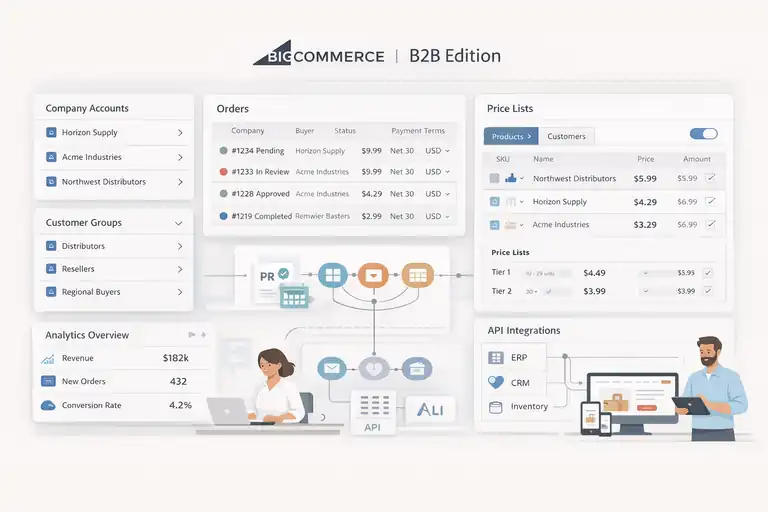
BigCommerce B2B Edition is usually where conversations land when teams want real B2B functionality without signing up for a multi-year enterprise implementation.
I often recommend it to mid-market companies that have outgrown basic ecommerce but don’t want the weight of SAP or Salesforce.
B2B-Specific Features Without Heavy Custom Development
BigCommerce includes many B2B features natively, which means less reliance on custom code.
What you get out of the box:
- Company accounts with multiple buyers
- Purchase orders and net payment terms
- Shared catalogs and customer groups
I’ve seen teams launch B2B portals in weeks instead of months because these basics are already there. That speed matters when sales teams are waiting on ecommerce to support real deals.
This balance between capability and simplicity is why BigCommerce often earns a spot among the best b2b ecommerce platforms for mid-market brands.
Customer-Specific Pricing And Purchase Permissions
BigCommerce handles customer-specific pricing in a way that feels practical, not over-engineered.
Key pricing controls include:
- Price lists by customer or group
- Tiered pricing by quantity
- Role-based purchasing permissions
A common setup I see is regional distributors with negotiated pricing while resellers see standard wholesale rates. BigCommerce supports that cleanly without custom logic.
From my experience, most mid-market B2B businesses don’t need extreme pricing complexity. They need accuracy and clarity, which BigCommerce delivers.
Flexible API-First Architecture For System Integrations
BigCommerce uses an API-first architecture, meaning it’s built to connect with other systems easily.
Typical integrations include:
I’ve worked on projects where BigCommerce acted as the frontend while the ERP handled pricing and inventory. The APIs are well-documented and friendly to middleware tools.
If integrations are on your roadmap, BigCommerce is surprisingly flexible for its size.
Faster Time-To-Market Compared To Enterprise Suites
This is where BigCommerce really shines.
Why launches happen faster:
- Cloud-hosted with no infrastructure setup
- Fewer required customizations
- Clean admin interface for non-technical teams
One distributor I advised went live in under 90 days, including ERP integration. That’s nearly unheard of with enterprise platforms.
If speed is a competitive advantage for you, BigCommerce deserves serious consideration.
Lower Total Cost Of Ownership For Growing B2B Brands
BigCommerce typically costs less over time than enterprise suites.
Cost advantages include:
- Lower licensing fees
- Reduced development overhead
- Less dependency on specialized developers
I’ve seen brands reinvest those savings into marketing or customer experience instead of maintenance. For growing B2B companies, that flexibility can be a game-changer.
Shopify Plus With B2B Features For Modern Wholesalers
Shopify Plus with B2B features is often underestimated in B2B discussions.
I used to be skeptical myself, but Shopify has quietly built solid B2B tools for wholesalers and manufacturers who value speed and simplicity.
Native B2B On Shopify For Company Profiles And Pricing
Shopify now offers native B2B functionality inside the platform, not just through apps.
Core B2B capabilities include:
- Company profiles with multiple buyers
- Price lists tied to companies
- Storefronts that adapt by login
This means wholesale buyers see their negotiated pricing automatically. No duplicate stores. No messy workarounds.
For many modern B2B sellers, this is more than enough.
Simple Management Of Wholesale And DTC In One Store
One of Shopify’s biggest strengths is running B2B and DTC from a single backend.
Practical benefits include:
- Shared inventory across channels
- Unified order management
- Consistent branding and UX
I’ve seen brands eliminate entire systems by consolidating B2B and DTC into one Shopify Plus store. Less complexity means fewer mistakes and faster decisions.
If you sell both to businesses and consumers, this setup is incredibly efficient.
Custom Pricing Lists And Payment Terms
Shopify supports custom pricing lists and payment terms for B2B buyers.
Available options include:
- Net payment terms
- Custom price lists by company
- Minimum order quantities
For example, a wholesale buyer might see net-30 terms and volume discounts, while retail customers pay upfront. Shopify handles this without breaking the storefront experience.
It’s not as deep as SAP or Adobe, but it covers most real-world wholesale needs.
Extensive App Ecosystem For Workflow Extensions
Shopify’s app ecosystem is one of its biggest advantages.
Popular B2B extensions cover:
- Advanced approvals
- ERP and accounting integrations
- Custom reporting and analytics
I’ve used apps to add lightweight approval flows in days, not months. The key is choosing apps carefully to avoid unnecessary complexity.
This flexibility helps Shopify stay competitive among the best b2b ecommerce platforms for fast-moving teams.
Faster Adoption For Lean B2B Ecommerce Teams
Shopify Plus is designed for teams that want to move quickly.
Why adoption is faster:
- Intuitive admin interface
- Minimal training required
- Large pool of Shopify experts
I’ve watched non-technical teams manage complex B2B catalogs with confidence after a few weeks. That’s rare.
If your team values speed, autonomy, and ease of use, Shopify Plus can be a surprisingly strong B2B choice.
Quick Comparison: BigCommerce B2B Edition vs Shopify Plus
| Feature Area | BigCommerce B2B Edition | Shopify Plus |
| Best For | Structured mid-market B2B | Modern wholesalers |
| B2B Features | Native and robust | Native and growing |
| Customization Depth | Moderate | App-driven |
| Time-To-Market | Fast | Very fast |
| Ease Of Use | High | Very high |
If I had to sum it up honestly, BigCommerce feels like B2B-first with ecommerce polish, while Shopify Plus feels like ecommerce-first that finally understands B2B. Neither is wrong.
The right choice depends on how much structure versus speed your business truly needs.

I’m Juxhin, the voice behind The Justifiable.
I’ve spent 6+ years building blogs, managing affiliate campaigns, and testing the messy world of online business. Here, I cut the fluff and share the strategies that actually move the needle — so you can build income that’s sustainable, not speculative.
Related posts:
 CartFlows Pricing & Alternatives: Which One Wins?
 What Is Headless Commerce and Why Does It Matter?
 Ecommerce Website Design Tips That Boost Conversions Fast
 How Do You Grow Online Business Without Big Marketing Budgets?
 15 Trending Dropshipping Products That Sell Right Now
 Dropshipping Guide: Build a Store That Actually Sells