
Table of Contents
Some links on The Justifiable are affiliate links, meaning we may earn a small commission at no extra cost to you. Read full disclaimer.
When I first tried to make sense of SaleHoo pricing, I remember wondering whether the cost actually matched the real value behind each plan. If you’ve felt that same uncertainty, you’re not alone.
In this guide, I’ll break down what you truly get for your money so you can decide confidently without second-guessing yourself.
Understanding How Salehoo Pricing Works Across All Plans
Before you decide on a plan, it helps to understand how SaleHoo builds its pricing model and why those differences actually matter when you’re running an online store.
How Salehoo Structures Its Pricing And Why It Matters
SaleHoo keeps its pricing intentionally simple, which I honestly appreciate because some ecommerce tools make it feel like you need a financial advisor just to sign up.
They use three tiers: Starter, Pro, and Enterprise. Each tier unlocks more supplier access, product imports, training, and store connections.
What makes this structure so important is how it scales with you. You’re not forced into features you don’t need early on, and you’re not boxed in later when you want to expand to more stores or upload more products. It’s a gradual path rather than a leap.
If you’re testing the waters, the Starter tier gives you enough runway to learn without pressure. But if you’re running multiple Shopify stores or you’re pushing volume, the extra capacity in Pro changes your day-to-day workflow in a big way.
What Factors Influence The Total Cost Of Your Salehoo Membership
SaleHoo’s pricing isn’t just about the subscription fee. A few things shift your overall cost:
- Your number of stores: More connected stores generally means you’ll need Pro instead of Starter.
- Your product import volume: If you’re pushing hundreds of SKUs, Starter’s cap will eventually feel tight.
- Your support needs: Enterprise becomes relevant when you want custom research, a dedicated manager, or tailored integrations.
- Your learning curve: If you want guided courses, Pro and Enterprise offer more structured training.
I’ve seen sellers underestimate how quickly they outgrow import or supplier contact limits. If you’re running paid ads or testing multiple niches, those limits can matter more than you think.
Differences Between One-Time, Monthly, And Lifetime Billing Options
SaleHoo gives you multiple billing routes: annual, monthly, and lifetime. Each one fits a different mindset.
Monthly billing keeps things flexible if you’re experimenting. Annual billing drops the monthly cost significantly, which I find helpful when I know I’m committing to a full year of growth.
The lifetime option, when available, is usually the best long-term value because you remove recurring costs entirely.
Here’s how I think about it:
- Monthly = “I’m testing.”
- Annual = “I’m committed.”
- Lifetime = “I want this tool as a permanent part of my business stack.”
The key is matching your level of certainty to your payment style so you don’t overspend early or limit yourself later.
What’s Included In The Starter Plan And Who Should Choose It
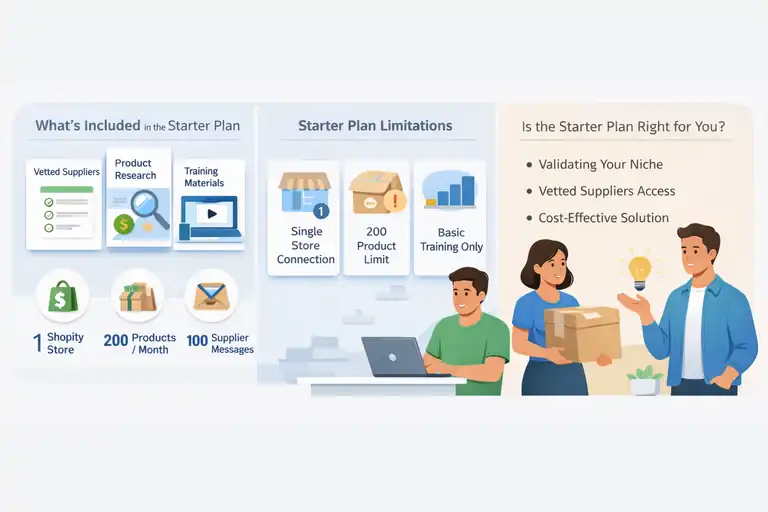
The Starter plan is designed for beginners, but it still packs enough tools to launch your first online store with confidence.
Key Features Inside The Starter Plan And How They Benefit New Sellers
The Starter plan gives you access to thousands of vetted suppliers, product research tools, and a helpful foundation of training materials.
You can connect one Shopify store, import up to 200 products a month, and message up to 100 suppliers. That’s more than enough for anyone building their first store.
A few underrated strengths here:
- Product insights help you avoid niches with poor margins.
- Templates speed up communication with suppliers.
- Pre-generated supplier reports eliminate hours of manual vetting.
For someone just starting out, these features remove a lot of the guesswork. When I was new, having supplier verification alone saved me from costly mistakes.
Limitations Of The Starter Tier You Should Know Before Buying
Starter is powerful, but it does have some guardrails that matter as you scale.
- You can’t connect multiple stores.
- Import limits may feel tight if you’re constantly testing products.
- You won’t get advanced training or custom research.
These limits aren’t deal-breakers. They’re just something to plan around. Most beginners won’t hit these ceilings immediately, but once you start scaling, you’ll notice them.
When The Starter Plan Saves You Money Compared To Other Platforms
This plan shines when you compare it with alternatives that charge monthly fees for basic directory access. Many similar tools charge more but don’t include supplier support or market insights.
Starter saves you money when:
- You’re validating your niche and don’t need unlimited imports.
- You want vetted suppliers instead of sifting through marketplaces manually.
- You don’t want to commit to higher-tier platforms before proving your store can generate sales.
If cost efficiency is your top priority, Starter delivers strong value without locking you into a higher tier before you’re ready.
What The Pro Plan Adds And Whether The Upgrade Is Worth It
Pro is designed for sellers ready to scale beyond a single store or those who need deeper research tools to optimize product selection and supplier relationships.
Advanced Seller Tools Included In The Pro Plan
When you move to Pro, you unlock more serious selling capabilities. You can connect up to three Shopify stores, import up to 600 products instantly, and access advanced training like the Amazon product launch course.
Here’s where Pro stands out:
- Unlimited supplier contacts mean you can negotiate better deals.
- Research insights help you choose products with higher sell-through rates.
- Three sub-users support team collaboration if you’re no longer a one-person operation.
If you’re planning to scale, these extras genuinely make your operations smoother. I’ve seen sellers double their revenue simply by leveraging supplier communication more aggressively.
How Additional Store Connections And Imports Impact Your Workflow
Multiple Shopify connections matter more than people realize. It lets you:
- Test niche ideas in separate stores.
- Segment audiences without mixing product categories.
- Run micro-brands simultaneously.
Higher import limits also reduce manual workload. Instead of hand-uploading product batches, you can move quickly and test dozens of items at a time.
This operational speed is huge. In ecommerce, getting products live faster often translates into reaching profitable test results sooner.
Scenarios Where The Pro Plan Delivers A Higher Return On Investment
Pro becomes worth the money when your business model relies on rapid testing or managing multiple stores.
A few real-world examples:
- Scaling sellers: If you’re adding new product lines weekly, Starter will slow you down.
- Team-based operations: Sub-users allow assistants or VAs to help with product uploads and supplier outreach.
- High-volume communications: Negotiating directly with multiple suppliers helps bring costs down, which dramatically improves margins.
If you’re spending money on ads, the faster testing cycle alone often pays for the upgrade. In many cases, sellers recoup the Pro plan cost within a month of improved supplier deals.
What Enterprise Buyers Actually Get Beyond Standard Salehoo Pricing
If you’re curious about what happens once you move past Starter and Pro, the Enterprise tier is where SaleHoo starts tailoring things specifically to your business instead of giving you a preset plan.
I see this tier as less of a subscription and more of a partnership.
Custom Features And Support Included In Enterprise Packages
Enterprise gives you access to features that don’t exist in the standard plans at all. You get a dedicated account manager, which basically means you have someone inside SaleHoo helping you with strategy, sourcing decisions, and troubleshooting.
It also includes a custom-built store when needed. This isn’t a template—they design it for you so everything fits your products and brand. If you’ve ever spent nights fixing theme issues, you’ll know how valuable that is.
You also get unlimited product imports and supplier access. That alone is a huge unlock, especially once you’re managing large catalogs or multiple brands.
In my experience, the best part is the custom supplier research. Rather than browsing through existing directories, you can ask their team to source suppliers that match your exact niche or quality requirements.
How Tailored Integrations Affect Scaling And Operations
Enterprise shifts your operations from manual workflows to integrated systems. When SaleHoo sets up store integrations for you—whether it’s multiple Shopify stores, automation rules, or data syncing—it cuts out repetitive admin work.
A few ways this impacts your scale:
- Faster onboarding of suppliers without manual vetting
- Stable workflows where inventory and pricing update automatically
- Reduced errors when importing or updating product listings
If you’re working with VA teams or managing multiple sales channels, these integrations prevent the “operational drag” that slows growth.
From what I’ve seen, businesses often scale faster simply because they’re no longer drowning in backend tasks.
Who Truly Needs Enterprise-Level Access And When It Becomes Cost-Effective
Enterprise is not built for beginners. It’s meant for sellers who already have traction, typically:
- Multi-store brands
- Agencies managing ecommerce clients
- Established sellers expanding globally
- Teams needing white-glove onboarding
It becomes cost-effective once the value of saved time outweighs the subscription cost.
For example, if your team spends 20 hours a month manually handling imports or sourcing suppliers, Enterprise can eliminate most of that. The ROI often shows up quickly for businesses operating at scale.
In my opinion, it’s best for sellers who want help not just with tools, but with overall ecommerce strategy, supplier relationships, and tech setup.
Comparing Salehoo Pricing To Competitors To Evaluate Real Value
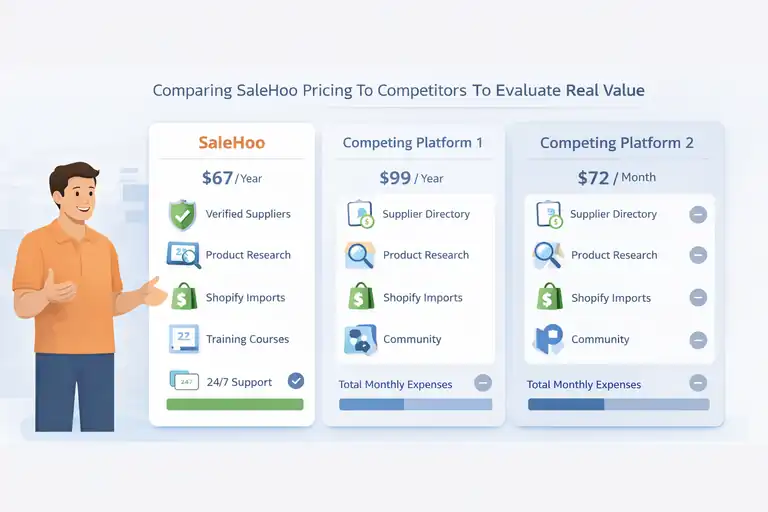
SaleHoo sits in a unique position because it combines supplier access, product research, and training in one platform.
To really evaluate the value of its pricing, it helps to see how it stacks up against competing directories and research tools.
How Salehoo’s Supplier Vetting Stacks Up Against Other Directories
One of the biggest advantages SaleHoo has is its supplier vetting team. They manually check suppliers for legitimacy, communication reliability, and business history. Many competing directories rely on automated listings where anyone can join.
This matters because supplier issues are one of the top causes of store failure. A 2023 ecommerce survey showed that 28% of new sellers quit due to unreliable suppliers. SaleHoo’s vetting significantly reduces that risk.
Where others give you a list, SaleHoo gives you confidence baked into the list.
Feature Differences That Affect Long-Term Cost And Performance
When you compare features side by side, the long-term cost usually depends on what you need most.
SaleHoo includes:
- A research tool tracking over a million products
- One-click Shopify imports
- A supportive community of 137,000+ sellers
- Training courses
- Human support 24/7
Most competitors split these features into separate subscriptions. For example, you might need a sourcing directory, a research tool, and a third-party importer—and suddenly you’re paying three monthly fees instead of one.
Over time, consolidating tools inside SaleHoo often reduces your total overhead and simplifies your workflow.
When Salehoo Is Cheaper Than Alternatives And When It Isn’t
SaleHoo is usually cheaper when you’re starting with fewer stores or products. Their Starter and Pro plans pack several tools into one subscription, while other platforms tend to charge separately.
However, if you only need one narrow feature—like product research alone—it’s possible that a single-purpose tool might cost less upfront. But once you factor in supplier verification, training, imports, and support, SaleHoo tends to win on overall value.
I tell people this: If you want an all-in-one solution, SaleHoo pricing comes out ahead. If you’re only looking for a single feature, a smaller alternative might beat it.
Breaking Down The Real Cost Of Using Salehoo For Dropshipping
The actual cost of using SaleHoo for dropshipping depends on your store size, product volume, and how deeply you use the research tools. The plan price is just the starting point.
How Product Imports, Store Connections, And Research Tools Influence Cost
The more products you test, the more you’ll rely on import allowances. If you’re running multiple stores or constantly cycling through new products, Starter may feel restrictive. Pro gives you breathing room with triple the imports and more store connections.
Research tools also play a huge role. If you’re testing many niches, the product research dashboard can save hours of manual analysis. It isn’t obvious at first, but time savings are a real cost factor.
I like to think of it this way:
- Imports affect your speed.
- Store connections affect your scope.
- Research tools affect your accuracy.
And in dropshipping, accuracy often means the difference between burning ad money and finding a winner.
Hidden Expenses New Sellers Overlook When Evaluating Pricing
Most new sellers forget to factor in:
- App fees for Shopify
- Product sample costs
- Paid ads
- Virtual assistant hours
- Additional tools not included in competing directories
SaleHoo reduces some of these expenses by centralizing supplier access and product research. But depending on your workflow, you might still invest in external apps like reviews, fulfillment automation, or email marketing.
One hidden expense I see a lot is wasted ad spend due to picking the wrong products. The research tool alone can prevent that, which indirectly saves significant money.
Total Monthly Cost Example Based On A Typical Dropshipping Workflow
Let’s take a simple example to make this more concrete. Imagine a beginner running one Shopify store with moderate testing:
- Shopify Basic Plan: $39
- SaleHoo Starter: $9 (billed annually)
- Two low-cost apps (reviews + fulfillment): ~$20–$30
- Starter ad testing budget: $150–$300
- Occasional sample product: $20
Your real monthly cost lands around $220–$380 depending on how aggressively you test.
Now, if you’re running multiple stores with more frequent imports, the Pro plan changes the equation—but it also increases your earning potential. Higher import volume gives you more chances to find winning products, lowering your cost per test over time.
In short, SaleHoo pricing becomes cost-effective when you use it to speed up testing and reduce mistakes. That’s where most of the hidden savings show up.
How Much You Actually Save With The Lifetime Plan
The lifetime option can look expensive upfront, but if you plan to use SaleHoo long-term, it completely changes your cost structure.
I like thinking of it as locking in your operating costs before you grow.
When Lifetime Access Makes Financial Sense For Sellers
Lifetime access becomes practical once you know ecommerce is something you’re committed to.
If you’re already running a store or planning to expand into multiple niches, the lifetime model helps you stop thinking about recurring fees.
A few situations where it makes sense:
- You’ve already renewed annually once or twice.
- You manage or plan to manage multiple shops.
- You rely on research tools heavily for product testing.
From what I’ve seen, most sellers who stay in the game beyond a year end up saving more long-term with lifetime access simply because subscription creep disappears.
Long-Term Cost Comparison Between Yearly And Lifetime Plans
A quick way to evaluate lifetime pricing is to map it against your expected usage. For example:
- If the annual plan costs a few hundred dollars, three years of use often matches or exceeds the lifetime price.
- If you use SaleHoo for five years, you save thousands compared to yearly billing.
I once helped a seller who spent nearly $1,800 over five years on recurring directory and research tools. When she switched to lifetime access, her yearly savings freed up budget for testing new ad creative instead—and her store scaled faster as a result.
It’s not about the fee itself. It’s about what eliminating that fee allows you to invest in instead.
Potential Risks Of Buying Lifetime Access And How To Evaluate Them
I try to be realistic about this: Lifetime pricing isn’t perfect for everyone.
Here are a few risks to consider:
- If you’re not sure you’ll stick with ecommerce, the upfront price may not pay off.
- If you only need a research tool temporarily, lifetime might be overkill.
- If your niche is seasonal or experimental, you might outgrow the need earlier than expected.
To evaluate it clearly, ask yourself one simple question: Will I use SaleHoo consistently for at least two to three years? If the answer is yes, the lifetime plan usually works in your favor.
Which Salehoo Plan Offers The Best Value Based On Your Business Model
I always tell people that SaleHoo pricing only makes sense when you match it to what your business actually needs.
Different selling styles require different tools and limits.
Best Pricing Fit For Beginners Testing Their First Store
For complete beginners, the Starter plan almost always offers the best value. You get vetted suppliers, market insights, and basic Shopify integration without committing to a high monthly bill.
If you’re still unsure what you want to sell, Starter gives you a safe playground. You learn how supplier outreach works, you test a few niches, and you get the hang of importing products.
A few signs Starter is right for you:
- You plan to launch one store only.
- You want to test fewer than 200 products per month.
- You’re still learning supplier communication and niche validation.
In my experience, beginners appreciate having limits because it keeps things manageable and reduces overwhelm.
Best Pricing Fit For Sellers Scaling With Multiple Stores
Once you start running multiple stores—or even one store with aggressive testing—you’ll feel the Starter limits pretty quickly. That’s where the Pro plan earns its price.
Pro is best for:
- Sellers with two or more Shopify stores.
- Anyone testing new product lines weekly.
- People who want access to unlimited supplier contacts.
- Sellers who want team collaboration through sub-users.
The biggest benefit is workflow speed. When you can import 600 products and connect three stores, your testing cycles shorten from weeks to days.
Best Pricing Fit For Established Brands Needing White-Glove Support
Enterprise is a different world entirely, and honestly one that brings peace of mind for sellers doing larger volumes. You’re not just getting tools—you’re getting a partner.
Choose Enterprise if:
- You’re building multiple brands simultaneously.
- You want custom-built stores or tailored integrations.
- You need a dedicated account manager guiding your sourcing strategy.
- You want unlimited imports because your catalog grows constantly.
In my opinion, Enterprise is more about support than software. It’s for sellers who want to operate like a professional brand without hiring a huge internal team.
How To Decide If Salehoo Pricing Is Worth It For Your Niche
Different niches require different supplier types, product testing speeds, and risk levels.
So deciding whether SaleHoo pricing is worth it really depends on what you sell.
Evaluating Supplier Access Based On Your Product Category
Some niches absolutely benefit from SaleHoo’s supplier directory. For example:
- Fashion categories with fast-moving trends
- Home and lifestyle products with global suppliers
- Beauty brands that need reliable sourcing
- Tech accessories with high competition
If your niche depends heavily on supplier reliability or consistency in product quality, SaleHoo’s vetting process saves you countless hours and protects your reputation with customers.
If your niche is something hyper-local or handmade, the platform might not add as much value.
Using Market Insight Tools To Predict Your Potential Profit Margin
The research tool is especially useful when you’re unsure about a niche’s profitability.
It shows demand levels, competition, and price ranges so you can estimate margins before buying inventory or running ads.
I like using it to:
- Spot under-served categories.
- Compare multiple product ideas quickly.
- Avoid products where the margin is too thin for ads.
Even one avoided mistake can save hundreds in wasted ad spend.
When A Cheaper Alternative Might Suit Your Niche Better
Sometimes you don’t need a massive supplier directory or detailed research.
A cheaper alternative might work when:
- You already have your supplier relationships.
- You sell digital or print-on-demand products.
- Your catalog is extremely small and rarely changes.
- Your niche is so specialized that directory tools won’t help much.
When that’s the case, paying for features you won’t use isn’t the smartest move. But for most physical-product niches, SaleHoo’s bundled tools usually justify the pricing.
Expert Tips To Maximize The Value You Get From Salehoo Pricing
No matter which plan you choose, there are ways to squeeze more value out of your subscription and make every dollar count.
Strategies To Extract More Value From Research And Supplier Tools
I recommend treating the research tool like a testing lab. Instead of guessing what might sell, use real data to guide your decisions.
A few quick strategies:
- Look for products with rising demand but low competition.
- Compare 5–10 similar products before choosing one to test.
- Use supplier communication templates to speed up your workflow.
The more organized your research, the fewer failed tests you’ll run.
How To Avoid Overspending By Choosing The Right Plan And Workflow
You can prevent overspending by aligning your plan with your current stage, not your dream stage.
I know it’s tempting to jump straight to Pro or Enterprise, but sometimes the simplest setup is enough to get results.
To keep costs lean:
- Use Starter until you consistently hit import limits.
- Upgrade only when store volume demands it.
- Track which tools you actually use weekly.
Most sellers overspend not because the plans are pricey, but because they choose a plan meant for a different stage of business.
Practical Ways To Use Salehoo Features To Reduce Operating Costs
There are a few underrated features that help bring costs down over time.
For example:
- Vetted suppliers reduce refund rates and chargebacks.
- Pre-made communication templates reduce VA hours.
- Market insights help avoid unprofitable niches.
- Unlimited contacts in Pro let you negotiate better bulk pricing.
One seller I worked with cut their cost of goods by nearly 12% simply by contacting more suppliers and comparing quotes—a feature that only becomes possible when your plan allows unlimited outreach.
When you use SaleHoo intentionally, the platform doesn’t just cost money. It saves money in all the little places you normally wouldn’t notice.
Frequently Asked Questions
What is salehoo pricing and how does it work?
Salehoo pricing is tier-based, with Starter, Pro, and Enterprise plans. Each tier unlocks different limits for product imports, supplier access, store connections, and support, allowing you to scale as your business grows.
Is salehoo pricing worth it for beginners?
Yes, for beginners the Starter plan is usually worth it because it combines vetted suppliers, basic product research, and Shopify integration at a low cost, reducing early mistakes and setup time.
Does salehoo pricing include hidden fees?
No, salehoo pricing itself is transparent. However, your total cost may also include Shopify fees, apps, ads, or product samples, which are separate from SaleHoo’s subscription.

I’m Juxhin, the voice behind The Justifiable.
I’ve spent 6+ years building blogs, managing affiliate campaigns, and testing the messy world of online business. Here, I cut the fluff and share the strategies that actually move the needle — so you can build income that’s sustainable, not speculative.
Related posts:
 How the Salehoo App Works and Why It Speeds Up Product Research
 Is SaleHoo Legit? What Real Sellers Actually Discover
 Viral Launch Chrome Extension: The Ultimate Tool for Sellers
 How to Use Dsers Shopify for Seamless Dropshipping
 Start Dropshipping Today: A Simple Guide for Complete Beginners
 Salehoo Directory Free: What You Can Access Without Paying