Table of Contents
Some links on The Justifiable are affiliate links, meaning we may earn a small commission at no extra cost to you. Read full disclaimer.
When you first hear how a blogger earn money, it can sound mysterious—almost like something only big influencers or long-time creators can figure out.
But from what I’ve seen, earning online becomes much more predictable once you understand the systems behind it.
Have you ever wondered what actually drives fast blog income growth and which steps matter most? This guide breaks everything down so you can move with clarity and confidence.
Understanding How Bloggers Earn Money Through Core Revenue Streams
This section breaks down the foundational ways a blogger earn money so you can build income that grows steadily instead of unpredictably.
Diversifying Income With Multiple Monetization Paths
When I talk to newer bloggers, I often notice they’re relying on just one income stream. From what I’ve seen, that almost always slows down long-term growth. A blog is more stable when income comes from different places that support each other.
Why diversification works: When one revenue source dips, others pick up the slack. For example, ad revenue often drops in January, but affiliate sales tend to hold steady. By having both, your income becomes less stressful and more predictable.
Simple ways to diversify:
- Add display ads: Quick to set up through networks like Monetag or Adsterra.
- Layer affiliate links: Use programs like Flexoffers or niche-specific SaaS platforms.
- Sell digital products: Templates, checklists, or ebooks that solve a specific problem.
- Offer services: Coaching, freelancing, or audits based on your niche.
A helpful example: If your blog is about gardening, you could earn from seed affiliate links, ad impressions on seasonal posts, and a downloadable planting calendar. That’s three income streams from the same audience without feeling pushy.
Choosing the Right Revenue Mix Based on Blog Niche
Choosing the right mix is one of those steps that makes everything easier. I’ve found that every niche tends to have its own high-earning patterns.
For instance, tech and software blogs often make most of their income from affiliate programs, while lifestyle blogs lean heavily on display ads.
Here’s a simple way to pick your mix:
- If your niche has products people buy repeatedly (like beauty or pets), affiliates perform well.
- If your niche attracts high traffic with low buying intent (like recipes or decor ideas), display ads bring consistent income.
- If your readers need guidance (like fitness or career change), digital products or coaching fit naturally.
A quick UI example: To check conversion data from affiliate links, you’d typically open your affiliate dashboard → navigate to Reports → click Conversions or Top Links. That one screen alone tells me which monetization style a niche responds to best.
Shifting From Hobby Blogging to Business-Focused Strategy
One of the biggest mindset shifts I had was realizing that blogging stops being unpredictable the moment you treat it like a small business. That doesn’t mean becoming rigid; it just means making decisions with intention.
What shifting to business mode looks like:
- Creating content based on keyword research, not random ideas
- Planning income goals and aligning posts that support those goals
- Tracking your metrics weekly (traffic, CTR, RPM, product sales)
- Updating old posts with SEO improvements rather than always starting new ones
I believe this small mindset change—seeing your blog as a business—can increase your income faster than any plugin or new tactic.
Building a Predictable Monthly Earnings Structure
A predictable structure reduces anxiety, especially when income fluctuates. Many full-time bloggers follow a simple system to stabilize earnings.
Here’s the approach I personally suggest:
- Traffic drivers: Evergreen articles that consistently bring visitors
- Conversion drivers: Articles designed to sell affiliates or digital products
- Trust builders: Story-based or helpful posts that grow loyalty
- Email funnels: Automated sequences that sell even when you’re offline
According to HubSpot, businesses using email automation see an average 50–70% increase in conversion rates. Even a small five-email sequence can dramatically stabilize month-to-month income.
Proven Ways a Blogger Earn Money With Display and Video Ads
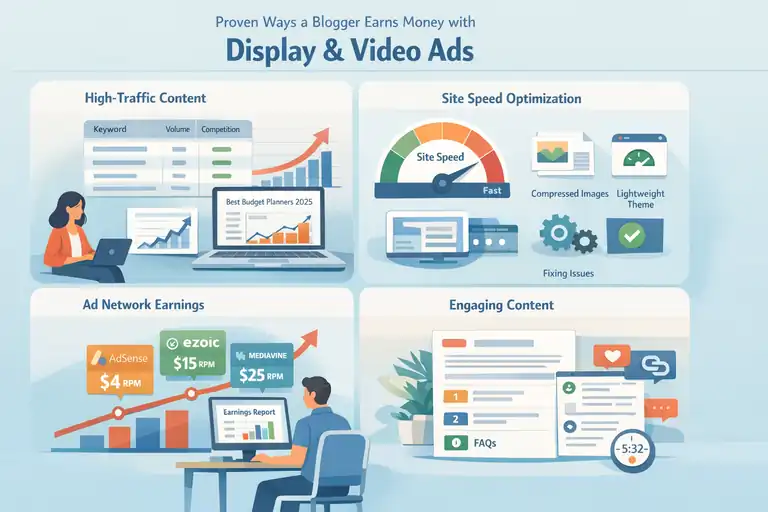
Ads are one of the fastest ways to start earning, and this section focuses on how to boost ad revenue using strategies that actually work in real life.
Increasing Ad Impressions With High-Traffic Content
When I started, I didn’t realize how much ad revenue depends on traffic concentration. One high-traffic article can make more in a month than twenty low-performing posts combined.
A simple way to increase impressions is to target keywords with high search volume and low competition.
For example, a post ranking for “best budget planners 2025” will earn more impressions than something vague like “how to stay organized.”
A practical workflow:
- Use a keyword tool → filter by volume and difficulty → choose topics with clear search intent → write 1,500–2,000 word posts
- Update the post every 3–6 months to maintain rankings
- Add internal links to distribute traffic to other monetized posts
This alone can double ad impressions without publishing more content.
Improving Site Speed and Layout for Higher Ad RPM
Ad RPM increases when your site loads quickly and users stay on the page longer. I’ve seen RPM jump 15–30% after fixing layout issues alone.
Common improvements:
- Compress images before uploading (TinyPNG or native WordPress compression)
- Use a lightweight theme (GeneratePress or Astra)
- Remove unused plugins that slow loading
- Place ads where they don’t disrupt reading, such as after the first or second paragraph
A real example: In Ezoic, if you navigate to Dashboard → Leap → Diagnostics, it shows which elements slow your site. Fixing just one “heavy script” can raise page load time by a full second.
Using Ad Networks That Maximize Earnings for Small Blogs
Small blogs often start with Google AdSense, but after you hit 10,000–50,000 monthly sessions, networks like Ezoic or Monumetric tend to pay significantly more.
Typical differences I’ve seen:
- AdSense: $1–$6 RPM
- Ezoic: $8–$18 RPM for similar content
- Mediavine: $15–$30 RPM (but requires 50,000 sessions/month)
This means a blog with 30,000 monthly pageviews might earn:
- $90–$180 with AdSense
- $240–$540 with Ezoic
That’s why choosing the right network can instantly increase revenue without writing a new post.
Optimizing Content Length and Engagement for Better CPM Rates
Longer articles keep readers scrolling, which increases ad impressions per session. But that doesn’t mean adding fluff—instead, expand through tutorials, examples, scenarios, and visuals.
A structure I often use:
- Short intro
- Clear H2 sections
- Visual steps or screenshots
- A short conclusion
Adding engagement elements like FAQ sections, internal links, or short stories can also increase time on page. Higher engagement = better CPM rates because advertisers pay more for attentive audiences.
Effective Affiliate Marketing Methods That Help Bloggers Earn More
Affiliate income grows fast once you understand how to match the right product with the right reader at the right moment.
Finding High-Paying Affiliate Programs With Strong Conversions
High-paying doesn’t always mean high-earning. I’ve learned that a $100 commission is worthless if the audience never buys. That’s why I always look at EPC (Earnings Per Click) instead of just commission rate.
How to pick strong programs:
- Browse affiliate networks like Impact, and Awin
- Sort products by EPC or conversion rate (most dashboards have this under Reports → Performance)
- Focus on products your readers are already searching for
For example, if you run a budgeting blog, recommending YNAB (with $20–$60 commissions) converts far better than promoting generic finance apps.
Writing Product Reviews That Drive Action and Trust
Reviews work when they’re personal. I always include what I liked, what annoyed me, and who the product is actually for. Being honest improves trust—and trust improves clicks.
A helpful structure:
- Explain why you tried the product
- Share one personal example of how you used it
- Include pros and cons
- Add screenshots or UI steps (like Settings → Export → Download Report)
- End with who should or shouldn’t use it
This type of review feels real instead of salesy, which boosts conversions. According to a Statista study, 82% of online shoppers read product reviews before buying, which explains why review-based blogs are top earners.
Integrating Affiliate Links Naturally Into Informational Posts
One of the best ways to increase affiliate revenue is to place links where they naturally help readers.
I avoid stuffing links in the first paragraph; instead, I insert them at moments when the reader might wonder, “Which tool should I use for this?”
Examples:
- A productivity article recommending a planner app in the section about scheduling
- A cooking tutorial linking to specific tools used in the recipe
- A travel guide linking to booking platforms only after explaining an itinerary step
This approach increases trust and improves click-through rates because it feels helpful, not pushy.
Tracking Performance Data to Improve Affiliate Click-Through Rates
The fastest way I’ve ever increased affiliate income was by tracking which links were clicked and adjusting based on the data.
Common tools:
- Affiliate dashboards (Impact, Amazon Associates → Reports)
- Link tracking plugins like Pretty Links
- Google Analytics events to monitor outbound clicks
A simple workflow I personally use:
- Check the top clicking pages every Monday.
- Add a comparison table if clicks are high but conversions are low.
- Move links closer to high-intent sections.
- Rewrite CTA lines to be clearer and more specific.
Just by adjusting link placement, I’ve seen CTR rise from 1% to 4–5%, which can triple affiliate income without adding more traffic.
Step-By-Step Strategies to Earn Money Quickly With Digital Products
Digital products are one of the fastest ways to increase your income because you create them once and sell them repeatedly without extra work.
I’ll walk you through the exact steps I’ve used myself.
Validating Digital Product Ideas With Real Audience Needs
When I rushed into my first digital product years ago, it barely sold because I created what I wanted, not what readers needed. So now I always validate ideas first.
Start by identifying topics people consistently ask about.
You can do this by checking:
- Google Search Console → Performance → Queries
- Blog post comments or emails
- Social media questions and DMs
Once you see patterns, do a quick interest check.
You can run a simple poll asking: “Which resource would help you the most right now?”
This alone weeds out low-demand ideas.
A small example: If readers keep asking “How do I create a weekly meal plan?”, a printable planner or meal-prep guide is an easy win.
The more you validate, the fewer products you have to “guess” on, which speeds up income dramatically.
Creating Ebooks, Guides, or Templates That Solve Specific Problems
From what I’ve seen, digital products sell best when they solve one clear and specific problem. Broad ebooks rarely sell well, but targeted resources do.
To build a product quickly, start small:
- Checklists: Fast to create and easy to price
- Templates: Google Docs, Notion, Canva, budgeting sheets
- Short guides: 15–25 pages that answer one problem in depth
If you’re using Canva, the path is usually: Home → Create a design → US Letter Document.
This gives you a clean layout that’s easy to export as PDF.
An example scenario: A parenting blogger noticed her audience struggled with screen-time schedules. She created a simple downloadable weekly planner and sold it for $7. That product alone brought consistent monthly revenue without additional work.
Setting Up Simple Sales Funnels for Passive Conversions
You don’t need complicated funnels to start selling. I’ve had great results with small, simple ones that run on autopilot.
Try this basic funnel:
- Blog post → teach a topic
- Lead magnet → offer something related (free checklist)
- Email sequence → send 3–5 helpful emails
- Soft pitch → recommend the digital product
If you’re using Kit, the setup is usually: Automations → New Automation → Subscriber Joins Form → Email Sequence.
A three-email sequence often performs surprisingly well:
- Teach something helpful
- Share a quick story or mistake
- Offer the product that solves the problem
This builds trust and sells naturally without feeling pushy.
Pricing Digital Products for Maximum Profitability
Pricing is both an art and a strategy. If you price too low, people undervalue it. Too high, and conversions drop.
What I personally recommend:
- $5–$19 for templates and printables
- $15–$39 for short guides
- $49–$149 for comprehensive toolkits or bundles
A simple trick: Create a “Good, Better, Best” tier system.
Even if someone doesn’t buy the highest tier, it increases the perceived value of the mid-tier option.
I’ve seen this raise digital product revenue by 20–40% without any extra traffic.
Expert Tactics for Bloggers Earning Money Through Online Services
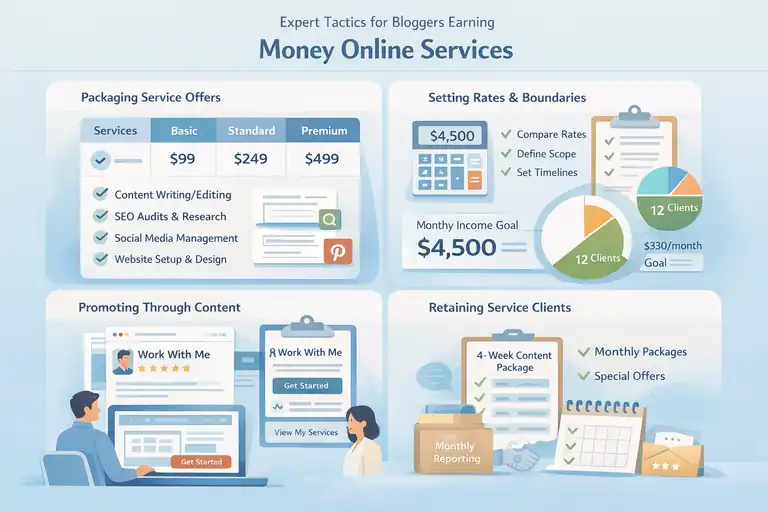
Services give bloggers a fast income boost because you get paid immediately. This section helps you package and sell your expertise without feeling overwhelmed.
Packaging Skills Into Service Offers That Sell Well
Most bloggers underestimate how valuable their skills are. If you’ve created content, optimized SEO, designed graphics, or grown social traffic—you already have marketable skills.
A simple way to package your knowledge into services:
- Blog content writing or editing
- SEO audits or keyword research
- Pinterest or social media management
- Website setup or redesign
If you’re creating service packages, organize them like this:
- Basic (starter tasks)
- Standard (most value)
- Premium (done-for-you solutions)
For example, an SEO blogger might offer a “Keyword Starter Pack” where they research 50 keywords and deliver them in a Google Sheet. Simple for you—high value for a business owner.
Setting Rates and Boundaries to Avoid Undercharging
Most beginners charge too little. I’ve made that mistake too, and it burns you out quickly.
A good starting method is to work backward from the monthly income you want.
If your goal is $3,000 a month, and you offer a $300 service, you need 10 clients—not 30 at $100.
To avoid undervaluing yourself:
- Compare industry rates (Upwork, Fiverr Pro, job boards)
- Define what’s included and what’s not
- Set clear delivery timelines
I suggest creating a simple PDF outlining your process. Even a one-page “Here’s how I work” document builds clarity and helps you set healthy boundaries.
Promoting Services Naturally Through Blog Content
One of the easiest ways to attract clients is by weaving your services into helpful content.
A few natural placements you can use:
- Add a “Work With Me” box at the bottom of posts
- Mention a service when you explain how you solved a reader problem
- Add internal links to your service page
- Include a small CTA inside your about page
If you use WordPress, you can add a service box by navigating to: Appearance → Widgets → Footer → Custom HTML Widget.
Readers who just consumed your helpful post are already in “trust mode,” so conversions feel natural rather than forced.
Turning Service Clients Into Long-Term Retainers
The real stability comes from clients who stay for months. I’ve personally found that retaining even 2–3 clients can cover most blog expenses effortlessly.
Ways to keep clients long term:
- Deliver on time
- Communicate clearly
- Provide small wins early (like quick SEO fixes)
- Offer monthly packages
For example, instead of selling a one-time Pinterest setup, offer a monthly management package.
Or if you do content writing, offer a 4-blog-post-per-month retainer.
Clients appreciate predictability just as much as you do.
How to Grow Blog Income Fast With Smart SEO and Traffic Systems
SEO is the backbone of long-term blog income, especially when you’re trying to scale your earnings quickly and sustainably.
Targeting High-Intent Keywords With Commercial Value
Instead of only writing “informational posts,” try mixing in keywords that signal buying intent. These posts convert better and help a blogger earn money faster.
High-intent keywords usually include:
- Best
- Review
- Alternatives
- Cheap
- Tools
- Software
For example, a keyword like “best meal prep containers” signals someone who’s ready to buy. If you create content around that, your affiliate earnings can increase dramatically.
A quick practical workflow:
- Use Ahrefs, Semrush, or Ubersuggest
- Filter keywords by low KD (keyword difficulty)
- Sort by CPC (cost per click) to find buyer keywords
- Choose those with both buying intent and manageable difficulty
This small shift can double your affiliate potential.
Updating Old Articles to Boost Rankings and Earnings
Updating content is one of the easiest ways to grow income without publishing anything new. Google loves fresh content, and users appreciate updated tips.
A simple update process:
- Open Google Search Console
- Go to Performance → Pages
- Find posts ranking in positions 5–20
- Update them with new data, examples, and FAQs
- Improve the introduction and H2 clarity
- Add one internal link from a high-traffic page
According to Backlinko, updating old content can increase organic traffic by up to 53%.
I’ve personally seen some posts double ad revenue within a month of updating.
Building Authority With Strategic Backlink Acquisition
You don’t need hundreds of backlinks. You just need the right ones.
A few approaches I personally recommend:
- Guest posting on relevant niche sites
- Signing up for HARO or Qwoted for journalist requests
- Creating statistics-based articles (journalists love linking to stats)
- Publishing original research or charts
A quick example: I once published a “Blogging Stats for 2024” post that included a simple chart. Within three months, over 110 websites linked to it because they needed a source.
Backlinks like these lift your entire site, not just one article.
Scaling Content Production Without Losing Quality
To grow income fast, you eventually need more content. But quality matters more than quantity.
A simple scaling workflow I suggest:
- Build templates for similar content types
- Create keyword batches and write posts in themed clusters
- Outsource simple pieces (like list posts) while keeping high-value posts for yourself
- Use AI for outlines or research, but rewrite in your voice
If you’re using Trello or Notion, create a pipeline like: Ideas → Keyword Research → Draft → Edit → Upload → Published
This visual workflow helps prevent overwhelm and lets you scale content without losing your quality standards.
Fast-Growth Monetization Techniques That Accelerate Earnings
This section focuses on the high-ROI techniques I recommend when you want your income to grow faster than your traffic.
Using Email Marketing to Increase Conversions and Sales
Email marketing is one of the most reliable ways a blogger earn money because it lets you reach readers even when SEO is slow. I believe it’s the closest thing to “guaranteed income” many bloggers can build.
I suggest starting with a simple lead magnet that solves a small problem quickly. When someone opts in, follow with a short email sequence that builds trust and introduces a paid offer naturally.
Useful email flow:
- Email 1: Teach something quick and helpful
- Email 2: Share a personal mistake and how you fixed it
- Email 3: Introduce a related digital product or affiliate recommendation
If you’re using ConvertKit, the path is: Automations → New Automation → Subscriber Joins Form → Add Email Sequence.
A stat worth noting: Email marketing has an average ROI of 4,200% (DMA report). Even a list of 300 engaged subscribers can generate consistent sales.
Leveraging Trending Topics for Rapid Traffic Spikes
Trending content can create quick waves of traffic that boost ad revenue and social visibility. I use this sparingly because trends fade, but they’re powerful when you need a short-term boost.
Here’s how to spot trends fast:
- Google Trends → check “Rising Topics”
- Pinterest Trends → identify seasonal surges
- Twitter/X trending hashtags
- YouTube trending videos in your niche
A real scenario: A productivity blogger created a post titled “How To Use the 2025 Time-Blocking Trend” right when the term was surging. For two weeks, the post ranked on page one and tripled her ad revenue.
Trends are temporary, but the exposure often creates permanent new readers.
Implementing A/B Testing to Improve Revenue Per Visitor
A/B testing sounds technical, but even simple tests can increase your earnings without touching your traffic.
Things worth testing:
- Placement of affiliate links
- CTA phrases (“Get the guide” vs. “Download now”)
- Button vs. text links
- Ad density on long posts
If you use Elementor, you can duplicate a block → adjust one variable → assign one version to 50% of users. This makes testing almost effortless.
I once saw a blogger increase her affiliate clicks by 38% simply by moving her product box above the first H2. Small changes often create big revenue shifts.
Automating Repetitive Tasks to Free Time for High-ROI Work
Manual tasks slow income growth. Automation helps you focus on content, products, and SEO—the things that actually make money.
Tasks I usually automate:
- Social sharing (using tools like Metricool)
- Email sequences
- Internal linking suggestions (Link Whisper)
- Image compression (ShortPixel plugin)
For example, if you publish in WordPress, you can set up automatic social posting under:
Settings → Sharing → Connect Social Accounts.
Automation doesn’t replace your creativity, but it removes the low-value work that drains your energy.
Practical Ways to Reinvent Content to Boost Income Growth
Reinventing content helps you reach new audiences, recover old posts, and maximize the value of everything you’ve already created.
Turning Blog Posts Into Videos, Reels, or Podcast Episodes
Repurposing content into different formats lets you reach people who may never read a full article. It also multiplies your reach across platforms like YouTube, TikTok, and Spotify.
Start by choosing posts that already get traffic.
Create:
- Short reels summarizing key tips
- A YouTube walkthrough using screenshots
- A podcast episode discussing the topic with personal insights
If you use Canva for video, the path is usually: Home → Create a design → Mobile Video.
This gives you a template-sized canvas for short, shareable clips.
A blogger I know turned a “How To Budget $50 a Week” post into a reel that went viral, bringing 20,000 new visitors to her site in three days.
Repurposing Evergreen Articles for New Audiences
Evergreen posts are perfect for repurposing because they’re always relevant. Instead of writing from scratch, update and expand them.
Try repurposing into:
- Email mini-lessons
- Infographics
- Pinterest pins
- Downloadable checklists
- Slide decks for LinkedIn or webinars
Even changing the angle can breathe new life into old content.
For example:
- Original: “How To Save Money on Groceries”
- Repurposed angle: “Grocery Hacks for Busy Parents”
The same content, but positioned for a specific group, often performs better.
Refreshing Low-Performing Posts for Revenue Recovery
Some posts don’t earn because they’re outdated, thin, or mismatched with search intent. Refreshing them can recover traffic and income quickly.
Steps I suggest:
- Open Google Search Console
- Go to Performance → Pages
- Sort by “Lowest Click-Through Rate”
- Update title, intro, internal links, stats, and product recommendations
Small upgrades—like adding new examples or replacing broken links—often revive rankings.
I’ve personally seen income increase within 7–14 days for updated posts, especially when improving affiliate placements.
Creating Series-Based Content to Increase Engagement
Series-based content keeps readers hooked and encourages repeat visits. It also helps you cover a topic more thoroughly, improving topical authority.
Try creating series like:
- A 7-day challenge
- A 5-part beginner guide
- A niche toolkit broken into multiple parts
- A “Start Here” sequence for newcomers
If you’re using WordPress, create a category for the series under: Posts → Categories → Add New Category.
Readers love clear paths. It helps them know what to read next, and more engagement always supports income growth.
Smart Financial Habits That Help Bloggers Scale Income
Scaling income isn’t only about earning more—it’s about managing your money so growth becomes natural and sustainable.
Tracking Blog Revenue and Expenses for Better Decisions
Tracking helps you understand where money is coming from and where it’s being wasted. I believe this is one of the most overlooked habits in blogging.
Track metrics monthly:
- Affiliate income
- Ad revenue
- Product sales
- Software subscriptions
- Outsourcing costs
If you prefer spreadsheets, try a simple Google Sheet with columns for each income stream and each expense. Or use a tool like QuickBooks (under Dashboard → Bookkeeping → Chart of Accounts) for automation.
Once you see the data clearly, decisions stop being emotional and become strategic.
Outsourcing Tasks That Slow Down Monetization
You don’t have to do everything yourself. Outsourcing frees your time for writing, strategy, and high-value tasks.
Common things to outsource:
- Graphic design
- Video editing
- Social scheduling
- Formatting blog posts
- Keyword research
I advise outsourcing the tasks that feel draining or that you avoid. Even hiring someone for 5 hours a month can make a huge difference.
A quick example: A food blogger I worked with hired someone just to format posts and create recipe cards. Her output doubled, and so did her ad revenue within six months.
Reinvesting Profits Into Tools That Increase Growth
Tools are not expenses when they speed up growth—they’re investments. But only if they replace hours of manual work or significantly increase revenue potential.
Tools worth reinvesting in:
- SEO tools (Ahrefs, Semrush, or Keysearch)
- Email marketing platforms (Aweber, MailerLite)
- Image or video editing tools (Canva Pro)
- Website speed optimizers (WP Rocket, NitroPack)
A $20–$50 monthly investment in the right tool can easily return hundreds or thousands over time.
Creating Sustainable Routines to Maintain Consistent Output
Blogging only becomes profitable when you stay consistent. Routines make that easier.
A routine I often suggest:
- Monday: Research keywords
- Tuesday: Draft new post
- Wednesday: Edit and format
- Thursday: Update old posts
- Friday: Promote and schedule
Consistency builds trust with readers and search engines.
Even posting once a week can compound growth over time.
A small reminder I tell myself often: You don’t need to be perfect—just consistent.
Frequently Asked Questions
How does a blogger earn money in the fastest way?
A blogger earn money fastest by combining affiliate marketing, digital products, and email marketing, rather than relying on ads alone.
How long does it take for a blogger to start earning income?
Most bloggers start earning small amounts in 3–6 months, with faster growth if they focus on SEO, high-intent keywords, and monetization early.
What is the most reliable income source for bloggers?
Affiliate marketing and digital products are the most reliable because they scale with traffic and don’t depend solely on pageviews.

I’m Juxhin, the voice behind The Justifiable.
I’ve spent 6+ years building blogs, managing affiliate campaigns, and testing the messy world of online business. Here, I cut the fluff and share the strategies that actually move the needle — so you can build income that’s sustainable, not speculative.