
Table of Contents
Some links on The Justifiable are affiliate links, meaning we may earn a small commission at no extra cost to you. Read full disclaimer.
Blog writing can do much more than just share your ideas—it can earn you real income with every post you publish.
The key is knowing how to write strategically, not just creatively. Have you ever wondered how some bloggers seem to make money from nearly every article they write while others struggle to get even a few clicks?
In this guide, I’ll walk you through the most effective blog writing tips that turn your words into revenue—whether through ads, affiliate links, products, or client leads.
Choose Profitable Blog Topics That Match Reader Intent
When it comes to blog writing that actually earns, your topic choice makes or breaks everything.
You can write beautifully, but if readers (and search engines) aren’t actively looking for your subject, you’ll struggle to generate consistent income.
Let me show you how to find the kind of topics that bring both traffic and conversions.
How To Identify High-Demand Blog Niches Using Data Tools
The easiest way to find profitable niches is to follow the data, not just intuition. I usually start with free and paid tools that show what people are searching for—and more importantly, what they’re willing to spend on.
Here’s what works best:
- Google Trends: Shows long-term topic momentum. Type in a niche (like “home fitness” or “freelance writing”) and look for consistent or rising interest.
- Ahrefs / SEMrush: Paid tools that reveal search volume, keyword difficulty, and monetization potential. For example, if “AI content tools” has 30K monthly searches and lots of affiliate products, it’s a goldmine.
- AnswerThePublic: Displays real questions people ask, such as “how to start a travel blog” or “best budget laptops for writers.” These often convert better because they match user intent directly.
I suggest noting down 5–10 niche ideas, then checking their audience potential and competition.
Look for keywords where the intent is buying, solving a problem, or learning a skill—that’s where money flows.
Finding Evergreen Topics That Keep Earning Long-Term
Short-term trends can spike your traffic, but evergreen topics build steady income over time.
I’ve seen posts I wrote years ago about “how to write SEO blogs” still bringing in traffic today because the need never disappears.
To find evergreen ideas:
- Choose topics that solve timeless problems (e.g., “how to save money,” “how to lose weight safely,” “how to start freelancing”).
- Avoid overly news-driven or seasonal subjects unless they’re part of your strategy.
- Update content every 6–12 months to keep it relevant—small tweaks can revive your rankings.
One trick I use: enter your keyword into Google, scroll to the bottom, and note the “Related Searches.” These often reveal core evergreen questions that people repeatedly ask.
Balancing Passion With Profit When Selecting Blog Ideas
I always tell new bloggers: passion matters, but so does payoff. You can love your topic, but if no one’s searching for it—or worse, no one’s buying anything related—you’ll hit a wall.
Here’s how I balance both:
- Step 1: List 5 topics you enjoy writing about.
- Step 2: Use a keyword tool to see if they have steady search demand.
- Step 3: Check affiliate potential or ad value (you can use Google Keyword Planner’s CPC data for this).
Example: You might love cooking, but “vegan meal prep for beginners” is more profitable than “my favorite soup recipes,” because it aligns with search intent and has monetization paths like meal plans or kitchen tools.
My rule of thumb: If you can write 50 posts on a topic without running out of ideas, and it has proven search and purchase intent, you’ve found a winner.
Craft Headlines That Drive Clicks And Revenue
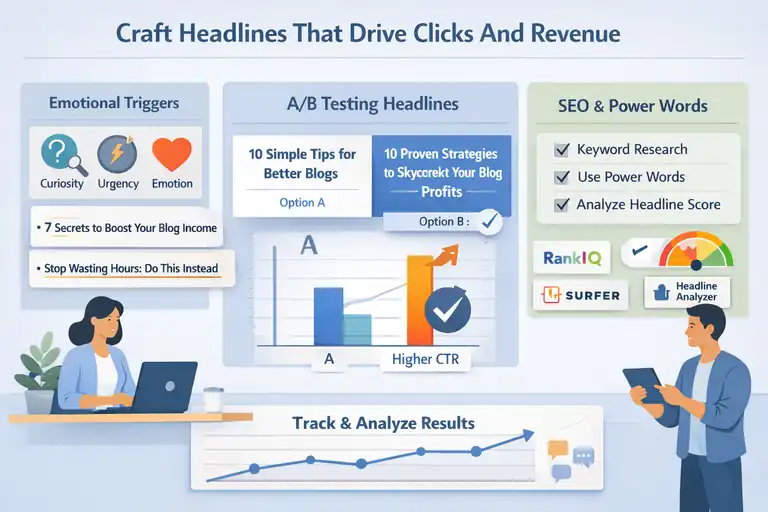
A headline isn’t just a title—it’s your ad for the content. Even if your post ranks well, a weak headline can cost you hundreds of potential readers and conversions.
The goal is to make readers feel something while staying honest and relevant to the blog’s promise.
Using Emotional Triggers To Boost CTR Without Clickbait
The best-performing headlines tap into curiosity, urgency, or emotion—without misleading readers.
For example:
- Instead of “Tips for Writing Blogs,” say “7 Blog Writing Secrets That Turn Posts Into Profit.”
- Instead of “Ways to Save Time,” try “Stop Wasting Hours: Do This Instead.”
I suggest testing emotional tones like curiosity, fear of missing out (FOMO), or personal gain. You can check your headline’s emotional impact using free tools like CoSchedule Headline Analyzer, which scores based on word balance and sentiment.
Just remember: never promise what the post can’t deliver. Authentic emotion builds trust, and that’s what keeps people clicking again.
Incorporating Power Words And SEO Keywords Naturally
Power words make your headlines pop, while SEO keywords help them rank. The trick is blending both naturally. I usually follow this simple pattern:
- [Number or Trigger] + [Adjective/Power Word] + [Keyword/Topic] + [Result or Promise]
Example: “10 Proven Blog Writing Tips That Earn You Money Every Time.”
You can use tools like SurferSEO to discover keyword variations that fit naturally within emotional headlines. I’ve found that starting or ending with a benefit (“That Work,” “That Earn,” “That Save You Time”) increases CTR by 15–20%.
Testing Multiple Headlines To Find The Highest-Converting One
If you’re publishing regularly, A/B testing headlines is worth the effort. I often write 3–5 variations before choosing the final one. Platforms like WordPress (Thrive Headline Optimizer) or VWO can help test which version gets more clicks.
Here’s how I do it manually:
- Share the post on social media with different headlines.
- Track which gets more engagement (clicks, comments, or shares).
- Update the post title and meta description based on results.
This small tweak alone can raise organic traffic and ad revenue significantly. Sometimes, the difference between “good” and “great” is a single word swap—like “effective” instead of “simple.”
Write Value-Driven Blog Introductions That Hook Readers
Your introduction decides if someone stays or bounces. In blog writing, the first 100 words set the emotional tone and the SEO foundation. It’s not about sounding smart—it’s about proving relevance fast.
The Art Of Opening With Curiosity And Relevance
Start by showing readers you understand their world. I often open with a question, a relatable pain point, or a quick stat.
For example: “Did you know 80% of readers never scroll past the first paragraph?” That one line sets context and urgency.
Use curiosity strategically:
- Begin with “what if,” “imagine,” or “ever wondered why” prompts.
- Immediately connect it to the problem your post solves.
- Avoid vague hooks—specific curiosity converts better.
If your intro feels like a conversation, not a lecture, readers will trust you faster.
Framing The Reader’s Problem To Build Instant Connection
This is where empathy sells. I suggest writing as if you’re speaking directly to one person who’s struggling.
For instance: “You’ve spent hours writing, but no one’s reading your blog. I’ve been there too.” That shared experience builds trust before you offer solutions.
A solid structure looks like this:
- Identify their struggle.
- Validate their feeling.
- Promise a clear, specific outcome.
When readers feel seen, they’ll give you their attention—and attention is what turns into clicks, sales, or subscriptions.
Using Short, Conversational Sentences To Increase Engagement
Dense paragraphs push readers away, especially on mobile. Keep your sentences under 20 words where possible, and use line breaks generously.
Quick tips:
- Write like you talk.
- Use contractions (“you’ll,” “it’s,” “they’re”) for flow.
- Read your intro out loud—it should sound natural, not rehearsed.
A conversational rhythm builds connection and boosts readability metrics like average time on page, which Google quietly rewards in rankings.
Pro Tip: Before you publish, read your intro from the reader’s perspective: “Would I keep reading?” If the answer is yes, you’re already halfway to writing a blog that earns.
Structure Blog Posts For Maximum Monetization
If you want to turn blog writing into a real income stream, structure is your secret weapon.
A well-structured post doesn’t just look cleaner—it guides readers toward taking profitable actions, like clicking affiliate links, subscribing, or making a purchase.
Let’s break down how to organize your content for both clarity and conversions.
Using The Inverted Pyramid To Prioritize High-Value Info
The inverted pyramid structure is one of my go-to strategies for profitable blogging. It means you start with the most valuable, attention-grabbing information first, then gradually move toward supporting details.
Think of it this way: readers skim, especially online. If you make them dig for value, they’ll bounce.
But if your first paragraph delivers something useful or surprising, they’ll stay longer—and longer sessions mean more ad impressions, affiliate clicks, and engagement.
Here’s how I suggest applying it:
- Start with impact: Lead with your main takeaway or a quick solution. For example, if your post is about writing faster, say, “You can double your writing speed by using an AI-assisted outline.”
- Add proof or context: Follow with brief data, a relatable example, or a short story.
- End with detail: Use the remaining sections to expand on your key ideas or provide step-by-step methods.
When readers get instant value, they trust you—and trust is what drives revenue.
Adding Strategic Call-To-Action (CTA) Placements Within Content
CTAs are the turning point between passive reading and active engagement. I’ve learned through experience that where you place your CTAs is just as important as what they say.
Here’s a structure that consistently performs well:
- Top of the post: A soft CTA, like “Download the free checklist below” or “Bookmark this guide.”
- Middle of the post: A contextual CTA after a key insight—this could be an affiliate link, such as recommending a tool you genuinely use.
- End of the post: A strong action prompt, like “Apply these tips using [tool name] and start earning from your next post.”
To make CTAs blend naturally, always explain why you’re suggesting them.
For example, “I recommend Grammarly Premium because it highlights tone and engagement issues that can affect conversions.” That transparency turns a sales mention into a trust signal.
Linking To Related Posts To Increase Page Views And Time On Site
Internal linking is one of the easiest ways to keep readers engaged—and it’s often overlooked.
Every additional click keeps someone longer on your site, signaling to Google that your content is valuable.
I recommend adding internal links in three smart ways:
- Contextual links: Naturally mention and link to other relevant posts within the paragraph. Example: “If you’re new to keyword research, check out my step-by-step beginner’s guide.”
- End-of-section suggestions: Add short prompts like “Related: How to Write Headlines That Convert.”
- In-content recommendations: Insert a quick resource box with links to tutorials or case studies.
If you’re using WordPress, plugins like Link Whisper can automatically suggest relevant internal links based on your keywords, saving hours of manual effort.
Pro tip: Keep links relevant and add value; avoid linking for the sake of SEO. Readers notice authenticity—and they reward it with clicks.
Optimize Every Post For SEO And Affiliate Earnings
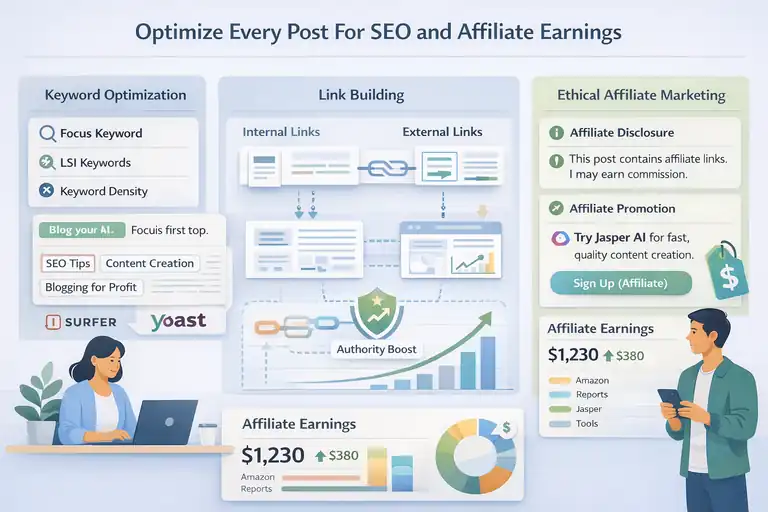
Writing for SEO doesn’t mean stuffing keywords—it means structuring your post so it naturally ranks while supporting monetization goals.
When done right, SEO optimization and affiliate strategy work hand in hand to grow both traffic and income.
Naturally Integrating Keywords Without Overstuffing
Keyword optimization should feel invisible. The goal is for your blog post to read naturally while still signaling relevance to search engines.
Here’s what I personally do:
- Place the focus keyword (like “blog writing”) in the first 100 words, the meta title, and at least one H2 heading.
- Use related variations (LSI keywords) such as “content creation,” “blogging for profit,” and “SEO-friendly posts.”
- Sprinkle them naturally in sentences like: “When you approach blog writing with strategy, every post can become an asset.”
If you’re unsure how your keyword density looks, tools like Squirrly can guide you. But remember—clarity and flow always come before optimization.
Using Internal And External Links To Build Authority
Google rewards blogs that demonstrate expertise and reliability. One way to do that is through a balance of internal and external links.
- Internal links connect your posts, creating a content web that strengthens topic authority.
- External links point to credible sources, showing that your information is well-researched.
For instance, linking to data from HubSpot, Statista, or Backlinko can validate your points and build trust. I recommend aiming for at least two internal and two external links per 1,000 words.
This linking structure not only boosts SEO but also makes your content more helpful—something both readers and algorithms appreciate.
Including Affiliate Links Ethically And Transparently
Affiliate links can turn an educational post into a passive income stream—but only if they’re handled ethically. Readers trust transparency.
Always disclose affiliate partnerships clearly (for example, with a short note like, “This post contains affiliate links, meaning I may earn a small commission at no extra cost to you.”).
To make affiliate mentions natural:
- Recommend only tools or products you’ve personally used or can verify.
- Explain why it’s useful and how to use it.
- Avoid overwhelming readers with too many links—2–4 per post is ideal.
For instance, instead of just dropping an affiliate link to “Jasper AI,” I might write: “I use Jasper AI to speed up first drafts. It’s like having an assistant who writes the rough version so I can focus on refining the voice.” This approach sells through authenticity, not pressure.
Write With Conversion Psychology In Mind
The best blog writing converts because it connects emotionally first and logically second. You’re not just sharing tips—you’re guiding readers toward change.
Conversion psychology helps you align your content with human behavior, making each paragraph quietly persuasive.
Using Storytelling To Build Trust Before Selling
Stories sell because they feel real. Before suggesting a product or idea, share a quick scenario or experience that mirrors your reader’s struggles.
For example: “When I started my first blog, I thought posting twice a week was enough. But it wasn’t until I started optimizing my structure and CTAs that I saw real income.” That kind of story builds credibility fast.
You can also use mini customer stories or user examples to show real outcomes—just make sure they’re honest. Storytelling humanizes your brand and increases retention.
Applying The “Problem–Agitate–Solve” Copywriting Formula
This classic copywriting method works beautifully in blog writing because it mirrors how readers process emotion and logic.
- Problem: Identify what’s holding them back. Example: “You spend hours writing, but your posts barely get clicks.”
- Agitate: Add emotion to it. “It’s frustrating watching others grow while you feel invisible.”
- Solve: Offer relief. “Here’s how I fixed that—and how you can, too.”
You can apply this formula in intros, CTAs, or even affiliate sections. It’s subtle but incredibly powerful at keeping readers engaged until the end.
Turning Features Into Benefits To Increase Reader Buy-In
When mentioning tools, services, or products, focus on benefits, not features. People don’t buy what something does—they buy what it does for them.
For instance, instead of saying, “Grammarly checks your grammar,” say, “Grammarly helps you sound more professional and confident, so your posts attract better-paying clients.”
I suggest using this framework:
- Feature: What it does.
- Benefit: What it helps achieve.
- Result: Why it matters.
Example: “Jasper AI generates blog outlines (feature) so you can plan posts faster (benefit), giving you more time to focus on strategy and monetization (result).”
By writing through that lens, your content naturally becomes persuasive without sounding like a sales pitch.
Pro Tip: Before publishing, read your post as if you were the reader. Ask yourself, “Does this make me want to take action?” If the answer is yes, then your blog writing isn’t just good—it’s profitable.
Create Visuals That Strengthen Blog Monetization
Visuals can do more than make your blog look good—they can actually make you money.
I’ve seen countless bloggers overlook how powerful a single infographic or product image can be for increasing engagement, affiliate clicks, and overall time on page.
Let’s talk about how to use visuals strategically to strengthen your monetization efforts.
Using Infographics And Charts To Boost Shareability
Infographics are among the most shareable forms of content on the internet. They compress information into a visual story, which makes complex ideas simple and easy to digest.
When people share your infographics, they’re effectively spreading your blog link—and that means more traffic and monetization potential.
Here’s how I use them effectively:
- Summarize data-rich sections: Turn statistics, steps, or comparisons into a clean infographic using tools like Canva or Venngage.
- Add your branding: Include your blog logo and URL at the bottom of every image to earn credit when it’s shared.
- Encourage embedding: Offer readers an embed code below your infographic (you can generate one using Embedly). This lets other bloggers post it while linking back to your original article.
I once created a simple “10 Steps to SEO-Friendly Blog Writing” chart that got picked up by five niche sites. That single image brought over 2,000 extra visits and several affiliate clicks within two weeks. That’s the quiet power of visual shareability.
Optimizing Images For SEO And Page Speed
Beautiful visuals mean nothing if they slow your page down. Readers bounce quickly from slow-loading blogs, and Google notices it.
I suggest optimizing every image before uploading—it’s one of the easiest ways to boost both speed and rankings.
Here’s my process:
- Resize before upload: Keep images under 150KB when possible.
- Use descriptive file names: Instead of “image1.jpg,” use “blog-writing-infographic.jpg.”
- Add alt text naturally: Write a short, keyword-relevant description (e.g., “chart showing blog writing process”).
- Compress with tools: Try TinyPNG or ShortPixel.
If you’re using WordPress, install a plugin like Smush or Imagify to automate compression. A fast-loading, visually rich post keeps readers around longer—giving your CTAs and affiliate links more time to work.
Embedding Product Photos Or Tutorials To Support Affiliate Content
One of the most underrated monetization tactics is showing the product, not just mentioning it.
I’ve found that including real screenshots or tutorial images dramatically improves affiliate conversions because it builds trust and reduces hesitation.
For example, if you’re recommending Jasper AI for writing, include a screenshot of the dashboard with a caption like: “Here’s how the outline generator looks inside Jasper—it takes 10 seconds to create a blog structure.”
Quick guidelines:
- Use your own screenshots for authenticity.
- Add simple captions that describe what’s being shown.
- Avoid clutter—one strong image per key product is enough.
This approach helps readers visualize results, which makes them more confident about taking action.
Pro Tip: Use a consistent visual style—same font, border, and tone—to strengthen your brand identity. Consistency builds subconscious trust.
Build Reader Loyalty To Boost Recurring Income
Monetization isn’t just about one-time clicks—it’s about turning casual readers into loyal followers who keep returning (and converting).
The more you nurture your audience, the more stable your income becomes.
Encouraging Email Signups With Content Upgrades
Email subscribers are your most valuable audience. Unlike social media followers, you own your list. One of the best ways to grow it is through content upgrades—bonus materials that expand on your blog post.
Here are examples that work well:
- A downloadable checklist (e.g., “10 SEO Tasks Before You Publish a Blog”)
- A free mini-course or PDF guide
- Editable templates (like content calendars or keyword planners)
Use tools like MailerLite to create signup forms directly in your posts. I recommend placing them mid-article and at the end for higher visibility.
Once they’re subscribed, nurture them with regular, value-packed emails. I’ve seen this build trust so strongly that my readers often buy affiliate products based solely on my recommendations.
Creating A Consistent Posting Schedule That Builds Trust
Readers trust reliability. Posting consistently shows commitment, and that matters more than posting frequently. You don’t need to publish every day—just show up regularly.
Here’s what I suggest:
- Pick a realistic frequency (once a week or biweekly).
- Create a simple editorial calendar in Notion or Trello to stay on track.
- Let readers know your posting rhythm (e.g., “New post every Friday”).
Consistency also helps SEO—Google rewards blogs that publish regularly. I’ve noticed posts from consistent publishers often outperform sporadic ones even with fewer backlinks.
Personalizing Your Writing Voice To Keep Readers Coming Back
Your voice is what makes people stay. I believe this is where most blogs win or lose. Readers don’t return for information—they return for connection.
To personalize your writing:
- Use “you” and “I” naturally, as if talking to one reader.
- Share small stories or honest struggles related to your topic.
- Use humor or warmth to make technical content feel human.
Example: “I once spent hours editing a single headline—only to realize it wasn’t about perfection, it was about empathy.”
Your authenticity is your differentiator. The more real you sound, the more loyal your readers become—and loyalty eventually turns into long-term income.
Promote Your Blog Posts For Maximum Visibility
Even the most valuable blog writing won’t earn you anything if no one sees it. Promotion is where traffic—and income—truly begin.
Once your post is published, you need to distribute it across multiple channels strategically.
Leveraging Social Media Platforms To Drive Targeted Traffic
Social media isn’t just for exposure—it’s for driving targeted traffic that converts. But not every platform works the same.
Here’s how I use each effectively:
- Pinterest: Best for visual or “how-to” content. Create vertical pins (1000x1500px) using Canva with clear titles and brand colors.
- LinkedIn: Great for professional and educational content. Share excerpts or insights from your post to build authority.
- Twitter (X): Use short, engaging hooks with a link to your blog. Example: “I turned one blog post into $500 in affiliate income—here’s how I structured it.”
- Facebook Groups: Share your post in relevant groups, but focus on adding value to discussions first.
Schedule posts using Later so you can maintain consistent visibility without burning out.
Collaborating With Influencers Or Guest Posts For Exposure
Partnerships can expand your reach faster than ads. I suggest collaborating with creators in your niche through guest posts, link swaps, or joint webinars.
Here’s how to start:
- Identify micro-influencers (under 20k followers) who share your audience.
- Offer something valuable first—like a content collaboration or expert quote.
- Write guest posts that naturally link back to your most monetized articles.
I once partnered with a small marketing YouTuber by providing blog resources for their audience. That single feature brought 500+ new subscribers and tripled my affiliate clicks that month.
Sometimes, strategic relationships outperform paid promotions.
Using Paid Ads Strategically To Amplify Profitable Content
Paid ads can be powerful when used wisely, but I always recommend starting small and testing. Focus on posts that already perform well organically—those are your best candidates for amplification.
Smart ad strategy looks like this:
- Use Facebook Ads for lead magnets or affiliate-heavy posts.
- Run Pinterest Ads for evergreen blog topics (like “best tools for content creators”).
- Set a modest daily budget ($5–$10) and monitor CTR, CPC, and conversions weekly.
If you use Google Analytics, track how ad-driven visitors behave—are they clicking your CTAs or signing up for emails? Adjust your targeting accordingly.
Paid ads aren’t magic; they’re multipliers. They work best when your blog already delivers genuine value and is optimized for monetization.
Pro Tip: Think of your blog like a small business. Every post you publish is a product, and every promotion channel is a storefront. Treat it that way, and each piece of content becomes an asset that keeps earning for years.
Analyze Blog Performance To Increase Earnings Over Time
Once your blog starts generating income, the real growth begins with understanding why it earns—and where you’re leaving money on the table.
I’ve learned that consistent analysis, even for just 30 minutes a week, can reveal surprising opportunities to boost performance and long-term profit.
Tracking Metrics That Matter: CTR, RPM, And Conversion Rate
To improve your blog writing results, you need to track the right numbers—not vanity metrics like likes or impressions.
The three most important performance indicators for monetized blogs are CTR (Click-Through Rate), RPM (Revenue Per Mille), and Conversion Rate.
Here’s how each one works:
- CTR (Click-Through Rate): Measures how often readers click on your affiliate links, ads, or CTAs. Low CTR means your calls to action or link placements might need improvement.
- RPM (Revenue Per Mille): Tells you how much money you make per 1,000 visitors. It’s key for evaluating ad and affiliate income. You can find this metric inside Google AdSense or Ezoic.
- Conversion Rate: Reflects how many visitors take a desired action—buying a product, signing up, or downloading something. Tools like Google Analytics 4 or Hotjar help track these behaviors easily.
I suggest setting up a simple tracking sheet in Google Sheets. Each week, record these metrics for your top 10 posts. Over time, patterns will emerge—helping you spot what works and where to focus optimization.
A/B Testing Content And CTAs For Better Results
I used to think testing was only for marketers with fancy tools, but in reality, even small bloggers can do it easily. A/B testing means comparing two versions of a page, headline, or CTA to see which performs better.
Here’s how I do it:
- Choose one variable: For example, test two different CTA buttons—one saying “Read More” and another saying “Start Earning Now.”
- Split traffic: Use plugins like Thrive Optimize (WordPress) to show different versions to different visitors.
- Analyze results: Give it at least a week, then pick the version with higher conversions.
Small tweaks—like changing CTA color, link placement, or even one headline word—can sometimes boost conversions by 20–40%. I once doubled the clicks on an affiliate post just by moving the CTA above the fold.
Adjusting Strategy Based On Analytics And Reader Feedback
Numbers tell one story; readers tell another. I recommend combining both to refine your strategy.
Use Google Analytics to identify pages with high bounce rates or low engagement. Then look at reader feedback—comments, email replies, or social DMs—to understand what they loved or found confusing.
Here’s how you can act on data:
- If a post has lots of traffic but few conversions, improve your CTAs.
- If it ranks low, optimize titles, meta descriptions, and internal links.
- If readers request a related topic, create a follow-up post or downloadable resource.
One of my favorite habits is sending a quick survey through Google Forms to email subscribers asking, “What kind of content would help you most right now?” The answers often reveal your next profitable idea.
Diversify Income Streams From Each Blog Post
Relying on one source of income is risky. Whether it’s ads, affiliates, or products, diversifying turns your blog into a stable business rather than a seasonal hustle.
Each post can support multiple revenue streams when structured smartly.
Monetizing With Display Ads And Affiliate Programs
Display ads are a great start—they generate income from traffic alone. Networks like Google AdSense, Mediavine, or Ezoic automate ad placement and payout. However, the real money often lies in affiliate marketing.
To do it right:
- Choose affiliates that match your content naturally. For example, a productivity blogger might promote Notion or Grammarly.
- Use comparison tables showing key differences between tools. This visual clarity often increases clicks.
- Keep ads minimal and well-placed to avoid slowing your site.
From what I’ve seen, balancing ads (for passive income) and affiliates (for active income) gives you the best of both worlds.
Creating Digital Products Or Ebooks Based On Blog Topics
Digital products turn your expertise into a long-term revenue stream. If your blog consistently solves problems, you can easily package that knowledge into paid guides, ebooks, or templates.
For example, if you write about blog writing, you could create a mini course or ebook titled “Monetize Your Blog Posts in 30 Days.” Tools like Gumroad, Podia, or Teachable make setup simple, even if you’ve never sold anything before.
I suggest validating demand first: create a free lead magnet or beta version to test interest. If people sign up, it’s a good sign your audience will pay for the full product.
Offering Coaching, Courses, Or Services Through Blog Content
Once you establish authority, offering services or coaching becomes a natural next step. I’ve seen many bloggers transition from ad revenue to premium consulting—earning more from one client than from 10,000 ad views.
To start:
- Add a “Work With Me” page showcasing your expertise and testimonials.
- Mention services within relevant posts (e.g., “If you’d like a personalized blog monetization plan, I offer one-on-one sessions.”).
- Use Calendly or TidyCal to automate bookings.
Courses, too, can scale your time. Tools like Thinkific or Kajabi let you record short video lessons and charge a one-time or recurring fee. It’s a powerful way to turn loyal readers into long-term clients.
Maintain Consistency And Authority In Blog Writing
Long-term blog income depends on trust—and trust is built through consistency, quality, and authority.
Readers (and Google) reward blogs that show up regularly with helpful, authentic content.
Developing A Unique Writing Style That Builds Brand Recognition
Your voice is your brand’s fingerprint. I’ve noticed that the blogs I remember most have a clear, relatable tone that feels human.
Here’s how to develop your own:
- Write like you talk. Don’t over-edit personality out of your posts.
- Use storytelling and relatable examples to create emotional connection.
- Be consistent with formatting, tone, and structure across every post.
You don’t need to sound perfect—you need to sound real. Readers remember writers who make them feel understood, not lectured.
Staying Updated With SEO And Content Marketing Trends
SEO evolves constantly. What worked last year might not work now. I suggest dedicating at least one hour weekly to learning updates.
Follow trusted sources like Backlinko, Search Engine Journal, or Google’s Search Central Blog.
Practical steps:
- Monitor core algorithm updates and adjust your strategy accordingly.
- Experiment with new content formats—AI-assisted outlines, interactive posts, or audio summaries.
- Keep mobile optimization and Core Web Vitals in check for better rankings.
Staying updated keeps your blog writing sharp and competitive. It’s not about chasing trends—it’s about understanding them well enough to adapt before others do.
Setting A Long-Term Content Strategy For Sustainable Growth
To keep your blog profitable, you need a plan that balances creativity with strategy. I recommend building a 6–12 month content roadmap focused on high-earning, evergreen topics.
Here’s how to create one:
- Audit your top performers: Use Google Analytics to see which posts bring traffic and income.
- Expand on what works: Create clusters of related posts around those winning topics.
- Set quarterly goals: For example, “Publish 10 SEO-optimized articles and one digital product per quarter.”
A documented plan ensures steady growth even when motivation dips. Over time, it transforms your blog from a collection of posts into a well-oiled business engine.
Pro Tip: Every post you publish adds to your long-term equity as a creator. Treat each one like an asset, not a task. The more strategically you write, analyze, and adapt, the more your blog will reward you—with both income and impact.
FAQ
How can blog writing help you earn money?
Blog writing helps you earn by attracting readers through valuable content, then monetizing with ads, affiliate links, sponsored posts, or digital products.
What are the best tips for profitable blog writing?
Focus on SEO, choose topics with high demand, use engaging headlines, and include clear CTAs that drive readers to take action or make purchases.
How do I optimize my blog posts for higher earnings?
Use targeted keywords naturally, link to relevant products or services, and update old posts regularly to maintain rankings and boost conversions.

I’m Juxhin, the voice behind The Justifiable.
I’ve spent 6+ years building blogs, managing affiliate campaigns, and testing the messy world of online business. Here, I cut the fluff and share the strategies that actually move the needle — so you can build income that’s sustainable, not speculative.
Related posts:
 Best Blog Platform to Make Money With Low Effort
 What’s the Best Website to Start a Blog for Income?
 Best Blogs to Make Money for New Content Creators
 Online Blog Ideas That Help You Build Income Faster
 Create a Blog Post That Ranks and Brings in Traffic
 Create a Blog Free and Start Earning With No Risk