
Table of Contents
Some links on The Justifiable are affiliate links, meaning we may earn a small commission at no extra cost to you. Read full disclaimer.
If you’re researching doba alternatives, chances are you’ve already hit a few limitations with Doba or you’re wondering if there’s a better dropshipping platform for your specific business model.
This guide is for store owners, beginners, and scaling sellers who want clearer supplier access, better margins, or stronger integrations.
The core question I’m answering is simple: Which dropshipping platforms are genuinely better alternatives to Doba, and how do they compare in real-world use?
Spocket As A Doba Alternative For Fast US And EU Shipping
Spocket is often the first platform I recommend when someone tells me, “Doba feels slow and expensive.”
It’s built around speed, supplier transparency, and tighter control—especially for sellers targeting US and EU customers.
Curated Supplier Network With Regional Fulfillment
One of Spocket’s biggest advantages over Doba is how its supplier network is structured.
Instead of acting like a massive directory, Spocket curates suppliers primarily from the US, EU, Canada, and Australia. That changes the entire customer experience.
Why this matters in practice:
- Faster shipping times (often 3–7 days instead of 2–4 weeks)
- Fewer “Where is my order?” emails
- Higher trust for first-time buyers
I’ve seen stores switch from Doba to Spocket and immediately reduce refund requests simply because products arrived when customers expected them to. When you’re running paid ads, that speed isn’t a nice-to-have—it’s survival.
Real-world scenario: If you’re selling home office gear to US customers, Spocket lets you filter suppliers already shipping domestically. With Doba, you’re often guessing where fulfillment actually happens.
Product Quality Control Compared To Doba’s Marketplace
Doba’s marketplace is large, but size isn’t the same as quality.
Spocket puts more emphasis on supplier screening and sample ordering. You can order test products directly through the platform, which is something many sellers skip—and later regret.
What Spocket does better here:
- Supplier reviews are easier to evaluate
- Product samples are straightforward to order
- Fewer duplicated or misleading listings
I always suggest this: Order one product yourself before scaling ads. It’s boring, but it saves you from angry emails and chargebacks later. Spocket makes that step less painful than Doba does.
Shopify And WooCommerce Integration Differences
Both platforms integrate with Shopify, but the experience isn’t equal.
Spocket’s app feels purpose-built for Shopify and WooCommerce users. Product import, pricing rules, and order syncing are cleaner and more intuitive.
Key integration differences that matter day-to-day:
- Faster product push to store
- Easier pricing automation
- Cleaner order status updates
Doba’s integration works, but it feels like a layer added on top of a directory. Spocket feels like it was designed for modern ecommerce workflows from day one.
Pricing Structure And Profit Margin Potential
Pricing is where sellers often hesitate—until they do the math.
Here’s a quick comparison:
| Platform | Starting Cost | Supplier Access | Shipping Speed | Margin Control |
| Spocket | Monthly plan | Curated | Fast (US/EU) | High |
| Doba | Monthly + fees | Broad directory | Mixed | Medium |
Spocket’s higher plan cost can look intimidating, but faster shipping and better product consistency usually lead to higher conversion rates. In my experience, higher conversion beats lower software fees every time.
SaleHoo As A Doba Alternative For Supplier Vetting
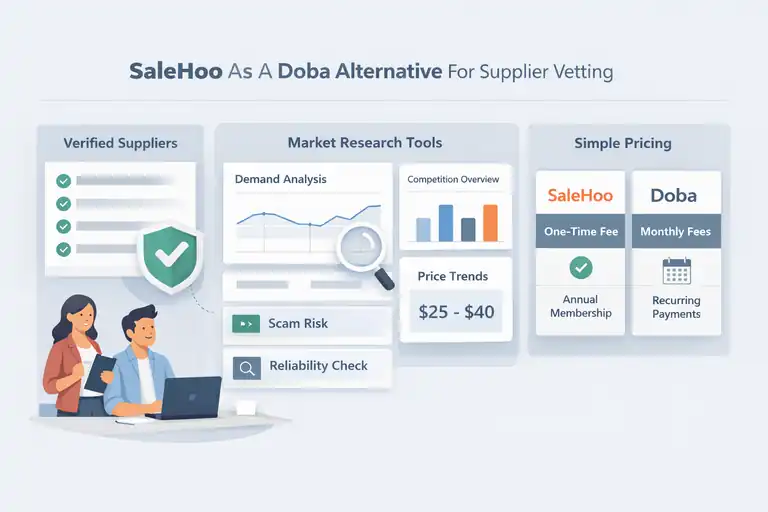
SaleHoo isn’t flashy—and that’s exactly why it works.
If Doba feels overwhelming or risky, SaleHoo takes the opposite approach: fewer suppliers, but far more trust.
Verified Wholesale Suppliers Versus Doba’s Directory Model
SaleHoo’s core value is supplier vetting.
Every supplier in its database is reviewed for legitimacy, business history, and reliability. That’s a huge difference from Doba’s open directory-style approach.
What you gain with SaleHoo:
- Lower risk of scam suppliers
- Clearer supplier expectations
- More stable long-term relationships
If you’ve ever paid for a Doba supplier only to realize they’re a middleman of a middleman, SaleHoo feels like a relief.
Market Research Tools For Product Demand Validation
This is where SaleHoo quietly outperforms Doba.
SaleHoo includes built-in market research tools that help you evaluate:
- Search demand
- Competition level
- Price ranges that actually sell
How this plays out in real life: Instead of guessing which product to import, you can sanity-check demand before building a product page. That alone can save weeks of wasted effort.
I’ve used SaleHoo specifically when I wanted validation before committing to a niche—and it’s surprisingly good at stopping bad ideas early.
One-Time Membership Value Compared To Monthly Fees
SaleHoo’s pricing model is refreshingly simple.
You pay once for annual access instead of stacking monthly fees like Doba does.
| Platform | Pricing Model | Best For |
| SaleHoo | Annual membership | Long-term sellers |
| Doba | Monthly plans | Directory access |
For sellers who hate recurring software costs, this alone makes SaleHoo attractive. You’re not pressured to “make it work fast” just to justify another monthly bill.
Best Use Cases For New Versus Experienced Sellers
SaleHoo isn’t for everyone—and that’s okay.
SaleHoo works best if you:
- Want maximum supplier trust
- Prefer research before execution
- Plan to build long-term supplier relationships
Doba might still fit if you:
- Want sheer product variety
- Don’t mind testing multiple suppliers
- Need quick access to many categories
My honest take? If you’re new and risk-averse, SaleHoo feels safer. If you’re experienced and aggressive, Doba or Spocket might move faster—but with more volatility.
Modalyst As A Doba Alternative For Brand-Focused Stores
Modalyst is what I reach for when someone says, “I don’t want my store to look like every other dropshipping site on the internet.”
If branding matters to you, Modalyst plays a very different game than Doba.
Access To Name-Brand And Private Label Products
Modalyst stands out because it gives you access to actual brands, not just anonymous suppliers.
You’ll find well-known labels, independent designers, and private-label-ready products. That opens doors Doba simply doesn’t.
Why this matters in real life: If a customer recognizes a brand, trust skyrockets. Conversion rates follow.
Original scenario: Imagine selling fitness apparel. With Doba, you’re often listing generic products with stock photos used by dozens of stores. With Modalyst, you can sell branded activewear and position your store like a boutique—not a reseller.
Key advantages here:
- Higher perceived value
- Easier storytelling on product pages
- Stronger repeat purchase potential
I’ve found that Modalyst stores rely less on aggressive discounts because branding does more of the selling.
Automation And Inventory Sync Capabilities
Modalyst is built for sellers who hate babysitting inventory.
Inventory levels sync automatically, orders flow to suppliers, and product updates happen without manual work.
Where Modalyst shines operationally:
- Real-time inventory sync
- Automatic order routing
- Clean Shopify app experience
This matters when you scale. Manual checks don’t just waste time—they create expensive mistakes.
Scenario from experience: A product goes viral on TikTok overnight. Modalyst updates inventory instantly. With Doba, overselling can happen before you even notice.
Less chaos. Fewer refunds. Better sleep.
Pricing Tiers And Scalability Limits
Modalyst’s pricing is tiered, and that’s both good and limiting.
Here’s a quick breakdown:
| Plan Type | Monthly Cost | Product Limit | Best For |
| Free | $0 | Limited | Testing |
| Paid | Tiered | Higher limits | Growth |
| Pro | Higher | Unlimited | Scaling |
The limitation isn’t cost—it’s fit. Modalyst works best when you’re selective about products, not when you want thousands of SKUs.
In my opinion, that constraint is healthy. Too many products usually means weaker branding anyway.
Ideal Store Types That Benefit Most From Modalyst
Modalyst isn’t for everyone—and that’s intentional.
Best fit if you:
- Care about brand identity
- Want recognizable or premium products
- Plan long-term positioning
Not ideal if you:
- Want massive product volume
- Compete mainly on price
- Test dozens of niches at once
If your goal is building something that doesn’t scream “dropshipping,” Modalyst gives you a real shot.
Worldwide Brands As A Doba Alternative For Wholesale Dropshipping
Worldwide Brands is old-school—and that’s not an insult.
It’s built for sellers who want legitimate wholesale relationships, not quick-flip products.
Certified Wholesale Supplier Database Depth
Worldwide Brands focuses on certification over quantity.
Every supplier is verified, authorized, and vetted. That’s a stark contrast to Doba’s open marketplace approach.
What this means in practice:
- Fewer suppliers, higher trust
- Legitimate resale rights
- Real wholesale pricing
Real-world example: If you’re applying to sell on Amazon or Walmart Marketplace, Worldwide Brands suppliers are far less likely to trigger compliance issues.
It’s boring. It’s slow. It works.
Long-Term Cost Comparison With Doba Subscriptions
Worldwide Brands uses a lifetime membership model.
You pay once, and that’s it.
| Platform | Cost Structure | Long-Term Value |
| Worldwide Brands | One-time fee | High |
| Doba | Monthly subscription | Ongoing expense |
For sellers planning to operate for years, this pricing model wins quietly. No pressure to “make it worth it this month.” No churn anxiety.
From what I’ve seen, patient sellers benefit the most.
Product Category Coverage And Limitations
Worldwide Brands doesn’t cover everything—and it doesn’t pretend to.
You’ll find strong coverage in:
- Electronics
- Home goods
- Apparel
- Health and beauty
You won’t find:
- Trendy impulse products
- Fast-fashion clones
- Viral gimmicks
That’s the trade-off. Stability over trends.
Seller Profiles That Get The Most ROI
Worldwide Brands is ideal for a very specific seller profile.
Best fit if you:
- Want wholesale legitimacy
- Sell on Amazon, eBay, or Walmart
- Care about supplier relationships
Not ideal if you:
- Want rapid product testing
- Rely on trends
- Need instant gratification
If Doba feels chaotic, Worldwide Brands feels like a filing cabinet. Not exciting—but incredibly effective if you know what you’re building.
AliExpress Dropshipping Center As A Doba Alternative For Cost Control
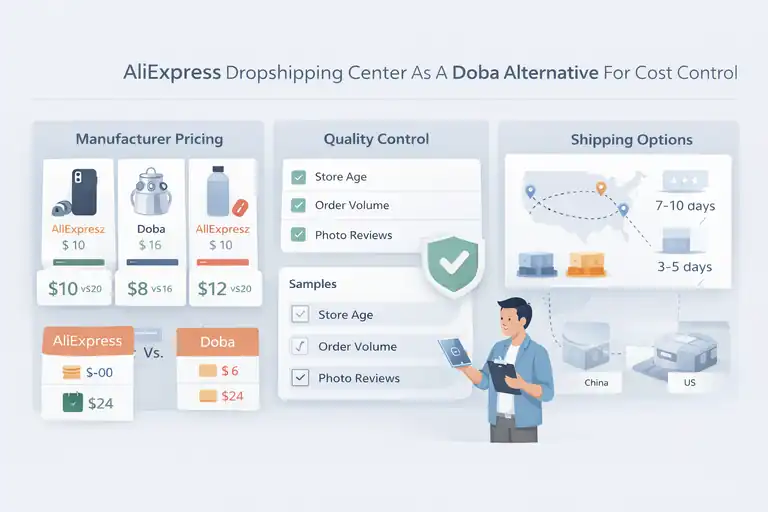
AliExpress Dropshipping Center is the blunt instrument of dropshipping. It’s not elegant, but if your main goal is cost control, nothing competes with it directly.
Direct Manufacturer Pricing Versus Aggregated Platforms
AliExpress cuts out most middlemen, and that changes your margins immediately.
You’re often buying straight from manufacturers or first-tier distributors instead of paying directory markups like you do with Doba.
What this looks like in practice: A product that costs $18 on Doba might cost $6–$8 on AliExpress. That difference can be the gap between barely breaking even and running ads profitably.
Why I still use it selectively:
- Maximum pricing flexibility
- Easy supplier switching
- Massive product variety
The downside? You’re trading convenience for control. AliExpress assumes you know what you’re doing.
Supplier Reliability And Quality Risk Management
AliExpress is powerful—but chaotic.
Supplier quality ranges from excellent to “how is this even real?” You have to manage that risk manually.
How experienced sellers reduce problems:
- Order samples before listing
- Check store age and order volume
- Read photo reviews, not just star ratings
Original scenario: Let’s say you’re testing a phone accessory. You order two samples from different suppliers. One arrives in premium packaging, the other looks like it lost a fight with customs. You choose fast—and avoid refunds later.
Doba tries to simplify this. AliExpress gives you full responsibility.
Shipping Time Trade-Offs And Buyer Expectations
Shipping is the biggest trade-off—and also the most misunderstood.
AliExpress now offers faster options like AliExpress Standard Shipping and US warehouses, but delays still happen.
The real key isn’t speed—it’s honesty.
If your product page promises 7–10 days and delivers in 9, customers are happy. Promise 3 days and deliver in 12? Refund city.
I’ve seen sellers succeed wildly with AliExpress simply by setting expectations clearly and under-promising.
When AliExpress Outperforms Doba And When It Doesn’t
AliExpress wins when:
- You’re testing products quickly
- Margins matter more than convenience
- You’re comfortable managing suppliers
Doba wins when:
- You want structured workflows
- You prefer centralized billing
- You value simplicity over flexibility
My opinion? AliExpress is a scalpel. Doba is a safety glove. Choose based on how steady your hands are.
Inventory Source As A Doba Alternative For Automation-First Sellers
Inventory Source is what you use when you’re done playing around and want systems.
It’s built for sellers who care more about automation and data accuracy than browsing products.
Multi-Supplier Sync And Order Automation
Inventory Source focuses on operational efficiency.
It syncs inventory across multiple suppliers and automates order routing without manual intervention.
What automation actually changes:
- Fewer overselling errors
- Faster order processing
- Less admin work per sale
Real-world scenario: You’re selling the same product from two suppliers. One goes out of stock. Inventory Source reroutes orders automatically. With Doba, you’d likely find out after angry emails.
This is backend power—not flashy, but critical at scale.
Platform Integrations And Data Accuracy
Inventory Source integrates with major platforms like Shopify, WooCommerce, Amazon, and BigCommerce.
More importantly, it prioritizes data accuracy over aesthetics.
Key strengths here:
- Reliable inventory sync
- Cleaner SKU management
- Fewer listing discrepancies
From what I’ve seen, sellers who care about reporting, forecasting, and analytics appreciate Inventory Source far more than directory-style platforms.
Pricing Flexibility Compared To Doba Plans
Inventory Source pricing is modular.
You pay based on:
- Automation level
- Number of suppliers
- Integration depth
| Platform | Pricing Style | Best For |
| Inventory Source | Modular | Process-driven sellers |
| Doba | Tiered plans | Simplicity seekers |
It’s not cheaper by default—but you’re paying for control, not access.
Operational Complexity Versus Control Benefits
Inventory Source isn’t beginner-friendly—and that’s the point.
You gain:
- Deep automation
- Supplier-level control
- Scalability without chaos
You give up:
- Plug-and-play simplicity
- Casual experimentation
If Doba feels like training wheels, Inventory Source feels like a manual transmission. Harder at first—but far more powerful once you know how to drive it.
Comparing Doba Alternatives By Pricing, Suppliers, And Control
At this point, the real question isn’t “Which platform is best?” It’s “Which platform gives me the right level of control without breaking my business model?”
Monthly Cost Versus Long-Term Business Value
Monthly pricing can be deceptive.
A lower fee feels safer, but it doesn’t always lead to better outcomes.
How this plays out in practice: A seller pays $60/month for a directory but struggles with refunds due to slow shipping. Another seller pays $99/month for better suppliers and ships faster. The second seller wins—even though the software costs more.
What I look at instead of price:
- Conversion rate impact
- Refund reduction
- Customer lifetime value
Here’s a high-level comparison:
| Platform | Typical Cost Model | Long-Term Value |
| Spocket | Monthly | High |
| SaleHoo | Annual | High |
| Modalyst | Tiered | Medium–High |
| AliExpress | Free | Variable |
| Inventory Source | Modular | High |
| Doba | Monthly | Medium |
Cheap tools cost you later. That’s a lesson most sellers learn the hard way.
Supplier Transparency And Direct Communication
Supplier access changes how fast you can fix problems.
Platforms like AliExpress and Worldwide Brands allow direct communication. Others, like Doba, act as intermediaries.
Original scenario: A product arrives damaged. With direct supplier access, you negotiate replacements immediately. With an intermediary, you wait—while the customer waits.
Why transparency matters:
- Faster issue resolution
- Better negotiation leverage
- Stronger long-term relationships
In my experience, sellers who talk directly to suppliers sleep better.
Automation Depth And Manual Workload
Automation isn’t about laziness. It’s about avoiding preventable mistakes.
Low automation leads to:
- Overselling
- Missed orders
- Inventory mismatches
High automation enables:
- Scale without chaos
- Predictable workflows
- Cleaner analytics
Inventory Source dominates here. Doba simplifies—but caps control. You have to decide which pain you prefer.
Choosing Based On Business Stage And Goals
The wrong tool at the wrong stage creates friction.
- Early-stage sellers benefit from simplicity and speed.
- Growth-stage sellers need margins and reliability.
- Scaling sellers need systems and automation.
There’s no forever tool. Just the right tool right now.
How To Choose The Right Doba Alternative For Your Store Model
This is where most guides get vague. Let’s not do that.
Beginners Focused On Speed And Simplicity
If you’re new, friction is your enemy.
Best options:
- Spocket for faster wins
- SaleHoo for safer decisions
Scenario: You want your first sale this month, not a perfect system next year. Choose tools that remove steps—not add them.
Brand Builders Prioritizing Quality And Consistency
Brand builders should avoid generic platforms.
Best options:
- Modalyst for brand perception
- Worldwide Brands for legitimacy
You’re not racing. You’re building trust. That changes every decision.
Scaling Stores Needing Automation And Margin Control
Scale breaks fragile systems.
Best options:
- Inventory Source for automation
- AliExpress for margin testing
If you’re doing volume, manual work will eventually cost more than software.
Risk Tolerance And Cash Flow Considerations
This is the part no one likes to admit.
Low risk tolerance: SaleHoo, Worldwide Brands
High risk tolerance: AliExpress
Balanced approach: Spocket or Modalyst
Personal take: Your cash flow decides your risk tolerance—not your confidence.
Final Expert Tip
If you’re stuck choosing, don’t ask which platform is “best.” Ask this instead:
Which problem is currently costing me the most money?
Then choose the Doba alternative that fixes that problem first.
FAQ
What are the best Doba alternatives for dropshipping?
The best Doba alternatives depend on your goal. Spocket is ideal for fast US and EU shipping, SaleHoo works best for verified wholesale suppliers, Modalyst fits brand-focused stores, AliExpress offers maximum cost control, and Inventory Source is strongest for automation-driven sellers.
Are Doba alternatives cheaper than Doba?
Some are, but cheaper doesn’t always mean better. AliExpress has no platform fees, while SaleHoo uses a low annual membership. However, tools like Spocket or Inventory Source may cost more monthly but often deliver higher profit margins through faster shipping, better suppliers, and automation.
Which Doba alternative is best for beginners?
For beginners, Spocket and SaleHoo are the safest starting points. Spocket simplifies product sourcing with fast shipping, while SaleHoo reduces risk by offering vetted suppliers and market research tools, making early decisions easier and less costly.

I’m Juxhin, the voice behind The Justifiable.
I’ve spent 6+ years building blogs, managing affiliate campaigns, and testing the messy world of online business. Here, I cut the fluff and share the strategies that actually move the needle — so you can build income that’s sustainable, not speculative.
Related posts:
 How the Salehoo Catalog Helps You Spot Winning Items Quickly
 How the Salehoo App Works and Why It Speeds Up Product Research
 Salehoo Stores Review: Are These Stores Worth It?
 What Is SaleHoo All About? A Clear Guide for Beginners
 Top Ecommerce Platforms That Make Selling Simple
 Doba Pricing Explained: Plans, Fees, and Hidden Costs