
Table of Contents
Some links on The Justifiable are affiliate links, meaning we may earn a small commission at no extra cost to you. Read full disclaimer.
Finding reliable affiliate marketing partners quickly can feel like searching for gold in a crowded mine—you know the treasure is there, but not all that glitters is worth your time.
I’ve learned that the right partnerships can transform a blog or business into a steady revenue stream, while the wrong ones drain your energy.
So, in this guide, I’ll walk you through exactly how to find trustworthy affiliate partners fast—using proven strategies, vetted platforms, and smart outreach techniques that actually work.
Understand What Makes a Reliable Affiliate Marketing Partner
Finding the right affiliate marketing partners is a mix of intuition, research, and data.
It’s not just about who pays the highest commission—it’s about who aligns with your values, treats affiliates fairly, and supports growth long-term.
Identify the Core Qualities of a Trustworthy Partner
The best partners share three core traits: transparency, consistency, and brand-audience fit.
- Transparency: A reliable affiliate partner provides clear tracking, real-time reporting, and open communication about updates. For instance, platforms like Awin and Impact give affiliates access to detailed performance dashboards, making it easy to monitor click-throughs and conversions without hidden data.
- Consistency: You want a partner who maintains stable payouts and communication. A brand that disappears between campaigns or delays payments is a red flag.
- Brand Fit: If your content focuses on sustainable living, partnering with a fast-fashion retailer doesn’t make sense. A strong partnership grows when your audience genuinely values the promoted product.
A quick test: Ask yourself, Would I personally recommend this product even if there was no commission involved? If the answer is yes, you’re on the right path.
Evaluate Program Transparency and Commission Structures
Transparency in commission rates and conversion tracking is crucial for building trust.
Look for:
- Clear Commission Rules: Some programs use tiered structures, meaning the more sales you drive, the higher your commission. For example, Impact allows brands to customize performance tiers you can view directly from your dashboard.
- Cookie Duration: This determines how long you get credit after someone clicks your link. A 30-day cookie is standard, but premium programs may extend it to 90 days.
- Attribution Model: Check whether the program rewards the first click, last click, or shared commission—this impacts your earnings potential.
From experience, always avoid affiliate programs that don’t clearly display these details upfront. Lack of transparency is an early warning sign of unreliable practices.
Look for Brands That Match Your Audience’s Values
Aligning with your audience’s values builds credibility—and conversions. If you promote a brand your readers already trust or aspire to use, you’ll naturally see higher engagement.
Here’s a quick approach I use:
- Survey or Poll Your Audience: Ask what tools or products they already use.
- Analyze Engagement: See which affiliate mentions in your content get clicks or shares.
- Compare Tone and Positioning: The brand’s messaging should fit your own. A serious finance blogger promoting a meme crypto brand, for instance, sends mixed signals.
Awin makes this easier by letting you filter affiliate programs based on verticals—like sustainability, tech, or wellness—so you can match your niche without guesswork.
Check Payment Reliability and Payout Frequency
Nothing sours an affiliate relationship faster than unreliable payments. Before joining any program, confirm these three factors:
- Payout Schedule: Reliable networks such as FlexOffers and Rakuten Advertising offer predictable monthly payments.
- Minimum Threshold: Some networks require $50 or $100 in commissions before payout; others, like MyLead, allow earlier withdrawals.
- Payment Methods: Look for PayPal, direct deposit, or wire transfers. If a program only offers crypto or gift cards, proceed with caution.
Pro tip: Always join at least one large, proven network (like Awin or Impact) to ensure your affiliate income remains stable even if one partner falters.
Use Trusted Affiliate Networks to Find Quality Partners
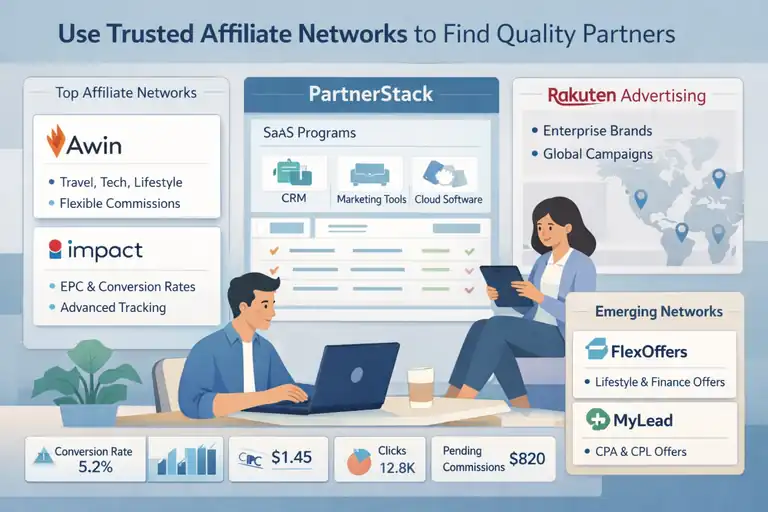
A quick way to find dependable affiliate marketing partners is by using reputable affiliate networks.
These platforms vet programs, handle tracking, and ensure payments, saving you countless hours of trial and error.
Explore Top Affiliate Networks Like Awin and Impact
Awin and Impact are two of the most respected global affiliate networks, and both excel at transparency and scale.
- Awin: Offers programs across nearly every niche—finance, travel, tech, lifestyle—and features intuitive reporting dashboards. You can search programs by commission type, brand reputation, or region.
- Impact: Ideal for professional affiliates. Its Partner Discovery tool helps filter by conversion rate, EPC (earnings per click), and brand size. The tracking interface also shows attribution paths, which means you can see how your traffic contributes to conversions even if it’s not the final click.
If you’re new, start with Awin—it’s user-friendly and provides excellent support documentation.
Leverage PartnerStack for SaaS and Software Partnerships
If your audience includes tech enthusiasts, marketers, or small business owners, PartnerStack is a goldmine. It’s designed specifically for SaaS affiliate programs, featuring top tools like Freshsales and HubSpot CRM.
Why it works well:
- You can filter offers by software category (e.g., “marketing automation” or “CRM”).
- It provides pre-built affiliate assets such as banners and product demos.
- Automated payouts mean you don’t chase commissions manually.
Think of PartnerStack as a “LinkedIn for SaaS partnerships”—everything from onboarding to performance tracking happens in one clean dashboard.
Use Rakuten Advertising for Enterprise-Level Brands
Rakuten Advertising connects affiliates with global enterprise brands—from fashion and retail to travel. It’s known for strong partner support and a rigorous vetting process.
You’ll often find brands like Macy’s or Lenovo on Rakuten. These high-trust companies boost your credibility instantly.
Plus, Rakuten’s backend dashboard allows performance tracking across multiple countries, making it great for affiliates with international audiences.
However, approval can take longer—so apply only to brands that clearly fit your niche.
Discover Emerging Networks Like FlexOffers and MyLead for Diverse Niches
While Awin and Impact dominate the mainstream space, FlexOffers and MyLead excel in diversity and speed.
- FlexOffers: Perfect for bloggers covering lifestyle, finance, or home improvement niches. It lists thousands of advertisers and supports deep linking (creating affiliate links directly to any page).
- MyLead: Specializes in CPA (cost-per-action) offers, which means you can earn for actions like sign-ups or app installs, not just sales. This makes it a strong choice for social media or micro-influencer campaigns.
I personally like testing new offers through MyLead—it’s fast, and you can filter by EPC or conversion rate right from the dashboard.
Research Partner Reputation and Performance Before Joining
Before you commit to an affiliate partnership, you need to verify reputation.
It’s easy to get dazzled by a high commission rate, but if the partner doesn’t convert—or worse, fails to pay—you lose both time and credibility.
Analyze Affiliate Reviews and Network Feedback
Always start by researching real experiences from other affiliates. Look for discussions on forums like AffiliateFix or Reddit’s r/AffiliateMarketing.
Ask questions like:
- Are payments consistent?
- Is the support responsive?
- Are there tracking discrepancies?
Platforms like Impact even feature internal feedback scores from affiliates, giving you insight into program reliability before joining.
Use Tools Like SpyFu and BigSpy to Check Competitor Partnerships
Want to know which affiliate programs are actually performing well? Use SpyFu or BigSpy.
- SpyFu: Shows the paid and organic keywords competitors use. If you notice they promote a specific affiliate brand repeatedly, that’s a strong signal it converts well.
- BigSpy: Lets you view live ads across Facebook, TikTok, and Google. For example, if multiple influencers are pushing a MyLead offer, it’s likely a trending, profitable campaign.
These tools reveal which brands are actively supporting affiliates with ad creatives and resources—a huge plus.
Review Social Proof and Case Mentions on Platforms Like LinkedIn
LinkedIn is a goldmine for partnership insights. Search for “Affiliate Manager + [Brand Name]” and you’ll often find the company representative.
Look at:
- How long they’ve been in the role (longer = stability).
- Recent posts or updates about affiliate promotions.
- Mutual connections or public feedback from other affiliates.
Reaching out directly with a short, respectful message—something like “Hey, I love your brand and saw you manage the affiliate program. Would love to learn about your top-performing offers”—can build trust instantly.
Avoid Partners With Poor Support or Unverified Offers
Unresponsive support is a major red flag. If you don’t receive clear communication during onboarding, expect worse later.
To protect yourself:
- Avoid programs that promise “unlimited commissions” without showing terms.
- Be cautious with new programs lacking a proper website or contact info.
- Check if the affiliate platform (e.g., Awin or Rakuten) lists the brand as verified.
I’ve seen affiliates lose hundreds in unpaid commissions due to poor vetting. Spending 15 minutes to research can save months of frustration.
Reach Out Directly to Brands Offering Affiliate Programs
Sometimes, the fastest way to find great affiliate marketing partners isn’t through a network—it’s by going straight to the brand itself.
Reaching out directly helps you build personal relationships, negotiate better deals, and often unlock exclusive perks that networks can’t offer.
Identify Brands Already Selling Well in Your Niche
Start by looking for products that are already winning in your niche. These are the ones your audience likely trusts or uses.
Here’s how I usually find them:
- Use Google Trends or SimilarWeb: Type in your niche keyword (e.g., “eco-friendly skincare”) and look at brands with rising interest.
- Check Amazon Best Sellers: Many top-performing ecommerce brands run affiliate programs independently.
- Spy on competitors: Look at which affiliate links appear frequently on their sites using SEO tools like Sitechecker or Serpstat.
For example, if you’re in the finance space and notice multiple blogs linking to a particular investment platform, that’s a solid signal the brand converts well.
Once you’ve spotted potential partners, visit their website footer—most brands list “Affiliate Program” or “Partnerships” there. That’s usually your entry point.
Use Email Templates to Pitch Partnership Opportunities
You don’t need to be pushy or overly formal when reaching out. A short, personal message works best.
Here’s a template I’ve used successfully:
Subject: Partnership Idea for [Brand Name]
Hi [Name],
I’ve been using [Brand/Product] for a while and love how it [specific benefit]. My audience of [your niche or demographic] often asks about similar tools, and I think your product would be a great fit.
Would you be open to exploring an affiliate collaboration? I can feature you in a [specific channel, e.g., blog post, email, YouTube review] with tracked results.
Looking forward to hearing from you,
[Your Name]
Personalization matters. Mentioning a real detail—like a blog post where you reviewed their product—makes the pitch feel genuine, not transactional.
Highlight Audience Insights and Traffic Data in Your Outreach
Numbers give you credibility. Even small creators can impress brands if they present data clearly.
Include:
- Monthly website traffic: Even 5,000–10,000 engaged visitors can attract niche brands.
- Demographics: “80% of my readers are female entrepreneurs aged 25–35” is more compelling than vague audience claims.
- Engagement metrics: CTRs (click-through rates), email open rates, or social reach.
If you’re using tools like MonsterInsights or AIOSEO, you can easily export traffic reports. I usually attach a one-page PDF with my analytics snapshot—it adds professionalism and shows transparency.
Brands love data-driven partners because it signals accountability and long-term potential.
Negotiate Custom Terms Like Exclusive Coupons or Higher Commissions
Once a brand is interested, don’t stop at joining their standard affiliate program. Negotiate terms that reward your influence.
Ask for:
- Exclusive Coupon Codes: These not only boost conversions but also make tracking easier.
- Higher Commission Rates: Once you prove consistent conversions, many brands will raise your rate by 5–10%.
- Custom Landing Pages: Some brands create personalized landing pages featuring your name or content style—these convert 20–40% better in my experience.
Negotiation tip: Start by demonstrating performance (e.g., “My post on [similar brand] drove 500 clicks and 50 sales in 30 days”). Show data first, then request improvements.
Verify Credibility Using Affiliate Tracking and Management Tools
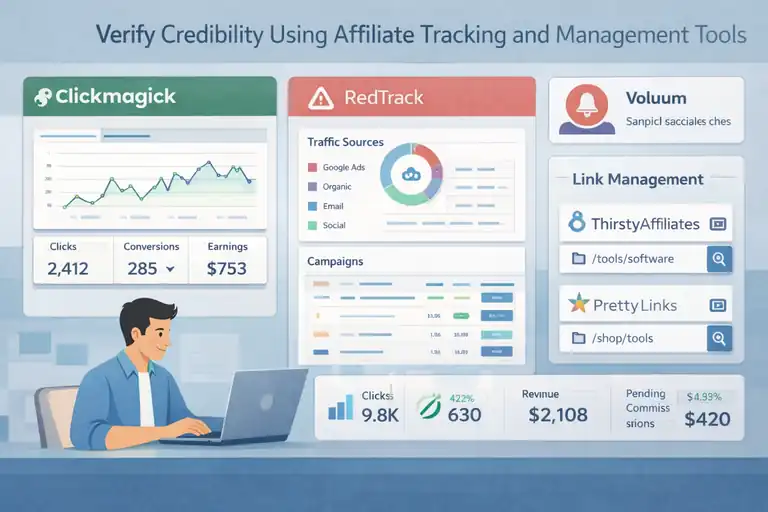
Even trustworthy brands need verification. Reliable tracking ensures that every click, sale, and payout is recorded accurately.
With the right tools, you can detect issues early and protect your commissions.
Use ClickMagick or RedTrack to Track Link Performance
ClickMagick and RedTrack are two of the most reliable tools for monitoring affiliate performance.
- ClickMagick: Ideal for beginners. It tracks every click, unique visitor, and conversion in real time. For example, you can create a tracking link, share it in a blog post, and see exactly how many conversions it drives in the dashboard.
- RedTrack: More advanced and suited for multiple campaigns. It integrates directly with ad networks like Google Ads or Facebook, letting you attribute conversions by traffic source.
I prefer RedTrack for multi-channel campaigns—it helps me see if blog traffic or email subscribers convert better, saving me from wasting ad spend.
Implement ThirstyAffiliates or PrettyLinks for Link Management
If you use WordPress, plugins like ThirstyAffiliates or PrettyLinks make affiliate link management simple.
Here’s how:
- ThirstyAffiliates lets you cloak links (turning long affiliate URLs into clean ones like “yourblog.com/go/product”).
- PrettyLinks allows grouping, tracking, and even automating redirects.
Example: Inside PrettyLinks, click “Add New,” paste your affiliate URL, and create a slug like “/tools/awin.” You’ll now have a cleaner, trackable link for analytics and brand consistency.
These plugins also prevent broken links—a common issue when brands change affiliate URLs or campaigns expire.
Check Conversion Data Regularly for Transparency
Transparency builds confidence. Always check that your reported conversions match your own tracking.
Steps I follow weekly:
- Log into your affiliate dashboard (e.g., Awin or Impact).
- Export your conversion reports.
- Compare click and sale numbers with your ClickMagick data.
If you notice discrepancies beyond 5–10%, reach out to the affiliate manager immediately. Keeping this routine avoids losing revenue to untracked conversions or technical errors.
Monitor Fraud or Suspicious Activity with Voluum
Voluum is built for serious affiliate marketers—it offers fraud detection, IP filtering, and bot traffic analysis.
For instance, if you suddenly see a spike in clicks from one region but no conversions, Voluum can flag that pattern automatically. This helps you block low-quality sources and keep your reputation clean with brands.
It’s worth noting: some affiliate programs will actually reward you for identifying fraudulent clicks early because it protects their data integrity too.
Shortlist High-Performing Partners Through Testing
Once you’ve joined several affiliate programs, you’ll notice that not all perform equally.
The goal now is to test and identify which partners deliver the best long-term ROI (return on investment).
Test Small Campaigns Before Fully Committing
Start small—always. Run a mini-campaign for 2–3 weeks before going all in.
Example approach:
- Publish a single blog post or send one email feature for each affiliate.
- Track clicks, conversions, and refund rates.
- Compare audience reactions (comments, replies, engagement).
This approach helps filter out programs that look promising but don’t actually convert with your readers. It’s the difference between promoting what works and what sounds good on paper.
Compare EPC (Earnings Per Click) and Conversion Rates
EPC (earnings per click) is a great metric for comparing programs fairly.
Here’s how I calculate it manually: (Total Commission ÷ Total Clicks) × 100 = EPC.
For instance, if you earned $50 from 200 clicks, your EPC is $0.25. A higher EPC means better audience alignment or stronger brand trust.
Keep a spreadsheet to compare EPC and conversion rates across programs—Awin and Impact both provide this data directly in their dashboards.
Assess Content Fit Through Real-Time Analytics (e.g., MonsterInsights)
Using MonsterInsights on WordPress makes this step easy. It shows which affiliate links get the most clicks and from which pages.
Let’s say your “Best Budget Laptops” post sends most clicks to one specific brand. That’s a clear sign your audience prefers that product. You can double down by adding more content or tutorials for it.
This type of analytics-based decision-making ensures you focus on content that drives results—not just traffic.
Drop Underperforming Programs Quickly to Save Time
The toughest but smartest move is knowing when to walk away. If a partner doesn’t deliver after several test runs, remove their links.
I follow a simple rule: If EPC stays below $0.10 or conversion rates fall under 1% after two months, it’s time to cut it.
By removing weak performers, you:
- Free up space for stronger programs.
- Keep your content cleaner and more trustworthy.
- Improve your overall affiliate earnings.
Remember—affiliate marketing success isn’t about promoting more partners. It’s about promoting the right ones consistently.
Build Long-Term Relationships With Top Affiliates
Once you’ve identified reliable affiliate marketing partners, the real work begins—nurturing those relationships over time.
The strongest affiliates don’t just exchange links; they build partnerships grounded in trust, shared goals, and consistent communication.
Communicate Regularly About Updates and Promotions
Strong communication keeps partnerships alive. Don’t just reach out when you need something—stay connected even between campaigns.
Here’s what I do:
- Monthly check-ins: A short message like “Hey, just wanted to share this post featuring your product—traffic has been great this month!” shows initiative.
- Early access: Let partners know about upcoming launches or seasonal promotions. It helps them prepare content in advance.
- Feedback loop: Ask what type of content converts best for them. This insight helps you align your strategy and build credibility.
Most affiliate managers appreciate proactive communication. I’ve noticed that when I maintain consistent contact, I often get insider tips about new offers before they go public.
Offer Mutual Value Through Co-Created Campaigns
Affiliate success works both ways. The more you support your partners, the more they’ll invest in you.
Try co-creating content that benefits both sides:
- Interviews or webinars: Invite your affiliate manager for a short live Q&A about their product. It humanizes the brand and boosts conversions.
- Guest posts: Offer to write a case study for their blog featuring your audience insights.
- Email swaps: Some partners are open to sharing your content with their email subscribers in return for visibility.
One of my favorite collaborations was a co-written ebook with an affiliate tool I used daily. They provided design and promotion, and I brought the content—it led to 3x more sign-ups than my regular campaigns.
Request Exclusive Deals or Bonuses for Loyal Partners
Once you’ve proven your performance, ask for something that sets you apart.
Here’s what’s worth negotiating:
- Exclusive coupon codes: These make your links more appealing and easier to track.
- Custom landing pages: Awin and Impact both allow brands to create affiliate-specific pages for stronger branding.
- Performance bonuses: After consistent conversions, request a 5–10% commission bump or quarterly incentive.
I usually frame it like this: “My last campaign generated 400 sign-ups. If I hit 500 next quarter, could we explore a higher tier?” This approach shows confidence backed by data, not entitlement.
Use CRM Tools Like HubSpot or Monday for Affiliate Relationship Management
If you manage several affiliates, a CRM tool keeps everything organized. HubSpot and Monday are perfect for tracking relationships and follow-ups.
Here’s a simple setup I use in Monday:
- Column 1: Partner name and contact details.
- Column 2: Communication log (last email or call).
- Column 3: Current deal or promotion.
- Column 4: Next follow-up date.
This helps you manage relationships systematically rather than reactively. Over time, these tools become your affiliate command center.
Leverage Data and Automation to Scale Partnerships
Manual tracking works when you have a few partners. But as your network grows, automation becomes essential for scaling without burnout.
Automate Reports and Tracking Using RedTrack or Tapfiliate
Both RedTrack and Tapfiliate make it easy to automate your affiliate analytics and reports.
- RedTrack: Best for performance marketers. It can automatically generate weekly reports with conversion metrics, traffic source performance, and ROI. You can set these reports to email you every Monday morning—no manual exports needed.
- Tapfiliate: Ideal if you manage your own program. It tracks affiliate referrals, generates unique codes, and integrates with Shopify and WordPress for smooth payouts.
Automation frees up your time for strategy while keeping your data reliable and up to date.
Use Analytics Tools Like Sitechecker and Surfer SEO to Align Content
It’s not just about tracking links—you also need to align your content with performance trends.
- Sitechecker: Scans your website for technical SEO issues that might block affiliate clicks or conversions.
- Surfer SEO: Analyzes your content and shows how to improve keyword use for pages promoting affiliate offers.
For instance, when I optimized one affiliate guide using Surfer SEO’s content editor, the organic traffic increased by 42% within a month. Better visibility equals more affiliate clicks without extra effort.
Apply Predictive Insights to Choose Future Partners
After a few months of consistent tracking, you’ll start noticing patterns—certain niches convert better, or specific brands resonate more with your audience.
Use that data to predict which future affiliates will perform best.
A small trick: export historical conversion data from RedTrack or ClickMagick and run it through a simple Excel pivot table. You’ll instantly see which affiliate types (SaaS, ecommerce, courses) bring the highest ROI.
This insight makes your next partnership decisions evidence-based, not guesswork.
Set Up a Streamlined Onboarding System for New Affiliates
If you recruit affiliates or work with multiple brands, standardize your onboarding process.
Here’s a simple workflow I use:
- Welcome Email: Introduce your expectations, communication frequency, and payment schedule.
- Shared Drive Folder: Store brand assets, logos, and approved content templates.
- Tracking Setup Guide: A short PDF or Loom video showing how to track conversions or use your dashboard.
Even small creators benefit from having this system—it signals professionalism and builds immediate trust with partners.
Stay Updated on Industry Trends and Network Changes
Affiliate marketing moves fast. Networks merge, brands rebrand, and commission structures evolve. Staying current keeps your partnerships relevant and profitable.
Join Affiliate Marketing Communities on Reddit and Slack
Communities are where real insights surface before official announcements.
Join groups like r/AffiliateMarketing on Reddit or private Slack spaces like Affiliate Insider Hub. These places often share breaking updates, algorithm shifts, and payout changes from major networks.
I once learned about a payout policy change on Impact two weeks before the official email—thanks to a Slack thread. It gave me time to adjust campaigns early.
Follow Awin and Impact News for Program Updates
Both Awin and Impact maintain active news portals where they publish network updates and industry insights.
- Awin’s blog features trends like cookie duration changes and new advertiser launches.
- Impact’s partner newsletter often shares data-backed insights, like which verticals are performing best each quarter.
Bookmark these pages or subscribe to their emails—you’ll spot new earning opportunities before others do.
Track Commission Policy Shifts Using Tools Like SEO Buddy or Rank Math
Affiliate SEO doesn’t stop at content creation. Tools like SEO Buddy and Rank Math can help you track when key affiliate pages lose ranking or visibility.
I once noticed a 20% drop in traffic on a top-converting page. Using Rank Math’s analytics, I found the drop coincided with a brand’s commission cut. Without that insight, I might’ve kept promoting a lower-paying offer.
Monitoring SEO and commission data together gives you a full picture of performance.
Regularly Review Networks to Replace Outdated or Inactive Programs
Some affiliate programs go dormant or stop accepting new affiliates. Set a quarterly review to prune these from your list.
During this audit:
- Check if brands still actively update creatives or banners.
- Remove links that no longer track or redirect.
- Replace outdated programs with active ones from FlexOffers, Impact, or Awin.
Keeping your affiliate roster lean ensures you’re promoting programs that actually convert.
Pro Tip: Build a Private Partner Database for Faster Vetting
As you grow, managing dozens of affiliate relationships becomes complex.
A private partner database saves time, prevents duplicate outreach, and helps you quickly vet new opportunities.
Keep a Spreadsheet of Trusted Affiliate Contacts
Start with a simple Google Sheet or Notion table.
Include:
- Partner name and contact info
- Affiliate network or platform (e.g., Awin, PartnerStack, Rakuten)
- Commission rate and cookie duration
- Notes on responsiveness and reliability
This makes it easy to see which programs deserve priority when planning new campaigns.
Record Conversion, Communication, and Payment Data
Track performance and responsiveness side by side. For example, one brand might have a 12% conversion rate but slow payment cycles—data like this helps you decide whether to continue.
A simple structure:
| Brand | Conversion Rate | Avg. Payout Time | Communication Rating | Notes |
This visual summary helps you make smarter affiliate decisions at a glance.
Tag Partners by Niche, Commission Type, and Reliability
Add color-coded tags to your spreadsheet or CRM tool:
- Green: High-performing and reliable
- Yellow: Medium performance, needs follow-up
- Red: Low-performing or inactive
You’ll quickly know where to invest energy and where to let go.
Update It Quarterly to Keep Only the Highest Performers
A quarterly review ensures your partner list stays sharp.
Each quarter, remove programs that have:
- Low traffic or conversion trends
- Repeated payout issues
- Outdated creatives or poor support
This habit keeps your affiliate ecosystem healthy, efficient, and profitable.
Pro Insight: Treat your affiliate relationships like real business partnerships, not just transactions. The more you communicate, optimize, and streamline your workflow, the faster your affiliate marketing partners ecosystem grows—sustainably and profitably.
FAQ
How do I find reliable affiliate marketing partners fast?
Join trusted affiliate networks like Awin, Impact, and PartnerStack, then filter programs by niche, conversion rate, and payout reliability to find the best partners quickly.
What makes a good affiliate marketing partner?
A reliable partner offers transparent tracking, timely payments, and products that align with your audience’s interests and values.
How can I check if an affiliate partner is trustworthy?
Review affiliate feedback, confirm payment history, and use tracking tools like ClickMagick to verify accurate reporting and genuine conversions.

I’m Juxhin, the voice behind The Justifiable.
I’ve spent 6+ years building blogs, managing affiliate campaigns, and testing the messy world of online business. Here, I cut the fluff and share the strategies that actually move the needle — so you can build income that’s sustainable, not speculative.
Related posts:
 How to Become a Better Affiliate Marketer
 What No One Tells You About Affiliate Marketing
 10 Digital Marketing Affiliate Marketing Hacks That Work
 The Affiliate Marketing Guide No One Told You About
 10 Best Affiliate Marketing Products That Sell Like Crazy
 How To Build An Affiliate Marketing Site That Sells