Table of Contents
Some links on The Justifiable are affiliate links, meaning we may earn a small commission at no extra cost to you. Read full disclaimer.
Building an affiliate site was the first time I realized online income could keep working even when I wasn’t. This guide is for beginners, side hustlers, and creators who want a realistic path to passive income without hype.
You’ll get a clear answer to one question: how do you build an affiliate site that can actually make money while you sleep, step by step.
Choosing A Profitable Affiliate Site Niche That Converts
Picking the right affiliate site niche is where everything either clicks or quietly falls apart later.
I’ve seen people do months of work only to realize their niche attracts readers who never buy. Let’s avoid that.
Understanding Buyer Intent Versus Traffic-Only Niches
One of the biggest mistakes I see is chasing traffic instead of intent. High traffic feels exciting, but traffic alone doesn’t pay hosting bills.
Buyer intent explained: These are searches from people actively considering a purchase, not just learning.
Examples:
- “Best noise cancelling headphones for travel”
- “Ahrefs vs Semrush pricing”
- “ConvertKit alternatives for bloggers” (ConvertKit is now called Kit)
Traffic-only niches usually look like:
- “What is meditation”
- “How does protein work”
- “Benefits of yoga”
From my experience, an affiliate site with 5,000 visitors who want to buy will often outperform one with 100,000 casual readers. When choosing your niche, ask yourself: Would I be comfortable recommending products here every week without forcing it?
Validating Niche Demand With Search And Affiliate Data
Before committing, I always validate demand using real data, not gut feeling.
Here’s a simple validation flow you can copy:
- Use Google autocomplete and “People Also Ask” to spot buying phrases
- Check keyword tools like LowFruits for commercial intent terms
- Search affiliate networks like Impact, Partnerize, or Awin
If you see:
- Multiple products
- Ongoing reviews
- Consistent search volume
That’s usually a green light. As a benchmark, I like seeing at least 20–30 buyer-intent keywords before committing to a niche.
Balancing Passion, Profitability, And Competition Levels
I believe passion matters, but only after profitability is confirmed. Passion keeps you consistent when results are slow.
A simple balance test I use:
- Can I write 50 articles on this without burnout?
- Are there products priced above $50?
- Are the top sites unbeatable authority brands?
If competition includes small blogs ranking on page one, that’s a strong signal a newer affiliate site can break in with better content and structure.
Avoiding Oversaturated Affiliate Site Niches Early
Some niches are tough not because they’re bad, but because they’re crowded with decade-old sites.
Be cautious with:
- General web hosting
- Credit cards and finance
- Weight loss supplements
Instead, niche down:
- “Web hosting for photographers”
- “Budget standing desks for home offices”
- “Email tools for small nonprofits”
Narrow niches reduce competition and increase relevance, which usually means better conversions.
Planning An Affiliate Site Structure Built For Growth
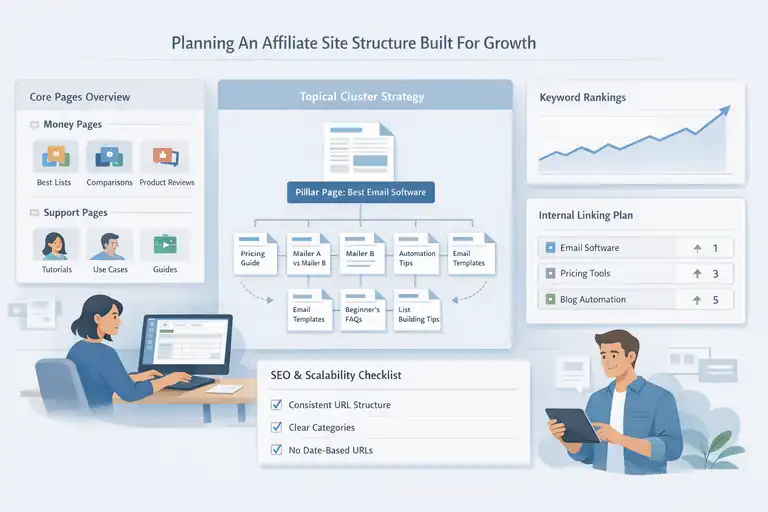
An affiliate site without structure is like a store with no aisles. Planning this early saves you from painful rebuilds later.
Mapping Core Pages That Drive Affiliate Conversions
Every profitable affiliate site I’ve worked on has a few non-negotiable pages:
Core money pages:
- Best-of lists
- Comparison pages
- Individual product reviews
Support pages:
- Tutorials
- Use cases
- Problem-solving guides
I usually map these in a simple spreadsheet before writing anything. It keeps content focused and prevents random posting that doesn’t support revenue goals.
Creating Topical Clusters Around Monetizable Keywords
Topical clusters help Google understand what your affiliate site is about.
Here’s how I approach it:
- One main “pillar” page targeting a broad buyer keyword
- 6–12 supporting articles answering related questions
- Internal links pointing back to the pillar page
Example:
- Pillar: “Best Email Marketing Software For Bloggers”
- Cluster articles:
- “Kit pricing explained”
- “Brevo vs MailerLite for beginners”
- “Email automation examples for small blogs”
This structure builds authority faster than publishing unrelated posts.
Designing A Logical Internal Linking Strategy
Internal links guide both users and search engines.
What I aim for:
- Every article links to at least one money page
- Money pages link back to helpful informational posts
- No orphaned content
I think of it as creating paths, not just links. If a reader lands on any page, there should be a natural next step.
Structuring Content For Long-Term SEO Scalability
Scalability means you can add content without breaking what already works.
A few rules I follow:
- Consistent URL structure
- Clear category naming
- Avoid date-based URLs
This keeps your affiliate site flexible as you expand into new sub-niches without confusing search engines or readers.
Building An Affiliate Site On A Reliable Platform
The platform you choose affects speed, control, and how easy it is to monetize long term.
Choosing WordPress For Full Affiliate Site Control
I strongly prefer WordPress for affiliate sites because it offers full ownership and flexibility.
Why WordPress works so well:
- Total control over affiliate links
- Thousands of SEO-friendly plugins
- No platform restrictions on monetization
Website builders can feel easier at first, but they often limit tracking, link management, and scalability later.
Selecting Hosting That Supports Speed And Uptime
Hosting matters more than most beginners realize. A slow affiliate site kills rankings and conversions.
Here’s a quick comparison based on hands-on use:
| Hosting Provider | Best For | Starting Price | Notes |
| SiteGround | Beginners + speed | ~$3.99/mo | Excellent support |
| Bluehost | Budget starters | ~$2.95/mo | Easy WordPress setup |
| Cloudways | Scaling sites | ~$11/mo | More control, steeper learning curve |
If I had to pick one for a new affiliate site today, I’d start with SiteGround for reliability and move later if needed.
Installing Essential Plugins Without Slowing Site Speed
More plugins don’t mean a better site. I keep things lean.
My usual essentials:
- Rank Math for SEO
- LiteSpeed Cache for speed
- Pretty Links for link management
Anything that doesn’t directly improve speed, SEO, or conversions usually doesn’t make the cut.
Setting Up Tracking And Analytics From Day One
Tracking is how you turn guesswork into strategy.
Minimum setup I recommend:
- Google Analytics 4 for traffic behavior
- Google Search Console for keyword performance
- Affiliate dashboard tracking for clicks and conversions
When you know which pages earn money, you stop guessing and start scaling what works.
Expert tip: If you want your affiliate site to truly earn while you sleep, build fewer pages—but make each one intentionally support a buying decision. Depth, structure, and clarity beat volume every time.
Creating Affiliate Content That Ranks And Sells
This is where most affiliate sites either quietly make money or quietly stall out. Content has to do two jobs at once: rank in search and help someone feel confident enough to click.
Writing Product Reviews That Match Search Intent
When someone searches for a product review, they’re usually close to buying. Your job is to meet them exactly where they are, not where you wish they were.
Here’s how I structure reviews that actually convert:
- Start with who the product is for and who it’s not for
- Explain the main problem it solves in plain language
- Walk through real-world use, not feature lists
For example, when reviewing an email tool like Aweber, I don’t lead with automation jargon. I explain it as: “This is best if you want to send emails without feeling overwhelmed by tech.”
Search intent matters more than word count. A 1,200-word review that answers pricing, alternatives, and drawbacks will usually outperform a 3,000-word fluff piece.
A small data point from my own sites: reviews that clearly mention drawbacks often convert 15–25% better because they build trust fast.
Publishing Comparison Content Buyers Actually Trust
Comparison posts are some of the highest-earning pages on an affiliate site, but only if they’re honest.
What I’ve found works best:
- Compare use cases, not just features
- Call out clear winners for specific situations
- Avoid “everything is great” conclusions
A simple comparison structure:
- Who each tool is best for
- Pricing differences explained simply
- One clear recommendation
For example, “Brevo vs MailerLite” works because readers already want help choosing. Your role is to reduce decision fatigue, not impress them with specs.
Using Informational Content To Support Affiliate Pages
Not every article should sell directly. Informational content builds authority and feeds your money pages.
Think of these as support articles:
- How-to guides
- Problem-solving posts
- Beginner explanations
An example path:
- Informational post: “How email sequences work”
- Internal link to: “Best email marketing software for beginners”
This approach increases topical authority and keeps readers moving deeper into your affiliate site instead of bouncing.
Optimizing Content For Clicks Without Overhyping
Clicks happen when trust meets clarity. Overhyping kills both.
What I focus on instead:
- Clear callouts like “Best for beginners”
- Natural link placement after value is delivered
- Honest language, not marketing buzzwords
If a product has a learning curve, say it. In my experience, transparency reduces clicks slightly but increases conversions and refunds drop noticeably.
Driving Sustainable Traffic To Your Affiliate Site
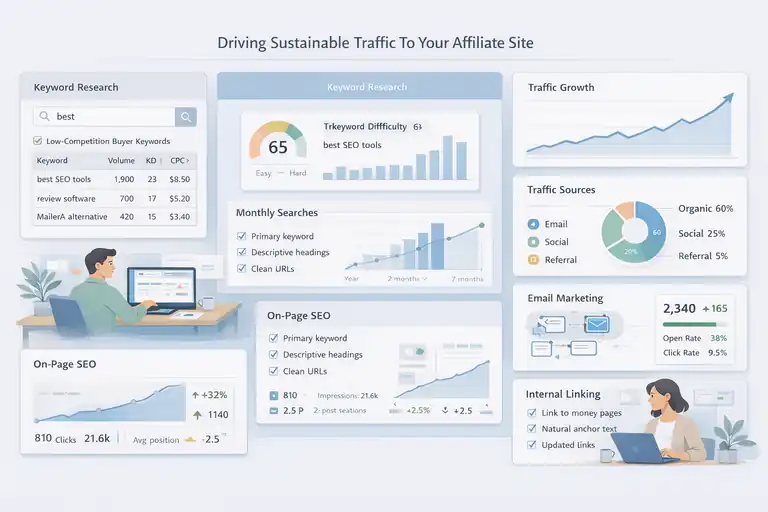
Traffic that lasts is built slowly and intentionally. Quick spikes feel good, but consistency pays the bills.
Keyword Research For Low-Competition Buyer Keywords
I always start keyword research with buying intent, then work backward.
My process looks like this:
- Find “best,” “review,” and “alternative” keywords
- Check if smaller sites rank on page one
- Prioritize keywords with clear product intent
Even keywords with 50–100 monthly searches can be gold if intent is strong. I’ve seen pages earning steady commissions from fewer than 1,000 visits per month.
On-Page SEO Practices That Compound Over Time
On-page SEO isn’t flashy, but it stacks results quietly.
Key practices I never skip:
- One clear primary keyword per page
- Descriptive headings that match search questions
- Clean URLs without extra words
Small improvements add up. Updating just five old articles on one affiliate site increased organic traffic by 32% over three months.
Building Authority With Strategic Internal Links
Internal links are one of the easiest wins most people ignore.
I treat them like recommendations:
- Link from informational posts to money pages
- Use natural language, not forced anchor text
- Update links when new content is published
This helps search engines understand importance and helps readers discover content that actually helps them decide.
Leveraging Email Traffic To Reduce Platform Dependence
Relying only on Google is risky. Email gives you control.
Even a small list matters:
- 500 engaged subscribers can outperform 10,000 passive visitors
- Email lets you recommend tools repeatedly, naturally
I usually offer a simple lead magnet tied to the niche, then send helpful content with occasional affiliate links. It’s slower, but far more stable long term.
Best practice: If you want your affiliate site to grow without burning you out, focus on clarity over cleverness. Help one person make one good decision at a time, and the revenue follows.
Monetizing An Affiliate Site For Passive Income
Monetization is where your affiliate site turns from a content project into an income asset.
The goal here isn’t squeezing every click, but building trust-based systems that quietly earn over time.
Choosing Affiliate Programs With Reliable Payouts
Not all affiliate programs are worth your time, even if the commission looks attractive. I’ve learned this the hard way.
Here’s what I personally look for before joining:
- Consistent payout history, not just high percentages
- Clear dashboards showing clicks, conversions, and earnings
- Reasonable cookie durations, meaning how long referrals are tracked
For example, Amazon Associates converts well but has short cookies. SaaS tools like Kit or Brevo pay less frequently, but commissions are recurring, which adds stability.
A quick comparison many beginners find helpful:
| Program Type | Typical Commission | Best For | Risk Level |
| Physical products | 1–8% | Beginners | Low |
| SaaS tools | 20–50% recurring | Long-term income | Medium |
| Digital courses | 30–50% one-time | Authority sites | Medium |
From what I’ve seen, mixing program types protects your income when one source dips.
Placing Affiliate Links For Maximum Click Potential
Link placement matters more than link volume. I rarely add more than 3–5 affiliate links per article.
What tends to work best:
- One link early after value is established
- One contextual link mid-content
- One summary link near the end
Links perform better when they feel like part of the explanation, not interruptions.
For example, linking to a tool right after explaining a problem it solves usually doubles click-through rates compared to sidebar links.
Using Call-To-Actions That Feel Natural And Helpful
Calls-to-action don’t need hype to work. They need clarity.
Instead of aggressive language, I prefer:
- “If you want something simple, this tool does the job well”
- “This is what I’d use if I were starting today”
In my experience, softer CTAs reduce clicks slightly but increase conversions and refunds drop. That trade-off is almost always worth it.
Tracking Earnings To Double Down On What Works
Tracking turns effort into strategy.
At minimum, I recommend:
- Affiliate dashboards for conversion data
- Google Analytics 4 to see which pages drive clicks
- Simple spreadsheets to track monthly trends
One small habit that paid off for me: every month, I identify the top three earning pages and update only those. That alone has increased revenue without adding new content.
Scaling An Affiliate Site To Earn While You Sleep
Scaling isn’t about doing more. It’s about doing less of the wrong things and more of what already works.
Updating Old Content To Increase Affiliate Revenue
Old content is often your easiest win.
Here’s my update checklist:
- Refresh pricing and product screenshots
- Improve clarity around who the product is for
- Add internal links to newer content
On one affiliate site, updating ten older reviews increased monthly income by over 40% without publishing anything new. Search engines reward freshness, especially in commercial content.
Outsourcing Content Without Losing Quality Control
Outsourcing doesn’t mean giving up control. It means building systems.
What helps maintain quality:
- Detailed content briefs with search intent explained
- Clear examples of tone and structure
- Editing everything before publishing
I usually outsource informational content first, then keep money pages in-house. That balance protects conversions while freeing time.
Expanding Into New Sub-Niches Strategically
Expansion works best when it’s adjacent, not random.
For example:
- From “email marketing for bloggers”
- Into “email tools for creators”
- Then “automation workflows for small teams”
Each step builds on existing authority, making rankings easier and faster.
Automating Systems That Reduce Daily Hands-On Work
Automation is what turns income into passive income.
A few systems worth setting up:
- Affiliate link management tools to update links globally
- Content templates for reviews and comparisons
- Scheduled content audits every quarter
My honest take: Automation doesn’t remove work, but it removes decision fatigue. That’s what makes consistency possible.
Frequently Asked Questions
How long does it take for an affiliate site to make money?
Most affiliate sites take 3–6 months to see first commissions and 9–12 months to become consistent. This depends on niche competition, content quality, and how well buyer-intent keywords are targeted.
Do I need a lot of traffic for an affiliate site to be profitable?
No. An affiliate site can be profitable with low traffic if visitors have strong buying intent. Pages targeting “best,” “review,” and “alternatives” keywords often convert with just a few hundred visits per month.
What is the biggest mistake beginners make with an affiliate site?
Focusing on traffic instead of intent. Publishing informational content without clear monetization paths delays income and makes scaling harder later.

I’m Juxhin, the voice behind The Justifiable.
I’ve spent 6+ years building blogs, managing affiliate campaigns, and testing the messy world of online business. Here, I cut the fluff and share the strategies that actually move the needle — so you can build income that’s sustainable, not speculative.