
Table of Contents
Some links on The Justifiable are affiliate links, meaning we may earn a small commission at no extra cost to you. Read full disclaimer.
If you’re searching for klaviyo alternatives for small business, you’re probably in that frustrating spot where Klaviyo looks powerful, but the cost starts feeling heavy long before your store feels “big.”
I’ve seen that happen a lot. A platform can be excellent and still be the wrong fit for a smaller budget, a lean team, or a simpler marketing setup.
The good news is you have real options now. Several tools cost less, stay easier to manage, and still give you the automations, segmentation, and reporting most small businesses actually need.
Why so many small businesses outgrow Klaviyo on price
Klaviyo is not a bad platform. In many cases, it is genuinely one of the strongest ecommerce email and SMS tools on the market. The issue is that “best” and “best for a small business” are not always the same thing.
When Klaviyo becomes expensive faster than expected
For a small business, the problem usually is not the first month. It is month six. Klaviyo’s free plan is limited to up to 250 active profiles, 500 email sends per month, and 150 mobile message credits, which is enough for testing but not much more.
Its paid pricing also scales with active profiles, so your bill rises as your list grows, even if you are not emailing that list aggressively.
That matters because small businesses often collect contacts faster than they monetize them. Imagine you run a niche skincare store. You add popups, capture 4,000 subscribers, and feel great about growth.
But if your automations are still basic and your campaigns are not driving much repeat revenue yet, profile-based pricing can start to feel punishing. You are paying for potential, not just performance.
I believe that is where many owners make the wrong move. They assume the answer is “use the most advanced tool anyway and grow into it.” In practice, that often creates software stress, extra monthly spend, and a messy setup no one has time to maintain.
What small businesses usually need instead
Most small businesses do not need enterprise-grade complexity. They need three things done really well:
- Reliable automations: Welcome series, abandoned cart, browse abandonment, post-purchase, and win-back.
- Clean segmentation: Grouping people by behavior, purchase history, engagement, or signup source.
- Clear reporting: Revenue attribution, click performance, and enough analytics to know what is working.
That is why cheaper alternatives can outperform Klaviyo for smaller teams. A simpler tool with faster setup and lower pricing can create better execution. And execution matters more than feature count.
Email is still one of the strongest ROI channels. Forbes Advisor reports email marketing generally returns about $42 for every $1 spent, while HubSpot says email was the top ROI channel for B2C brands in 2025.
Klaviyo itself also reports abandoned cart flows produce its highest average revenue per recipient and highest average placed-order rate among flows, which tells you something important: the basics still drive a lot of the money.
How to choose the right Klaviyo alternative for your business model
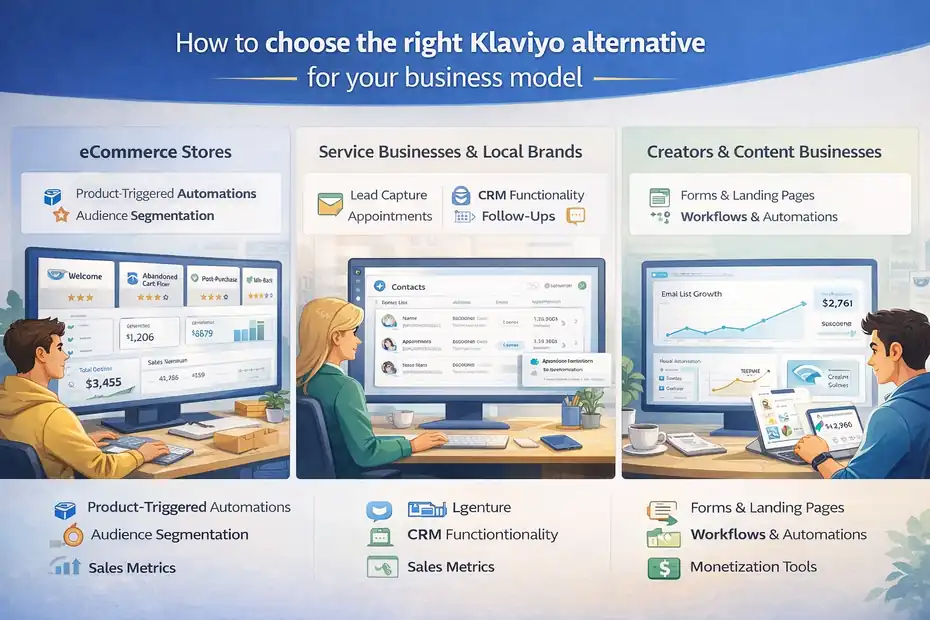
Before you compare tools, you need to be honest about what kind of business you are running. This is where most “best software” lists get lazy.
They rank tools in a vacuum, but your ideal platform depends on your catalog, sales cycle, send frequency, and team size.
Ecommerce stores should prioritize revenue flows over extra features
If you sell physical products, especially on Shopify or WooCommerce, your best alternative should make lifecycle marketing easy. That means product-triggered automations, discount support, audience syncing, and purchase-based segmentation.
For ecommerce, I suggest you care less about pretty dashboards and more about how quickly you can launch the flows that usually move revenue first. Start with these:
- Welcome flow: Converts new subscribers before they cool off.
- Abandoned cart flow: Recovers high-intent shoppers.
- Post-purchase flow: Builds repeat purchase behavior.
- Win-back flow: Re-engages inactive buyers.
If your tool handles those four cleanly, you are already covering the highest-value use cases for many small stores. Since cart abandonment remains extremely high across ecommerce, getting this automation live matters more than chasing fancy AI features too early.
Dynamic Yield cites a global average cart abandonment rate above 77%, and Campaign Monitor says cart abandonment emails can deliver a purchase rate greater than 10%.
Service businesses and local brands often need simpler automation
If you run a salon, agency, clinic, coaching business, or local service brand, you may not need deep ecommerce data at all. In that case, Klaviyo can be overkill.
You probably need lead capture forms, appointment or inquiry follow-up, light CRM functionality, and a simple newsletter workflow.
A platform like Brevo can make more sense because it combines email, SMS, CRM, and transactional messaging in one place. That all-in-one setup can reduce the number of tools you pay for separately.
This is one of those situations where the “cheaper alternative” is not just cheaper. It is more appropriate. And appropriate software usually wins.
Creators and content-first businesses need audience monetization tools
If your business runs on newsletters, content, digital products, courses, or community, then your alternatives shift. In that case, Kit is often more natural than Klaviyo because it is designed around subscriber growth, forms, landing pages, visual automations, and creator monetization.
I would not recommend forcing an ecommerce-first platform into a creator-first business unless you have a very good reason. It usually creates friction. The right platform should feel like it understands your sales model from day one.
The best Klaviyo alternatives for small business right now
This is the part you came for. Here are the strongest alternatives, and more importantly, who each one is actually best for.
Omnisend: Best overall for small ecommerce brands
Omnisend is the most direct Klaviyo competitor for smaller ecommerce stores. It is built for email, SMS, forms, segmentation, and automation without making the setup feel overly technical. Its free plan includes all features with up to 500 emails per month, and paid plans start at $16 per month.
Omnisend also positions itself clearly around ecommerce use cases, which makes it easier for product-based brands to get value quickly.
What I like most about Omnisend is focus. It does not try to be everything for every business. For a small Shopify brand, that is a strength. You can get core flows live quickly, connect your store, use product data, and build campaigns without a long learning curve.
A realistic example: if your store does 100 to 300 orders a month and you want abandoned cart, browse abandonment, popups, SMS, and seasonal campaigns, Omnisend is usually enough. You may not miss Klaviyo at all.
The tradeoff is that truly advanced brands may still outgrow it later. But for small business, “good enough plus lower cost plus faster execution” is often the smarter choice.
Brevo: Best for low-cost email volume and all-in-one simplicity
Brevo is one of the strongest options for businesses that want predictable pricing and broad functionality. Its Starter plan begins at $9 per month and includes email, SMS, segmentation, forms, and basic reporting.
Unlike contact-based tools, Brevo is known for volume-oriented pricing, which can be a big advantage if your subscriber count is growing faster than your send frequency.
This is important for small businesses with big lists but modest sending habits. Maybe you publish one newsletter a week, run a monthly promo, and use a couple of automations. In that case, paying mainly for send volume can feel far more reasonable than paying heavily for stored profiles.
Brevo also shines for hybrid businesses. If you are mixing newsletters, transactional emails, CRM tasks, and occasional SMS, having those in one platform can save time and money.
I recommend Brevo most often to local businesses, agencies, B2B service brands, and stores that want affordability without losing too much functionality. It is not the most glamorous option, but it is practical. And practical tools tend to survive longer in small businesses than flashy ones.
MailerLite: Best for beginners who want simplicity without the mess
MailerLite remains one of the easiest ways to start email marketing without getting buried in settings. Its pricing page shows an Advanced plan starting at $20 per month, while independent 2026 pricing breakdowns consistently cite a Growing Business tier starting around $10 per month and a free plan for smaller lists.
If you are overwhelmed by Klaviyo, this matters. Sometimes the real cost of software is not the invoice. It is confusion. It is logging in, staring at automations you do not fully trust, and postponing campaigns because the platform feels heavier than your team.
MailerLite is strong for:
- Simple newsletters: Regular promotions, updates, and announcements.
- Basic automations: Welcome emails, lead magnets, lightweight nurturing.
- Landing pages and forms: Useful for early-stage brands building lists.
I suggest MailerLite when the business is still finding its messaging. If you are not yet deeply segmenting by purchase behavior, SKU interest, or lifecycle stage, paying for a more complex platform may not help.
The main caution is ecommerce depth. MailerLite can work for smaller stores, but if your strategy depends on advanced product-based automation, Omnisend usually feels more natural.
ActiveCampaign: Best for advanced automation on a smaller budget than enterprise tools
ActiveCampaign is not the cheapest tool on this list, but it can still be a smart Klaviyo alternative if your business needs stronger automation logic. ActiveCampaign says plans start at $15 per month, and its pricing page highlights marketing automation, email marketing, and ecommerce integrations even on lower tiers.
Where it wins is flexibility. If your funnel is more complex than standard ecommerce flows, ActiveCampaign can do a lot. Think lead scoring, branching automations, sales handoff, and behavior-based sequences that go beyond basic “if subscriber did X, send Y.”
I would recommend it to businesses that have one of these traits:
- Longer sales cycles
- Lead nurturing across multiple touchpoints
- A mix of marketing and sales process
- A team that will actually use automation depth
Here is the honest downside: ActiveCampaign can become more expensive as contacts and features grow. So it is not automatically the “cheap” choice. It is the value choice when you need sophistication but still want a more accessible option than heavier enterprise software.
Drip: Best for DTC brands that care about retention
Drip sits in a useful middle ground. It is ecommerce-focused, automation-friendly, and retention-oriented. Its official pricing page shows plans starting at $39 per month, with pricing based on list size and send volume, plus a free trial and migration support.
That starting price means Drip is not the bargain-basement option. But I still include it because some small businesses are not just looking for “cheap.” They are looking for “cheaper than Klaviyo, but still serious.”
Drip is worth considering if your store already has some traction and you care about customer lifecycle marketing more than newsletter blasts. I have seen brands choose Drip when they want stronger segmentation and ecommerce logic than simpler tools provide, but they do not want to pay Klaviyo pricing as they scale.
If your business sells consumables, repeat-purchase products, bundles, or membership-style offers, retention often matters more than acquisition efficiency. That is where Drip can justify itself. You are not buying it for generic campaigns. You are buying it to squeeze more value from the customers you already paid to acquire.
Kit: Best for creators, educators, and audience-first brands
Kit, formerly ConvertKit, is not a direct ecommerce clone of Klaviyo, and that is exactly why it works so well for some small businesses. Its official site focuses heavily on forms, landing pages, automated sequences, and creator monetization.
If your business model is built around a newsletter, course, digital product, coaching offer, or personal brand, Kit often feels much more intuitive than Klaviyo. You are organizing people by interests, funnels, and offers rather than by product events and ecommerce behaviors.
I believe too many creator businesses pick ecommerce software because they think “more advanced” means “better.” In reality, a creator-first platform often lets you move faster and sell more because it matches how your audience grows.
Kit makes the most sense when your customer journey looks like this: subscribe, consume content, trust builds, buy later. If that sounds like your business, it belongs on your shortlist.
Quick comparison: Which tool is best for your situation?
A simple comparison can save you hours of second-guessing. Here is the practical version.
| Tool | Best for | Starting price | Main strength | Main limitation |
|---|---|---|---|---|
| Omnisend | Small ecommerce stores | $16/mo | Ecommerce flows and SMS | Less ideal for non-ecommerce businesses |
| Brevo | Cost-conscious SMBs | $9/mo | Low-cost all-in-one setup | Less ecommerce-native than Omnisend |
| MailerLite | Beginners and lean teams | ~$10/mo | Simplicity and ease of use | Lighter ecommerce depth |
| ActiveCampaign | Advanced automation | $15/mo | Flexible workflows and segmentation | Can get pricey as you scale |
| Drip | DTC retention-focused brands | $39/mo | Ecommerce lifecycle marketing | Higher entry cost |
| Kit | Creators and content businesses | Varies by plan | Audience growth and monetization | Not built for deep ecommerce needs |
Pricing and plan positioning are based on the vendors’ official pricing pages and current 2026 market references.
How to migrate away from Klaviyo without breaking your email revenue
Switching tools feels risky because it is risky if you do it sloppily. But if you migrate methodically, you can usually move platforms without losing momentum.
Export the assets that actually matter first
Do not start by rebuilding random campaigns. Start with the assets that protect revenue.
Prioritize these exports and recreations first:
- Core segments: Engaged subscribers, recent purchasers, VIPs, inactive users.
- High-performing flows: Welcome, abandoned cart, browse abandonment, post-purchase.
- Signup forms: Popups, embedded forms, landing page captures.
- Templates: Your main newsletter and promotional layouts.
- Suppression lists: Unsubscribed, bounced, and spam-complaint addresses.
The reason is simple. You do not need perfect parity on day one. You need operational continuity. If your welcome and cart flows are working, your business stays alive while you optimize the rest.
I recommend documenting each automation in plain English before rebuilding it. Example: “Subscriber joins list from popup, waits 10 minutes, receives 10% offer, exits if purchased.” That one habit prevents a lot of migration mistakes.
Warm up carefully if sending behavior changes
If your new tool uses different sending infrastructure, your deliverability may shift for a while. That does not mean disaster. It means you need to be intentional.
Start with your most engaged subscribers first. Send to people who opened or clicked recently, then expand gradually. Keep subject lines clean, avoid giant list blasts on day one, and watch open rates, clicks, unsubscribes, and spam complaints closely.
This is where small businesses sometimes panic too early. A temporary dip in engagement during migration is normal. What matters is whether performance stabilizes within a few campaigns and whether your automated flows keep producing revenue.
From what I’ve seen, a cleaner smaller list often performs better than dragging old inactive contacts into a fresh platform anyway.
Common mistakes small businesses make when choosing a Klaviyo alternative
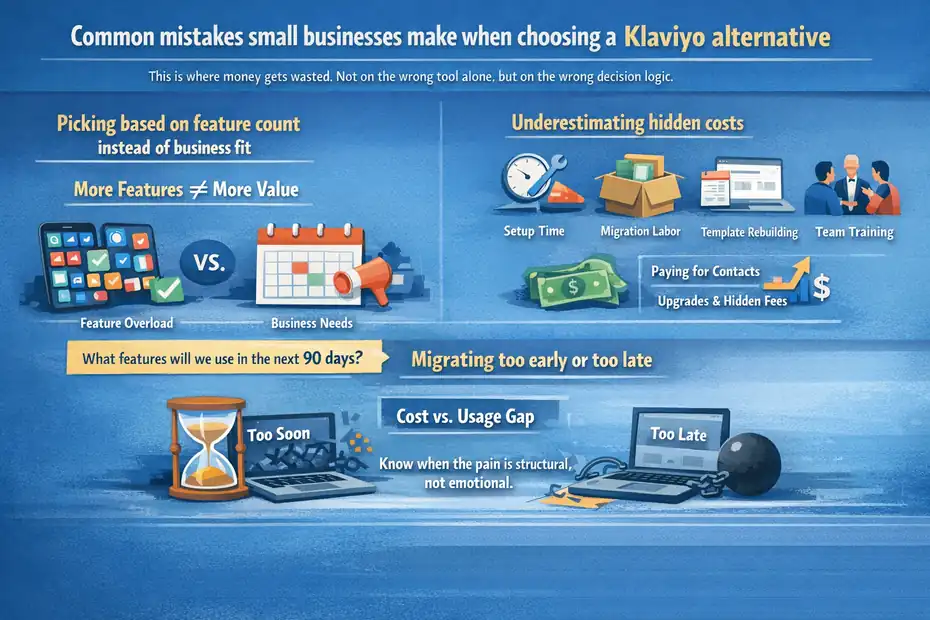
This is where money gets wasted. Not on the wrong tool alone, but on the wrong decision logic.
Picking based on feature count instead of business fit
A lot of owners compare software like they are buying a phone: more features must be better. But software is not valuable because it can do more. It is valuable because your team will actually use it well.
If you run one campaign a week and three automations, you probably do not need the tool with the deepest branching logic in the category. You need the one you can understand, maintain, and afford.
I suggest asking this instead: “What features will we use in the next 90 days?” That one question cuts through a lot of noise.
Underestimating hidden costs
The visible monthly price is only part of the cost. Hidden costs usually include:
- Setup time
- Migration labor
- Template rebuilding
- Team training
- Paying for contacts you barely monetize
- Upgrading earlier than expected because of growth
This is one reason profile-based pricing feels painful for many smaller brands. Your contact database can expand faster than revenue efficiency improves. If monetization lags, your software starts taxing growth instead of supporting it.
Migrating too early or too late
There is a sweet spot. Migrate too early, and you may waste time switching before you understand your real needs. Migrate too late, and you may stay trapped in a costly setup that slows decision-making.
A practical rule I like: switch when the gap between what you pay and what you use starts feeling consistently unreasonable for at least two or three billing cycles. That usually means the pain is structural, not emotional.
The setup every small business should build after switching
Whatever alternative you choose, the first 30 days matter more than the software brand. A mediocre platform with a sharp setup will outperform a great platform with a lazy setup.
Start with the four automations that usually matter most
Do not try to build everything at once. Build the flows most likely to create measurable wins.
- Step 1: Welcome flow Introduce the brand, set expectations, and make a first-offer conversion push.
- Step 2: Abandoned cart flow Recover high-intent visitors while the buying signal is still fresh.
- Step 3: Post-purchase flow Confirm the order, reduce buyer anxiety, and create the next sale opportunity.
- Step 4: Win-back flow Re-engage customers before they disappear completely.
Klaviyo’s own benchmark data shows abandoned cart flows produce the highest average revenue per recipient among flows, so that one should almost never be delayed.
A simple scenario: if your store gets 50 abandoned carts a week, even modest recovery rates can justify your platform cost quickly. That is why I usually focus on flows before regular campaigns.
Build segmentation before you need it, not after
Segmentation sounds advanced, but it should begin early. Even basic tags or groups make your campaigns more useful.
Start with segments like:
- New subscribers
- Customers
- Repeat customers
- VIP customers
- Engaged non-buyers
- Inactive contacts
You do not need 30 segments. You need a few meaningful ones. Segmentation improves relevance, and relevance protects deliverability and revenue over time.
Benchmark reporting from Efficy/Apsis highlights segmentation as central to relevance and ROI, which lines up with what most experienced email marketers already know from practice.
Advanced optimization strategies once the basics are working
Once your new platform is stable, the growth comes from refinement. This is the part many smaller businesses skip because they think optimization is only for larger brands. It is not.
Improve revenue per subscriber, not just list size
List growth is exciting, but revenue per subscriber is a more useful small-business metric. A bigger list that buys less is not progress.
Focus on these optimization levers:
- Offer alignment: Match incentives to buyer intent instead of defaulting to blanket discounts.
- Send timing: Test timing around signup, browse activity, and post-purchase moments.
- Message match: Make sure email promises align with the landing page and product page.
- Frequency control: More sends do not automatically mean more revenue.
I believe many small businesses chase list growth because it feels visible. But monetization quality matters more. A list of 3,000 engaged buyers often beats a list of 15,000 passive subscribers.
Use platform choice to simplify your operations, not just cut cost
A good switch should reduce friction across the business. That might mean fewer manual exports, cleaner customer data, easier campaign production, or fewer software subscriptions overall.
For example, Brevo can replace separate CRM and transactional tools for some businesses. Omnisend can simplify ecommerce lifecycle marketing. MailerLite can shorten campaign production time for small teams. The point is not only to save money on paper. It is to make email marketing easier to run consistently.
That consistency is where results compound.
So which Klaviyo alternative should you choose?
This is the honest answer.
Choose Omnisend if you run a small ecommerce store and want the closest practical replacement with less cost and less complexity.
Choose Brevo if you want the most flexible low-cost option for a broader small business setup, especially if email volume matters more than contact count.
Choose MailerLite if you are a beginner, a tiny team, or a business that values simplicity over sophisticated ecommerce depth.
Choose ActiveCampaign if your automation needs are genuinely complex and you will use that complexity.
Choose Drip if retention is central to your business and you want a serious ecommerce platform without defaulting to Klaviyo.
Choose Kit if you are building around content, audience, courses, or creator-led sales.
For most readers searching klaviyo alternatives for small business, I would start with Omnisend, Brevo, and MailerLite. Those three cover the widest range of smaller business needs without pushing you into enterprise-style pricing too early.
And in most cases, that is the real win: not finding the most powerful tool, but finding the one that helps you send better emails, launch smarter automations, and keep more money in the business.
FAQ
What are the best klaviyo alternatives for small business?
The best klaviyo alternatives for small business include tools like Omnisend, Brevo, MailerLite, ActiveCampaign, and Kit. Each offers lower pricing, easier setup, and essential email automation features. The right choice depends on whether you run an ecommerce store, service business, or creator-based brand.
Why should small businesses look for alternatives to Klaviyo?
Small businesses often look for alternatives to Klaviyo because pricing increases quickly as contact lists grow. Many smaller brands do not need advanced features, so they benefit more from simpler, lower-cost tools that still provide strong automation, segmentation, and campaign performance.
Is Klaviyo too expensive for small businesses?
Klaviyo can become expensive for small businesses because it charges based on active contacts. As your list grows, costs increase even if revenue does not scale at the same pace. This makes it less ideal for early-stage businesses or those with limited marketing budgets.
Which Klaviyo alternative is best for ecommerce beginners?
Omnisend is often the best Klaviyo alternative for ecommerce beginners because it focuses on essential flows like abandoned cart and welcome emails. It offers an easy setup, built-in ecommerce features, and affordable pricing, making it ideal for small stores starting with email marketing.
Can you switch from Klaviyo to another platform easily?
Yes, switching from Klaviyo to another platform is possible with proper planning. You need to export your contacts, segments, and automations, then rebuild key flows like welcome and abandoned cart emails. With a structured approach, most businesses can migrate without losing performance.

I’m Juxhin, the voice behind The Justifiable.
I’ve spent 6+ years building blogs, managing affiliate campaigns, and testing the messy world of online business. Here, I cut the fluff and share the strategies that actually move the needle — so you can build income that’s sustainable, not speculative.
Related posts:
 Constant Contact Pricing: Which Plan Is Right for You?
 Aweber Systems Review: Reliable Email for Marketers
 Aweber Email Marketing Review: Hidden Truths
 Top 10 Email Service Providers: Powerful Tools for Businesses
 Aweber CRM Explained: How It Works with Email
 Aweber Pros And Cons for Marketers Guide