
Table of Contents
Some links on The Justifiable are affiliate links, meaning we may earn a small commission at no extra cost to you. Read full disclaimer.
If you’re asking whether is Klaviyo worth the price for a small store right now, the honest answer is: sometimes yes, sometimes absolutely not.
Klaviyo still gives small ecommerce brands a very strong mix of segmentation, automation, reporting, and native commerce integrations, and its free plan now covers up to 250 active profiles and 500 emails per month.
But its pricing model is tied to active profiles and sending limits, so costs can rise faster than many founders expect if list hygiene is weak or the store is not yet generating enough repeat-purchase revenue.
The short answer: Klaviyo is worth it only when your store can actually use what you’re paying for
For small stores, the real question is not whether Klaviyo is “good.” It is whether your store is far enough along to turn its extra targeting and automation into revenue.
What Klaviyo is really charging you for
Klaviyo’s billing is not just about sending newsletters. Its free plan includes up to 250 active profiles, 500 email sends per month, 150 mobile message credits, built-in reporting, and email support.
Once you move beyond that, Klaviyo’s help documentation makes clear that billing is driven by active profiles and message usage, and accounts can be moved up to a higher tier when profile limits are exceeded.
That matters more than most small stores realize. In practice, you are paying for three things at once: customer data storage, automation capacity, and the ability to target people based on real shopping behavior. That is very different from simpler email tools that mostly charge you to send campaigns.
This is where Klaviyo can feel expensive. If your list is messy, full of old leads, or packed with people who never open anything, you can end up paying for inactive opportunity instead of actual revenue. Klaviyo itself recommends suppressing unengaged profiles to reduce billable contacts without causing a major revenue hit.
My take is simple: The platform is not overpriced by default, but it is unforgiving if you are careless. Small stores that treat email like a real retention channel usually see the value faster. Small stores that just want to send occasional promos usually feel the pain first.
Why small stores are drawn to Klaviyo in the first place
There is a reason so many Shopify-first brands keep ending up here. Klaviyo is built around ecommerce data, not just generic email broadcasting.
Its Shopify integration is designed to sync customer profiles and order data so you can trigger flows from actions like browsing, starting checkout, ordering, or returning to buy again.
That sounds technical, but the practical meaning is easy: instead of sending the same email to everyone, you can send different messages to first-time buyers, repeat buyers, high-value customers, window shoppers, or people who abandoned cart. That is the core value proposition.
Klaviyo also has a large integration ecosystem. The company says it supports 350+ integrations, which matters if your stack already includes loyalty software, subscriptions, reviews, shipping tools, or a separate customer support setup.
For a small store, that flexibility can save a lot of duct-tape work later. I believe that is one of the biggest reasons founders stick with Klaviyo even when they complain about the bill.
Rebuilding flows, forms, segments, and attribution in a different tool is annoying. If the setup is already making money, inertia becomes rational.
Why “worth it” depends more on revenue model than store size
A tiny store can justify Klaviyo. A bigger store can still waste money on it. Store size alone is the wrong filter.
Imagine two brands with the same subscriber count. Store A sells a $25 impulse item with thin margins and weak repeat purchase behavior. Store B sells a $70 replenishable product with healthy repeat purchase potential.
Klaviyo is naturally more valuable to Store B because flows like post-purchase education, replenishment reminders, win-back emails, and VIP segmentation can drive repeat revenue more reliably.
That lines up with the broader economics of email. Litmus reports that 35% of companies see email ROI in the range of $10 to $36 for every $1 spent, with customer engagement emails, promotional emails, and newsletters among the highest-ROI formats.
So the smarter framing is this: Klaviyo tends to be worth the price when your store has enough margin, enough customer data, and enough repeat-purchase potential to let automation work. It tends to feel overpriced when you have none of those things and are still buying a high-capability platform anyway.
What you actually get for the money
This is where many reviews get lazy. They say Klaviyo has “great automation” and stop there. That is not useful.
Let me break down what a small store is really buying.
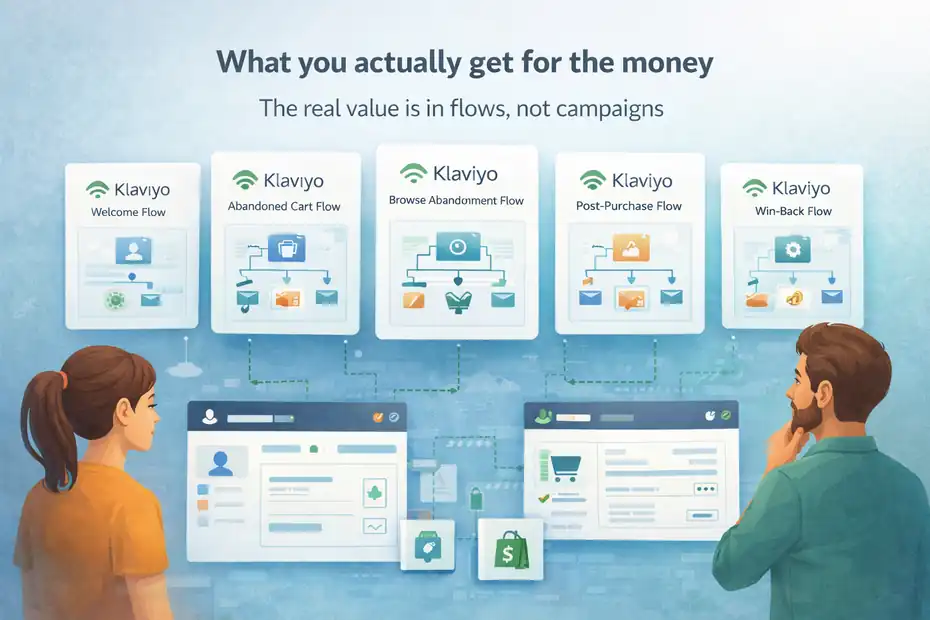
The real value is in flows, not campaigns
Campaigns are the emails you manually send, like product launches or weekend promotions. Flows are automated emails that run based on behavior. For small stores, flows usually create the strongest case for Klaviyo because they keep working after you set them up.
A basic small-store setup often includes a welcome flow, abandoned cart flow, browse abandonment flow, post-purchase flow, and win-back flow. None of those require a massive brand to work. They require data and decent messaging.
This is exactly where Klaviyo has an edge over simpler tools. Its ecommerce integrations and customer profile syncing make behavioral automation easier to build around store events. On Shopify, Klaviyo explicitly supports syncing customer profiles and order data for more targeted messaging.
In my experience, this is the dividing line. If you only plan to send one newsletter a week, Klaviyo is probably more software than you need. If you want automated revenue from cart recovery, replenishment, cross-sell, and repeat-purchase journeys, the platform starts making much more sense.
A small store does not need every advanced feature. But it does need a system that can make money while you sleep. That is what you are really paying for.
Segmentation is where the price starts to make sense
A lot of founders underestimate segmentation because it sounds like a “nice to have.” It is not. It is the difference between sending one discount blast to everyone and sending the right message to people most likely to buy.
Klaviyo’s platform is built around profile and event data, which is why its pricing revolves around active profiles in the first place. The system is designed to store and act on customer-level behavior.
For a small store, useful segmentation does not need to get fancy. You can get strong results by separating:
- First-time customers from repeat customers
- High-AOV buyers from discount-only buyers
- Recent subscribers from dormant subscribers
- Product-category shoppers from general browsers
That lets you protect margin. Instead of offering 15% off to your whole list, you might send a stronger offer only to people who engaged but did not purchase. You might also exclude recent buyers from a broad promo and send them a cross-sell instead.
This is the kind of thing that makes a pricier tool pay for itself. Better segmentation raises relevance. Better relevance usually lifts opens, clicks, conversion rate, and list health.
Even when a founder cannot quote those numbers from memory, they usually feel the difference in store performance after a few months of more disciplined targeting.
Reporting and attribution matter more than most small brands admit
Klaviyo also includes built-in reporting on the free plan, and higher tiers deepen what you can measure. That sounds boring until you try to decide whether email is working.
The truth is that many small stores underinvest in email because they do not measure it clearly. Then they overspend on paid social because the spend is visible and immediate. Email often looks less exciting, even when it is more profitable.
With a platform like Klaviyo, you can usually get a cleaner view of which flows, campaigns, segments, and signup sources are driving revenue. That helps with better decisions like:
- Which lead magnet brings buyers instead of freebie hunters
- Which product categories deserve their own flows
- Which customers should be suppressed instead of repeatedly mailed
- Which promotions create sales without training people to wait for discounts
I suggest thinking of this as “decision leverage.” Good reporting does not directly make money, but it tells you where the money is already coming from. For a small store trying to stretch every dollar, that can be worth a lot.
When Klaviyo is worth the price for a small store
This is the part most people want. Not theory. A real threshold.
It is worth it when you already have traction and want retention, not just traffic
Klaviyo makes the most sense once your store has enough incoming demand to feed the system. You do not need to be huge, but you do need consistent traffic, some order volume, and at least a modest stream of new subscribers.
If your store gets regular purchases and you are serious about repeat revenue, Klaviyo becomes easier to justify. Email still produces strong returns for many businesses, with Litmus reporting that 35% of companies see between $10 and $36 in ROI for every $1 spent.
Now picture a small skincare store doing 150 orders a month. A solid welcome flow, cart recovery sequence, and post-purchase cross-sell series could recover sales that would otherwise vanish. Even a handful of extra orders per month may offset the subscription.
This is where I think many “Klaviyo is too expensive” takes miss the point. They often evaluate the monthly fee in isolation. But software like this should be judged against recovered revenue, repeat purchase rate, and customer lifetime value. If those numbers move in the right direction, the bill matters less.
Klaviyo’s own ecosystem messaging also leans into this commerce-first value. The company highlights deep ecommerce integration and says Shopify merchants saw an average 62% boost in GMV in 12 months after starting with Klaviyo, though that kind of headline number should be treated as directional rather than a guarantee for your specific store.
It is worth it when you will actually use email and SMS together
Klaviyo’s pitch gets stronger when you run more than one owned channel. The company says brands using Klaviyo for email and SMS see a 19% increase in GMV growth rate, and its SMS pages position the platform as an integrated cross-channel system rather than a standalone email tool.
For a small store, that does not mean “turn on every channel immediately.” It means there is more upside if your customer journey benefits from timely text messages alongside email. Cart reminders, back-in-stock alerts, and launch reminders are common examples.
Still, I would be careful here. SMS can improve results, but it also adds compliance work, creative demands, and extra spend. So I would only count SMS in the value equation if you genuinely have the audience and offer for it.
If you do, Klaviyo becomes more defensible. One data model across email, SMS, and store activity is simply cleaner than patching together disconnected apps.
That is one of those benefits that feels abstract until you are inside a campaign calendar trying to coordinate launches and automations.
It is worth it when your list is clean and your offer is strong
This is the least sexy answer and maybe the most important one. Klaviyo works best when your fundamentals are already decent.
Because billing is tied to active profiles and usage, list quality affects your cost efficiency directly. Klaviyo’s documentation specifically recommends suppressing unengaged profiles to reduce billable contacts while minimizing revenue loss.
So if you have:
- A product people actually want
- Decent gross margins
- A list that is permission-based and reasonably engaged
- A habit of suppressing dead weight
- A few high-intent flows live
Then yes, Klaviyo can be worth the price much earlier than people think.
I have seen small brands make expensive software feel cheap simply by staying disciplined. And I have seen stores with bigger audiences make it feel wildly overpriced because they never cleaned their lists and kept mailing people who stopped caring months ago.
When Klaviyo is probably not worth it
Not every store needs the Cadillac version of retention marketing. Sometimes the smartest move is to stay simpler for longer.
It is usually not worth it for very early stores with little traffic
If your store is brand new, has almost no subscribers, and is still trying to validate product-market fit, Klaviyo can be overkill.
Yes, the free plan is generous enough to test with up to 250 active profiles and 500 monthly emails, so there is little downside to experimenting early. But paying beyond that before you have traction is often premature.
At that stage, your bigger problem is usually not segmentation or advanced flows. It is getting enough qualified traffic and enough orders to learn what people actually want.
This is why some founders feel burned. They sign up for a powerful platform before they have enough data to power it. Then they judge the software for failing to create demand that does not yet exist.
My opinion: If you are still in the “friends, family, and first fifty customers” phase, Klaviyo is useful as a learning environment, but not necessarily as a paid line item. Use the free plan, build the basic bones, and do not rush.
It is not worth it if you only want basic newsletters
If all you really need is the ability to send occasional announcements or simple weekly promos, Klaviyo’s depth may not justify its cost.
A good example is Shopify Email. Shopify’s official help docs say merchants get 10,000 free emails, then pay $1 per 1,000 additional emails up to 300,000, with lower rates beyond that. For many small stores that only send straightforward campaigns, that pricing is materially simpler and often cheaper.
That does not make Shopify Email better overall. It just means the cheaper option wins when your needs are simple.
Here is the blunt version: if you are not using flows, segmentation, and customer-level targeting, you are not really using what makes Klaviyo expensive. In that case, paying more is hard to defend.
It is not worth it if your profile management is sloppy
This is one of the easiest ways to overspend. Klaviyo’s own billing docs explain that profile limits can trigger movement to a higher tier, and its active profile management docs explain how to suppress unengaged people to reduce billable profiles.
So if you:
- Import old lists without cleaning them
- Keep “never engaged” contacts active
- Rarely suppress dormant subscribers
- Let abandoned signup tests accumulate junk leads
Then your cost can climb without a matching lift in revenue.
This is not really a pricing problem. It is an operations problem.
I think this is where many small-store owners misdiagnose the issue. They say Klaviyo is overpriced when the real issue is that they are paying to store and message people who are not helping the business. Once you look at the bill through that lens, the path forward gets much clearer.
A practical way to decide if Klaviyo is worth it for your store
You do not need a spreadsheet masterpiece to answer this. You need a simple test.
Use a break-even mindset instead of a “software budget” mindset
Most founders ask, “Can I afford this monthly tool?” I think the better question is, “How many extra orders does this tool need to create or recover to pay for itself?”
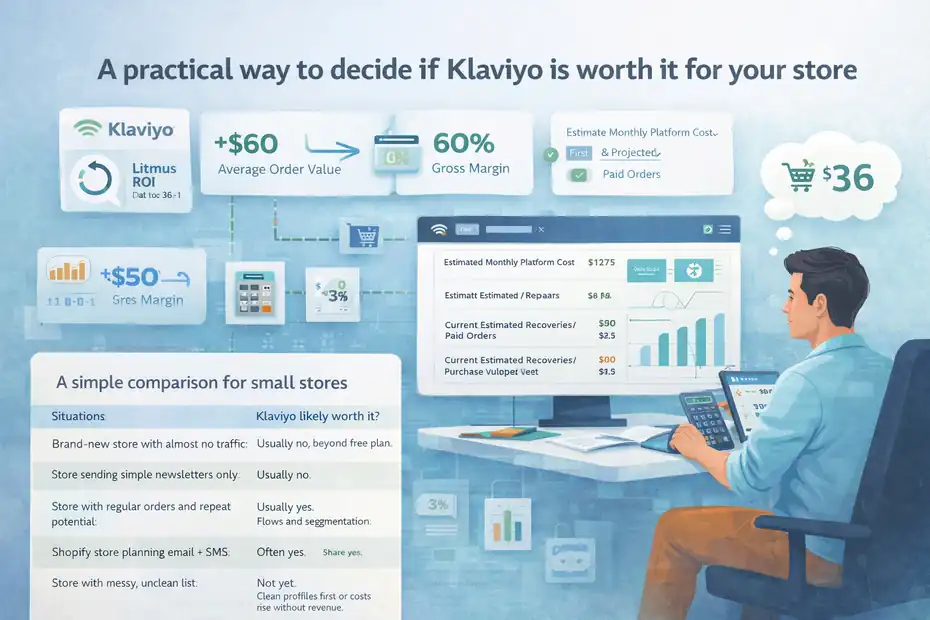
Say your average order value is $60 and your gross margin after product costs is 60%. That means a recovered order contributes about $36 in gross profit before fixed overhead. In that case, even a modest lift from email automation can justify a low-to-mid subscription quickly.
Now compare that to the economics of email generally. Litmus says many businesses still see email ROI between 10:1 and 36:1.
You are not guaranteed that return, of course. But it gives you a useful benchmark: if your email channel is nowhere near paying back its software, the issue may be setup quality, offer strength, or list health, not the existence of the channel itself.
Here is the mindset I recommend:
- Estimate monthly platform cost
- Estimate how many cart recoveries or repeat orders would cover it
- Decide whether your current traffic and order volume make that realistic
If the answer is yes, the tool deserves a trial. If the answer is no, stay lean and revisit later.
Audit these five signals before you upgrade
Before spending more, look at five practical signals.
- Subscriber growth: Are you consistently adding qualified subscribers, not just giveaway entrants?
- Traffic quality: Are people browsing enough products and reaching checkout often enough to feed behavior-based flows?
- Repeat purchase potential: Do customers have a real reason to buy again?
- Margin room: Can you support software cost without needing every campaign to be a home run?
- Team capacity: Will someone actually build and optimize flows?
That last one matters more than people admit. Klaviyo is not a magic wand. Even with templates and AI-assisted features on the platform, somebody still needs to write messages, monitor performance, and keep segments clean.
The free plan already includes basics like the drag-and-drop editor and AI-powered subject line generator, but execution is still execution.
If you score well on those signals, Klaviyo becomes much easier to justify. If you do not, the software may be ahead of your business.
A simple comparison for small stores
| Situation | Klaviyo likely worth it? | Why |
|---|---|---|
| Brand-new store with almost no traffic | Usually no, beyond free plan | You do not have enough data or purchase volume yet |
| Store sending simple newsletters only | Usually no | A lower-cost tool can handle that |
| Store with regular orders and repeat potential | Usually yes | Flows and segmentation can pay back quickly |
| Shopify store planning email + SMS | Often yes | Shared data and channel coordination add value |
| Store with messy, unclean list | Not yet | Clean profiles first or costs rise without revenue |
The point of the table is not to oversimplify. It is to keep you from buying software for the business you want before it matches the business you have.
How to make Klaviyo worth the price faster
If you decide to use it, do not try to build everything. That is how small teams get overwhelmed.
Start with the flows that usually move revenue first
I would begin with four flows:
- Welcome series
- Abandoned cart
- Post-purchase
- Win-back
These are simple enough to launch without a giant team and powerful enough to prove whether the platform can earn its keep.
Because Klaviyo’s setup is rooted in synced customer and order data, these flows can be tied to real behavior rather than static lists.
The mistake I see often is founders spending too much time polishing campaigns while their core automations are weak or missing. Campaigns matter, but flows usually generate the cleanest case for ROI because they are tied to intent.
If those four are healthy, you can expand later into browse abandonment, category-specific cross-sells, replenishment, VIP, and back-in-stock messaging.
Keep your active profiles under control
This is probably the highest-leverage cost-control habit inside Klaviyo.
Klaviyo explains that active profiles affect billing and recommends suppressing people who have not engaged for a sustained period. It also notes that if your active profile count exceeds your plan limit, you may be moved to a higher plan tier in the next billing cycle.
So make list hygiene a monthly task, not a panic task.
A practical routine looks like this:
- Review non-engaged subscribers
- Suppress long-term inactive contacts
- Remove low-quality acquisition sources
- Watch sudden profile jumps after promotions or imports
This is not glamorous work. It is profitable work. A clean list improves deliverability, protects engagement, and lowers wasted spend at the same time.
Do not buy “advanced” complexity before you need it
Klaviyo has a lot of surface area now: email, SMS, analytics, service, reviews, and more. That is great for mature brands, but small stores can get distracted.
My advice is to earn the next layer. Use the platform in stages.
First, prove email flows. Then improve segmentation. Then test more channel coordination. Then consider adjacent products only if they solve a real bottleneck.
That matters because the company’s platform has expanded well beyond basic email marketing, and its billing docs show multiple product categories with different pricing logic depending on usage or active profiles.
For a small store, simplicity is a moat. The more focused your implementation, the faster you will know whether Klaviyo is creating real incremental revenue.
Final verdict: is Klaviyo worth the price for small stores right now?
Yes, Klaviyo is worth the price for small stores right now when the store already has some traction, a product with repeat-purchase or upsell potential, and a willingness to use segmentation and automation properly.
Its free plan is strong, its ecommerce integrations are deep, and its profile-based data model gives serious small brands room to grow.
No, it is not worth the price for small stores that only want simple newsletters, have weak traffic, or are careless about active profile management.
In those cases, the platform’s sophistication becomes cost without payoff, and a simpler option can be the smarter move. Shopify Email’s pricing alone shows how much cheaper “basic sending” can be when that is all you need.
So here is my honest conclusion: Klaviyo is not too expensive for small stores. It is too expensive for unready stores.
That distinction matters. If your store can turn customer data into retention revenue, Klaviyo can be a smart buy. If not, stay lean, use the free tier, and upgrade only when the business gives you a real reason.
FAQ
What makes Klaviyo expensive for small stores?
Klaviyo pricing is based on active profiles and email volume, not just sends. This means costs can increase as your list grows, even if engagement is low. For small stores, poor list hygiene or low conversion rates can make the platform feel expensive compared to simpler tools.
Is Klaviyo worth the price for beginners?
Klaviyo can be worth it for beginners if they plan to use automation and segmentation early. However, for very new stores with little traffic or sales, the advanced features may go unused, making it harder to justify upgrading beyond the free plan.
When does Klaviyo start paying for itself?
Klaviyo typically becomes worth the price once your store generates consistent traffic and repeat purchases. Automated flows like abandoned cart and post-purchase emails can recover lost revenue, helping offset the monthly cost when implemented correctly.
Can I use Klaviyo for free as a small store?
Yes, Klaviyo offers a free plan that includes up to 250 active profiles and 500 monthly emails. This is enough for small stores to test basic flows and campaigns before deciding if upgrading to a paid plan is financially justified.
Is Klaviyo better than cheaper email tools?
Klaviyo is better than cheaper tools when you need advanced segmentation, automation, and ecommerce data tracking. If your strategy relies on basic newsletters only, lower-cost tools may provide similar results without the higher pricing structure.

I’m Juxhin, the voice behind The Justifiable.
I’ve spent 6+ years building blogs, managing affiliate campaigns, and testing the messy world of online business. Here, I cut the fluff and share the strategies that actually move the needle — so you can build income that’s sustainable, not speculative.
Related posts:
 Klaviyo Alternatives For Small Business: Better Tools That Cost Less
 How to Advertise Your Business: Utilizing Email Marketing Strategies
 Top 10 Email Service Providers: Powerful Tools for Businesses
 10 Proven Strategies to Collect Emails and Boost Your Business
 How to Get More Leads: 5 Proven Strategies to Boost Sales Now
 The Top 7 Signup Forms Trends of This Year: Increase Your Signups!