
Table of Contents
Some links on The Justifiable are affiliate links, meaning we may earn a small commission at no extra cost to you. Read full disclaimer.
Best alternatives to GetResponse for ecommerce stores usually come down to one simple question: do you need a broader all-in-one tool, or a platform that is more obsessed with store revenue, retention, and customer behavior?
I’ve seen a lot of merchants outgrow general email software when they realize they need better segmentation, stronger cart recovery, and reporting tied to actual sales, not just opens and clicks.
In this guide, I’ll walk you through the platforms worth considering, who each one fits best, where GetResponse still holds up, and how to choose the option that can genuinely help your store convert more visitors into repeat buyers.
Why ecommerce stores start looking beyond GetResponse
GetResponse is not a weak platform.
In fact, its current plans include ecommerce-friendly features like abandoned cart recovery, promo codes, sales funnels, product recommendations, automation workflows, landing pages, and web push, with pricing that starts at $19 per month for up to 1,000 subscribers on monthly billing.
When GetResponse still makes sense
If your store is small, your list is still growing, and you want email, landing pages, simple automation, and lead generation tools in one place, GetResponse can still be a practical fit.
I think this is especially true for merchants who sell through a mix of ecommerce and content, such as a store that also runs webinars, newsletters, or gated lead magnets.
What GetResponse does well is reduce tool sprawl. You can build signup forms, automate welcome emails, recover carts, and run sales-focused campaigns without stitching together five separate apps.
For a lean team, that matters. It also helps that GetResponse includes revenue-focused features like product recommendations and abandoned cart messaging rather than treating ecommerce as an afterthought.
Where I usually see friction is not around basic functionality, but around specialization.
Once a store starts caring deeply about product-level segmentation, lifecycle revenue, channel orchestration, and more advanced retention logic, a platform built more narrowly for ecommerce often feels sharper.
That is the point where many merchants start searching for alternatives.
The signs you’ve outgrown it
You may have outgrown GetResponse if your store team keeps asking questions the platform doesn’t make easy to answer. For example, which customers buy once and disappear, which product category should trigger a replenishment flow, or which campaign influenced a repeat purchase from VIP buyers.
A few common warning signs show up fast:
- Your automations exist, but they feel generic rather than behavior-driven.
- Your segmentation is usable, but not rich enough for serious retention work.
- You want stronger native ecommerce workflows across email, SMS, and customer data.
- Your team cares more about revenue attribution than broad marketing features.
- You run on Shopify, WooCommerce, or BigCommerce and want tighter store-first execution.
In my experience, this is where “good email software” and “good ecommerce growth software” stop being the same thing. A lot of stores do not need more features in general. They need the right features for conversion, repeat purchase rate, and customer lifetime value.
What actually makes a better GetResponse alternative for ecommerce
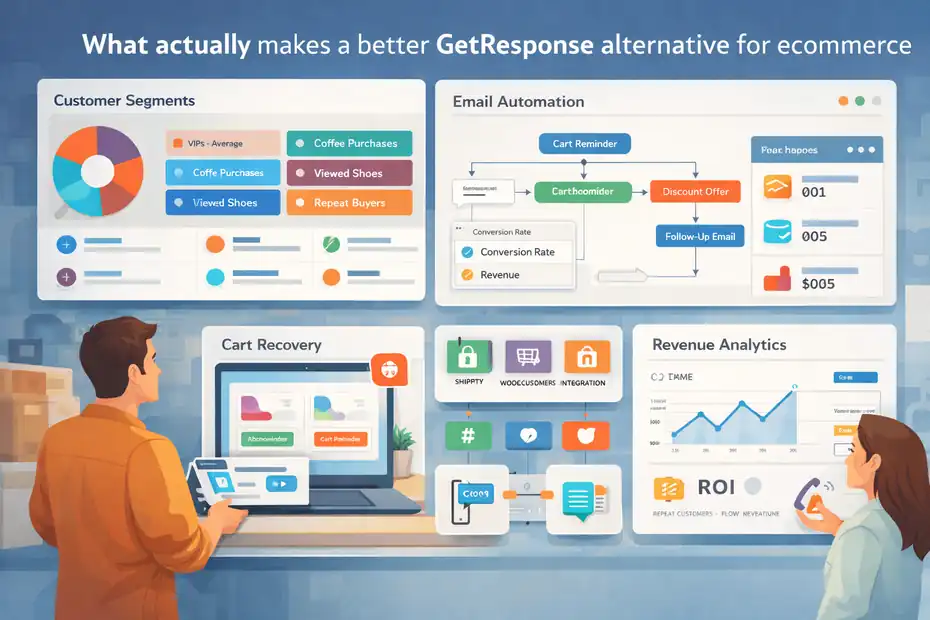
Not every email platform that says it supports ecommerce is truly built for it. This is where many comparison posts get fluffy. Let me make it practical.
The ecommerce features that matter most
A better alternative should help you connect messaging to buying behavior. That means more than a drag-and-drop email editor. You want the basics, but you also want customer data flowing into automation rules in a way that reflects how people shop.
The features I’d prioritize are these:
- Product-based segmentation: Target shoppers by viewed category, purchased product, order count, or average order value.
- Revenue-triggered automation: Recover carts, cross-sell related items, win back lapsing buyers, and prompt second purchases.
- Native or strong store integrations: Especially for Shopify, WooCommerce, Adobe Commerce, and BigCommerce.
- Omnichannel support: Email matters most for many stores, but SMS, forms, and sometimes push can improve recovery and repeat sales.
- Reporting that ties to money: Revenue per recipient, flow revenue, repeat customer revenue, and campaign attribution.
This is why platforms like Klaviyo and Omnisend get so much attention from merchants. They are not just email senders. They are trying to sit closer to the transaction and the customer journey.
Klaviyo positions itself around unified customer data plus email, SMS, and other channels, while Omnisend leans heavily into ecommerce automation and reports a claimed $79 return for every $1 spent.
The less obvious factors most stores ignore
I believe stores often choose the wrong platform because they focus on headline pricing and ignore operational fit. The cheaper option can easily become the expensive one if your team avoids using the advanced parts.
A few overlooked factors matter a lot:
- Learning curve: A powerful platform is not helpful if nobody builds the flows.
- Pricing model: Some tools scale on contacts, some on sends, and some bundle channels differently.
- Migration pain: Templates, forms, automations, and suppression lists are rarely moved perfectly.
- Deliverability setup: Domain authentication, list hygiene, and warm-up matter more than the logo on the dashboard.
- Team workflow: Some platforms are better for founders; others suit retention teams.
This is also why there is no single best choice for everyone. A one-person Shopify brand and a seven-figure catalog store do not need the same thing. One needs speed and simplicity. The other needs segmentation depth and revenue analytics.
The best alternatives to GetResponse for ecommerce stores
This is the section most people came for, so let’s get specific.
I’ll give you the short version first: Klaviyo is usually the strongest pick for serious ecommerce retention, Omnisend is often the easiest value-for-money choice, Mailchimp works for simpler teams that want a familiar system, Brevo is attractive for budget-conscious senders, and ActiveCampaign is strong when automation depth matters across more than just the store.
Klaviyo: Best for serious ecommerce retention and data-driven growth
Klaviyo is the first tool I’d look at if your store runs on Shopify and retention is a real growth lever, not a side project. The platform combines email and SMS, ties messaging to customer data, and now emphasizes an AI-first, unified-data setup across channels.
Its pricing starts with a free plan, and Klaviyo also says brands using email plus SMS see a 19% increase in GMV growth rate.
It publishes 2026 ecommerce benchmarks based on data from more than 183,000 customers, which tells you how heavily it leans into measurement.
What I like most is how naturally Klaviyo fits revenue workflows. You can build flows around browse abandonment, cart abandonment, post-purchase upsells, replenishment windows, VIP segmentation, and predicted-value cohorts. For a store with repeat-purchase potential, that’s gold.
The downside is simple: Cost and complexity can rise with scale. If your list is large and your team is not ready to use advanced segmentation, you may end up paying for sophistication you barely touch.
Still, for brands that want to turn customer data into repeat revenue, Klaviyo is usually the benchmark against which everyone else gets judged.
Omnisend: Best for ease, speed, and strong ecommerce value
Omnisend is the platform I often recommend to stores that want ecommerce-first functionality without the heavier feel of Klaviyo.
It focuses on email and SMS for ecommerce brands, supports major store platforms, and puts welcome, cart, post-purchase, and promotional automation front and center.
Its pricing page currently shows discounted entry plans and built-in SMS credits on higher tiers, while the company markets itself around reliability and store-focused execution.
What stands out is usability. Many merchants can get to a working set of core flows faster in Omnisend than in more advanced platforms. That matters more than people admit. A 90 percent-finished automation live today is often better than a perfect architecture that never gets launched.
I also think Omnisend is strong for stores that want to keep teams lean. It gives you enough ecommerce logic to do meaningful segmentation and recovery without overwhelming a founder or small retention manager.
If I were running a growing mid-market Shopify store and wanted a practical balance of power, speed, and cost, Omnisend would be very hard to ignore.
Mailchimp: Best for simpler ecommerce operations and familiar workflows
Mailchimp is still relevant, especially for merchants who value familiarity, broad adoption, and an easier learning curve.
Its current pricing structure includes Free, Essentials, Standard, and Premium tiers, and Mailchimp says connected-store users using automation flows saw up to 7x more orders compared with bulk emails during the measured period it cites.
In February 2026, it also announced more data-driven ecommerce capabilities aimed at profitable growth.
I would not call Mailchimp the most ecommerce-native option on this list, but that does not mean it is weak.
For stores with straightforward lifecycle needs, it can absolutely do the job. Welcome series, abandoned cart basics, product announcements, and simple customer journeys are all realistic here.
Where I’d be cautious is advanced retention strategy. If your store wants deep segmentation by purchasing behavior, more granular revenue views, or a system that feels like it was built around ecommerce logic first, Mailchimp may start to feel broad rather than specialized.
But for smaller teams, or stores already comfortable with the ecosystem, it remains a credible alternative to GetResponse.
Brevo: Best for budget-conscious stores and mixed-channel sending
Brevo is interesting because it approaches the market differently. Rather than centering everything on subscriber count, it has long leaned into send-based pricing, plus CRM, SMS, chat, and transactional email in one environment.
Its pricing page currently highlights a free plan and entry-level paid plans beginning at a low monthly cost, positioning it as an accessible all-in-one communication platform.
For ecommerce stores, Brevo is often best when the challenge is affordability and operational flexibility. Maybe you need email campaigns, order-related messaging, basic automation, and CRM-style contact management without stepping into a more expensive ecommerce-retention stack. In that case, Brevo can be a smart move.
I would not place it above Klaviyo or Omnisend for advanced store retention, but that is not really the point. Brevo wins when budget pressure is real and your business wants a practical system that covers marketing plus transactional communication.
For many stores, especially earlier-stage ones, that can be enough to justify the switch.
ActiveCampaign: Best for advanced automation logic beyond basic ecommerce
ActiveCampaign sits in a slightly different lane. It is not as ecommerce-branded as Klaviyo or Omnisend, but it remains one of the strongest automation platforms for businesses that want complex journeys, cross-channel logic, and deeper customer orchestration.
The company says it serves more than 180,000 businesses, offers tiered pricing, and supports ecommerce-related integrations and add-ons.
This is a good fit when your store’s lifecycle marketing is not simple.
For example, imagine you run a store with B2B wholesale inquiries, long consideration cycles, educational email sequences, and multiple customer paths.
In that case, ActiveCampaign’s automation depth can be more valuable than having the most store-specific dashboard.
The tradeoff is that implementation may take more thought.
I suggest ActiveCampaign when a business sees marketing automation as a true system, not just a campaign channel. If your store is moving toward advanced journeys and layered nurturing, it deserves a serious look.
Which platform is best for different store types
A lot of articles stop at naming tools. That’s not enough. The real decision comes from matching platform style to store model.
Best choice for small Shopify stores
For a smaller Shopify store, I’d usually compare Omnisend, Mailchimp, and Brevo first. The reason is simple: speed matters more than architecture in the beginning.
If your store is doing modest volume and you mainly need a welcome series, abandoned cart emails, a post-purchase follow-up, and the occasional campaign, Omnisend is often the smoothest balance of ecommerce focus and ease of use.
Mailchimp works well if your team already knows it and wants familiar workflows. Brevo is attractive if cost control is the top priority and you also care about transactional messaging or CRM-lite functionality.
My opinion here is pretty simple: Small stores do not need the “most advanced” platform. They need the one they will actually launch properly in the next two weeks.
Best choice for fast-growing mid-market brands
Once a store is growing, retention starts compounding. This is where Klaviyo and Omnisend usually pull ahead. Both are built around ecommerce behavior more directly than generalist platforms, and both make it easier to think in flows rather than one-off blasts.
Klaviyo tends to shine when the store has enough volume and team capability to exploit segmentation, benchmark data, and multichannel personalization. Omnisend feels stronger when the brand wants robust ecommerce automation without a heavier setup burden.
If your store already has traction, I would choose based on operating style. Data-hungry retention team? Klaviyo. Lean team that wants speed and reliable execution? Omnisend.
Best choice for hybrid brands selling beyond pure ecommerce
Some businesses are not classic online stores. Maybe you sell products, but you also run content, webinars, memberships, or education. That changes the equation.
In that scenario, GetResponse itself can still be competitive because of its broader toolkit, and ActiveCampaign can be strong when automation complexity extends beyond pure storefront behavior. Brevo also deserves a look if customer communication spans multiple channels and teams.
This is one area where I would not blindly choose the most ecommerce-famous tool. Sometimes the best platform is the one that fits the whole business model, not just the cart recovery piece.
How to choose the right GetResponse alternative without regretting it
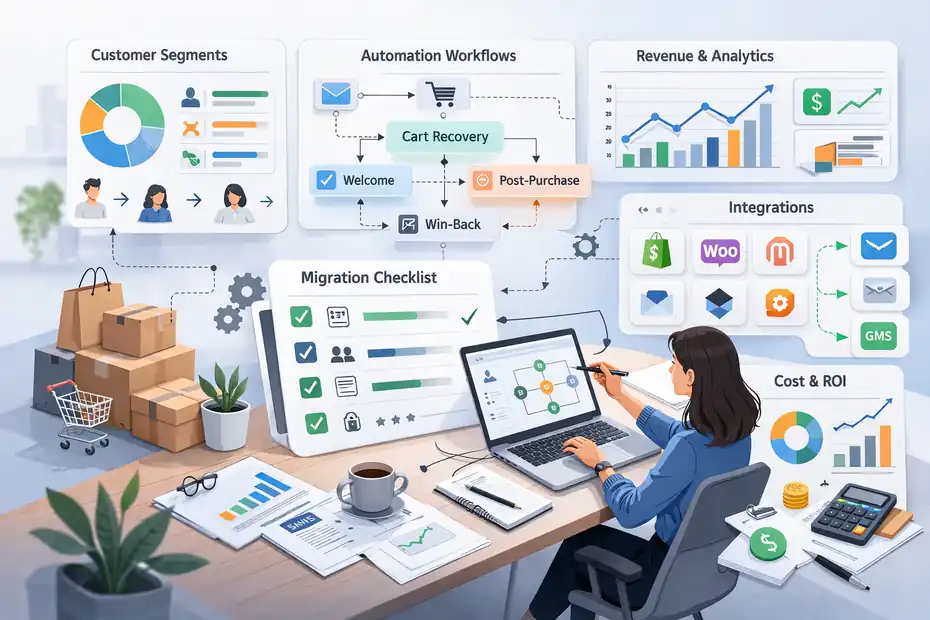
The smartest migrations are boring. They are not driven by hype. They are driven by fit.
Start with your revenue model, not feature lists
Before comparing plans, map how your store actually makes money. Do you rely on repeat purchases? Seasonal promotions? Consumable products? New launches? High average order value with longer consideration?
That answer should guide your platform choice. A consumables brand may need replenishment logic and strong post-purchase timing. A fashion brand may care more about category-based segmentation and launch campaigns.
A store with many first-time buyers but weak second-purchase rates needs lifecycle automation before it needs fancy templates.
I recommend asking three questions:
- Which automations drive the next 20 percent of revenue?
- What customer data do we need to segment buyers properly?
- Does our team have the time and skill to use a more advanced platform?
Once you answer those, the shortlist usually becomes obvious.
Compare switching cost, not just monthly cost
This part gets ignored constantly. The subscription price is only one piece of the cost. Migration has a real operational price.
A realistic switch may involve:
- Rebuilding popups and embedded forms
- Recreating templates and flows
- Cleaning and tagging contact data
- Reauthenticating domains
- Testing deliverability and event tracking
- Updating reporting dashboards
Mailchimp and ActiveCampaign both emphasize onboarding and migration support in their current materials, and ActiveCampaign also highlights no setup fees plus onboarding options. That can matter more than saving a few dollars a month.
I’ve seen stores save money on paper and lose weeks of momentum in practice. Be honest about internal bandwidth.
Migration tips for moving away from GetResponse
A platform switch is one of those projects that sounds easy until it touches your live revenue. Here’s how I’d handle it.
Migrate the essentials first
Do not rebuild everything at once. Start with the flows that protect revenue immediately. In most stores, that means welcome, abandoned cart, browse abandonment if available, post-purchase, and win-back.
Keep the first phase focused:
- Export and clean your contact list
- Preserve consent data and suppression lists
- Connect store data and confirm event tracking
- Rebuild highest-value automations first
- Authenticate your sending domain before volume ramps up
This approach lowers risk. You do not need every historic automation live on day one. You need the money flows working.
GetResponse itself explains that ecommerce automations rely on store data sync, abandoned cart conditions, and message blocks that pull in product information.
Any alternative you choose should be tested with the same discipline before full cutover.
Validate data and attribution before scaling campaigns
One of the biggest migration mistakes is assuming that because emails are sending, everything is fine. It is not fine if revenue attribution is broken, products are not syncing correctly, or order events are delayed.
I suggest checking:
- Are products and categories syncing accurately?
- Are cart and checkout events firing on time?
- Are purchase events attributed to flows correctly?
- Are unsubscribes and suppression rules behaving properly?
- Are your UTM settings consistent for analytics?
You do not need perfection, but you do need confidence. Otherwise you can spend a month optimizing broken reporting and draw the wrong conclusions.
Common mistakes when choosing GetResponse alternatives
This is where a lot of stores burn time and money.
Picking the “most powerful” platform instead of the most usable one
I’ve seen merchants choose a sophisticated platform because every Twitter thread says it is elite, then use maybe 15 percent of it. That is not strategy. That is software cosplay.
A platform only creates value when your team can execute inside it consistently. If you are a small brand without a dedicated retention marketer, ease of use may outperform raw capability for the next year. That is why Omnisend and Mailchimp keep winning deals despite tougher competition.
The best platform is not the one with the longest feature page. It is the one that helps you publish and improve the right automations repeatedly.
Ignoring list quality and deliverability basics
Some merchants switch tools hoping conversion rates will magically jump. Sometimes they do improve, but a bad list is still a bad list.
If open rates are falling, click rates are weak, and revenue per send is unimpressive, the problem might be poor segmentation, stale contacts, weak offers, or deliverability issues rather than the platform itself.
GetResponse, like other providers, points users toward domain authentication options such as SPF, DKIM, and DMARC to improve inbox placement. The same principle applies no matter where you migrate.
My advice is boring but effective: Clean the list, authenticate the domain, rebuild your core flows, and improve your offers before expecting software alone to save the channel.
How to get better conversions after switching platforms
Changing tools is not the goal. More revenue is the goal.
Build the five flows that matter most
Most ecommerce stores do not need 25 automations to see results. They need five flows done well:
- Welcome series: Turn subscribers into first-time buyers.
- Abandoned cart: Recover near-purchases.
- Browse or product-view abandonment: Re-engage high intent.
- Post-purchase: Confirm the order, cross-sell, educate, and push the second purchase.
- Win-back: Reactivate lapsed customers before they disappear.
This is the real foundation. Omnisend, Klaviyo, Mailchimp, and GetResponse all position these lifecycle motions as central to ecommerce performance, though they differ in depth and execution style.
If I were prioritizing from scratch, I’d spend 80 percent of my effort here and 20 percent on campaigns.
Optimize for second purchase, not just first purchase
This is the part I wish more merchants obsessed over. The fastest gains often come from improving the path between first and second order. Once a customer buys again, the economics of acquisition get much healthier.
Practical levers include product education, replenishment timing, complementary product recommendations, loyalty nudges, review requests, and category-based follow-ups.
GetResponse explicitly promotes product recommendation features for upsell and cross-sell, and ecommerce-first tools like Klaviyo and Omnisend are built to support similar retention plays through automation and segmentation.
For many stores, second-purchase rate is the metric that separates “we send email” from “email is a profit center.”
Final verdict: the best alternatives to GetResponse for ecommerce stores
The best alternatives to GetResponse for ecommerce stores are not all trying to win in the same way, and that is exactly why this decision deserves some thought.
If you want the strongest ecommerce-specific option for segmentation, customer data, and retention depth, I’d put Klaviyo at the top. If you want a more approachable ecommerce-first platform with very strong value and faster setup, Omnisend is a serious contender.
If you want familiarity and simpler workflows, Mailchimp still earns a place. If budget matters most, Brevo is worth a close look. And if your automation needs go beyond standard store journeys, ActiveCampaign can be the smarter long-term move.
My honest take is this: Most ecommerce stores should not ask, “What is the most popular alternative?” They should ask, “Which platform helps our team turn customer behavior into repeat revenue with the least friction?”
That is the answer that usually converts.
FAQ
What are the best alternatives to GetResponse for ecommerce stores?
The best alternatives to GetResponse for ecommerce stores include platforms like Klaviyo, Omnisend, Mailchimp, Brevo, and ActiveCampaign. These tools focus more on customer behavior, automation, and revenue tracking, helping online stores improve conversions, retention, and personalized marketing campaigns more effectively than general email platforms.
Why should ecommerce stores switch from GetResponse?
Ecommerce stores may switch from GetResponse when they need deeper customer segmentation, better automation tied to purchase behavior, and stronger revenue tracking. Platforms built specifically for ecommerce often provide more advanced tools for abandoned carts, repeat purchases, and lifecycle marketing that directly impact sales performance.
Is Klaviyo better than GetResponse for ecommerce?
Klaviyo is often better than GetResponse for ecommerce because it is built around customer data and revenue-focused automation. It allows stores to create highly targeted campaigns based on shopping behavior, which can lead to higher conversions, improved retention, and more accurate performance tracking.
Which GetResponse alternative is best for small ecommerce stores?
For small ecommerce stores, Omnisend, Mailchimp, and Brevo are strong alternatives because they are easy to use and quick to set up. These platforms offer essential automation features like welcome emails and cart recovery without overwhelming users, making them ideal for lean teams or beginners.
How do I choose the right ecommerce email marketing platform?
To choose the right platform, focus on your store’s needs, such as automation complexity, budget, and growth stage. Consider how well the platform handles customer data, segmentation, and revenue tracking. The best choice is one your team can use consistently to drive measurable sales results.

I’m Juxhin, the voice behind The Justifiable.
I’ve spent 6+ years building blogs, managing affiliate campaigns, and testing the messy world of online business. Here, I cut the fluff and share the strategies that actually move the needle — so you can build income that’s sustainable, not speculative.
Related posts:
 Boost Sales with Automated Email Marketing: 10 Proven Strategies
 How Omnisend WooCommerce Integration Performs
 Omnisend Marketing: How to Drive More Sales Fast
 Omnisend Automation: How to Scale Your Store on Autopilot
 What is Getresponse: A Brief Introduction
 How Do I Create An Email Newsletter And What Should It Include?