
Table of Contents
Some links on The Justifiable are affiliate links, meaning we may earn a small commission at no extra cost to you. Read full disclaimer.
A solid debutify conversion rate optimization strategy can turn a nice-looking Shopify store into one that actually sells consistently. If you are using Debutify or thinking about it, the real goal is not just making your store prettier.
It is helping more visitors take action. That means more add-to-carts, more completed checkouts, and better average order value without needing to buy more traffic.
In this guide, I’ll walk you through how to build that strategy from the ground up, including setup, testing, optimization, and scaling so you can make smarter changes with confidence.
What A Debutify Conversion Rate Optimization Strategy Really Means
Before you start changing banners, icons, and product pages, it helps to understand what you are actually optimizing for. A real conversion strategy is not about random tweaks.
It is about removing friction, increasing trust, and guiding shoppers toward purchase with less hesitation.
Debutify Is A Framework, Not The Strategy
Debutify gives you a conversion-focused Shopify theme and a set of add-ons designed to support sales. That matters, but the theme itself is not the strategy. The strategy is how you use layout, messaging, trust elements, product presentation, and shopper psychology together.
A lot of store owners install Debutify and expect conversions to rise automatically. Sometimes they do, especially if the old theme was cluttered or slow. But in most cases, the lift is limited unless you build a system around it.
I have seen stores improve their conversion rate simply by moving from a confusing product page to a cleaner Debutify structure, but the biggest gains usually come from combining that cleaner design with better copy, stronger offers, and tighter testing.
Think of it this way. Debutify helps you create the environment. Your conversion rate optimization strategy decides what should happen inside that environment.
For many stores, that strategy needs to answer five questions clearly:
- Why should someone trust you?
- Why should they want this product now?
- What could stop them from buying?
- What page element removes that hesitation?
- What metric tells you the change worked?
When you frame it like that, optimization becomes much less random and much more profitable.
Your Main Goal Is Not More Clicks, It Is More Completed Purchases
Many people optimize for small actions and forget the real goal. Yes, clicks matter. Add-to-cart rate matters. Time on page can be useful. But your main target is completed purchases and profit per visitor.
For example, imagine your product page gets prettier and your add-to-cart rate rises from 5% to 7%, but your checkout completion rate drops because your shipping terms are confusing. That is not a win. It is just prettier leakage.
I suggest thinking in layers:
- First layer: Product page engagement
- Second layer: Add-to-cart rate
- Third layer: Checkout initiation
- Fourth layer: Purchase completion
- Fifth layer: Average order value and repeat behavior
A good debutify conversion rate optimization strategy improves the whole path, not just one metric in isolation.
In my experience, the stores that grow fastest are the ones that stop celebrating vanity metrics too early. They look at the full funnel. They ask whether a change helped more people buy, whether those customers were profitable, and whether the page became clearer rather than louder.
That mindset will make every Debutify customization more useful from this point forward.
Start With Conversion Foundations Before You Touch Add-Ons
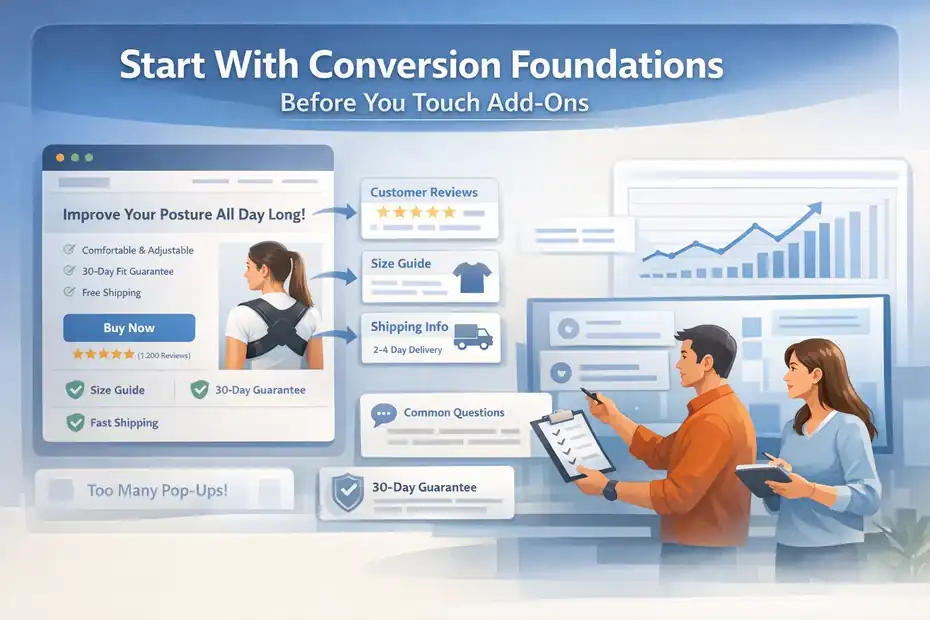
This is where many stores get the order wrong. They install every possible feature, then wonder why the page feels busy.
Before you activate anything, make sure the fundamentals are doing their job.
Clarify Your Offer So The Theme Has Something Strong To Present
No theme can rescue a weak offer. If your pricing feels off, your shipping is vague, your product angle is generic, or your return policy creates doubt, Debutify will only make those issues look more polished.
Your offer needs to be obvious within seconds. A first-time visitor should understand what the product is, who it is for, why it is better, and what risk-reduction exists if they buy today. This is especially important on mobile, where screen space is limited and attention disappears fast.
Here is a simple offer framework I recommend:
- Product promise: What result does the customer get?
- Proof point: Why should they believe you?
- Risk reducer: What lowers buying anxiety?
- Urgency driver: Why act now instead of later?
Imagine you are selling a posture corrector. “Improve posture” is too vague. A stronger offer sounds more like: “Comfortable daily posture support designed for long desk hours, with a 30-day fit guarantee.”
That gives the theme better material to display clearly in the hero section, product page, and call-to-action area.
Debutify performs best when the store already has a focused offer. If your product positioning is muddy, fix that first.
Make Sure Your Product Pages Answer Objections Early
Most purchases are delayed by unanswered objections, not lack of interest. A shopper might like the product but still hesitate because they are wondering about sizing, shipping time, ingredients, compatibility, warranty, or whether it actually works.
This is where your conversion strategy becomes practical. Instead of guessing what to design, you identify the objections and answer them where the hesitation happens.
Debutify makes this easier because its layout is built for cleaner product page structure, but the answers still need to come from you.
I recommend listing your top customer objections from support tickets, reviews, live chat questions, and abandoned cart feedback. Then map those objections directly into the product page.
For example:
- Sizing concern: Add a visible size guide near variant selection
- Trust concern: Add review snippets and guarantee messaging near the buy box
- Shipping concern: Show estimated delivery windows before checkout
- Product doubt: Use images, FAQs, and use-case copy to explain performance
A practical benchmark many ecommerce teams watch is conversion rate by landing page. If one product page converts at 1.2% and another at 3.1%, the difference often comes down to clarity and objection handling more than design style alone.
That is why I believe the best Debutify stores feel simple. They are not packed with features. They just answer the right questions at the right time.
Build Your Store Structure Around The Shopper Journey
Once the basics are solid, you can shape the store around how a visitor actually thinks.
This is where Debutify becomes much more useful because you can guide people page by page instead of decorating pages in isolation.
Optimize The Homepage For Direction, Not Decoration
Your homepage is often overestimated and underused. It usually does not close the sale by itself, but it does shape first impressions and direct people toward the right next step.
A high-converting homepage in Debutify should quickly do three things: explain what you sell, show why it is trustworthy, and send the visitor toward a product or collection page with minimal confusion.
I suggest keeping the homepage focused on these sections:
- A clear hero with product category and value proposition
- A featured collection or bestseller section
- Social proof or credibility indicators
- One or two benefit blocks
- A strong path to shop now
What you do not need is endless storytelling above the fold, multiple competing popups, or six different calls to action that fight each other.
Imagine a skincare store using Debutify. Instead of opening with a vague lifestyle image and generic text like “Glow Naturally,” the homepage could lead with a more useful statement: “Simple daily skincare for acne-prone and sensitive skin.” That instantly filters the audience and improves click quality.
Your homepage should help the right customer identify themselves fast. In most cases, better direction beats more design flair.
Design Collection Pages To Help Shoppers Decide Faster
Collection pages are often ignored in conversion discussions, but they matter more than many people think. This is where shoppers compare options, scan price points, and decide whether your store feels easy to shop.
A strong debutify conversion rate optimization strategy treats collection pages as decision pages, not just product grids. The goal is to reduce overwhelm and make product selection easier.
Helpful elements include:
- Clean filtering by type, size, use case, or need
- Clear product titles that explain what makes each item different
- Price visibility without surprises
- Review stars or trust signals where appropriate
- Quick indication of bestsellers or top-rated products
One common mistake is showing too many similar products without explaining who each one is for. When everything looks alike, the shopper delays. When differences are obvious, the shopper moves.
For instance, if you sell supplements, product names alone may not be enough. “Magnesium Blend” is weaker than “Magnesium Blend For Sleep Support.” That small shift can improve click-through from collection to product page because the visitor understands relevance faster.
I have seen this reduce bounce and lift product page engagement noticeably, especially for stores with more than 15 products in a category.
Use Debutify Add-Ons With Intent, Not Just Because They Exist
Debutify is known for conversion-focused add-ons, but this is where people can overdo it.
More features do not automatically mean more conversions. Sometimes they just create noise.
Prioritize Add-Ons That Solve A Specific Buying Friction
The smartest way to use Debutify add-ons is to connect each one to a real customer hesitation. Every enabled feature should have a job. If it does not solve friction, build trust, or increase average order value, it probably does not belong.
Here are a few examples of useful intent-based matching:
- Cart urgency tools: Best when shoppers delay because they feel no reason to act now
- Trust badges: Best when your store is new or unfamiliar and needs credibility reinforcement
- Sticky add-to-cart: Best when mobile users scroll through long product descriptions
- Upsell prompts: Best when product pairings are natural and genuinely helpful
- Sales countdowns: Best only when tied to a real promotion or deadline
What usually hurts performance is stacking all of these at once. The page starts shouting. Visitors feel manipulated instead of supported.
In my experience, a clean page with two or three well-chosen persuasion elements often beats a page with eight conversion widgets fighting for attention. That is especially true on mobile, where screen clutter creates fatigue quickly.
Treat every add-on like an employee. If it cannot explain its role in one sentence, remove it.
Match Add-Ons To Funnel Stage Instead Of Applying Them Everywhere
Different shoppers need different nudges depending on where they are in the buying process. Someone landing cold from a social ad is not ready for the same messaging as someone already adding to cart.
That is why I suggest mapping Debutify features by funnel stage:
- Awareness stage: Clear product benefits, visual trust, simple navigation
- Consideration stage: Reviews, FAQs, comparison help, shipping clarity
- Decision stage: Sticky cart, urgency cues, guarantee reminders
- Post-cart stage: Relevant upsells, free shipping thresholds, bundle suggestions
For example, trust badges may matter most on the product page near the add-to-cart button, while upsells often work better in the cart where intent is already established. A countdown timer might be effective during a real launch campaign, but it can damage trust if it resets constantly and feels fake.
A realistic scenario: A home fitness store adds review highlights and a sticky add-to-cart button on product pages, then uses cart upsells for resistance bands with yoga mats. That feels connected and useful. If the same store also adds spinning popups, fake timers, multiple announcement bars, and random cross-sells everywhere, performance often drops.
The lesson is simple. Debutify features work best when they support the shopper’s next decision, not when they interrupt it.
Create Product Pages That Convert With Less Effort
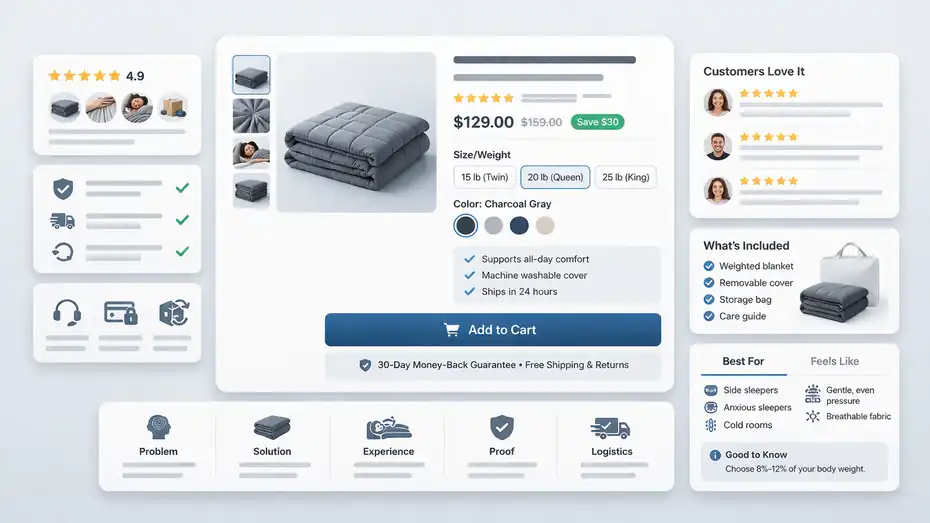
Your product page is usually the center of your CRO strategy. This is where Debutify can shine if you keep the page focused, credible, and easy to act on.
Structure The Buy Box To Reduce Hesitation
The buy box is the part of the product page that contains the title, price, variants, call to action, and often the most important trust elements. This section does a huge amount of conversion work.
I recommend organizing it in this order:
- Product title that clearly identifies the item
- Review proof or rating near the top
- Price and any savings explanation
- Variant or size selection
- Key benefit summary
- Add-to-cart button
- Risk reducer such as guarantee, shipping, or returns
That sequence mirrors how many people think. First, “What is this?” Then, “Can I trust it?” Then, “How much is it?” Then, “Is this the right version?” Then, “Why should I buy?”
A common mistake is placing too much text before the action area. On mobile, that can bury the button and weaken momentum. Debutify’s layout helps with this, especially when paired with sticky add-to-cart behavior, but the content order still matters.
I also suggest using concise benefit bullets under the price or variants. Keep them tight and outcome-driven. For example:
- Supports all-day comfort
- Machine washable cover
- Ships in 24 hours
These bullets should reduce uncertainty, not repeat vague marketing language.
Use Product Descriptions To Sell Through Clarity, Not Hype
A product description should not read like a brochure. It should act like a smart sales assistant. That means answering practical questions, describing benefits honestly, and helping the shopper picture ownership.
One framework I like is:
- Problem: What pain point does the shopper face?
- Solution: How does the product address it?
- Experience: What does using it feel like?
- Proof: What supports the claim?
- Logistics: What should they know before buying?
Let’s say you sell a weighted blanket. Instead of writing “premium comfort for optimal rest,” explain what that means in plain language: who it is for, how the fabric feels, how much pressure it provides, how to choose a size, and when not to use it. That kind of clarity builds more trust than polished fluff ever will.
You can also break the description into mini sections using compact formatting:
- Best for: Side sleepers, anxious sleepers, and cold rooms
- Feels like: Gentle, even pressure without overheating
- Good to know: Choose 8% to 12% of body weight for the best fit
I believe this is one of the easiest wins for most stores. Better product descriptions often improve conversion rate, lower return confusion, and reduce support load at the same time.
Track The Right Metrics So You Know What To Improve
You cannot optimize what you are not measuring.A lot of store owners change page elements based on gut feeling, then have no idea why results moved.
Good CRO needs clean tracking and simple interpretation.
Focus On Funnel Metrics Before You Chase Tiny Design Wins
You do not need twenty dashboards to build a strong strategy. You need a handful of clear metrics that show where buyers are getting stuck.
I suggest watching these first:
- Conversion rate by product page
- Add-to-cart rate
- Reached checkout rate
- Checkout completion rate
- Average order value
- Bounce rate on key landing pages
- Revenue per visitor
These metrics help you separate page problems from offer problems. For example, if traffic is strong and add-to-cart rate is weak, the issue is often product page clarity or trust. If add-to-cart rate is healthy but checkout completion is poor, the problem may be shipping, payment friction, or surprise costs.
A realistic benchmark many ecommerce brands aim for is improving conversion rate by even 0.3 to 1 percentage point over time, because small gains compound fast. A store with 30,000 monthly visitors and a $75 average order value can feel a huge difference between converting at 1.8% and 2.4%.
That is why funnel measurement matters more than isolated design opinions.
Use Analytics To Build A Repeatable Testing Loop
Once your baseline is clear, you can test smarter. Your goal is not endless experimentation. Your goal is a repeatable loop:
- Find the drop-off point
- Form a hypothesis
- Make one meaningful change
- Measure the outcome
- Keep, revise, or remove the change
For example, if a product page has strong traffic but low add-to-cart rate, your hypothesis might be: “Visitors do not trust the product enough because social proof is buried.” You then move reviews higher, add a clear guarantee, and measure the result over a meaningful sample.
This is where tools like Shopify analytics, GA4, heatmaps, and session recordings become useful, but only when tied to a real question. A heatmap is not helpful by itself. It becomes helpful when you are trying to understand whether shoppers even reach your shipping policy, click size charts, or ignore your CTA.
In my experience, stores improve faster when they document tests in a simple spreadsheet with four columns: page, change, hypothesis, result. That keeps your strategy grounded in evidence instead of memory.
Avoid Common CRO Mistakes That Hurt Debutify Stores
This part is important because many conversion losses come from good intentions executed badly.
Debutify can support conversions well, but it can also amplify confusion if the setup is careless.
Do Not Let The Store Feel Too Aggressive
One of the fastest ways to lose trust is to make the store feel pushy. This often happens when store owners add fake scarcity, popups that appear too quickly, too many urgency messages, or flashy notifications that distract from product understanding.
Visitors are more skeptical in 2026, not less. Most people have seen “Only 2 left” messages that are not true. They have seen countdown timers that reset. They notice when every product looks permanently on sale.
That does not mean urgency never works. It means authenticity matters. If you are running a real weekend promotion, say so clearly. If stock is actually limited, showing low inventory can help. But if the page feels manipulative, conversion quality usually drops even if short-term clicks rise.
I suggest aiming for calm confidence. A strong Debutify store should feel easy, trustworthy, and helpful. Not desperate.
Stop Changing Too Many Things At Once
Another common mistake is making five or six changes at the same time, then guessing which one caused the result. This slows learning and creates false confidence.
For example, imagine you:
- Rewrite the headline
- Add trust badges
- Change product images
- Turn on sticky cart
- Add an upsell
- Launch a discount
If sales rise, what actually helped? You will not know. That makes future decisions weaker.
Whenever possible, change one major variable at a time on a meaningful page. Not every store has enough traffic for statistically perfect split testing, and that is okay. Even then, controlled testing is still better than chaotic redesigns.
I believe disciplined simplicity is underrated in ecommerce. The stores that win often look less “clever” and more coherent.
Optimize For Mobile First Because That Is Where Friction Hides
For many Shopify stores, mobile traffic dominates. If your Debutify setup looks fine on desktop but feels clumsy on a phone, your strategy is incomplete.
Make The Mobile Buying Experience Fast And Obvious
Mobile users are impatient and context-switching constantly. They are shopping while commuting, multitasking, or half-distracted on the couch. That means your store needs to reduce cognitive load fast.
Here is what I suggest checking first on mobile:
- Is the product title visible without awkward scrolling?
- Can users see price and variants quickly?
- Is the add-to-cart button easy to reach?
- Do trust signals appear before too much scrolling?
- Are image galleries smooth and fast?
- Does the page feel crowded?
Debutify can help with mobile-focused conversion design, but you still need to test the actual experience on your own device. I always recommend going through the full store as if you were a skeptical first-time buyer. Use a phone, not just preview mode.
A good mobile product page often feels shorter than you think. Not because it lacks content, but because it prioritizes what matters first.
Reduce Load Time And Visual Clutter
Page speed and visual simplicity are tightly connected. A slower page does not just load later. It also feels less trustworthy. Even a one or two second delay can damage momentum, especially for paid traffic.
This is where restraint matters. Too many apps, oversized media files, extra widgets, and layered scripts can slow down even a well-designed theme. Debutify may be built with performance in mind, but your store stack still affects real-world speed.
Keep an eye on:
- Compressed images
- Limited third-party scripts
- Fewer overlapping widgets
- Clean font usage
- Minimal autoplay content
Many store owners think adding more conversion elements will raise conversion rate. Sometimes the opposite is true. One store might gain more from removing two scripts and simplifying the page than from adding another promotional banner.
That is why I believe speed is a conversion feature, not just a technical issue.
Scale Your Strategy With Smarter Testing And Segmentation
Once the basics are working, the next level is not just adding more features. It is getting more precise.
That means improving offers, page logic, and merchandising based on audience behavior.
Segment Your Best Opportunities By Traffic Source And Product Type
Not all visitors behave the same way. Someone arriving from branded search often converts differently than someone from Instagram, email, or a cold TikTok ad. Your CRO strategy gets stronger when you stop treating all traffic as identical.
Start by comparing:
- Product page conversion by traffic source
- Bounce rate by campaign type
- Average order value by device
- Conversion rate by collection or category
This helps you find pattern-based opportunities. For example, email traffic may convert well without extra trust building because those visitors already know you.
Paid social traffic may need stronger above-the-fold clarity and faster objection handling. High-ticket products may need more reassurance, while lower-cost impulse buys may benefit more from friction reduction and urgency.
A realistic scenario: A pet product store notices that paid social traffic converts poorly on a general collection page but performs much better when ads land on a single product page with testimonials and a bundle offer. That insight changes the whole strategy.
The more clearly you map performance to source and intent, the less guesswork you need.
Increase Revenue Per Visitor, Not Just Conversion Rate
At some point, chasing only conversion rate becomes too narrow. A better business goal is revenue per visitor, because it captures both conversion and order value.
This is where Debutify can support cart and bundle optimization if used carefully. Instead of forcing random add-ons, focus on natural expansion:
- Frequently bought together pairings
- Quantity breaks for replenishable products
- Free shipping thresholds
- Post-purchase upsells that solve a related need
For example, if you sell coffee equipment, offering filters alongside a pour-over kit feels helpful. Offering an unrelated accessory just to lift cart size usually feels annoying.
In my experience, the best upsells work when the shopper thinks, “That actually makes sense.” That is the moment you want.
A store converting at 2.2% with a $95 average order value may outperform a store converting at 2.8% with a $60 average order value. That is why advanced optimization should balance both efficiency and value.
Your Practical Debutify CRO Action Plan
You do not need to overhaul everything this week.
A better approach is to build your debutify conversion rate optimization strategy in the right order so each improvement compounds.
Follow This Simple Implementation Sequence
If you want a realistic roadmap, this is the order I would use:
- Audit the offer: Clarify product promise, pricing logic, shipping, returns, and guarantee.
- Fix product page fundamentals: Improve headlines, images, benefit bullets, descriptions, FAQs, and objection handling.
- Clean the homepage and collection pages: Make navigation easier and reduce confusion.
- Add only essential Debutify features: Choose add-ons based on real buyer friction.
- Track baseline metrics: Measure conversion rate, add-to-cart, checkout completion, and average order value.
- Run focused tests: Change one meaningful element at a time.
- Optimize mobile: Review the entire purchase journey on real devices.
- Scale what works: Apply wins to similar products, traffic sources, or collections.
This sequence prevents the most common mistake, which is trying to “hack” conversion before the store is fundamentally clear.
What Success Usually Looks Like Over Time
A strong CRO strategy rarely produces magic overnight. What it usually produces is cleaner decision-making and better performance over time.
In the first phase, you might notice:
- Lower bounce on product pages
- Better add-to-cart rate
- Fewer support questions
- More consistent conversion across devices
In the second phase, you often see:
- Better checkout completion
- Higher average order value
- More stable paid traffic performance
- Stronger revenue per visitor
That is the real goal. Not gimmicks. Not random theme edits. A store that steadily converts better because it understands the shopper better.
I believe that is the best way to use Debutify. Not as a shortcut, but as a conversion-friendly foundation you can build on with discipline, testing, and empathy for the buyer.
If you approach it that way, your store will not just look more polished. It will become easier to trust, easier to shop, and much more likely to convert.
FAQ
What is a Debutify conversion rate optimization strategy?
A debutify conversion rate optimization strategy is a structured approach to improving how many visitors complete purchases on a Shopify store using the Debutify theme. It focuses on reducing friction, improving trust, and guiding users through the buying journey with optimized product pages, layout, and conversion-focused features.
How does Debutify help increase conversion rates?
Debutify helps increase conversion rates by providing a clean, fast-loading theme with built-in conversion-focused elements like trust badges, sticky add-to-cart, and upsell features. When used strategically, these tools improve user experience, reduce hesitation, and encourage more shoppers to complete purchases.
What are the most important elements to optimize in Debutify?
The most important elements to optimize in Debutify include the product page layout, buy box structure, mobile usability, and trust signals. Clear product descriptions, strong offers, fast load speed, and strategic use of add-ons all play a major role in improving conversion rates.
How can I improve my Shopify conversion rate using Debutify?
You can improve your Shopify conversion rate using Debutify by refining your product pages, simplifying navigation, answering customer objections, and testing key elements like headlines and calls to action. Focus on clarity, trust, and speed rather than adding too many features at once.
What mistakes should I avoid when using Debutify for CRO?
Common mistakes include overloading pages with too many add-ons, using fake urgency tactics, ignoring mobile optimization, and making multiple changes at once without tracking results. These issues can reduce trust and make it harder to identify what actually improves conversion performance.

I’m Juxhin, the voice behind The Justifiable.
I’ve spent 6+ years building blogs, managing affiliate campaigns, and testing the messy world of online business. Here, I cut the fluff and share the strategies that actually move the needle — so you can build income that’s sustainable, not speculative.
Related posts:
 8 Conversion-Boosting Debutify Shopify Theme Features Explained
 How To Start A Dropshipping Business With No Money
 Dropshipping Business Model Success: Tips for Long-Term Growth
 Viral Launch Chrome Extension: The Ultimate Tool for Sellers
 How to Use Dsers Shopify for Seamless Dropshipping
 How to Use Jungle Scout Amazon for Product Sourcing