
Table of Contents
Some links on The Justifiable are affiliate links, meaning we may earn a small commission at no extra cost to you. Read full disclaimer.
Hello bar vs optinmonster comparison is one of those searches that usually means one thing: you do not want another vague “both are great” answer. You want to know which tool will actually fit your site, budget, traffic, and conversion goals.
I went through the current product pages, pricing details, and platform claims, and the real difference is simpler than most reviews make it sound.
Hello Bar is usually the easier, lower-friction choice for straightforward lead capture.
OptinMonster is usually the better fit when you need deeper targeting, ecommerce triggers, and more advanced campaign logic.
What This Comparison Really Comes Down To
This comparison is not really about whether either tool can make a popup, bar, or form. Both can.
The better question is whether you need simplicity with faster setup, or deeper control with more moving parts.
What Hello Bar Is Best At
If I had to summarize Hello Bar in plain English, I would say it is built to help you publish conversion elements quickly without turning your site into a full CRO lab.
Its core strengths are sticky bars, modals, sliders, page takeovers, embedded forms, visual customization, basic-to-strong targeting, and a genuinely accessible free plan.
The current pricing page says the Starter plan is free forever with up to 5,000 popup views, while paid plans begin at $39 per month annually.
That matters more than it sounds. A lot of small publishers, local businesses, coaches, and lean SaaS teams do not need twenty layers of logic.
They need one strong lead magnet bar, one exit popup, one homepage callout, and enough reporting to know whether the campaign is pulling its weight. In that situation, Hello Bar often feels lighter and more practical.
I also think Hello Bar’s biggest hidden advantage is psychological, not technical. It encourages publishing. When software feels less intimidating, campaigns go live faster, and live campaigns beat “perfect” campaigns that stay in draft mode for three weeks.
That is not a vendor claim. That is just what usually happens in real teams.
What OptinMonster Is Best At
OptinMonster is stronger when conversions depend on precise targeting, sequencing, and behavioral triggers rather than simple placement.
On its pricing and homepage materials, it emphasizes all campaign types, hundreds of templates, page targeting, A/B testing on higher plans, geolocation, new-vs-returning visitor logic, onsite retargeting, follow-up campaigns, cart-related targeting, and ecommerce integrations such as Shopify and WooCommerce.
That makes it a different class of tool for some buyers. If you run a store, membership site, large content operation, or agency, you may care less about “can I launch a popup today?” and more about “can I show a free shipping message only when the cart is close to threshold, then swap it for a cross-sell after opt-in, then exclude buyers?” OptinMonster is built for those layered scenarios.
So the short answer is this: Hello Bar wins more often for simplicity and entry-level value. OptinMonster wins more often for advanced conversion operations. That is the framework I would use before looking at any feature checklist.
How Hello Bar And OptinMonster Work
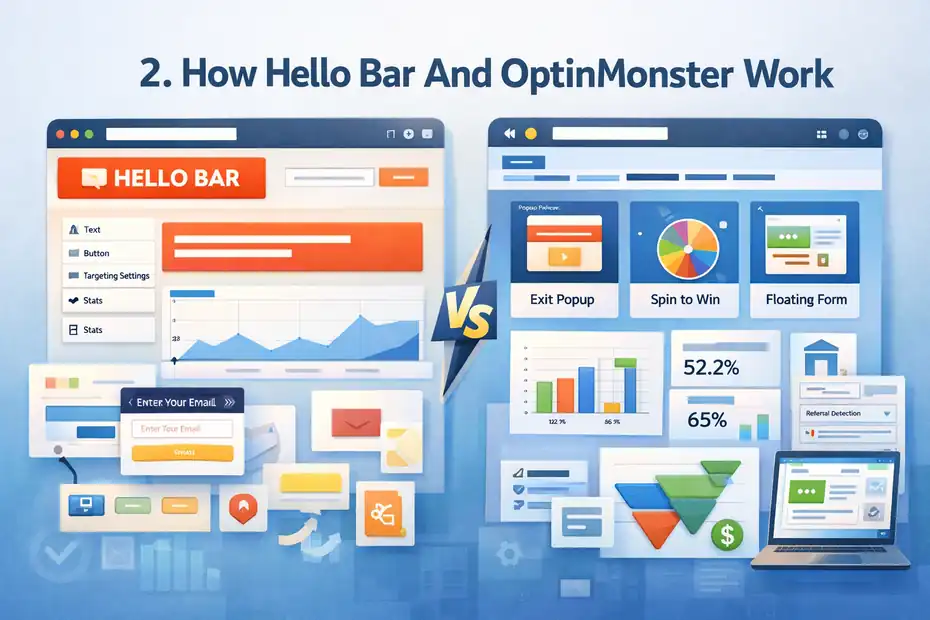
Both products sit on your website and display conversion-focused messages, forms, or overlays based on rules you define. But the way they feel in practice is different.
How Hello Bar Fits Into A Typical Funnel
Hello Bar is easy to understand because it mirrors how most smaller teams already think. You choose a format such as a top bar, modal, slider, alert, or page takeover. Then you connect it to one goal: collect emails, push traffic to an offer, announce something important, or reduce abandonment.
The platform highlights visual editing, prebuilt themes, design matching, targeting by location or campaign source, analytics, custom reports, and A/B testing on paid plans.
Imagine you run a B2B consultant site. You add a sticky bar promoting a free checklist. On blog posts, you show a modal after 8 seconds. On pricing pages, you swap the message for a demo CTA.
That is a very normal Hello Bar workflow, and it matches the product’s strength: getting a useful message in front of the right visitor without heavy setup overhead.
One useful Hello Bar detail many people miss is that it prices by popup views, not broad site traffic. If your campaigns only appear selectively, your bill can feel reasonable relative to actual usage. That can work well for targeted, lower-volume sites.
How OptinMonster Fits Into A Typical Funnel
OptinMonster works the same at the highest level, but it pushes you toward a more systematic CRO mindset. Instead of just “show a popup here,” you are more likely to think in segments, triggers, and campaign paths.
The platform supports all major campaign types and a long list of targeting and automation features, including page targeting, scroll triggers, device targeting, content locking, geolocation, onsite retargeting, follow-up campaigns, campaign scheduling, UTM targeting, referral detection, cart and form abandonment, and success scripts.
For an ecommerce store, that matters. You can show one offer on collection pages, another when a shopper’s cart reaches a threshold, and a different follow-up after a visitor already engaged with an earlier campaign.
OptinMonster’s Shopify-specific messaging around product pages, collection pages, cart subtotals, and item counts makes its ecommerce intent very clear.
I would describe OptinMonster as a tool that rewards operators who enjoy testing and segmentation. If you are the kind of marketer who likes asking, “What should happen next for this specific visitor?” you will probably get more value from it.
Feature Comparison For Real Conversion Use Cases
A feature list alone is not enough. What matters is whether a feature changes outcomes for the kind of site you actually run.
Bars, Popups, And Embedded Forms
On core campaign formats, both tools cover the essentials. Hello Bar includes bars, modals, alerts, sliders, page takeovers, and embedded options.
OptinMonster includes all campaign types from its entry plan and is widely positioned around popups, floating bars, fullscreen overlays, slide-ins, inline forms, and more.
If your only goal is to publish a sticky announcement bar, a lead capture popup, and maybe one embedded newsletter form, both tools can do the job.
In my opinion, this is where many buyers overcomplicate the choice. You do not need advanced software to solve a basic placement problem.
The real split appears when campaign design becomes part of a broader funnel. Hello Bar gives you enough variety for most standard lead-gen use cases.
OptinMonster becomes more attractive when the format is not the hard part, but the logic behind when, why, and to whom the format appears.
Targeting And Personalization Depth
This is where the hello bar vs optinmonster comparison gets more serious. Hello Bar offers targeting based on location, campaign/source data, timing, returning visitor conditions, and related display settings. That is more than enough for many content-first sites.
OptinMonster goes further. Its public feature list includes page targeting, time on site, scroll triggers, device targeting, new vs returning visitor rules, geolocation, UTM campaign targeting, referral detection, cookie retargeting, onsite retargeting, and follow-up campaigns. Those are not small differences. They change the ceiling of what you can build.
Here is a simple way to think about it:
- Choose Hello Bar when you mostly need one offer matched to one page type or audience slice.
- Choose OptinMonster when you need different offers for different visitor states across a journey.
That sounds subtle, but it is usually the difference between “good enough” and “worth paying more for.”
Ecommerce And Revenue-Focused Features
If your website sells products directly, OptinMonster usually pulls ahead. Its Growth tier specifically calls out ecommerce-oriented features, including Shopify, WooCommerce, Magento, Easy Digital Downloads, MemberPress, coupon wheel campaigns, and cart-focused targeting.
Its Shopify app messaging also mentions targeting by product page, collection page, cart subtotal, item count, and specific products in cart.
Hello Bar can still support ecommerce promotions, especially bars and popups around discounts, announcements, and free shipping messaging. But its public positioning is broader and simpler, not as explicitly built around layered store logic.
So if you run Shopify and your revenue depends on recovering abandoning shoppers, nudging cart thresholds, and sequencing offers based on buying intent, I would lean OptinMonster.
If you just need a storewide promo bar, email capture offer, or seasonal announcement, Hello Bar can be enough.
Pricing, Limits, And Total Cost
This is where a lot of reviews get sloppy. “Cheaper” depends on how each platform meters usage and how many advanced features you actually need.
Hello Bar Pricing In Practical Terms
Hello Bar’s current plans are Starter at $0 with up to 5,000 popup views, Growth at $39 per month billed annually with up to 50,000 popup views, Premium at $69 per month with up to 150,000 popup views, and Elite at $129 per month with up to 500,000 popup views.
The pricing page also emphasizes unlimited popups, and on paid plans, unlimited subscribers and A/B tests.
That free plan is not trivial. For a blogger getting started, a new SaaS landing page, or a local business collecting a few hundred leads per month, Hello Bar can let you validate the whole channel before paying. That lowers risk a lot.
I also like that the cost structure is easy to explain to a client or founder. You are mainly scaling around popup views and plan tier. Fewer pricing surprises usually means faster buying decisions.
OptinMonster Pricing And Feature Gating
OptinMonster’s current annual pricing page shows Basic at $7 per month, Plus at $19 per month, and Growth at $49 per month, all marketed with annual billing discounts. Basic includes all campaign types, 700+ templates, page targeting, time and scroll triggers, and basic integrations.
Plus adds A/B testing, device targeting, content locking, yes/no forms, full analytics reporting, and advanced integrations. Growth adds geolocation targeting, new-vs-returning visitor logic, onsite retargeting, follow-up campaigns, ecommerce integrations, coupon wheels, and success scripts.
On paper, that can look cheaper than Hello Bar. Sometimes it is. But you need to be honest about which plan you would actually use. If the reason you are considering OptinMonster is advanced targeting or ecommerce behavior, the relevant plan is often not Basic.
That is why I suggest comparing based on required functionality, not entry price. A $7 plan you outgrow in two days is not cheaper in any useful sense.
Which One Is The Better Value
For low-complexity lead generation, Hello Bar often offers stronger value because it combines easier setup, a true free entry point, and enough campaign types for common use cases.
For advanced teams, OptinMonster can deliver better value because the incremental revenue from sharper targeting can easily cover the extra cost. If one smarter cart-threshold campaign increases average order value or recovers a slice of abandoning traffic, the math changes fast.
OptinMonster also cites customer examples such as adding 95,654 names in seven months and claims around doubled opt-in rate or a 12% lift in sales from exit-intent use cases, though those are vendor-provided case claims and not guarantees.
That last point matters. Higher-priced software is only “expensive” when you are not using the features that justify it.
Setup Experience And Day-To-Day Usability
This section matters more than feature nerds like to admit. A tool can be “more powerful” and still be the wrong choice if your team will barely use it.
Which Tool Is Easier To Launch Quickly
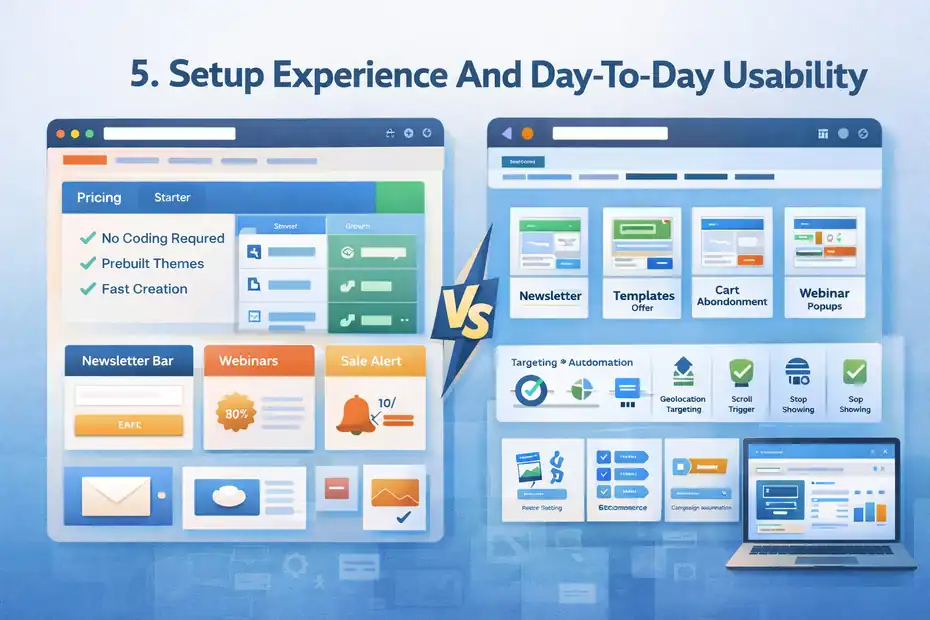
Hello Bar has a very strong usability argument. Its pricing page stresses no coding, fast creation, prebuilt themes, and design assistance that can match your site’s look automatically. That kind of workflow is exactly what non-technical users need.
For many teams, the first real conversion win comes from shipping something obvious: a newsletter bar, lead magnet popup, webinar callout, or sale announcement.
Hello Bar reduces the number of decisions standing between idea and launch. In my experience, that is a real advantage for solo operators and small marketing teams.
A realistic example: Imagine you run a content site and want to test whether a “Free Templates” offer beats “Join The Newsletter.” With Hello Bar, you can usually get both variants live quickly enough that testing becomes normal behavior instead of a project.
Which Tool Is Better For Operators And Agencies
OptinMonster is still designed for usability, and it explicitly says no coding is required. But it is more feature-rich, which usually means more setup choices. That is not a flaw. It is the price of power.
If you are an agency or in-house growth marketer, that trade-off can be worth it. OptinMonster’s materials mention client-site use, sub-accounts, custom branding, and account management on Growth plans, which are all strong agency signals.
I would put it like this: Hello Bar is easier to love on day one. OptinMonster is easier to grow into over six months if you actively run tests, segments, and multi-scenario campaigns.
Performance, Targeting, And Optimization
A conversion tool should not just collect leads. It should help you improve conversion rate over time without creating a bad user experience.
Analytics, Testing, And Learning Loops
Hello Bar includes analytics, custom reports, and A/B testing on paid plans. That is enough for a healthy optimization loop on most small and midsize sites. You can launch, compare, refine, and remove underperformers without building a complex measurement stack.
OptinMonster adds more sophistication earlier in the funnel strategy. Plus includes full analytics reporting and A/B testing, while higher plans add behavior-focused targeting that makes the testing itself more meaningful.
Instead of only asking “Which headline wins?” you can ask “Which offer wins for returning mobile users from paid social on product pages?”
That is a huge difference in mature marketing teams. Better segments often outperform prettier designs.
Site Performance And User Experience
OptinMonster publicly states that its embed code loads in a non-blocking, asynchronous way and says it will not slow down your site. That is reassuring, especially for stores or publishers worried about script bloat.
Hello Bar’s current public pricing page is more focused on conversions and usability than technical performance language, so I would not overstate anything there.
What I can say is that both tools are mainstream enough that the bigger UX risk usually comes from how you configure campaigns, not the fact that the software exists.
A badly timed full-screen popup can hurt more than any feature gap. In contrast, a well-timed bar after 6 to 10 seconds can convert better than an instant interruption.
Hello Bar’s recent content specifically highlights that delayed popups outperform immediate ones, which aligns with broader CRO practice.
Best Fit By Business Type
This is the section most readers actually need, because software comparisons are rarely universal. The right answer depends on your site model.
Bloggers, Publishers, And Personal Brands
For blogs, media sites, newsletters, coaches, and creator-led brands, I usually lean Hello Bar first. The free plan, simple deployment, signature bar format, and lower operational complexity all make sense here.
Hello Bar also says over 500,000 or 600,000 websites have used it, depending on the page, and presents itself as a broad, accessible conversion tool for non-technical users.
Most publisher funnels are not that complicated. You need to grow email subscribers, promote a lead magnet, highlight a product launch, or push readers to a webinar. Hello Bar covers those jobs comfortably.
A practical scenario: A niche finance blogger could run a top bar for a free calculator, an exit modal for a newsletter, and a homepage slider for a premium report. That is already enough to improve list growth meaningfully without adding a more advanced tool stack.
Ecommerce Brands And Stores
For ecommerce, OptinMonster usually earns the stronger recommendation. The explicit Shopify, WooCommerce, Adobe Commerce, and cart-behavior capabilities put it in a better position for revenue-focused targeting. Its Growth plan is even described as a must-have if you sell anything on your website.
That does not mean Hello Bar cannot work for a store. It absolutely can for promo bars, discount capture, announcement campaigns, and simple lead generation.
But when the store’s margin depends on intent-based personalization, OptinMonster is generally the more purpose-built option.
If your store is at the stage where one extra percentage point of conversion rate means real money, the advanced targeting options matter.
Agencies And Multi-Site Marketers
Agencies need repeatability, segmentation, client controls, and enough depth to justify their retainers. That is why OptinMonster often makes more sense for agency workflows. Its Growth plan explicitly mentions sub-accounts, custom branding, and client-site suitability.
That said, I would not rule out Hello Bar for agencies serving local businesses or simple lead-gen clients. If your client roster mostly wants appointment booking, newsletter capture, and promo banners, simpler software can actually protect margins because it reduces setup and support time.
So for agencies, the real question is not “Which is better?” It is “What kind of clients do we serve repeatedly?”
Common Mistakes When Choosing Between Them
Most bad software decisions happen because buyers compare the wrong variables. A few mistakes show up again and again in this category.
Mistake 1: Buying For Features You Will Never Use
This is the classic trap. You buy the more advanced tool because it sounds more professional, then use 10% of it.
If your whole funnel is one lead magnet and one newsletter popup, you may not need deep behavioral targeting. In that case, paying for complexity can slow you down instead of helping.
I suggest starting with your next 90 days, not your fantasy roadmap. Which campaigns will you actually launch and optimize this quarter? That answer usually points to the right platform faster than any comparison chart.
Mistake 2: Comparing Entry Prices Instead Of Real Plans
A cheap entry point can be misleading. OptinMonster’s Basic plan is inexpensive, but some of the reasons marketers choose it, like A/B testing, advanced integrations, geolocation, follow-up campaigns, and ecommerce logic, live on higher tiers.
Hello Bar’s free and lower tiers are attractive, but you still need to confirm the views and features match your usage.
The correct comparison is not Basic vs Starter. It is “the lowest plan that supports my actual strategy” vs “the lowest plan that supports my actual strategy.”
Mistake 3: Ignoring Team Bandwidth
A tool is only powerful if someone is using it consistently. Hello Bar often wins when the team is small, the founder is doing marketing personally, or nobody wants a long learning curve.
OptinMonster wins when there is enough time and expertise to take advantage of segmentation and optimization depth.
This sounds obvious, but it is one of the most expensive mistakes in conversion tooling. Fancy unused software quietly drains budget.
Final Verdict: Which Tool Should You Choose
At this point, the hello bar vs optinmonster comparison is pretty clear.
Choose Hello Bar If You Want Simplicity And Faster Wins
Hello Bar is the better fit when you want to launch quickly, keep costs predictable, use a real free plan, and run proven but relatively straightforward campaigns like announcement bars, email capture popups, sliders, and lead magnet offers.
Its current pricing, campaign formats, design assistance, and accessible positioning make it especially appealing for bloggers, publishers, creators, consultants, and smaller businesses.
I would personally choose Hello Bar first for a content site, service business, or early-stage brand that mainly needs more subscribers and more clicks on key offers without turning conversion optimization into a full-time discipline.
Choose OptinMonster If You Need Advanced CRO Muscle
OptinMonster is the better fit when your growth plan depends on segmentation, behavioral targeting, follow-up campaigns, cart logic, ecommerce integrations, and layered visitor journeys.
Its current feature set and Growth-tier positioning make it stronger for stores, agencies, and sophisticated marketers who will actually use that extra control.
I would lean OptinMonster for Shopify, WooCommerce, membership businesses, or any site where higher-intent traffic is valuable enough that better targeting can produce measurable ROI quickly.
My Bottom-Line Recommendation
If you want the cleanest practical answer, here it is: Hello Bar is usually the smarter first choice for simple list building and promotional messaging.
OptinMonster is usually the smarter growth choice for advanced conversions and ecommerce targeting.
Neither recommendation is universal. But for most buyers, the right move is to choose the platform that matches the complexity you will genuinely use, not the one with the longest feature page.
That is how you get better conversions without buying yourself extra friction.
FAQ
What is the main difference between Hello Bar and OptinMonster?
The main difference in a hello bar vs optinmonster comparison is simplicity versus advanced targeting. Hello Bar focuses on quick setup and basic lead capture, while OptinMonster offers deeper segmentation, behavioral targeting, and ecommerce-focused features for more complex conversion strategies.
Which tool is better for beginners, Hello Bar or OptinMonster?
Hello Bar is generally better for beginners because it is easier to set up and requires less technical knowledge. It allows users to launch basic campaigns quickly, making it ideal for bloggers, small businesses, and anyone who wants fast results without managing complex settings.
Is OptinMonster worth it for ecommerce websites?
Yes, OptinMonster is often worth it for ecommerce websites because it supports advanced targeting like cart behavior, product-based triggers, and follow-up campaigns. These features help increase conversions and average order value, which can quickly justify the higher cost for growing stores.
Does Hello Bar have a free plan?
Yes, Hello Bar offers a free plan that includes basic features and a limited number of popup views. This makes it a strong option for users who want to test lead generation strategies without upfront investment before upgrading to paid plans.
Which tool converts better, Hello Bar or OptinMonster?
Conversion performance depends on how you use the tool. Hello Bar can perform very well for simple campaigns, while OptinMonster often converts better in advanced setups due to its targeting, segmentation, and optimization capabilities across different user behaviors.

I’m Juxhin, the voice behind The Justifiable.
I’ve spent 6+ years building blogs, managing affiliate campaigns, and testing the messy world of online business. Here, I cut the fluff and share the strategies that actually move the needle — so you can build income that’s sustainable, not speculative.
Related posts:
 How to Get More Leads: 5 Proven Strategies to Boost Sales Now
 Top 5 Automated Sales Funnel Hacks for Explosive Growth!
 MailerLite Landing Page: Step-By-Step Setup for Beginners
 SurveyMonkey Real User Experience For Lead Generation: What To Expect
 How To Use ManyChat For Chatbot Marketing With Real Wins
 Top Marketing for Business Tactics Every Entrepreneur Must Know