
Table of Contents
Some links on The Justifiable are affiliate links, meaning we may earn a small commission at no extra cost to you. Read full disclaimer.
ManyChat vs Chatfuel comparison is one of those decisions that looks simple at first, then gets surprisingly expensive if you choose the wrong platform.
I’ve seen this happen a lot: a business picks the tool with the flashiest promise, builds half its flows, then realizes the channel support, pricing model, or automation style does not actually match how customers message them.
In this guide, I’ll break down how ManyChat and Chatfuel really compare in 2026, where each platform feels stronger, what trade-offs matter most, and which one is more likely to fit your business without wasting time or budget.
What ManyChat And Chatfuel Actually Do
Both tools sit in the same broad category: chat automation software for messaging channels. But that label can hide an important difference.
Two platforms can both claim “automation,” while one is clearly built for social DM marketing and the other feels more centered on lead handling, support, and WhatsApp-first sales workflows.
Understanding The Core Job Of Each Platform
When people search for a manychat vs chatfuel comparison, they are usually not asking, “Which chatbot tool exists?” They are really asking, “Which one will help me get more leads, answer messages faster, and convert conversations into revenue without making my inbox worse?”
That is the right question.
ManyChat positions itself around chat marketing and audience growth across Instagram, Facebook Messenger, WhatsApp, SMS, email, and TikTok beta, with strong emphasis on automated conversations, comment-to-DM flows, and creator or brand engagement.
Its public messaging leans heavily into turning social interactions into subscribers, customers, and repeat conversations.
Chatfuel, by contrast, presents itself more around automating customer conversations across WhatsApp, Instagram, Facebook, TikTok DMs, and website widgets, with recurring language around bookings, smart follow-ups, support, and turning inbound inquiries into paying clients.
That subtle difference matters. It suggests a stronger service-business and sales-assistant angle, especially for businesses living inside WhatsApp.
In plain English: ManyChat often feels like the better-known growth engine for social messaging, while Chatfuel often feels like the more sales-conversation-focused operator for businesses that want leads handled and followed up fast.
Why This Comparison Matters More In 2026
The decision matters more now because messaging is no longer a side channel. For many brands, Instagram DMs, WhatsApp, and Messenger are where intent shows up first.
A person comments on a reel, taps a story, clicks a Click-to-WhatsApp ad, or sends a direct question before ever touching a checkout page.
That means your automation tool is no longer just “nice to have.” It becomes part lead capture system, part support layer, part conversion funnel, and part follow-up machine.
I believe this is where many buyers get tripped up. They compare headline features instead of comparing business models. A creator selling a free guide via Instagram comments has different needs from a clinic managing bookings on WhatsApp.
An ecommerce store recovering abandoned conversations has different needs from an agency routing hundreds of inbound leads.
So before looking at features, I’d frame it this way:
- ManyChat is often easier to justify when your growth starts on social engagement.
- Chatfuel is often easier to justify when your sales and support motion leans hard into WhatsApp and direct inquiry handling.
That framing will make every section after this much easier to evaluate.
Channel Support And Ecosystem Fit
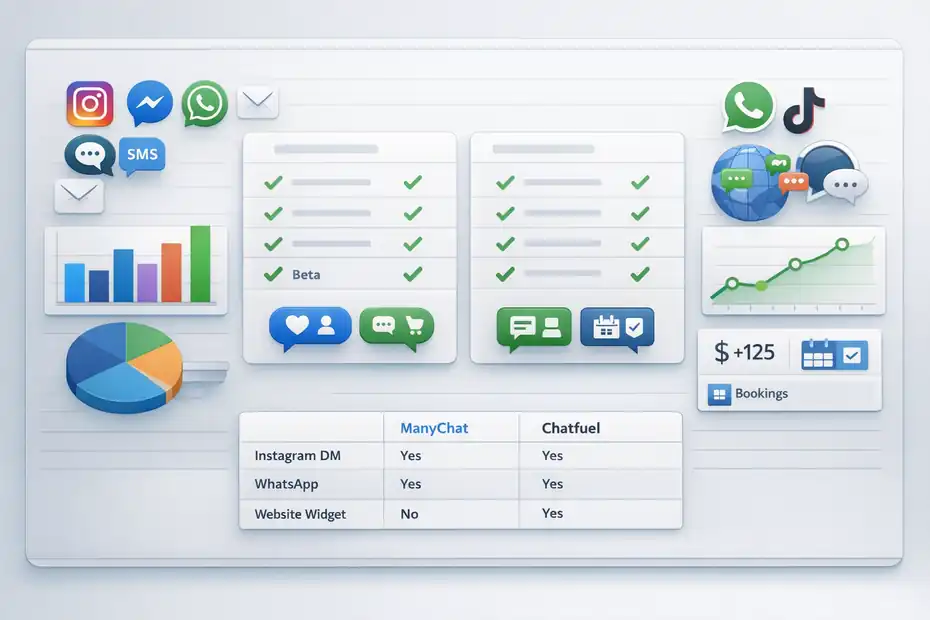
The best automation platform is usually the one that matches where your customers already talk to you. This section is where a lot of “wrong tool” decisions begin or end.
Where ManyChat Has The Broader Marketing Feel
ManyChat’s official materials highlight Instagram Direct Messages, Facebook Messenger, WhatsApp, SMS, email, and TikTok beta, alongside use cases like automated replies, engagement flows, and audience growth.
The platform also emphasizes creators, ecommerce, social media marketers, and agencies as core customer groups.
That matters because channel mix influences workflow design. If your marketing engine starts with Instagram content, Facebook comments, DM keyword triggers, and lead magnets, ManyChat fits naturally into that behavior. You can build journeys that feel like an extension of social content rather than a separate support desk.
A realistic scenario: Imagine you run a course business. Someone comments “guide” on an Instagram post, gets an automated DM, opts in, receives a resource, and then later gets nudged toward a webinar or offer. That is exactly the kind of motion where ManyChat tends to feel intuitive.
I’d also say ManyChat’s brand positioning gives confidence to creators and consumer-facing brands. It feels designed for marketers first, even when it supports service and support use cases too.
Where Chatfuel Feels Stronger For Direct Sales Conversations
Chatfuel officially promotes WhatsApp, Instagram, TikTok, Facebook, and website widgets, with repeated emphasis on automating inquiries, bookings, support, smart follow-ups, and client communication. Its WhatsApp pages especially push business outcomes like repeat sales, personalized promos, and customer journey automation.
That gives Chatfuel a different feel. It is less “grow a social audience through automated engagement” and more “capture inbound demand and manage the conversation without dropping the lead.”
This can be a better fit for:
- Local service businesses
- Sales teams handling inbound leads
- Appointment-based businesses
- WhatsApp-heavy international businesses
- Teams that need messaging tied closely to follow-up and response handling
In my experience, this distinction is more important than flashy feature comparisons. A platform can technically support a channel and still not feel native to the way you sell.
Quick Channel Snapshot
| Area | ManyChat | Chatfuel |
|---|---|---|
| Instagram DM automation | Yes | Yes |
| Facebook Messenger | Yes | Yes |
| Yes | Yes | |
| TikTok | Beta | Yes, promoted in core offering |
| SMS and email | Yes | Not highlighted in main pricing page |
| Website widget | Not emphasized in main positioning | Yes |
This snapshot is based on the current official product and pricing pages from both companies.
Ease Of Use And Setup Experience
Most people do not need “the most powerful” platform. They need the one they can actually launch this week. Setup friction is where momentum lives or dies.
ManyChat Is Usually Easier For Marketing-Led Teams
ManyChat’s messaging consistently stresses getting started quickly, especially for Instagram automation and no-code flow building. Its product pages are built around use cases like auto-DMing followers, collecting leads, and responding to comments without turning setup into a technical project.
That tends to make ManyChat approachable for founders, creators, social media managers, and lean ecommerce teams. The logic often feels visually marketing-friendly: trigger, reply, ask, tag, segment, follow up.
A practical way to judge this: if your team already thinks in campaigns, offers, lead magnets, and DM prompts, ManyChat will probably feel natural faster.
Here is how ManyChat setup often plays out in practice:
- Step 1: Connect your social channel.
- Step 2: Choose or build a starter flow.
- Step 3: Set triggers such as comments, keywords, or entry points.
- Step 4: Add follow-up logic and simple segmentation.
- Step 5: Publish, test, and refine based on reply behavior.
That is not unique technology, but the packaging matters. Some tools reduce intimidation better than others, and ManyChat tends to do that well for growth-focused teams.
Chatfuel Can Feel More Operational And Business-Process Driven
Chatfuel also emphasizes no-code setup and says setup takes minutes for business owners. But the way it frames setup is more operational: automate support, manage bookings, capture inquiries, route conversations, and stay on top of leads.
That can be a strength, not a weakness.
If your mental model is not “build a nurture flow” but “stop missing messages and make sure every lead gets a response,” Chatfuel may actually feel more aligned with your day-to-day work.
I would describe the difference like this:
- ManyChat often feels like building a marketing funnel inside messaging.
- Chatfuel often feels like building a sales or support workflow inside messaging.
Neither is inherently better. It depends on whether your pain point is growth orchestration or operational responsiveness.
For small teams, this matters a lot. I’ve seen businesses buy a tool that was technically capable but psychologically wrong for the team using it. The result was simple: no one opened it after week three.
Automation Depth And Workflow Logic
This is where surface-level comparisons stop being useful. Most tools can send a reply. The real question is how well they handle branching, follow-up, lead qualification, and conversation intent.
ManyChat Works Best When You Want Structured Funnel Logic
ManyChat’s feature language highlights unlimited custom flows on paid plans, audience engagement, automated conversations, comment-triggered messaging, and multi-step journeys.
That makes it especially attractive for brands that want to create guided experiences rather than only reactive support.
Think of use cases like these:
- A creator delivers a free checklist after a keyword DM.
- An ecommerce brand uses comment automation to start a product finder flow.
- A coach qualifies leads through a short question sequence before sending a booking link.
- A brand tags users by interest and sends targeted follow-up messages later.
That style of automation is powerful because it does not just answer questions. It shapes the conversation and moves users toward a next step.
I suggest ManyChat when the business needs intentional conversation design. You are not just trying to reduce manual replies. You are trying to build a repeatable path from attention to action.
Chatfuel Feels Strong When The Goal Is Handling Live Demand Efficiently
Chatfuel’s public positioning focuses on AI agent responses, client chats, bookings, follow-ups, support, and conversion from active inquiries. That makes it appealing for businesses where the most important automation job is handling real incoming conversations quickly and consistently.
A simple example: Imagine you run a medspa or real estate agency. People message at unpredictable times with direct intent: pricing, availability, timing, packages, location, next steps. You need the automation to hold the conversation, answer common questions, collect contact details, and move the person closer to booking or speaking with a human.
That is where Chatfuel’s business-assistant framing can feel valuable.
I would not reduce this to “one is basic, one is advanced.” That is too simplistic. A better way to say it is this:
- ManyChat often shines when the business wants designed journeys.
- Chatfuel often shines when the business wants responsive conversation handling at scale.
That is a meaningful difference in how you architect automation.
Pricing, Cost Structure, And Value For Money
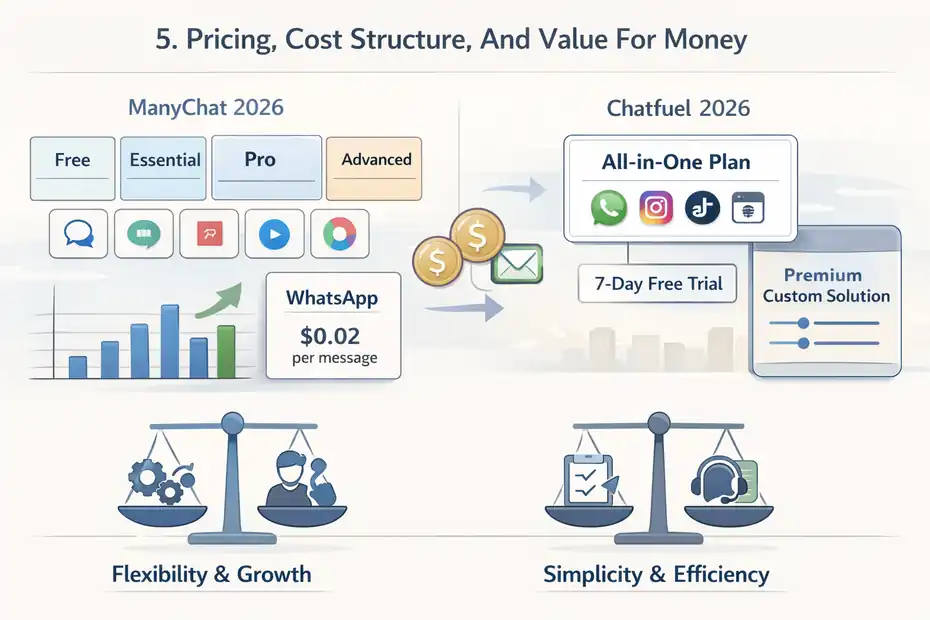
Pricing is where people often compare the monthly number and ignore the cost behavior behind it. That is a mistake.
The cheaper-looking tool is not always the cheaper tool after volume, channels, and team usage kick in.
What ManyChat Pricing Looks Like In 2026
ManyChat’s pricing pages show a free tier plus multiple paid tiers, and its help documentation says the platform now offers five plans: Free, Essential, Pro, Business, and Advanced, with changes introduced on March 2, 2026.
The public pricing pages also indicate plan differences by channel access and features, while the help center notes regional availability can vary.
That tells us a few practical things:
- ManyChat has become more segmented than the old simple free-vs-pro framing.
- Feature access and channel access now matter more when estimating cost.
- You need to check your region and intended use case before assuming a plan fit.
ManyChat also publishes separate WhatsApp pricing guidance with per-message rates, which is important because WhatsApp cost can be a separate budgeting layer beyond the software subscription itself.
This is the kind of detail many comparisons skip. If WhatsApp is a core channel for you, your real cost is not just platform subscription. It is subscription plus messaging economics plus whatever labor you save or revenue you create.
What Chatfuel Pricing Looks Like In 2026
Chatfuel’s official pricing page highlights a 7-day free trial, refund window language, and one main plan pitch that includes all channels such as WhatsApp, Instagram, TikTok, and website widget, along with an AI agent. It also references a Premium custom solution for businesses that need more.
On paper, that simpler pitch can be attractive.
Many buyers prefer clear packaging because it reduces planning friction. Instead of decoding multiple channel tiers, they just want to know whether the platform covers the channels and automation use cases they care about.
That said, “simple” pricing pages do not always mean total cost is simple in real use. You still need to evaluate message volume, WhatsApp economics, escalation needs, and whether advanced workflows will push you into custom arrangements later.
My Honest Pricing Take
I believe ManyChat usually makes more sense when you want flexibility across marketing use cases and can justify spending based on audience growth or campaign outcomes.
Chatfuel often looks cleaner when your business wants a more bundled all-channels story and is less interested in stitching together multiple engagement systems.
A useful way to think about value:
- Choose ManyChat when better campaign automation can increase lead volume or conversion enough to justify plan complexity.
- Choose Chatfuel when simpler packaging and inquiry-handling efficiency matter more than granular marketing flexibility.
Best Use Cases: Who Should Choose Which Tool
This is the part I wish more comparison articles would lead with. Features matter, but fit matters more.
ManyChat Is Usually Better For Creators, Ecommerce, And Social Growth
ManyChat explicitly targets creators, ecommerce brands, social media marketers, and agencies in its positioning, and its strongest public use cases revolve around Instagram growth, comment automation, follower engagement, lead capture, and cross-channel messaging.
That makes it a strong fit for businesses such as:
- Creators selling digital products or memberships
- Ecommerce brands running product education or launch campaigns
- Brands using reels, stories, and comment triggers to capture demand
- Agencies managing social messaging funnels for clients
- Businesses that want email, SMS, and social chat to support one another
Imagine you sell skincare online. A reel gets attention. People comment “routine.” ManyChat sends a DM, asks skin goals, segments the lead, recommends a starter bundle, and offers a discount or educational sequence. That is the kind of buyer journey where ManyChat feels purpose-built.
Chatfuel Is Often Better For WhatsApp-Centric Sales And Service Businesses
Chatfuel’s public messaging makes it especially compelling for businesses focused on WhatsApp automation, booking flows, direct response handling, and follow-up-heavy conversations.
This often includes:
- Clinics and appointment-based businesses
- Local service companies
- Real estate teams
- Education consultancies
- Travel or hospitality businesses
- Sales-led teams using messaging as first contact
A realistic case: Someone clicks a WhatsApp ad asking about pricing. Chatfuel qualifies the lead, answers standard objections, offers available slots, and hands off to a human if needed. That is not glamorous, but it is commercially powerful.
Fast Decision Framework
If you are stuck, use this filter:
- Choose ManyChat if your biggest opportunity is social engagement turned into leads.
- Choose Chatfuel if your biggest opportunity is faster handling of inbound conversations on WhatsApp and similar channels.
- Choose based on your main revenue path, not on a random feature list.
That one rule will save you hours.
Common Mistakes People Make When Comparing Them
This is where I want to cut through the fluff a bit. Most comparison decisions go wrong for very predictable reasons.
Mistake 1: Comparing Features Without Mapping Your Funnel
A platform can have excellent automation features and still be wrong for you. The issue is not capability. The issue is alignment.
I recommend mapping your real customer journey before you compare anything:
- Step 1: Where does the first message usually happen?
- Step 2: What question or action triggers that message?
- Step 3: What should happen next automatically?
- Step 4: When should a human step in?
- Step 5: What counts as a conversion?
Once you have that, the platform choice gets clearer. Without it, you end up overvaluing whatever demo looks smoother.
Mistake 2: Ignoring Channel Economics
This is especially important with WhatsApp. Many businesses budget for software and forget message costs, approval requirements, and operational overhead. ManyChat’s help docs explicitly publish WhatsApp per-message pricing guidance, which is a reminder that messaging channels can carry variable cost, not just flat SaaS cost.
So when evaluating either platform, do not ask only, “What is the monthly subscription?”
Ask:
- How many conversations do we expect?
- Which channels will carry the bulk of traffic?
- Are we optimizing for lead volume, support efficiency, bookings, or direct revenue?
- What manual work will this remove?
That is how you calculate return, not just cost.
Mistake 3: Thinking Automation Means No Human Process
This one gets overlooked all the time. Even the best automation system still needs ownership. Someone has to monitor replies, refine logic, update offers, and watch drop-off points.
From what I’ve seen, the businesses that get the most from ManyChat or Chatfuel treat automation like a live sales asset, not a one-time setup. They review conversations, update branches, test copy, and tighten the handoff between bot and human.
The platform matters, but the operating discipline matters just as much.
How To Choose The Right Platform Step By Step
If you want a practical answer rather than a theoretical one, use this process. It works well because it forces a business decision, not just a software decision.
Step 1: Identify Your Primary Channel
Start with where most buying intent shows up today, not where you hope it will show up later.
- If it is Instagram comments, story replies, and DM triggers, ManyChat usually deserves the first serious look.
- If it is WhatsApp inquiries, bookings, and client messages, Chatfuel often becomes the stronger candidate fast.
This sounds obvious, but people skip it because they want a future-proof tool. I’d rather choose the tool that wins on today’s bottleneck.
Step 2: Define Your Main Conversion Event
What exactly are you trying to produce?
- Lead capture
- Appointment booking
- Product recommendation
- Customer support deflection
- Repeat purchase
- Follow-up after ad clicks
ManyChat often feels stronger when the conversion path includes guided nurture and campaign design. Chatfuel often feels stronger when the conversion path starts with an immediate inquiry and needs fast handling.
Step 3: Estimate Your Workflow Complexity
You do not need a giant automation map on day one. But you do need to know whether your flow is simple or layered.
A simple flow might be: keyword reply, qualification question, booking link, handoff.
A layered flow might be: comment trigger, lead magnet delivery, segmentation, timed follow-up, offer split, retargeting path, and multi-channel continuation.
The more your business benefits from designed journeys, the more ManyChat tends to make sense. The more your business benefits from operational conversation handling, the more Chatfuel tends to make sense.
Step 4: Test Real Scenarios, Not Just Templates
I strongly suggest testing one realistic use case in each platform instead of browsing feature pages for hours.
For example:
- A pricing inquiry
- A booking request
- A product finder flow
- A comment-to-DM lead capture path
The winning platform is often the one that feels easier to maintain after launch, not the one that looks prettier in the sales copy.
Advanced Optimization Tips After You Choose
Choosing the platform is just the start. The real gains come from how you structure conversations and measure outcomes.
Optimization Tactics That Matter On Either Platform
No matter which platform you choose, the same core principles usually drive better results:
- Reduce first-step friction: Ask one easy question first instead of five.
- Segment early: Know whether the person is a buyer, browser, support request, or existing customer.
- Use intent-based replies: Different questions deserve different paths.
- Shorten time to value: Deliver the promised answer, link, offer, or booking option quickly.
- Create a clean human handoff: Let automation do the repetitive part, not the entire relationship.
I’ve seen small changes here improve performance more than switching tools ever did.
A mini scenario: A business asks for name, email, budget, service type, timeline, and location before answering a simple pricing question. Completion drops. They cut it to one qualifying question and one CTA, then let a human handle the rest. Conversion improves because the conversation feels more natural.
Metrics Worth Tracking
A serious manychat vs chatfuel comparison should also include what success looks like after implementation.
Track metrics like:
- Response rate
- Completion rate through the flow
- Lead capture rate
- Booking rate
- Human handoff rate
- Time to first response
- Revenue or qualified leads per 100 conversations
This is where the “best platform” becomes measurable. If one tool helps you build faster but the flow performs worse, that matters. If another tool feels heavier but increases qualified appointments, that matters more.
When To Rebuild Instead Of Tweak
Not every poor result means the platform is wrong. Sometimes the workflow is wrong.
Rebuild when:
- Too many users drop after the first question
- Replies are generic and feel robotic
- Handoffs happen too late
- You are automating edge cases instead of the main intent
- The conversation path does not match how real customers ask things
In my experience, conversation quality beats complexity almost every time.
Final Verdict: Which Wins For Automation?
There is no honest universal winner, but there is a clearer winner depending on what kind of automation you actually need.
ManyChat Wins If Your Growth Starts On Social Engagement
ManyChat is the better choice for many creators, ecommerce brands, marketers, and agencies that want structured social messaging funnels, comment-to-DM automations, lead capture journeys, and broader marketing-oriented channel support including SMS and email.
Its positioning, channel mix, and product design make it especially strong for audience growth and guided conversions.
If your business grows through content, community, launches, DMs, and social engagement, I would lean ManyChat first.
Chatfuel Wins If Your Business Lives Inside Inbound Conversations
Chatfuel is the stronger choice for businesses that depend heavily on WhatsApp, direct inquiries, bookings, service conversations, and fast follow-up.
Its public product story is less about social audience nurturing and more about turning conversations into appointments, customers, and managed client interactions.
If your biggest problem is missed leads, inconsistent responses, or operational messaging overload, I would lean Chatfuel first.
My Bottom-Line Recommendation
If I had to simplify the manychat vs chatfuel comparison into one sentence, it would be this:
ManyChat usually wins for marketing-led automation, while Chatfuel usually wins for WhatsApp-heavy sales and support automation.
That is the cleanest, most useful answer.
For many of us, the smarter choice is not the platform with more hype. It is the one that matches the way customers already start conversations with our business. Pick that, build one revenue-focused workflow first, and optimize from there. That is how automation actually starts paying off.
FAQ
What is the main difference between ManyChat and Chatfuel?
The main difference in a manychat vs chatfuel comparison is their focus. ManyChat is built for marketing automation and social engagement, while Chatfuel is more focused on handling inbound conversations, especially on WhatsApp, for sales, bookings, and customer support.
Which platform is better for Instagram automation?
ManyChat is generally better for Instagram automation because it is designed around social engagement, comment-to-DM flows, and audience growth. It helps businesses turn followers into leads through structured messaging funnels and automated responses tied to content interactions.
Is Chatfuel better for WhatsApp marketing?
Chatfuel is often better for WhatsApp marketing because it focuses heavily on managing conversations, handling inquiries, and automating follow-ups. It works well for businesses that rely on WhatsApp for customer communication, bookings, and direct sales conversations.
Can beginners easily use ManyChat or Chatfuel?
Both platforms are beginner-friendly, but ManyChat often feels easier for marketers and creators due to its visual flow builder. Chatfuel may feel more natural for service-based businesses focused on handling customer inquiries and setting up simple automated responses.
Which is more affordable, ManyChat or Chatfuel?
Pricing depends on your usage and channels. ManyChat offers multiple tiers with flexible features, while Chatfuel provides simpler bundled plans. The better value depends on whether your business needs advanced marketing automation or streamlined conversation handling.

I’m Juxhin, the voice behind The Justifiable.
I’ve spent 6+ years building blogs, managing affiliate campaigns, and testing the messy world of online business. Here, I cut the fluff and share the strategies that actually move the needle — so you can build income that’s sustainable, not speculative.
Related posts:
 Best ManyChat AI Features That Save You Hours
 Top 5 Automated Sales Funnel Hacks for Explosive Growth!
 Best Sales Funnels Builder for Explosive Growth
 Can You Trust the ManyChat Chatbot to Deliver?
 7 Reasons to Try Omnisend Email Marketing Today
 Omnisend Marketing Automation That Actually Increases Revenue