
Table of Contents
Some links on The Justifiable are affiliate links, meaning we may earn a small commission at no extra cost to you. Read full disclaimer.
Later review for ecommerce brands usually comes down to one practical question: will this platform help you generate more revenue, or will it simply make your social calendar look prettier?
If you run an online store, that distinction matters. You do not need another scheduling tool that creates busywork. You need something that helps you publish consistently, turn attention into clicks, and connect social activity to actual store growth.
In this review, I’ll break down where Later fits, where it falls short, and which types of ecommerce brands are most likely to benefit from it.
What Later Is Really Built To Do
Later is a social media management platform centered on planning, scheduling, publishing, and analyzing content across major channels.
Its current positioning goes beyond simple post scheduling: it also emphasizes Link in Bio traffic capture, creator and influencer campaign tools, AI-assisted planning, and cross-channel content management for brands and teams.
Why Ecommerce Brands Even Consider Later
If you sell online, the appeal is obvious. Social media is not just a branding channel anymore. It is part storefront, part discovery engine, part retention layer.
Later tries to sit in the middle of that system by helping you plan content, post at scale, and route traffic from social profiles into product pages or campaign landing pages.
In my experience, that matters most for brands that live on visual platforms. If your store depends on Instagram Reels, TikTok clips, product launches, seasonal promos, or creator content, a visual-first scheduler can save serious time.
That is where Later has built most of its reputation. Third-party review summaries also consistently highlight ease of use, time savings, and strong visual scheduling as standout strengths.
The bigger point is this: Later is not a full ecommerce operating system. It will not replace your storefront, email platform, attribution stack, or product analytics. What it can do is tighten the content workflow that feeds those systems.
For the right brand, that is valuable. For the wrong one, it becomes another dashboard your team barely opens.
The Core Promise Behind The Platform
Later’s promise is simple: help brands publish better social content more consistently, then measure what is working well enough to improve performance over time.
On the product side, that promise shows up through its social scheduler, visual content calendar, analytics, AI support features, and Link in Bio tools.
On the enterprise or campaign side, it also expands into influencer marketing and Shopify-connected creator gifting.
That sounds broad, but the practical use case is narrower. Later is strongest when your team has a steady content engine and needs better organization. Think about a skincare brand posting tutorials, UGC, launch teasers, and seasonal bundles every week.
The challenge is rarely “how do we get on social?” It is “how do we keep this machine running without wasting hours every day?”
That is the problem Later is trying to solve. And if that is your exact problem, the platform starts to look much more useful.
Who Later Is Best For And Who Should Skip It
Not every ecommerce brand needs a platform like Later. Some do. Some absolutely do not. I think this is where most software reviews get too soft.
They talk about features but avoid making a clear judgment about fit.
Best-Fit Ecommerce Brands
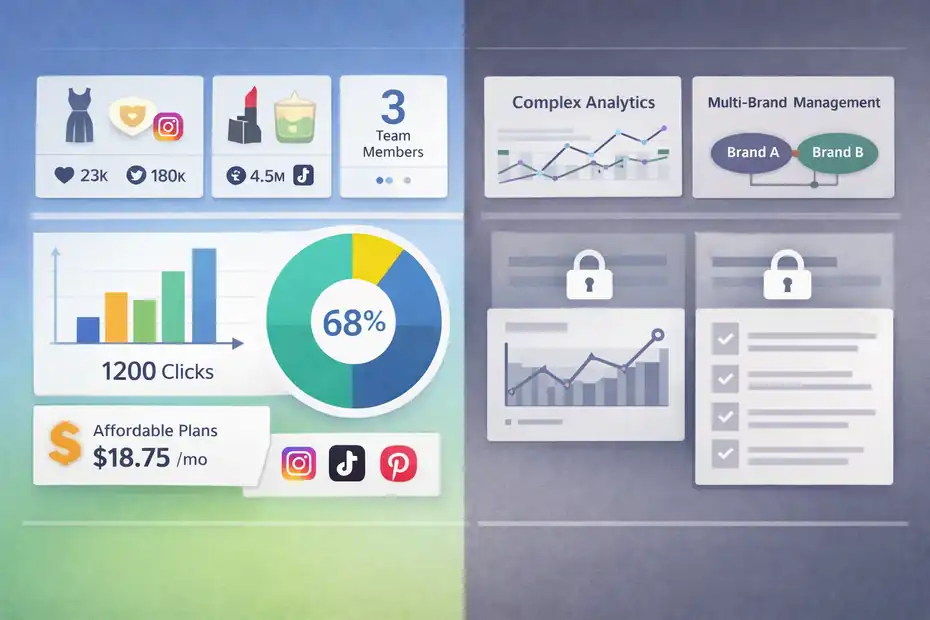
Later looks strongest for small to mid-sized ecommerce teams that need a practical, visual content workflow without jumping straight into heavier enterprise social suites. Its pricing tiers currently start at $18.75 per month billed yearly for Starter, $37.50 for Growth, and $82.50 for Scale, with differences in users, social sets, post limits, and analytics depth.
That pricing structure makes it more approachable for brands that are still being careful with software spend. If you are a founder-led brand, lean DTC team, or in-house marketer juggling several channels, Later is probably easier to justify than a large enterprise stack.
Review summaries on G2 and Capterra also repeatedly point to affordability and usability as major reasons customers stay with it.
The best-fit profile usually looks like this:
- Visual Products: Fashion, beauty, home decor, food, accessories, wellness, and lifestyle stores tend to benefit most.
- Content-Heavy Marketing: Brands posting several times a week across Instagram, TikTok, Pinterest, and Facebook.
- Lean Teams: Businesses that want a cleaner workflow before hiring more people.
- Traffic-Focused Social: Stores trying to turn bio traffic, creator content, and regular posting into site visits and product interest.
If that sounds like your business, Later is worth serious consideration.
Brands That May Outgrow It Quickly
Later is less compelling for brands that need deep attribution, highly advanced reporting, or complex multi-brand governance. G2 review summaries mention recurring concerns around analytics limitations and restrictions around some publishing capabilities, especially for teams with broader operational needs.
I would be cautious if your team needs social reporting to answer board-level questions like: which content theme influenced assisted revenue by region, product category, and cohort over 90 days? That is not really Later’s home turf.
It offers analytics, and the Scale plan includes custom analytics, but it is still fundamentally a social management platform, not a deep commerce intelligence suite.
It can also feel limiting if you manage many brands, many markets, or complicated approval chains. One older but still telling review theme from Capterra is that the platform feels great for simpler setups and less ideal once account complexity grows.
So yes, Later can help ecommerce brands. But it helps specific ecommerce brands far more than others.
The Features That Actually Matter For Sales
A lot of software reviews get lost in feature lists. Let me keep this grounded: ecommerce brands do not care about features in isolation. They care about whether those features help produce traffic, creative output, operational efficiency, and revenue signals.
Scheduling And Content Planning
Later’s strongest and most consistently praised feature set is still scheduling. The platform supports multi-channel planning, visual scheduling, and a content calendar designed to make publishing easier across the networks it supports. Review summaries from G2 repeatedly mention time savings and an intuitive workflow as core strengths.
That matters more than people admit. Consistency is one of the biggest weak spots for ecommerce social teams. A brand usually does not fail on social because it lacks ideas. It fails because ideas stay in Slack threads, draft folders, or someone’s camera roll. Later helps solve that operational mess.
Imagine you run a mid-sized candle brand with one content manager and one founder still approving posts. Without a system, every launch week feels chaotic. With Later, you can map your teasers, UGC clips, reminder posts, and final offer content in one calendar view.
That will not magically increase conversions by itself. But it does reduce the friction that stops good campaigns from shipping.
And honestly, that is often the first win.
Link In Bio And Click-Through Potential
Later’s Link in Bio tool is one of the more relevant ecommerce features because it gives brands a way to convert profile traffic into destination clicks. The platform explicitly positions it as a way to drive traffic and sales from Instagram and TikTok profiles, including connecting posts to specific URLs.
For ecommerce teams, this is practical. Social traffic often leaks because the path from content to product page is messy. If someone lands on your profile after seeing a Reel, you want that next step to feel obvious. A product collection, bundle page, launch page, best-sellers page, or quiz can all work better than sending everyone to a generic homepage.
This is where I think Later earns part of its value. It helps bridge the gap between social attention and storefront intent. That does not mean it replaces dedicated CRO work. It means it removes a common point of drop-off.
A simple example: If your spring campaign includes five hero products, your bio landing page can route visitors directly to each one. That usually beats the classic “link in bio” dead end where shoppers have to hunt for what they just saw.
Analytics And Performance Feedback
Later includes platform analytics on paid plans, with more advanced reporting and custom analytics on higher tiers. Official pricing details show that analytics depth increases as you move up the plan ladder, which is important because entry-level users should not expect full-scale reporting.
The balanced take is this: Later’s analytics are useful for content optimization, but they are not the deepest reason to buy the tool. That lines up with outside review patterns, where users often praise ease of use yet still mention analytics limitations.
For most ecommerce brands, that means Later can answer questions like:
- Which post formats get more reach or clicks?
- Which posting times are working better?
- Which channels deserve more attention?
- Which campaigns are driving more profile and link engagement?
Those are helpful questions. They are just not the entire revenue picture. You will still need your ecommerce analytics stack to understand conversion rate, AOV, assisted revenue, retention, and paid-social overlap.
How Later Supports The Ecommerce Workflow
This is the part I think matters most: not “what features exist,” but “how the tool fits your actual operating rhythm.”
From Product Calendar To Social Calendar
Most ecommerce teams already run on a product or promo calendar. You have launches, discounts, collection drops, seasonal pushes, influencer sends, and content shoots. Later helps translate that business calendar into a publishing calendar.
That sounds basic, but it is not. A lot of teams stay reactive because they do not have a bridge between merchandising and marketing. One team knows the launch date. Another team remembers to post about it two days later. That disconnect quietly kills momentum.
With a planning platform like Later, you can build content around each revenue moment ahead of time.
For example, a 10-day product drop could include early waitlist content, social proof clips, feature demos, creator content, FAQ posts, urgency messaging, and last-chance reminders. When that flow is mapped visually, gaps become obvious.
I suggest thinking of Later as a layer that makes your campaign sequencing visible. It helps you spot when you have four awareness posts and zero conversion-focused posts, or when you are pushing one hero product too hard while ignoring upsell items.
That kind of visibility is not flashy, but it can improve sales discipline.
Supporting Lean Team Collaboration
Later’s pricing tiers scale by both social sets and user count, which makes it easier to tell whether the platform matches your team structure. Starter includes one user, Growth includes two users, and Scale includes four users, with broader profile access as plans increase.
For small ecommerce brands, that is usually enough. One marketer can draft content, another person can review, and the founder or creative lead can step in for approvals without everything happening manually.
This is one reason the product tends to land well with small businesses and lean teams. Later’s own small-business messaging also leans into time-saving automation and reduced operational drag.
Where it gets trickier is when your workflow becomes heavily layered. If you need region-specific approval trees, legal reviews, franchise coordination, or complex brand hierarchies, you may feel the edges of the platform sooner.
But for the average ecommerce brand with a focused team, Later is often “structured enough” without becoming heavy.
Later Pricing And Value For Money
Pricing matters because “worth it” depends on context. A tool can be good and still be the wrong purchase.
Current Plans And What You Get
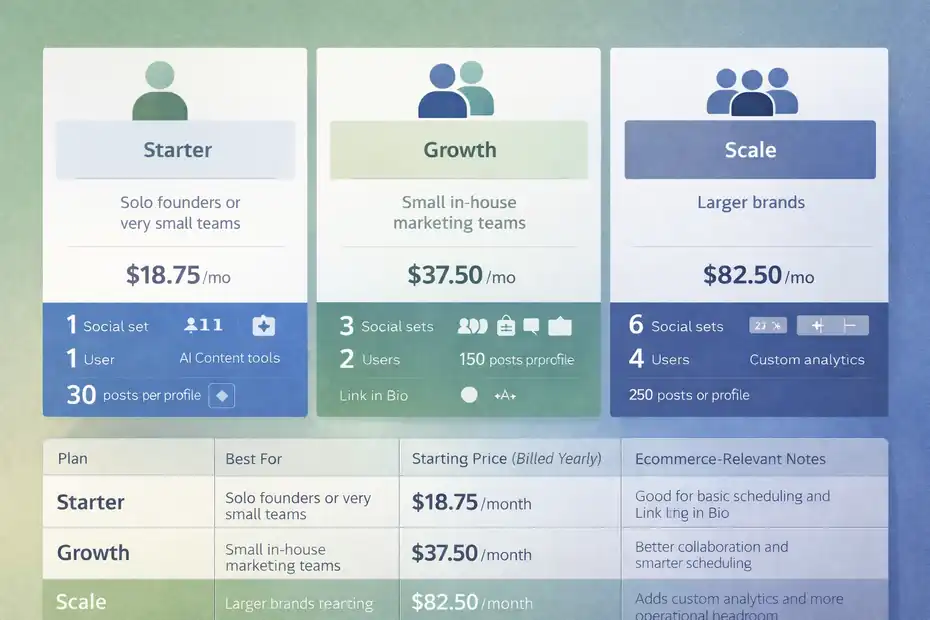
Based on Later’s current pricing page, the main social media management plans are: Starter at $18.75 per month billed yearly, Growth at $37.50, and Scale at $82.50.
Starter includes one social set, one user, up to 30 posts per profile, AI content tools with five monthly credits, limited analytics history, Link in Bio, and basic support.
Growth adds more social sets, more users, and smart scheduling with future trends. Scale expands users, profile capacity, and custom analytics.
Here is the simple comparison:
| Plan | Best For | Starting Price (Billed Yearly) | Ecommerce-Relevant Notes |
|---|---|---|---|
| Starter | Solo founders or very small teams | $18.75/month | Good for basic scheduling and Link in Bio |
| Growth | Small in-house marketing teams | $37.50/month | Better collaboration and smarter scheduling |
| Scale | Larger brands needing stronger reporting | $82.50/month | Adds custom analytics and more operational headroom |
For many ecommerce businesses, that pricing is reasonable. It is low enough to test without panic, but high enough that you should still expect business value in return.
Is It Expensive Or Cheap Compared To The Outcome?
I believe Later is affordable if it replaces scattered manual work. If your team is wasting five to eight hours a week hunting assets, copying captions into native apps, and rebuilding campaign calendars, the software can easily pay for itself in labor alone.
Review feedback on both G2 and Capterra often frames the platform as a time saver with a relatively approachable cost structure.
Where people get disappointed is when they buy Later hoping it will directly “increase sales” on its own. That is the wrong expectation. Later improves the system around your content. It does not manufacture demand, fix weak offers, or compensate for poor creative.
So the real value question is not “will this app make me money tomorrow?” It is “will this app help my team execute a social commerce strategy more consistently and more intelligently?” For many brands, that answer is yes.
Where Later Helps Sales And Where It Does Not
This is the heart of the review. More sales or just more posts? The honest answer is: Later can help create more sales, but only through a few very specific mechanisms.
How Later Can Contribute To Revenue
Later can support sales by improving content consistency, shortening the path from social interest to site visits, and making campaign execution more repeatable. Its scheduler, Link in Bio feature, and analytics together create a system that helps brands publish regularly, route traffic more cleanly, and learn from results over time.
That matters because most ecommerce social growth comes from repetition and iteration, not one viral post. If your team can produce 20 percent more quality content with fewer bottlenecks, that is meaningful. If you can connect top-performing posts to cleaner landing paths, that is meaningful too.
A simple scenario: Imagine a supplements brand running a three-week campaign around a new bundle. Later helps plan awareness content, testimonials, founder videos, and urgency posts in sequence. The brand uses Link in Bio to send traffic directly to the bundle page, not the homepage. After two weeks, analytics show that testimonial-style content gets more clicks than polished product-only graphics. The team shifts creative accordingly.
That is how the platform contributes to sales: indirectly, but usefully.
Where It Stops Helping
Later does not solve merchandising, offer strategy, creative quality, landing page conversion, or customer retention. It also does not replace more robust revenue attribution tools. If your content is weak or your products are not compelling, scheduling them more efficiently will not suddenly fix the problem.
This is why some teams end up disappointed. They assume consistency equals performance. It does not. Consistency is only useful when the message, product, and destination page are strong enough to convert.
I would frame it this way: Later can increase the odds that good marketing gets executed well. It cannot rescue bad marketing.
That distinction is the entire review in one sentence.
Influencer And Creator Use Cases For Ecommerce Brands
This is one area where Later becomes more interesting than a basic social scheduler.
The company also has a dedicated influencer marketing side, and that matters for ecommerce brands that rely on creator-led growth.
Shopify Integration For Creator Gifting
Later offers a Shopify integration within its influencer marketing tools that supports creator product sharing and gifting workflows. Official materials describe connecting a Shopify store directly to Later’s influencer campaign process so brands can automate parts of gifting, creator product selection, and campaign tracking.
For ecommerce brands running seeding campaigns, that is a real operational advantage. Creator gifting sounds simple until you have to manage addresses, product preferences, tracking, inventory coordination, and follow-up communication across dozens of creators.
If Later reduces even part of that manual work, the value can be significant. Especially for beauty, fashion, food, and lifestyle brands where product seeding is a constant part of customer acquisition.
This is also one of the clearer examples of “more sales, not just more posts.” Creator content tied to the right products can influence both discovery and conversion. The catch is that this benefit sits more on Later’s influencer side than its basic scheduler side.
When The Creator Layer Makes Later More Compelling
If your ecommerce brand is already investing in creators, Later becomes easier to justify because it can connect more of your social workflow under one roof. The platform positions itself around campaign intelligence, creator partnerships, and measurable outcomes, not just posting tools.
That said, I would not buy Later only for influencer ambitions unless you are specifically evaluating that product line. But if your team already needs scheduling and Link in Bio, the added creator infrastructure can make the ecosystem more attractive.
For brands that are mostly organic and not creator-led, this part may matter less.
Common Weaknesses And Frustrations
A real review should talk about the rough edges. Later definitely has some.
Analytics Ceiling And Advanced Reporting Limits
The most consistent third-party criticism appears to be around analytics depth and certain feature limitations. G2 summaries mention users appreciating scheduling and usability while still flagging issues with analytics and some publishing capabilities. Capterra reviews echo similar themes, with several users wanting more precise reporting.
For ecommerce operators, this matters because social reporting is often where “nice tool” turns into “not enough for us.” If you need stronger attribution, more granular segmentation, or a clearer connection between content and store revenue, you may outgrow Later’s native reporting faster than you expect.
I do not think this is a deal-breaker for every brand. It depends on your maturity. For earlier-stage teams, content-level analytics are often enough. For more advanced teams, they are usually not.
Complexity Creep As The Team Grows
Another pain point is scale. Capterra’s review mix suggests that simpler teams tend to have a smoother experience than users managing lots of accounts or more complex operations.
This is common with social tools. What feels clean at 4 profiles and 2 users can feel tight at 28 profiles, multiple stakeholders, and layered approvals. If your brand is expanding fast, it is worth thinking ahead. A cheap tool you replace in nine months is not always cheaper than buying more infrastructure earlier.
That does not make Later bad. It just means you should buy it for the stage you are in, not the stage you imagine five years from now.
How To Decide If Later Is Worth It For Your Brand
You do not need a dramatic yes-or-no framework here. You need a practical one.
A Simple Decision Filter
Later is probably worth testing if these statements are true for your business:
- You post often enough that manual scheduling feels annoying.
- Your products are visual enough to benefit from Instagram, TikTok, or Pinterest workflows.
- Your team is lean and needs organization more than enterprise complexity.
- You want stronger click paths from social content into landing pages or product pages.
- You can judge success clearly through saved time, increased publishing consistency, and better traffic flow.
It is probably not the right priority if:
- You barely publish now and do not yet have a reliable content engine.
- You need advanced attribution more than scheduling support.
- Your social strategy is weak and you are hoping software will invent one for you.
- Your team is already enterprise-level and needs much deeper governance and reporting.
I recommend being brutally honest about this. A tool should remove friction from a working system. It should not be expected to become the system.
My Final Verdict
For most ecommerce brands, Later is not “just more posts,” but it can become that if you use it lazily.
Used well, it is a strong workflow tool for visual commerce brands that need better content planning, easier publishing, cleaner bio traffic routing, and enough analytics to improve execution. Its current pricing is accessible, its usability is consistently praised, and its creator-commerce angle gives it more depth than a bare-bones scheduler.
Used poorly, it becomes a neat calendar that helps you publish content nobody buys from.
So here is my honest answer to the title question: Later can help ecommerce brands drive more sales, but only because it makes good social commerce operations easier to run. It is not a revenue shortcut. It is an execution tool. And for the right brand, that is exactly enough.
FAQ
What is Later and how does it help ecommerce brands?
Later is a social media scheduling platform that helps ecommerce brands plan, publish, and track content across multiple channels. It improves consistency, saves time, and supports traffic generation through features like Link in Bio, making it easier to turn social engagement into website visits and potential sales.
Is Later good for increasing ecommerce sales?
Later can support ecommerce sales by improving content consistency and directing traffic through optimized bio links. However, it does not directly increase revenue on its own. Sales depend on product quality, offer strength, and conversion optimization, while Later helps execute social strategies more efficiently.
How does Later compare to other social media tools for ecommerce?
Later stands out for its visual content calendar and ease of use, making it ideal for ecommerce brands focused on Instagram and TikTok. However, it offers less advanced analytics compared to some competitors, so it works best for brands prioritizing workflow and content execution over deep data analysis.
Who should use Later for ecommerce marketing?
Later is best suited for small to mid-sized ecommerce brands with visual products and consistent posting needs. It works well for teams that want a simple, organized way to manage content and drive traffic without investing in complex or expensive enterprise-level social media platforms.
Does Later include analytics for ecommerce performance tracking?
Later includes built-in analytics that help track post performance, engagement, and link clicks. While useful for content optimization, it does not provide full ecommerce attribution or revenue tracking, so brands still need additional tools to measure conversions and overall sales performance accurately.

I’m Juxhin, the voice behind The Justifiable.
I’ve spent 6+ years building blogs, managing affiliate campaigns, and testing the messy world of online business. Here, I cut the fluff and share the strategies that actually move the needle — so you can build income that’s sustainable, not speculative.
Related posts:
 Honest Later Review For Instagram Marketing: Real Growth Or Hype?
 Sprout Social Competitors You Didn’t Know Existed
 Later Review For Small Business: Can It Actually Save You Time?
 ManyChat Instagram Tutorial: Automate Replies Fast
 Sprout Social Media Tools You’ll Actually Use
 Omnisend Automation: How to Scale Your Store on Autopilot