Table of Contents
Some links on The Justifiable are affiliate links, meaning we may earn a small commission at no extra cost to you. Read full disclaimer.
Serpstat all in one SEO platform review is really a question about value: can one tool handle keyword research, audits, rank tracking, backlink analysis, and competitor research without making your workflow feel cramped? That is exactly what I looked at here.
Serpstat positions itself as an all-in-one SEO and search marketing platform with keyword research, competitor analysis, site audit, rank tracking, backlink analysis, clustering, and more, and its pricing starts well below many premium SEO suites.
What Serpstat Is And Who It Is Best For
Serpstat is built for people who want one platform to cover the daily SEO essentials without paying enterprise-level prices.
The big question is not whether it has enough features on paper, but whether those features are practical enough for your real workflow.
What Serpstat Tries To Cover
Serpstat is not a single-purpose keyword tool. It is positioned as a broader search marketing suite that includes keyword research, competitor analysis, rank tracking, site audit, backlink analysis, batch analysis, keyword clustering, and some AI-related workflows.
The company also says the platform is trusted by 1.1 million plus users and highlights 600-plus reviews on its site, which at least suggests it has moved well beyond the “small niche tool” stage.
From what I’ve seen, that matters because many SEOs do not actually need the absolute deepest tool in every category. They need one place where they can research keywords, spot competitor gaps, run technical checks, monitor rankings, and produce reports without bouncing between five subscriptions. That is the lane Serpstat is trying to own.
If you are a freelancer, in-house marketer, small agency, affiliate site builder, or content-led business, that positioning makes sense.
If you are a very large enterprise team that depends on massive custom datasets, highly specialized link intelligence, or heavy data warehousing, you may outgrow it faster.
The Best-Fit User Profiles
I believe Serpstat is strongest for three groups.
- Freelancers And Solo Consultants: The entry plan includes core features like keyword research, site analysis, rank tracking, site audit, and backlink analysis at $50 per month, with 5 projects, 100 searches per day, and 10,000 top-100 position checks.
- Growing SEO Teams: The Team plan adds unlimited projects, API access, scheduled reports, share access, AI tools, and higher limits, which is where the platform starts feeling more operational than experimental.
- Agencies That Need Breadth Over Prestige: The Agency tier adds white-label reports, more seats, and much larger limits, which can matter more than having the most talked-about brand in the SEO space.
Imagine you run SEO for 12 client sites and need ranking reports, a technical audit routine, and keyword discovery every week. In that situation, Serpstat is easier to justify than a more expensive stack that gives you marginal gains you may not fully use.
How The Platform Works In Daily SEO Use

A good all-in-one tool should reduce friction, not just add menus. This is where Serpstat’s real value shows up or breaks down.
The Core Workflow Inside The Platform
The cleanest way to use Serpstat is to treat it like a loop.
You start with keyword research to find target terms, related phrases, difficulty, CPC, and competitor clues. Then you move into competitor analysis to identify pages and domains already winning traffic.
After that, site audit and page-level recommendations help you fix obvious technical or on-page issues, while rank tracking shows whether your changes actually move positions over time.
Serpstat’s feature pages explicitly connect those workflows by grouping keywords, comparing domains, auditing pages, and tracking rankings inside the same ecosystem.
That sounds simple, but it matters. A lot of SEO tools feel powerful only when you already know exactly what you want. Serpstat feels more like a working desk for routine SEO operations. I would not call it perfect, but I would call it usable.
One recent product update also stands out: in March 2026, Serpstat added automatic import of historical rankings from other SEO tools into its rank tracking workflow.
In plain English, that makes migration less painful if you are switching platforms and do not want to lose trend history.
Where It Feels Smooth And Where It Feels Average
The smoother parts are the everyday tasks. Keyword discovery, domain-level comparisons, visibility checks, and standard rank monitoring fit the platform well. If your work mostly involves publishing content, tracking priority terms, and reviewing competitors, you can get moving quickly.
Where it can feel more average is depth. This is a common tradeoff in all-in-one tools. A platform can be broad and still not be the deepest specialist in every module.
For example, backlink analysis may be good enough for most campaigns without being the first thing a dedicated link-building team would choose for forensic-level work.
Serpstat does emphasize a backlink database with 1.7 trillion links and 170 million domains, plus coverage across 249 countries, which is meaningful scale, but scale alone does not guarantee that every advanced user will prefer it over a premium specialist workflow.
That is why I see Serpstat less as “the best at every individual SEO task” and more as “one of the more practical value picks if you want broad coverage in one login.”
Keyword Research, Competitor Analysis, And Content Planning
This is the area where many buyers start. If the research side is weak, the rest of the platform becomes harder to trust.
Keyword Research Capabilities
Serpstat’s keyword research module covers the basics you would expect: keyword ideas, similar keywords, suggestions, difficulty, search volume, CPC, PPC competition, and the ability to analyze competitors through keyword results.
It also supports clustering and text analysis, which is useful when you want to turn a messy keyword list into an actual site structure or content brief.
For a content team, that is enough to answer the main planning questions:
- What topics are worth targeting?
- How difficult do they look?
- Which related terms belong on the same page?
- Which competitor pages are already owning that search intent?
In my experience, the real advantage is not “finding more keywords than everybody else.” It is moving faster from keyword discovery to page planning.
If you run a small e-commerce shop selling coffee gear, for example, you can map “best burr grinder,” “manual burr grinder,” “espresso grinder,” and “grinder under $100” into separate content or category opportunities instead of stuffing them into one weak article.
That is where clustering earns its place. It helps you avoid the classic beginner mistake of targeting ten near-identical phrases with ten thin pages.
Competitor Research And Opportunity Discovery
Serpstat’s competitor analysis features are built around identifying SEO and PPC competitors, finding their high-performing keywords, spotting popular pages, and comparing domain-level visibility, traffic, and rankings.
That matters because better SEO often comes from better pattern recognition, not just more content. When you compare your site to two or three real SERP competitors, you usually notice one of these gaps:
- They cover more subtopics than you do.
- They have stronger internal linking around a topic cluster.
- They rank with pages you do not even have yet.
- They dominate a group of lower-difficulty keywords you have ignored.
I suggest using Serpstat here as a planning tool, not just a spying tool. Look for repeatable patterns: page type, subtopic coverage, title angles, and keyword grouping logic. That is much more valuable than copying a competitor’s keywords into a spreadsheet and calling it strategy.
A practical scenario: If you run a SaaS blog and discover a competitor gets traffic from integration pages, comparison pages, and use-case pages rather than just educational posts, that is not a small insight. That can reshape your whole editorial calendar.
Site Audit, Rank Tracking, And Backlink Analysis
This is where an all-in-one platform proves whether it can support ongoing SEO, not just research at the start.
Site Audit And Technical SEO Monitoring
Serpstat includes site audit across all major plans, with the Individual plan allowing 30,000 pages to audit and the Team plan increasing that to 150,000. JavaScript rendering appears from the Team tier upward, which is important if your site relies heavily on scripts to load content.
That is a practical split. A smaller brochure site or blog may never care about JavaScript rendering. A larger modern website absolutely might.
I would use Serpstat’s audit more as an issue-prioritization system than a vanity score checker. The goal is not to stare at percentages. The goal is to find what blocks crawling, indexing, internal link flow, page performance, canonical control, and content accessibility.
For many of us, technical SEO gets overwhelming because tools dump hundreds of warnings with no sense of business priority. The smartest way to use an audit platform is this:
- Fix crawl and index issues first.
- Fix duplicate and canonical issues second.
- Improve internal linking and orphaned pages next.
- Clean up performance or lower-priority notices after that.
If you handle it in that order, Serpstat becomes useful even if you are not a hardcore technical SEO.
Rank Tracking And Backlink Workflows
Rank tracking is available across the plans, with daily updates and support for desktop and mobile rankings. The monthly top-100 position checks range from 10,000 on Individual to 500,000 on Agency.
Serpstat also supports project migration from another service, and its recent update around automatic history imports helps preserve ranking context during a switch.
This is a strong part of the product for agencies and consultants because clients rarely care about abstract SEO theory. They care about movement. They want to know whether the target terms are climbing, flattening, or slipping.
Backlink analysis is more nuanced. Serpstat’s separate data site says its backlink database contains 1.7 trillion links, 170 million domains, and two years of historical data, with coverage across 249 countries.
Those numbers are meaningful, but here is my honest take: backlink tools are judged less by raw index size and more by whether they help you make better decisions.
Can you identify toxic-looking patterns, lost links, strong referring domains, and competitor link sources quickly? For everyday SEO, Serpstat can do that job.
For extremely link-heavy campaigns, some advanced teams may still want a second specialized perspective.
Pricing, Plans, And Overall Value
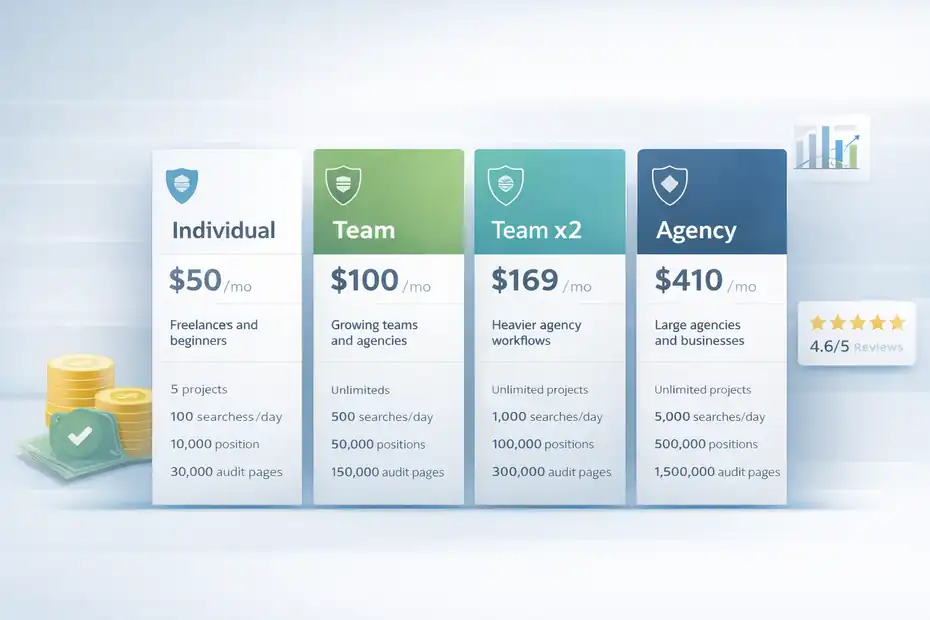
Price is one of the main reasons people consider Serpstat in the first place. The platform is clearly trying to compete on “enough power for less money.”
Serpstat Pricing Breakdown
Here is the current official plan structure at a glance.
| Plan | Monthly Price | Best For | Key Limits |
|---|---|---|---|
| Individual | $50 | Freelancers and beginners | 5 projects, 100 searches/day, 10,000 position checks, 30,000 audit pages |
| Team | $100 | Growing teams and agencies | Unlimited projects, 500 searches/day, 50,000 position checks, 150,000 audit pages |
| Team x2 | $169 | Heavier agency workflows | Unlimited projects, 1,000 searches/day, 100,000 position checks, 300,000 audit pages |
| Agency | $410 | Large agencies and businesses | Unlimited projects, 5,000 searches/day, 500,000 position checks, 1,500,000 audit pages |
The Team plan is probably the first truly operational tier for serious SEO work because it adds API, share access, AI tools, batch analysis, and scheduled reports. The Individual plan is good, but it feels more like a capable solo toolkit than a shared system.
Is The Value Actually Good?
I think the value proposition is real, but only if you match the plan to your workflow.
If you only need occasional keyword checks and one small site audit every few months, even $50 a month can feel wasted. But if you are tracking several client sites, exporting data, reviewing technical issues weekly, and building content calendars from competitor gaps, Serpstat starts looking efficient very quickly.
G2 currently shows Serpstat at 4.6 out of 5 stars across 463 verified reviews, which supports the idea that a lot of users see it as strong value rather than a cheap compromise.
Still, there is a subtle point here. “Affordable” is not the same as “best.” The better question is this: does it remove enough friction from your SEO process to pay for itself? For many freelancers, small teams, and agencies, I think the answer is yes.
Strengths, Weaknesses, And Common Frustrations
No review is useful if it sounds like product marketing. Serpstat does some things very well, and it also has tradeoffs you should know before buying.
What Serpstat Does Well
The biggest strength is breadth at a reasonable price. Serpstat covers keyword research, site audits, rank tracking, competitor analysis, backlink analysis, clustering, batch analysis, reporting, and API access on upper tiers. That reduces the need for separate point solutions in a lot of normal SEO workflows.
I also think the platform benefits from being structured around actual SEO tasks instead of abstract dashboards. You can move from research to tracking to auditing without feeling like you switched products.
A few strengths stand out most:
- Good Coverage For Day-To-Day SEO: It handles planning, auditing, and monitoring in one place.
- Strong Mid-Market Value: The Team plan looks especially practical for agencies and in-house teams.
- Useful Workflow Additions: Scheduled reports, API access, project sharing, and migration support make it more than a hobby tool.
- Solid Market Validation: The platform cites 1.1M+ users, while G2 shows a 4.6 rating from hundreds of verified reviews.
If you are tired of paying premium prices just to use 30% of a platform’s features, this part of Serpstat will probably appeal to you.
Where The Tradeoffs Show Up
The tradeoff is depth versus value. All-in-one platforms almost always make you choose between “broad enough for everything” and “best available in each individual category.” Serpstat leans toward broad enough.
That can show up in a few ways. A power user may want more from certain datasets, more refined competitive views, or more advanced link intelligence depending on the niche
A very large team may also hit workflow expectations that go beyond what a mid-market platform is designed to handle.
Another issue is expectation mismatch. Some buyers sign up hoping an affordable tool will perform identically to the most expensive leaders in every module.
That is usually not realistic. Serpstat is better judged as a smart-value SEO operating platform than as a “category killer” in every feature.
My advice is simple: Buy it for integrated workflow and cost-efficiency, not because you expect every screen to outperform specialist tools.
Final Verdict And Whether Serpstat Is Worth It
A review should end with a decision, not a shrug. Here is mine.
Who Should Buy It
I recommend Serpstat if you want an SEO platform that covers the full working cycle: research, competitor analysis, technical audits, rank monitoring, and backlink review, without demanding a premium-software budget.
Its official pricing starts at $50 per month, and the Team tier adds the collaboration and reporting features that make it especially useful for active SEO operations.
This is a particularly good fit if you are:
- Running SEO for a small or mid-sized business
- Managing several client accounts
- Building topical content clusters regularly
- Needing audits and rank tracking in the same platform
- Trying to reduce tool sprawl
If that sounds like you, Serpstat is not just “good enough.” It is often the more rational purchase.
Who Should Probably Look Elsewhere
I would be more cautious if your workflow depends on ultra-deep enterprise data operations, very specialized link analysis, or advanced research needs where you already know you prefer a top-tier niche tool in one category.
That does not mean Serpstat is weak. It means the best tool depends on the shape of your SEO work. A 3-person agency and a global enterprise SEO team are solving very different problems.
My final take is this: Serpstat all in one SEO platform review comes out positively because the product seems to understand what many buyers actually need in 2026. They do not need endless complexity. They need one platform that helps them research smarter, fix the right issues, track progress clearly, and justify SEO work without overspending. On that standard, Serpstat is a strong option.
Quick Pros And Cons
| Pros | Cons |
|---|---|
| Broad all-in-one SEO feature set | Not necessarily the deepest specialist in every module |
| Entry pricing is accessible | Some advanced users may want more data depth |
| Team plan adds real operational value | Best experience depends on choosing the right plan limits |
| Useful for freelancers, SMBs, and agencies | Enterprise-scale users may still prefer heavier specialist stacks |
| Rank tracking, audits, and research work well together | Backlink workflows may be enough for most users, but not every power user |
Bottom Line
If you want my simple opinion, Serpstat is worth serious consideration when budget, workflow efficiency, and feature breadth all matter at the same time.
It is not trying to win by being the loudest SEO brand. It is trying to be the tool you can actually keep using every week without regretting the bill.
For a lot of businesses, that is a very smart place to compete.
FAQ
What is Serpstat and how does it work?
Serpstat is an all-in-one SEO platform that helps you research keywords, analyze competitors, track rankings, audit websites, and monitor backlinks. It works by collecting search data and presenting insights so you can improve your website’s visibility and performance in search engines step by step.
Is Serpstat good for beginners in SEO?
Yes, Serpstat is beginner-friendly because it combines multiple SEO tools into one platform with a simple interface. It allows new users to perform keyword research, track rankings, and run site audits without needing advanced technical knowledge, making it a practical starting point.
How much does Serpstat cost?
Serpstat pricing starts at around $50 per month for the Individual plan, which includes core SEO features like keyword research, rank tracking, and site audits. Higher plans offer more data limits, team access, and advanced tools, making it scalable for growing businesses and agencies.
How does Serpstat compare to other SEO tools?
Serpstat stands out for offering a wide range of SEO features at a lower price compared to many competitors. While it may not be the deepest tool in every category, it provides enough functionality for most users who want an efficient all-in-one SEO workflow.
Is Serpstat worth it for small businesses?
Serpstat is worth it for small businesses that need an affordable SEO solution covering research, tracking, and optimization. It helps streamline workflows, reduce tool costs, and improve search visibility without requiring multiple subscriptions, making it a strong value option for limited budgets.

I’m Juxhin, the voice behind The Justifiable.
I’ve spent 6+ years building blogs, managing affiliate campaigns, and testing the messy world of online business. Here, I cut the fluff and share the strategies that actually move the needle — so you can build income that’s sustainable, not speculative.