
Table of Contents
Some links on The Justifiable are affiliate links, meaning we may earn a small commission at no extra cost to you. Read full disclaimer.
Apollo IO worth it for startups is a fair question, because early-stage teams cannot afford tools that look useful but fail to create pipeline. When cash is tight, every subscription has to earn its place.
Apollo.io can be valuable because it combines prospecting data, outreach automation, enrichment, and sales workflow tools in one platform, but it is not automatically the right choice for every startup.
In this guide, I’ll break down the real ROI, hidden costs, setup process, mistakes, and optimization steps so you can decide with a clear head instead of guessing.
Understand What Apollo.io Actually Does For A Startup
Apollo.io is not just a contact database. It is a sales intelligence and engagement platform, which means it helps you find potential buyers, understand their companies, contact them, and manage outreach from one place.
What Apollo.io Is In Simple Terms
At its simplest, Apollo.io helps you answer one question: Who should we contact, and how do we reach them efficiently?
For a startup, that matters because the hardest part of early growth is often not closing customers. It is finding enough of the right conversations. You might have a strong product, a good offer, and a founder who can sell, but without a repeatable way to find prospects, revenue feels random.
Apollo.io combines several functions that startups often buy separately. You can search for companies, filter decision-makers, view contact details, build outbound sequences, track replies, and enrich records.
Apollo describes itself as an AI sales platform for building pipeline, with outbound, inbound, data enrichment, and deal execution features under one roof. It also says over 600,000 companies use the platform.
The startup appeal is obvious. Instead of stitching together a contact database, email sequencing tool, CRM enrichment product, and manual spreadsheet workflow, you can start with one system. That does not mean it replaces everything forever, but it can reduce early complexity.
In my experience, Apollo.io is strongest when a startup already knows its target customer reasonably well. If you know the industries, company sizes, job titles, pain points, and buying triggers you want to target, Apollo becomes a growth engine.
If you are still guessing your market, Apollo can help you test, but it will not magically fix unclear positioning.
How Apollo.io Fits Into A Startup Sales Stack
Think of Apollo.io as the front end of your sales motion. Your CRM stores relationships and deal history. Apollo helps you fill the top of the funnel with targeted prospects and outreach activity.
A basic startup sales stack might look like this:
| Need | What It Means | Where Apollo.io Can Help |
|---|---|---|
| Prospecting | Finding companies and contacts that match your ideal customer | Contact and account search |
| Data Enrichment | Filling missing emails, job titles, company details, and other fields | Enrichment and sync workflows |
| Outreach | Sending emails, creating sequences, and following up | Sales engagement features |
| Calling | Logging calls and reaching prospects by phone | Dialer and call workflow features |
| Reporting | Tracking reply rates, booked meetings, and pipeline impact | Outreach analytics and dashboards |
Apollo’s sales engagement page highlights contact and account search, lead scoring, inbound optimization, sales engagement, meetings, deal management, call recording, analytics, coaching, workflow automation, and enrichment as part of its broader product ecosystem.
For a startup, this matters because you usually do not have a full revenue operations team. You need systems that are simple enough for a founder or first sales hire to operate. Apollo can work well when you keep the workflow lean: Find accounts, verify fit, write relevant outreach, track responses, and push qualified conversations into your CRM.
Where I see startups go wrong is treating Apollo like a magic list machine. They pull thousands of contacts, send generic messages, and then blame the tool when replies are weak. The real value comes from using Apollo as a targeting and workflow system, not just a big database.
When Apollo.io Is Most Useful
Apollo.io is most useful when your startup sells to other businesses and needs outbound sales, account-based prospecting, or structured lead generation. It is especially relevant for B2B SaaS, agencies, recruiting firms, consulting companies, financial services, software vendors, and professional service teams.
Imagine you sell cybersecurity training to companies with 50 to 500 employees. Without a platform like Apollo, you might search manually, copy names into a spreadsheet, guess emails, and send one-off messages.
That gets messy fast. With Apollo, you can build a search around industry, employee count, location, job title, and company attributes, then create a cleaner prospecting workflow.
Apollo becomes less useful if your startup depends mostly on consumer marketing, marketplace supply acquisition, local walk-in traffic, or app-store discovery. It can still support partnerships or B2B channels, but it may not be the main growth driver.
I suggest thinking about Apollo through a simple filter: Do you need to identify and contact specific business decision-makers at scale? If yes, Apollo deserves serious consideration. If no, your money may be better spent on content, paid acquisition, product-led growth, or community building.
Calculate The Real ROI Before You Buy
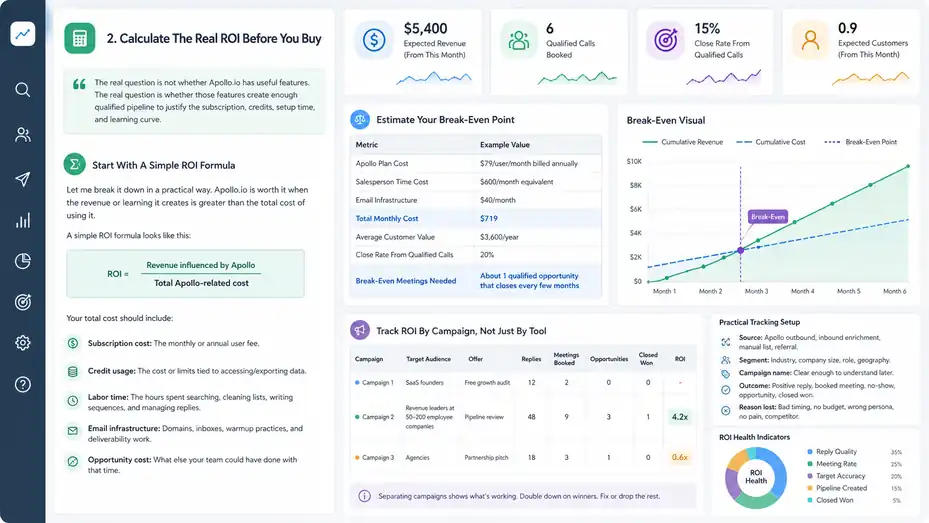
The real question is not whether Apollo.io has useful features.
The real question is whether those features create enough qualified pipeline to justify the subscription, credits, setup time, and learning curve.
Start With A Simple ROI Formula
Let me break it down in a practical way. Apollo.io is worth it when the revenue or learning it creates is greater than the total cost of using it.
A simple ROI formula looks like this: ROI = Revenue influenced by Apollo ÷ Total Apollo-related cost
Your total cost should include:
- Subscription cost: The monthly or annual user fee.
- Credit usage: The cost or limits tied to accessing/exporting data.
- Labor time: The hours spent searching, cleaning lists, writing sequences, and managing replies.
- Email infrastructure: Domains, inboxes, warmup practices, and deliverability work.
- Opportunity cost: What else your team could have done with that time.
For example, say your startup pays $79 per user per month annually for a plan, spends 15 hours per month managing outbound, and books 6 qualified calls.
If one customer is worth $6,000 annually and your close rate from qualified calls is 15%, those 6 calls may create 0.9 customers on average. That is $5,400 in expected annual revenue from that month’s activity.
Of course, sales cycles are not that neat. Some deals close later, some ghost you, and some leads were already in motion. But this kind of math stops you from judging Apollo by vanity metrics like exported contacts or email opens.
In my opinion, the key startup metric is not “How many leads did we get?” It is “How many qualified sales conversations did we create at a cost we can repeat?”
Estimate Your Break-Even Point
Your break-even point tells you how many customers or meetings Apollo needs to help generate before it pays for itself.
Let’s use a hypothetical startup selling a B2B SaaS product at $300 per month. That is $3,600 annual contract value. If the startup’s gross margin is high, one closed customer can easily cover several months of Apollo usage.
Here’s a simple scenario:
| Metric | Example Value |
|---|---|
| Apollo Plan Cost | $79/user/month billed annually |
| Salesperson Time Cost | $600/month equivalent |
| Email Infrastructure | $40/month |
| Total Monthly Cost | $719 |
| Average Customer Value | $3,600/year |
| Close Rate From Qualified Calls | 20% |
| Break-Even Meetings Needed | About 1 qualified opportunity that closes every few months |
This is why Apollo can be attractive for startups with meaningful B2B contract values. You do not need hundreds of customers to justify it. You need a repeatable path from targeted contact to qualified conversation to closed deal.
But the math changes quickly for low-ticket products. If your product is $19 per month and you rely on high-volume self-serve signups, Apollo may be too expensive as a primary acquisition channel. You might still use it for partnerships or high-value accounts, but not broad outbound.
I recommend calculating break-even before upgrading. It forces you to define what success means. For many startups, the first 30 days should not be judged by closed revenue alone. It should be judged by reply quality, meeting rate, target-account accuracy, and whether your message is landing.
Track ROI By Campaign, Not Just By Tool
One mistake I see often is judging Apollo.io as one big expense instead of measuring each campaign separately.
For example, a startup might run three outbound campaigns:
| Campaign | Target Audience | Offer | Result |
|---|---|---|---|
| Campaign 1 | SaaS founders | Free growth audit | Low replies |
| Campaign 2 | Revenue leaders at 50–200 employee companies | Pipeline review | Strong replies |
| Campaign 3 | Agencies | Partnership pitch | Moderate replies |
If you only look at total Apollo cost, you may think the tool is average. But when you separate campaigns, you might find that Campaign 2 is profitable and Campaign 1 is a positioning problem.
This matters because Apollo gives you access to many segments. That flexibility is powerful, but it can also hide bad strategy. You need to tag campaigns, track replies, and connect meetings to pipeline stages.
A practical tracking setup could include:
- Source: Apollo outbound, inbound enrichment, manual list, referral.
- Segment: Industry, company size, role, geography.
- Campaign name: Clear enough to understand later.
- Outcome: Positive reply, booked meeting, no-show, opportunity, closed won.
- Reason lost: Bad timing, no budget, wrong persona, no pain, competitor.
From what I’ve seen, the startups that get ROI from Apollo treat it like an experiment engine. They test narrow segments, learn quickly, and double down on what produces real sales conversations.
Review Apollo.io Pricing And Cost Drivers
Apollo.io pricing can look simple at first, but startups should pay attention to credits, plan limits, billing terms, exports, integrations, and the cost of additional workflow needs.
Understand The Main Pricing Structure
Apollo.io offers a free starting option and paid plans. Its pricing page says users can sign up for free, upgrade or downgrade, and purchase additional credits when needed. It also explains that export credits are consumed when contacts are exported outside Apollo, such as through CSV, CRM sync, or API enrichment.
Third-party pricing summaries in 2026 commonly list Apollo’s annual paid tiers around Basic at $49 per user per month, Professional at $79 per user per month, and Organization at $119 per user per month, with monthly billing usually costing more.
Because SaaS pricing changes, I would always verify the current pricing page before purchase, especially if you are budgeting for multiple seats.
The practical point is this: The subscription price is only one part of your cost. The plan you choose affects credits, features, integrations, automation access, and team workflows.
For an early startup, I would usually avoid buying more than you can use in the first month. Start with the smallest plan that lets you validate the motion. If you cannot generate replies with a focused test, a larger plan will not solve the core issue.
That said, the free plan can be useful for testing search quality, understanding filters, and building your first small list. It may not be enough for serious outbound, but it can help you decide whether your target market exists clearly inside Apollo before you commit.
Watch The Credit System Closely
Credits are where many startups underestimate cost. A credit system controls how much data you can reveal, export, enrich, or use depending on the action.
Apollo’s pricing page explains that export credits are used when exporting contact data outside Apollo, including CSV, CRM, Person API enrichment, or syncing data to another system. It also says additional credits can be purchased inside the account.
This means your cost depends on how you work. If you keep most prospecting and engagement inside Apollo, you may use credits differently than a team exporting every contact into a CRM or separate outreach tool. If your workflow requires constant enrichment or bulk exports, credit usage can become a real budget item.
Here’s a simple way to manage credits:
- Define your weekly prospecting limit: For example, 200 new contacts per week.
- Prioritize high-fit accounts first: Do not spend credits on weak matches.
- Export only when necessary: Keep early research inside Apollo when possible.
- Review credit burn weekly: Treat credits like ad spend, not free inventory.
- Remove bad-fit contacts before export: Clean the list before you pay to move data.
I suggest creating a “credit approval rule” for your team. For example, nobody exports contacts unless the company matches your ideal customer profile and the person matches one of your approved buyer roles. It sounds small, but it prevents messy, expensive list building.
Compare Apollo.io Against Buying Separate Tools
A fair ROI breakdown has to compare Apollo against alternatives. Not just direct competitors, but the messy stack a startup might build without it.
| Function | Separate Tool Category | Startup Challenge | Apollo.io Benefit |
|---|---|---|---|
| Contact Data | B2B database | Data quality varies and can be expensive | Centralized prospecting database |
| Email Sequences | Outreach software | Another subscription and integration | Built-in sequencing workflows |
| Enrichment | Data enrichment tool | Extra cost and setup | Built-in enrichment options |
| Dialing | Calling software | Separate call logging and workflows | Dialer and call features on certain plans |
| Analytics | Reporting tool or CRM reports | Hard to connect activity to outcomes | Native outreach analytics |
Apollo says email campaigns are included on every account, although non-paying plans only connect Gmail accounts, while paid plans can connect Microsoft Office or other providers. It also says Apollo integrates with platforms like Salesforce, HubSpot, Outreach, SalesLoft, Marketo, SendGrid, LinkedIn, and email providers.
This is where Apollo often makes sense for startups: It can reduce tool sprawl. You may not get the most advanced version of every feature, but you get enough in one place to move faster.
However, if your startup already has a mature outbound stack, Apollo may be more valuable as a data source than as the full engagement layer. In that case, your ROI depends on data quality, enrichment, and integration fit rather than all-in-one convenience.
Decide Whether Your Startup Is Ready For Apollo.io
Apollo.io works best when your startup has enough clarity to target the right buyers.
If your positioning is still fuzzy, you may need to sharpen your ideal customer profile before expecting strong outbound results.
Build Your Ideal Customer Profile First
Your ideal customer profile, or ICP, is the type of company most likely to buy, succeed, and stay with your product. It is not just “small businesses” or “SaaS companies.” It should be specific enough to guide search filters.
A useful ICP includes:
- Industry: The market or vertical you serve.
- Company size: Employee count or revenue range.
- Geography: Countries, regions, or local markets.
- Trigger events: Hiring, funding, new leadership, expansion, compliance pressure.
- Pain points: The costly problem your product solves.
- Buyer roles: The job titles involved in purchase decisions.
Let’s say you sell onboarding software for remote teams. A weak ICP would be “HR teams.” A stronger ICP would be “US-based SaaS companies with 50–300 employees, remote or hybrid teams, hiring at least 5 roles per month, where the Head of People owns onboarding quality.”
That level of detail makes Apollo useful. You can search smarter, write more relevant messaging, and avoid wasting credits on contacts who look good on paper but have no reason to care.
I believe startups should write the ICP before touching any prospecting tool. Otherwise, the database controls your strategy. You see lots of contacts and start chasing quantity. That feels productive, but it often creates low-quality outbound.
Validate Buyer Roles Before Scaling
In early-stage sales, you may not know the true buyer yet. The person who replies may not be the person who signs. The person with the pain may not own the budget. Apollo can help you test this, but you need to design the test intentionally.
For example, if you sell analytics software, you might test three roles:
| Role | Likely Pain | Possible Objection |
|---|---|---|
| Head Of Growth | Needs better campaign visibility | May not own data infrastructure |
| VP Sales | Wants pipeline insights | May see it as a reporting issue |
| RevOps Manager | Owns systems and reporting | May need executive approval |
Instead of blasting all three with the same message, create separate positioning. The Head of Growth cares about campaign decisions. The VP Sales cares about forecast confidence. RevOps cares about clean workflows and fewer manual reports.
Apollo helps because you can segment by title and company attributes. But the real startup skill is learning which role responds with urgency. If RevOps replies politely but never moves, while VP Sales books calls quickly, that tells you something valuable.
I recommend running small tests of 50 to 100 contacts per persona before scaling. Keep the message simple, track reply quality, and note the objections. Your goal is not just meetings. Your goal is market learning that improves the next campaign.
Know When Apollo.io Is Too Early
Apollo.io may be too early if you do not yet know who you sell to, what pain you solve, or why buyers should act now.
Here are signs you should pause before upgrading:
- Your homepage still changes every week because the offer is unclear.
- You cannot describe your best-fit customer in one sentence.
- You have no proof, case study, demo, or specific outcome to show.
- Your product requires heavy explanation before anyone understands it.
- You are trying five unrelated markets at once.
This does not mean you should avoid Apollo forever. It means you should use it lightly for research and validation rather than full-scale outbound.
A founder-led startup can use the free or lowest plan to study account lists, identify common job titles, inspect company patterns, and manually test outreach. That is often enough at the beginning.
In most cases, Apollo becomes more worth it after you have a basic sales hypothesis: “We help [specific buyer] at [specific company type] achieve [specific result] without [specific pain].” Once you have that, Apollo gives you a practical way to test and scale the hypothesis.
Set Up Apollo.io For Your First ROI Test
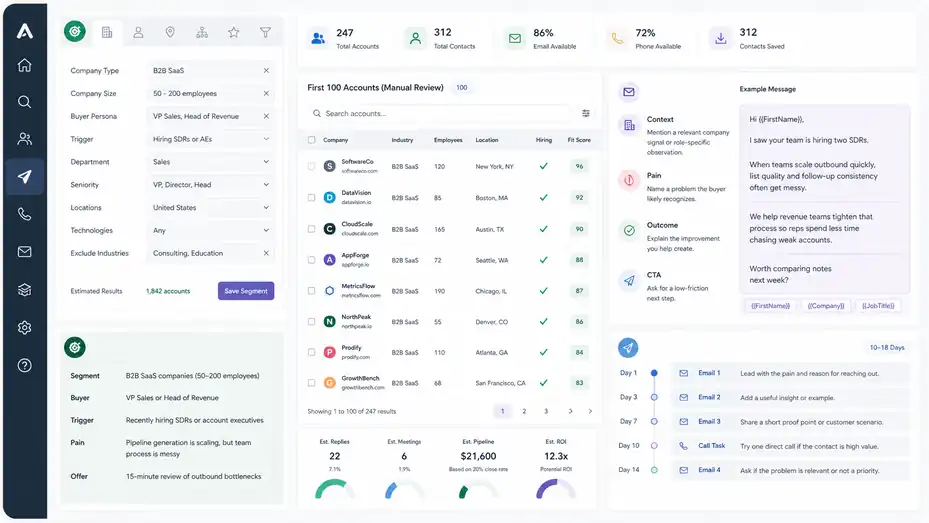
Your first Apollo.io setup should be simple. Do not try to build a huge outbound machine on day one.
Build a clean test that proves whether the platform can help create qualified conversations.
Create A Small, Focused Prospecting Segment
Start with one narrow market segment. This is where many startups struggle because broad targeting feels safer. It is not. Broad targeting usually produces vague messaging and weak replies.
A focused segment might look like this:
- Segment: B2B SaaS companies with 50–200 employees.
- Buyer: VP Sales or Head of Revenue.
- Trigger: Recently hiring SDRs or account executives.
- Pain: Pipeline generation is scaling, but team process is messy.
- Offer: A 15-minute review of outbound bottlenecks.
That is much stronger than “sales leaders at software companies.”
Inside Apollo, your search should match this logic. Use filters to narrow by company size, industry, geography, department, seniority, and job title. Then manually scan the first batch of accounts. Do the companies actually look like real buyers? Are job titles relevant? Are there obvious bad fits?
I advise founders to review the first 100 contacts manually. It feels slow, but it saves time later. You will quickly notice title variations, industries that do not fit, or company types that should be excluded.
Your first test should be small enough to inspect but large enough to learn from. For many startups, 100 to 300 contacts is enough for an initial signal.
Write Outreach Around Pain, Not Features
The biggest Apollo mistake is using strong data with weak messaging. The platform can help you find people, but it cannot make a generic pitch feel relevant.
A good startup outbound message should answer four questions quickly:
- Why this person?
- Why now?
- What problem are you pointing at?
- What is the easy next step?
Avoid leading with your product category. Instead of saying, “We built an AI-powered revenue intelligence platform,” say something closer to, “I noticed your team is hiring SDRs, and many teams at that stage struggle to keep prospecting quality consistent.”
That kind of message connects to a real situation.
Here’s a simple structure:
- Context: Mention a relevant company signal or role-specific observation.
- Pain: Name a problem the buyer likely recognizes.
- Outcome: Explain the improvement you help create.
- CTA: Ask for a low-friction next step.
Example: “I saw your team is hiring two SDRs. When teams scale outbound quickly, list quality and follow-up consistency often get messy. We help revenue teams tighten that process so reps spend less time chasing weak accounts. Worth comparing notes next week?”
It is not flashy. That is the point. Clear beats clever in outbound.
Build A Sequence Without Over-Automating
A sequence is a planned set of follow-up steps. It might include email, call tasks, LinkedIn touches, or reminders. Apollo’s sales engagement tools support multi-touch workflows, and its sales engagement page describes platforms like this as systems for planning, automating, tracking, and optimizing outbound communications across channels.
For your first startup test, keep the sequence modest. You do not need 12 steps and a dramatic breakup email. You need a professional follow-up rhythm that respects the buyer.
A simple first sequence could be:
- Email 1: Lead with the pain and reason for reaching out.
- Email 2: Add a useful insight or example.
- Email 3: Share a short proof point or customer-style scenario.
- Call task: Try one direct call if the contact is high value.
- Email 4: Ask whether the problem is relevant or not a priority.
Space the touches over 10 to 18 days. That gives people time to respond without feeling chased.
I recommend writing each step with a different purpose. Do not send the same message four times with “just following up” at the top. Each touch should add context, reduce uncertainty, or make the decision easier.
For a startup, your goal is not to sound like a big corporate sales team. Your advantage is relevance, speed, and honesty. Use that.
Measure The Metrics That Actually Matter
Apollo.io can show activity metrics, but startups need to focus on metrics that connect to revenue learning. Opens and clicks are useful signals, but they are not proof of ROI.
Track Reply Quality, Not Just Reply Rate
Reply rate matters, but reply quality matters more. A 12% reply rate with mostly “not interested” responses may be weaker than a 5% reply rate with several serious buying conversations.
Classify replies into simple categories:
| Reply Type | Meaning | What To Do |
|---|---|---|
| Positive | Interested, asks for details, or agrees to talk | Book quickly |
| Referral | Sends you to another person | Follow up with context |
| Timing | Interested but not now | Create a nurture reminder |
| Objection | Raises price, fit, priority, or trust concern | Tag the objection |
| Negative | Clear no | Remove respectfully |
| Neutral | Vague or unclear | Ask one simple question |
This is where Apollo can become a learning system. Every reply tells you something about your market. If many people say “We already use something,” you may need competitor positioning. If many say “Not a priority,” your pain may not be urgent enough. If they refer you to another title, you may be targeting the wrong role.
In my experience, the best early outbound teams read replies like customer research. They do not just celebrate meetings. They study language, objections, timing, and buyer assumptions.
A practical benchmark for a cold outbound test is not universal, but many startups should look for signs like positive replies, relevant objections, and at least a few booked meetings from a tightly targeted list. If you get silence across multiple segments, the issue may be targeting, offer clarity, deliverability, or message quality.
Measure Cost Per Qualified Meeting
Cost per qualified meeting is one of the clearest Apollo ROI metrics for startups.
The formula is: Cost per qualified meeting = Total campaign cost ÷ Number of qualified meetings booked
Include subscription cost, credit cost, and time cost. If you spend $800 in total monthly campaign cost and book 8 qualified meetings, your cost per qualified meeting is $100.
Then compare that against your business model. If your average customer is worth $10,000 per year and you close 20% of qualified meetings, a $100 meeting cost may be excellent. If your product is worth $500 per year, it may be too high.
Here is a simple example:
| Metric | Scenario A | Scenario B |
|---|---|---|
| Monthly Apollo-Related Cost | $800 | $800 |
| Qualified Meetings | 4 | 12 |
| Cost Per Qualified Meeting | $200 | $67 |
| Close Rate | 25% | 15% |
| Average Annual Revenue Per Customer | $5,000 | $2,000 |
| Expected Revenue | $5,000 | $3,600 |
Scenario A has fewer meetings but better economics because the deal value and close rate are stronger. This is why you cannot judge outbound by volume alone.
I suggest setting a target cost per qualified meeting before you launch. It gives your team a clear decision rule. If Apollo helps you beat that number, keep optimizing. If not, diagnose before scaling.
Connect Apollo Activity To Pipeline
The biggest ROI blind spot is failing to connect Apollo activity to pipeline. You need to know which campaigns create opportunities, not just replies.
A clean pipeline tracking process should include:
- Campaign source: The exact Apollo sequence or segment.
- Meeting outcome: Qualified, unqualified, no-show, rescheduled.
- Opportunity value: Estimated deal size.
- Stage movement: Discovery, demo, proposal, negotiation, closed.
- Close reason: Why the deal won or lost.
Apollo’s own site states that it offers dashboards for tracking metrics such as open rates, response rates, and pipeline growth, helping teams refine outreach with data-driven insights.
For startups, I would keep reporting simple at first. You do not need a giant dashboard. You need a weekly view of contacts added, emails sent, positive replies, booked meetings, qualified opportunities, and estimated pipeline.
A useful founder question is: “Which segment would I confidently spend more time on next week?” If the data cannot answer that, your tracking is not specific enough.
Avoid The Common Startup Mistakes With Apollo.io
Apollo.io can create leverage, but it can also create a false sense of progress. The most common mistakes are not technical. They are strategic.
Mistake 1: Exporting Too Many Contacts Too Early
It feels exciting to see thousands of potential contacts. That excitement can become expensive and messy if you export before filtering.
The better approach is to build from a small, high-confidence list. Review accounts manually. Remove bad-fit industries. Check whether titles match actual buying power. Look for company signals that support your message.
For example, if you sell hiring software, a company with open roles is more relevant than a company that merely matches your industry filter. If you sell compliance support, regulatory pressure or recent expansion may matter more than headcount alone.
Exporting too many contacts also creates operational clutter. Your CRM fills with weak records. Your team follows up with people who were never likely buyers. Your deliverability may suffer if your outreach quality drops.
I recommend using a “tight list first” rule: Build 100 excellent prospects before building 1,000 average ones. A small list with clear relevance will teach you more than a giant list built on hope.
Mistake 2: Treating Automation Like A Shortcut Around Relevance
Automation helps you follow up consistently. It does not replace relevance.
Apollo’s sequencing features can save time, but if the message is bland, automation simply helps you send bland messages faster. That is not growth. That is scaled noise.
A good cold email should feel like it belongs in the recipient’s inbox. It should reference their role, company situation, or likely business problem. You do not need fake personalization like “Loved your recent post” if you did not actually read it. You need honest relevance.
A better approach is segment-level personalization. Instead of customizing every sentence manually, create messages for specific groups. For example:
- CFOs at bootstrapped SaaS companies: Focus on efficient growth and cost control.
- Sales leaders at funded startups: Focus on pipeline consistency and rep ramp.
- Operations leaders at agencies: Focus on delivery bottlenecks and client visibility.
This keeps outreach scalable without becoming robotic.
In my opinion, early-stage startups should not automate until they can write one good manual email that gets replies. Once the message works manually, automation helps you repeat it.
Mistake 3: Ignoring Deliverability
Deliverability means whether your emails actually reach the inbox. If your messages land in spam, your targeting and copy barely matter.
Apollo can help manage outreach workflows, but you still need healthy email practices. Use a professional domain setup, avoid sudden sending spikes, keep messages plain and human, and monitor bounce rates.
Simple deliverability habits include:
- Use a dedicated outbound domain: Protect your main company domain.
- Authenticate email properly: Set up SPF, DKIM, and DMARC.
- Start with low volume: Increase gradually instead of blasting.
- Avoid spammy wording: Skip hype, fake urgency, and heavy formatting.
- Clean lists before sending: Bad data creates bounces and hurts reputation.
For startups, deliverability is especially important because your brand is new. You do not have much trust yet. A sloppy outbound setup can damage domain reputation and make future campaigns harder.
It is worth treating deliverability like infrastructure, not an afterthought. Before you blame Apollo, check whether your emails are reaching inboxes, whether bounce rates are acceptable, and whether your sending volume looks natural.
Optimize Apollo.io For Better Startup ROI
Once your first campaign produces signals, the next step is optimization.
This is where Apollo becomes more valuable because you can improve targeting, messaging, timing, and follow-up based on actual data.
Improve Targeting With Exclusions
Most people think prospecting is about finding who to include. Strong targeting is also about knowing who to exclude.
Exclusions help you avoid wasting credits and sending irrelevant outreach. For example, you may exclude companies that are too small, too large, outside your service area, in low-fit industries, or already using a competitor you cannot displace.
A startup selling premium onboarding software might exclude:
- Companies under 30 employees because they lack process complexity.
- Companies over 1,000 employees because sales cycles are too long.
- Industries with low remote hiring needs.
- Job titles below manager level.
- Students, consultants, or freelancers if they are not buyers.
This kind of filtering improves every downstream metric. Fewer bad-fit contacts means better reply quality, better sales calls, cleaner CRM data, and less wasted founder time.
I suggest reviewing your negative replies weekly. They often reveal exclusion rules. If five people say, “We are too small for this,” adjust company size. If three say, “This is handled by corporate,” maybe enterprise subsidiaries are a bad fit. If many say, “We do not have this problem,” your trigger signal may be weak.
Optimization is not glamorous, but it is where ROI improves.
Use Buying Triggers To Create Better Timing
A buying trigger is an event or signal that makes a prospect more likely to care now. Apollo is more powerful when you use it to find timely accounts, not just static lists.
Common B2B buying triggers include:
- Hiring: A team is growing and needs process support.
- Funding: A company has capital and growth pressure.
- Leadership change: New executives may review tools and vendors.
- Expansion: New markets create operational needs.
- Technology change: A company adopts or replaces related software.
- Compliance pressure: New rules create urgency.
A generic message says, “We help companies improve sales productivity.” A trigger-based message says, “I noticed your team is hiring SDRs, which is usually when outbound process starts getting harder to manage.”
The second message feels more relevant because it explains why you are reaching out now.
For many startups, trigger-based outbound produces better conversations than broad persona-based outbound. It also feels more respectful. You are not interrupting random people. You are connecting your offer to a visible business moment.
I recommend building campaigns around one trigger at a time. That makes results easier to understand. If hiring-trigger campaigns outperform funding-trigger campaigns, you have a clear path for your next test.
Refine Sequences Using Reply Patterns
Your first sequence is a draft. The market edits it for you.
Read every reply. Look for repeated words, objections, and questions. If prospects keep asking, “How is this different from our CRM?” your message needs clearer positioning.
If they ask, “Do you work with companies our size?” your targeting or proof needs adjustment. If they say, “Circle back next quarter,” you may have a timing issue rather than a fit issue.
A useful weekly optimization routine:
- Review positive replies: Identify which subject lines, openings, or pain points created interest.
- Review objections: Group them by price, timing, authority, trust, or need.
- Review silence: Check whether the segment was too broad or the CTA too demanding.
- Adjust one variable: Change the target, message, offer, or sequence length, not everything at once.
- Relaunch a small test: Validate before scaling.
I like changing one major variable per test because it keeps the learning clean. If you change the segment, subject line, offer, CTA, and follow-up timing all at once, you will not know what caused the improvement.
Apollo can support faster testing, but your judgment still matters. The tool gives you activity. You create insight.
Compare Apollo.io Plans For Startup Use Cases
Choosing the right Apollo.io plan depends on your stage, team size, sales motion, and need for credits, integrations, analytics, and automation. Do not buy based on feature excitement alone.
Use The Free Plan For Validation
The free plan is useful when you are exploring whether Apollo has enough of your target market and whether the workflow feels right.
Use it to answer:
- Are my target companies easy to find?
- Are the buyer titles available?
- Do the filters match how I define my ICP?
- Does the platform feel usable for my team?
- Can I build a small list without friction?
Apollo says users can start free, and its pricing page mentions a free Starter option after trial or downgrade.
For a solo founder, the free plan can be enough to learn the interface and validate your first search logic. But I would not expect it to support a serious outbound engine long-term. The limits will usually push you into a paid plan if outbound becomes a core channel.
The free plan is best for research, not scale.
Choose A Paid Plan Based On Workflow Needs
A paid plan starts making sense when you have a clear ICP, a tested message, and a weekly outbound process. The question becomes which features you actually need.
| Startup Situation | Likely Plan Logic | Why |
|---|---|---|
| Solo founder testing outbound | Lowest paid tier or free first | Keep risk low while validating |
| Founder plus first SDR | Mid-tier plan may make sense | More sequencing and workflow needs |
| Sales team with CRM sync | Higher plan may be needed | Integrations and admin controls matter |
| Multi-rep outbound team | Organization-level evaluation | Reporting, permissions, and scale become important |
| Heavy enrichment workflow | Review credit costs carefully | Credits may drive true cost |
Apollo’s pricing page notes that integrations include Salesforce, HubSpot, Outreach, SalesLoft, Marketo, SendGrid, LinkedIn, and email providers, with API access available on Custom plans.
I would choose the plan that removes your current bottleneck, not the one with the most impressive feature list. If your bottleneck is finding accurate contacts, prioritize data and credits. If your bottleneck is follow-up consistency, prioritize sequences. If your bottleneck is team visibility, prioritize reporting and CRM integration.
Startups often overbuy because they imagine the team they want to become. Buy for the next 60 to 90 days, then upgrade when usage proves it.
Know When To Pair Apollo.io With Other Tools
Apollo can cover a lot, but it does not mean you should force every workflow into it.
You may still need separate tools for CRM management, advanced deliverability monitoring, website analytics, product analytics, or customer success. Apollo’s value is strongest around prospecting, enrichment, and engagement.
A practical early-stage setup might be:
| Function | Tool Type | Purpose |
|---|---|---|
| CRM | Lightweight CRM | Track deals and customer history |
| Apollo.io | Sales intelligence and engagement | Find prospects and run outreach |
| Email Provider | Business email | Send and receive outreach |
| Analytics | Website/product analytics | Measure conversion after interest |
| Calendar | Scheduling tool | Book meetings easily |
The key is avoiding unnecessary complexity. Every extra tool creates setup, cost, and maintenance. Apollo’s all-in-one nature can reduce this burden, especially before you hire sales operations.
In my experience, a startup should add tools only when a clear pain appears. Do not build an enterprise stack before you have enterprise problems.
Troubleshoot Low Results From Apollo.io
If Apollo.io is not producing results, do not cancel immediately and do not scale immediately.
Diagnose the bottleneck carefully. Usually, the issue is one of four things: Targeting, message, deliverability, or sales follow-up.
If You Get No Replies
No replies usually means one of three problems: Your emails are not reaching inboxes, your targeting is wrong, or your message is too easy to ignore.
Start with deliverability. Check bounce rates, sending volume, domain setup, and whether emails appear in spam. Then inspect your list. Are these real buyers? Do they have the pain you describe? Are you contacting the right seniority level?
Next, review your opening line. Many cold emails fail in the first two sentences. If your email begins with a long introduction about your company, rewrite it around the buyer’s situation.
A stronger first line might connect to a trigger, role, or pain.
For example: “Many RevOps teams I speak with hit reporting friction when the sales team grows past 20 reps.” That is more useful than “I’m the founder of a platform that helps businesses optimize revenue operations.”
Also check your CTA. Asking for 30 minutes may be too much for a cold prospect. Try a softer question like, “Is this something your team is working on this quarter?” It reduces pressure and invites a reply.
If You Get Replies But Few Meetings
Replies without meetings often mean your message creates curiosity but not urgency.
This can happen when your offer is too vague. “Improve efficiency” is not enough. Improve what? By how much? For whom? In what situation?
Try tightening the value proposition. Instead of “We help sales teams save time,” say, “We help SDR managers reduce manual list cleanup before campaigns.” Specific problems feel more real.
You may also need better proof. A startup does not always have big case studies, but you can still use credible evidence:
- A short customer result.
- A before-and-after workflow example.
- A common benchmark from your own tests.
- A clear explanation of how the process works.
- A low-risk audit or diagnostic offer.
If prospects reply with interest but stall, your next step may be too heavy. Offer a specific reason to meet. For example: “I can show you the three list-quality issues we usually find in teams hiring SDRs.” That feels more tangible than “Would you like a demo?”
If Meetings Do Not Convert
If Apollo generates meetings but they do not convert, the problem is probably not Apollo. It is qualification, sales process, offer-market fit, or expectation setting.
Look at meeting quality. Are prospects actually in your ICP? Do they have budget? Do they own the problem? Did your outreach promise something different from what your product delivers?
A common startup mistake is booking meetings with anyone who replies positively. That feels good, but it wastes time. Add simple qualification questions before or during the call:
- What made this relevant right now?
- How are you solving this today?
- What happens if you do nothing?
- Who else cares about this problem?
- Is there a timeline for fixing it?
If people enjoy the conversation but do not buy, your pain may not be urgent enough. If they see the pain but cannot get approval, you may be too low in the organization. If they want the outcome but resist price, your value story may need work.
Apollo can help fill the calendar. Your sales process has to turn the right meetings into revenue.
Scale Apollo.io Once ROI Is Proven
Scaling Apollo.io is not about sending more messages immediately. It is about turning a working campaign into a repeatable system without losing quality.
Create Repeatable Campaign Playbooks
A campaign playbook documents what works so you can repeat it. This is especially important when you hire your first SDR or hand off outbound from founder to sales.
A simple playbook should include:
- Target segment: The exact ICP filters and exclusions.
- Buyer roles: Primary and secondary contacts.
- Trigger signals: Events that make outreach timely.
- Messaging angle: The pain and outcome used.
- Sequence structure: Number of steps and timing.
- Qualification rules: What counts as a good meeting.
- Objection handling: Common replies and suggested responses.
- Performance benchmarks: Expected reply rate, meeting rate, and conversion.
This prevents your outbound motion from living only in the founder’s head.
For example, if your best campaign targets operations leaders at agencies with 20 to 100 employees, document the exact company attributes, job titles, subject lines, and proof points. Then your next team member can execute without reinventing everything.
In my opinion, a startup is ready to scale Apollo when one campaign works twice. One win can be luck. Two similar wins suggest a pattern.
Expand Segments Carefully
Once one segment works, expand to adjacent segments. Do not jump randomly.
If your best segment is VP Sales at B2B SaaS companies with 50–200 employees, your next test might be:
- Same role, larger companies.
- Same company type, different revenue leader title.
- Same pain, different industry.
- Same trigger, adjacent buyer.
This keeps learning connected. You are not starting from zero each time.
Use a controlled expansion table:
| Current Winning Segment | Adjacent Test | Risk |
|---|---|---|
| VP Sales at 50–200 employee SaaS companies | CROs at 200–500 employee SaaS companies | Longer sales cycle |
| HR leaders at remote-first startups | People Ops managers at hybrid companies | Less urgent pain |
| Agency owners | Operations directors at larger agencies | Different authority level |
Scaling should feel like widening a proven path, not wandering into a new forest.
Apollo makes expansion easy because there are many filters and contacts. That ease is both a benefit and a danger. Keep your expansion disciplined.
Build A Weekly Revenue Review
To keep Apollo ROI healthy, review performance weekly. Do not wait until the end of the quarter to discover your campaigns were creating weak pipeline.
A useful weekly review includes:
- Segment performance: Which audience produced the best conversations?
- Message performance: Which angle got positive replies?
- Meeting quality: Were calls with real buyers or curious non-buyers?
- Pipeline created: How much qualified opportunity value came from Apollo?
- Bottlenecks: Was the issue data, copy, deliverability, follow-up, or close rate?
Keep the meeting short and honest. The goal is not to defend the tool. The goal is to improve the system.
Apollo.io is worth it only as long as it helps create learning, pipeline, or revenue at a cost that makes sense. A weekly review keeps you from drifting into busywork.
Make The Final Decision: Is Apollo.io Worth It For Startups?
Apollo.io can be worth it for startups, but only when the startup has a clear B2B target, a realistic outbound process, and the discipline to measure ROI beyond vanity metrics.
When Apollo.io Is Worth It
Apollo.io is likely worth it if your startup sells B2B, has a clear ICP, and needs a repeatable way to find and contact decision-makers.
It is especially worth considering when:
- Your average customer value can support outbound acquisition.
- You know which companies and roles you want to reach.
- You can write relevant, pain-based outreach.
- You have time to manage replies and follow-up quickly.
- You want one platform for prospecting and engagement.
- You are ready to track meetings, opportunities, and revenue.
Apollo’s own materials position it as a unified platform for pipeline growth, with sales intelligence, engagement, enrichment, workflow automation, and analytics. It also reports a 4.7/5 rating based on 9,015 G2 reviews on its review page.
For many early B2B startups, that combination is compelling. You can move faster than manual prospecting and avoid buying five separate tools before you know your sales motion.
My practical take: Apollo is most worth it when one closed deal can cover several months of usage and when your team treats outbound as a learning system, not a spam cannon.
When Apollo.io Is Not Worth It
Apollo.io may not be worth it if your startup lacks positioning clarity, sells a very low-ticket product, or does not have the capacity to follow up with leads properly.
It may also be a poor fit if:
- Your buyers are not well represented in B2B databases.
- Your sales motion is mostly inbound, viral, or consumer-led.
- You cannot define your ideal customer clearly.
- You need highly specialized data Apollo does not reliably provide.
- You are unwilling to invest in deliverability and message quality.
- Your team will export contacts but not work them carefully.
The tool will not fix a weak offer. It will not create urgency where none exists. It will not replace founder conversations, customer research, or product-market fit work.
I would be cautious if your team is buying Apollo because “we need more leads” but cannot explain which leads, why they buy, and what message will make them respond. That is usually a strategy issue wearing a software costume.
My Recommended Startup Decision Framework
Here’s the clean decision framework I would use.
| Question | If Yes | If No |
|---|---|---|
| Do we sell B2B? | Apollo may fit | Likely not a core channel |
| Do we know our ICP? | Build targeted campaigns | Use Apollo lightly for research |
| Is ACV high enough? | ROI can work quickly | Be careful with acquisition cost |
| Can we manage outbound weekly? | Test paid plan | Stay free or wait |
| Can we track pipeline? | Measure real ROI | Fix tracking first |
| Do we have a strong message? | Scale carefully | Validate manually first |
Final verdict: Apollo io is worth it for many startups when it is used as a focused outbound and sales intelligence system. It is not worth it when it becomes a shortcut for unclear targeting or generic outreach.
Start small. Build one tight list. Run one focused campaign. Measure qualified meetings and pipeline. Then decide with data.
That is the honest ROI breakdown. Apollo can absolutely pay for itself, but only when your startup brings the strategy, discipline, and follow-through that turn contact data into real conversations.
FAQ
Is Apollo IO worth it for startups?
Apollo IO can be worth it for startups that sell B2B, know their ideal customer, and need a repeatable outbound sales process. It is most valuable when one closed deal can cover the monthly cost and the team actively tracks replies, meetings, pipeline, and revenue.
How much does Apollo IO cost for startups?
Apollo IO offers free and paid plans, with costs depending on users, credits, features, and billing terms. Startups should calculate the full cost, including subscription fees, contact credits, email setup, and sales time, before deciding whether the platform can produce profitable outbound ROI.
What startups benefit most from Apollo IO?
Apollo IO works best for B2B startups selling software, services, consulting, recruiting, or high-value business solutions. It is especially useful when the startup targets specific decision-makers, uses cold email or sales outreach, and has a clear offer that can turn qualified meetings into revenue.
When is Apollo IO not worth it for startups?
Apollo IO may not be worth it if a startup has unclear positioning, a low-priced consumer product, no defined target customer, or no time to manage outbound campaigns. The tool can find prospects, but it cannot fix weak messaging, poor qualification, or lack of product-market fit.
How can startups measure Apollo IO ROI?
Startups can measure Apollo IO ROI by tracking cost per qualified meeting, reply quality, booked demos, pipeline created, and closed revenue. The best approach is to run small campaigns, compare results by segment, and only scale when the numbers show repeatable sales opportunities.

I’m Juxhin, the voice behind The Justifiable.
I’ve spent 6+ years building blogs, managing affiliate campaigns, and testing the messy world of online business. Here, I cut the fluff and share the strategies that actually move the needle — so you can build income that’s sustainable, not speculative.
Related posts:
 Apollo IO Platform Walkthrough Guide: From Signup To First Leads
 Apollo IO B2B Lead Generation Tool Review: Hidden Power or Hype?
 Generating Leads on LinkedIn: The Ultimate Guide for B2B Sales Professionals
 B2B Commerce: Driving Sales Through Effective Marketing Strategies
 Lead Generation Magic: 6 Steps to Double Your Sales
 Apollo IO Pricing Explained: Plans, Costs & Real Value