
Table of Contents
Some links on The Justifiable are affiliate links, meaning we may earn a small commission at no extra cost to you. Read full disclaimer.
Brand24 pros and cons for businesses sounds like a simple question, but it usually hides a bigger one: is this tool actually worth paying for when you need better visibility into brand mentions, reputation, and campaign performance?
I’ve looked at the current feature set, pricing, and review patterns, and my honest take is that Brand24 can be a very strong fit for teams that want fast, practical social listening without jumping straight into heavyweight enterprise software.
The catch is that it is not perfect, and some businesses will feel its limits faster than others.
What Brand24 Is And Why Businesses Consider It
Brand24 sits in that useful middle ground between basic alerts and expensive enterprise listening suites.
For many businesses, that is exactly why it gets serious attention.
What Brand24 Actually Does
Brand24 is a media monitoring and social listening platform that tracks mentions of your brand, product, campaign, competitor, or topic across web and social sources, then organizes those mentions into a dashboard with filters, sentiment, reach, influencers, and reporting.
The company says it collects mentions from more than 25 million sources, and its FAQ highlights features such as sentiment analysis, comparison views, topic analysis, influencer tracking, AI insights, and branded PDF or email reports.
In plain English, that means you are not manually searching Google, Reddit, X, news sites, blogs, and review pages one by one. You create a project, add keywords, exclusions, languages, or sources, and the platform starts collecting the conversation around those terms.
That alone can save a small marketing or PR team a surprising amount of time.
I think this is why Brand24 appeals to businesses that have outgrown free monitoring methods but are not ready for a complex enterprise stack.
G2’s review summary describes it as affordable and strong for reputation management, campaign tracking, competitor monitoring, customer feedback, and social selling, which lines up with how mid-market teams usually evaluate this category.
Why Businesses Start Looking At Brand24
Most businesses do not go shopping for social listening tools because they love dashboards. They do it because something starts breaking in their workflow.
Maybe your team is missing negative press until it spreads. Maybe your paid campaign generated conversation, but no one can prove which comments mattered.
Maybe customer support keeps hearing “people are saying this online,” but nobody has a clear system for collecting those mentions. Those are real business problems, not vanity metrics.
Brand24 positions itself around solving exactly those issues with real-time mention tracking, sentiment analysis, trend detection, and reporting.
The current plan structure also signals who it wants to serve: Individual for very small use cases, Team for startups and small businesses, Pro for growing companies and small agencies, Business for scaling teams, and Enterprise for larger organizations.
From what I’ve seen, the strongest reason to consider Brand24 is speed-to-value. You can get a working monitoring setup faster than you could with a more technical platform, and unlimited users on several plans make internal sharing easier for cross-functional teams.
That matters if marketing, PR, leadership, and support all need visibility into the same conversation.
The Biggest Pros Of Brand24 For Businesses
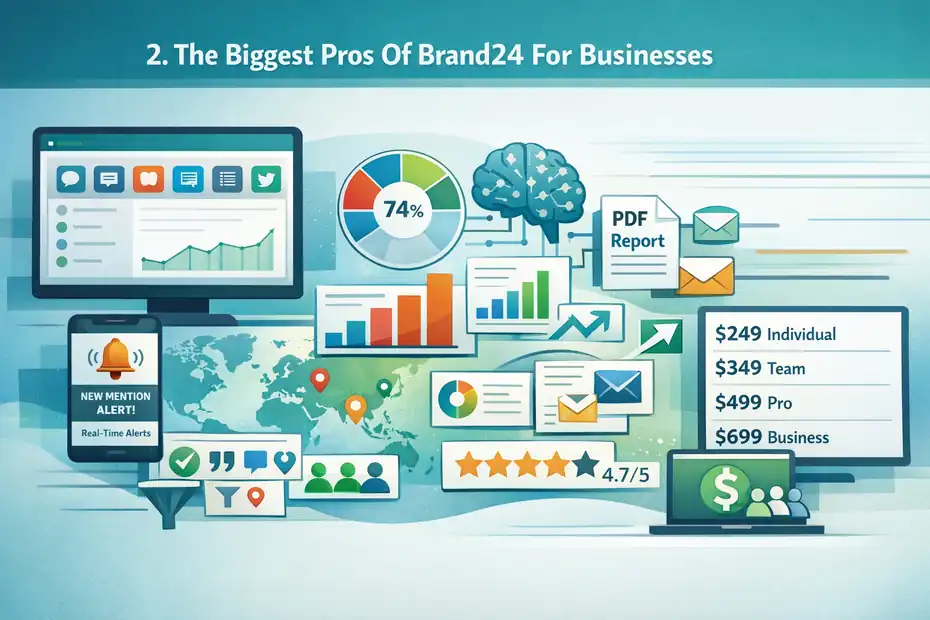
This is where Brand24 earns most of its positive reputation. It solves several messy problems in a way that feels practical rather than overengineered.
Pro 1: Fast, Broad Monitoring That Makes Teams More Responsive
One of Brand24’s biggest strengths is how quickly it helps a business move from scattered mention hunting to centralized monitoring. Its FAQ says projects can be built around keywords, refined with Boolean logic, exclusions, languages, and source limitations, then filtered by source, sentiment, popularity, and tags. That combination is useful because broad monitoring without filtering usually turns into noise.
For a business, speed matters more than most buying guides admit. If your brand gets mentioned in a review site post, industry blog, Reddit thread, or complaint on social media, the value is often in seeing it early enough to respond well.
Brand24’s plans also show different update speeds, from every 12 hours on Individual to hourly on Team and real-time on higher tiers, which directly affects how quickly you can act.
Real users repeatedly point to this as a strength. G2’s review summary highlights real-time monitoring and ease of use, while Capterra reviews mention fast alerts, intuitive workflows, and the ability to track mentions across web, news, social, and niche blogs.
I believe this is especially valuable for lean teams. Imagine a small ecommerce brand launching a seasonal collection. If a creator mentions the product on TikTok, a customer posts a complaint on X, and a niche publisher links to the campaign in the same week, the team needs one place to catch all of that.
Brand24’s core advantage is that it helps you see the conversation before it becomes a bigger problem or a missed opportunity.
Pro 2: Reporting, Sentiment, And AI Features Reduce Manual Work
A second major advantage is how much manual summarizing Brand24 tries to remove from the process. The platform includes AI sentiment analysis, AI Insights, AI Events Detection, AI Topics, Brand Assistant, PDF reports, scheduled email reports, and data exports depending on plan level.
For many businesses, that means less time pulling screenshots into decks and more time making decisions.
The reporting side deserves more credit than it usually gets. Brand24’s FAQ explains that users can create branded PDF reports with selected metrics, charts, top mentions, trending hashtags, company colors, logos, and commentary.
Weekly email reports can also be sent to stakeholders. That is not glamorous, but it is incredibly useful when leadership wants updates without logging into a platform.
User feedback supports this. One Capterra review specifically praised reports as ideal for sharing media information with a board of directors, while others mention personalization, filters, and reporting as strong points. G2 also summarizes that users appreciate clear reports and actionable insights.
I’d frame the AI layer carefully. It is helpful when it speeds up interpretation, but it should not replace human judgment. Still, for businesses that need a first-pass summary of sentiment shifts, trending topics, or notable spikes, Brand24’s AI features can shorten the time between “data collected” and “decision made.”
That is a real operational benefit, especially for busy teams managing multiple campaigns.
Pro 3: It Is More Accessible Than Many Enterprise Listening Platforms
Brand24’s pricing is not cheap in an absolute sense, but it is often more accessible than high-end enterprise listening tools. Current published pricing starts at $249 per month for Individual, $349 for Team, $499 for Pro, $699 for Business, and Enterprise from $1,499 per month when billed annually.
Several tiers include unlimited users, which is important because some competing platforms increase cost based on seats or add-on modules.
That structure matters for small and mid-sized businesses. A lot of companies need listening, but they do not need a giant platform built for multinational governance, dozens of dashboards, and extensive consulting. They need a tool their team will actually use.
Third-party sentiment suggests Brand24 is doing well in that lane. On G2, it shows 4.6 out of 5 stars from 336 reviews. On Capterra, it shows 4.7 out of 5 from 253 reviews, with customer service at 4.8 and ease of use at 4.7. Review excerpts repeatedly mention value for money, ease of use, and accessible reporting.
In my experience, accessibility is not just about price. It is also about adoption. A cheaper tool that nobody uses is expensive. A mid-priced tool with a clear learning curve and visible outputs often produces better ROI.
Brand24 seems strongest when the buyer wants meaningful listening capabilities without the onboarding burden that comes with some enterprise-first platforms.
The Main Cons Of Brand24 For Businesses
To be fair, the same traits that make Brand24 accessible also create tradeoffs. This is not a flawless tool, and some businesses will hit friction quickly.
Con 1: Relevance, Filtering, And Sentiment Still Need Human Oversight
The most common downside in review patterns is quality control at the mention level. Capterra reviews note that filters can allow irrelevant or incorrect content through, and some users say messages can be too general or random.
G2’s review summary also mentions that sentiment analysis can sometimes be inaccurate and may need manual adjustment.
This is not unique to Brand24. Social listening is messy by nature. Words have multiple meanings, slang changes, sarcasm confuses sentiment models, and common brand names can overlap with unrelated topics.
But it is still a real con, because businesses often expect a monitoring tool to “just know” which mentions matter.
Let me put that into a realistic scenario. If your brand name is also a common word, a city name, or an acronym, you may pull in off-topic chatter unless your Boolean setup is tight. If your team trusts the default feed too much, you can waste time reacting to noise or misread the true sentiment around a campaign.
My honest view is that Brand24 works best when someone owns the hygiene of the project. That means refining keywords, adding exclusions, filtering sources, and manually validating important trends.
The platform can speed up discovery, but it should not be treated like a fully autonomous truth machine. For businesses without anyone willing to maintain those rules, this weakness can feel bigger over time.
Con 2: Pricing Can Feel High For Smaller Teams Or Light Use Cases
Brand24 is often described as affordable relative to enterprise alternatives, but that does not mean it will feel affordable to everyone. The entry-level paid plan is still a meaningful monthly spend for a startup, local business, or small team that only needs occasional monitoring.
The Team plan is $349 per month billed annually, and that is before you start evaluating whether your mention volume and keyword allowance are enough.
Review feedback reflects that tension. One Capterra reviewer called it “great for the price” while still describing it as a little pricey compared to other software. Another lower-rated review flagged poor value for money after technical difficulty and confusion around integration expectations.
This is where buyers sometimes make a mistake. They compare Brand24 to “free” alternatives like Google Alerts or manual searches and assume the paid jump is too steep. But those are not equivalent systems.
A fairer comparison is against the hours spent finding mentions, preparing reports, and missing opportunities. Even so, the cost can be hard to justify if your business has low mention volume, a narrow geographic footprint, or no one assigned to use the platform consistently.
I suggest treating pricing as a workflow decision, not a software decision. If Brand24 saves a marketer five to ten hours a month and improves issue response time, the math may work. If nobody logs in and reports go unread, even a discounted plan becomes wasted budget.
Con 3: Some Advanced Needs May Outgrow The Platform
Brand24 has added a lot, including AI visibility tracking, AI integrations, and more advanced reporting on higher plans.
But the public plan structure still suggests a product designed to serve small businesses, growing teams, agencies, and mid-market users more naturally than highly specialized enterprise organizations.
That matters if your business needs extremely deep customization, large-scale global governance, highly specialized data workflows, or a broader command center connecting many business units.
Brand24 offers Enterprise plans, dedicated consulting, and advanced reports, but some companies will still want a heavier platform category depending on complexity.
User comments hint at this in smaller ways. Some reviewers mention learning curves for more advanced features, memory load issues, timezone friction for support scheduling, or difficulty using the tracking setup to its fullest potential.
None of these are deal-breakers on their own, but together they suggest that the platform still requires some operational maturity from the customer.
I would not call this a failure. It is more a question of fit. Brand24 appears strongest when a business wants fast implementation, practical social listening, and stakeholder-ready outputs. It appears weaker when the business expects one platform to become a massive, deeply customized intelligence environment.
That is an important difference, because a tool can be very good and still be wrong for the most complex buyer.
Which Types Of Businesses Benefit Most From Brand24
Brand24 is not equally useful for every business model. Fit is where most buying decisions become obvious.
Best Fit: Small And Mid-Sized Teams That Need Actionable Monitoring
The strongest fit seems to be businesses that need a practical monitoring system without building an internal analytics operation around it.
The published plans even spell this out: Team is aimed at startups and small businesses, Pro at growing businesses and small agencies, and Business at scaling businesses and established agencies.
That positioning makes sense. If you run a small ecommerce brand, SaaS company, agency, hospitality group, nonprofit, or PR team, your core need is usually straightforward: catch relevant mentions, understand sentiment, find spikes, report to stakeholders, and react quickly.
Brand24’s review mix also comes from a broad spread of roles and company sizes, including social media managers, advisors, nonprofit operations leaders, and larger marketing teams.
A realistic use case would be a 20-person direct-to-consumer business launching a new product line. Marketing wants campaign impact, support wants complaint visibility, leadership wants weekly summaries, and PR wants to catch media mentions.
Brand24’s unlimited users on many tiers and its export/reporting options make that cross-team access easier than tools that charge heavily per seat.
I also think agencies get solid value when they need client-friendly reporting and faster onboarding for new monitoring projects. The ability to create branded PDF reports and scheduled summaries is especially useful when account managers need to prove activity and outcomes without manually rebuilding decks every week.
Weaker Fit: Very Small Brands, Very Complex Enterprises, Or Low-Intent Buyers
On the other hand, some businesses will struggle to justify Brand24. The first group is very small brands with limited brand search demand or low public conversation.
If your business gets only a trickle of mentions each month, a premium monitoring subscription may be overkill. You can still benefit from monitoring, but the ROI becomes harder to prove.
The second group is highly complex enterprises. If you need highly customized workflows, broad internal governance, deep global intelligence operations, or a larger enterprise ecosystem built around listening, you may eventually feel boxed in by a more streamlined platform.
Brand24 has an Enterprise tier and consulting options, but the product’s clearest value proposition still leans toward usability and speed rather than maximum complexity.
The third weak-fit group is what I call low-intent buyers. These are companies that know they “should” monitor mentions but have no clear use case, no owner, and no response workflow. For them, any social listening tool becomes shelfware.
That is why I recommend deciding first what you want Brand24 to do: crisis alerts, campaign tracking, competitor benchmarking, influencer discovery, executive reporting, or customer insight collection. If you cannot name the job, it is very hard for any platform to prove value.
How To Evaluate Brand24 Before You Buy
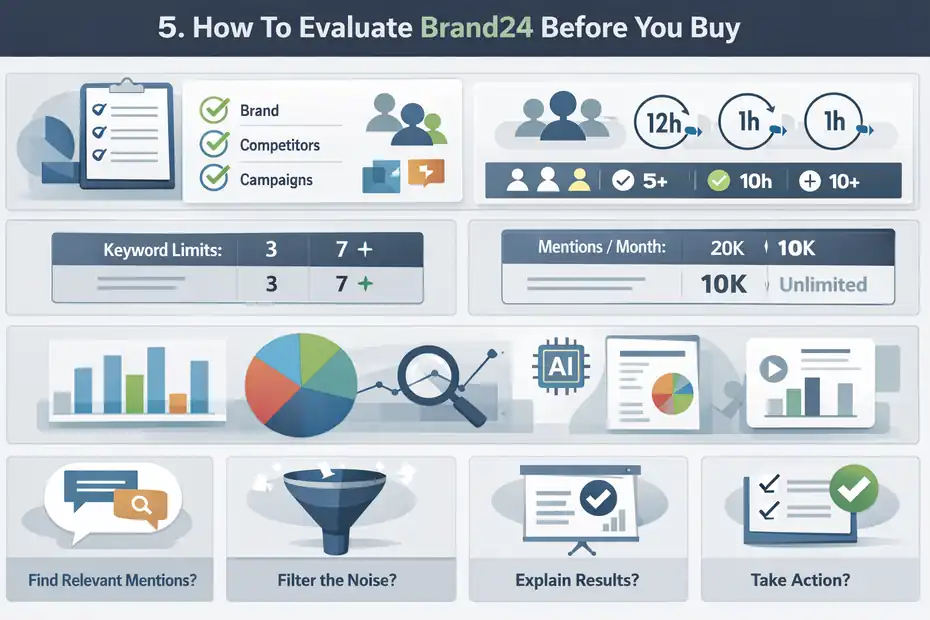
The smartest way to buy Brand24 is not to ask whether it is “good.” It is to test whether it improves a specific business workflow.
Audit Your Monitoring Needs Before Comparing Plans
Start with a simple internal audit. List the brands, products, campaigns, executives, competitors, or industry terms you would actually track. Then estimate how many stakeholders need access, how often you need updates, and whether reporting matters more than raw data access.
This matters because Brand24’s plans differ on keyword counts, mention limits, users, update frequency, and advanced AI/reporting features. The Individual plan has 3 keywords, 2K mentions per month, 1 user, and 12-hour updates.
Team raises that to 7 keywords, 10K mentions, unlimited users, and hourly updates. Pro and above add real-time updates and broader AI/reporting features.
A lot of bad software purchases happen because buyers overfocus on the headline feature and underfocus on operational fit. If your team monitors multiple product categories, local markets, executives, and competitors, low keyword caps will become painful quickly.
If your leadership expects instant alerts, slower update intervals will disappoint them. If your team depends on polished reporting, lower tiers may feel restrictive.
I suggest choosing the plan based on your reporting and response habits, not just your budget. A cheaper plan that misses the way your team works often becomes more expensive than a slightly higher plan that matches your real process.
Run A Practical Trial With Real Queries And Real Workflows
During a trial or demo period, do not just click around the dashboard. Use live business questions.
Track a branded term, a competitor, a campaign hashtag, and one broad industry keyword. Add exclusions. Test source filters. Look at mention relevance. Check whether the sentiment makes sense. Export a report. Ask whether someone outside marketing can understand the output.
Brand24’s FAQ highlights use cases like comparing against competitors, identifying influencers, spotting trending topics, generating reports, and even connecting data to AI assistants through MCP and the official ChatGPT app.
Those features sound good, but the real test is whether your team can turn them into action.
Here is the standard I would use:
- Step 1: Can the platform find relevant mentions we would have missed?
- Step 2: Can we clean the noise fast enough?
- Step 3: Can we explain the results to leadership without rebuilding everything manually?
- Step 4: Can someone clearly act on what the dashboard shows?
If the answer is yes across those steps, Brand24 is probably a good operational fit. If the dashboard looks interesting but nobody can turn it into decisions, the tool may not be right for your team, even if the feature list looks impressive.
Common Mistakes Businesses Make With Brand24
Most disappointment with listening tools comes from setup errors and unrealistic expectations, not from the tool alone.
Mistake 1: Tracking Broad Keywords Without Tight Filters
The fastest way to ruin your Brand24 experience is to throw in a broad keyword and assume the system will magically understand what matters.
The FAQ makes it clear that Brand24 supports required and excluded words, source filtering, and project constraints by language or site. Those controls are not optional extras. They are part of the core setup.
If your brand name overlaps with generic language, events, or other organizations, a loose setup can flood your dashboard with junk. Then the team starts saying the data is wrong, when the real issue is that the query logic was too weak from the start.
I’ve seen this happen often in social listening. A company tracks “Apple-like” ambiguous terms, broad acronyms, or campaign slogans that people use in unrelated contexts. The result is false confidence or total frustration.
A smarter approach looks like this:
- Step 1: Start with the core brand and product terms.
- Step 2: Add exclusions for unrelated meanings.
- Step 3: Limit by geography, language, or site where needed.
- Step 4: Review the first batch of mentions and refine aggressively.
This is one of those boring best practices that makes all the difference. Brand24 can surface useful insights quickly, but only if you give it a cleaner signal to work with.
Mistake 2: Treating The Dashboard As Strategy Instead Of Input
Another mistake is assuming the tool itself creates strategy. It does not. It gives you evidence, patterns, and faster visibility. Your team still has to interpret what those patterns mean.
Brand24 offers sentiment, reach, top mentions, influencers, comparison views, AI summaries, and trend detection.
That is useful. But no platform can fully tell you whether a spike is dangerous, whether a creator mention is worth outreach, or whether a competitor’s increased share of voice actually affects revenue in your business.
This becomes especially important with AI-generated summaries. Some Capterra feedback praises AI summaries and AI integrations, while other reviews say the summaries have become too quantitative and less substantively useful for decision-making.
That tells me the feature can help, but it still benefits from human interpretation.
I recommend a simple rule: treat Brand24 as your listening layer, not your final brain. Use it to identify what is happening, then connect those findings to customer support tickets, campaign data, web analytics, and revenue context.
When you do that, the platform becomes much more valuable. When you do not, it risks becoming an attractive dashboard full of disconnected observations.
How To Get Better Results From Brand24 After Setup
Once the setup is live, the next question is how to squeeze more value out of it. This is where many businesses separate basic use from strategic use.
Build A Weekly Workflow Around Mentions, Trends, And Reporting
The easiest way to improve ROI is to make Brand24 part of a recurring operating rhythm. The platform already supports automated email reports and customizable PDF reports, so the missing piece is usually internal process, not software capability.
A practical weekly workflow could look like this:
- Monday: Review spikes, negative sentiment, and top mentions from the prior week.
- Tuesday: Share campaign or PR highlights with leadership through an email or PDF summary.
- Wednesday: Check competitor comparison and top industry themes.
- Thursday: Review influencers or publications that mentioned your brand.
- Friday: Log recurring complaints, questions, or message themes for marketing and support.
This sounds simple, but simple is good. Consistency is what turns monitoring into business intelligence.
For example, a SaaS company might notice three recurring complaint themes in Brand24 mentions, then compare those against support logs and find that one onboarding issue is driving both negative sentiment and churn risk. That is the kind of insight that justifies the subscription.
I believe Brand24 delivers its best value when it becomes a weekly decision-support tool rather than a crisis-only tool. Most teams buy listening platforms for emergencies, but the day-to-day insight loop is where the long-term payoff usually lives.
Use Reports And AI Features To Support, Not Replace, Human Analysis
Brand24’s AI stack is expanding beyond basic listening. The FAQ references AI Insights, AI Topics, Brand Assistant, LLM visibility monitoring through Chatbeat, and integrations with ChatGPT, Claude, Gemini, and MCP-compatible assistants.
That is a notable differentiator for businesses that want faster summaries or want to ask conversational questions about their listening data.
That said, I would use these features in layers.
Use AI summaries for first-pass interpretation. Use Brand Assistant to speed up internal Q&A. Use reporting automation to reduce repetitive work. Then have a human review the findings before making messaging, PR, product, or escalation decisions.
Why? Because review feedback already shows mixed reactions to automation quality. Some users love the AI integrations and find them helpful, while others feel the summaries have become too statistical or less useful for decision-making.
So the smart workflow is not “let AI do it.” It is “let AI accelerate it.”
That distinction matters. Businesses that treat Brand24’s AI features as a time-saver will probably be happy. Businesses that expect perfect interpretation, flawless sentiment, and strategic judgment from automation will probably be disappointed.
Used thoughtfully, though, these features can shorten reporting cycles and make the platform feel more modern than older monitoring tools that still rely heavily on manual exploration.
Final Verdict On Brand24 Pros And Cons For Businesses
Brand24 is not the cheapest option, not the deepest enterprise platform, and not a magic button for perfect brand intelligence. But it is a very credible social listening and media monitoring choice for businesses that want useful coverage, faster response time, strong reporting, and a relatively accessible path into serious monitoring.
Its current pricing, review scores, and feature set all support that conclusion.
The biggest pros are clear: broad mention tracking, easier cross-team visibility, practical reporting, real-time or near-real-time monitoring on higher plans, and a growing AI feature set that can reduce manual work.
Review patterns also consistently praise ease of use, customer service, reporting, and responsiveness.
The main cons are just as important: filtering still needs human supervision, sentiment and summaries are not perfect, pricing can feel high for small or low-volume businesses, and some advanced organizations may outgrow the platform. Those are not minor footnotes.
They are the real tradeoffs you need to understand before buying.
My honest recommendation is this: Brand24 is a strong fit if your business needs a dependable, team-friendly listening tool that turns online chatter into something operationally useful. It is a weaker fit if you have tiny monitoring needs, no internal owner, or highly complex enterprise requirements.
For many small and mid-sized businesses, though, the balance of pros and cons looks favorable, especially when the goal is faster insight without enterprise-level complexity.
FAQ
What are the main benefits of Brand24 for businesses?
Brand24 helps businesses track online mentions in real time, monitor brand reputation, and generate automated reports. It simplifies social listening by collecting data from multiple sources and presenting insights clearly. This allows teams to respond faster, understand audience sentiment, and make more informed marketing and PR decisions.
Is Brand24 worth it for small businesses?
Brand24 can be worth it for small businesses if they actively monitor brand mentions or run campaigns regularly. It saves time and improves visibility, but the pricing may feel high for very small teams with limited mentions. The value depends on how consistently the business uses the insights.
What are the downsides of using Brand24?
The main downsides include occasional irrelevant mentions, imperfect sentiment analysis, and pricing that may not suit smaller budgets. Businesses also need to refine keyword filters manually to improve accuracy. Without proper setup and ongoing adjustments, the data can become noisy or less actionable.
How accurate is Brand24 sentiment analysis?
Brand24 sentiment analysis is helpful for spotting general trends, but it is not always fully accurate. It can misinterpret sarcasm, slang, or context. Most businesses use it as a starting point and manually review important mentions to ensure better decision-making and more reliable insights.
Who should use Brand24 the most?
Brand24 works best for small to mid-sized businesses, agencies, and marketing teams that need practical social listening without complex setup. It is ideal for tracking campaigns, monitoring reputation, and generating reports. Larger enterprises with advanced needs may require more customizable or scalable solutions.

I’m Juxhin, the voice behind The Justifiable.
I’ve spent 6+ years building blogs, managing affiliate campaigns, and testing the messy world of online business. Here, I cut the fluff and share the strategies that actually move the needle — so you can build income that’s sustainable, not speculative.
Related posts:
 Top Brand24 Competitors Offering Excellent Value
 Sprout Social Listening: How It Works for Brands
 10 Secrets to Generating Leads Online & Skyrocketing Sales
 ClickMagick Pricing: How to Get the Most for Your Money
 CallRail Call Tracking: How It Works and Why It Matters
 Why CallRail Cost Might Be Worth the Investment