Table of Contents
If you’ve ever felt overwhelmed by the endless tasks that come with growing your online store, you’re not alone. From managing orders to handling returns, every step can eat away at your time.
That’s where ecommerce fulfillment services come in—they don’t just ship your products; they help you scale faster and smarter.
I’ve seen many store owners go from struggling to keep up with orders to focusing entirely on growth, simply by outsourcing their fulfillment.
Let’s break down how these services can accelerate your ecommerce success and give you the freedom to scale quickly.
Streamlining Order Management For Faster Growth
Managing orders efficiently is one of the biggest challenges when scaling an online store.
The right ecommerce fulfillment services streamline everything from inventory updates to order tracking—freeing you to focus on growth instead of operations.
Simplifying Inventory Synchronization Across Channels
When you sell on multiple platforms—Shopify, Amazon, eBay, or Etsy—keeping inventory synced can feel like juggling fire. Fulfillment services automate that process.
They connect directly to all your sales channels, ensuring product quantities are updated instantly when a sale happens. No more overselling or disappointing customers with out-of-stock messages.
Example: If you sell the same product on both Shopify and Amazon, and a buyer purchases it on Amazon, your Shopify stock automatically updates. That means fewer customer complaints and zero manual tracking.
Pro tip: Choose a fulfillment partner that supports real-time multi-channel integration. This reduces stock discrepancies and helps you restock strategically based on actual demand.
Automating Order Processing To Eliminate Manual Work
Manually handling orders eats up time and introduces human error. With automation, every order placed triggers an immediate action—packing, shipping, and updating the customer.
Fulfillment systems automatically:
- Import new orders across all platforms
- Assign them to the nearest warehouse
- Generate shipping labels instantly
This process eliminates delays and improves your order-to-ship time, which is crucial for customer satisfaction.
From my experience, businesses that automate order processing often see a 25–40% improvement in fulfillment speed within the first few weeks.
Reducing Errors With Real-Time Tracking And Data Integration
Small mistakes in order handling can snowball into negative reviews and returns. That’s where real-time tracking and data integration save the day.
Modern fulfillment software connects with your CRM, ERP, and analytics tools—ensuring every order, shipment, and return is traceable. You can track shipments in real-time and spot errors before they reach the customer.
Example: If a label is mismatched, the system flags it before it ships. This proactive approach not only reduces returns but also strengthens customer trust.
Improving Efficiency Through Centralized Fulfillment Dashboards
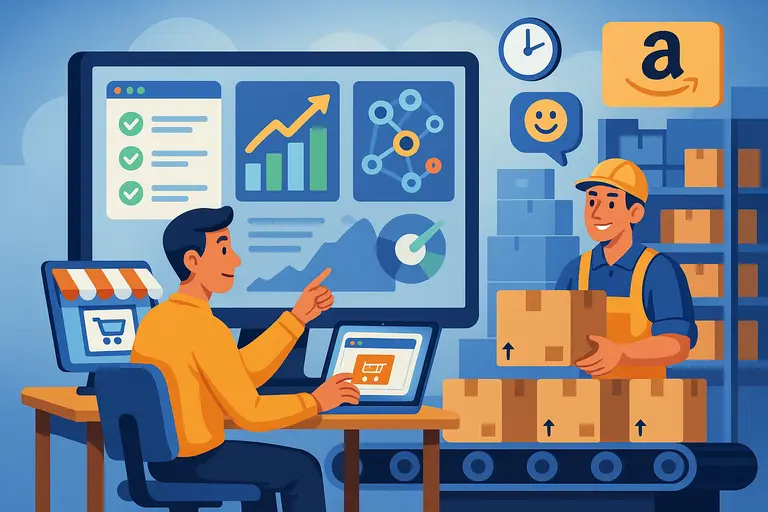
Centralized dashboards give you full visibility into your operations from one place—inventory, shipping status, and order metrics all in one screen.
You can easily:
- Monitor order flow by location
- Track performance KPIs like delivery time or return rates
- Adjust workflows instantly when issues appear
I personally recommend using fulfillment dashboards with mobile access. It allows you to stay in control even when you’re on the go, which can be a game-changer for growing stores.
Enhancing Customer Satisfaction With Reliable Delivery
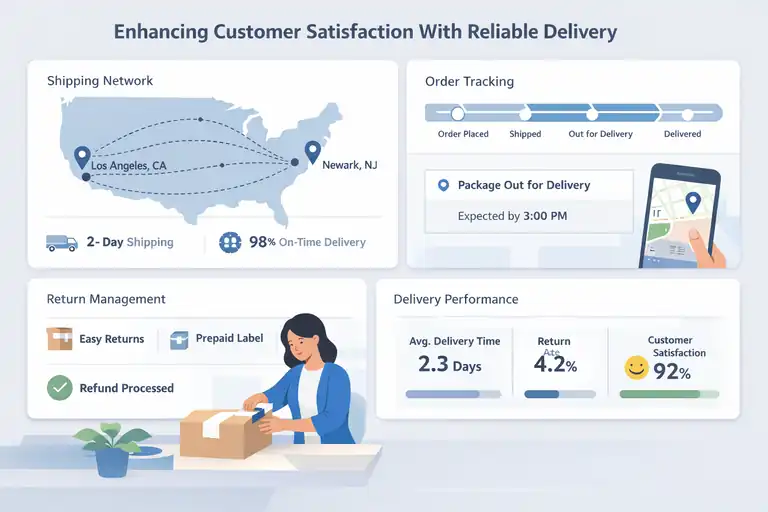
Fast, reliable delivery can make or break an ecommerce brand. Fulfillment services help you meet customer expectations by improving speed, visibility, and consistency.
Offering Faster Shipping Options Through Strategic Warehousing
Fulfillment centers strategically placed near key markets can cut delivery times dramatically. Instead of shipping from a single central warehouse, products are stored closer to your customers.
That means you can offer 2-day or even same-day shipping in certain regions—without paying premium rates.
Example: A California-based store using warehouses in Los Angeles and New Jersey can deliver nationwide in under 3 days. That kind of coverage builds serious competitive advantage.
Building Trust With Transparent Tracking And Communication
Customers crave visibility. When they can track their order in real time, they feel in control and confident.
Modern ecommerce fulfillment services integrate live tracking links directly into email and SMS updates, keeping customers informed at every step.
Transparency like this boosts repeat purchases and reduces “Where’s my order?” inquiries. In fact, studies show that 83% of shoppers are more likely to buy again from stores that provide consistent order updates.
Managing Returns Seamlessly To Retain Loyal Customers
Returns are unavoidable—but how you handle them defines your reputation. Fulfillment partners simplify the process with pre-labeled return slips, automated refunds, and real-time restocking updates.
That means customers can return items effortlessly, and you get instant visibility on inventory adjustments.
From what I’ve seen, stores with hassle-free return policies often enjoy higher customer lifetime value. People buy again when they know returning an item won’t be a nightmare.
Creating Consistency In Delivery Times For Brand Reliability
Consistency builds trust. Customers who know your delivery times are reliable will come back again and again.
Fulfillment partners standardize operations, using advanced routing and carrier selection to minimize delays. Even during peak seasons, their systems allocate shipments intelligently to avoid bottlenecks.
This creates a sense of predictability—something smaller businesses struggle to achieve on their own.
Reducing Costs Through Optimized Fulfillment Strategies
Scaling doesn’t just mean selling more—it also means managing costs strategically.
The best ecommerce fulfillment services reduce expenses through volume discounts, smart storage, and predictive analytics.
Lowering Shipping Rates With Bulk Carrier Partnerships
Fulfillment companies negotiate bulk shipping rates with major carriers like UPS, DHL, and FedEx. These rates are far cheaper than what individual merchants could access.
The savings—often 10–30%—can be passed directly to customers or reinvested into marketing.
Example: A small apparel brand shipping 500 orders per month might save over $1,000 monthly just through reduced carrier fees. That’s money better spent on growing your brand.
Minimizing Storage Costs Through Smart Inventory Allocation
Instead of storing all products in one central location, fulfillment networks distribute inventory across multiple warehouses based on demand patterns.
This cuts down on both storage and shipping costs—you’re not paying for unused space or long-distance deliveries.
It’s also eco-friendly: fewer miles mean lower emissions and better brand perception.
Reducing Labor Expenses By Outsourcing Logistics
In-house logistics require hiring, training, and managing warehouse staff—not to mention equipment and insurance costs. Fulfillment outsourcing eliminates that entire burden.
You pay only for the space and services you use, which scales flexibly with your order volume.
I’ve seen small teams go from 10 warehouse workers to just two remote coordinators—saving thousands per month without losing control over operations.
Leveraging Data To Forecast And Prevent Overstocking
Inventory overstocking ties up cash that could be used elsewhere. Fulfillment services use predictive analytics to anticipate demand and prevent excess stock.
They analyze trends like seasonal sales patterns, return rates, and SKU performance—then suggest restocking thresholds.
This data-driven approach ensures products move efficiently, improving cash flow and reducing waste.
Pro tip: Review fulfillment reports weekly. Small tweaks in reorder points can lead to big savings over time.
Expanding Market Reach With Multi-Location Fulfillment Centers
Scaling your ecommerce brand doesn’t always mean building more warehouses or hiring more people. With multi-location fulfillment centers, you can reach new markets faster without the heavy upfront investment.
It’s one of the smartest ways to grow efficiently while improving delivery speed and customer satisfaction.
Scaling Into New Regions Without Building Infrastructure
When you partner with an ecommerce fulfillment service that has multiple warehouses, you instantly gain access to their entire network. That means your products can be stored and shipped from locations closest to your customers—no need to build your own facilities.
Example: Imagine you run a skincare brand based in Texas. Your fulfillment partner has centers in New York, Chicago, and Los Angeles. Orders placed on the East Coast automatically ship from New York, reducing both cost and delivery time.
This setup lets small and mid-sized stores expand nationally (and even internationally) at a fraction of the traditional cost.
Quick tip: Start by identifying your top three sales regions. Then ask your fulfillment partner where their nearest warehouses are to those zones—it’s the simplest way to expand reach strategically.
Offering International Shipping With Localized Warehouses
Global expansion sounds intimidating, but localized fulfillment makes it surprisingly achievable. Many fulfillment providers have international hubs that handle customs, taxes, and cross-border logistics on your behalf.
When you store inventory in these hubs, you can offer local shipping rates and faster delivery to international customers—without managing complex import/export paperwork.
Example: A Canadian store can use a UK fulfillment center to serve European customers, avoiding international shipping delays and VAT headaches.
Pro insight: If you’re testing a new international market, start with low inventory in one fulfillment hub. Once you see consistent sales, scale your stock there gradually.
Shortening Delivery Windows To Compete With Big Retailers
Competing with giants like Amazon is tough—but not impossible. Multi-location fulfillment lets you offer Prime-like delivery speeds without owning a single warehouse.
By distributing inventory strategically, your average delivery window drops from 5–7 days to 2–3 days. That faster fulfillment translates directly into higher conversion rates. In fact, studies show that 40% of online shoppers abandon carts due to slow shipping estimates.
Personal tip: Highlight your delivery times on your product pages. Customers are more likely to buy when they know their order will arrive quickly.
Adapting Inventory Placement Based On Customer Demand
Smart fulfillment providers use demand-based allocation, meaning they move inventory to the areas where it’s selling most. This ensures products are always near your highest-demand customers.
As an example, if a certain SKU suddenly starts trending in California, the system shifts more stock to West Coast warehouses automatically. This avoids backorders, cuts shipping costs, and improves delivery consistency.
This dynamic placement also prepares your business for seasonal spikes. You’ll never run out of stock in one region while sitting on surplus elsewhere.
Enabling Business Focus On Core Growth Activities
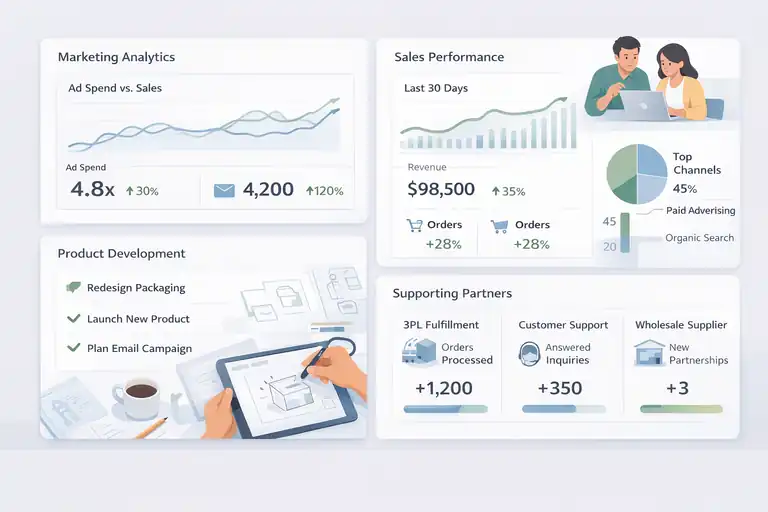
Outsourcing logistics is more than just convenience—it’s a growth strategy.
When your ecommerce fulfillment services handle the day-to-day operations, you and your team can focus on scaling the parts of your business that actually move the needle.
Shifting Resources From Logistics To Marketing And Sales
When you stop worrying about packing boxes, you can finally focus on what truly grows your business: reaching new customers.
Fulfillment services take over the repetitive tasks—picking, packing, labeling—freeing up both time and headspace. Those hours can now be spent crafting marketing campaigns, optimizing ad spend, or building relationships with wholesale partners.
Example: One online boutique I worked with saved nearly 20 hours per week after switching to third-party fulfillment. They used that time to launch influencer collaborations—and doubled their monthly revenue in just two months.
Empowering Teams To Innovate Instead Of Managing Shipments
Your team’s energy is finite. When they’re tied up with tracking shipments and handling customer delivery issues, innovation stalls.
By outsourcing fulfillment, you give your team room to breathe—to experiment with product ideas, improve your store’s UX, or develop new partnerships.
It’s not just about delegation; it’s about unleashing creativity that was previously buried under logistics work.
In my experience, even small teams see a noticeable morale boost once they’re free from the chaos of daily shipping management.
Freeing Up Time To Improve Product Development And Branding
Your brand is your long-term differentiator. When logistics are off your plate, you can finally refine your packaging, product design, and brand story.
Example: A sustainable apparel company used the time saved from fulfillment outsourcing to redesign its eco-friendly packaging—cutting costs by 15% while strengthening its brand image.
This kind of shift—focusing on value creation instead of order execution—is what turns small brands into established players.
Allowing Entrepreneurs To Scale Without Hiring More Staff
Hiring and managing staff is expensive and time-consuming. Fulfillment partners act as your operational team—without adding payroll or HR overhead.
Your costs scale directly with your order volume. When sales grow, your fulfillment partner simply processes more shipments. When things slow down, your costs adjust automatically.
That flexibility is ideal for small ecommerce businesses navigating unpredictable growth cycles.
Pro tip: Look for partners that offer flexible contracts and seasonal scaling support. It ensures you only pay for the capacity you actually use.
Leveraging Advanced Technology For Smarter Operations
Technology is the silent growth engine behind modern fulfillment.
The best ecommerce fulfillment services use advanced software, automation, and AI to make operations faster, smarter, and more predictable.
Using AI And Automation To Predict Demand Accurately
AI tools analyze order history, search trends, and seasonal patterns to forecast demand with surprising accuracy. This helps you stock just the right amount—avoiding both stockouts and overstocking.
For instance, AI might predict that a certain product sells 40% more during summer months. You can then adjust inventory and marketing campaigns ahead of time.
Some fulfillment platforms even automate restocking suggestions based on these predictions, so you never run dry on high-demand SKUs.
Integrating Fulfillment Software With Ecommerce Platforms
Modern fulfillment systems integrate seamlessly with Shopify, WooCommerce, BigCommerce, and Amazon. This two-way sync keeps orders, inventory, and tracking information updated automatically.
It eliminates manual data entry and ensures customers always see accurate stock levels and shipping timelines.
From what I’ve seen, businesses that integrate fulfillment software with their ecommerce platforms reduce order errors by up to 35%—and customers notice that reliability.
Tracking KPIs To Optimize Performance And Reduce Waste
A good fulfillment partner doesn’t just move boxes; they track performance metrics that show you where to improve.
Key performance indicators (KPIs) to monitor include:
- Order accuracy rate
- On-time delivery rate
- Average fulfillment time
- Return processing time
Regularly reviewing these numbers helps identify bottlenecks, prevent delays, and maintain a strong customer experience.
Pro insight: Schedule a monthly KPI review with your fulfillment partner. It’s one of the simplest ways to keep your operations sharp and scalable.
Enhancing Scalability With Cloud-Based Fulfillment Solutions
Cloud-based systems make your fulfillment operations accessible from anywhere. You can log in to monitor inventory, approve orders, or check shipping costs—all in real time.
These platforms also allow for instant scalability. When your sales spike—say during Black Friday—the system can process and allocate thousands of orders automatically.
It’s like having a 24/7 operations team that never sleeps.
This level of flexibility and visibility is what separates growing ecommerce stores from those that stay stagnant.
Strengthening Brand Reputation Through Consistent Service
Your brand’s reputation isn’t built just on products—it’s shaped by how customers experience your brand from purchase to delivery.
Ecommerce fulfillment services play a direct role in this, ensuring that every order arrives on time, in perfect condition, and with a sense of care that reflects your brand’s values.
Ensuring High-Quality Packaging And Presentation
Packaging is your customer’s first physical touchpoint with your brand. It can either elevate the experience or cheapen it. A strong fulfillment partner helps you maintain that quality at scale.
They follow your exact packaging guidelines—down to materials, inserts, and branded touches—so your unboxing experience remains consistent no matter how many orders you ship.
Example: If you sell premium candles, your fulfillment partner can use custom boxes, branded tissue paper, and thank-you cards—creating the same elegant presentation every time.
Pro tip: Run a quarterly packaging audit. Have a few orders shipped to yourself from different regions to ensure your brand presentation remains consistent everywhere.
Maintaining Brand Integrity With White-Label Fulfillment
White-label fulfillment means your fulfillment partner ships products under your brand name, not theirs. This keeps your customer’s perception seamless—they feel like the package came directly from you, not a third party.
This is especially important for growing brands that want to appear established and trustworthy. White-label services also allow for branded return labels, ensuring even reverse logistics maintain your brand identity.
In my experience, this level of consistency reinforces professionalism and builds long-term trust, especially for first-time buyers.
Building Positive Reviews Through Reliable Delivery Experiences
Timely, error-free delivery is one of the biggest drivers of positive reviews. When customers receive their orders exactly as promised, they’re far more likely to leave glowing feedback.
Most top-tier fulfillment providers use real-time tracking, proactive notifications, and error prevention systems to ensure on-time delivery.
Here’s a simple truth: A smooth delivery creates silent satisfaction—no complaints, no questions, just trust. And trust leads to repeat purchases and organic reviews that fuel your brand reputation.
Turning Exceptional Fulfillment Into A Competitive Advantage
Fast shipping and reliable fulfillment aren’t just operational wins—they’re marketing assets. You can turn fulfillment speed into a selling point.
Highlight delivery reliability on your product pages, ad copy, and customer emails. For instance, showing “Ships within 24 hours” or “Delivered in 2–3 days nationwide” can increase conversions by as much as 35%.
Personal tip: Treat your fulfillment promise as part of your brand story. Customers remember when you keep your word—and that’s how small businesses start to feel like big, trusted brands.
Adapting Quickly To Seasonal And Sudden Demand Spikes
Sales seasons, holidays, and viral moments can make or break an ecommerce business. The ability to scale fulfillment operations instantly during demand surges is what separates those who grow from those who crumble under pressure.
Scaling Operations Instantly During Peak Seasons
Fulfillment partners are built for scale. During major retail events—like Black Friday or Christmas—they can increase staff, extend working hours, and allocate more warehouse space automatically.
You don’t need to hire seasonal workers or rent extra storage. Your fulfillment provider absorbs those surges seamlessly so your customers never notice the chaos behind the scenes.
Example: One apparel brand I worked with saw a 300% spike during Cyber Monday. Their fulfillment partner shipped all orders within 48 hours—without a single delay.
Managing Unexpected Order Surges Without Hiring Extra Staff
Sometimes, a product goes viral unexpectedly. Without the right infrastructure, you can drown in orders overnight.
Ecommerce fulfillment services offer built-in scalability—more packing stations, more couriers, more automation—without you lifting a finger. This flexibility keeps your brand looking organized even when demand goes wild.
It’s like having an invisible backup team that springs into action whenever your store blows up online.
Ensuring Inventory Readiness For Flash Sales Or Viral Moments
Inventory forecasting tools in fulfillment platforms can alert you when stock levels dip dangerously low. They analyze sales velocity and predict when you’ll run out—helping you reorder before it’s too late.
Pro tip: If you plan a flash sale, communicate early with your fulfillment partner. They can pre-stage popular SKUs for faster packing and shipping, preventing bottlenecks.
This preparation ensures your viral moment becomes a success story—not a fulfillment nightmare.
Keeping Customer Experience Smooth During High-Volume Periods
Even during high-demand seasons, your customers expect the same level of service. A strong fulfillment network ensures that every order, big or small, receives equal attention.
With automated tracking updates and multiple shipping options, customers stay informed without overwhelming your support inbox.
Consistency here builds trust. When customers see your brand stay dependable even during busy times, they remember—and that’s what keeps them coming back.
Gaining Valuable Insights Through Fulfillment Analytics
Data is one of the most underrated advantages of working with professional ecommerce fulfillment services. The analytics they provide reveal patterns you’d otherwise miss—helping you make smarter business decisions.
Monitoring Order Accuracy, Shipping Speed, And Return Rates
Every fulfillment center tracks metrics like how fast orders ship, how often errors occur, and how quickly returns are processed.
These insights help you identify where things slow down or go wrong. For example, if your return rate suddenly spikes on a certain product, it might indicate a sizing or quality issue worth fixing.
Quick reference metrics to monitor:
- Average fulfillment time per order
- On-time delivery percentage
- Error rate per batch
- Cost per shipment
Keeping an eye on these numbers ensures your fulfillment performance matches your growth goals.
Identifying Bottlenecks To Improve Supply Chain Efficiency
Sometimes, delays aren’t about poor performance—they’re about hidden inefficiencies. Analytics can uncover those.
For example, if orders from one region consistently take longer to deliver, it may signal the need for another warehouse closer to that market.
I always recommend reviewing monthly reports with your provider to catch patterns early. A small process tweak can lead to huge improvements in customer experience and cost savings.
Using Customer Data To Predict Buying Trends
Fulfillment data reveals more than logistics—it shows customer behavior. You can see what sells fastest in specific areas, when purchase volumes spike, and which products drive repeat orders.
By combining this data with your marketing analytics, you can plan seasonal promotions or bundle offers more effectively.
It’s not just about shipping smarter—it’s about selling smarter.
Making Data-Driven Decisions For Continuous Growth
The best brands don’t guess—they measure. By using fulfillment data, you can make informed decisions about everything from inventory planning to marketing spend.
For instance, if data shows one warehouse constantly runs low on certain SKUs, it’s time to redistribute stock or expand capacity there.
When you treat analytics as a growth tool, not just a reporting tool, your operations evolve naturally alongside your sales.
Partnering With The Right Ecommerce Fulfillment Provider
Choosing the right partner can make all the difference between scaling smoothly and struggling to meet demand.
The best ecommerce fulfillment service feels like an extension of your team—not just a vendor.
Evaluating Providers Based On Scalability And Integration
Before signing any contract, ask how well the provider scales. Can they handle double or triple your current order volume? Do they integrate with your sales channels, CRMs, and accounting software seamlessly?
The more connected their systems are, the less manual work you’ll have to do.
Pro tip: Request a demo of their platform before committing. A transparent dashboard and clear reporting are signs of a reliable partner.
Comparing Costs, Service Levels, And Storage Capabilities
Price matters—but so does what you get for that price. Compare fulfillment quotes side-by-side, looking at:
- Storage fees per pallet or bin
- Pick-and-pack fees per order
- Shipping discounts offered
- Return processing costs
Don’t just chase the cheapest provider. Choose one that balances affordability with reliability and customer experience.
Checking Industry Specialization And Regional Network Coverage
Some fulfillment partners specialize in specific industries—like apparel, supplements, or electronics. Working with one familiar with your niche can save you countless headaches.
Likewise, check where their warehouses are located. A broad network means faster shipping and lower costs.
For example, if most of your customers are on the East Coast, a provider with strong coverage there is worth its weight in gold.
Building A Long-Term Partnership For Sustainable Growth
A good fulfillment relationship is long-term and collaborative. You’ll grow together—sharing feedback, optimizing processes, and planning expansions.
Regular communication builds trust. Schedule quarterly reviews to discuss data insights, new features, and improvement opportunities.
From my experience, the best fulfillment providers don’t just deliver boxes—they deliver peace of mind. And when you find that partner, scaling becomes natural, not stressful.