
Table of Contents
Some links on The Justifiable are affiliate links, meaning we may earn a small commission at no extra cost to you. Read full disclaimer.
How to start an ecommerce business feels simple when you look at success stories, but when you sit down to actually build one, it gets real fast. You have to pick the right product, choose a platform, set up payments, create trust, and figure out how to get traffic without wasting money.
The good news is you do not need a huge team or a perfect launch to make this work. You need a focused plan, a store built for buying, and a way to get your first customers moving quickly.
Start With A Business Model That Matches Your Reality
Before you touch store design, you need a business model that fits your budget, margins, time, and risk tolerance.
This is where many people make their first expensive mistake: they choose a model because it looks easy on social media, not because it actually fits their situation.
Pick The Fulfillment Model Before You Pick The Product
The fulfillment model is simply how the product gets made, stored, and delivered. It affects your cash flow, shipping speed, returns, customer experience, and profit margin.
- Private label: You sell your own branded version of an existing product. This usually gives better margins and stronger branding, but it needs more setup.
- Dropshipping: A supplier ships orders for you. It is easier to start, but you usually get lower margins and less control.
- Print on demand: Products are printed only after the order comes in. This works well for creators and niche brands.
- Wholesale or inventory-led: You buy stock upfront and fulfill orders yourself or through a warehouse. This gives you the most control, but also the most risk.
I suggest choosing based on what you can manage for 12 months, not what sounds exciting for 12 days. Imagine you are starting with a small budget and a part-time schedule. A light-inventory or print-on-demand setup may help you validate demand faster. If you already understand a category and can negotiate supply well, private label can become a stronger long-term play.
The fastest route to first sales is usually not the flashiest model. It is the one that lets you launch quickly, fulfill reliably, and keep enough margin to reinvest.
Choose A Niche With Pain, Passion, Or Convenience Built In
A good niche usually solves one of three things: a real problem, a strong identity, or a repeat purchase habit. If your product has none of those, selling gets harder because you have to create demand instead of meeting it.
Here is the filter I use:
- Pain-driven products: These solve a frustrating problem. Think posture tools, storage solutions, or products that save time.
- Passion-driven products: These connect to identity or hobbies. Think running, pet owners, gaming desks, or handmade crafts.
- Convenience-driven products: These make everyday life easier or faster. Think refills, organization, or simple home essentials.
The niche should also be specific enough to target clearly. “Fitness products” is too broad. “Grip accessories for home climbers” is much more useful because you immediately know who the customer is, where they hang out, and what language they use.
In my experience, the best niche ideas come from communities, not keyword tools alone. Read product reviews, Reddit threads, YouTube comments, and marketplace questions. Look for repeated complaints, feature requests, and emotional language. When people say things like “I wish this came in…” or “Why does every brand forget…,” that is a signal.
Validate Demand Before You Build Too Much
Validation is where you reduce guessing. You do not need full certainty, but you do need evidence that people want the thing enough to buy it.
Use a simple validation stack:
- Search demand around the problem and product type
- Marketplace activity on Amazon or Etsy
- Competitor stores with active reviews and recent social proof
- Audience response to test content, waitlists, or small paid campaigns
A realistic early test might be this: create a simple landing page, show three product angles, and run a small traffic test. If people click but do not buy, your offer or product page may be weak. If nobody clicks, the positioning may be off. If people join a waitlist or add to cart, you have something worth pursuing.
You do not need thousands of visits to learn something useful. Even a few hundred targeted sessions can tell you whether your idea is confusing, ignored, or promising. That is enough to prevent months of building around the wrong product.
Build An Offer People Can Understand In Seconds
Once your niche is clear, your next job is to make the offer obvious. Not clever. Not vague. Obvious. Most new stores do not fail because the product is terrible. They fail because visitors cannot quickly understand what the product does, who it is for, and why this store is trustworthy.
Define The Core Offer, Not Just The Product
A product is the item. An offer is the reason to buy now from you instead of later from someone else. That difference matters.
A strong offer usually includes:
- The product and its main benefit
- A clear audience fit
- A reason to act now
- Risk reduction such as returns, guarantees, or free shipping thresholds
For example, “stainless steel water bottle” is just a product. “Leak-proof insulated bottle for commuters who want cold drinks all day without carrying bulky gear” is closer to an offer. It tells me what it does, who it helps, and why it matters.
I believe new store owners should spend more time on offer clarity than logo design. You can have average branding and still get sales with a sharp offer. The reverse is rarely true.
A useful shortcut is to write your offer as one sentence: For [audience], this [product] helps you [benefit] without [common frustration].
That framework keeps your message grounded in outcomes. It also makes your product page, ad copy, email signup, and homepage headline easier to write later.
Price For Margin, Trust, And Testing Room
Pricing is not just math. It is psychology, positioning, and survival. If your margin is too thin, you will not have room for ads, refunds, shipping issues, or discounts. If your price feels disconnected from perceived value, conversions will suffer.
Start with these pricing layers:
| Pricing Factor | What To Check | Why It Matters |
|---|---|---|
| Product cost | Unit cost from supplier | Base margin starts here |
| Shipping cost | Domestic and international | Hidden margin killer |
| Transaction fees | Payment processor and platform fees | Eats into every order |
| Returns and replacements | Expected refund rate | Protects profit |
| Acquisition cost | Cost to get one customer | Decides if ads can work |
| Perceived value | Packaging, photos, positioning | Supports higher prices |
Let me break it down simply. If your product costs $12, shipping averages $5, and fees take another few dollars, selling for $24 may look okay on paper but leave no room for growth. A beginner-friendly ecommerce business needs margin space, not just break-even pricing.
I recommend testing price together with value framing. A higher price can convert better when the page explains benefits well, includes social proof, and reduces risk. Cheap is not always convincing. Sometimes cheap just looks suspicious.
Create A Starter Offer That Helps You Get The First Sales Faster
Your first sales usually come from a focused starter offer, not a giant catalog. Too many products dilute attention and slow decision-making.
A strong starter offer might look like this:
- One flagship product
- One simple bundle
- One low-friction upsell
- One clear guarantee or threshold offer
Imagine you are selling desk organization tools. Instead of launching 27 items, you launch one cable management kit, one bundle for remote workers, and one add-on pouch. Now the store feels curated, easier to understand, and easier to market.
This also improves your ads and content. You can repeat one strong message across product pages, short videos, email flows, and social posts. That kind of repetition is not boring. It is how brands become memorable.
In the beginning, focus beats variety. One tight offer with a believable promise is often enough to get traction.
Choose The Right Ecommerce Platform And Essential Stack
You do not need a huge tech stack to start an ecommerce business well. You need the right foundation. The platform should make selling easier, not trap you in technical setup for weeks.
Pick A Platform Based On Speed, Control, And Complexity
For most beginners, Shopify is the easiest way to launch because hosting, checkout, and store management are built in. If you already work inside WordPress.org or want more control over content and customization, WooCommerce can make sense. BigCommerce is another option if you want a more structured platform with strong native commerce features.
Here is the practical comparison:
| Platform | Best For | Strength | Watch Out For |
|---|---|---|---|
| Shopify | Fast launch and simplicity | Easy setup, strong app ecosystem | Monthly app costs can grow |
| WooCommerce | Content-heavy stores and flexibility | High control, works well with WordPress | More setup and maintenance |
| BigCommerce | Structured scaling | Good built-in features | Smaller ecosystem than Shopify |
I suggest choosing the platform you can confidently manage for the next year. A store that goes live this month on a simple platform beats a “perfect” custom setup that never launches.
Most first-time founders overestimate how much customization they need and underestimate how important speed is.
Set Up The Few Tools That Actually Matter Early
Your early stack should support sales, not distract you. You do not need 19 apps on day one.
The essentials are usually:
- Payment processing with Stripe and/or PayPal
- Analytics through Google Analytics 4
- Email capture and automation through Klaviyo or Mailchimp
- Search and SEO support with Yoast SEO if you use WordPress
- Basic design assets from Canva if you need fast brand visuals
That is enough to operate intelligently. You can always add more later, but the first goal is visibility into traffic, purchases, and follow-up.
A common beginner mistake is installing tools because they feel “professional.” The better question is this: will this tool help me collect revenue, understand buyers, or increase conversion in the next 30 days? If the answer is no, skip it for now.
Configure Payments, Shipping, And Policies Before Traffic Hits
Nothing kills early momentum like a checkout issue. Before you send a single person to your store, test the full buying experience on mobile and desktop.
Check these carefully:
- Payment methods work in your target market
- Shipping rates make sense and are shown clearly
- Tax settings are correct enough for your setup
- Order confirmation emails arrive properly
- Refund, shipping, and contact pages are visible
Trust matters a lot here. Shoppers are quick to leave if checkout feels uncertain. Baymard’s ongoing ecommerce research continues to show that extra costs, low trust, forced account creation, and long checkout flows are major reasons people abandon carts.
I recommend placing policy links in the footer, showing delivery expectations on product pages, and making returns easy to understand. You are not just writing policies for legal coverage. You are writing them to reduce hesitation.
Build A Store That Converts Before You Worry About More Traffic
A lot of people ask how to start an ecommerce business and immediately jump to ads. I get it. Traffic feels exciting.
But traffic magnifies whatever already exists. If your store is confusing, ads will just help more people leave faster.
Structure The Homepage To Answer The Right Questions Fast
Your homepage does not need to say everything. It needs to answer the first few buying questions clearly:
- What do you sell?
- Who is it for?
- Why is it better or different?
- What should I do next?
A solid homepage usually includes a simple hero section, product or category highlights, proof elements, and one consistent call to action. Skip the long brand story at the top. People care about themselves first. Your story matters later, after they trust that you can help them.
A simple homepage flow might be:
- Clear headline and product context
- Main product or category
- Benefits or differentiators
- Reviews or trust cues
- Featured products or bundle
- Final call to action
In my experience, beginners often bury their best-selling product under banners, slideshows, or vague lifestyle copy. Clean stores usually outperform “fancy” stores because the path is obvious.
Write Product Pages That Remove Doubt, Not Just Describe Features
A product page should do more than list materials and sizes. It should sell the decision.
Inside each product page, cover these layers:
- What it is
- Who it is for
- What problem it solves
- How it works in real life
- What reduces risk
Use plain language. “Premium ergonomic support system” sounds polished, but “keeps your wrists from aching during long work sessions” sells better because it is specific and human.
I recommend writing sections in this order: benefit-first intro, photo-backed proof, feature breakdown, FAQ, shipping and returns, and reviews. Add dimensions and technical specs, but do not lead with them unless buyers truly shop that way.
Mini scenarios help a lot.
For example: “Ideal if you work from a laptop at the kitchen table and want a cleaner setup without drilling or permanent changes.” That sentence helps the right person self-identify quickly.
The best product pages reduce questions before support tickets happen.
Focus Hard On Mobile Experience And Checkout Simplicity
Most new stores get a large share of visits from mobile, but many are still built from a desktop mindset. That is a quiet conversion killer.
Review mobile basics carefully:
- Headline is readable without zooming
- Main benefit appears early
- Add-to-cart button is easy to find
- Images load fast and show details clearly
- Sticky bars and popups do not block the screen
- Checkout asks only for what is necessary
Shopify’s recent benchmark content puts average ecommerce conversion rates in roughly the low single digits, depending on category and device. That is exactly why small usability problems matter so much. You are not trying to go from 40% conversion to 45%. You are often trying to go from 1.2% to 2.1%, which can completely change the economics of your store.
Simple checkouts win. Fewer fields, guest checkout, and visible shipping expectations usually help more than another design tweak.
Launch With A First-Traffic Plan That Fits A New Store
You do not need every channel. You need one or two channels that match your product and your ability to execute consistently.
The best first traffic source is the one you can learn fast, create content for regularly, and measure clearly.
Use Organic Content To Build Demand Before Ads Carry The Load
Organic content is one of the cheapest ways to learn what messaging works. It also builds trust before someone ever visits your store.
For many ecommerce businesses, this means content on Instagram, TikTok, Pinterest, YouTube Shorts, or blog posts. The right channel depends on the product. Visual products do well on short-form social. Search-driven problems do well with SEO content and tutorials.
If you sell a product with a visible before-and-after effect, social content can create momentum quickly. If you sell a product people actively research, educational content may be stronger.
I suggest creating content around these angles:
- Problem awareness
- Product use cases
- Comparisons
- Objections and myths
- Customer outcomes
- Behind-the-scenes trust content
When I see stores stall early, it is often because all their content looks like ads. New customers usually want proof, context, and familiarity before they want a pitch.
Run Small Paid Tests Instead Of Big Emotional Launches
Paid traffic can work early, but only if you treat it like testing, not gambling. A small paid campaign should answer a question. It should not exist just because you feel ready to “scale.”
A useful starter test could compare:
- Two product angles
- Two audiences
- Two landing page messages
- Two creative styles
Google Ads can work well for high-intent search terms when people already know what they want. Meta campaigns paired with the Meta Pixel often work well for visual products, retargeting, and offer testing.
Do not spend heavily until you know three things: your click-through rate is healthy enough, your landing page converts, and your margin can tolerate acquisition cost.
A beginner-friendly mindset is this: Buy data first, not scale first. Even a failed test is useful if it tells you whether the issue is traffic quality, offer mismatch, or page conversion.
Use Marketplaces And Partnerships To Get Early Proof Faster
Your own store should be the long-term asset, but marketplaces and partnerships can help you get those first orders, reviews, and product feedback faster.
Good early channels might include:
- Etsy for handmade, design-led, or personalized products
- Amazon for broad product discovery and search demand
- Micro-influencer gifting or affiliate-style collaborations
- Local creator partnerships or niche community referrals
I do not recommend becoming fully dependent on a marketplace, but I do think they can help validate pricing, packaging, and messaging. A few real purchases and reviews give you stronger material for your own store than endless guessing.
Think of marketplaces as temporary demand labs, not the entire business model. Your real goal is still to build an owned brand with direct customer relationships.
Turn First Orders Into Repeatable Revenue
The first sale is exciting. The second system matters more. Real ecommerce growth usually comes from improving conversion, increasing average order value, and getting customers to come back.
Set Up Email And Retargeting Before You Need Them
Most visitors will not buy on the first visit. That is normal. What matters is whether you have a way to bring them back.
Your early email setup should include:
- Welcome series
- Abandoned cart series
- Post-purchase flow
- Browse or product reminder flow if available
This is where Klaviyo or Mailchimp can do useful work. You do not need advanced automation logic on day one. You need basic follow-up that feels timely and helpful.
A welcome email should reinforce the promise, not just say hello. An abandoned cart email should remind the buyer what they liked, address common hesitation, and bring them back simply. A post-purchase email should reduce buyer anxiety, explain what happens next, and open the door to the next order.
Retargeting works the same way. You are not showing ads to strangers. You are reminding interested people that your product still exists.
Improve Average Order Value Without Feeling Pushy
Average order value, or AOV, is how much the average customer spends per order. Raising it even slightly can improve your margins fast.
The easiest ways to increase AOV are:
- Bundles
- Quantity breaks
- Relevant add-ons
- Free shipping thresholds
- Post-purchase upsells
The key word is relevant. If someone buys a standing desk mat, an anti-fatigue cleaner or a cable clip might make sense. A random unrelated add-on just feels messy.
I suggest setting your free shipping threshold slightly above your current average order value. That creates a natural reason for people to add one more useful item. It also feels better than discounting everything.
Good AOV strategies make the order more complete, not more confusing. That is the difference between smart merchandising and aggressive squeezing.
Track The Metrics That Actually Tell You What Is Broken
You do not need a dashboard full of vanity numbers. You need a handful of metrics that tell you where the leak is.
Use Google Analytics 4 and your platform analytics to watch these first:
| Metric | What It Tells You | Healthy Early Question |
|---|---|---|
| Conversion rate | How well traffic turns into orders | Is the store persuading buyers? |
| Add-to-cart rate | Product page interest | Do visitors want the item? |
| Checkout completion rate | Friction after cart | Is checkout breaking trust? |
| Average order value | Revenue efficiency | Are bundles and thresholds working? |
| Customer acquisition cost | Cost to get one buyer | Can the model support growth? |
| Repeat purchase rate | Retention strength | Is the product worth coming back for? |
If add-to-cart is weak, your product page or offer may be the problem. If carts are strong but checkout drops, trust or shipping costs may be hurting you. If traffic is high and everything is low, your targeting could be off.
This is where tools like Hotjar can help you see behavior patterns, but only after your fundamentals are in place.
Avoid The Mistakes That Slow Down New Ecommerce Stores
The fastest way to improve is often to stop doing what is quietly hurting performance. Most early ecommerce mistakes are not dramatic. They are small decisions that pile up.
Do Not Launch With Too Many Products Or Messages
New stores often try to look bigger than they are. That usually creates clutter. More products mean more decisions, more pages, more inventory risk, and weaker messaging.
A tighter launch helps you:
- Write stronger copy
- Test one clear offer
- Shoot better content
- Simplify operations
- Learn faster from real buyers
I have seen small stores with three products outperform stores with 80 because the smaller store felt more trustworthy and easier to shop. Curated beats crowded, especially early.
Do Not Copy Competitors So Closely That You Become Replaceable
Researching competitors is smart. Cloning them is lazy and dangerous. If your photos, claims, and pricing feel interchangeable, shoppers will compare you on price alone.
Build your edge around one of these:
- Better product angle
- Better use-case focus
- Better customer education
- Better branding fit for a niche
- Better buying experience
You do not need to reinvent commerce. You just need a clearer reason to exist.
Do Not Treat SEO, Content, And Retention As “Later”
Many new founders depend entirely on paid traffic, then panic when costs rise. I believe that is one of the biggest long-term mistakes. SEO content, product education, email, and retention are slower to build, but they create resilience.
Tools like Semrush and Ahrefs can help with keyword research once you are ready to invest, but the core principle is simpler than the tools: answer the questions your buyers already have.
That means publishing guides, comparisons, how-tos, care instructions, and use-case content that support both search traffic and conversion.
Scale What Works Instead Of Chasing New Tricks
Once you get steady sales, the next stage is not chaos. It is disciplined scaling. You keep what works, improve weak points, and expand carefully.
Expand Products Based On Customer Behavior, Not Random Ideas
Your best product roadmap usually comes from customers. Look at repeat purchases, support requests, reviews, and bundle performance. Those signals tell you what people want next.
A simple scaling path is:
- Improve your best seller
- Create a better bundle
- Add one complementary product
- Expand only after the new item proves demand
This keeps your catalog strategic instead of bloated.
Build Systems For Fulfillment, Support, And Reporting
Growth adds pressure behind the scenes. If operations break, marketing success becomes stressful fast.
Once order volume rises, tools like ShipStation or Shippo can help streamline label creation, shipping workflows, and tracking. But again, only add these when the operational pain is real.
I recommend documenting your order process, return handling, customer service replies, and weekly reporting rhythm before things get busy. Scale is easier when it is boring behind the scenes.
Keep Improving Conversion Before You Spend More On Traffic
This is the part many people skip. They try to buy more traffic before they improve what happens after the click.
From what I have seen, the biggest gains often come from:
- Better product page clarity
- Better offer framing
- Cleaner mobile UX
- Faster site speed
- More believable reviews and proof
- Stronger email recovery flows
That work is not glamorous, but it is profitable. A store that converts better can afford more traffic, survive rising ad costs, and grow with less stress.
Final Thoughts
If you want to know how to start an ecommerce business the smart way, here is the honest answer: start smaller than your ego wants, validate faster than your fear allows, and build the store around clarity instead of complexity.
You do not need a giant catalog, a perfect brand book, or a huge ad budget to get your first sales. You need a real niche, a clear offer, a trustworthy buying experience, and one reliable way to bring targeted people into the store.
Get the first version live. Learn from real visitors. Fix what causes hesitation. Then keep going. That is how ecommerce businesses actually get built.

I’m Juxhin, the voice behind The Justifiable.
I’ve spent 6+ years building blogs, managing affiliate campaigns, and testing the messy world of online business. Here, I cut the fluff and share the strategies that actually move the needle — so you can build income that’s sustainable, not speculative.
Related posts:
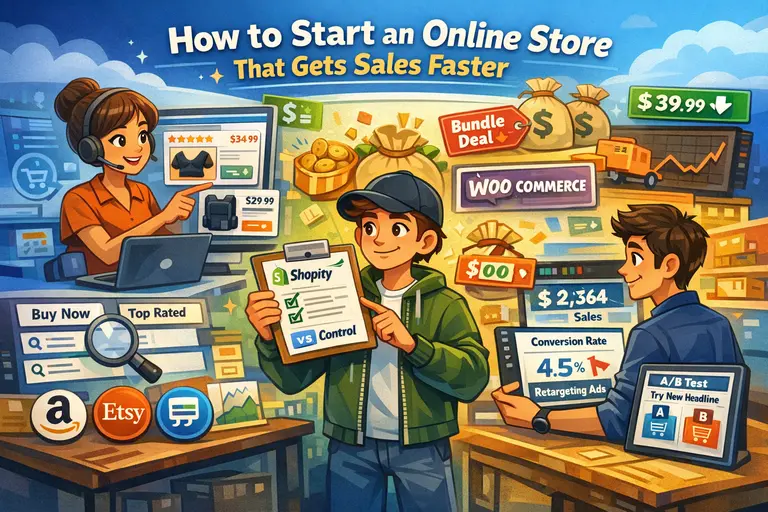 How to Start an Online Store That Gets Sales Faster
 Is Creating An Online Store Worth It? The Honest Pros, Cons, And Numbers
 Ecommerce Store Guide: 7 Negative Pitfalls to Avoid
 Why Is Creating An Online Store So Hard? 11 Brutal Truths Beginners Miss
 Should I Start Creating An Online Store? 9 Honest Signs You’re Ready
 Ecommerce Platform Business Opportunities You Can Start With Real Profit Potential