
Table of Contents
Some links on The Justifiable are affiliate links, meaning we may earn a small commission at no extra cost to you. Read full disclaimer.
LearnWorlds worth it for online course businesses is a fair question, especially when you are trying to choose a platform that will not box you in six months from now. I’ve looked at enough course platforms to know that flashy demos can hide real tradeoffs.
LearnWorlds stands out because it combines strong course delivery, deep customization, interactive video, and serious training features in one system. But that does not automatically make it the best fit for everyone.
The real answer depends on your business model, your content style, and how much control you actually need.
What LearnWorlds Is And Who It Is Really Built For
LearnWorlds is more than a simple course uploader. It positions itself as an AI-powered LMS, which basically means a learning management system designed to help you build, sell, manage, and track online learning experiences from one place.
On its public site, LearnWorlds highlights interactive videos, ebooks, assessments, certificates, SCORM content, surveys, course pathways, and community-style learning features. That is a wider learning stack than many creator-first platforms offer.
Who It Is Best For
When I look at LearnWorlds, I do not see a platform built only for hobby creators. I see something aimed at businesses that care about learner experience, brand control, and structured education. That includes coaches with premium programs, training companies, membership academies, certification programs, and even B2B education teams.
What makes that important is the difference between “selling content” and “running a learning business.” If your model is mostly a few videos and a checkout page, LearnWorlds may be more platform than you need. But if you want progress tracking, stronger learner engagement, multiple content formats, branded course environments, or business training workflows, it starts to make more sense.
I also think its native support for things like SCORM matters more than most beginners realize. SCORM is a standard format used in professional training and compliance learning. Many solo creators will never touch it, but training providers and company education teams often care a lot.
LearnWorlds specifically markets SCORM support to corporate learning, HR, onboarding, and training organizations, which tells you a lot about where it wants to compete.
Why The Audience Fit Matters More Than The Feature List
A lot of buyers get distracted by giant comparison charts. I get it. Features feel concrete. But the better question is whether the platform matches your business maturity.
Imagine two businesses. One is a first-time creator selling a $49 mini-course to a small email list. The other sells a $1,500 certification with exams, cohorts, workbooks, and client reporting. Those businesses do not need the same platform, even if both technically “sell courses.”
That is where LearnWorlds becomes interesting. It is usually strongest when the business treats education as a real product, not just a side file download. In my experience, that is the dividing line.
How LearnWorlds Works For A Real Course Business
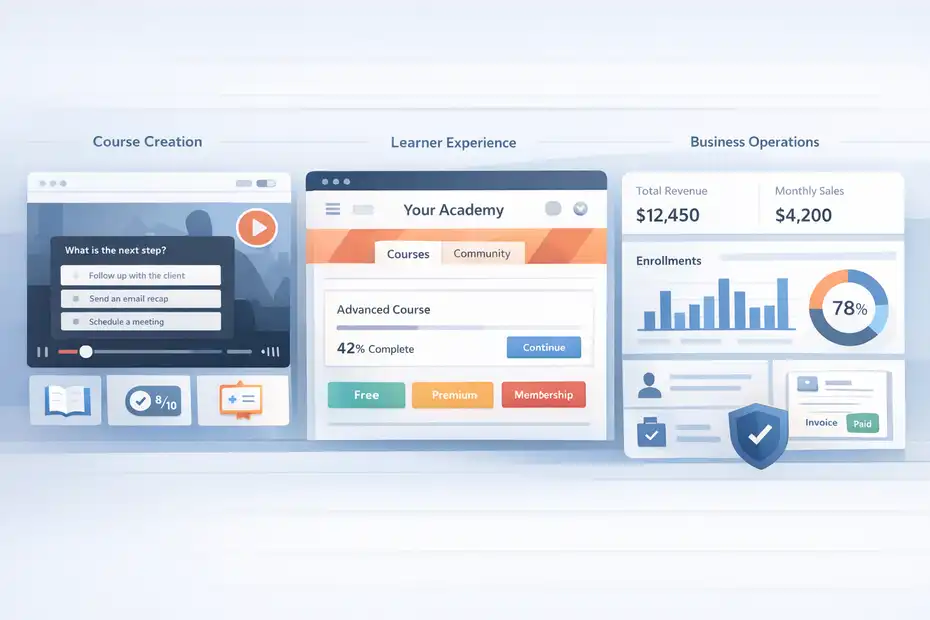
If you are trying to decide whether LearnWorlds is worth it, you need to understand how the platform behaves in practice, not just what it claims in a headline.
The key thing is that LearnWorlds combines three layers: course creation, learner experience, and business operations.
Course Creation And Delivery
At the course level, LearnWorlds lets you build with videos, ebooks, quizzes, certificates, surveys, live sessions, and structured learning paths. It also leans heavily into interactive video, where you can add questions, call-to-action buttons, pop-ups, and engagement elements directly inside the player.
LearnWorlds says those video tools also include analytics, subtitles, translations, summaries, and transcript-based enhancements.
That matters because engagement is often the hidden weak point in course businesses. Most course creators focus on getting the sale.
Fewer focus on completion rate, learner confidence, and the moment where a student starts drifting. Interactive learning features can help keep people involved instead of passively watching.
A realistic example: If you teach sales training, you could place a question checkpoint halfway through a lesson and require the student to reflect before moving on. If you run a skincare academy, you could add a button inside the lesson that opens a treatment checklist or product protocol. That makes the learning experience feel more alive and more useful.
Website, Branding, And Learner Experience
This is one of LearnWorlds’ bigger selling points. The platform emphasizes branded school sites, customizable course players, and flexibility around free, paid, private, drip-fed, and curated course pathways.
In plain English, it gives you more control over how the student environment looks and feels than many lighter course platforms.
That control is important if your business depends on trust, perceived authority, or premium positioning. A clean, branded learning environment can raise perceived value fast. It can also reduce the “I bought a cheap template course” feeling that hurts referrals and renewals.
For many of us, this is where value shows up indirectly. Better presentation improves completion, support satisfaction, and word of mouth, even when it does not appear as a neat line item on a dashboard.
Business Operations And Reporting
LearnWorlds also pushes into the business side with ecommerce, payment integrations, tax integrations, user progress reporting, learner monitoring, invoicing, and security features like 2FA.
Its plan comparison page highlights payment gateways including Stripe and PayPal, plus options like Apple Pay, Google Wallet, and buy-now-pay-later methods through Stripe. It also mentions reporting filters and tax integrations such as Stripe Tax and Quaderno.
This is where the platform starts to justify its price for serious operators. A course business stops being “content online” pretty quickly. It becomes payments, taxes, completion tracking, support tickets, certificates, access rules, cohorts, and retention. If one platform can handle more of that cleanly, it can save real operational time.
Where LearnWorlds Delivers The Most Value
This is the section where the answer starts shifting from “maybe” to “yes” for the right business. LearnWorlds is not valuable because it has a lot of buttons.
It is valuable when those buttons solve expensive problems.
It Gives You More Control Over The Learning Product
Some platforms are good at selling. Others are better at teaching. LearnWorlds tends to lean toward the second group without ignoring the first.
Its content mix is wider than basic course platforms. You are not limited to simple video modules. You can create richer learning paths, add assessments, use certificates, build ebooks, run live components, and track progress. That is especially useful when your product promise depends on transformation, not just information.
I believe this is one of the biggest reasons businesses stay with LearnWorlds. If your customers need structure, checkpoints, or proof of completion, the platform supports that better than a lightweight creator tool.
A simple scenario makes this clear. Say you sell a leadership course to HR departments. A plain video library is harder to position as serious training. A branded academy with assessments, pathways, certificates, and progress tracking feels more enterprise-ready. That difference can affect close rates.
Interactive Video Can Be A Real Competitive Advantage
Most course platforms say they support video. LearnWorlds treats video like an interactive learning surface. Its interactive video tools include embedded questions, call-to-action buttons, pop-ups, and analytics, which is unusually strong for a course platform.
That can help in three ways:
- It can improve completion by interrupting passive watching.
- It can drive action, such as booking a call or downloading a worksheet.
- It can create a more premium student experience.
I would not call this feature important for every course business. But for skills training, professional education, software demos, onboarding, certification prep, and high-ticket coaching support, it can genuinely matter.
Think of it like this: if your content is your product, then engagement design is part of product quality. LearnWorlds gives you more room to shape that than most alternatives.
It Bridges Creator And Training Company Needs
This is one area where LearnWorlds is unusually flexible. Its public materials clearly show it serves creators, training providers, and organizations that need formal learning standards like SCORM. That is not a common overlap.
That bridge matters if your business is evolving. Maybe today you sell direct-to-consumer courses. Next year you want to license training to teams, schools, or client organizations. A platform that can grow with that shift is worth more than a cheaper one you outgrow.
Where LearnWorlds Can Feel Expensive Or Frustrating
A real review needs to say this clearly: LearnWorlds is not automatically “worth it” just because it is powerful.
Some businesses will absolutely pay for capabilities they never use.
The Learning Curve Is Real
The more flexible a platform becomes, the more setup choices it creates. That is the tradeoff.
Capterra’s overview describes LearnWorlds as strong for visual course design and brand control, but it also notes a learning curve, occasional bugs, and pricing concerns for smaller teams, especially if they need advanced customization or multilingual support.
That tracks with how these platforms usually work. More control means more decisions: page structure, learner paths, reports, checkout setup, course player options, certificates, content types, integrations, and permissions.
If you are the kind of owner who wants things to “just work” with minimal setup, you may find LearnWorlds a little heavy.
I suggest being honest with yourself here. Do you enjoy configuring systems? Or do you want the shortest route from idea to sale? That answer changes everything.
Some Smaller Businesses Will Overbuy
This is the most common mistake I see with software. People buy for their ideal future business, not their current business.
If you have one flagship course, a simple sales process, and no real need for advanced reporting or interactive content, LearnWorlds may still work well, but it may not be your best financial decision. You may end up spending time setting up features that your students never notice.
This is especially true if you are pre-validation. At that stage, speed often beats sophistication. A simpler platform can be the better move while you prove demand.
That does not mean LearnWorlds is overpriced. It means price only makes sense when matched to actual operational complexity.
You Need To Watch The Gap Between Features And Execution
One thing I always look for is whether a platform’s feature depth turns into real business use, or just impressive screenshots. LearnWorlds generally has a strong reputation, with 4.7 out of 5 stars on G2 across hundreds of reviews, and 4.7 on Capterra from 190 reviews.
That is a healthy sign. Still, review summaries also mention the occasional technical friction and complexity.
That tells me the platform is well regarded, but not magic. You still need good implementation, solid course design, and a reason for using the more advanced capabilities.
Pricing, Costs, And The Real ROI Question
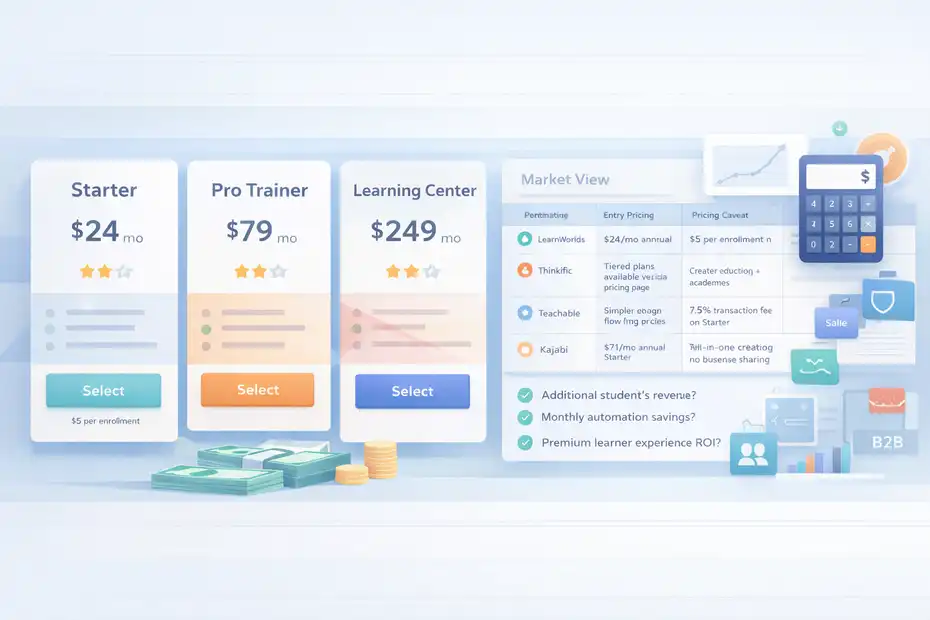
This is where the “worth it” question becomes practical. You are not buying features. You are buying a return.
LearnWorlds publicly lists plans starting around Starter at $24 per month, Pro Trainer at $79 per month, and Learning Center at $249 per month on annual billing.
It also states that the Starter plan includes a $5 fee per course enrollment, while higher plans remove that platform transaction fee.
Pricing Snapshot Compared With Alternatives
A rough market view helps. Official pricing pages show LearnWorlds competing in the same general decision set as Thinkific, Teachable, and Kajabi, though each plays a slightly different game.
| Platform | Entry Pricing Seen Publicly | Notable Pricing Caveat | General Positioning |
|---|---|---|---|
| LearnWorlds | $24/mo annual for Starter | $5 per enrollment on Starter | Learning experience + customization |
| Thinkific | Pricing page available; tiered plans | Pricing varies by plan and billing | Creator education + scalable academies |
| Teachable | $39/mo monthly Starter | 7.5% transaction fee on Starter | Simpler selling flow for creators |
| Kajabi | $71/mo annual Starter | Higher starting price, no revenue sharing | All-in-one creator business platform |
The exact fit matters more than the sticker price. LearnWorlds looks more affordable than Kajabi at entry level and more feature-rich for learning design than many creator-focused tools, but it can cost more in time and complexity.
Teachable starts simple, but its Starter tier includes a 7.5% transaction fee. Kajabi emphasizes all-in-one business operations and no revenue sharing, but its public pricing starts materially higher.
How To Calculate Whether The Cost Makes Sense
Here is the simple way I recommend looking at it.
Ask three questions:
- How much revenue does one additional successful student represent?
- How much time would better automation, reporting, and delivery save each month?
- Would a more premium learner experience support higher pricing or lower churn?
If better delivery lets you retain just two extra students in a $500 program, that alone can cover a lot of software cost. If branded learning and tracking help you close one B2B client, the platform may pay for itself many times over.
On the other hand, if you are selling a low-ticket mini-course with minimal support, the extra sophistication may not move the needle enough.
The Hidden Cost Is Not Always The Subscription
I think this is where people get software ROI wrong. The hidden cost is often not the monthly fee. It is the mismatch.
A cheap platform becomes expensive when you outgrow it and need workarounds. An advanced platform becomes expensive when you never use its strengths.
The winner is the one that matches your actual business model right now, while still giving you some room to grow.
How To Decide If It Fits Your Business Model
This is the fastest framework I can give you. LearnWorlds is usually worth it when your business needs richer education delivery, stronger brand control, or more operational structure.
Choose LearnWorlds If Your Business Looks Like This
You will probably get strong value from LearnWorlds if you sell premium courses, certifications, coaching-backed programs, academies, or training products where completion and student experience matter as much as checkout conversion.
You are also a strong fit if you need:
- Branded course environments
- Multiple learning formats
- Progress tracking and reporting
- Interactive lessons
- Better support for formal education or training workflows
- Room to serve both individuals and organizations
This is where LearnWorlds can become a business asset rather than just a software expense.
Be Careful If Your Business Looks Like This
You may want to think twice if you are in one of these situations:
- You are launching your first tiny course and need maximum simplicity.
- You mostly care about funnels, email, and creator commerce over learning design.
- You have no need for advanced learner experience features.
- You hate setup and want a more stripped-down interface.
- You are price-sensitive and your margins are still very thin.
I do not say that to push you away from the platform. I say it because a good platform recommendation should protect you from overcomplicating your business too early.
A Quick Decision Filter
If your product promise sounds like “access my content,” LearnWorlds may be optional.
If your product promise sounds like “complete this program, build this skill, pass this certification, or train this team,” LearnWorlds becomes much more compelling.
That one sentence test is not perfect, but it is surprisingly useful.
Best Use Cases By Business Type
Not all online course businesses buy software for the same reason. LearnWorlds shines differently depending on what you sell.
Solo Expert Selling Premium Signature Courses
For a solo expert, LearnWorlds is often worth it when the course is premium enough that student experience affects referrals, testimonials, and renewals. A $1,000 flagship program can justify branded delivery, richer lesson design, and better perceived authority more easily than a $49 course.
In this case, I would treat LearnWorlds as a product quality tool. The cleaner your academy feels, the less your offer looks like a repackaged information bundle.
Membership Academy Or Continuing Education Brand
If you run a membership, library, or educational brand with ongoing releases, LearnWorlds starts making even more sense. Structured pathways, content variety, and a more complete school environment can keep members engaged longer.
This matters because retention is the whole business in recurring models. A prettier dashboard alone will not save churn, but a stronger learning environment can absolutely help people keep using what they paid for.
Training Company Or B2B Education Provider
This is one of the strongest fits. LearnWorlds openly supports things like SCORM, reporting, learner monitoring, security controls, and enterprise-style options on higher tiers.
That makes it more attractive for compliance training, client education, employee onboarding, and professional certification businesses.
If you sell training to organizations, the platform can help you look more credible and operate more cleanly than many creator-first tools.
Common Mistakes People Make Before Choosing
Picking software is rarely just a feature decision. It is usually a judgment problem.
Mistake One: Choosing Based On Marketing Hype
Every platform promises growth, simplicity, and scale. That is normal. The better move is to map features to your workflow.
Do you need assessments? Certificates? Formal progress tracking? Interactive video? Better branding? Multiple course types? If yes, LearnWorlds deserves a serious look. If not, hype should not push you into complexity.
Mistake Two: Ignoring Enrollment Economics
That $5 per enrollment on the Starter plan is not a big deal for some businesses and a bad deal for others. If you sell high-ticket offers, it may barely matter. If you sell volume at lower prices, it adds up faster.
LearnWorlds is transparent about that fee on Starter, so it is worth doing the math before you assume the cheapest plan is the best one.
Mistake Three: Underestimating Setup Time
A platform with more depth often needs more thoughtful implementation. That can be a great trade when the business is ready for it. It can also become procrastination in disguise.
I recommend asking: “Am I choosing a better tool, or am I avoiding selling by building a prettier system?” That question stings, but it saves people a lot of money.
How To Test LearnWorlds Before Committing
The smartest way to answer “Is LearnWorlds worth it?” is not to debate it forever. It is to test the platform against your actual workflow.
Build One Real Offer, Not A Fake Demo
Use a trial or short test period to create one real mini-version of your business:
- One actual course or sample module
- One checkout flow
- One onboarding sequence
- One certificate or assessment if relevant
- One branded landing page or school area
That tells you far more than clicking around a template dashboard.
Score It Against Business Outcomes
Do not evaluate the platform only on aesthetics. Score it on outcomes:
| Test Area | What To Ask |
|---|---|
| Setup Speed | Could you build your core offer without getting lost? |
| Learning Experience | Does the student experience feel worth your price point? |
| Brand Control | Does it look and feel like your business, not the platform’s? |
| Operations | Can you manage payments, learner progress, and support cleanly? |
| Growth Fit | Will this still work if you double your students or expand offers? |
This kind of scorecard helps because it keeps you from being dazzled by features you will never touch.
Run A Simple ROI Simulation
Here is an easy model. Estimate your monthly software cost. Then estimate the value of one of these outcomes:
- One extra sale from better perceived quality
- One fewer refund from clearer course delivery
- One hour saved per week in admin
- One B2B client won because the academy feels more professional
If even one of those numbers exceeds the cost consistently, the platform may already justify itself.
Honest Verdict: Is LearnWorlds Worth It?
Yes, LearnWorlds is worth it for online course businesses when you are building a real education product and not just uploading content behind a paywall.
That is my honest verdict.
I think LearnWorlds earns its place when your business needs richer learning design, stronger branding, better learner engagement, and more operational depth than a basic creator platform offers.
Its interactive video tools, structured learning features, customization, and support for more formal training use cases make it genuinely attractive for premium courses, academies, and training businesses.
Its public pricing also makes it more accessible than higher-end all-in-one tools like Kajabi, while still offering capabilities many lighter platforms do not match.
But no, it is not automatically worth it for every business. If you are brand new, very price-sensitive, or mainly need a fast, simple way to sell a straightforward course, you may be paying for depth you do not need yet. The learning curve and setup overhead are real, and third-party review summaries reflect that even alongside strong overall ratings.
So here is the cleanest answer I can give you.
LearnWorlds is worth it when:
- Your course business depends on learner experience, not just checkout pages.
- You want a branded academy, not a generic course shell.
- You need room to serve premium students, members, teams, or clients.
- You are willing to invest a little more setup effort for a stronger product.
LearnWorlds is probably not worth it when:
- You only need the simplest possible launch stack.
- Your margins are tight and advanced features will sit unused.
- You care more about creator commerce convenience than structured learning delivery.
If I were advising a serious course business with ambitions beyond a simple starter offer, I would absolutely put LearnWorlds on the shortlist. For the right business, it is not just “worth it.” It can be one of the smarter long-term platform decisions you make.
FAQ
Is LearnWorlds worth it for online course businesses?
Yes, LearnWorlds is worth it for online course businesses that need strong course delivery, branding control, and interactive learning features. It makes the most sense for premium courses, memberships, and training businesses. For very simple course setups, a lighter platform may feel easier and more cost-effective.
Who should use LearnWorlds for selling online courses?
LearnWorlds works best for coaches, educators, training companies, and course creators who want more than basic video hosting. It is especially useful when your business needs certificates, assessments, interactive video, student tracking, and a branded learning experience that feels more professional and valuable to paying students.
What makes LearnWorlds different from other course platforms?
LearnWorlds stands out because it focuses heavily on the learning experience, not just sales pages. It offers interactive video, course customization, branded school design, and advanced learning tools. That makes it a stronger fit for businesses that care about engagement, completion rates, and long-term student satisfaction.
Is LearnWorlds good for beginners starting an online course business?
LearnWorlds can work for beginners, but it is usually better for people who already know what they want to sell. The platform has more depth than simple course tools, so setup can take longer. If you want fast validation with minimal complexity, a simpler platform may feel less overwhelming.
How do I know if LearnWorlds fits my business model?
LearnWorlds fits best when your offer is built around transformation, structured learning, or professional training. If your students need progress tracking, certificates, assessments, or a premium branded experience, it is a strong option. If you only need a basic course checkout and content area, it may be more than necessary.

I’m Juxhin, the voice behind The Justifiable.
I’ve spent 6+ years building blogs, managing affiliate campaigns, and testing the messy world of online business. Here, I cut the fluff and share the strategies that actually move the needle — so you can build income that’s sustainable, not speculative.
Related posts:
 LearnWorlds Features Overview: Tools That Power Online Courses
 Internet Marketing Ideas: Increase Your Marketing Efforts
 How to Increase Social Media Followers
 Squirrly SEO – The Ultimate WordPress SEO Plugin for Boosting Your Website’s Rankings
 Create a Blog Post That Ranks and Brings in Traffic
 LearnWorlds Online Course Platform Review: Hidden Advantages