
Table of Contents
Some links on The Justifiable are affiliate links, meaning we may earn a small commission at no extra cost to you. Read full disclaimer.
A strong manychat conversational marketing strategy works because it meets people where they already are: inside DMs, replies, and message threads that feel natural instead of forced.
If you are trying to turn social attention into leads and sales without sounding robotic, ManyChat is one of the clearest tools to build that bridge, especially across Instagram, WhatsApp, Messenger, SMS, and now TikTok-focused automation use cases.
Understand What A ManyChat Conversational Marketing Strategy Really Is
A lot of brands treat chat automation like a support shortcut. That is too small.
The real opportunity is using conversation as a sales journey, not just a response mechanism.
What Conversational Marketing Means In Practice
A manychat conversational marketing strategy is the system you use to move someone from curiosity to action through interactive messages instead of static landing pages alone.
In plain English, that means your prospect comments on a post, replies to a Story, sends a keyword, or clicks a DM prompt, and the conversation guides them toward the next best step. That step might be claiming a lead magnet, answering a qualification question, booking a call, or buying a product.
What makes this different from old-school funnels is the timing. The message arrives when intent is already high. Someone is not passively browsing a homepage. They are actively engaging. That is why conversational flows often feel more natural than sending every person to the same generic page.
ManyChat is built around that behavior. The platform supports two-way automation across Instagram Direct Messages, Facebook Messenger, WhatsApp, SMS, and promotional use cases highlighted on its site, with TikTok-focused automation also appearing in its recent product messaging.
In my experience, this is where a lot of businesses finally connect marketing and sales. You are not just “getting engagement.” You are designing a path where engagement becomes qualified intent.
Why This Strategy Works Better Than Generic Social Traffic
Social traffic is messy. A post can perform well and still produce almost no revenue because attention and action are not the same thing. A conversational strategy helps reduce that gap by giving people a low-friction next step inside the platform where they are already active.
This matters because social channels are still central to marketing performance.
HubSpot’s 2026 marketing statistics page says Instagram is the most popular social media platform used by marketers at 70%, and marketers cite Instagram as the top ROI-driving social platform.
HubSpot also notes that 26% of marketers plan to explore selling products directly on social media in 2026.
That context matters for ManyChat. If your audience is already discovering products on social, a DM-based journey lets you capture interest before it cools off. Instead of hoping someone clicks a bio link, waits for a page to load, and keeps going, you can guide them through a short decision flow right inside the conversation.
I believe this is one of the biggest reasons conversational marketing converts. It shortens the mental distance between “this looks interesting” and “I want details.”
The Core Sales Motions You Should Build Around
Most successful ManyChat strategies are not trying to automate everything. They focus on a few high-intent motions that repeat every week.
A practical setup usually centers on these motions:
- Lead Capture: Offer a guide, quiz result, checklist, coupon, or training through DM.
- Qualification: Ask one to three questions to segment people by need, budget, or urgency.
- Recommendation: Match the person with the right product, service, or content path.
- Follow-Up: Send reminders, FAQs, proof, or urgency-based nudges.
- Handoff: Route sales-ready leads to a human, calendar, checkout page, or support team.
Imagine you run a skincare brand. Someone comments “routine” on a reel. Instead of sending them to a cluttered homepage, your flow asks about skin type, main concern, and routine preference, then gives a product match and a discount code. That feels helpful, not pushy.
That is the heart of the strategy: not more messages, but better-timed messages with a clear purpose.
Build The Foundation Before You Automate Anything
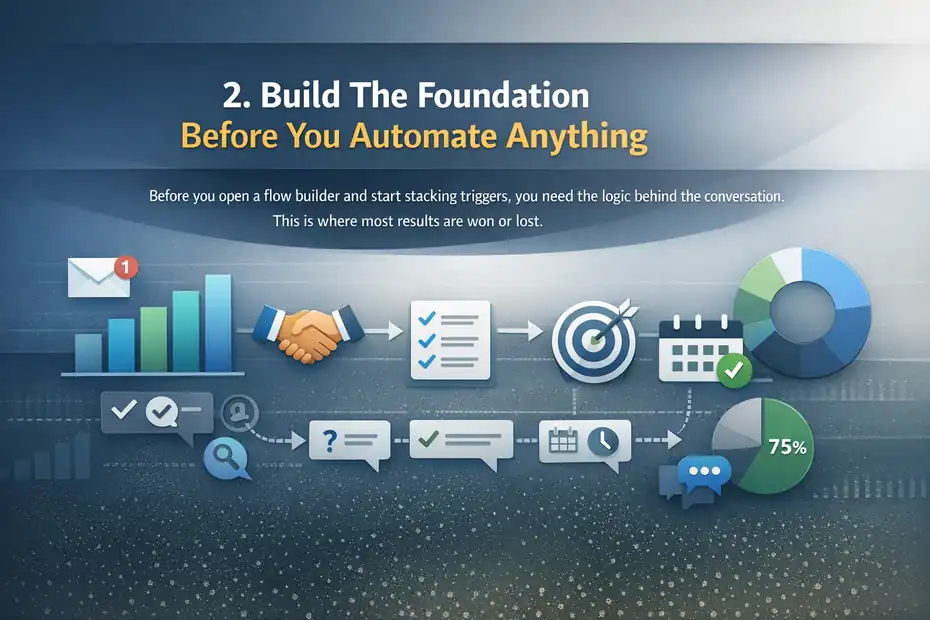
Before you open a flow builder and start stacking triggers, you need the logic behind the conversation. This is where most results are won or lost.
Start With One Offer And One Conversion Goal
The cleanest manychat conversational marketing strategy starts narrow. One offer. One audience segment. One measurable outcome. I recommend resisting the urge to build a giant automated maze right away.
Pick a single conversion goal such as:
- Lead generation: Capture email, phone, or opt-in interest.
- Sales assist: Help a person choose the right product or package.
- Appointment booking: Move qualified prospects to a call or demo.
- Recovery: Re-engage people who showed interest but did not buy.
If you try to push education, support, lead gen, upsells, event registration, and feedback collection through the same first flow, it usually gets messy fast. The flow becomes clever instead of useful.
A better starting point is something like this: “When a prospect comments on our pricing explainer reel, send a DM that helps them choose the right package and book a consult.” That is focused. It gives you a specific trigger, a specific audience, and a specific business result.
I have seen simple flows outperform “advanced” setups because the message path was obvious. Clarity converts. Complexity confuses.
Map The Conversation Like A Human, Not Like Software
This is the part many people skip, and it shows. Before building anything in ManyChat, write the conversation as if you were manually replying to a prospect.
Ask yourself:
- What usually makes this person start the conversation?
- What is the first question they need answered?
- What confusion blocks the sale?
- What proof would help them trust us?
- What is the easiest next step?
Then sketch the flow in plain language. Not blocks. Not logic trees. Actual human conversation.
For example:
- Thanks them for reaching out.
- Confirms what they want.
- Asks one qualifying question.
- Gives the most relevant recommendation.
- Handles the top objection.
- Offers one next step.
That sequence feels obvious because it mirrors good sales conversations. It also prevents a common automation mistake: asking too much too early. If the first thing your flow does is request five pieces of information, drop-off will rise.
From what I’ve seen, the best conversational funnels feel less like forms and more like guided choices.
Choose The Right Channel Based On Intent
ManyChat supports several messaging environments, but not every channel fits the same intent. On its official site, ManyChat emphasizes Instagram, WhatsApp, Messenger, SMS, and TikTok-related automation use cases, while its Instagram product page focuses heavily on DM-triggered growth and sales moments.
That matters because channel choice should follow buyer behavior:
- Instagram: Best for creator brands, ecommerce discovery, giveaways, lead magnets, and product education from content.
- WhatsApp: Better for warmer leads, customer communication, order questions, and more direct conversion-focused chats.
- Messenger: Still useful for Facebook-driven audiences and some service businesses.
- SMS: Useful for short reminders or reactivation when consent is clear.
I suggest starting where intent is already visible. If your business gets lots of post comments, Story mentions, or DM questions on Instagram, begin there. If your customers already use WhatsApp for buying questions, prioritize that path.
The channel is not the strategy. It is the delivery layer. The strategy is how you move a person from interest to action with the fewest possible points of friction.
Set Up High-Converting ManyChat Flows Step By Step
Once your goal is clear, it is time to build flows that feel natural, fast, and genuinely helpful. This is where the platform matters, but the psychology matters more.
Use Entry Points That Capture High Intent Fast
ManyChat’s Instagram automation materials highlight DM-based growth actions like auto-messaging new followers, comment-driven replies, and guided conversations designed to move people toward offers or appointments.
Its educational resources also reference automation triggers, key features, and setup training for Instagram automation.
The best entry points are the ones tied to visible intent. In practice, that often means:
- Comment triggers: Great for reels, testimonials, before-and-after posts, and educational posts.
- Story replies: Useful when someone reacts to an offer, FAQ, or poll.
- Keyword DMs: Strong for podcasts, webinars, or creator promotions.
- Link-in-bio prompts: Good when you want a DM journey instead of a static page.
Here is a simple rule I use: match the trigger to the content promise. If the post says “Comment ‘guide’ and I’ll send it,” the first DM should deliver that guide immediately. Do not bait people with one promise and then switch to a sales pitch.
That sounds obvious, but it is one of the fastest ways to destroy trust. Deliver first. Then guide the next step.
Structure Each Flow Around Micro-Commitments
A sale rarely happens because of one message. It happens because the conversation keeps earning tiny yeses.
Inside each flow, use micro-commitments:
- Yes 1: The person opens the DM.
- Yes 2: They tap the option that matches their need.
- Yes 3: They answer one simple question.
- Yes 4: They click the recommended next step.
- Yes 5: They complete the booking or purchase action.
This is why multi-choice prompts work so well. They reduce friction and make the conversation feel easy. Instead of asking, “Tell us everything you need,” ask, “What are you looking for today?” and offer three clear options.
Imagine a fitness coach selling a low-ticket challenge and a high-ticket coaching package. The flow can ask whether the person wants “meal support,” “fat loss,” or “accountability.” That one answer instantly changes the angle of the recommendation.
I recommend keeping the early path short. If someone has to click through eight branches before they see value, you are probably overengineering the flow.
Add Segmentation Without Making It Feel Like A Form
Segmentation is where ManyChat becomes powerful. You can tag people, branch conversations, and personalize follow-ups based on intent. But the trick is making it feel conversational.
Instead of asking for data because you want it, ask questions that help them get a better answer.
For example:
- “Are you shopping for yourself or for your team?”
- “Which result are you trying to get first?”
- “Would you rather start with the quick option or the full solution?”
Those questions do double duty. They improve the user experience and make your follow-up more relevant.
If you sell services, a great pattern is problem-based segmentation. If you sell products, goal-based segmentation usually works better. If you sell education, experience-level segmentation is often the most useful.
In my experience, the sweet spot is one to three segmentation questions. More than that, and the conversation starts feeling like homework. The goal is not to collect perfect data. The goal is to make the next message more useful than a generic one.
Turn Conversations Into Sales Without Sounding Pushy
This is where businesses either make money or accidentally build a polite little chatbot that never closes anything.
You need a sales path, but it has to feel earned.
Lead With Relevance, Not Pressure
Most people do not mind being sold to when the recommendation feels relevant. What they hate is being rushed into an offer before the context is clear.
A good sales-oriented flow usually follows this sequence:
- Context: Confirm what the person wants.
- Diagnosis: Ask a simple question that improves relevance.
- Recommendation: Present one clear option first.
- Proof: Add credibility, outcome examples, or a common use case.
- Action: Offer a direct next step.
This works because it mirrors how helpful sales conversations happen in real life. You listen first, then guide.
Let’s say someone replies to your Story after seeing a testimonial. A weak flow says, “Buy now.” A stronger flow says, “Glad you messaged. Are you looking for help with setup, optimization, or scaling?” Then the next message can be tailored to that answer, followed by a targeted offer.
I believe this is the biggest mindset shift in conversational selling. You are not pushing a product. You are helping someone sort through a decision faster.
Use Proof And Specificity Inside The Conversation
The fastest way to make a conversational flow feel generic is vague language. “This can help your business grow” means almost nothing. Specificity is what builds trust.
Use concrete proof elements such as:
- A mini result: “Most clients finish setup in under a week.”
- A realistic metric: “This flow reduced manual DM replies by 40%.”
- A practical use case: “Best for brands getting daily pricing questions.”
- A scenario: “Ideal if your team is losing leads from Story replies.”
You do not need giant claims. You need believable context.
Outside the platform itself, market behavior supports this direction. Zendesk’s 2025 CX trends coverage said 75% of CX leaders expected 80% of customer interactions to be resolved without human intervention in the next few years, while Salesforce’s AI-connected customer research highlights rising customer expectations and trust concerns around how brands use AI.
That tells us two things. First, automation is becoming normal. Second, trust is still fragile. So your messages should sound grounded, useful, and human.
Create Follow-Ups That Feel Timely, Not Annoying
Most sales happen after the first interaction, not during it. That is why follow-up matters so much. But timing and tone matter even more.
A strong follow-up sequence often includes:
- Reminder: “Still want the guide or recommendation?”
- Clarifier: “Need help choosing the right option?”
- Proof touch: “Here is how others use this.”
- Urgency touch: “Offer ends tonight” or “spots close Friday.”
- Human handoff: “Reply here and I’ll point you in the right direction.”
I suggest thinking of follow-up as assisted decision-making, not pestering. If the person asked about your offer yesterday, a reminder is useful. If they never engaged beyond a cold trigger, three aggressive sales nudges may feel like spam.
The best follow-ups respect temperature. Warm leads can handle stronger CTAs. Cold leads need more value first.
Measure, Optimize, And Fix What Is Not Converting
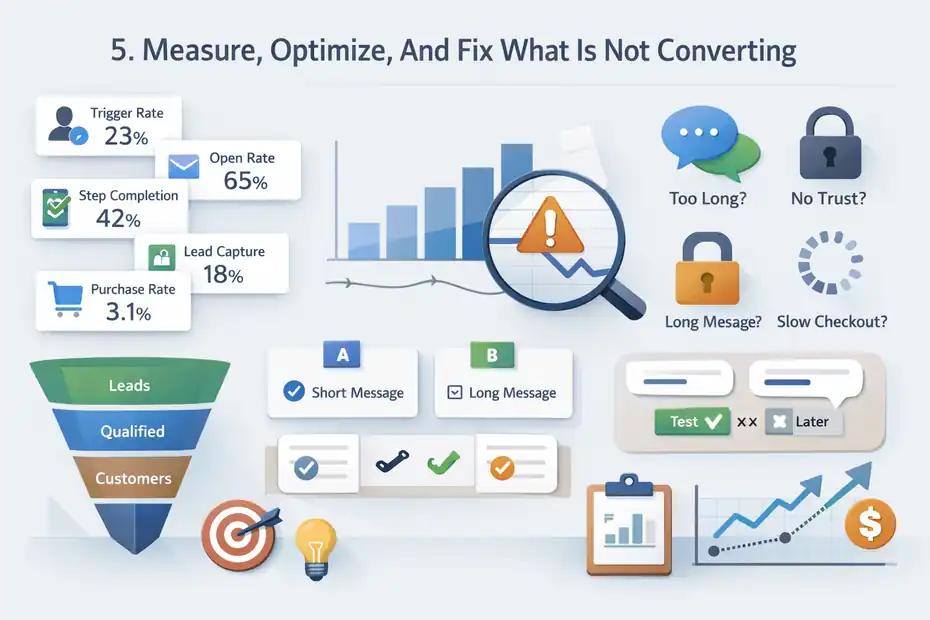
A manychat conversational marketing strategy is not done when the flow is live. It becomes profitable when you keep removing friction from the path.
Track The Metrics That Actually Matter
Vanity metrics can fool you in chat automation. Opens and clicks matter, but they are not enough on their own. You need to track the moments that predict revenue.
The most useful metrics are usually:
- Trigger rate: How many people enter the flow.
- Open rate or first engagement rate: How many respond to the initial message.
- Step completion rate: Where people continue or drop off.
- Lead capture rate: How many give contact info or qualify.
- Booking or purchase rate: How many complete the business goal.
- Human handoff rate: How many need manual support before converting.
HubSpot’s 2026 statistics page also notes that average ecommerce conversion rates remain under 2% across all ecommerce sites, depending on category and source.
That is useful context because it reminds you not to judge a conversational funnel by fantasy benchmarks. A DM flow that improves buyer intent, captures leads you would have lost, or raises assisted conversions can be a major win even if the direct purchase percentage looks modest.
Diagnose Drop-Off By Looking For Friction, Not Failure
When a flow underperforms, most people rewrite the copy first. Sometimes that helps, but copy is often not the real issue. Friction is.
Common friction points include:
- The first message is too long.
- The value promise is unclear.
- The flow asks too many questions too early.
- The call to action appears before trust is built.
- The recommendation feels generic.
- The handoff goes to a weak page or slow checkout.
Here is a simple troubleshooting method I use:
- If people do not open or respond: Fix the hook and the immediate relevance.
- If they respond but drop after question one: Reduce cognitive load.
- If they engage but do not click through: Improve the recommendation and proof.
- If they click but do not buy: The issue may be off-platform, not inside ManyChat.
This sounds basic, but it keeps you from changing everything at once. One clean diagnosis is usually worth more than ten random edits.
Run Small Tests Instead Of Full Rebuilds
Optimization works best when you isolate one variable at a time. I recommend testing short, high-impact changes before rebuilding the entire funnel.
Good tests include:
- Shorter opening message versus longer context-heavy opener.
- One qualifying question versus three.
- Product recommendation first versus education first.
- Button choices versus open text reply.
- Immediate CTA versus delayed CTA after proof.
For example, if your flow begins with a large paragraph explaining your brand, test a version that starts with a direct acknowledgment of why the person messaged. That alone can improve engagement.
In many cases, the biggest lift comes from small edits. One extra click removed. One question deleted. One proof message added at the right moment.
That is why I like conversational marketing so much. You can improve it quickly without rebuilding your whole acquisition system.
Use The Right Tools And Costs Without Letting The Tool Lead The Strategy
Tools matter, but only after the strategy is clear. ManyChat should support your funnel, not dictate it.
What ManyChat Gives You Operationally
ManyChat’s official product and pricing pages position it as a cross-channel chat automation platform for Instagram, WhatsApp, Messenger, SMS, and TikTok-oriented use cases, with a free plan and paid tiers that start at $15 per month, then scale with contact volume.
ManyChat’s help documentation also notes that a new pricing model was introduced on March 2, 2026, and plan availability can vary by region.
That matters operationally because it lets smaller teams start lean, test an offer, and only scale spending as their audience and contact base grow.
At a practical level, ManyChat is most useful when you need to:
- Capture demand from social comments and DMs.
- Qualify leads automatically.
- Route people by intent.
- Collect basic contact details.
- Trigger follow-ups without manual chasing.
- Blend automation with human takeover when needed.
I would not treat it like a magic revenue button. I would treat it like a conversion layer between audience attention and business action.
When WhatsApp, Instagram, Or SMS Makes The Most Sense
This is where channel economics and behavior meet. On Instagram, the strength is discovery. On WhatsApp, the strength is directness. On SMS, the strength is immediacy. Each has a different job.
ManyChat’s own materials emphasize Instagram for growth and automated DM journeys, while its WhatsApp documentation shows message-based pricing that varies by market. A March 18, 2026 help page lists example WhatsApp rates by country, which is a reminder that WhatsApp automation costs are not one-size-fits-all.
My general recommendation is:
- Use Instagram to capture and warm demand from content.
- Use WhatsApp for warmer purchase conversations, post-click support, and higher-intent customer communication.
- Use SMS for concise reminders, appointment nudges, or reactivation where consent and message value are clear.
This prevents the classic mistake of forcing every use case into the same channel.
The Best Tool Stack Around ManyChat
You do not need a huge stack, but you do need a clean one. A conversational strategy usually performs best when ManyChat connects to the rest of your buyer journey.
A practical stack often includes:
- CRM or lead destination: To store qualified leads.
- Email platform: To continue nurturing outside the chat.
- Calendar tool: For calls, demos, or consultations.
- Checkout or cart system: For direct purchase handoff.
- Analytics layer: To attribute leads, bookings, and revenue.
The key is not adding more software. It is making sure the conversation does not end in a dead zone. If your DM flow performs well but sends people to a cluttered, slow, or confusing next step, your conversion problem may not be ManyChat at all.
In my experience, the strongest setup is the simplest one that preserves context from conversation to conversion.
Avoid The Mistakes That Quietly Kill Results
Most ManyChat strategies do not fail dramatically. They just underperform quietly because the basics are off.
Mistake 1: Treating Automation Like A Broadcast Channel
This is probably the most common problem. Businesses use chat automation to send more messages rather than better messages.
A strong manychat conversational marketing strategy is not about volume. It is about relevance. If every trigger leads to the same promo, the automation may save time, but it will not build trust or conversion efficiency.
You need the conversation to match the reason someone engaged. A person who comments on a tutorial needs a different path from someone who replies to a discount Story. Same platform, different intent.
I suggest asking one blunt question before publishing any flow: “Would this feel helpful if I received it?” If the answer is no, fix the sequence before you launch.
Mistake 2: Asking For Too Much Too Soon
Automation can tempt you into building a perfect data-gathering machine. That usually backfires. The more effort you demand before giving value, the more people disappear.
This is especially true in DMs. Messaging environments are intimate and fast. People expect momentum. If your first response feels like a form, they leave.
A better approach is progressive profiling. Give something useful first. Then ask one simple question. Then guide the next step. That rhythm feels natural because the conversation earns the right to continue.
I believe this one adjustment alone can rescue a lot of underperforming flows.
Mistake 3: Sending Great Traffic Into A Weak Offer
Sometimes the automation is fine. The real issue is the offer. If your flow is generating engaged conversations but not sales, you may not have a messaging problem. You may have a product-market fit or offer clarity problem.
Watch for signs like these:
- People ask the same clarifying question repeatedly.
- Qualified leads click through but do not buy.
- People engage with the content but ignore the CTA.
- Prospects want a different format, price point, or outcome.
When that happens, do not keep polishing the automation forever. Revisit the offer, the positioning, or the next-step destination.
A good conversational system makes buyer friction easier to see. That is one of its hidden advantages.
Scale A Winning Strategy Without Losing The Human Feel
Once one flow works, the goal is not just “more automation.” The goal is expanding what works while protecting relevance and trust.
Expand By Intent Cluster, Not By Random Content
The cleanest way to scale is to build around repeatable buyer intents. Think in clusters like:
- Product education
- Pricing questions
- Outcome-based recommendations
- Lead magnets
- Demo or booking requests
- Cart or checkout hesitation
- Post-purchase onboarding
Each cluster can have its own trigger, its own qualifying question, and its own CTA. That makes your automation ecosystem easier to manage because each flow has a clear purpose.
Imagine you are an agency. One content cluster attracts beginners who want a free audit checklist. Another attracts mature leads asking about retainers. Those should not enter the same sequence. They need different conversation paths and different conversion goals.
That is how you scale without making the whole system feel generic.
Blend Automation And Human Support Intentionally
The future is not “bots replace people.” The smarter model is automation handles the first 60% to 80% of repetitive interaction, then humans step in where nuance matters most.
Zendesk’s 2025 CX trends coverage and Salesforce’s recent customer research both point toward growing AI use alongside trust-sensitive customer expectations.
That lines up with what works in practice. Let the automation greet, qualify, route, answer basic FAQs, and recommend next steps. Then let a human step in when:
- The lead is high value.
- The purchase is complex.
- The objection is sensitive.
- The account needs customization.
- The person clearly wants direct support.
This gives you scale without losing judgment.
Build A Feedback Loop That Improves The System Every Month
A conversational strategy gets stronger when you treat it like a living sales asset. Every month, review the data and the real conversations.
Look for:
- Repeated objections
- Repeated product confusion
- Strong triggers by content type
- Weak drop-off points
- Questions your flow still does not answer
- Segments that convert far better than others
Then feed that learning back into content, offers, and flow design.
This is the part most brands miss. ManyChat is not just an automation tool. It is also a listening tool. The conversations tell you what people care about, what they fear, and what they still do not understand.
If you use that signal well, your content gets sharper, your offers get stronger, and your sales process gets easier.
Final Thoughts
A manychat conversational marketing strategy that drives sales is not built on clever automation tricks. It is built on relevance, timing, and clear next steps. Start with one offer, one audience, and one high-intent trigger.
Build a short conversation that helps people move forward faster. Then watch the drop-off points, tighten the message path, and scale only what proves itself.
That is the approach I recommend because it keeps the strategy grounded in real buyer behavior.
And when you get it right, ManyChat stops being “just another marketing tool” and becomes a practical sales system sitting right inside the conversations your audience is already having.
FAQ
What is a manychat conversational marketing strategy?
A manychat conversational marketing strategy is a system that uses automated chat flows to guide users from initial interest to conversion through platforms like Instagram, WhatsApp, and Messenger. It focuses on real-time engagement, personalized responses, and structured conversations that help qualify leads, answer questions, and drive sales without relying solely on traditional landing pages.
How does ManyChat help increase sales through conversations?
ManyChat increases sales by capturing high-intent interactions and turning them into guided conversations. It uses triggers like comments or DMs to start automated flows that recommend products, answer objections, and direct users to purchase or booking pages, reducing friction and improving conversion rates compared to passive website traffic.
What are the best entry points for a ManyChat funnel?
The best entry points for a ManyChat funnel include Instagram comment triggers, Story replies, keyword-based DMs, and link-in-bio prompts. These entry points work well because they capture users at moments of high intent, allowing businesses to immediately respond with relevant messages and guide them toward a specific outcome.
How do you optimize a ManyChat conversational flow?
To optimize a ManyChat conversational flow, focus on reducing friction, shortening messages, and improving relevance. Track where users drop off, simplify early questions, and test different calls to action. Small changes like clearer prompts or better timing can significantly increase engagement and conversions over time.
Is ManyChat suitable for small businesses or beginners?
Yes, ManyChat is suitable for small businesses and beginners because it offers a simple setup and scalable pricing. You can start with basic automation for lead capture or customer support, then expand into more advanced conversational marketing strategies as your audience and business needs grow.

I’m Juxhin, the voice behind The Justifiable.
I’ve spent 6+ years building blogs, managing affiliate campaigns, and testing the messy world of online business. Here, I cut the fluff and share the strategies that actually move the needle — so you can build income that’s sustainable, not speculative.
Related posts:
 ManyChat vs Chatfuel Comparison: Which Wins for Automation?
 Top Marketing for Business Tactics Every Entrepreneur Must Know
 ClickMagick Pricing: How to Get the Most for Your Money
 AI-Powered Ad Creative: Smarter Ads, Better ROI!
 Voluum Pricing: Which Plan Saves You the Most Money?
 Constant Contact Pricing: Which Plan Is Right for You?