
Table of Contents
Some links on The Justifiable are affiliate links, meaning we may earn a small commission at no extra cost to you. Read full disclaimer.
A strong hello bar lead generation strategy can turn casual, cold visitors into real leads without making your site feel pushy.
I like this approach because it meets people where they already are: browsing, comparing, hesitating, and deciding whether they trust you yet. Instead of trying to force a sale too early, you use well-timed bars, popups, and embedded offers to earn a small yes first.
That first yes is the bridge from anonymous traffic to an email subscriber, demo request, quiz taker, or qualified prospect.
Understand What A Hello Bar Lead Generation Strategy Really Does
A lot of people install a bar, add “Join Our Newsletter,” and hope for the best. That is not really a strategy.
A real system matches message, timing, page intent, and visitor temperature.
What Cold Traffic Actually Needs Before It Converts
Cold traffic is skeptical by default. These people usually do not know your brand, do not trust your claims yet, and often do not care about your company story. They care about one thing first: “Is this useful for me right now?”
That is why a hello bar lead generation strategy works best when the offer is smaller than the final sale. You are not asking a first-time visitor to make a giant commitment. You are asking for a low-friction next step, like downloading a checklist, taking a quiz, claiming a discount, or getting one practical email series.
In my experience, this is where many sites lose easy conversions. They confuse traffic with intent. A person landing on a blog post from Google is not in the same mindset as someone returning to your pricing page for the third time. If you show the same generic opt-in to both, you flatten your conversion potential.
Hello Bar is built around this idea of matching the offer to the moment. Its platform includes bars, modals, targeting by source and location, page-level rules, and behavior-based triggers so you can present different messages to different visitors instead of running one site-wide offer.
Hello Bar also says it is used by more than 600,000 websites, which matters because it suggests the tool has been shaped around common real-world onsite conversion use cases.
Why Onsite Lead Capture Still Matters For Cold Traffic
Cold traffic leaks fast. If you do nothing, most people leave and never come back. That is why onsite lead capture is still one of the simplest ways to turn expensive traffic into something you can follow up on later.
Popup and overlay benchmarks vary by dataset, but the bigger pattern is consistent: onsite capture still works. Wisepops reported an average popup conversion rate of 4.82% in its 2025/2026 dataset, while OptiMonk reported average popup conversion rates of 11.09% in its own 2025 analysis.
Different platforms measure different account mixes, which is why the numbers are not identical, but both support the same conclusion: well-executed popups remain a meaningful conversion channel.
The lesson is not “throw more popups on your site.” The lesson is that timing, offer strength, and targeting decide whether your capture unit feels helpful or annoying. I believe that is the real job of a hello bar lead generation strategy: not to interrupt everyone, but to identify the most natural moment to make a relevant offer.
If your traffic comes from SEO, ads, social, partnerships, or referrals, you are already paying for attention one way or another. Capturing part of that attention into leads gives you a second chance to convert people later through email, retargeting, or sales follow-up.
That second chance is often where the ROI shows up.
Build The Offer Before You Build The Bar
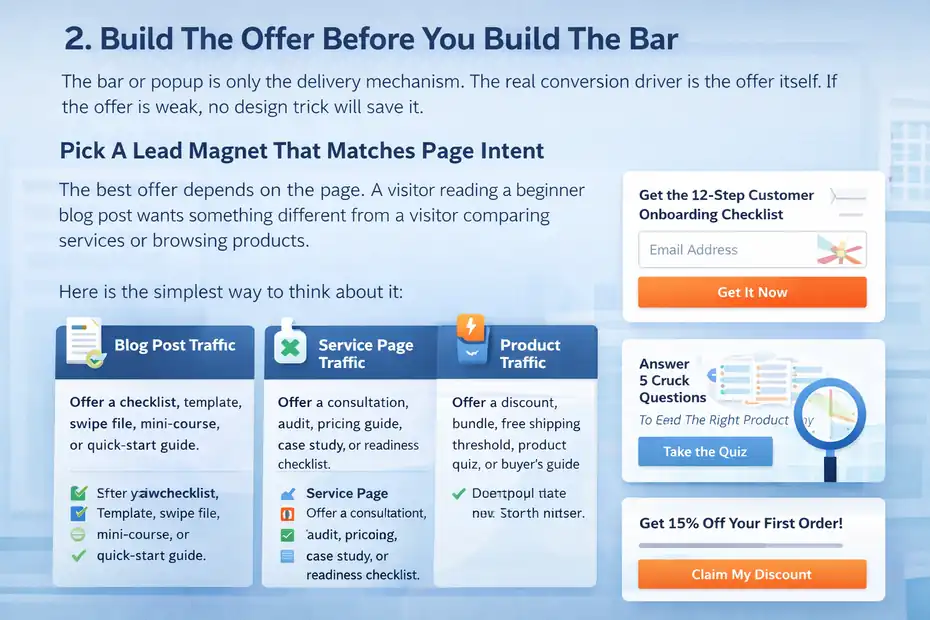
The bar or popup is only the delivery mechanism. The real conversion driver is the offer itself. If the offer is weak, no design trick will save it.
Pick A Lead Magnet That Matches Page Intent
The best offer depends on the page. A visitor reading a beginner blog post wants something different from a visitor comparing services or browsing products.
Here is the simplest way to think about it:
- Blog Post Traffic: Offer a checklist, template, swipe file, mini-course, or quick-start guide.
- Service Page Traffic: Offer a consultation, audit, pricing guide, case study, or readiness checklist.
- Product Page Traffic: Offer a discount, bundle, free shipping threshold, product quiz, or buyer’s guide.
- Homepage Traffic: Offer your clearest “start here” asset, not your broadest one.
Imagine you run a B2B SaaS site. A visitor lands on an article about onboarding mistakes. A generic “Subscribe to Updates” bar will usually underperform. A more aligned offer would be “Get the 12-Step Customer Onboarding Checklist.” Same traffic, same placement, very different perceived value.
I suggest writing the offer as a promise of outcome, not a description of format. “Reduce abandoned demos with this follow-up template” is stronger than “Download our PDF.” People want the result first.
This is also where semantic alignment helps SEO indirectly. When your page topic, headline, bar copy, and lead magnet all point to the same problem, the experience feels more coherent.
That usually improves engagement and increases opt-in quality because you are attracting the right subscriber, not just any subscriber.
Use A Low-Commitment First Conversion Goal
One reason cold traffic bounces is that brands ask for too much, too quickly. If someone just met you, a “Book a Call” CTA can feel premature. A lower-commitment goal often performs better at the top of funnel.
For many sites, the strongest first conversion goals are:
- Email signup for a specific resource
- Quiz completion
- Coupon claim
- Waitlist join
- Free tool use
- Calculator or assessment completion
I like quizzes and self-assessments especially for cold traffic because they create curiosity and qualify intent at the same time.
Hello Bar’s own pricing and feature materials position bars, modals, targeting, and integrations as part of a broader conversion toolkit, which makes this style of micro-conversion practical to deploy without custom coding.
A good rule is this: The colder the visitor, the smaller the ask. You can always deepen the relationship later with email sequences, segmented offers, and sales CTAs after the initial conversion.
This matters because lead quality is not just about whether someone opted in. It is about whether the opt-in reflects real problem awareness. A person who downloads a pricing calculator is often more valuable than a person who joins a vague newsletter.
The first action tells you what they care about. That gives you better follow-up, better segmentation, and usually better revenue per lead.
Choose The Right Hello Bar Format For The Right Moment
Different Hello Bar formats solve different conversion problems. This is where strategy gets practical.
You are deciding how visible the message should be and when it should appear.
When To Use Bars, Modals, Slide-Ins, And Embedded Forms
Hello Bar includes persistent bars, modals, styling tools, and targeting features across its plans. In simple terms, that gives you multiple ways to capture attention without using the exact same experience on every page.
Here is how I would think about each format:
- Bar: Best for broad, low-friction offers. Great on homepages, blog archives, and site-wide campaigns.
- Modal Popup: Best when you need stronger attention for a more compelling offer.
- Slide-In: Useful when you want visibility without completely taking over the screen.
- Embedded Form: Best for readers who are already engaged and do not need interruption.
If your traffic is mostly informational and search-driven, a top bar plus an embedded form often feels cleaner than a hard popup on the first pageview. If your traffic is from paid ads, a modal or slide-in may be better because those visitors often need a clearer next step.
I have seen many sites overuse modals because they want maximum visibility. The problem is that visibility alone does not create trust. Sometimes a simple bar that stays visible while the person reads performs better because it feels less demanding.
The right format depends on the job. Use modals for urgency, bars for continuity, slide-ins for gentle nudges, and embeds for intent confirmation.
Match Trigger Type To Visitor Psychology
This is where conversion rates usually rise or fall. The trigger should reflect what the visitor is doing.
Hello Bar supports exit-intent triggering on all plans, including the free tier, and its recent guidance also highlights hybrid setups that combine scroll-based and exit-intent rules for different moments in the session.
That matters because the visitor mindset changes during the session:
- At the beginning, they are evaluating relevance.
- Mid-scroll, they are consuming and assessing trust.
- On exit, they are deciding whether to leave without action.
A scroll trigger at around 50% to 70% depth works well when someone has shown enough interest to deserve a content upgrade. Exit intent works better when the person is about to leave and needs a final reason to act now.
For example, on a long blog post, I would not lead with a popup the second the page loads. I would let the content do some work first. Then I would trigger a relevant offer after meaningful engagement. If the person still leaves, I might show a second, simpler offer on exit, like a newsletter with one clear benefit.
That kind of sequencing feels smarter than showing the same message to everyone immediately. In my experience, it also protects the brand because it respects how trust actually builds.
Set Up A Funnel That Converts Cold Visitors Step By Step
The biggest mistake is treating Hello Bar like a design element instead of a funnel entry point. The bar is only step one.
Create A Simple Three-Step Conversion Path
A high-converting hello bar lead generation strategy usually follows a simple path:
- Capture attention with a relevant offer.
- Convert the visitor into a lead with minimal friction.
- Route that lead into the right next action.
Here is a practical example for a service business:
- Step 1: Blog visitor sees a bar offering a “Website Lead Leak Checklist.”
- Step 2: They submit email to get the checklist.
- Step 3: Thank-you page offers a free mini-audit or invites them to reply with one question.
That path works because each step earns the next. You are not jumping from stranger to sales call in one click.
For ecommerce, the path could look like this:
- Step 1: Product page visitor sees “Unlock 10% Off Your First Order.”
- Step 2: They enter email.
- Step 3: Welcome email delivers code and recommends top products.
Hello Bar’s platform emphasizes unlimited popups, subscribers, page targeting, and direct integrations on paid plans, which supports this kind of multi-step flow rather than a one-off form collection tactic.
I recommend sketching your funnel on paper first. If you cannot explain what happens after the opt-in in one or two sentences, the strategy is probably still too loose.
Use Thank-You Pages And Follow-Up To Increase Lead Value
The thank-you page is one of the most wasted pages on the internet. Most sites say “Check your inbox” and end the journey there. That is a missed opportunity.
A better thank-you page can do one of four things:
- Confirm the promised resource
- Segment the lead by interest
- Invite a second micro-conversion
- Build trust with proof or a next-step explanation
Let’s say you offer a lead magnet on a blog about conversion optimization. Your thank-you page could include a short video explaining the next step, plus a button to view a case study. That does not feel aggressive, but it keeps momentum alive.
I believe this is where cold leads become warmer leads. The first opt-in proves interest. The thank-you page helps shape intent.
Your email sequence matters too. The first three messages should usually do these jobs: deliver the promise, deepen the problem awareness, and introduce the next logical action. If you only send the asset and disappear, you leave money on the table.
The goal is not just to collect contacts. It is to create movement. A good hello bar lead generation strategy gets the opt-in. A great one moves the subscriber toward a meaningful commercial action.
Write Copy That Converts Without Sounding Desperate
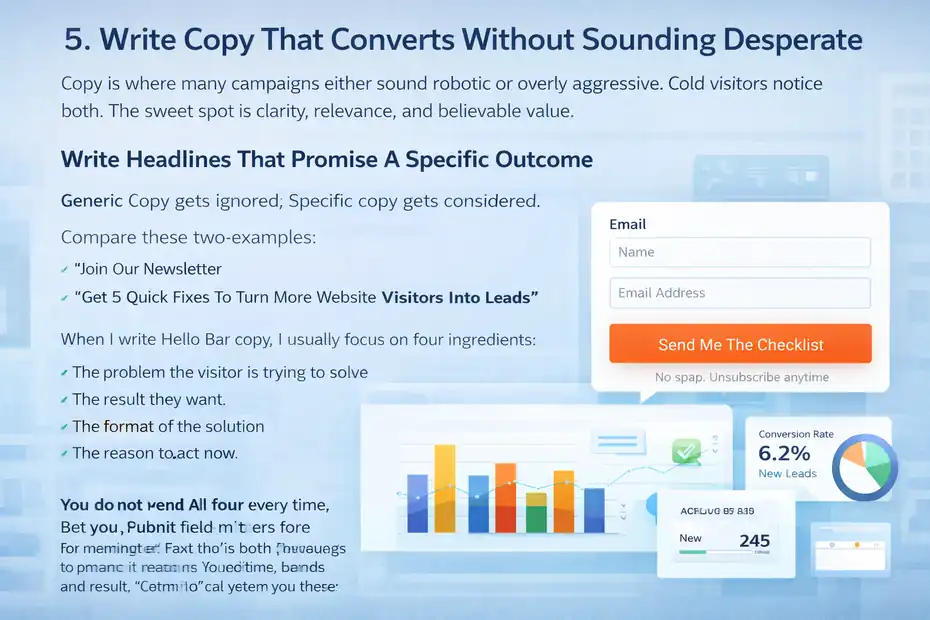
Copy is where many campaigns either sound robotic or overly aggressive. Cold visitors notice both.
The sweet spot is clarity, relevance, and believable value.
Write Headlines That Promise A Specific Outcome
Generic copy gets ignored. Specific copy gets considered.
Compare these two examples:
- “Join Our Newsletter”
- “Get 5 Quick Fixes To Turn More Website Visitors Into Leads”
The second one is better because it tells the reader what they get and why it matters. It also implies speed and usefulness.
When I write Hello Bar copy, I usually focus on four ingredients:
- The problem the visitor is trying to solve
- The result they want
- The format of the solution
- The reason to act now
You do not need all four every time, but you should have at least two.
For example: “Get the 7-point homepage conversion checklist” combines format and result. “Claim 10% off before you leave” combines benefit and urgency.
Hello Bar’s own recent content around trigger words, personalization, and exit intent leans heavily into message clarity, relevance, and urgency, which lines up with what usually works in practice.
I suggest avoiding fake urgency unless it is real. People can smell recycled “limited-time” language. If there is no true deadline, use value and relevance instead of pressure.
Reduce Friction In The Form And CTA
Every extra field lowers completion rates unless you have a very strong reason to ask for it. For cold traffic, name and email are often enough. In some cases, email alone is best.
The button copy matters too. “Submit” is weak. “Send Me The Checklist” is better because it reflects the payoff. Good CTA buttons feel like the next step, not a system command.
A few friction-reducing rules I use often:
- Ask for the minimum data needed
- Make the CTA benefit-focused
- Remove vague language
- Add a small trust cue if needed
- Keep the visual hierarchy obvious
A trust cue could be something simple like “No spam. Unsubscribe anytime.” You do not need to overdo it, but for unfamiliar visitors, it helps.
This is also where match matters. If the bar says “Get the Template,” the form and button should continue that same promise. Friction is not just about form length. It is also about cognitive mismatch.
The more the experience feels like one clean motion, the better the conversion odds.
Use Targeting And Segmentation To Stop Showing Everyone The Same Offer
Showing the same offer site-wide is easy. It is also one of the fastest ways to cap your results. Cold traffic is not one audience.
Segment By Source, Page Type, And Behavior
Hello Bar’s platform supports targeting by location, ad campaign, source, medium, and page context, which is a big deal because traffic source often predicts intent better than demographics do.
Here is a practical segmentation model I like:
- Organic Blog Traffic: Offer a relevant content upgrade
- Paid Traffic: Offer a direct benefit tied to the ad promise
- Returning Visitors: Offer a stronger CTA, such as a demo or discount
- Product Page Visitors: Offer a buying aid, quiz, or incentive
- High-Intent Pages: Offer a consultation, comparison guide, or trial prompt
Imagine someone clicks a Facebook ad for a skincare quiz. Sending them to a product collection page and showing a generic newsletter popup creates friction. A better move would be a bar or popup continuing the ad’s promise: “Find Your Ideal Routine In 60 Seconds.”
This is where conversion strategy becomes less about popups and more about continuity. The onsite message should feel like a natural continuation of the page and traffic source, not a random interruption.
I have found that even simple segmentation can outperform clever design tweaks. Relevance usually beats creativity.
Personalize Without Becoming Creepy
Personalization is helpful when it clarifies relevance. It becomes creepy when it feels invasive or oddly specific.
Good personalization sounds like this:
- “New here? Start with our free checklist.”
- “Reading about SEO? Get the on-page audit template.”
- “Shopping from the UK? See delivery details before you order.”
Bad personalization feels like surveillance.
Hello Bar’s recent personalization guidance emphasizes triggers based on geography, referral sources, and behavior. Used carefully, those rules can make your lead capture feel more helpful because the message reflects what the person is already doing.
I think the safest rule is this: Personalize around context, not identity. Use page, source, and action data to improve relevance. Do not try to sound like you know too much about the person.
That keeps the experience useful and respectful, which matters more than cleverness when you are converting cold traffic.
Optimize Conversion Rates With Testing, Timing, And Frequency Control
Once the funnel is live, the real gains usually come from optimization. Small improvements compound fast when traffic volume is high.
Test One Variable At A Time
Hello Bar’s paid plans include A/B testing, and the brand’s own pricing and comparison pages position testing as a core part of improving onsite conversion performance.
That matters because most campaigns underperform for one of four reasons:
- The offer is weak
- The copy is vague
- The trigger is mistimed
- The audience match is poor
If you change everything at once, you learn nothing. I recommend testing in this order:
- Offer
- Headline
- Trigger timing
- Format
- CTA button
- Form length
Start with the highest-leverage variable. In most cases, that is the offer. A stronger offer can double performance faster than a prettier design.
Use enough traffic before calling a winner. Do not declare victory after 22 impressions and 3 signups. Look for stable directional signals over a meaningful sample.
I also suggest keeping a simple testing log. Write down what changed, why you changed it, and what happened. This sounds basic, but it prevents random optimization. Over time, those notes become your conversion playbook.
Control Frequency So You Do Not Burn Trust
Aggressive frequency destroys user experience. Even if short-term signups rise, brand irritation can rise too.
A few practical controls help a lot:
- Do not show the same modal on every pageview
- Suppress repeat displays after signup
- Avoid stacking multiple overlays in one session
- Space out different offers logically
- Use softer formats for broad site-wide campaigns
Hello Bar’s recent materials specifically discuss frequency caps and hybrid rule management so users do not see conflicting overlays in the same session. That is important because the best-performing setup is often not the loudest one.
I believe restraint is a conversion tactic. A bar that appears at the right time once can outperform a popup that follows people everywhere. Cold visitors are still deciding whether you are trustworthy. Respectful timing helps that decision.
Avoid The Common Mistakes That Kill Lead Quality
More leads do not always mean better results. You can raise opt-ins and still hurt revenue if you attract low-intent subscribers.
Mistakes That Inflate Vanity Metrics
One common mistake is bribing every visitor with an offer that attracts the wrong people. A huge discount might generate lots of emails, but if those subscribers only care about deals and never buy again, the list quality falls.
Another mistake is offering something too broad. “Marketing tips” is vague. “12 ecommerce welcome email examples” is clear. Specificity filters for relevance.
Here are a few other traps I see often:
- Leading with a demo on low-intent pages
- Reusing the same opt-in across unrelated pages
- Asking for too much form data too early
- Ignoring mobile experience
- Measuring signups but not downstream revenue
Benchmarks from popup providers can be helpful for context, but they can also tempt you to chase raw conversion rate instead of qualified conversion rate. A 9% opt-in rate is not impressive if those leads never engage, click, or buy.
The real KPI is not “How many emails did I collect?” It is “How many qualified leads did this traffic source produce?”
Fix The Post-Opt-In Experience
A weak post-opt-in flow quietly ruins a strong front-end conversion strategy.
If subscribers do not receive the promised asset quickly, trust drops. If the first follow-up email is generic or salesy, engagement drops. If the thank-you page has no logical next step, momentum drops.
I recommend checking these post-opt-in basics regularly:
- Delivery email arrives fast
- Subject line matches the promise
- Asset is easy to access
- Welcome sequence matches the original intent
- CRM or email platform tags are applied correctly
This is where “lead generation” becomes “lead management.” A well-built Hello Bar campaign should connect to a larger system, not dump contacts into a list and hope things work out.
From what I have seen, the fastest gains often come from improving what happens after the signup, not just the signup itself. If your open rates, click rates, and booked calls are weak, the problem may not be your bar. It may be the transition after it.
Scale What Works Across More Pages, Offers, And Traffic Sources
Once you find a winning setup, the next step is not to copy it everywhere blindly. It is to scale the underlying logic.
Build A Repeatable Campaign Framework
A scalable hello bar lead generation strategy usually includes a repeatable structure:
- One core audience segment
- One matching offer
- One chosen trigger
- One follow-up sequence
- One success metric beyond signups
For example, if a content upgrade works on one SEO article, build similar upgrades for related articles in the same topic cluster. If a discount popup works for first-time product page visitors, test variants by category rather than forcing the same discount site-wide.
This is where operations matter. Hello Bar’s plan structure includes unlimited popups across tiers, and higher plans increase views and testing capacity, which is useful when you want to run multiple segmented campaigns without rebuilding from scratch.
Current published plan references list a free starter level and paid Growth, Premium, and Elite tiers with higher monthly view limits and optimization features.
Scaling works best when you create templates for offers, naming conventions, page groups, and reporting. That way you are expanding a system, not improvising every new campaign.
Know When To Upgrade Your Setup
You do not need an enterprise-level setup on day one. But you do need to know when your current version is holding you back.
Upgrade your approach when:
- You are getting enough traffic to support testing
- One generic offer is clearly underperforming across page types
- You need segmentation by source or intent
- Your email follow-up needs better tagging
- You want to compare lead quality across campaigns
At that point, the conversation shifts from “Should I use Hello Bar?” to “How granular should my conversion system become?”
That is a better problem to have. It means the foundation is working.
I think the smartest scaling mindset is this: do not add complexity for its own sake. Add it only when it improves relevance, reporting, or revenue. Complexity that does not raise performance is just maintenance disguised as strategy.
Put Your Hello Bar Lead Generation Strategy Into Action
At this stage, you do not need more theory. You need a clean launch sequence.
A Practical Launch Plan You Can Use This Week
Here is the rollout I would use for most sites:
- Choose one high-traffic page group.
- Pick one offer tightly matched to that page intent.
- Decide on one format, usually a bar or modal.
- Set one behavior trigger, such as scroll depth or exit intent.
- Keep the form short.
- Build a thank-you page with one next step.
- Connect the signup to a short welcome sequence.
- Track signups and the next downstream action.
For a blog, that downstream action might be click-through to a product page. For ecommerce, it might be first purchase. For B2B, it might be booked consultation or demo request.
This kind of focused rollout is better than launching six offers at once and not knowing what worked. Start narrow, then expand.
Hello Bar supports the core mechanics needed for this style of implementation, including multiple popup types, exit intent, targeting controls, and testing on paid plans, while published pricing shows a free entry point for low-volume validation.
What Good Results Usually Look Like
Results vary by industry, traffic quality, and offer strength, so I would not promise a magic number. But I do think there is a healthy expectation range.
If your offer is weak and untargeted, you may struggle to get meaningful results no matter what tool you use. If your offer is relevant, your timing is sensible, and your follow-up is solid, even modest conversion rates can turn into a steady lead engine.
The broader benchmark data from popup platforms suggests that average popup conversion performance can land anywhere from the mid-single digits to higher depending on dataset and implementation quality, with top performers doing far better than average.
That should encourage you, but not distract you. Your goal is not to win a benchmark contest. Your goal is to turn the right cold visitors into valuable leads.
If I were simplifying the entire article into one opinion, it would be this: a hello bar lead generation strategy converts cold traffic when it feels less like an interruption and more like a well-timed shortcut.
Give people a relevant next step, ask for the smallest commitment that makes sense, and make the follow-up genuinely useful. That is the version that tends to convert.
FAQ
What is a hello bar lead generation strategy?
A hello bar lead generation strategy uses targeted bars, popups, or overlays to capture visitor information and turn cold traffic into leads. It focuses on showing the right offer at the right time, helping convert anonymous visitors into email subscribers or potential customers without disrupting the user experience.
How does a hello bar convert cold traffic into leads?
A hello bar converts cold traffic by offering a low-commitment incentive, such as a discount, checklist, or guide. When paired with smart triggers like scroll or exit intent, it captures attention at the right moment, increasing the chances of turning visitors into subscribers or prospects.
What is the best offer for hello bar lead generation?
The best offer depends on the page intent and audience. For blog traffic, content upgrades like checklists or templates work well. For product pages, discounts or quizzes perform better. The key is aligning the offer with what the visitor is already interested in.
When should a hello bar appear on a website?
A hello bar should appear based on user behavior rather than instantly. Common triggers include scroll depth, time on page, or exit intent. Showing it after engagement improves conversions and prevents annoying users who are still evaluating your content.
How do you optimize a hello bar for higher conversions?
To optimize a hello bar, test one variable at a time, such as headline, offer, or timing. Keep forms simple, match the message to the page, and limit frequency to avoid fatigue. Focus on lead quality, not just signups, to improve long-term results.

I’m Juxhin, the voice behind The Justifiable.
I’ve spent 6+ years building blogs, managing affiliate campaigns, and testing the messy world of online business. Here, I cut the fluff and share the strategies that actually move the needle — so you can build income that’s sustainable, not speculative.
Related posts:
 Lead Generation Magic: 6 Steps to Double Your Sales
 10 Secrets to Generating Leads Online & Skyrocketing Sales
 How to Build Lead Pages That Convert Like Crazy
 How to Create an Aweber Landing Page That Converts Today
 Omnisend Popup: How to Turn Visitors Into Subscribers
 SurveyMonkey Review For Affiliate Marketers: Can It Boost Conversions?