
Table of Contents
Some links on The Justifiable are affiliate links, meaning we may earn a small commission at no extra cost to you. Read full disclaimer.
When I first stumbled upon the Salehoo Directory free features, I was skeptical. Could you really get any real value without paying? Turns out, there’s more you can access for free than most people realize.
Whether you’re an eCommerce beginner or a curious dropshipper doing supplier research, understanding what you can (and can’t) get without a subscription helps you decide if Salehoo is worth your money.
Let’s break down exactly what’s available for free — and how to make the most of it before committing.
What You Can Actually Access In The Salehoo Directory Free
If you’ve ever opened Salehoo’s website and wondered what you can actually see without paying, you’re not alone.
The Salehoo Directory free version gives you a taste of the platform — just enough to explore suppliers, browse niches, and see whether it fits your business needs before investing.
Previewing Limited Supplier Listings
The first thing you’ll notice in the free version is that Salehoo lets you preview supplier listings — but with limitations.
You can:
- View a handful of suppliers across different product categories.
- See their product types, shipping regions, and business models (like wholesale or dropshipping).
- Glimpse ratings and trust scores, giving you a rough idea of supplier reliability.
What you can’t do yet is directly message or view full supplier contact details. Think of this as a “shop window.” You can look in, see what’s on display, and assess if it’s worth stepping inside — but you can’t start doing business until you unlock full access.
In my experience, this preview mode is perfect for early-stage product hunters who just want to understand what kinds of suppliers are available in their niche without committing yet.
Viewing Basic Supplier Details Without Contact Access
When you click into a supplier preview, Salehoo shows limited data fields:
- Company name and summary of what they sell.
- Location and shipping capabilities.
- A preview of their top products or categories.
This is helpful for cross-checking supplier legitimacy before investing in the directory. I suggest using this stage to jot down suppliers that look promising and then compare them externally (through LinkedIn, Google Business, or Trustpilot).
It’s a bit like scouting — you get to verify the lay of the land before you start spending your resources.
Exploring Product Categories And Niches
Even without a paid account, you can browse the full Salehoo Directory free structure by product category. You’ll see niches like fashion, home décor, electronics, pet products, and more.
What’s great about this? You can get a feel for what’s popular and how many suppliers exist in each space.
A quick example: If you’re testing the waters in “eco-friendly kitchenware,” Salehoo’s free directory view will show you how many suppliers list similar items — giving you a rough sense of demand and saturation before you even start selling.
This kind of category-level exploration is underrated. It’s one of the easiest, no-cost ways to validate whether your chosen niche is active or oversaturated.
Using The Salehoo Free Trial Window To Test Searches
Occasionally, Salehoo opens up a free trial window (usually 7 days) that temporarily gives you a deeper peek. During this time, you can perform limited searches, view more suppliers, and test how the filtering works.
Here’s how to make the most of that short window:
- Plan ahead – Know which niches or product ideas you want to explore.
- Search strategically – Use filters like shipping region, MOQ (minimum order quantity), and business type.
- Save your results – Screenshot supplier previews or save them to a spreadsheet.
Even with trial limits, you can easily identify 10–20 viable supplier options for future outreach.
I’ve seen beginners use this method to build their initial supplier shortlist before even paying for access — it’s a smart move.
Salehoo Free Market Research Lab Features
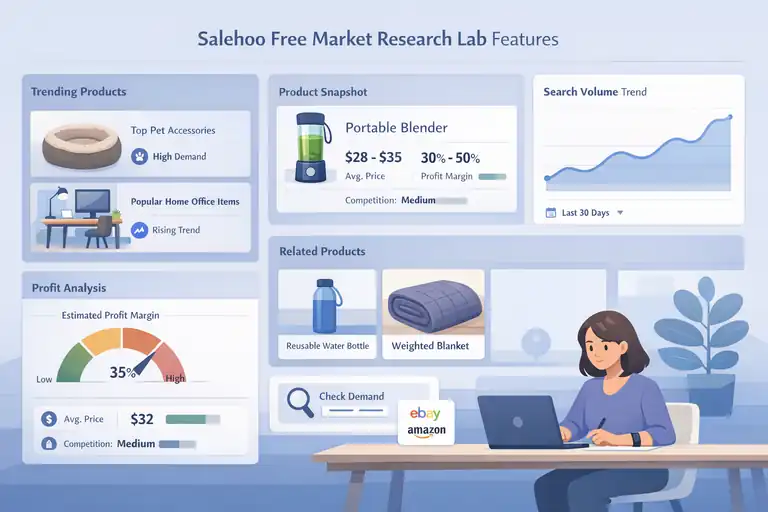
Besides the directory, Salehoo also offers its Market Research Lab, which analyzes product demand, competition, and pricing trends.
The free version doesn’t give full analytics access, but you can still see sample data that helps you understand the platform’s insights.
Accessing Trending Product Insights Without Subscription
Salehoo often provides free access to a few trending product reports — short previews that show what’s selling well globally or seasonally.
You might see sample listings like:
- “Top trending pet accessories of the month.”
- “Most searched home office products.”
Even if you can’t view the complete dataset, these snippets reveal the type of real-time data Salehoo tracks.
From what I’ve seen, this helps you spot early product ideas.
For instance, if you notice that portable blenders or reusable water bottles appear in multiple reports, you can validate that there’s a consistent demand pattern forming — even without paying.
Understanding How Salehoo Shows Product Profit Data
One of Salehoo’s strongest features is how it displays profit potential — but in the free version, you only get a sample view.
You’ll see example metrics like:
- Average product price.
- Estimated profit margin range.
- Competition score (low, medium, or high).
Although you can’t view this data for every product in the free plan, these examples teach you how to read Salehoo’s metrics when you upgrade.
I think of it as a guided tour — you can understand how Salehoo defines “profitable,” which helps you refine your own product evaluation even before using the full tool.
Using Free Market Research Samples For Product Validation
The smartest way to use the free Market Research Lab data is for early product validation.
Here’s how I usually recommend doing it:
- Look for repeated product categories in Salehoo’s free trending insights.
- Use external platforms like eBay, Amazon, or Google Trends to cross-check demand.
- Compare profit ranges from Salehoo’s samples to what you see elsewhere.
This simple process gives you a semi-accurate idea of whether a product is worth testing — without paying a cent.
For example, if Salehoo’s free report shows “weighted blankets” as trending, and you confirm strong Amazon search volume, you’ve just validated a potential winner using entirely free data.
What You Can Learn From Salehoo’s Free Training Resources
Salehoo doesn’t just give you supplier access — it also provides educational support, even if you’re not a paid member.
The Salehoo Directory free version opens doors to training materials, tutorials, and community learning spaces that can genuinely fast-track your understanding of eCommerce and dropshipping.
Getting Started With Salehoo’s Free Guides And Webinars
Salehoo offers a surprisingly deep library of free content — from beginner-friendly guides to live webinars that explain how to start and scale an online store.
The guides often cover:
- How to find profitable products without guesswork.
- The basics of building supplier relationships.
- How to test dropshipping products with minimal risk.
These aren’t just fluff pieces; they’re written by Salehoo’s internal team, many of whom have firsthand experience running eCommerce stores.
If you’re brand new, I’d suggest starting with their “How to Start a Dropshipping Business” guide. It walks you through the entire process — from niche selection to marketing — in plain, relatable language.
Even without a paid account, you’ll leave with a solid understanding of how to approach your first product launch.
I remember using these free resources before committing to any paid plan, and they honestly gave me more clarity than some paid courses elsewhere.
Exploring eCommerce And Dropshipping Tutorials Without Signing Up
You don’t have to log in to get access to Salehoo’s educational content.
Their website hosts multiple eCommerce and dropshipping tutorials that cover everything from choosing suppliers to understanding fulfillment models.
A few standout topics include:
- How to vet suppliers before placing your first order.
- Tips for spotting fake or low-quality wholesalers.
- The difference between private label and dropshipping models.
These tutorials are structured for self-paced learning, meaning you can explore them whenever you have a free moment — no sign-up required.
I’ve always appreciated that Salehoo shares this kind of value upfront. It shows confidence in their paid tools while helping beginners avoid common mistakes (like picking a supplier just because they’re cheap).
Using Free Educational Content To Build Supplier Strategy
Here’s where things get practical: you can actually build a supplier strategy using Salehoo’s free resources.
Here’s how I usually recommend approaching it:
- Use the free guides to understand what makes a supplier trustworthy.
- Combine that with the free directory preview to shortlist real suppliers.
- Leverage free webinars to learn communication and negotiation tips.
By the time you finish this, you’ll already have a mini “supplier strategy” built on research and structure — all without spending a cent.
This is particularly useful if you’re still deciding whether to focus on wholesale or dropshipping. Salehoo’s free content helps you clarify your direction before you invest in inventory or memberships.
How To Use The Free Salehoo Community Forum For Research
The Salehoo Community Forum is an underused goldmine.
Even without paying, you can read discussions from real sellers, dropshippers, and store owners who share their experiences, supplier reviews, and troubleshooting advice.
Finding Real Seller Discussions Without A Paid Account
The best part about the Salehoo Directory free forum access is that you can browse public threads.
You’ll find discussions like:
- “Which suppliers are best for small MOQ (minimum order quantity)?”
- “Can anyone recommend reliable US-based dropshippers?”
- “How to handle supplier delays during holiday seasons?”
This gives you a direct look into real-world business issues and solutions.
If you’re smart about it, you can use this forum as a living library of supplier intelligence. I used to note down supplier names mentioned repeatedly in positive threads — it’s a subtle but powerful research tactic.
Learning From Supplier Feedback Shared By Other Members
What I find most useful in the community forum is how transparent members are about their experiences. People often share honest reviews — both good and bad — about suppliers they’ve worked with.
You’ll find posts like:
- “Avoid this supplier, they never shipped my order.”
- “This one communicates well and offers bulk discounts.”
By analyzing these threads, you can save yourself weeks of trial and error. It’s like having access to a peer-reviewed list of suppliers, built by people already in the trenches of eCommerce.
In short, the forum gives you the kind of unfiltered insight that you won’t find in marketing materials or sales pages.
Using Community Insights To Shortlist Reliable Suppliers
You can turn free community insights into a working supplier shortlist with a simple three-step method:
- Collect names – Note suppliers that show up multiple times in positive discussions.
- Cross-check details – Verify them through the free directory view or Google.
- Watch for red flags – Avoid suppliers tied to frequent negative mentions or scam reports.
This approach has helped me identify trustworthy partners long before paying for any directory or sourcing platform.
It’s a practical, low-risk way to start building your supplier network while learning from others’ experience.
Comparing Salehoo Free Access To Paid Membership Benefits
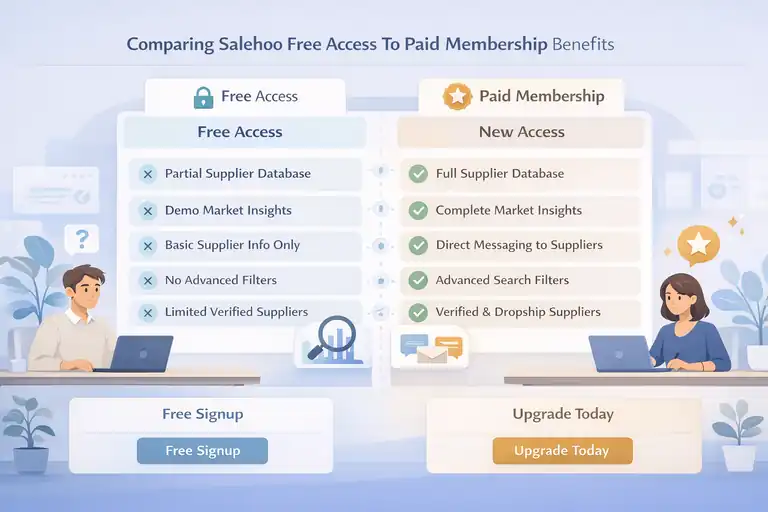
Now that you’ve seen what the Salehoo Directory free version offers, it’s worth understanding how it stacks up against the paid membership.
Knowing what’s missing helps you decide if and when an upgrade makes sense.
Key Features Missing From The Free Version
While the free version gives you a glimpse into Salehoo’s ecosystem, it stops short of the tools you’ll need to actually launch or scale a business.
Here’s what’s missing:
- Full supplier contact access – You can’t message or verify suppliers directly.
- Comprehensive supplier database – Only a fraction of suppliers are visible.
- Full Market Research Lab access – Limited to demo data and partial insights.
- Advanced filtering tools – Filters like “verified only” or “dropshippers only” are unavailable.
So, while free access is great for research and orientation, the paid version unlocks actual operational capability.
When It’s Worth Upgrading To Unlock Supplier Contact Info
I usually recommend upgrading when you’ve reached the stage of wanting to test suppliers directly.
Here’s a quick checklist to know if you’re ready:
- You’ve shortlisted 5–10 suppliers from free previews or forum mentions.
- You’ve validated a few product ideas through free market data.
- You’re ready to contact suppliers and request pricing or samples.
Once you’re here, the paid plan becomes a business tool, not an expense. It’s what bridges the gap between research and revenue.
Many sellers I know started with free access, learned how the platform works, and then upgraded confidently because they knew exactly what they’d gain.
Realistic Expectations: What Free Access Can And Can’t Do
Let’s be honest: Salehoo’s free version isn’t meant to replace a paid membership. It’s designed to help you learn the ropes — not to run a business.
What it can do:
- Help you research products and suppliers safely.
- Let you explore niches and market potential.
- Teach you how to evaluate suppliers and avoid scams.
What it can’t do:
- Allow direct supplier communication.
- Provide in-depth analytics or pricing data.
- Give unlimited browsing or filtering.
If you treat the free version as an education and validation tool rather than a business solution, you’ll get far more value from it.
In my view, Salehoo’s free tools and resources are like a warm-up round before the real game — you get to learn the rules, try a few moves, and decide if you’re ready to play seriously.
Expert Tips To Maximize Salehoo Directory Free Access
Getting the most out of the Salehoo Directory free version is all about working smarter, not harder. While you won’t get full supplier access, there’s still a lot of hidden value you can extract with the right approach.
Let me walk you through some practical ways to stretch the free features as far as possible.
How To Combine Free Salehoo Data With Other Tools
The smartest way to use Salehoo’s free access is by pairing it with external data tools. Salehoo gives you supplier previews and product categories — but to get the full picture, you can cross-reference that with other free platforms.
Here’s a quick combo I often use:
- Google Trends: Check if the products you see in Salehoo are gaining or losing search interest.
- Amazon Best Sellers: Compare product categories to confirm market demand.
- AliExpress: Verify supplier pricing ranges or check for alternative options.
By combining Salehoo’s structured supplier data with open-source insights, you can make more confident product decisions.
For instance, if Salehoo shows a trending niche like “eco-friendly home items,” and Google Trends confirms steady search growth, you’ve just validated a product idea using free data alone. That’s a powerful start for zero investment.
Using The Free Version To Build A Supplier Shortlist
Even though you can’t contact suppliers directly in the free version, you can still build a reliable shortlist for future use.
Here’s a step-by-step way to do it:
- Browse the supplier previews – Note down suppliers offering your target product type.
- Record key details – Save their company name, product type, and location.
- Cross-verify externally – Use Google or LinkedIn to learn more about their reputation.
- Organize everything – Create a spreadsheet with columns for niche, supplier name, and trust level.
When you’re ready to upgrade, that list becomes your fast-track access point. Instead of starting from zero, you’ll already have 10–20 pre-qualified suppliers to reach out to immediately.
I’ve done this personally when testing new niches. It saves hours once you have full directory access because you’ve already done the groundwork.
Turning Free Research Into A Profitable Product Strategy
Many people treat the Salehoo Directory free version as just a preview — but you can turn it into a strategic research tool.
Here’s how:
- Step 1: Use Salehoo’s product categories to identify what’s trending (for example, fitness gear or pet accessories).
- Step 2: Cross-check those ideas with Amazon Best Sellers to confirm buyer demand.
- Step 3: Compare profit ranges using Salehoo’s sample Market Lab data.
- Step 4: Use that validation to test small orders from external suppliers.
With this process, you’re not just browsing — you’re forming a full data-backed product plan.
I’ve seen sellers do this to discover micro-niches before spending a dime on subscriptions. It’s about using the free version as your research compass, not just a teaser.
Common Misconceptions About Salehoo Directory Free
There’s a lot of confusion online about what Salehoo Directory free really means. Some think it gives full access, others assume it’s just marketing bait.
The truth lies somewhere in the middle — and understanding it will help you avoid wasted time or false expectations.
Why “Free Access” Doesn’t Mean Unlimited Use
Let’s clear this up first: Free access doesn’t equal full access.
The free version is essentially a preview environment. You can browse, learn, and research — but you can’t operate your business fully. Salehoo designed it this way intentionally to let users explore without commitment.
You’ll still see:
- Limited supplier listings.
- Partial product previews.
- Example metrics from the Market Research Lab.
But you won’t get:
- Direct contact options for suppliers.
- Full analytics or verified supplier filters.
Think of it like a free sample in a store. It’s there to show you what’s possible, not to replace the actual product.
Understanding The Difference Between Free Trial And Free Directory
This is one of the most common points of confusion. The free directory and the free trial are not the same thing.
- Free Directory: Lets you view limited supplier and product information indefinitely, with no expiration.
- Free Trial: Temporarily unlocks full directory access for a few days (usually 7), letting you test features like direct supplier contact.
Here’s the best approach I’ve found: Use the free directory first to do your research and shortlist suppliers. Then, activate the free trial once you’re ready to test outreach or explore data in more depth. This way, you maximize your time during the short trial period and don’t waste any of those limited days figuring things out.
How To Avoid Misleading “Free Salehoo” Claims Online
You might’ve seen blogs or YouTube videos claiming to offer a Salehoo free membership link. Most of these are misleading.
Salehoo doesn’t offer full membership for free, and anyone who claims otherwise is likely promoting a referral scam.
A few ways to protect yourself:
- Always visit Salehoo directly from their official website (salehoo.com).
- Ignore any “cracked” or “unlocked” versions — they’re not legitimate and could risk your data.
- Check the Salehoo Help Center for their current offers or free trials.
If something sounds too good to be true, it probably is. Salehoo’s free tools are generous for learning and research, but they’re not replacements for the real thing — and that’s okay. You can still use them effectively if you know their limits.
Final Thoughts: Is Salehoo Directory Free Worth Your Time?
After everything we’ve covered, the question remains: is it worth investing your time in the Salehoo Directory free version? The answer depends on where you are in your eCommerce journey.
When The Free Version Is Enough For Beginners
If you’re new to dropshipping or eCommerce, the free version is more than enough to get started. You can learn:
- How supplier directories work.
- What types of products and niches are available.
- How to evaluate supplier trustworthiness.
It’s like taking a guided tour before signing a lease — you’re learning the landscape, testing your interests, and seeing what fits your business goals.
For anyone still exploring product ideas or learning how supplier relationships work, there’s no rush to pay yet. The free version teaches you a lot just by letting you observe and research.
Signs You’re Ready To Upgrade For Serious Dropshipping
Eventually, you’ll hit a wall — and that’s when upgrading starts to make sense.
Here are a few signs it’s time to go paid:
- You’ve identified 5–10 suppliers you want to contact.
- You’re ready to test samples or launch your first store.
- You need verified supplier data to avoid scams.
- You want to access full market analytics for pricing and competition.
At that stage, the paid version isn’t just another subscription — it’s a business investment that gives you direct control over your supplier relationships.
My Honest Take On Using Salehoo Without Paying
In my honest opinion, Salehoo’s free version is one of the most generous “previews” in the eCommerce space. It lets you learn, research, and plan your strategy safely — something most platforms hide behind a paywall.
But, it’s not a complete solution. You’ll outgrow it once you’re ready to act instead of just research. And that’s exactly how it’s meant to work.
If I had to sum it up:
- Use the free version to learn, validate, and plan.
- Upgrade when you’re ready to connect, test, and sell.
That’s how you turn the Salehoo Directory free experience into a smart stepping stone — not just another trial you forget about.
FAQ
What is included in the Salehoo Directory free version?
The Salehoo Directory free version lets you preview limited supplier listings, explore product categories, and view sample market insights without paying.
Can I contact suppliers with the Salehoo Directory free access?
No, you can’t contact suppliers directly in the free version. You’ll need a paid membership to unlock full supplier contact details and verified access.
Is the Salehoo Directory free trial the same as the free version?
No, the free trial offers temporary full access for a few days, while the Salehoo Directory free version gives limited, ongoing access for research and exploration.

I’m Juxhin, the voice behind The Justifiable.
I’ve spent 6+ years building blogs, managing affiliate campaigns, and testing the messy world of online business. Here, I cut the fluff and share the strategies that actually move the needle — so you can build income that’s sustainable, not speculative.
Related posts:
 How the Salehoo Catalog Helps You Spot Winning Items Quickly
 Viral Launch Chrome Extension: The Ultimate Tool for Sellers
 Connective Ecommerce Explained: Build Without Inventory
 Ecommerce Automation That Saves Time Without Breaking Sales
 How the Salehoo App Works and Why It Speeds Up Product Research
 Salehoo Products List That Helps You Find Winning Items Fast