Table of Contents
If you’ve ever wondered whether SaleHoo Stores can actually help you build a profitable dropshipping business, you’re not alone.
I’ve seen plenty of new eCommerce sellers debate whether it’s worth investing in SaleHoo’s ready-to-use tools or sticking with DIY store setups.
Let’s take a closer, no-fluff look at what SaleHoo Stores really offer, how they work, and whether they justify the price tag.
What Are SaleHoo Stores and How Do They Work?
If you’re new to eCommerce, SaleHoo Stores can sound like just another platform promising to make selling online easier.
But what SaleHoo has done is merge three essential parts of online retail—store setup, product sourcing, and supplier connection—into one simplified system.
How SaleHoo Stores Simplify eCommerce Setup
SaleHoo Stores take the confusion out of starting an online shop. Instead of juggling different services for web hosting, product sourcing, and supplier management, everything is built into one dashboard.
You choose a store template, connect it with products from verified suppliers, and publish your store—no coding, plugin setup, or manual inventory updates.
Here’s what makes it simple for beginners:
- All-in-one workflow: You can set up your store, import products, and manage suppliers without leaving the SaleHoo platform.
- Vetted suppliers: SaleHoo pre-approves suppliers to ensure reliability and faster shipping.
- Preloaded tools: From profit calculators to growth templates, everything is designed to shorten the learning curve.
In my experience, this is especially useful if you’re not tech-savvy. You can literally get a store running in a day, not weeks.
Key Features That Make SaleHoo Stores Stand Out
What makes SaleHoo Stores different from other platforms is how tightly it integrates eCommerce functions with sourcing.
Some standout features include:
- 8,000+ Verified Suppliers: You gain access to a large supplier directory without worrying about scams or poor-quality inventory.
- 2.5 Million Products: The built-in database helps you find trending and profitable products quickly.
- Shopify Integration: You can connect your SaleHoo store to Shopify to leverage its design flexibility and apps.
- In-built Profit Calculator: This feature helps forecast margins before listing products, which saves costly mistakes.
It’s essentially like having a dropshipping assistant who’s done the market research for you.
Differences Between SaleHoo Stores and Shopify
At first glance, SaleHoo Stores and Shopify might seem similar. Both let you create online stores—but their core focus differs.
- Shopify: It’s primarily a store builder. You handle everything—design, sourcing, and supplier management—yourself or through integrations.
- SaleHoo Stores: It’s an eCommerce system with built-in supplier connections, curated products, and ready-to-launch store templates.
If Shopify is a blank canvas for experienced sellers, SaleHoo Stores is more like a starter kit that gives beginners everything pre-assembled. You can still connect SaleHoo to Shopify later for more customization, but you’ll already have your supplier and product pipeline in place.
An Honest Look at SaleHoo’s Pricing Plans
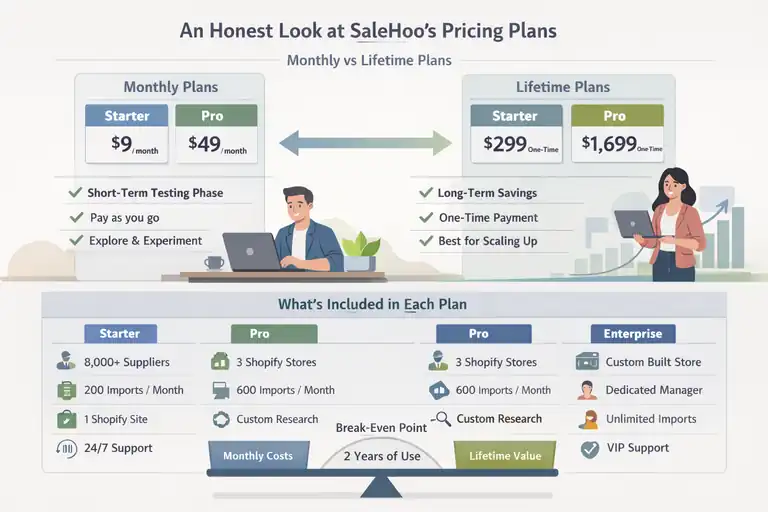
Pricing often determines whether SaleHoo Stores are truly worth it, especially for small sellers watching every dollar.
SaleHoo offers monthly and lifetime options, which can look very different in value depending on your goals.
Comparing Monthly vs Lifetime SaleHoo Store Plans
In the monthly setup, you pay as you go—$9/month for Starter and $49/month for Pro (billed annually). For long-term users, there’s a lifetime plan where you pay once—$299 for Starter or $1,699 for Pro.
Here’s how to look at it:
- Short-term (testing phase): The monthly plan works if you’re just exploring.
- Long-term (serious selling): The lifetime plan saves around 60%, so it’s ideal if you plan to build and scale over time.
From a practical standpoint, the lifetime plan pays off after about two years of consistent use.
What’s Included in Each Plan: Starter, Pro, and Enterprise
Each plan comes with increasing access and functionality.
- Starter ($9/mo or $299 one-time):
- 8,000+ suppliers
- 2.5M+ products
- 1 Shopify connection
- 200 imports/month
- 24/7 support and seller community access
- Pro ($49/mo or $1,699 one-time):
- Everything in Starter
- Connect up to 3 Shopify stores
- Import 600 products
- Unlimited supplier contacts
- Custom research and insights
- 3 team sub-users
- Enterprise (custom pricing):
- Custom-built store from scratch
- Dedicated account manager
- Unlimited imports
- VIP onboarding and support
For most sellers, the Pro plan hits the sweet spot—it’s scalable but still affordable compared to hiring freelancers or agencies for supplier sourcing.
Understanding the Real Value Behind the Price
Many people look at SaleHoo’s lifetime price and assume it’s expensive upfront. But think about it this way: a typical Shopify store with paid plugins, supplier tools, and market research subscriptions can easily exceed $1,000/year.
SaleHoo rolls those tools into one system—supplier directory, dropshipping course, support, and analytics. You’re essentially paying for convenience, quality assurance, and time saved.
If you’re serious about dropshipping but not ready to handle multiple moving parts, that value is hard to ignore.
Exploring SaleHoo Store Features in Depth
Now that pricing and setup are clear, let’s look at the heart of the platform—its features. SaleHoo isn’t just a store builder; it’s an entire selling ecosystem.
Built-In Supplier Directory and Product Database
SaleHoo’s supplier directory is its strongest asset. With 8,000+ vetted suppliers and 2.5 million products, it eliminates hours of manual research.
Here’s what stands out:
- Vetted suppliers only: Every supplier is verified to ensure reliability.
- Diverse product range: You can find items across dozens of categories—from electronics to beauty.
- Trend insights: The platform highlights high-demand products so you can avoid over-saturated markets.
If you’ve ever struggled finding legitimate suppliers on free directories, this alone is worth the cost.
Dropshipping Tools and Shopify Integration
SaleHoo integrates seamlessly with Shopify, letting you import products directly from your supplier list into your Shopify store.
- Quick import tool: Select a product, click, and it’s live on your store.
- Automated updates: Inventory and pricing sync automatically to prevent overselling.
- Profit calculator: Instantly check potential profit margins before you publish.
This makes scaling much smoother. I’ve seen beginners move from one product to a full niche store in a matter of weeks just by leveraging this automation.
Marketing, Analytics, and Automation Features
You can’t grow without data, and SaleHoo knows that. The platform provides built-in analytics and marketing templates to help you make smarter moves.
- Growth-hacking templates: Pre-written communication blueprints for customer engagement.
- In-built analytics: Track product performance, supplier reliability, and import trends.
- Profit tracking: A clear dashboard that shows what’s selling, where margins are strongest, and what needs improvement.
It’s not as advanced as Shopify’s ecosystem, but it’s surprisingly detailed for an all-in-one setup.
Customer Support and Seller Community Access
If you’ve ever felt lost in eCommerce forums, SaleHoo’s 24/7 support and 137,000+ member community are a relief.
- Live support: You can reach real people anytime.
- Community: Active members share product ideas, supplier tips, and troubleshooting help.
- Educational content: Access to training courses on Shopify, Amazon, and dropshipping strategies.
This support network makes SaleHoo especially friendly for beginners. You’re not alone in figuring things out, and that can make all the difference.
The Pros and Cons of Using SaleHoo Stores
Like any eCommerce platform, SaleHoo Stores has both impressive strengths and a few drawbacks depending on your goals.
I’ve used it, tested it, and spoken with sellers who’ve built their first successful stores using this system—so let’s look at what truly stands out and where you might hit some friction.
Major Advantages of SaleHoo Stores for New Sellers
If you’re starting from scratch, SaleHoo Stores can feel like having a business partner who’s already done the heavy lifting.
Here’s why it shines for new sellers:
- All-in-one simplicity: You don’t need to piece together different services. Your store, supplier access, and importing tools live in one place. That’s a big time-saver.
- No vetting worries: Every supplier in SaleHoo’s network is verified. You won’t spend nights wondering if a supplier is legitimate or if orders will vanish into thin air.
- Plug-and-play setup: The templates are clean and easy to customize. You can literally go from sign-up to a live store in under a day if you’re focused.
- Excellent support: The 24/7 help team actually responds fast, and their advice goes beyond tech issues—they often guide you on product trends or pricing strategy.
- Lifetime option: Paying once and never again for access is surprisingly rare in eCommerce software. It gives peace of mind, especially if you’re planning for long-term use.
What I personally like most is how SaleHoo combines learning with execution. You can take a dropshipping course and apply the lessons instantly inside your own store.
Common Drawbacks or Limitations to Be Aware Of
No tool is perfect, and SaleHoo Stores is no exception. It’s best to know what you’re walking into.
Here are some limitations worth noting:
- Limited customization: Compared to Shopify or WooCommerce, SaleHoo Stores’ design flexibility is more basic. You can change layouts and colors, but not rebuild the store from scratch.
- Smaller app ecosystem: You don’t get the endless app options that Shopify offers. If you love deep marketing integrations or unique plugins, you might feel constrained.
- No free trial: There isn’t a free trial option, which can make beginners hesitant to commit upfront. However, they do offer a refund period if you’re not satisfied.
- Primarily for dropshipping: While you can use SaleHoo Stores for wholesale or private-label products, the system’s sweet spot is dropshipping. That might limit some business models.
From what I’ve seen, these issues aren’t dealbreakers—they’re just trade-offs for simplicity and reliability. If you want total creative control, you might outgrow the platform.
When SaleHoo Stores Might Not Be the Right Fit
SaleHoo Stores is fantastic for new or intermediate sellers, but it’s not ideal for everyone.
You might want to look elsewhere if:
- You’re an advanced seller who already manages multiple stores and needs highly customized automation.
- You want to brand your store from the ground up with total design freedom and a custom checkout flow.
- You already have strong supplier relationships and just need a powerful front-end store builder.
I’ve seen experienced Shopify users try SaleHoo and realize it feels like “training wheels.” That’s not a bad thing—it’s just a different stage in your eCommerce journey.
If you’re new, SaleHoo’s guidance can fast-track your progress. But if you’re scaling aggressively or want deep analytics and custom funnels, you may prefer a more flexible system later on.
SaleHoo Stores vs Competitors: How Do They Compare?
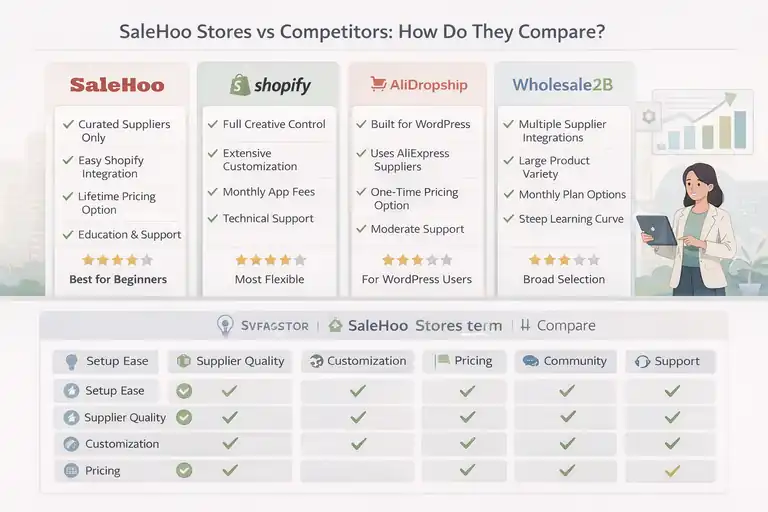
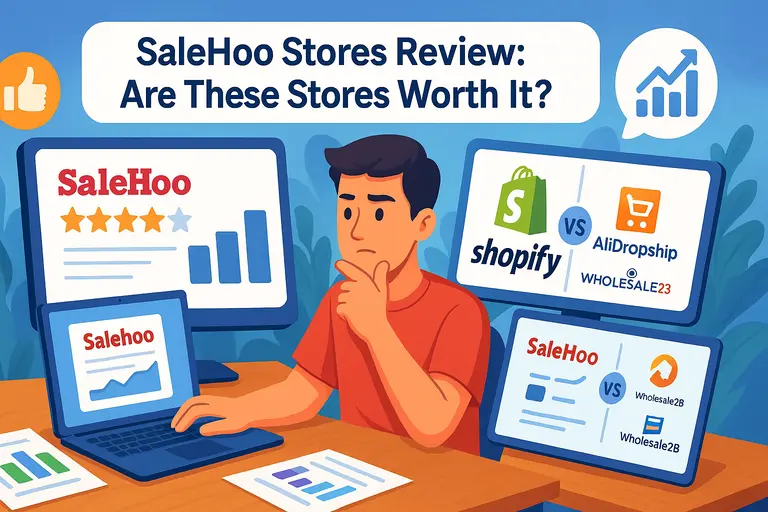
When evaluating whether SaleHoo Stores are worth it, it helps to compare them with their biggest competitors.
The main ones are Shopify, AliDropship, and Wholesale2B. Each has a different focus, so your choice depends on what stage you’re in and how hands-on you want to be.
SaleHoo Stores vs Shopify: Which Offers Better Value?
Shopify is the go-to for most eCommerce sellers, but it can be overwhelming for beginners. SaleHoo Stores offers a more guided path.
Here’s the real difference:
- Ease of setup: SaleHoo wins here. You can start selling within hours without dealing with plugins or external sourcing tools. Shopify takes more time to configure.
- Cost: SaleHoo’s lifetime pricing is cheaper long-term. Shopify requires ongoing monthly payments, plus app fees that can add up quickly.
- Control: Shopify gives you full creative control. SaleHoo focuses on simplicity and prebuilt functionality.
- Support: SaleHoo provides personalized support and seller guidance, while Shopify’s help is more technical.
In short, SaleHoo is better if you want convenience and pre-verified suppliers. Shopify is better if you crave flexibility and full customization. Many sellers actually use both—starting with SaleHoo and later transitioning to Shopify as they grow.
SaleHoo vs AliDropship and Wholesale2B
AliDropship and Wholesale2B are popular dropshipping tools, but they approach the business differently.
AliDropship:
- Built for WordPress users.
- Offers one-time pricing for a custom dropshipping store.
- However, you still source from AliExpress suppliers, which can mean longer shipping times and mixed product quality.
Wholesale2B:
- Focuses on large product variety with different supplier integrations.
- It’s good for experienced sellers but has a steeper learning curve and less community support.
SaleHoo Stores:
- Focuses on vetted suppliers only.
- Gives you both educational support and easy Shopify integration.
- Offers one-time lifetime access that bundles everything together.
If product quality and supplier reliability matter most to you, SaleHoo’s curated network gives you peace of mind. AliDropship’s model, while flexible, often leads to supplier uncertainty—a major pain point for new sellers.
Why Some Sellers Prefer a Hybrid Setup
Interestingly, many experienced sellers don’t stick to one platform—they use a hybrid approach.
For example:
- They start with SaleHoo Stores to find profitable, verified products.
- Then, once they understand what sells, they transition to Shopify for greater control and branding.
- Some even use SaleHoo’s supplier directory while managing fulfillment through other systems like WooCommerce.
It’s a practical route because you get the best of both worlds: a guided start and a scalable future. If you’re strategic, this method minimizes early costs and reduces your risk of choosing poor suppliers.
Who Should Use SaleHoo Stores?
SaleHoo Stores aren’t for everyone, but they’re a perfect fit for a few specific types of sellers. Understanding where you fall can help you make a smarter decision.
Best Fit for Beginners Entering Dropshipping
If you’re just starting out, SaleHoo Stores is one of the easiest ways to learn and launch quickly.
- You don’t need technical skills or prior experience.
- You get hands-on access to verified suppliers and ready-to-import products.
- The platform’s built-in tools help you understand pricing, profit margins, and customer management.
It’s almost like training wheels for dropshipping—but in a good way. It helps you avoid the most common early mistakes, like choosing bad suppliers or listing products with thin margins.
Ideal for Intermediate Sellers Scaling Their Stores
If you already have some sales under your belt, the Pro plan becomes very appealing.
- You can manage multiple Shopify stores.
- You get access to custom research and supplier insights.
- The unlimited supplier contact feature helps expand your catalog fast.
In my opinion, this is where SaleHoo really proves its worth. You’re no longer just testing ideas—you’re optimizing and scaling efficiently.
When Enterprise-Level Customization Makes Sense
For established brands or teams with big ambitions, the Enterprise plan provides something rare—personalized store building and strategy support.
You get:
- A dedicated account manager who helps design your store strategy.
- Full multi-store integration for larger operations.
- VIP onboarding and unlimited imports.
This plan makes sense if you want professional guidance but don’t want to hire a full development or sourcing team.
I’ve seen businesses use Enterprise as a shortcut to expansion without reinventing their entire infrastructure.
Are SaleHoo Stores Worth It in 2025?
By 2025, the eCommerce world has become far more competitive, but tools like SaleHoo Stores still hold their ground because they make the process simple and structured.
Whether it’s worth it for you really depends on how you plan to use it — as a learning tool, a long-term store platform, or a hybrid solution to scale an existing business.
Evaluating Return on Investment for SaleHoo Users
When I evaluate any eCommerce platform, I don’t just look at cost — I look at the return on investment (ROI). SaleHoo Stores stands out because it helps you avoid the biggest beginner expenses that usually drain new sellers.
Think about this:
- Setting up a Shopify store with premium apps and supplier tools can cost over $1,200 a year.
- SaleHoo’s lifetime plan for $299 or $1,699 includes sourcing tools, verified suppliers, training courses, and 24/7 support — all rolled into one.
That means your ROI starts improving the moment you save time on supplier research and product testing.
I’ve seen sellers who used SaleHoo identify winning products in a week that others spent months trying to find through trial and error.
If you treat SaleHoo as a full business foundation rather than a side tool, it easily pays for itself within the first few months.
Realistic Expectations: Profitability and Growth
Let’s be real — SaleHoo Stores won’t make you rich overnight. But it does give you a shorter and safer path toward building a profitable store.
Here’s what I’ve learned through hands-on experience:
- Initial results depend on effort: Expect your first 3–6 months to be about learning — product research, pricing, and understanding buyer behavior.
- SaleHoo reduces your risk: Since you’re sourcing from vetted suppliers, you avoid refunds, chargebacks, and shipping disasters that eat into profit margins.
- Long-term growth: Once you master the basics, you can integrate SaleHoo with Shopify or expand into multiple stores using the Pro plan.
One of my clients used SaleHoo’s supplier insights to test 20 trending products. Four of them became consistent sellers with 25–40% profit margins within 90 days. That’s what happens when you combine structure with effort.
So yes, profitability is possible — but only if you treat SaleHoo as a business tool, not a shortcut.
Expert Tip: How to Maximize Your SaleHoo Store Subscription
If you decide to go with SaleHoo, don’t just use it to build a store — leverage it. Here’s how you can get the most from your subscription:
- Use the supplier directory weekly: Keep exploring new suppliers and products. Even small shifts in product type can double your margins.
- Track data manually: The in-built profit calculator is great, but cross-check your profit data with Google Sheets or another tracking tool. It’ll help you make smarter pricing decisions.
- Stay active in the SaleHoo community: The seller group is packed with insights, product ideas, and marketing strategies you won’t find anywhere else.
- Combine with Shopify early: Even if you start small, connecting SaleHoo to Shopify opens up more customization and marketing opportunities.
- Reinvest profits in branding: Use early profits to upgrade store visuals, product photos, and social media presence — that’s what separates hobby sellers from real businesses.
In my experience, the sellers who win with SaleHoo are those who treat it like a business system, not just an app.
Final Verdict: My Take on SaleHoo Stores
Now that we’ve unpacked the features, pricing, and performance of SaleHoo Stores, let’s get to the heart of it: Are these stores actually worth your time and money? In my honest opinion, yes — if you’re the right kind of user.
Why SaleHoo Stores Can Be a Smart Starting Point
If you’re a beginner, SaleHoo is one of the few platforms that combines education, tools, and supplier access in a single system.
You don’t need to piece together multiple tools, and you don’t need to worry about supplier scams. The system teaches you while you earn — and that’s a massive confidence boost when you’re new.
What I especially appreciate is that it’s not a “get rich quick” setup. SaleHoo quietly encourages real business practices: testing, analyzing, and scaling. For people who like structure but want flexibility later, it’s a solid foundation.
When to Upgrade or Move Beyond the Platform
There comes a time when you’ll want more customization or deeper analytics. That’s when it might make sense to upgrade your workflow.
Here’s when I’d consider moving beyond SaleHoo Stores:
- When your brand identity is strong and you need more advanced marketing tools.
- When you’re ready to build custom automation or advanced integrations.
- When you want full control over checkout, customer journeys, or SEO optimization.
Many sellers transition to Shopify or WooCommerce after they’ve validated products and built a loyal audience through SaleHoo.
Think of SaleHoo as the launch pad and Shopify as the airplane. You use the first to get off the ground, and the second to scale higher.
Pro Tip: Combine SaleHoo Tools With Smart Branding Strategy
If I could give one final piece of advice, it’s this: don’t rely on product listings alone to build sales. Use SaleHoo’s tools to find great products — then build a brand around them.
Here’s a simple way to do it:
- Pick a niche that excites you: It’s easier to build content and trust when you actually like what you sell.
- Create simple social proof: Share product demos or short customer testimonials.
- Use SaleHoo’s data to position your offers: Instead of competing on price, highlight reliability and fast shipping.
From what I’ve seen, the sellers who build recognizable brands using SaleHoo often outperform those who just list trending products.
So, are SaleHoo Stores worth it in 2025? If you’re serious about learning the ropes, building ethically, and starting your online business the right way — absolutely.
It’s not the flashiest tool out there, but it’s one of the few that genuinely supports you from day one.
Frequently Asked Questions
Are SaleHoo stores worth it for beginners?
Yes. SaleHoo stores are designed for beginners who want a guided setup, verified suppliers, and fewer technical decisions when starting dropshipping.
Do SaleHoo stores replace Shopify completely?
No. SaleHoo stores work best as a starting system or alongside Shopify, especially for sourcing products and suppliers efficiently.
Is SaleHoo a one-time payment or monthly subscription?
SaleHoo offers both options. You can choose a lower monthly plan or a one-time lifetime payment, depending on your long-term goals.