
Table of Contents
Some links on The Justifiable are affiliate links, meaning we may earn a small commission at no extra cost to you. Read full disclaimer.
Here’s something I’ve noticed after working with dozens of WordPress sites: the squirrly seo wordpress plugin often attracts people who want an all-in-one SEO solution without juggling multiple tools.
I’ve tested it in real publishing workflows, and the big question always comes up—can it truly carry a site to page-one rankings on its own, or does it leave critical gaps you’ll need to fill elsewhere?
What Squirrly SEO Promises For WordPress Rankings
Squirrly positions itself as more than just another SEO plugin.
The core promise is simple: guide you step by step toward higher rankings without requiring deep SEO knowledge, all from inside WordPress.
Real-Time SEO Assistant And Live Content Optimization
One of Squirrly’s standout features is its real-time SEO assistant. As you write, it actively checks your content against a predefined focus keyword and gives live feedback.
How this works in practice: You type a paragraph, and Squirrly immediately evaluates keyword usage, readability, structure, and basic optimization signals. It feels closer to a writing coach than a checklist plugin.
From my experience, this is genuinely helpful for beginners who freeze when staring at an empty editor. It nudges you forward and reduces overthinking.
That said, it’s still rules-based. It can’t judge nuance, search intent depth, or whether your content is actually better than what’s already ranking.
Where it shines:
- Prevents under-optimized drafts
- Encourages complete, structured content
- Reduces common SEO mistakes early
Where it falls short:
- Cannot evaluate real SERP competitors
- Sometimes over-prioritizes keyword presence over clarity
Keyword Research And Opportunity Discovery Inside WordPress
Squirrly includes built-in keyword research, which is appealing if you want to avoid external tools. It labels keywords with competition levels and potential ranking difficulty.
What’s useful here: You can discover keywords without leaving WordPress, and Squirrly ties those keywords directly to content ideas and “focus pages.” That tight integration is something many plugins don’t do well.
However, the data is simplified. In competitive niches, I’ve seen keywords marked as “low competition” that are anything but. For small sites or local blogs, it’s often accurate enough. For serious SEO campaigns, it’s more directional than definitive.
Best use case:
- Early-stage sites
- Bloggers validating ideas quickly
- Non-SEO professionals avoiding complex dashboards
Built-In SEO Audits And Weekly Ranking Tasks
Squirrly’s SEO audits don’t just tell you what’s wrong—they assign weekly tasks. This is a psychological win. Instead of a massive to-do list, you get manageable actions.
Typical tasks include:
- Optimizing existing pages
- Improving internal links
- Updating metadata or content length
This task-based system keeps momentum high. I’ve seen site owners stick with SEO longer simply because Squirrly makes it feel achievable.
That said, audits are generalized. They won’t replace a technical crawl from tools like Ahrefs. Think of this as SEO habit-building, not forensic analysis.
AI Guidance Versus Manual SEO Control Tradeoffs
Squirrly leans heavily into AI-driven guidance. That’s empowering, but it comes with tradeoffs.
The upside:
- Faster decisions
- Less SEO paralysis
- Clear direction for non-experts
The downside:
- Limited customization for advanced users
- AI recommendations may conflict with strategic intent
In my opinion, Squirrly works best when you treat it as a guide, not an authority. Following it blindly can cap growth, but ignoring it defeats the purpose.
On-Page SEO Capabilities Of Squirrly SEO Plugin
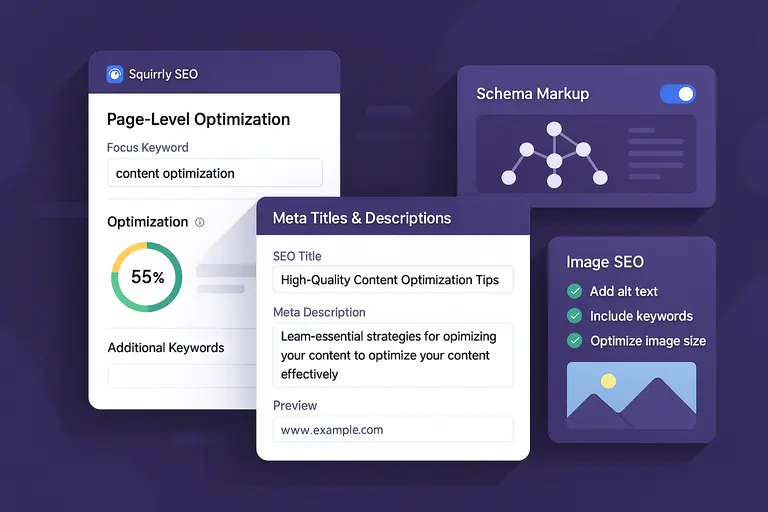
On-page SEO is where the squirrly seo wordpress plugin does its most consistent work. It covers the essentials well, with a few thoughtful extras.
Page-Level Optimization For Posts Pages And Categories
Squirrly lets you optimize individual posts, pages, and even category archives. That’s important, because category pages often rank better than blog posts in content-heavy sites.
What I like here: You can set focus keywords per page and track optimization scores individually. This encourages intentional publishing instead of bulk content dumping.
However, the scoring system can feel rigid. A page might score lower even if it’s clearly written for humans first. I often suggest using the score as a checkpoint, not a goal.
Meta Titles Descriptions And SERP Preview Controls
Meta title and description editing is clean and intuitive. Squirrly includes a live SERP preview so you can see truncation before publishing.
Why this matters: CTR influences rankings indirectly. A clear preview helps you write for clicks, not just bots.
One limitation: Advanced title testing and dynamic variables are more limited compared to Rank Math. For most users, though, it’s more than enough.
Schema Markup And Structured Data Automation
Squirrly automatically adds basic schema markup, such as articles and organization data.
Good news: You don’t need to touch JSON-LD or understand schema vocabulary.
Not-so-good news: Customization is minimal. If you want FAQ schema, review schema, or custom entity relationships, you’ll need another tool or manual code.
For simple blogs, this is fine. For rich SERP features, it’s limiting.
Image SEO And Media Optimization Features
Image SEO is often ignored, and Squirrly does a decent job surfacing it.
Features include:
- Alt text reminders
- Filename optimization prompts
- Image-related SEO checks
These small nudges add up, especially for image-heavy niches like food, travel, or ecommerce. I’ve seen image impressions increase noticeably when site owners consistently follow these prompts.
Content Strategy And Keyword Targeting With Squirrly
This is where the squirrly seo wordpress plugin really shows its personality.
It doesn’t just help you optimize pages after the fact—it tries to shape what you create and what you prioritize from the start.
Focus Pages Concept And Priority Page Scoring
Squirrly introduces something called Focus Pages. In plain terms, these are the pages you tell the plugin matter most for rankings and revenue.
Once you mark a page as a Focus Page, Squirrly assigns it a priority score and tracks how well it’s optimized over time. I like this idea because it forces discipline. Instead of “optimizing everything,” you’re choosing what actually deserves attention.
Here’s how I’ve seen this work well in practice:
- A local service site selects 5 service pages as Focus Pages
- A blogger flags pillar guides instead of weekly posts
- An affiliate site prioritizes comparison pages over reviews
The scoring itself is helpful, but not perfect. It measures completeness and keyword usage more than real competitiveness. I treat it as a focus tool, not a ranking predictor.
Content Briefs And AI Writing Guidance Limitations
Squirrly offers AI-generated content guidance, including outlines and suggestions. This can be comforting if you’re unsure where to start.
What it does well:
- Suggests basic structure
- Reminds you to include related terms
- Encourages longer, more complete content
Where it struggles is originality. The AI guidance tends to push safe, generic structures. If you follow it too closely, your content risks blending in with everything else on page one.
My honest take: Use the briefs to avoid missing essentials, then deliberately break away. Add personal experience, examples, or contrarian takes. That’s where rankings usually tip in your favor.
Keyword Competition Data Accuracy And Reliability
Squirrly’s keyword difficulty labels are simplified. They’re designed for clarity, not forensic accuracy.
In low-competition niches, I’ve found them reasonably reliable. In anything remotely competitive, they often underestimate difficulty. For example, a keyword labeled “easy” might still be dominated by high-authority domains.
This doesn’t make the data useless—it just means you shouldn’t bet everything on it. I often pair Squirrly’s suggestions with manual SERP checks:
- Who’s ranking?
- How deep is their content?
- Are they brands or small sites?
That quick reality check makes the data far more actionable.
Semantic SEO And Topic Coverage Support
Squirrly does encourage semantic coverage by prompting related terms and concepts. It won’t map entire topic clusters for you, but it nudges you away from thin content.
This works best when you already understand your audience. If you don’t, Squirrly won’t magically fill that gap. It’s a support system, not a strategy engine.
Technical SEO Coverage Inside Squirrly SEO Plugin
Technical SEO is where expectations matter. Squirrly covers fundamentals, but it’s not built to replace dedicated technical SEO tools.
XML Sitemaps Indexing And Crawl Control Settings
Squirrly handles XML sitemaps cleanly. You can include or exclude posts, pages, and taxonomies without touching code.
For most WordPress sites, this is enough. Google gets what it needs, and crawl issues are rare at this level.
Where it’s limited is advanced crawl control. You won’t get granular control over crawl budgets or complex indexing rules. For small to medium sites, that’s rarely a deal-breaker.
Core Web Vitals And Performance Optimization Gaps
This is a big one. Squirrly does not optimize performance. It can warn you, but it can’t fix slow sites.
Core Web Vitals—things like load speed and layout stability—are ranking factors. If your site is slow, Squirrly can’t save you.
In real setups, this means you’ll still need:
- A caching plugin
- Image compression
- Solid hosting
I’ve seen rankings stall simply because users assumed SEO plugins handled speed. They don’t.
Canonical URLs Noindex Rules And Duplicate Control
Squirrly gives you basic control over canonical URLs and noindex rules. This helps prevent duplicate content issues, especially on WordPress sites with archives and tags.
It works well for straightforward setups. On complex sites with pagination, faceted navigation, or ecommerce filters, it becomes limited quickly.
If your site structure is simple, you’re fine. If it’s not, you’ll feel the ceiling fast.
JavaScript SEO And Advanced Crawlability Constraints
Squirrly doesn’t address JavaScript SEO at all. If your site relies heavily on JS frameworks, dynamic loading, or complex themes, you’re on your own.
For traditional WordPress blogs, this isn’t an issue. For modern, app-like sites, it’s a real gap.
Link Building And Off-Page SEO Limitations

This is where the squirrly seo wordpress plugin is weakest—and it’s important to be honest about that.
Lack Of Native Backlink Analysis And Monitoring
Squirrly does not analyze backlinks. There’s no visibility into who’s linking to you, anchor text distribution, or link quality.
Backlinks remain one of the strongest ranking factors. Flying blind here is risky, especially as competition increases.
At minimum, you’ll want an external tool just to know where you stand.
No Outreach Or Digital PR Workflow Integration
There’s no outreach, prospecting, or digital PR support inside Squirrly.
That means no help with:
- Finding link opportunities
- Tracking outreach emails
- Measuring link acquisition progress
If link building is part of your growth plan—and it usually is—this work happens elsewhere.
Reliance On External Tools For Authority Growth
In practice, most successful Squirrly users rely on other tools for authority building. Common pairings include backlink trackers and outreach platforms.
This isn’t necessarily bad, but it does mean Squirrly is not a standalone ranking solution for competitive SERPs.
Impact Of Weak Link Data On Ranking Potential
Without link data, Squirrly can’t tell you why you’re stuck on page two. It can optimize content endlessly, but authority gaps remain invisible.
I’ve seen sites perfectly optimized on-page still lose because competitors simply had stronger links. Squirrly didn’t catch that—external tools did.
How Squirrly Compares To Yoast SEO And Rank Math
Choosing between Squirrly, Yoast, and Rank Math isn’t about which plugin is “best.”
It’s about how much control you want, how steep a learning curve you can tolerate, and how competitive your niche is.
Squirrly SEO Versus Yoast SEO Feature Depth
Yoast SEO is built around guardrails. It gives you clear rules, clear signals, and very little flexibility beyond them.
Squirrly feels more like a coach sitting next to you, while Yoast feels like a checklist taped to your monitor.
From hands-on use, here’s the practical difference:
- Yoast focuses heavily on content readability and basic on-page signals
- Squirrly goes deeper into workflow, prioritization, and habit-building
- Yoast is simpler, but also more limited once you outgrow it
For example, Yoast won’t help you decide which pages deserve your effort. Squirrly’s Focus Pages do. That single feature often changes how people plan content.
If you’re running a simple blog, Yoast is stable and predictable. If you want guidance without learning SEO theory, Squirrly feels more supportive.
Squirrly SEO Versus Rank Math Automation And Control
Rank Math is the opposite of Squirrly in philosophy. It gives you knobs, switches, and advanced controls everywhere.
Rank Math shines when:
- You want full schema customization
- You care about advanced technical SEO
- You enjoy tweaking settings
Squirrly shines when:
- You want direction instead of options
- You don’t want to manage 30 settings screens
- You prefer tasks over dashboards
In my experience, Rank Math wins on raw power. Squirrly wins on usability and momentum. I’ve seen beginners get more done with Squirrly, even though Rank Math could technically do more.
Learning Curve Differences For Beginners And Pros
This is where the gap becomes obvious.
For beginners:
- Squirrly feels approachable
- Tasks feel achievable
- Progress feels visible
For experienced SEOs:
- Squirrly can feel restrictive
- Data feels shallow
- Recommendations feel obvious
If you already know SEO, you may find yourself fighting the plugin instead of being helped by it.
When Hybrid Plugin Setups Make More Sense
A hybrid setup is surprisingly common.
I’ve seen successful sites use:
- Squirrly for content workflow and Focus Pages
- Rank Math for schema and technical control
- External tools for links and performance
This isn’t “wrong,” but it does add complexity. If you’re already mixing tools, you’re likely past the stage where Squirrly alone is enough.
Who Can Rank Using Only Squirrly SEO Plugin
This is the most important section, because the answer isn’t everyone—and that’s okay.
Low Competition Niches And Local Business Websites
Squirrly performs well in low-competition environments.
Local service sites, niche blogs, and early-stage projects often don’t need advanced SEO stacks. They need consistency, clarity, and follow-through.
In these cases, Squirrly can absolutely be enough to rank, especially when:
- Competitors have weak content
- SERPs are dominated by small sites
- Search intent is clear and narrow
I’ve seen local pages reach top three positions using Squirrly plus solid content and reviews alone.
Content-First Bloggers Without Heavy Technical Needs
If your strength is writing, Squirrly supports that strength instead of distracting you.
It works well for bloggers who:
- Publish long-form guides
- Update content regularly
- Care about structure and completeness
As long as performance and hosting are handled elsewhere, Squirrly keeps content SEO on track.
Solo Site Owners Avoiding Complex SEO Stacks
Solo creators often quit SEO because it feels overwhelming.
Squirrly reduces that overwhelm by:
- Turning SEO into weekly tasks
- Highlighting what matters most
- Removing decision fatigue
For one-person sites, that simplicity is a competitive advantage.
Situations Where Squirrly Is Likely Not Enough
Squirrly struggles when:
- Competition is link-heavy
- SERPs are dominated by brands
- Technical SEO is complex
- Growth depends on authority building
If backlinks decide the winners, Squirrly can’t help you catch up.
Final Verdict On Whether Squirrly Alone Can Rank
So, can Squirrly rank a site on its own? The honest answer is yes—but only in the right situations.
Scenarios Where Squirrly SEO Is Sufficient
Squirrly alone can work when:
- Competition is low to moderate
- Content quality is high
- Site performance is handled elsewhere
- You need guidance more than control
In these cases, the plugin does exactly what it promises.
Scenarios Requiring Additional SEO Tools
You’ll need more than Squirrly when:
- Backlinks drive rankings
- Technical SEO issues limit crawling
- You need advanced schema
- You want deep competitive analysis
This isn’t a failure of Squirrly. It’s a reflection of how SEO scales.
Practical Plugin Stack Recommendations For Growth
A realistic growth stack often looks like:
- Squirrly for content workflow and prioritization
- A performance plugin for speed
- An external backlink tool for authority tracking
This combination covers the gaps without overwhelming you.
Long-Term Scalability And SEO Maturity Considerations
Squirrly is excellent for building SEO habits. Long term, most growing sites outgrow it.
My personal take: Use Squirrly to build momentum, confidence, and consistency. When rankings plateau, that’s not failure—that’s a signal you’re ready for the next layer.

I’m Juxhin, the voice behind The Justifiable.
I’ve spent 6+ years building blogs, managing affiliate campaigns, and testing the messy world of online business. Here, I cut the fluff and share the strategies that actually move the needle — so you can build income that’s sustainable, not speculative.
Related posts:
 Schema Pro Review: The Ultimate SEO Optimization Plugin
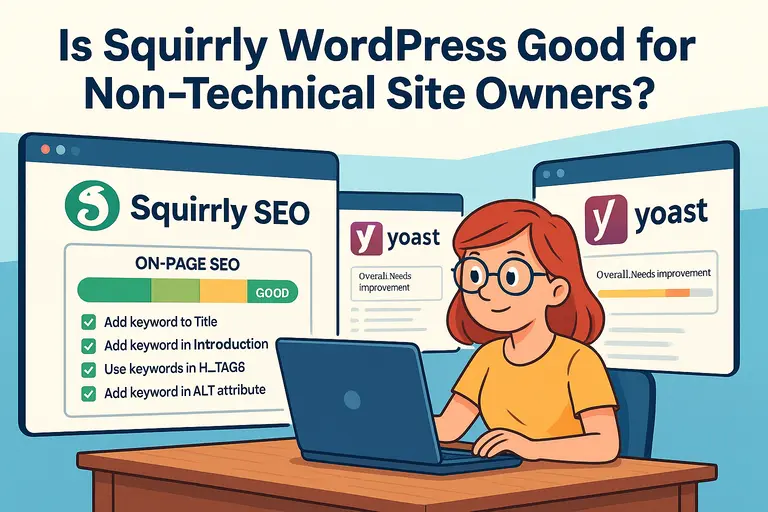 Is Squirrly WordPress Good for Non-Technical Site Owners?
 Squirrly SEO Pricing: What You Pay vs What You Get
 Squirrly SEO – The Ultimate WordPress SEO Plugin for Boosting Your Website’s Rankings
 Does the Squirrly SEO Plugin Improve Rankings?
 Squirrly SEO Pro Nulled: Why It’s a Risky Shortcut