
Table of Contents
Some links on The Justifiable are affiliate links, meaning we may earn a small commission at no extra cost to you. Read full disclaimer.
Starting an ecommerce business is something a lot of people think about, but very few get a clear, realistic picture of how to actually do it step by step.
I wrote this guide for beginners, side-hustlers, and would-be founders who want to build a real online store, not just read theory.
It answers one core question: what are the exact steps to go from idea to a functioning ecommerce business that’s ready to make sales?
Validate Your Ecommerce Idea With Real Market Demand
If there’s one step people rush through when starting an ecommerce business, it’s validation. I’ve seen smart people build beautiful stores around ideas nobody was actively searching for or willing to pay for.
This section is about grounding your idea in reality before you invest serious time or money.
Identify Problems People Already Pay To Solve
I always start with problems, not products. Products change. Problems don’t.
Look for frustrations people already spend money to fix. That’s the signal you want. A “nice-to-have” idea is risky. A “take-my-money” problem is where ecommerce businesses survive.
Here’s how I personally uncover these problems:
- Read 1–3 star reviews on Amazon and Etsy in your niche
- Scan Reddit threads and Facebook groups for repeated complaints
- Look at “people also ask” questions in Google
Pay attention to patterns. If dozens of people complain about the same issue, that’s demand talking.
Example scenario: If people keep saying “these water bottles leak in my bag,” the opportunity isn’t a water bottle. It’s a leak-proof water bottle designed for commuters.
That specificity is what turns an idea into something viable.
Research Search Demand Using Buyer-Intent Keywords
Once you spot a problem, the next step is confirming people are actively searching for solutions.
This is where buyer-intent keywords matter. These are searches that suggest someone is close to purchasing, not just browsing.
Examples of buyer intent:
- “best leak proof water bottle”
- “buy stainless steel water bottle”
- “water bottle for travel no leaks”
Tools I actually use or recommend:
| Tool | Why It’s Useful | Cost |
| Google Keyword Planner | Free baseline search data | Free |
| Ahrefs | Deep keyword and competitor insights | Paid |
| Ubersuggest | Beginner-friendly keyword ideas | Free/Paid |
As a rough benchmark, I like to see at least a few thousand monthly searches across related terms. You don’t need massive volume, but zero demand is a red flag when starting an ecommerce business.
Analyze Existing Ecommerce Stores And Market Gaps
Competition isn’t bad. It’s proof of demand.
What matters is whether you can do something meaningfully better or different.
When reviewing competitors, I focus on:
- Product positioning and messaging
- Pricing tiers and bundles
- Shipping times and return policies
- Customer complaints in reviews
I usually open 5–10 competitor stores and take notes. Patterns show up fast.
Look for gaps like:
- Poor product education
- Weak branding or generic copy
- Long shipping times
- Missing features customers want
Those gaps are your entry point, not the product itself.
Validate Price Willingness And Profit Potential
A product can sell and still be a terrible business.
Before moving forward, you need to confirm people will pay enough for you to make a profit after costs.
Here’s a simple pricing reality check I use:
- Product cost (including shipping)
- Payment processing fees
- Platform fees
- Estimated marketing costs
As a rule of thumb, I aim for pricing that allows at least a 60–70% gross margin. Anything thinner becomes stressful fast once ads and refunds enter the picture.
If competitors sell at $19 and your realistic price needs to be $39, that mismatch matters.
Test Demand With Pre-Sales Or Landing Pages
This is where you separate interest from actual buying behavior.
Before fully building out a store, I often test with:
- A simple landing page explaining the product
- A waitlist or email signup
- A pre-order option with transparent delivery timelines
Tools that make this easy:
- Shopify (password-protected pre-launch store)
- Carrd or Webflow for fast landing pages
- Stripe payment links for pre-orders
If people won’t join a waitlist or put money down, that feedback is gold. It’s much cheaper to learn now than after launch.
Choose A Profitable Ecommerce Business Model Early
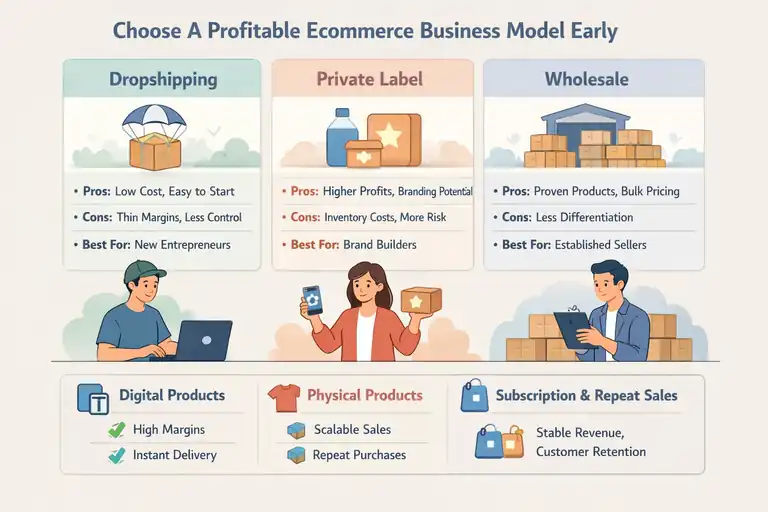
Your idea might be solid, but the wrong business model can quietly kill it. When starting an ecommerce business, this decision shapes cash flow, workload, and how fast you can scale.
Compare Dropshipping, Private Label, And Wholesale Models
Each model has tradeoffs. There’s no universal “best,” only what fits your situation.
Here’s a simplified comparison:
| Model | Pros | Cons | Best For |
| Dropshipping | Low upfront cost, fast launch | Thin margins, less control | Beginners testing ideas |
| Private Label | Strong branding, higher margins | Upfront inventory cost | Long-term brand builders |
| Wholesale | Proven products, predictable demand | Limited differentiation | Operationally focused sellers |
In my experience, dropshipping is great for validation, but private label is where real brand value lives.
Evaluate Digital Products Versus Physical Products
Digital products are underrated in ecommerce conversations.
Digital pros:
- No inventory or shipping
- Instant delivery
- Extremely high margins
Physical product pros:
- Higher perceived value
- Easier to scale with ads
- Better for repeat purchases
If your knowledge solves a problem, a digital product might be the simplest entry point. If the problem is physical, like storage or comfort, physical products make more sense.
I’ve seen many founders start with physical products when a simple digital guide would have validated demand faster.
Understand Subscription And Repeat Purchase Models
One-time purchases are harder than they look.
Subscriptions and repeat-purchase products create stability, which matters more than hype.
Examples include:
- Consumables like skincare or supplements
- Replacement-based products
- Membership access or refills
Even a light subscription option can double lifetime value. That makes ads cheaper and growth less stressful.
If you’re choosing between two ideas, I’d lean toward the one with built-in repeat demand.
Match Business Model To Skills, Budget, And Time
This is where honesty matters.
Ask yourself:
- How much time can I realistically commit weekly?
- Can I afford inventory upfront?
- Am I more marketing-driven or operations-driven?
If you hate customer support, complex fulfillment will burn you out. If you hate marketing, no ecommerce model will save you.
I believe the best ecommerce businesses align with how the founder naturally works, not how gurus say you should build.
Avoid Common Ecommerce Models That Limit Scalability
Some models look attractive but stall quickly.
Be cautious with:
- Ultra-low-ticket products under $10
- Custom-made items with long production times
- Trend-based products with short lifespans
These models often trap founders in constant firefighting mode.
When starting an ecommerce business, scalability isn’t about being huge. It’s about building something that doesn’t collapse when demand increases.
Expert tip: if you’re stuck choosing between ideas, validate two in parallel with small tests. The market will answer faster than overthinking ever will.
Research Products That Balance Demand, Margin, And Risk
This is the step where starting an ecommerce business turns from an idea into a real-world decision. A product can look exciting and still be a bad bet once demand, margins, and operational risk are put under a microscope.
My goal here is to help you avoid products that drain energy instead of building momentum.
Use Amazon, Etsy, And TikTok For Product Discovery
I don’t rely on one platform for product ideas. Each marketplace shows a different type of demand signal, and together they give a clearer picture.
Here’s how I break it down:
- Amazon: Shows mass-market demand and pricing pressure
- Etsy: Reveals niche demand, customization, and premium willingness
- TikTok: Highlights emerging trends and emotional buying triggers
On Amazon, I scan Best Seller lists and “Movers & Shakers” to see what consistently sells, not just what spikes for a day. Etsy is where I look for products people buy because they feel personal or solve a very specific problem. TikTok helps me spot why people buy, not just what they buy.
Example scenario: If a kitchen organizer is trending on TikTok, selling steadily on Amazon, and customized versions exist on Etsy, that’s a strong multi-platform signal. It suggests both demand and room to differentiate.
Analyze Competitor Pricing, Reviews, And Differentiation
Competitor research isn’t about copying. It’s about understanding expectations.
I usually analyze at least 10 competitors and look for patterns in:
- Pricing ranges
- Review volume and sentiment
- Repeated complaints or feature requests
When reading reviews, I focus on:
- What people love: This sets the baseline you must meet
- What people hate: This is where opportunity lives
If customers complain about durability, unclear instructions, or slow shipping, those are fixable problems. If they complain about the core function, that’s a warning sign.
I also note how competitors differentiate. If everyone uses the same generic images and copy, strong branding alone can be an advantage.
Calculate True Product Costs And Net Profit Margins
This is where many ecommerce beginners fool themselves.
The product cost is just the beginning. I always calculate true cost before committing.
My basic checklist looks like this:
- Product and packaging cost
- Shipping to customer
- Platform and payment processing fees
- Estimated ad cost per sale
- Refund and return allowance
As a simple rule, I aim for products that can sell at 3–4x landed cost. If a product costs $10 to fully deliver, selling it for $35–$45 gives breathing room.
Thin margins don’t just limit profit. They limit your ability to test ads, improve customer experience, and survive mistakes.
Avoid Saturated Products With Low Barriers To Entry
Saturation isn’t about competition count. It’s about how easy it is to copy.
Red flags I watch for:
- Identical product images across dozens of stores
- No branding, no differentiation
- Competing purely on price
If anyone can source the same product and launch in a weekend, you’re in a race to the bottom.
Instead, I look for products where differentiation requires:
- Better design
- Better education
- Better bundling
- Better positioning
Those are harder to replicate quickly and protect you as you scale.
Validate Shipping Feasibility And Return Risk
Shipping problems quietly kill ecommerce businesses.
Before committing, I ask:
- Is this product fragile, bulky, or heavy?
- Are returns likely due to sizing, fit, or expectations?
- Will shipping costs surprise customers at checkout?
High return rates destroy margins fast. Apparel and complex products often look profitable on paper but leak money through returns.
When starting an ecommerce business, boring logistics often matter more than exciting products. If shipping feels risky, listen to that instinct.
Source Reliable Suppliers And Test Product Quality
A great product idea means nothing without a reliable supplier.
I’ve learned the hard way that supplier quality impacts customer experience more than marketing ever will.
Find Suppliers Using Alibaba, Faire, And Local Wholesalers
Each sourcing channel serves a different purpose.
- Alibaba: Best for private label and custom manufacturing
- Faire: Ideal for curated wholesale products with lower risk
- Local wholesalers: Great for faster shipping and easier communication
On Alibaba, I filter for suppliers with trade assurance, multiple years in business, and verified factories. On Faire, I look for brands with consistent reorder rates. Local wholesalers are underrated if you want speed and reliability over novelty.
I suggest shortlisting 3–5 suppliers per product before moving forward.
Request Samples And Verify Product Consistency
Never skip samples. Ever.
When samples arrive, I check:
- Build quality and materials
- Packaging and unboxing experience
- Accuracy compared to listing photos
If ordering multiple samples, consistency matters. One good sample doesn’t guarantee consistent production.
I once rejected a supplier because two samples of the same product felt noticeably different. That saved months of customer complaints later.
Negotiate MOQs, Pricing, And Payment Terms
Most beginners assume prices are fixed. They’re not.
Common negotiation points include:
- Lower MOQs (minimum order quantities)
- Tiered pricing at higher volumes
- Partial deposits instead of full upfront payment
Even small concessions improve cash flow early on. Suppliers expect negotiation, especially once you show long-term intent.
Be respectful and clear. Good suppliers prefer stable partners, not aggressive bargain hunters.
Evaluate Supplier Communication And Fulfillment Speed
Communication quality predicts future problems.
I pay attention to:
- Response time
- Clarity of answers
- Willingness to explain processes
If communication is slow before payment, it rarely improves after.
Fulfillment speed also matters. Ask direct questions about production timelines, shipping methods, and peak-season delays.
Clear answers signal experience. Vague answers signal risk.
Create Backup Supplier Options To Reduce Risk
Single-supplier dependency is fragile.
I always keep at least one backup supplier, even if I don’t order immediately.
This protects you from:
- Stock shortages
- Quality drops
- Sudden price increases
When starting an ecommerce business, resilience beats perfection. Backup options give you leverage and peace of mind.
Expert tip: treat suppliers like long-term partners, not vendors. Clear communication and respect often lead to better pricing, priority production, and fewer surprises down the road.
Register Your Business And Handle Legal Foundations
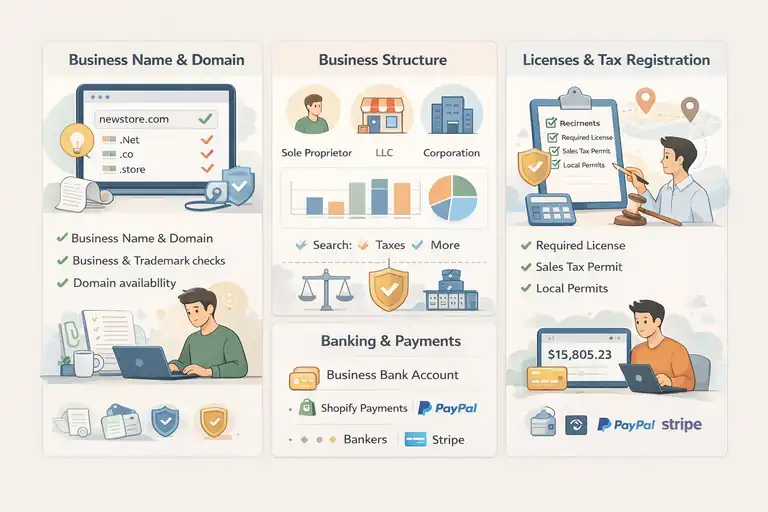
This part of starting an ecommerce business isn’t exciting, but it’s what keeps everything you build from falling apart later.
Getting the legal basics right early saves you stress, money, and painful cleanup once sales start coming in.
Choose A Business Name And Domain Strategically
Your business name doesn’t need to be clever. It needs to be clear, usable, and legally available.
I suggest choosing a name that is:
- Easy to spell and pronounce
- Not limiting future product expansion
- Available as a .com domain
Before you fall in love with a name, do three checks:
- Domain availability using a registrar
- Business name availability in your state or country
- Trademark conflicts in your category
A common mistake I see is picking a name too tightly tied to one product. If you start with water bottles but later add bags or accessories, a flexible name keeps doors open.
Decide Between Sole Proprietor, LLC, Or Corporation
This choice affects taxes, liability, and paperwork.
Here’s a simplified way to think about it:
| Structure | Best For | Key Tradeoff |
| Sole Proprietor | Testing ideas fast | No liability protection |
| LLC | Most ecommerce founders | Small setup cost |
| Corporation | Large or funded companies | Complex compliance |
In my experience, most people starting an ecommerce business move to an LLC once they see traction. It separates personal and business liability without heavy admin.
If you’re unsure, a local accountant or legal advisor can often clarify this in one short conversation.
Obtain Required Licenses And Sales Tax Registration
This step depends heavily on location, but it matters more than many realize.
You may need:
- A general business license
- A sales tax permit or VAT registration
- Local permits depending on your region
If you sell to customers in different states or countries, sales tax rules can apply based on where your business has “nexus,” meaning a physical or economic presence.
Platforms like Shopify offer built-in sales tax tools, but they don’t replace registration. Think of software as assistance, not compliance.
Open A Business Bank Account And Payment Setup
Mixing personal and business finances is a headache waiting to happen.
Once registered, open:
- A dedicated business bank account
- A business debit or credit card
Then connect payment processors like:
These services handle credit card processing and fraud checks. They take a small percentage per transaction, but they’re worth it for trust and ease.
Clean financial separation also makes accounting and taxes far simpler later.
Understand Basic Ecommerce Compliance Requirements
You don’t need to be a legal expert, but you do need awareness.
At a minimum, your store should include:
- Privacy policy
- Terms of service
- Refund and return policy
If you collect customer data, privacy laws like GDPR or similar regulations may apply depending on where your customers live.
I recommend using policy generators as a starting point, then customizing them to match how your business actually operates.
Build Your Online Store With Conversion In Mind
Your store isn’t just a catalog. It’s a salesperson working 24/7. When starting an ecommerce business, design choices directly affect trust, clarity, and sales more than most people expect.
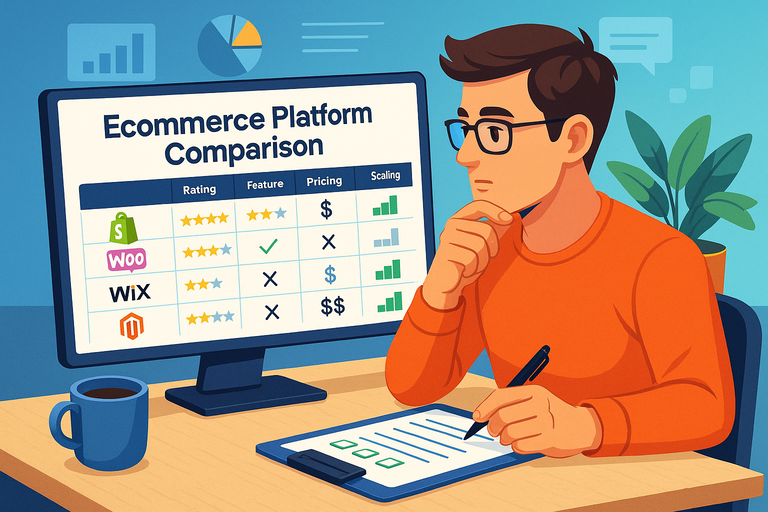
Choose Shopify Or WooCommerce Based On Business Needs
Both platforms work, but they serve different types of founders.
| Platform | Best For | Watch Out For |
| Shopify | Simplicity and speed | Monthly fees |
| WooCommerce | Flexibility and control | More setup work |
Shopify is beginner-friendly and handles hosting, security, and updates. WooCommerce runs on WordPress and gives more customization but requires more technical involvement.
I usually recommend Shopify if you want fewer decisions early and WooCommerce if you already manage WordPress comfortably.
Select A Fast, Mobile-Optimized Ecommerce Theme
Most traffic is mobile. A slow or cluttered theme quietly kills conversions.
When choosing a theme, prioritize:
- Fast loading speed
- Clear navigation
- Mobile-first layouts
Avoid themes overloaded with animations and features you don’t need. Simple stores often outperform complex ones because they reduce friction.
Before committing, preview the theme on your phone. If it feels annoying to use, customers will feel the same.
Structure Product Pages For Trust And Clarity
Product pages do the heavy lifting.
Every strong product page answers five questions fast:
- What is this?
- Who is it for?
- Why is it better?
- How much does it cost?
- What happens if I don’t like it?
I suggest structuring pages with:
- Clear product title and benefits
- High-quality images showing use
- Simple bullet-point features
- Social proof like reviews or testimonials
Clarity beats cleverness every time.
Set Up Secure Payments And Checkout Experience
Checkout is where momentum dies if things feel off.
Best practices I stick to:
- Offer multiple payment options
- Minimize required fields
- Display security and refund assurances
Even small changes, like enabling express checkout options, can lift conversion rates noticeably. Industry data often shows checkout optimization improving conversions by 10–30%.
Trust signals matter most here.
Configure Shipping Zones, Taxes, And Policies
This is where expectations are set.
Be transparent about:
- Shipping costs and timelines
- Tax calculations
- Return conditions
I recommend showing shipping information early, not hiding it at checkout. Surprises cause cart abandonment.
When starting an ecommerce business, clear policies reduce support tickets, refunds, and bad reviews more than aggressive marketing ever will.
Expert tip: before launching, ask a friend to buy something from your store and narrate their thoughts out loud. You’ll catch friction points you’ve become blind to.
Price Products For Profit Without Killing Conversions
Pricing is where starting an ecommerce business becomes real math instead of guesswork. Price too high and conversions stall. Price too low and you end up working hard for nothing.
The goal here is finding a price that supports profit while still feeling fair to the customer.
Calculate Break-Even Points And Target Margins
Before choosing any price, you need to know your break-even point. This is the exact moment where revenue stops losing money and starts making it.
Here’s how I personally calculate it in plain language:
- Product cost: What you pay the supplier, including packaging
- Fulfillment cost: Shipping, handling, and packaging materials
- Platform fees: Payment processing and ecommerce platform fees
- Marketing cost: Average ad spend required for one sale
Once you have that number, pricing becomes clearer. For example, if it costs you $18 to sell one unit all-in, pricing at $22 gives you stress, not profit. Pricing at $39 gives you room to breathe.
I aim for a minimum 60% gross margin whenever possible. That margin protects you when ads fluctuate, refunds happen, or suppliers raise prices.
Use Psychological Pricing Without Devaluing Brand
Psychological pricing sounds manipulative, but it’s really about understanding how people think.
Common approaches that work without feeling cheap:
- Charm pricing: $39 instead of $40
- Anchor pricing: Showing a higher “compare at” price
- Bundle pricing: Increasing perceived value without discounts
What I avoid is constant discounting. Once customers expect sales, full-price conversions drop fast.
If you want to build a brand instead of a bargain bin, use psychology to clarify value, not to pressure people.
Factor Shipping, Refunds, And Ad Costs Into Pricing
This is where many ecommerce founders underprice without realizing it.
Hidden costs I always bake into pricing:
- Free or subsidized shipping
- Refunds and return shipping
- Failed deliveries or damaged items
- Ad creative testing costs
Industry averages often show return rates between 5–30% depending on product category. Ignoring that reality can wipe out profits quietly.
I suggest adding a small “risk buffer” into your pricing model so one bad month doesn’t derail momentum.
Test Pricing Ranges Based On Customer Response
Pricing is not permanent. It’s a hypothesis.
When launching, I often test two or three price points over time while keeping everything else the same.
What I watch closely:
- Conversion rate
- Average order value
- Refund rate
- Customer complaints about price
Sometimes a higher price converts slightly less but makes more profit overall. Don’t assume lower prices always win.
Avoid Race-To-The-Bottom Pricing Mistakes
Competing on price alone is a trap.
If your main selling point is being cheaper, someone will always beat you. Larger competitors can survive on thinner margins. You can’t.
Instead, compete on:
- Better positioning
- Clearer benefits
- Stronger trust signals
- Better experience
When starting an ecommerce business, pricing should support sustainability, not just early sales dopamine.
Launch With Traffic Sources That Actually Convert
Traffic doesn’t equal sales. Relevant traffic does. This section focuses on launching with channels that bring buyers, not just visitors.
Set Up Google Analytics And Conversion Tracking
Before sending traffic anywhere, tracking must be in place.
At a minimum, I set up:
- Google Analytics: Tracks visitor behavior
- Conversion events: Purchases, add-to-cart, checkout starts
Without tracking, you’re guessing. With tracking, every decision gets easier.
A simple rule I follow: If I can’t measure it, I don’t scale it.
Launch With Organic Traffic And SEO Foundations
Organic traffic takes time, but it compounds.
Early SEO actions I recommend:
- Optimize product titles and descriptions
- Write helpful content answering buyer questions
- Use internal links between products and guides
Even a few well-optimized pages can drive consistent sales months later. SEO isn’t fast, but it’s forgiving if you’re on a budget.
If ads stop tomorrow, organic traffic keeps you alive.
Test Paid Ads Using Small, Controlled Budgets
Paid ads are powerful, but only when treated like experiments.
I start with:
- Small daily budgets
- One product, one audience
- Clear success metrics
Platforms like Meta and Google reward data, not desperation. Spending $20–$50 per day testing beats burning $1,000 hoping for magic.
If ads don’t convert organically first, ads won’t save them.
Leverage Influencers And User-Generated Content
Influencer marketing doesn’t require celebrities.
I’ve seen better results from creators with 5k–50k followers than massive accounts.
Why it works:
- Feels authentic
- Builds trust fast
- Creates reusable content
User-generated content, meaning real people using your product, often outperforms polished brand ads. It shows reality, not perfection.
Use Email Marketing For First Sales Momentum
Email is underrated early on.
Even a small list can generate your first consistent sales.
Simple early email flows:
- Welcome email explaining the product
- Education email showing how it solves a problem
- Reminder email for abandoned carts
Email gives you control. Social platforms don’t.
When starting an ecommerce business, owning your audience is one of the smartest long-term moves you can make.
Expert tip: don’t chase every traffic source at once. Pick one primary channel, make it work, then layer the next. Focus beats frenzy every time.
Fulfill Orders Smoothly And Protect Customer Experience
This is the part of starting an ecommerce business where trust is either reinforced or quietly destroyed.
Customers don’t remember your ads as much as they remember how smoothly their order showed up and how you handled things when something went wrong.
Create A Clear Order Processing Workflow
Order fulfillment sounds technical, but at its core it’s just a repeatable checklist.
I like to map the entire process on one page:
- Order received
- Payment confirmed
- Product picked and packed
- Shipping label created
- Tracking sent to customer
If any step feels fuzzy, that’s where mistakes creep in.
Early on, even if you’re fulfilling orders yourself, act like you’re training a future team member. That mindset forces clarity. It also makes automation much easier later.
A simple workflow reduces missed orders, delayed shipments, and late-night panic.
Set Customer Expectations With Shipping Transparency
Most customer frustration comes from surprises, not delays.
People are far more forgiving if they know what to expect upfront.
I recommend being clear about:
- Processing time before shipping
- Estimated delivery windows
- International shipping limitations
If shipping takes 7–10 days, say that. Don’t hint at “fast delivery” unless it’s truly fast.
In my experience, honest shipping pages reduce “Where is my order?” emails by more than half. That alone saves hours each week.
Handle Returns And Refunds Professionally
Returns are part of ecommerce, not a failure.
What matters is how you handle them.
Strong return practices include:
- Clear return windows
- Simple instructions
- Fast refunds once items are received
I’ve seen stores turn unhappy customers into repeat buyers just by being fair and responsive during a refund.
A messy return process doesn’t just lose one sale. It creates negative reviews that cost many future sales.
Automate Fulfillment Where Possible
Automation doesn’t mean losing control. It means removing repetitive work.
Useful automation tools include:
| Tool Type | What It Does | Why It Helps |
| Fulfillment apps | Auto-send orders to suppliers | Fewer manual errors |
| Shipping software | Creates labels and tracking | Faster dispatch |
| Email notifications | Sends updates automatically | Fewer support tickets |
Even small automations free mental space. That space is better spent improving the business instead of babysitting orders.
Monitor Reviews And Customer Feedback Closely
Reviews are free consulting.
I read every review, especially early on, and look for patterns.
Pay attention to:
- Shipping complaints
- Product quality issues
- Confusion about usage
If three people mention the same issue, it’s not a coincidence. It’s a system problem.
Fixing feedback quickly builds trust and protects your reputation while competitors ignore theirs.
Optimize, Scale, And Avoid Common Ecommerce Pitfalls
Growth feels exciting, but this is where many ecommerce businesses break.
Scaling before systems are ready creates stress instead of freedom. The goal here is controlled growth that actually sticks.
Track Key Metrics That Indicate Real Growth
Revenue alone lies.
The metrics I care about most are:
- Conversion rate
- Average order value
- Customer acquisition cost
- Customer lifetime value
If revenue grows but margins shrink, that’s not growth. That’s borrowed time.
I review metrics weekly, not obsessively, but consistently. Patterns matter more than daily spikes.
Improve Conversion Rates Before Scaling Traffic
This is one of my strongest opinions.
If your store converts at 1%, doubling traffic doubles losses if margins are weak. Improving conversion rate to 2% often doubles revenue without spending more on ads.
Simple conversion improvements include:
- Clearer product benefits
- Better images and FAQs
- Stronger trust signals
Conversion optimization is quieter than ads, but far more profitable long-term.
Expand Product Lines Strategically
More products don’t always mean more sales.
I suggest expanding only when:
- A product sells consistently
- Customers ask for related items
- Fulfillment can handle added complexity
Smart expansion examples:
- Accessories that complement a best-seller
- Bundles that increase order value
- Variations customers already request
Random product additions create inventory headaches and dilute focus.
Outsource Tasks To Free Up Founder Time
You shouldn’t be the bottleneck forever.
Once revenue stabilizes, outsourcing low-skill tasks is often the highest return move.
Common early outsourcing wins:
- Customer support
- Order processing
- Basic design or content tasks
This doesn’t mean losing control. It means protecting your energy for decisions that actually grow the business.
Avoid Cash Flow And Inventory Scaling Mistakes
This is where many ecommerce businesses quietly fail.
Common mistakes include:
- Ordering too much inventory too soon
- Reinvesting all cash without a buffer
- Scaling ads before fulfillment is stable
I always keep a cash cushion for at least one to two months of operating expenses. Growth is unpredictable, and that buffer buys peace of mind.
When starting an ecommerce business, slow and controlled often beats fast and fragile.
Expert tip: scale systems before scaling volume. If the business only works when you’re stressed and watching every detail, it’s not ready to grow yet.

I’m Juxhin, the voice behind The Justifiable.
I’ve spent 6+ years building blogs, managing affiliate campaigns, and testing the messy world of online business. Here, I cut the fluff and share the strategies that actually move the needle — so you can build income that’s sustainable, not speculative.
Related posts:
 How To Start A Dropshipping Business With No Money
 How to Launch a Dropshipping Startup From Scratch
 Dropshipping How to Start: Your Complete Beginner’s Guide
 Ecommerce Platform Comparison: Which One Fits Your Brand?
 Top Online Store Platforms for Building Income Streams
 E Commerce Companies to Learn From as You Scale Online