
Table of Contents
Some links on The Justifiable are affiliate links, meaning we may earn a small commission at no extra cost to you. Read full disclaimer.
Creating an online store can feel exciting and overwhelming at the same time—especially when your goal isn’t just to launch, but to land those first real sales.
I’ve seen many people get stuck overthinking the “perfect” setup, when in reality, your first 50 orders come down to a few smart, focused decisions made early on.
Validating Your Product Idea Before Building an Online Store
Before you invest time, money, or emotional energy, validation protects you from building something nobody actually wants.
This step alone determines whether creating an online store becomes profitable—or frustrating.
Identifying a Specific Problem Worth Paying to Solve
The fastest way I’ve seen people fail is selling a product they personally like, instead of solving a problem someone urgently wants fixed.
A real problem usually costs the customer time, money, or stress already.
How to spot a pay-worthy problem:
- People complain about it publicly (forums, Reddit, reviews).
- They already spend money trying to solve it.
- The workaround they use feels inconvenient or incomplete.
For example, “eco-friendly water bottles” is vague. “Leak-proof water bottles that fit airline seat pockets” is specific and emotional. Specificity creates urgency.
In my experience, if you can describe the frustration in one sentence that makes someone nod, you’re onto something. If not, keep digging before creating an online store around it.
Researching Demand Using Search Intent and Buyer Language
Demand isn’t just about search volume—it’s about intent. Someone searching “what is protein powder” isn’t ready to buy. Someone searching “best plant protein for digestion” probably is.
Focus on buyer language like:
- “Best,” “review,” “alternative,” “for [specific use]”
- “Where to buy,” “vs,” “price”
Pay attention to how people phrase questions. That wording becomes your product copy later.
A quick benchmark I use: if at least 20–30 long-tail keywords show buyer intent, demand is usually real enough for your first 50 orders.
Analyzing Competitors Without Copying Their Positioning
Competitors are proof of demand—not a reason to panic. The mistake is copying their messaging instead of spotting gaps.
What I look for:
- Repeated complaints in 3-star reviews
- Benefits they mention once but don’t emphasize
- Audiences they’re clearly not speaking to
If everyone leads with price, you can lead with durability. If everyone talks features, you talk outcomes. Creating an online store works best when you zig slightly instead of reinventing everything.
Setting a Clear Value Proposition for First-Time Buyers
Your value proposition answers one question instantly: Why should I trust you with my first order?
Keep it painfully simple:
- Who it’s for
- What problem it solves
- Why it’s better for them
For early stores, clarity beats cleverness every time. If a visitor understands your offer in five seconds, you’ve already done better than most.
Choosing the Right Platform for Creating an Online Store
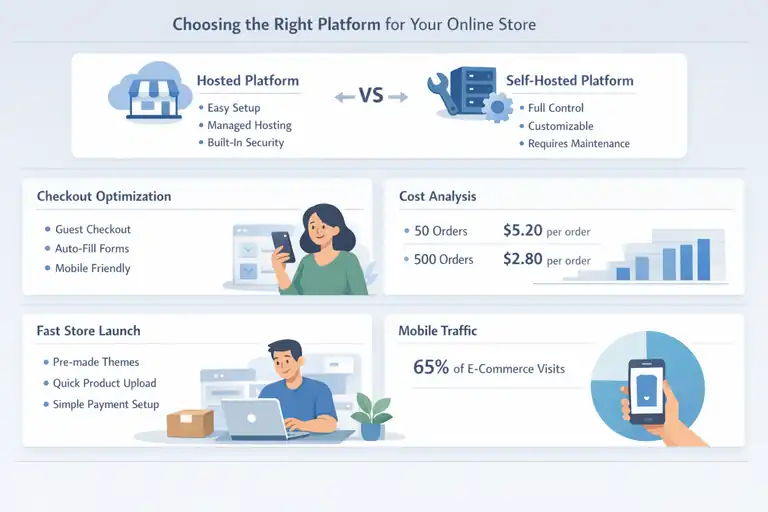
Your platform should remove friction, not create it. For your first 50 orders, speed and simplicity matter more than flexibility.
Comparing Hosted Platforms Versus Self-Hosted Solutions
Hosted platforms handle security, hosting, and updates for you. Self-hosted platforms give more control but require setup and maintenance.
My honest take:
- Hosted platforms are faster for beginners.
- Self-hosted only makes sense if customization is critical early.
When creating an online store, your goal is selling—not configuring servers. You can always migrate later once revenue proves the idea.
Evaluating Checkout Simplicity and Mobile Experience
Checkout is where most stores lose money. Studies consistently show mobile accounts for over 60% of ecommerce traffic, yet many stores still optimize for desktop first.
What actually matters:
- Guest checkout option
- Minimal form fields
- Clear payment buttons above the fold
If checkout feels even slightly annoying on your phone, it’s costing you sales.
Understanding Platform Fees, Limits, and Scalability
Fees look small until volume hits. Transaction fees, payment processing, and app add-ons quietly eat margins.
I recommend calculating:
- Cost per order at 50 orders
- Cost per order at 500 orders
If fees double without added value, that’s a red flag. Creating an online store should scale profit, not complexity.
Selecting a Platform That Supports Fast Store Launch
Momentum matters. A platform that lets you launch in days—not weeks—keeps motivation high and feedback fast.
Look for:
- Pre-built themes that convert
- Simple product uploads
- Easy payment setup
Your first store doesn’t need to be perfect. It needs to be live.
Building a Conversion-Focused Store That Drives Trust
People don’t trust new stores easily. Your job is to remove doubt at every step—visually, emotionally, and logically.
Designing a Clean Store Layout That Reduces Friction
Clutter kills conversions. I’ve seen stores improve sales just by removing unnecessary sections.
Prioritize:
- Clear headline above the fold
- One primary call-to-action
- Plenty of white space
If everything screams for attention, nothing stands out.
Creating Product Pages That Answer Objections Clearly
Every product page should quietly answer:
- Will this work for me?
- Is this worth the money?
- What if something goes wrong?
Use short sections, scannable bullets, and plain language. Avoid hype. Confidence comes from clarity.
Using Social Proof Signals Without Fake Urgency
You don’t need fake countdown timers. Real trust signals work better.
Effective early-stage proof:
- Real customer photos (even if only a few)
- Honest testimonials with specifics
- Clear return and refund policies
One genuine review beats ten vague ones.
Optimizing Site Speed and Mobile Usability Early
A one-second delay can reduce conversions by up to 7%. That’s brutal when traffic is hard-earned.
Check:
- Image sizes
- Mobile font readability
- Button spacing for thumbs
Creating an online store that feels smooth builds subconscious trust—and that’s what gets you to your first 50 orders faster.
Pro tip: If you ever feel stuck, ask yourself this: “What would make me hesitate if this wasn’t my store?” Fix that first.
Pricing and Offers That Help Secure Your First 50 Orders
Pricing is emotional before it’s logical. At this stage, your job isn’t maximizing profit per order—it’s reducing hesitation so people feel safe buying from a brand they’ve never heard of.
Setting Entry-Level Pricing to Reduce Buyer Hesitation
Early pricing should feel like a low-risk “yes,” not a long internal debate. When creating an online store, you’re asking for trust before you’ve earned it.
I usually suggest anchoring slightly below the perceived market average, not racing to the bottom. Cheap signals low quality. Reasonable signals confidence.
What works well early on:
- Clear price justification: Tie the price directly to one main outcome.
- Simple comparison: “Costs less than replacing X every 3 months.”
- Psychological thresholds: $29 feels very different from $31.
One store I helped saw conversion rates jump from 1.2% to 2.1% just by reframing price as “less than $1 a day.” Same price. Different context.
Structuring Simple Offers Without Complex Bundles
Bundles feel smart, but early on they slow decisions. Too many options create friction.
For your first 50 orders:
- Offer one core product.
- Add one optional upsell, not three.
- Skip “build your own” setups entirely.
A clean offer reduces cognitive load. If someone has to think, they hesitate. Hesitation kills early momentum.
Using Limited Incentives That Encourage First Purchases
Incentives work best when they feel earned, not desperate.
Good early incentives:
- First-time buyer bonuses: Free accessory or upgrade.
- Order-based perks: Free shipping over a clear threshold.
- Soft urgency: “Small batch available this week.”
Avoid fake timers. People can sense that stuff instantly.
Avoiding Discount Traps That Hurt Long-Term Margins
Discounts are addictive—and dangerous. If your first customers only buy with 30% off, that becomes your brand.
Instead:
- Reward action, not waiting.
- Incentivize first orders, not repeat delays.
- Protect your perceived value early.
You’re building habits—for yourself and your customers.
Traffic Sources That Actually Work for New Online Stores
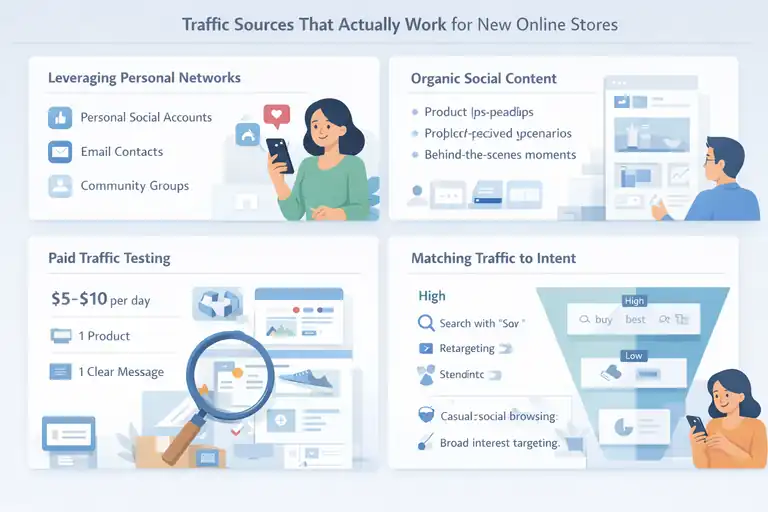
Traffic doesn’t fail—mismatched traffic fails. Early success comes from alignment, not volume.
Leveraging Personal Networks and Warm Audiences First
Your first buyers should come from people who already trust you.
That might feel awkward, but it works.
High-converting warm sources:
- Personal social accounts
- Email contacts
- Community groups you’re genuinely part of
Warm traffic often converts 2–3x higher than cold traffic. That feedback is priceless when creating an online store.
Using Organic Social Content to Validate Product Appeal
Organic content isn’t about going viral—it’s about testing reactions.
Post:
- Product-in-use clips
- Problem-focused before/after scenarios
- Honest behind-the-scenes moments
If people comment, save, or ask questions, you’re onto something. Silence is feedback too.
Testing Paid Traffic With Controlled, Small Budgets
Paid ads aren’t evil—they’re just misunderstood.
Start small:
- $5–$10 per day
- One product
- One clear message
Your goal isn’t scaling. It’s learning what people respond to without burning cash.
Matching Traffic Sources to Buyer Intent Levels
Not all traffic is equal.
High-intent traffic:
- Searches with “buy,” “best,” or “alternative”
- Retargeting people who already visited
Low-intent traffic:
- Casual social browsing
- Broad interest targeting
Match your expectations accordingly.
Order Fulfillment and Support Systems That Build Momentum
Delivery and support shape memory. People forget ads—but they remember bad shipping.
Setting Up Reliable Shipping and Delivery Expectations
Fast shipping is great. Accurate shipping is better.
Be clear about:
- Processing times
- Delivery windows
- Tracking availability
I’ve seen stores reduce refunds simply by adding one honest sentence about delays.
Creating Simple Post-Purchase Communication Flows
Silence after checkout creates anxiety.
At minimum, send:
- Order confirmation
- Shipping update
- Delivery confirmation
Short, human messages build trust faster than polished templates.
Handling Customer Questions Without Support Overload
Early support doesn’t need complexity.
Use:
- A clear FAQ page
- One support email
- Saved reply templates
Most early questions repeat. Prepare once. Reuse often.
Turning Early Buyers Into Repeat Customers and Referrals
Your first buyers are your loudest advocates.
Simple follow-ups work:
- “Did it arrive okay?”
- “Anything confusing?”
- “Want 10% off your next order?”
People love feeling heard.
Tracking Metrics That Matter When Creating an Online Store
Metrics should guide decisions—not inflate ego. Early on, less data is more useful than more noise.
Measuring Conversion Rate Instead of Vanity Metrics
Traffic doesn’t matter if nobody buys.
Focus on:
- Product page conversion rate
- Checkout completion rate
A store with 300 visitors and 10 orders is healthier than one with 5,000 visitors and zero sales.
Tracking Cost Per Order for Early Traffic Decisions
Cost per order tells the truth fast.
If you spend $100 to make $60, that’s not scaling—it’s leaking.
Track this before touching revenue goals.
Using Customer Feedback to Guide Store Improvements
Your customers tell you what to fix—if you listen.
Watch for:
- Repeated questions
- Confusion points
- Unexpected use cases
Those insights often outperform analytics tools.
Knowing When to Optimize Versus When to Scale
Optimize when:
- Conversion is under 1.5%
- Feedback mentions confusion
- Refunds feel frequent
Scale when:
- Orders feel predictable
- Support questions drop
- Margins are stable
Creating an online store isn’t about speed. It’s about rhythm.
Best practice: If one change clearly improves sales or reduces friction, document it. That habit compounds faster than any growth hack.

I’m Juxhin, the voice behind The Justifiable.
I’ve spent 6+ years building blogs, managing affiliate campaigns, and testing the messy world of online business. Here, I cut the fluff and share the strategies that actually move the needle — so you can build income that’s sustainable, not speculative.
Related posts:
 Start Dropshipping Today: A Simple Guide for Complete Beginners
 CJdropshipping Shopify Integration: Quick & Easy Setup!
 How to Use Dsers Shopify for Seamless Dropshipping
 How to Launch a Dropshipping Startup From Scratch
 Dropshipping Website Examples That Inspire and Convert
 How to Sell on SaleHoo: A Simple Guide for New Sellers