
Table of Contents
Some links on The Justifiable are affiliate links, meaning we may earn a small commission at no extra cost to you. Read full disclaimer.
SurveyMonkey review for affiliate marketers gets interesting once you stop thinking of it as “just a survey tool” and start looking at it as a conversion asset.
If your traffic is decent but your clicks, email signups, or buyer intent data feel fuzzy, SurveyMonkey can help you understand what people actually want before you send them to an offer. That said, it is not automatically the best quiz funnel platform for every affiliate setup.
In this guide, I’ll break down where SurveyMonkey helps, where it falls short, and whether it can realistically boost conversions for your business.
What SurveyMonkey Is And Why Affiliate Marketers Even Consider It
SurveyMonkey is best known as a survey and forms platform, but the real question for affiliate marketers is whether it can do more than collect feedback.
It can, though only in the right workflow.
What SurveyMonkey Actually Does
SurveyMonkey lets you create surveys, forms, quizzes, polls, and lead capture experiences, then distribute them through web links, email, social sharing, QR codes, embeds, or pop-ups on your site. Paid plans also support unlimited questions, while the free plan is much more limited.
SurveyMonkey currently highlights AI-assisted building, 200+ integrations, website embeds, payment collection, and analysis features such as thematic analysis, sentiment analysis, and AI-generated insights on qualifying plans.
For an affiliate marketer, that matters because surveys are not only about “research.” They can become pre-sell assets.
You can use them to:
- Segment visitors: Ask what problem someone wants to solve before recommending a product.
- Qualify leads: Identify beginners, comparison shoppers, and ready-to-buy readers.
- Improve messaging: Learn which objections stop clicks or purchases.
- Increase relevance: Match people to more tailored affiliate recommendations.
That is the part many marketers miss. A simple survey can make your content feel more personal without building a huge app or custom funnel.
Why Affiliates Use Surveys In The First Place
Affiliate marketing usually breaks when the message is too broad. You write one review, send one CTA, and hope one offer fits everyone. In reality, visitors show up with different budgets, goals, and levels of awareness.
Imagine you run a blog about email marketing tools. One visitor wants the cheapest beginner-friendly option. Another wants deep automation. A third wants Shopify integration. If all three see the same pitch, your click-through rate usually suffers.
A short survey fixes that by gathering intent before the recommendation. Instead of saying, “Here is the best tool,” you say, “Tell me what you need, and I’ll show you the best fit.” That shift can improve trust because the recommendation feels earned, not pushed.
In my experience, this is where SurveyMonkey starts to make sense. Not as a flashy top-of-funnel gimmick, but as a way to reduce mismatch between traffic and offer.
The Core Idea Behind Conversion Improvement
SurveyMonkey does not boost conversions by magic. It boosts conversions when you use it to remove friction, sharpen targeting, and personalize follow-up.
Here is the simple version:
- Bad funnel: Same message to everyone.
- Better funnel: Ask a few smart questions first.
- Best funnel: Route people to the most relevant content, lead magnet, or affiliate offer based on answers.
That logic is built into SurveyMonkey through skip logic and advanced branching. SurveyMonkey’s help docs confirm that you can route respondents based on earlier answers, show or hide future questions, and customize flow using conditions and actions.
That means you can build paths like:
- Newbie readers go to a beginner tool comparison
- Advanced readers go to premium software reviews
- Budget-conscious readers go to lower-cost recommendations
- Agency visitors go to team or enterprise-oriented content
That is useful. But it also leads to the next question: does SurveyMonkey do this better than other tools built specifically for quiz funnels?
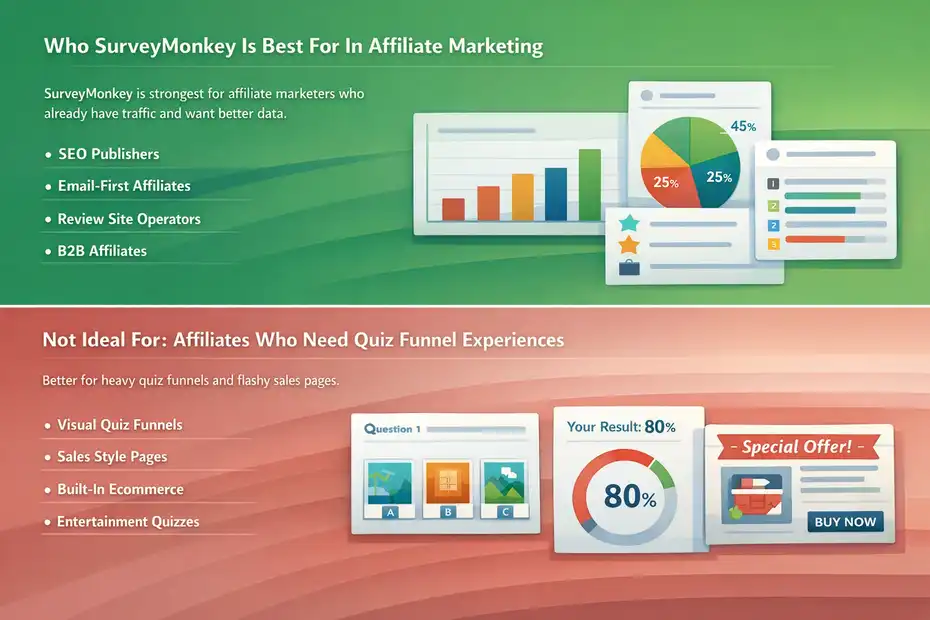
Who SurveyMonkey Is Best For In Affiliate Marketing
SurveyMonkey is not equally good for every affiliate business model.
The fit depends on your traffic source, offer complexity, and how much personalization you actually need.
Best Fit: Content-Driven Affiliates Who Need Better Audience Insight
SurveyMonkey is strongest for affiliate marketers who already have traffic and want better data.
This includes:
- SEO publishers: Bloggers and niche site owners who want to learn what readers need before presenting an offer.
- Email-first affiliates: Marketers who want to segment subscribers before promoting products.
- Review site operators: Publishers comparing tools, software, courses, or services.
- B2B affiliates: Marketers recommending platforms where buyer needs vary a lot by company size, budget, or use case.
If you are publishing informational content and monetizing later through reviews, comparisons, and email sequences, SurveyMonkey can fit naturally. It is especially helpful when the buyer journey is not one-click simple.
For example, if you promote project management software, hosting, CRMs, SEO tools, or email platforms, your audience often has different requirements. A survey can surface those needs before the recommendation page.
Weak Fit: Affiliates Who Need A Native Quiz Funnel Experience
Here is where I would be careful. SurveyMonkey is excellent at surveys and respectable for forms, but not every affiliate flow should be built inside a survey platform.
If your strategy depends on:
- visual, highly branded quiz funnels
- outcome pages designed like sales pages
- direct landing page optimization
- built-in quiz commerce experiences
- heavy front-end conversion testing on entertainment-style quizzes
then SurveyMonkey may feel a little too research-oriented.
That does not make it bad. It just means its center of gravity is still data collection and analysis, not necessarily the most aggressive consumer-style conversion funnel design.
I believe this is the single most important framing point in the entire review. SurveyMonkey helps affiliates who want smarter decisions and cleaner segmentation. It is less ideal for affiliates who want a “personality quiz meets landing page builder” experience.
Strongest Use Cases By Affiliate Vertical
Here is where I think SurveyMonkey is most useful:
| Affiliate Vertical | Fit | Why It Works |
|---|---|---|
| SaaS affiliate marketing | Strong | Buyers have different needs, budgets, and feature priorities |
| B2B tools and software | Strong | Surveys help qualify serious prospects before routing them |
| Education and online course affiliates | Strong | Great for matching learners to the right product level |
| Health and wellness content | Moderate | Useful for preference matching, but messaging must stay compliant |
| Ecommerce product affiliates | Moderate | Helpful for product recommendation funnels, though other quiz tools may convert harder |
| Broad impulse-buy consumer offers | Weak to Moderate | A survey can add too much friction unless the payoff is obvious |
That is the practical answer. SurveyMonkey is best when the purchase decision needs context.
SurveyMonkey Features That Matter Most For Conversions
Most software reviews waste time listing every feature. For affiliate marketers, only a handful really matter.
Survey Logic And Branching For Personalized Recommendations
This is one of SurveyMonkey’s most important conversion features.
Question skip logic lets you move respondents to later questions or pages based on earlier answers, while advanced branching lets you show or hide future questions using conditions and actions. SurveyMonkey also notes that advanced branching works best after your survey structure is finalized.
Why this matters for affiliates is simple: you can shorten the experience and make recommendations feel more relevant.
A basic example:
- Q1: What is your main goal?
- Q2: What is your budget?
- Q3: What platform do you use right now?
- Result path: Send them to the review or comparison page that best fits
Without logic, everyone answers everything. That feels slow and generic.
With logic, a beginner on a $29 budget does not have to answer enterprise questions. An advanced marketer does not have to click through newbie prompts. That makes the experience feel smarter, which usually improves completion rates and the likelihood of following your recommendation.
I suggest keeping affiliate recommendation surveys between 4 and 8 meaningful questions unless your audience is extremely motivated. Anything longer needs a strong perceived payoff.
Embeds, Pop-Ups, And On-Site Collection
SurveyMonkey supports website embeds and pop-ups on paid plans, along with sharing through web link, email, QR code, and social channels. It also mentions that some paid plans let you target website visitors based on actions and follow up with app users based on response data.
For affiliates, this opens a few useful deployment options:
- Embedded recommendation quiz: Place it inside a comparison page
- Exit-intent research form: Ask what stopped the click
- Post-content survey: Use it after a review article to understand objections
- Email segmentation form: Ask subscribers what they need before sending offers
This flexibility is underrated. You do not always need a standalone landing page. Sometimes the best move is a small embedded survey beneath a “not sure which tool is right for you?” prompt.
That can turn passive readers into active respondents without sending them somewhere else.
AI Building And Analysis
SurveyMonkey’s AI features include Build with AI on all plans, question type prediction, answer recommendations, and survey tips. On higher plans, it also offers Analyze with AI, thematic analysis, sentiment analysis, and response quality detection.
For affiliate marketers, these are useful in two ways.
First, they speed up setup. If you are not a research nerd, an AI-assisted starting point helps you build faster.
Second, they help with messy qualitative data. If you ask open-ended questions like “What stopped you from buying?” or “What matters most in choosing a tool?” thematic and sentiment analysis can surface patterns without forcing you to manually read every answer.
That is valuable because the real conversion gain often comes after the survey. The survey tells you:
- what objections show up repeatedly
- what language buyers use
- which features people care about most
- what pages or offers you should build next
So yes, AI matters here, but not because it sounds futuristic. It matters because it shortens the time between collecting feedback and improving the funnel.
Pricing, Plan Limits, And Whether The Cost Makes Sense
Pricing matters more in affiliate marketing than software companies like to admit. Your tool does not just need to work. It needs to pay for itself.
Current SurveyMonkey Pricing Snapshot
SurveyMonkey’s official individual pricing currently shows:
- Premier Annual: €99/month, billed annually, with 40,000 responses per year
- Advantage Annual: €36/month, billed annually, with 15,000 responses per year
- Standard Monthly: €39/month, with 1,000 responses per month
- Free plan: Up to 10 questions and view 25 responses per survey
SurveyMonkey also states that paid plans may incur overage fees up to $0.15 or equivalent per response over the response limit.
That pricing structure creates a very specific decision for affiliates.
If you are only collecting basic visitor feedback once in a while, the paid plans may feel expensive.
If you are actively using surveys to qualify leads, shape content strategy, segment email subscribers, or improve high-value SaaS commissions, the math can work quickly.
When The Cost Is Worth It
Let me make this practical.
Suppose you promote software with a $100 commission. If SurveyMonkey helps you generate or recover even 1 to 3 extra qualified sales per month, a mid-tier plan may already pay for itself.
It gets even easier to justify when you use the data across multiple assets:
- a better review page
- a segmented welcome email sequence
- a more relevant lead magnet
- cleaner audience messaging for future content
This is why I would not judge SurveyMonkey purely by “survey software price.” I would judge it by whether it helps your overall funnel convert better.
For high-ticket affiliates, that can be a reasonable bet.
For low-ticket consumer affiliate sites, it is a tougher sell.
Where Pricing Can Hurt
This is also where many affiliates will hesitate, and honestly, I think that hesitation is fair.
There are three friction points:
- Response caps: If a survey unexpectedly performs well, overages can become annoying.
- Feature gating: Some advanced analysis and branding features sit on higher plans.
- Value mismatch for tiny sites: New affiliates may not yet have enough traffic to justify the spend.
User reviews on G2 and Capterra also regularly praise SurveyMonkey’s ease of use but mention pricing and feature access as common concerns, especially for users who want more flexibility or better value from lower-tier plans.
So the pricing verdict is simple: Good value for serious marketers using data strategically, questionable value for hobby affiliates and very early-stage sites.
How SurveyMonkey Can Boost Conversions In Real Affiliate Funnels
This is the part that matters most. Let’s move from software features to actual conversion use cases.
Use Case 1: Audience Segmentation Before The Click
One of the smartest ways to use SurveyMonkey is before you send traffic to the affiliate offer.
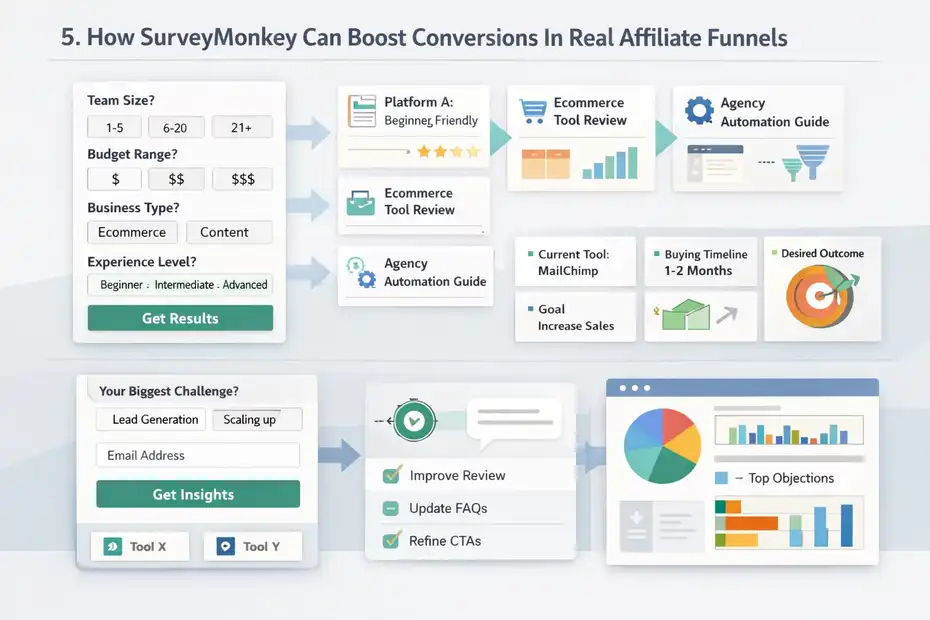
Example: You run a post titled “Best Email Marketing Tools For Small Business.” Instead of pushing every reader into the same comparison, you place a short embedded survey that asks:
- team size
- budget range
- top priority
- ecommerce or content business
- experience level
Then you route readers to the most relevant page:
- beginners → simpler platform review
- ecommerce stores → integration-focused recommendation
- agencies → advanced automation comparison
This improves conversions because the recommendation is more aligned with buyer context.
I have seen this kind of segmentation outperform generic CTA buttons in situations where the purchase decision is complex. It reduces the mental load on the visitor. They do not have to read every option. You narrow the field for them.
Use Case 2: Email Capture With Intent Data
An email signup without context is nice. An email signup with buying intent is much better.
You can use SurveyMonkey to collect:
- email address
- main challenge
- current tool stack
- timeframe to buy
- desired outcome
That gives you richer segmentation than a plain “join our newsletter” box.
For example, instead of one generic sequence, you can create:
- a beginner onboarding sequence
- a comparison sequence for active shoppers
- a premium-tool sequence for higher-budget leads
That usually improves open rates, click rates, and downstream affiliate revenue because the content feels more relevant.
The point is not just list growth. It is smarter follow-up.
Use Case 3: Objection Mining For Better Review Pages
This is one of my favorite uses, and it is often overlooked.
SurveyMonkey can help you discover why people are not converting.
Add a short survey on:
- product comparison pages
- bonus pages
- abandoned click pages
- subscriber re-engagement emails
Ask questions like:
- What is stopping you from choosing a tool today?
- Which feature matters most to you?
- What concerns do you have about pricing?
- Which alternatives are you comparing?
Then use those answers to improve:
- review copy
- FAQ sections
- comparison tables
- CTA wording
- bonus positioning
SurveyMonkey’s analysis tools, filters, crosstabs, and AI-supported thematic grouping can help you identify patterns faster once you start collecting responses.
This is where conversions often improve the most: not from the survey itself, but from the messaging changes it enables.
Step-By-Step Setup For Affiliate Marketers
If you decide to test SurveyMonkey, the setup should be strategic. Do not build a survey just because you can. Build one around one conversion problem.
Step 1: Choose One Funnel Goal
Start with one of these:
- Goal 1: Increase click-through rate to affiliate offers
- Goal 2: Improve email lead quality
- Goal 3: Learn why visitors are not buying
- Goal 4: Match users to the right offer or product tier
Pick only one.
This matters because most bad surveys fail from trying to do too much. They become half research project, half lead form, half quiz, and fully confusing.
If your main problem is poor CTR from review pages, build a recommendation survey.
If your problem is low email revenue, build a segmentation form.
If your problem is weak messaging, build a friction survey.
Keep the objective narrow enough that success is obvious.
Step 2: Map Questions To A Recommendation Outcome
Every question should help you make a better recommendation or understand a stronger objection.
A simple framework:
- Question 1: What are you trying to achieve?
- Question 2: What is your budget?
- Question 3: What matters most to you?
- Question 4: What tools are you already using?
- Question 5: Where should we send your personalized recommendation?
Notice what is missing: fluff.
Do not ask demographic questions unless they directly affect the recommendation. Do not ask opinion questions unless you plan to use the answers.
I suggest writing the destination first. Decide where each answer path should lead, then reverse-engineer the smallest number of questions needed to get there.
That one habit makes surveys feel faster and convert better.
Step 3: Use Logic To Keep The Survey Short
SurveyMonkey’s skip logic and advanced branching are what keep the experience efficient.
Let’s say you promote website builders.
A better flow would look like this:
- Path A: “I need an online store” → ask about payments, inventory, and product count
- Path B: “I need a portfolio site” → ask about design control and ease of use
- Path C: “I need a blog” → ask about SEO and content management
This is much cleaner than forcing everyone through the same path.
A good rule: If a question does not affect what you recommend next, cut it.
Step 4: Connect Survey Results To Content Or Follow-Up
This is where many affiliates stop too early.
A survey only becomes a conversion tool when the result changes what happens next.
Your output could be:
- a custom results page
- a recommended-tool article
- a segmented email sequence
- a downloadable buyer guide
- a consultation or advisory CTA
SurveyMonkey supports integrations with tools like HubSpot and Mailchimp, and it highlights 200+ native integrations overall.
That means your survey can become part of a bigger system instead of sitting alone in a forgotten page.
Common Mistakes That Kill Results
SurveyMonkey can help conversions, but it can also create friction if you build the wrong experience.
Making The Survey Too Long
The first mistake is obvious but common. Marketers get excited and start asking everything.
Long surveys lower completion rates unless the reward is strong. SurveyMonkey itself advises that logic should move people forward and that page structure matters when using logic.
For affiliate use, I would keep it lean:
- recommendation surveys: 4 to 8 questions
- objection surveys: 2 to 4 questions
- post-purchase or reader research surveys: longer is okay if the audience is warm
When in doubt, remove one question.
Asking Questions That Do Not Change The Outcome
A question is expensive. It costs attention.
If someone answers a question and nothing changes:
- the result page stays the same
- the email sequence stays the same
- the recommendation stays the same
then that question probably should not exist.
This is where many surveys become “interesting” but not useful. They collect data nobody acts on.
I recommend reviewing each question with one filter: what decision does this answer improve?
Weak Result Pages Or Weak Next Steps
This is the silent killer.
You collect answers, then send people to a generic thank-you page. That wastes the whole funnel.
The result should feel specific:
- “Based on your answers, these are the best email tools for a store under 1,000 subscribers.”
- “You said pricing and ease of use matter most, so start here.”
- “You’re already using Shopify, so this comparison will be the most relevant.”
Even a small amount of specificity can lift trust because it shows the survey did something real.
Overusing Surveys Where Simpler UX Would Win
Sometimes a simple comparison table converts better than a survey.
This happens when:
- buyer intent is already high
- the visitor already knows the category well
- the choice is simple
- the offer is low-ticket and impulse-driven
In those cases, a survey may add unnecessary friction.
That is why I do not see SurveyMonkey as a universal fix. It is a great tool for reducing uncertainty, not for replacing clear buying paths that already work.
SurveyMonkey Vs Other Options For Affiliate Marketers
A useful review needs a reality check. SurveyMonkey is good, but not automatically the best choice in every affiliate scenario.
Where SurveyMonkey Wins
SurveyMonkey has a few clear strengths:
- Mature survey infrastructure: It is built for collecting and analyzing structured responses at scale.
- Strong logic capabilities: Useful for routing users into relevant recommendation paths.
- Solid integration ecosystem: Officially 200+ native integrations.
- Useful AI analysis: Especially for open-text feedback and message mining.
- Credibility and adoption: SurveyMonkey continues to highlight major market presence, G2 recognition, and large review volume.
For affiliate marketers who care about insight quality and segmentation logic, those are meaningful advantages.
Where It Loses
It is weaker when you need:
- a more visual quiz-first funnel
- highly styled result pages
- a front-end lead-gen experience built mainly for entertainment and immediate opt-in
- simpler economics for tiny affiliate sites
- more “salesy” conversion design out of the box
This is not a flaw so much as a product orientation issue. SurveyMonkey started from research and feedback. Some other tools start from quiz funnels and lead generation.
That difference matters.
If your goal is “understand my audience better, segment them, and optimize recommendations,” SurveyMonkey is a strong candidate.
If your goal is “launch a flashy quiz funnel that feels like a mini landing page in 30 minutes,” there may be better-fitting tools.
My Honest Position On The Trade-Off
I believe SurveyMonkey is better for serious affiliate operators than for beginners.
That sounds backwards, but it makes sense. Beginners often need the shortest path to first conversions. Experienced affiliates often need better data, cleaner segmentation, and stronger message-market fit.
SurveyMonkey serves the second group better.
So the question is not “Is SurveyMonkey good?” It is “Do you need insight-driven conversion improvement, or do you need a lightweight quiz funnel tool?”
Your answer decides everything.
Advanced Optimization Strategies To Get More From It
Once the basic survey is live, the real gains come from iteration.
Use Surveys To Rewrite Money Pages
One of the best ways to use SurveyMonkey is to improve your highest-value pages.
Run a small survey asking readers:
- what almost stopped them from buying
- what feature matters most
- what alternatives they are comparing
- what they still feel unsure about
Then update your review page with:
- stronger objection handling
- better comparison sections
- more relevant CTA copy
- improved FAQ blocks
- clearer who-it’s-for language
This is practical CRO, not theory.
A lot of affiliates guess at objections. Surveys let you stop guessing.
Build Segment-Specific Recommendation Paths
Instead of one generic “best tools” page, create paths by use case:
- best for beginners
- best for agencies
- best for ecommerce
- best for budget-conscious users
- best for advanced automation
Then use SurveyMonkey to sort people into those pages.
This works especially well in SaaS affiliate niches because feature relevance is rarely universal. A platform that is perfect for an ecommerce brand may be a terrible fit for a consultant or content publisher.
The tighter the recommendation match, the higher the chance of a click and a qualified sale.
Combine Quantitative And Qualitative Feedback
This is where SurveyMonkey becomes more powerful than a plain opt-in form.
Do both:
- Quantitative questions: Budget, business type, traffic level, use case
- Qualitative questions: Biggest frustration, concern, desired outcome
Then analyze them together.
SurveyMonkey’s filtering, crosstabs, thematic analysis, and AI analysis features make this kind of mixed-feedback workflow easier to work through as the response volume grows.
That gives you sharper insights like:
- budget objections show up most among beginners
- agencies care more about integrations
- ecommerce users mention migration pain more often
- advanced users complain less about price and more about workflow depth
That is conversion gold because it lets you write different messages for different segments instead of hoping one message fits all.
Final Verdict: Can SurveyMonkey Boost Conversions For Affiliate Marketers?
Yes, SurveyMonkey can boost conversions for affiliate marketers, but not in the lazy way many people hope.
It is not a button you switch on and suddenly commissions go up.
It works when you use it to:
- identify intent
- segment visitors
- personalize recommendations
- collect objection data
- improve follow-up sequences
- refine money-page messaging
If that is your strategy, SurveyMonkey is genuinely useful.
Its strongest advantages are logic, flexibility, data collection depth, analysis capabilities, and integration options. SurveyMonkey also offers AI-supported survey creation on all plans and more advanced AI analysis on higher tiers, which can save time when you are working with a lot of open-ended responses.
Its biggest downsides are cost sensitivity, response limits, and the fact that it is not always the most conversion-styled tool for quiz-first funnels. Official pricing and plan caps make that trade-off pretty clear.
So here is my honest conclusion.
SurveyMonkey is a smart buy for affiliate marketers who already have traffic and want to turn audience insight into better offers, sharper content, and more relevant recommendations.
It is a weaker fit for beginners looking for a cheap, highly visual, quiz-funnel shortcut.
My rating for affiliate marketers:
- Ease of use: 8.5/10
- Segmentation power: 8.5/10
- Conversion potential: 7.5/10
- Value for money: 6.5/10 for beginners, 8/10 for established affiliates
- Overall fit for affiliate marketing: 7.8/10
The short version is this: SurveyMonkey is not the flashiest affiliate tool, but in the right hands, it can absolutely help boost conversions by making your recommendations more relevant and your funnel decisions more informed.
FAQ
What is SurveyMonkey used for in affiliate marketing?
SurveyMonkey is used to collect audience data, segment visitors, and personalize product recommendations. Affiliate marketers use it to understand user intent before promoting offers, which helps improve targeting, messaging, and overall conversion rates across content, email funnels, and landing pages.
Can SurveyMonkey increase affiliate conversions?
Yes, SurveyMonkey can increase affiliate conversions by helping you match users with the most relevant offers. By collecting preferences, budgets, and goals, you can guide visitors toward better-fitting products, reducing friction and improving click-through rates and purchase intent.
Is SurveyMonkey better than quiz funnel tools for affiliates?
SurveyMonkey is better for data-driven segmentation and audience insights, but not always ideal for visual quiz funnels. If your goal is research and personalized recommendations, it works well. If you need highly styled, conversion-focused quizzes, other tools may perform better.
How do you use SurveyMonkey for affiliate marketing funnels?
You can use SurveyMonkey by creating a short survey that identifies user needs, then routing them to specific product pages or email sequences. The key is connecting survey responses to tailored recommendations that feel relevant and helpful to each visitor.
Is SurveyMonkey worth it for beginner affiliate marketers?
SurveyMonkey may not be the best option for beginners with low traffic due to pricing and feature limits. It becomes more valuable once you have consistent visitors and want to improve conversions through better segmentation and audience insights.

I’m Juxhin, the voice behind The Justifiable.
I’ve spent 6+ years building blogs, managing affiliate campaigns, and testing the messy world of online business. Here, I cut the fluff and share the strategies that actually move the needle — so you can build income that’s sustainable, not speculative.
Related posts:
 Free Landing Page Design: Tips and Tricks for a High-Converting Page
 Performance Based Marketing: Transform Your Advertising Strategy
 Lead Generation Magic: 6 Steps to Double Your Sales
 Affiliate Tools: Tips for Selecting the Right Platform
 The Top 7 Signup Forms Trends of This Year: Increase Your Signups!
 ClickMagick ClickBank Integration – Track, Optimize & Profit!