
Table of Contents
Some links on The Justifiable are affiliate links, meaning we may earn a small commission at no extra cost to you. Read full disclaimer.
Connective ecommerce is changing how people start online businesses—no warehouses, no bulk orders, no inventory headaches. Imagine running a full-scale brand without ever touching a product. Sounds impossible?
It’s not. This model links digital storefronts directly to suppliers, streamlining fulfillment and letting you focus on what truly matters—marketing, customer experience, and growth.
But how exactly does connective ecommerce work, and how can you build a profitable business with it? Let’s break it down step by step.
Understanding The Connective Ecommerce Model
Let’s start by getting clear on what connective ecommerce really means. In short, it’s a modern approach to online selling that links your store directly with suppliers and fulfillment systems, allowing you to sell products without holding any inventory yourself.
Everything—from product listings to order fulfillment—happens automatically through connected systems.
What Makes Connective Ecommerce Different From Traditional Ecommerce
Traditional ecommerce usually requires you to buy, store, and ship products. That means big upfront costs, warehouse management, and inventory risk.
Connective ecommerce flips that model completely. Instead of buying stock, your store is digitally connected to your suppliers.
Here’s how it plays out in practice:
- Traditional Ecommerce: You purchase inventory, store it, and handle logistics.
- Connective Ecommerce: You connect your site to supplier catalogs via software. Orders are sent to the supplier automatically for fulfillment.
What I really like about this model is that it lowers the barrier to entry. You don’t need to worry about dead stock or shipping delays caused by manual processing. It’s designed for efficiency—every part of the business “talks” to the next through automation.
In a traditional setup, your success depends heavily on logistics. In connective ecommerce, your success depends more on your marketing, user experience, and supplier reliability.
That shift makes the model especially attractive for creators and digital entrepreneurs who want to focus on the front end—branding, customer service, and scaling.
How Connective Ecommerce Eliminates The Need For Inventory
Inventory management is one of the biggest challenges (and costs) in ecommerce. Connective ecommerce bypasses it through real-time product synchronization.
When a customer places an order on your site, that order instantly routes to your connected supplier—who then packs and ships the product directly to your customer.
Your online catalog mirrors the supplier’s catalog automatically, which means product availability and pricing stay up-to-date without you lifting a finger.
For example, in Shopify, you can use an app like Syncee or Modalyst to connect your store with suppliers. When a product goes out of stock with the supplier, it disappears from your storefront automatically.
That’s connective commerce at work—your store acts like a live window to your supplier’s inventory.
The key takeaway: you sell, they fulfill. You focus on growing your audience, optimizing ads, and refining customer experience—without worrying about where to store 500 boxes of coffee mugs.
The Core Technologies That Power Connective Ecommerce Systems
Connective ecommerce runs on a combination of automation, integration, and cloud-based data management. These systems make it possible for multiple software platforms—your online store, supplier database, and fulfillment services—to communicate instantly.
The most important technologies include:
- APIs (Application Programming Interfaces): These act as bridges between your store and supplier systems, ensuring instant data sharing.
- Automation Tools: Platforms like Zapier or Shopify Flow automate routine tasks such as sending order data, updating inventory, or syncing tracking numbers.
- Cloud Infrastructure: This keeps your product and order data centralized and accessible across devices, no matter where your business operates.
Here’s a simple example of how this looks: Customer places an order → Order details pass through your store’s API → Supplier receives the data → Product ships automatically → Tracking info syncs back to your store.
It’s a clean, hands-free cycle—no spreadsheets, no manual coordination, no chaos.
Why Connective Ecommerce Appeals To Modern Entrepreneurs
I believe connective ecommerce resonates deeply with today’s entrepreneurs because it reflects how digital business works now—lean, agile, and scalable.
Modern entrepreneurs value flexibility. They want to test ideas fast, pivot quickly, and avoid heavy startup costs. Connective ecommerce offers exactly that:
- Low Financial Risk: You don’t buy stock until it’s sold.
- Fast Market Testing: You can launch new products instantly.
- Location Independence: Work from anywhere; everything is cloud-managed.
- Automation-Friendly: Systems handle the grunt work so you can focus on growth.
It’s also emotionally liberating. When you’re not buried under logistics, you can actually enjoy the creative side of business—storytelling, branding, connecting with customers.
In essence, connective ecommerce is more than just a technical system. It’s a mindset shift—from ownership to connection, from control to collaboration.
How Connective Ecommerce Works Behind The Scenes
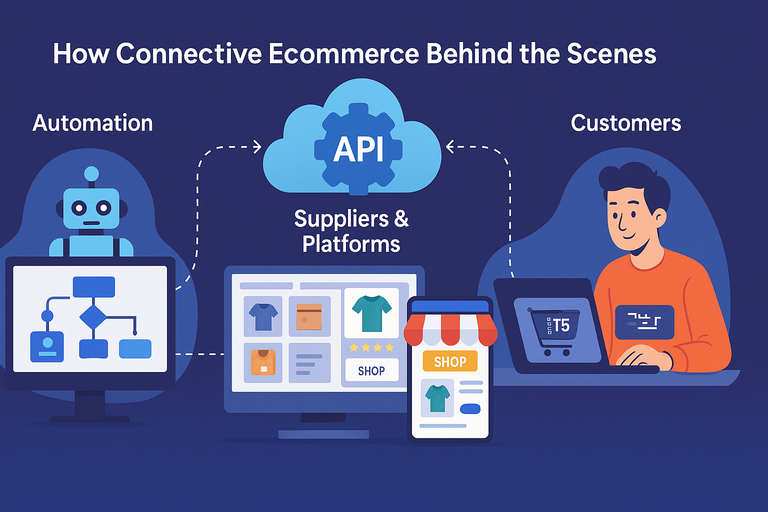
To really understand the power of connective ecommerce, it helps to look under the hood. The magic lies in how all these systems communicate—without human intervention slowing things down.
The Role Of Automation In Connective Ecommerce Fulfillment
Automation is the backbone of connective ecommerce. It handles what used to be dozens of manual steps—processing orders, updating stock, sending tracking emails—all within seconds.
For instance, when an order is placed on your store, the system automatically:
- Transfers the order details to the supplier.
- Deducts the item from available stock.
- Generates a shipping label.
- Sends tracking information to the customer.
This is done through pre-set workflows or trigger-based rules. In Shopify, you might set up an automation rule in Shopify Flow that says: When an order is created → Send fulfillment request to supplier.
The beauty of it is consistency—no missed orders, no late updates, no manual errors.
Connecting Suppliers, Platforms, And Customers Seamlessly
In connective ecommerce, the “connective” part is about integration. Your store isn’t an island—it’s a hub that links multiple platforms into a single ecosystem.
For example:
- Your store platform (like Shopify) connects to
- A supplier network (like Doba or Salehoo), which connects to
- Fulfillment centers and shipping partners.
When these connections are properly established, the system behaves like one continuous organism. The moment a customer makes a purchase, every connected part of the chain reacts automatically.
I like to think of it as digital choreography—each system knows its cue, moves in perfect timing, and delivers a synchronized performance.
How Data Integration Ensures Real-Time Product Updates
In traditional ecommerce, product updates are manual—you upload new prices, update stock counts, and pray it all matches your supplier’s database. With connective ecommerce, data integration handles this for you automatically.
Data integration means that your supplier’s database “feeds” into your store in real-time. If the supplier updates a product description, price, or availability, those changes reflect instantly on your site.
The impact of this is massive:
- You avoid selling out-of-stock products.
- Your pricing stays competitive.
- You reduce refund and customer complaint rates.
Think of it as your store constantly syncing its heartbeat with your supplier’s—always in rhythm, never skipping a beat.
The Importance Of APIs And Cloud-Based Systems In Operations
APIs are the invisible heroes of connective ecommerce. They’re like digital translators that allow different platforms—storefronts, CRMs, suppliers, and fulfillment centers—to talk to each other fluently.
For example, an API might take a product ID from your supplier’s database and convert it into your store’s format. That ensures every item, order, and tracking number aligns across systems.
Cloud-based systems then make sure all this data is accessible, secure, and fast. Instead of saving order data on your local computer, everything is stored in the cloud—making updates instant and operations globally scalable.
From what I’ve seen, the stores that master this layer—APIs plus cloud—are the ones that scale effortlessly. They can onboard new suppliers or expand to new countries without rebuilding their tech stack.
Expert Tip: Before you launch your own connective ecommerce business, invest time in mapping your automation flow and verifying API connections. The more seamless your system integration, the fewer surprises you’ll face when orders start pouring in.
Benefits Of Building With Connective Ecommerce
Connective ecommerce isn’t just about simplifying operations—it’s about unlocking freedom.
By connecting your online store directly to suppliers and automation tools, you can build a lean, scalable business that doesn’t drain your savings or your sanity.
Here’s what makes this model so powerful in practice.
Lower Startup Costs And Reduced Financial Risk
One of the biggest barriers to starting a business is upfront investment. Traditional ecommerce often demands thousands of dollars just to buy stock, store inventory, and manage logistics. Connective ecommerce eliminates that.
Here’s how:
- No inventory purchases: You only pay suppliers after a customer buys a product.
- No storage fees: Products ship directly from suppliers to customers, skipping warehouses entirely.
- No logistics infrastructure: Shipping, packaging, and returns are handled through integrations.
For example, if you’re using Shopify with a supplier integration like Spocket, you can list hundreds of products in your store with zero initial cost. You don’t risk being stuck with unsold stock.
I’ve seen entrepreneurs start functional connective ecommerce stores with under $200—mainly for hosting, a domain, and marketing. It’s a model that lowers your financial exposure while keeping your growth potential high.
The reduced risk means you can experiment freely. Try new products, target new audiences, or adjust pricing without worrying about wasted capital.
In essence, connective ecommerce democratizes business ownership—it gives anyone with internet access a fair shot.
Faster Time-To-Market For New Entrepreneurs
In the digital world, speed matters. Connective ecommerce allows you to launch a business in days rather than months. You don’t wait for suppliers to deliver inventory before you start selling.
Here’s what accelerates time-to-market:
- Instant product catalog uploads: Tools like Syncee let you import products with one click.
- Automated syncing: Inventory, pricing, and descriptions update in real-time.
- Pre-built store templates: Ecommerce platforms like BigCommerce help you go live fast.
Let’s take a real scenario: imagine you find a trending niche—say, ergonomic office accessories. In a traditional setup, you’d spend weeks negotiating with suppliers and ordering samples.
With connective ecommerce, you can connect to a verified supplier, list their products on your site, and start selling within 24 hours.
This speed gives you a first-mover advantage in emerging markets. And since everything’s connected digitally, scaling or pivoting becomes just as quick.
Greater Scalability With Minimal Overhead
Scalability is where connective ecommerce shines brightest. Because your operations are automated and cloud-connected, growth doesn’t require more staff or physical infrastructure.
Here’s what that looks like in practice:
- Automation replaces manual work: Order processing, tracking, and stock updates happen automatically.
- Suppliers handle fulfillment: You don’t need more storage as you expand.
- Cloud-based tools scale instantly: Adding new suppliers or sales channels takes minutes, not weeks.
I recommend setting up integrations through platforms like Shopify Flow or Zapier. These automate repetitive tasks—like sending order confirmations or updating shipping statuses—so your systems grow without your workload ballooning.
This lean structure allows you to handle hundreds of orders per day with minimal human involvement. And because you’re not weighed down by logistics, you can focus entirely on marketing, data analytics, and customer relationships—the real levers of growth.
Enhanced Customer Experience Through Smart Fulfillment
Even though you’re not handling fulfillment yourself, connective ecommerce actually improves customer satisfaction—if it’s set up right. Smart fulfillment ensures faster delivery, real-time tracking, and transparent communication.
Here’s how it works:
- Automated order tracking: Customers receive instant updates via integrated email or SMS systems.
- Dynamic shipping options: Platforms can automatically select the fastest or cheapest fulfillment route.
- Accurate stock visibility: Since product data syncs directly with suppliers, customers don’t order out-of-stock items.
For instance, using a fulfillment partner like ShipBob or Printful (depending on your product type) can ensure your customer receives a branded package that feels professional—even though it never touched your hands.
A seamless fulfillment process doesn’t just improve delivery—it builds trust. And in ecommerce, trust is what turns a first-time buyer into a loyal customer.
Pro Insight: I always suggest testing the order flow yourself. Place an order through your own store, track its fulfillment, and experience what your customer does. You’ll quickly identify where improvements can be made.
How To Build A Connective Ecommerce Store Step-By-Step
Now that you understand the benefits, let’s walk through how to actually build your own connective ecommerce business. The good news?
You don’t need to be a developer or have a big budget to start—just patience, the right tools, and clear strategy.
Step 1: Choose A Reliable Connective Ecommerce Platform
Your ecommerce platform is the foundation. It’s where your website lives, your customers shop, and your integrations run. I personally recommend starting with Shopify, BigCommerce, or WooCommerce.
Here’s what to look for:
- API support: Ensures smooth supplier integrations.
- App ecosystem: Allows automation, analytics, and fulfillment extensions.
- Ease of use: Intuitive dashboard and customizable templates.
If you’re new, Shopify is the most beginner-friendly. You can go to Shopify Dashboard → Apps → Connect Supplier, and start integrating directly with platforms like Spocket or Syncee in minutes.
This platform choice determines your flexibility later—so pick one that grows with your needs.
Step 2: Connect With Verified Suppliers Or Marketplaces
Once your platform is ready, connect it to a verified supplier network. Verified suppliers ensure consistent quality and reliable shipping times, which are critical for customer trust.
Some trusted supplier networks include:
- Spocket: Focuses on US and EU-based suppliers for faster delivery.
- Syncee: Offers a large global catalog with real-time stock syncing.
- Modalyst: Integrates with Shopify and Wix for quick setup.
Before connecting, I suggest checking supplier ratings, average shipping times, and product return policies. Think of it as building a long-term partnership, not just a transaction.
Tip: Always order samples before listing products on your store. You’ll catch potential quality or packaging issues early.
Step 3: Integrate Automation Tools For Orders And Tracking
Automation is where connective ecommerce becomes truly scalable. These tools handle the repetitive tasks you’d otherwise spend hours managing.
Here’s what to automate first:
- Order routing: Automatically send order details to suppliers.
- Stock syncing: Ensure your store matches supplier availability.
- Tracking updates: Push real-time shipping updates to customers.
If you’re using Shopify, tools like Shopify Flow or Zapier can create “if-this-then-that” rules. For example: If a new order is created → send fulfillment request → update tracking once shipped.
I always recommend starting with automation templates and then customizing them as your store grows. Keep it simple first, then build complexity as needed.
Step 4: Design A Conversion-Focused Online Storefront
Your storefront is your brand’s face. It’s what convinces visitors to click buy now instead of bouncing off your page.
To build trust and drive sales:
- Use clear, professional design: Choose mobile-responsive themes.
- Optimize navigation: Limit menus to essential categories.
- Add trust elements: Include reviews, FAQs, and secure checkout badges.
In Shopify, go to Online Store → Themes → Customize, and focus on clarity and brand consistency.
I also suggest including lifestyle photos or short videos that show products in real-world use. It’s not about showing every feature—it’s about sparking emotion and showing value.
Step 5: Optimize Product Listings And Pricing Strategies
Your product listings are where conversions happen. Each listing should blend storytelling, clarity, and trust signals.
To optimize effectively:
- Write honest, benefit-driven descriptions: Focus on how the product improves the buyer’s life.
- Use SEO keywords naturally: Include variations of your main product terms.
- Test pricing regularly: Try small price changes to find the sweet spot between conversion and profit.
In Shopify, you can use Shopify Analytics → Reports → Conversion Rate by Product to see which listings perform best.
I recommend applying A/B testing tools like Neat A/B Testing to experiment with different product titles, descriptions, or photos.
Pricing in connective ecommerce is fluid. Since you’re not managing storage or logistics costs, you can afford to test aggressively—adjust margins, run bundle offers, or apply psychological pricing strategies (like $29.95 instead of $30).
Essential Tools And Platforms For Connective Ecommerce
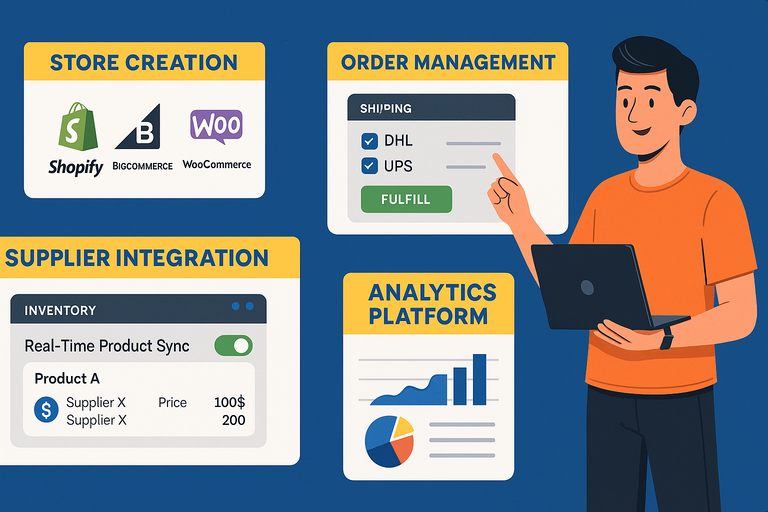
To make connective ecommerce work smoothly, you need the right tools—those that link your store, suppliers, and customers seamlessly. Think of it like a digital ecosystem where every system “talks” to each other.
The tools you choose will determine how efficiently you can scale, automate, and analyze your business.
Best Platforms For Store Creation (Shopify, BigCommerce, WooCommerce)
The foundation of connective ecommerce starts with choosing the right ecommerce platform. I’ve tested many over the years, and the three best options for building a store that integrates with automation and supplier systems are Shopify, BigCommerce, and WooCommerce.
Shopify: The go-to for beginners and pros alike. Its App Store → Dropshipping section offers direct integrations with suppliers like Spocket, Syncee, and DSers. The built-in Shopify Flow automation tool helps automate tasks like order routing and customer notifications.
BigCommerce: Ideal for scaling. It offers stronger B2B tools and supports multi-channel selling (like listing products on Amazon and eBay directly). It’s slightly more technical than Shopify, but its API capabilities are top-notch for advanced connective ecommerce setups.
WooCommerce: Perfect if you already use WordPress. It’s open-source, meaning you can customize every detail. You can connect plugins like AliDropship or Modalyst to sync products from suppliers.
If you want to launch fast, Shopify is the easiest to set up. If you want complete flexibility and lower long-term fees, WooCommerce gives you more control.
Quick tip: Before committing to a platform, test their free trials for a week. Try importing a few products, setting up checkout, and testing automation flows. The “feel” of the platform will tell you more than the specs ever could.
Top Automation Tools For Order Management And Shipping
Automation is what makes connective ecommerce feel effortless. It’s the bridge between customer orders and supplier fulfillment. Without it, you’d spend hours manually transferring data and checking shipments.
Here are the tools I recommend most:
- Shopify Flow: Automates workflows like “when order paid → send fulfillment request → update tracking.”
- Zapier: Connects different apps—like when an order hits your store, Zapier can automatically send data to your supplier’s system.
- ShipStation: Handles multi-channel order fulfillment and shipping label creation. It syncs directly with Shopify, WooCommerce, and BigCommerce.
- AfterShip: Automates shipping notifications and provides branded tracking pages.
For example, if you use ShipStation, you can log into your dashboard, choose Integrations → Connect Store → Shopify, and instantly see all new orders. The system then auto-generates shipping labels based on predefined carrier rules.
I always advise automating order confirmation emails and shipping updates—these small automations create a smooth customer experience without any manual work.
Supplier Integration Software For Real-Time Product Sync
Supplier integration is the backbone of connective ecommerce. It ensures your product listings, stock levels, and prices are always up to date. Without it, you risk selling out-of-stock items or listing incorrect prices.
Reliable integration tools include:
- Spocket: Connects to US and EU-based suppliers with real-time inventory sync. Great for faster delivery times.
- Syncee: Offers global supplier access and auto-updates product data, descriptions, and prices.
- DSers: Official AliExpress partner for bulk product imports and order management.
- Modalyst: Integrates with Shopify, Wix, and BigCommerce, offering brand-name suppliers and private-label options.
A practical workflow example: when a supplier updates inventory on Syncee, your connected Shopify store automatically reflects those changes. No manual input needed.
From my experience, the best approach is to connect with at least two supplier platforms. This diversifies your inventory and protects your business if one supplier experiences stock delays.
Analytics Platforms To Track Sales And Customer Behavior
In connective ecommerce, data is your compass. Analytics tools show you what’s working—and what’s draining your profits. You don’t need to guess; you can measure.
Recommended tools include:
- Google Analytics 4 (GA4): Tracks user behavior across your site—where visitors come from, how long they stay, and what makes them convert.
- Shopify Analytics: Great for tracking sales performance and product conversion rates directly in your dashboard.
- Hotjar: Provides heatmaps and session recordings to see how customers interact with your store.
- Klaviyo: Combines email marketing and analytics, showing which campaigns drive the most revenue.
For instance, in Shopify Analytics, you can go to Reports → Conversion Rate by Product to identify which items perform best. Use this insight to focus your marketing spend or adjust pricing.
I always recommend checking your analytics weekly. A quick review of metrics like bounce rate, add-to-cart ratio, and average order value can guide your next optimization move.
Common Mistakes To Avoid In Connective Ecommerce
Even though connective ecommerce simplifies operations, many entrepreneurs make avoidable errors that cost them time, money, and credibility.
Here are the big ones I’ve seen—and how to sidestep them.
Choosing The Wrong Supplier Or Fulfillment Partner
Your supplier is your silent business partner. A weak one can destroy your reputation faster than bad marketing ever could.
Watch for these red flags:
- Long or inconsistent shipping times.
- Poor packaging or unbranded deliveries.
- Lack of real-time stock syncing.
I suggest always ordering test samples first. This gives you insight into product quality, packaging, and delivery speed. Platforms like Spocket and Syncee allow supplier ratings and reviews—use them.
If your supplier doesn’t communicate promptly, that’s your cue to move on. A slow reply before partnership often means slower fulfillment after orders start rolling in.
Ignoring Product Quality Control And Delivery Speed
Even though you’re not handling inventory, quality still reflects on your brand. Customers don’t care who shipped it—they only know your name is on the receipt.
Test every product you plan to sell. If you use multiple suppliers, maintain a spreadsheet with columns for product quality scores, average delivery times, and return rates.
I once saw a seller lose 40% of repeat customers simply because delivery times varied wildly. Speed consistency often matters more than speed itself.
A smart tactic is to prioritize suppliers who use local fulfillment centers in your target region. For instance, a US-based customer should receive products from a US warehouse when possible.
Overlooking Customer Support And After-Sales Service
Automation handles many operations, but it can’t replace empathy. Customer support is where you build trust and repeat business.
Set up an easy-to-find Help Center and automate ticket routing with tools like Zendesk or Gorgias. Both integrate with Shopify and BigCommerce.
Respond to customer messages within 24 hours—ideally faster. A quick, human response can save a refund or even turn an unhappy customer into a loyal one.
I recommend adding a chatbot to handle FAQs (like shipping updates or return policies), freeing your time for personalized support where it really counts.
Neglecting Branding And Content Marketing Efforts
A common mistake is focusing so much on automation that you forget the emotional side of commerce—your brand.
Connective ecommerce doesn’t mean “faceless dropshipping.” You still need to tell a story. Build a brand voice that reflects authenticity and care.
Practical steps:
- Create a blog around your niche to boost SEO and credibility.
- Customize packaging inserts or thank-you emails with your logo.
- Use branded product photos instead of generic supplier images.
Your audience buys from people, not platforms. A brand story and consistent visuals make your business memorable and trustworthy.
How To Market A Connective Ecommerce Business Effectively
Once your connective ecommerce store is live, the next step is getting eyes—and clicks—on your products. Marketing is where you turn automation into profit.
Building A Strong Online Brand Presence
Your brand is your first impression. It’s how people recognize and trust you.
Start by defining your brand tone (friendly, expert, minimalist) and visual style. Use consistent colors, fonts, and photography across your site, ads, and emails.
I suggest creating a Brand Style Guide—even a simple Google Doc with examples of your tone, logo usage, and image style. This ensures consistency as you grow or hire help.
Social proof is key here. Feature customer reviews, testimonials, and UGC (user-generated content) on your homepage and product pages. People trust people more than they trust ads.
Leveraging Paid Ads And Social Media For Product Visibility
Paid ads help you reach buyers faster than organic methods. Platforms like Facebook Ads Manager and Google Ads allow you to target people already searching for your products.
Start small—$10 to $20 per day—and focus on testing. In Facebook Ads Manager, go to Campaigns → Create → Sales Objective → Website Purchases to begin.
Pair this with social media engagement. Use short-form videos on TikTok or Instagram Reels to show your products in real life. Even simple “unboxing” clips can outperform static images.
Remember, paid traffic brings visitors; your brand and website experience convert them.
Using Email Automation For Customer Retention
Email remains one of the most profitable channels for ecommerce. In connective ecommerce, it helps you nurture relationships and drive repeat purchases.
Tools like Mailerlite and Omnisend make it easy to create automation flows. Start with:
- Welcome Series: Send when someone joins your list.
- Abandoned Cart: Remind visitors of forgotten items.
- Post-Purchase Follow-Up: Request reviews or offer loyalty discounts.
For example, in Klaviyo, go to Flows → Create Flow → Abandoned Cart and use a 3-email sequence: one gentle reminder, one discount, one urgency message.
I recommend segmenting your list by purchase behavior—so your high-value customers receive exclusive offers, not generic blasts.
Optimizing SEO To Drive Organic Traffic And Conversions
SEO is the long game, but it’s worth every minute you invest. Unlike ads, organic traffic compounds over time.
To optimize:
- Use keywords naturally in product titles and descriptions.
- Write helpful blog posts around buyer questions.
- Compress images for faster load times (Google prioritizes speed).
- Build backlinks through guest posts or industry collaborations.
In Shopify, you can adjust SEO settings under Products → Edit → Search Engine Listing Preview. Focus on clarity—titles should match what users actually search for.
I also suggest adding a blog to your store. For example, if you sell sustainable fashion, write posts like “5 Eco-Friendly Outfit Ideas for Summer.” This builds authority and attracts organic visitors ready to buy.
Pro Tip: Combine automation with authenticity. Let your systems handle the repetitive tasks, but keep your storytelling, branding, and customer care human. That’s the balance that turns connective ecommerce from a side hustle into a sustainable business.
Future Trends Shaping Connective Ecommerce
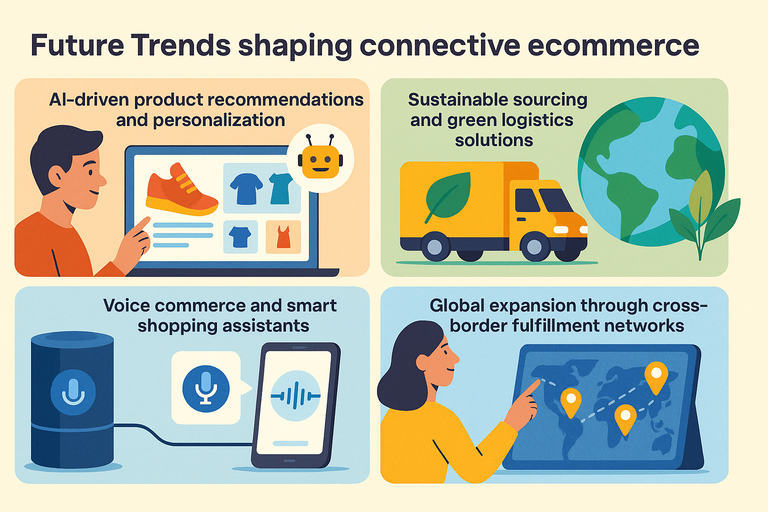
The connective ecommerce model isn’t just a passing trend—it’s the blueprint for how online business will function over the next decade.
As automation, AI, and logistics technologies mature, the boundaries between ecommerce, fulfillment, and customer experience will blur even further. Here are the innovations that are already shaping the future of this industry.
AI-Driven Product Recommendations And Personalization
Artificial intelligence (AI) is redefining how online stores engage with customers. Instead of showing everyone the same products, AI-powered systems now personalize recommendations based on each shopper’s behavior, browsing history, and even location.
How it works: When someone visits your store, AI tools like Nosto analyze real-time data—pages viewed, time on site, and past purchases—to suggest items most likely to convert.
For example, if a visitor adds a running shoe to their cart, AI might display matching athletic socks or a water bottle on the checkout page. That personalized touch increases average order value and customer satisfaction.
What I find most powerful about AI in connective ecommerce is how seamlessly it integrates with supplier systems. If a supplier adds a new product to your connected catalog, AI can instantly include it in recommendation algorithms—no manual updates required.
Pro insight: I recommend starting small with Shopify’s built-in personalization apps before moving to advanced AI tools. Even modest personalization can lift conversion rates by 10–15%.
Sustainable Sourcing And Green Logistics Solutions
Sustainability is no longer optional—it’s a core expectation. Shoppers increasingly favor brands that care about environmental impact. Connective ecommerce gives you a unique edge here because you can select suppliers committed to eco-friendly sourcing and logistics.
Platforms like Syncee and Modalyst now include sustainability filters, allowing you to find suppliers who use recyclable packaging or carbon-neutral shipping.
Green logistics is also evolving fast. Carriers like UPS Carbon Neutral and DHL GoGreen offer offset shipping options that automatically calculate and neutralize emissions per delivery.
A practical move I advise: highlight your sustainability efforts directly on product pages. For example, add a small tag that says Ships carbon neutral or Made with recycled materials. Transparency builds trust and gives your brand a modern, ethical identity.
And here’s the best part—eco-conscious practices often reduce costs long-term by optimizing packaging and minimizing returns. Sustainable is also strategic.
Voice Commerce And Smart Shopping Assistants
Voice commerce is quietly becoming a major player. Smart speakers like Alexa, Google Assistant, and Siri are transforming how consumers discover and order products.
In connective ecommerce, this means your store must be optimized for voice search and natural language queries.
For instance, instead of typing “buy wireless earbuds,” someone might say, “Hey Google, order affordable wireless earbuds near me.” If your product titles, descriptions, and metadata use conversational language, you’re more likely to appear in those results.
You can test this easily by using Shopify’s built-in SEO editor:
Go to Products → Edit → Search Engine Listing Preview → Add natural phrases like ‘best running shoes for comfort’.
Smart shopping assistants are also evolving into personalized shoppers that connect directly to your supplier catalog. Soon, a customer may say, “Alexa, reorder my favorite moisturizer,” and your connected system will handle everything—from supplier notification to shipping—automatically.
I genuinely believe voice commerce will become a major competitive advantage for connective ecommerce brands within the next three years. The earlier you adapt, the better positioned you’ll be.
Global Expansion Through Cross-Border Fulfillment Networks
One of the most exciting aspects of connective ecommerce is how easily it scales globally. Cross-border fulfillment networks—powered by AI and cloud-based systems—let you sell anywhere without setting up warehouses or local offices.
Modern fulfillment partners like ShipBob and Easyship have global distribution hubs that connect directly to ecommerce platforms. When a customer in Germany places an order, the system automatically ships from the nearest available warehouse, not your primary supplier.
This model drastically reduces delivery times and shipping costs while maintaining your brand’s consistency.
To make it work, I recommend setting up region-specific catalogs. For example, use your platform’s geolocation feature to show local currency, preferred payment methods, and available shipping options.
Cross-border commerce is expected to grow to nearly $8 trillion by 2030 (Statista, 2024). If you position your store within that network now, you’ll ride the wave instead of chasing it.
Is Connective Ecommerce Right For You?
Connective ecommerce is incredibly appealing—but it’s not for everyone. Like any business model, it requires the right mindset, preparation, and long-term strategy. Let’s break down how to decide if it’s the right fit for you.
Key Questions To Evaluate Your Readiness
Before you dive in, ask yourself a few honest questions:
- Do you prefer managing logistics or focusing on branding and customer relationships?
- Are you comfortable relying on third-party suppliers?
- Can you commit time to learning automation and integration tools?
- Are you prepared for initial trial and error before finding reliable partners?
If your answers lean toward flexibility, creativity, and tech curiosity—connective ecommerce could be a perfect match.
From my experience, this model suits people who want to build businesses around lifestyle freedom rather than operational control. It’s for thinkers, creators, and marketers more than logistics managers.
How To Assess Profitability And Long-Term Growth
Profitability in connective ecommerce depends on how well you balance automation costs, supplier pricing, and marketing ROI.
Here’s a simple formula I use when advising new sellers:
Profit = (Selling Price – Supplier Cost – Transaction Fees – Ad Spend)
Tools like Shopify Analytics or Google Sheets can automate this calculation. Aim for at least a 30–40% gross margin to stay profitable after automation fees.
For long-term growth, focus on retention. It’s 5x cheaper to retain an existing customer than to acquire a new one. That’s where email marketing and subscription models come in.
If you’re selling consumable or repeat-use products, consider setting up an auto-renew subscription via Recharge.
When profitability and retention align, your growth compounds naturally.
The Best Niches For Starting A Connective Ecommerce Store
Some niches perform far better in connective ecommerce due to supplier variety and product margins. Based on recent trends, here are some profitable categories:
- Eco-friendly lifestyle products: Reusable bags, bamboo utensils, sustainable apparel.
- Health and wellness: Supplements, ergonomic accessories, massage tools.
- Pet care: Smart feeders, grooming kits, and accessories.
- Home and organization: Minimalist furniture, LED lighting, and décor items.
I personally suggest starting with a niche you care about—it makes marketing feel authentic and less forced. For instance, if you’re passionate about fitness, selling smart workout gear or recovery tools will come naturally.
Once you gain traction, expand by offering complementary products. That’s how you create brand ecosystems rather than one-off stores.
When To Scale Or Diversify Your Product Offerings
The right time to scale is when your systems—automation, suppliers, and analytics—are stable and predictable.
Here’s what I look for before scaling:
- Consistent monthly sales for at least 3 months.
- Reliable supplier fulfillment without major delays.
- Profit margins holding steady even after ad spend.
When those are in place, start diversifying. You can either expand within your niche (e.g., adding matching accessories) or test a new vertical with low-risk suppliers.
Scaling too soon often breaks systems. My advice? Let your automation and support processes mature first—then build outwards confidently.
Expert Tips To Succeed With Connective Ecommerce
You’ve learned how connective ecommerce works, but success lies in execution.
After helping dozens of entrepreneurs build stores, I’ve noticed patterns among those who thrive—and those who stall. Here’s what really moves the needle.
Focus On Building Strong Supplier Relationships
Behind every great connective ecommerce store is a reliable supplier network. Treat suppliers like partners, not vendors.
Reach out regularly, ask for updates, and negotiate better shipping terms as your volume grows. A five-minute message on Syncee Chat or Spocket Messaging can save you from unexpected delays later.
I advise creating a shared spreadsheet for stock levels and delivery metrics. It keeps communication transparent and builds trust.
Automate Early But Stay Involved In Quality Control
Automation saves time, but don’t let it distance you from your product experience.
Automate your workflows—order routing, inventory syncing, shipping notifications—but personally review key steps like order testing and product packaging.
For instance, I recommend placing a few test orders monthly under different names to check fulfillment accuracy and delivery quality. It’s a simple practice that keeps you in control while automation does the heavy lifting.
Use Data Analytics To Drive Smarter Business Decisions
Data turns uncertainty into clarity. By tracking what works—and what doesn’t—you can adjust your strategy in real time.
Monitor your top 10 best-selling products, customer lifetime value (CLV), and return rate monthly. Tools like Google Looker Studio visualize these metrics beautifully.
I also suggest setting up a weekly KPI Dashboard that includes:
- Average order value (AOV)
- Conversion rate
- Cart abandonment rate
- Fulfillment time
Small changes—like improving checkout flow or adjusting pricing—often create big financial differences.
Keep Evolving With Market Trends And Customer Feedback
Connective ecommerce isn’t static. What works this year may not work next.
Stay curious—follow industry blogs, join ecommerce communities, and listen closely to your customers. Their feedback is your most valuable roadmap.
Use post-purchase surveys or review requests to understand what people love (or dislike). Adapt based on that data.
Finally, never stop experimenting. Try new suppliers, tweak your branding, or explore emerging technologies like AR shopping previews or chatbot sales assistants. Growth comes from iteration, not perfection.
Final Thought: Connective ecommerce rewards creativity, consistency, and care. When you combine automation with human connection—treating your store like a living system—you’re not just building an online business. You’re building freedom, scalability, and a brand that lasts.

I’m Juxhin, the voice behind The Justifiable.
I’ve spent 6+ years building blogs, managing affiliate campaigns, and testing the messy world of online business. Here, I cut the fluff and share the strategies that actually move the needle — so you can build income that’s sustainable, not speculative.
Related posts:
 How to Use Dsers Shopify for Seamless Dropshipping
 Best Online Store Platforms to Launch Your Brand Today
 Ecommerce Automation That Saves Time Without Breaking Sales
 Salehoo WooCommerce Integration That Boosts Growth
 How to Dropship With SaleHoo: What Makes It Easier
 E Commerce Companies to Learn From as You Scale Online