
Table of Contents
Some links on The Justifiable are affiliate links, meaning we may earn a small commission at no extra cost to you. Read full disclaimer.
If you’ve been looking for affiliate marketers to grow your brand, you’re not alone. Finding the right partners who genuinely align with your product can be the difference between steady sales and explosive growth.
I’ve seen many businesses struggle not because affiliate marketing doesn’t work—but because they didn’t know where or how to find quality marketers.
Let’s break down a practical, proven process to help you attract the best affiliate partners who can truly elevate your program.
Define Exactly What You Need in an Affiliate Marketer
Before you start looking for affiliate marketers, take time to define what kind of partners will actually help your business grow.
This step saves you from wasted time and mismatched partnerships later.
Identify Your Ideal Affiliate Profile
Start by picturing your perfect affiliate partner. Who do they serve? What type of content do they create? What’s their tone and credibility level?
For instance, if you sell eco-friendly skincare products, your ideal affiliate might be a wellness blogger or a micro-influencer who already promotes clean beauty. The closer their audience aligns with your customer base, the better.
Here’s a quick checklist to clarify your ideal affiliate profile:
- They already create content in your niche (e.g., fitness, tech, finance).
- They have a proven ability to convert, not just attract followers.
- They’re transparent about their partnerships and audience data.
I always recommend starting with people who already use or love your product — they’ll market it more authentically because they believe in it.
Determine Niche Relevance and Audience Fit
A common mistake when looking for affiliate marketers is assuming any large audience equals good results. The truth? Relevance beats reach every time.
Ask yourself:
- Does the affiliate’s audience have a real need for your product?
- Is their content style consistent with your brand’s voice?
- Are they active on the same platforms where your target customers hang out?
Let’s say you’re in SaaS. A tech blogger writing about productivity tools will perform far better than a general lifestyle influencer. Audience overlap drives conversions.
It’s worth spending a few hours reviewing comments or posts from their community—it tells you more about fit than any vanity metric ever could.
Set Clear Performance Metrics and Expectations
Before signing anyone, define what “success” means. Are you tracking sales, leads, or clicks?
Common metrics include:
- Conversion rate: How many clicks lead to purchases.
- Average order value (AOV): Helps measure quality of referred customers.
- Customer lifetime value (CLV): Determines long-term impact.
Use affiliate tracking software (like Awin’s built-in reporting dashboard) to monitor these numbers in real time. You can even set commission tiers—higher payouts for affiliates who exceed targets.
The clearer your expectations, the stronger your relationships will be.
Use Trusted Affiliate Networks to Find Marketers
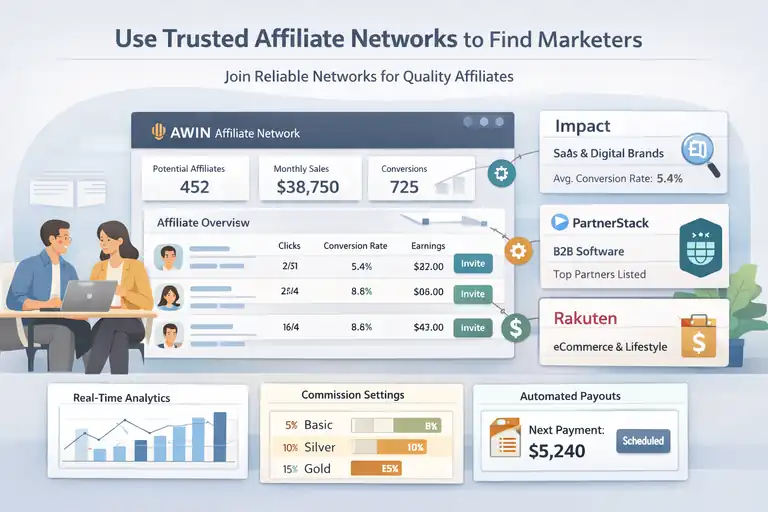
Affiliate networks simplify recruitment by connecting you with verified marketers and handling payments securely.
The key is choosing platforms that attract quality affiliates in your niche.
Join Reliable Networks Like Awin for Quality Affiliates
Awin is one of the largest and most reputable affiliate networks, now encompassing all former ShareASale programs. It’s a great place to start because:
- It pre-vets affiliates to ensure authenticity.
- You can view affiliate stats before inviting them.
- It integrates tracking and commission management in one place.
To get started:
- Sign up as a merchant on Awin.
- Set your commission structure.
- Publish your program for affiliates to join.
I’ve found Awin particularly useful for brands in retail, software, and digital products—its network reach is massive.
Explore Platforms That Match Your Industry Niche
If your audience is more specialized, niche-specific affiliate platforms often deliver better results.
For example:
- Impact: Ideal for SaaS and digital brands.
- PartnerStack: Great for B2B software affiliate programs.
- Rakuten Advertising: Strong for eCommerce and lifestyle brands.
Each platform offers different tools and commission setups. Compare sign-up processes, analytics, and affiliate screening options.
A quick example: On Impact, you can filter affiliates by vertical (like finance or fitness) and instantly see their average conversion rates before reaching out. That’s gold when you want to save time and avoid low-quality partners.
Evaluate Network Tools for Tracking and Payments
Reliable tracking and transparent payouts are crucial for long-term affiliate relationships.
Here’s what to look for:
- Real-time analytics: See who’s driving results and when.
- Flexible commission rules: Reward affiliates by performance tier.
- Automated payments: Prevent delays that can damage trust.
Platforms like Awin and Impact automate payment processing, ensuring affiliates get paid on schedule. That reliability makes you look professional—and it’s one reason affiliates stick around.
If you ever need to cross-check performance data, export reports into Google Sheets or your CRM to visualize ROI trends over time.
Reach Out to Established Content Creators and Influencers
Not all great affiliates live inside a network. Many top-performing partners are independent creators who prefer direct relationships with brands they trust.
Find Bloggers and YouTubers With Relevant Audiences
Search Google or YouTube for creators already ranking for terms related to your product. For example, if you sell project management tools, look for YouTubers reviewing “best productivity apps.”
When evaluating creators:
- Check their content quality and engagement tone.
- Ensure their audience demographics align with yours.
- See if they already use affiliate links—this shows experience.
You can use platforms like BuzzSumo to find creators by keyword and niche.
Once you identify a few, follow them, engage genuinely with their content, and learn their style before pitching.
Assess Engagement Rates, Not Just Follower Counts
A smaller, engaged community often outperforms large but passive audiences.
Here’s a quick way to estimate engagement:
- For Instagram: (likes + comments) ÷ followers × 100
- For YouTube: (average views ÷ subscribers × 100)
Anything above 2–3% is generally strong, but engagement should also feel authentic. Look for thoughtful comments or community discussions, not generic emojis.
In my experience, affiliates who genuinely connect with their audience drive higher-quality traffic and repeat customers.
Craft Personalized Outreach Messages That Build Trust
Cold outreach works only when it feels personal. Instead of sending generic “join our affiliate program” emails, start by acknowledging their work.
Here’s a simple outreach structure:
- Compliment their content (mention a specific post or video).
- Explain why you think they’d be a great fit.
- Clearly outline your offer—commission rate, benefits, tools.
- End with an easy next step (like a call or signup link).
Example: “Hey [Name], I loved your YouTube review on productivity apps—your breakdown of user experience really resonated. I think our tool could fit naturally into your content. Would you be open to exploring an affiliate partnership? We offer 30% recurring commissions and custom tracking links via Awin.”
Authentic outreach shows you’ve done your homework—and it dramatically boosts your acceptance rate.
Leverage Affiliate Recruitment Tools and Marketplaces
If you’re serious about finding high-performing partners while saving time, affiliate recruitment tools and marketplaces are your best friends.
They automate much of the outreach process, helping you focus on building relationships instead of manually scouting every potential affiliate.
Use Tools That Automate Affiliate Discovery and Vetting
When you’re looking for affiliate marketers, automation tools can uncover qualified affiliates who match your brand’s niche and performance standards.
These platforms collect data from blogs, YouTube channels, and social profiles—then rank them based on relevance and engagement.
A few solid options include:
- Affise Reach: Helps you discover affiliates based on industry, traffic quality, and conversion rates.
- PartnerStack: Ideal for SaaS brands; automatically matches you with creators already promoting similar tools.
- Impact: Offers discovery filters like “audience demographics” and “conversion history.”
Let me give you a quick example. Suppose you’re managing an eco-lifestyle brand. Inside Impact, you can set filters for sustainability bloggers with average conversion rates above 3% and North American audiences. Within seconds, you’ll have a list of vetted partners ready for outreach.
These tools also provide credibility scores—so you don’t waste time on affiliates who can’t deliver consistent performance.
Compare Affiliate Databases by Reach and Niche Relevance
Not all affiliate directories are created equal. Some platforms prioritize massive reach, while others specialize in certain niches.
Here’s how I personally evaluate databases before committing:
- Check niche depth: Does it have enough affiliates in your category?
- Look for conversion history: Quality matters more than quantity.
- Assess integration options: Can it connect with your tracking system like Awin or Impact easily?
For instance, Awin’s Advertiser Directory lets you browse thousands of affiliates by vertical—from travel to tech—while showing metrics like click-through rate (CTR) and earnings per click (EPC). Meanwhile, Refersion Marketplace focuses more on product-based partnerships, great for eCommerce brands.
My tip? Start narrow. Choose a platform that aligns tightly with your audience before scaling to bigger databases. Precision beats volume every time.
Track Outreach Campaigns to Improve Conversion Rates
Recruiting affiliates isn’t a one-and-done task—it’s an ongoing process that benefits from tracking and iteration.
To manage outreach effectively:
- Use CRM integrations (like Monday or Freshsales) to track affiliate conversations.
- Tag affiliates by stage: contacted, in negotiation, active, paused.
- A/B test your outreach messages to see which tone or offer performs best.
For example, I once noticed that mentioning “custom tracking dashboards via Awin” boosted response rates by nearly 20%. Affiliates appreciate transparency and control, so small messaging tweaks can make a real difference.
Over time, analyzing this data helps you refine your approach—turning outreach from guesswork into a repeatable, high-converting process.
Attract Affiliates With a Competitive and Transparent Program
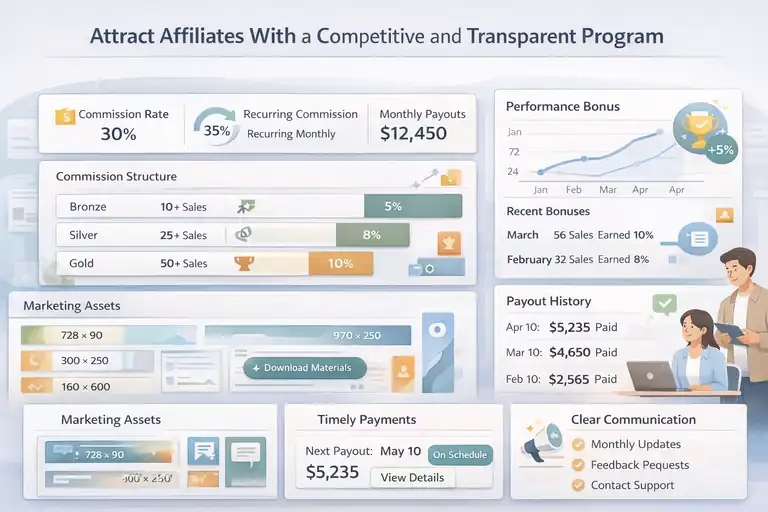
Once you’ve found potential affiliates, the next challenge is convincing them to join your program.
A fair, transparent offer builds trust and helps you stand out in a crowded market.
Offer Fair Commission Rates and Performance Bonuses
Affiliates are business partners, not just promoters. They evaluate programs based on earning potential and fairness.
Here’s what typically works:
- Flat commissions between 10–30% for physical products.
- Recurring commissions (20–40%) for software or digital products.
- Tiered bonuses for top performers—e.g., +5% commission after 50 sales.
A great example is how Kit (formerly ConvertKit) structured its affiliate program. Affiliates earn recurring commissions as long as customers stay subscribed—a model that rewards both consistency and quality leads.
I recommend testing a few structures early on. Sometimes, a slightly higher rate or early payout window can double your affiliate interest.
Provide Marketing Assets That Simplify Promotion
Affiliates perform better when they have the right materials. Providing pre-made creatives saves them time and keeps your messaging consistent.
Essential materials include:
- Banners and product images in multiple sizes.
- Email swipe copy they can customize.
- Social media post templates and video assets.
You can host all of these inside your affiliate dashboard (for example, within Awin’s “Assets” tab). Affiliates simply click Download Materials to access the latest approved graphics.
The easier you make it for them, the faster they’ll start promoting—and the fewer errors you’ll need to correct later.
Maintain Clear Communication and Reliable Payments
Trust is everything in affiliate marketing. Delayed payments or unclear policies can destroy even the best partnerships.
Here’s what I recommend:
- Use automated payment systems like Awin or Impact to ensure on-time payouts.
- Send monthly updates about product launches, promotions, and new creatives.
- Keep an open line for feedback—some of your best optimization ideas will come from affiliates.
One small but effective touch: send a short thank-you note after an affiliate’s first sale. It’s human, personal, and surprisingly rare—and it builds loyalty faster than any bonus ever could.
Promote Your Program Through Strategic Channels
Even the best affiliate program won’t grow if nobody knows about it.
Promoting your offer through the right mix of channels helps attract engaged partners who align with your brand.
Use Your Website, Email List, and Social Media to Recruit
Start with your owned channels—they’re free and already reach people who trust your brand.
Here’s how to do it:
- Add a “Join Our Affiliate Program” link in your website footer.
- Send an email to customers or newsletter subscribers announcing the program.
- Post about it on social platforms, highlighting real earnings or success stories.
For instance, if your email tool is Brevo (formerly Sendinblue), you can set up an automation that sends an affiliate invite after a customer’s third purchase—catching them when loyalty is strongest.
This type of automation turns happy customers into potential affiliates without any manual effort.
Partner With Industry Communities or Online Forums
Communities are often overlooked goldmines for affiliate recruitment. Niche forums, Facebook groups, or Slack communities host professionals who already understand your market.
Join conversations authentically—offer value first, then mention your affiliate opportunity naturally when it fits.
For example, if you run a productivity software, share insights about workflow automation in a Notion or ClickUp user group. Then mention that your affiliate program rewards users for referrals.
It’s not about spamming links; it’s about showing genuine involvement in the ecosystem your affiliates care about.
Run Paid Campaigns to Target Potential Affiliates
Paid promotion can accelerate recruitment, especially when you’re launching or scaling fast.
You can run:
- LinkedIn Ads: Target content creators or entrepreneurs.
- Google Search Ads: Bid on terms like “affiliate programs for bloggers.”
- Facebook Ads: Retarget existing customers with affiliate invites.
Start small—$20–50 per day—to test audiences. Use simple visuals like screenshots of your affiliate dashboard or real earning examples.
Paid outreach works best when combined with authenticity. If your landing page clearly explains commissions, support, and payouts, your ad clicks can convert into loyal partners almost instantly.
Build Long-Term Relationships With Top Performers
Once you’ve found affiliates who consistently deliver results, your focus should shift from recruitment to retention.
Building genuine, long-term relationships transforms good affiliates into brand advocates who stick with you for years.
Offer Exclusive Perks for High-Performing Affiliates
Top affiliates deserve recognition—and not just through commissions. When you reward your best performers, you reinforce their motivation and loyalty.
You can offer:
- Higher commission tiers once affiliates cross specific sales thresholds.
- Exclusive bonuses or early access to new products.
- Personalized landing pages with their name or brand logo.
For example, in Awin, you can create custom commission structures inside the Advertiser Control Panel by navigating to Affiliate Management → Commission Rules. This lets you automatically bump top affiliates to a higher percentage once they meet certain performance metrics.
I’ve found that small, thoughtful gestures—like handwritten thank-you cards or surprise bonuses—often do more than big payouts. It shows that you value the relationship, not just the revenue.
Create Feedback Loops to Improve Collaboration
Open communication builds trust and helps both sides grow. Don’t treat your affiliates like a faceless sales channel—invite them into your marketing process.
Here’s what that can look like:
- Schedule short monthly check-ins to discuss campaign performance.
- Send surveys asking what resources or creatives they’d like next.
- Invite top affiliates to private Slack groups or Discord channels for faster feedback loops.
For instance, you might host a quarterly “Affiliate Strategy Session” over Zoom. Share upcoming product launches, get their feedback, and ask what tools could help them promote better.
This collaborative approach often leads to creative campaigns that outperform anything your internal team could have planned alone.
Affiliates appreciate feeling heard—and when they do, they stick around.
Showcase Success Stories to Inspire Other Marketers
Recognition is one of the most powerful motivators. Featuring top affiliates publicly not only rewards them but also shows newer affiliates what’s possible.
You can highlight success stories on:
- Your affiliate program landing page.
- Email newsletters sent to current affiliates.
- Blog or LinkedIn posts showcasing their achievements.
For example, you could write a short post like: “How Emma Generated $10K in 60 Days Using Our Affiliate Program.” Keep it authentic—share what strategies she used, her challenges, and what changed after she joined.
This kind of visibility builds pride and community. It also turns your affiliates into recruiters, as they share their stories with peers who might want to join.
Measure, Optimize, and Retain Quality Affiliates
To keep your affiliate program healthy, you need to measure performance regularly and refine what’s working.
Optimization isn’t a one-time event—it’s an ongoing process that protects your ROI and keeps affiliates motivated.
Track Conversions and ROI From Each Partner
Data is your best friend when managing affiliates. Tracking helps you identify who’s driving real value and where to focus your resources.
Here’s what you should track:
- Conversion rate: How often clicks turn into sales.
- Revenue per affiliate: Helps identify your top earners.
- Customer lifetime value (CLV): Measures the long-term quality of traffic.
Most platforms like Awin or Impact include a Performance Dashboard that breaks down these metrics per affiliate. You can export these reports weekly to spot trends or dips.
I like to maintain a simple Google Sheet that ranks affiliates by ROI and engagement. It’s quick to review and makes bonus decisions far easier.
Use Tools Like VWO or Optimizely for A/B Testing
Testing can make a huge difference in your affiliate campaigns. Tools like VWO or Optimizely let you experiment with different creatives, landing pages, or offers to see what converts best.
A small tweak—like changing your call-to-action from “Sign Up Now” to “Start Free Today”—can increase conversions by 10–20%.
Here’s a quick workflow:
- Create two landing page versions inside your CMS.
- Connect VWO or Optimizely to split incoming traffic evenly.
- Measure which version drives higher affiliate conversions.
This process doesn’t just optimize your performance—it gives affiliates more effective materials to work with, improving their results too.
Continuously Improve Commission Structures and Offers
Markets evolve, and so should your affiliate program. Regularly review whether your commission structure still makes sense compared to competitors.
You can adjust by:
- Adding performance bonuses during product launches.
- Offering recurring commissions for subscription-based products.
- Introducing limited-time incentive campaigns (like 10% extra for referrals in Q1).
For example, SaaS brands often reward affiliates for renewals, not just sign-ups. That keeps affiliates invested in promoting customer retention rather than one-time sales.
The key is transparency—communicate changes early and clearly, so affiliates always feel respected and informed.
Avoid Common Mistakes When Looking for Affiliate Marketers
When you’re looking for affiliate marketers, a few common pitfalls can derail your progress. Avoiding them from the start saves time, money, and unnecessary frustration.
Don’t Prioritize Quantity Over Quality
It’s tempting to aim for hundreds of affiliates, but more isn’t always better. Ten dedicated affiliates who truly understand your brand can outperform a hundred passive ones.
Focus on affiliates who:
- Consistently generate engaged traffic.
- Have genuine trust with their audience.
- Communicate proactively and professionally.
In my experience, quality affiliates often ask smart questions before joining. That’s a good sign—they’re invested in creating real impact.
Avoid Vague Program Descriptions or Poor Communication
Affiliates can’t promote what they don’t understand. Your program page should clearly outline:
- Commission structure and payout frequency.
- Tracking method (e.g., cookies, referral links).
- Support contact and response time.
For example, on Awin, you can edit your program details under Advertiser Profile → Program Overview. Make it detailed, transparent, and updated.
Also, respond quickly to inquiries. A simple “Got your message, I’ll review and reply by tomorrow” can make a world of difference in trust-building.
Never Ignore Compliance or Transparency Standards
Affiliate marketing works best when it’s ethical. Make sure affiliates follow guidelines like:
- Disclosing sponsored partnerships clearly.
- Using accurate, non-misleading product claims.
- Following FTC regulations and privacy laws.
Include a short “Compliance Guide” in your onboarding materials. This not only protects your brand but also helps affiliates promote with confidence.
Remember—trust and transparency are the foundation of long-term success.
Pro Tip: Build a Reputation That Attracts Affiliates Naturally
The best affiliates often find you. If your brand has a great reputation, word spreads quickly among affiliate communities.
Building that reputation takes consistency, transparency, and genuine care for your partners.
Position Your Brand as a Trusted Partner
Be the brand affiliates want to work with. That means honoring commitments, providing excellent support, and keeping systems transparent.
You can build trust by:
- Publishing detailed FAQs about your program.
- Keeping payments on schedule (automate with Awin).
- Sharing data insights that help affiliates optimize.
From what I’ve seen, when affiliates know they can rely on you, they bring in others from their network—essentially turning your best performers into brand ambassadors.
Highlight Affiliate Success Stories on Your Website
Public recognition works wonders. Create a “Top Affiliates” section on your website showcasing stories, interviews, or quotes from successful partners.
Keep it genuine. Share metrics like conversion growth or average earnings increase, but focus on storytelling—how collaboration made a difference.
This builds social proof and attracts like-minded marketers who aspire to the same results.
Keep Your Program Fresh, Transparent, and Rewarding
Finally, treat your affiliate program like a living system. Update creatives, introduce fresh campaigns, and communicate upcoming changes well in advance.
Here are a few ways to keep it engaging:
- Launch seasonal affiliate contests with prizes.
- Update your affiliate portal UI for easier navigation.
- Send monthly “Affiliate Digest” emails highlighting top updates.
I’ve found that affiliates love programs that evolve—they feel part of something growing, not stagnant. Keep things dynamic, and you’ll attract more talent naturally without heavy recruitment efforts.
FAQ
How do I start looking for affiliate marketers for my business?
Begin by joining trusted affiliate networks like Awin or Impact, then reach out to niche creators whose audiences align with your products. Focus on quality over quantity.
What should I look for in a good affiliate marketer?
Look for affiliates with engaged audiences, relevant content, and proven conversion rates. Check their credibility, communication style, and transparency before partnering.
How can I attract top-performing affiliate marketers?
Offer fair commissions, reliable payments, and strong marketing support. Keep communication open, reward high performers, and build long-term relationships based on trust.

I’m Juxhin, the voice behind The Justifiable.
I’ve spent 6+ years building blogs, managing affiliate campaigns, and testing the messy world of online business. Here, I cut the fluff and share the strategies that actually move the needle — so you can build income that’s sustainable, not speculative.
Related posts:
 What Is An Affiliate Manager: Be a Successful Affliate
 What Is ShareASale? A Comprehensive Guide to Affiliate Marketing
 Fireads Affiliate Marketing: The Ultimate Guide to Earning Passive Income Online
 Flex Offers: A Complete Affiliate Marketing Network
 FlexOffers Affiliate Program Review: Is It Worth Joining?
 Affiliate Manager Salary: What You Need to Know