
Table of Contents
Some links on The Justifiable are affiliate links, meaning we may earn a small commission at no extra cost to you. Read full disclaimer.
How to use ManyChat for chatbot marketing is something a lot of business owners search when they are tired of chasing leads manually, answering the same questions, and watching conversations go cold.
I get it. Chatbot marketing can sound technical at first, but ManyChat is one of the few platforms that makes it feel practical.
When you set it up the right way, it can help you capture leads, qualify buyers, recover abandoned conversations, and move people toward action without sounding robotic.
Let me walk you through it in a way that actually makes sense.
Understand What ManyChat Actually Does
ManyChat can look simple on the surface, but it becomes powerful when you understand what job it is really doing in your marketing system.
At its core, it helps you automate conversations across channels like Instagram, Facebook Messenger, WhatsApp, and SMS so you can respond faster and guide people toward a next step.
What ManyChat Means In Chatbot Marketing
ManyChat is not just a chatbot builder. It is a conversation automation platform built for marketing, lead generation, support, and follow-up. That distinction matters because a lot of people build bots that only answer basic questions, then wonder why results feel flat.
In practice, chatbot marketing with ManyChat means using automated conversations to move someone from interest to action.
That action could be subscribing, booking, buying, requesting a quote, downloading a lead magnet, or replying to a campaign. Instead of waiting for a staff member to answer every message, the system handles the first layer of conversation automatically.
Here is the simplest way to think about it:
- Traditional messaging: A person asks, waits, and maybe leaves.
- ManyChat messaging: The system replies instantly, asks smart follow-up questions, and routes the person based on intent.
I believe this is why ManyChat works so well for smaller teams. You do not need a giant support department to feel responsive. Imagine you run a skincare brand on Instagram. Someone comments “price” on a Reel.
ManyChat can instantly send a DM, ask which product they want, share the link, and tag them as a warm lead. That is chatbot marketing tied directly to buyer intent, not just automation for the sake of automation.
Why Businesses Use ManyChat Instead Of Manual Messaging
The biggest reason is speed. In messaging, response time changes outcomes. If a prospect has to wait three hours for a reply, your chance of losing them goes up fast. If they get help within seconds, they are much more likely to stay engaged.
But speed is only part of it. ManyChat also gives structure to messy conversations. Manual inbox management usually creates three problems: missed leads, inconsistent replies, and no clean data.
One team member says one thing, another says something else, and nobody knows which message actually led to a sale.
ManyChat helps solve that by turning repeated conversations into repeatable flows. You can standardize:
- Lead capture: Name, email, phone, interest category.
- Qualification: Budget, timeline, service need, product fit.
- Routing: Sales team, support team, booking link, purchase page.
- Follow-up: Reminder sequences, abandoned cart nudges, re-engagement messages.
From what I have seen, this is where the real wins begin. Not because automation is magical, but because it removes friction. If you sell coaching, for example, your bot can ask whether someone wants one-on-one help, group coaching, or free resources.
That one simple branch saves time and makes the next step more relevant. Relevance is what keeps chatbot marketing from feeling spammy.
Choose The Right Use Case Before You Build Anything
A lot of ManyChat setups fail for one reason: people start building flows before they decide what the chatbot is supposed to achieve.
You will get better results much faster if you start with one clear use case tied to a business goal.
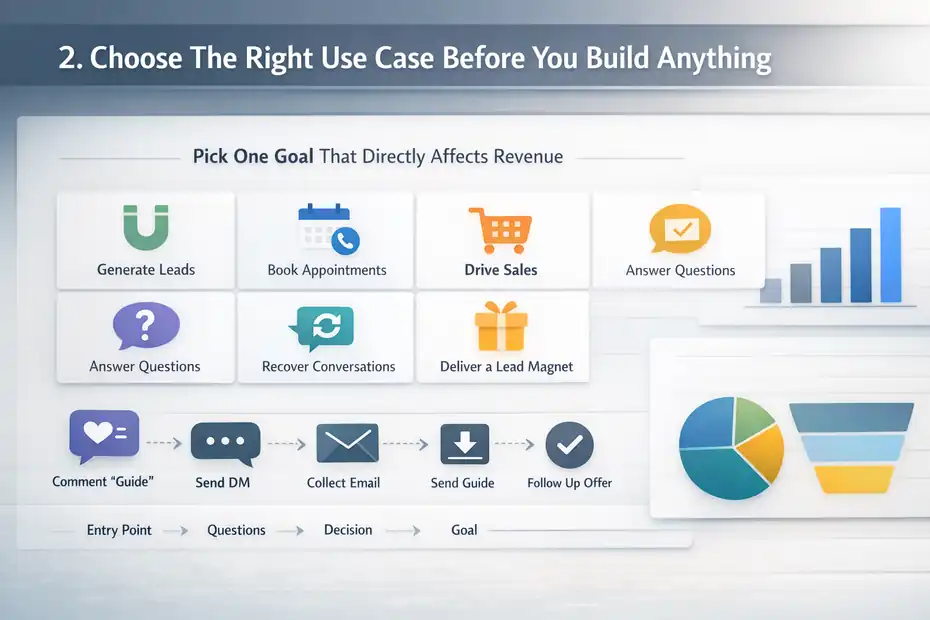
Pick One Goal That Directly Affects Revenue
Before you touch triggers, automations, or keywords, decide what success looks like. I suggest choosing one goal first, not five.
Many businesses try to automate lead capture, support, upsells, appointment booking, customer onboarding, and cart recovery all at once. That usually leads to a messy bot and weak performance.
The best starting goals are usually:
- Generate leads
- Book calls or appointments
- Drive product sales
- Answer pre-sale questions
- Recover abandoned conversations
- Deliver a lead magnet
Pick the one that matters most right now. If you are a local clinic, booking appointments may be the highest-value use case.
If you run an ecommerce store, product recommendation and abandoned cart recovery may matter more. If you are a consultant, lead qualification might be the smartest first move.
A simple framework helps here:
- Choose the action that creates the most business value.
- Identify the most common conversation that leads to that action.
- Build your first ManyChat flow around that single path.
Imagine you are running a small jewelry brand on Instagram. People constantly DM asking about sizes, shipping, and custom orders. Instead of building a giant bot, you could start with one flow that helps shoppers choose a product, answers shipping questions, and sends them to checkout.
That one focused use case often performs better than a “do everything” bot.
Map The Customer Journey Before You Open The Flow Builder
This is the part most people skip, and I think it is one of the biggest reasons chatbot marketing underperforms. Before building anything inside ManyChat, map the actual conversation you want the customer to have.
You do not need a fancy diagram. A simple outline is enough:
- Entry point: Comment, DM, Story reply, ad click, QR code, website widget.
- Intent: Why did they start the conversation?
- Questions: What do they usually ask next?
- Decision point: What determines the right next step?
- Goal: What conversion action do you want?
For example, say someone comments “guide” on your Instagram post about meal prep. Their journey could look like this: comment on post, receive DM, confirm they want the free guide, share email, receive the download link, then get a follow-up asking whether they want your paid meal plan.
That journey is much easier to automate because it is specific. It also helps you avoid robotic dead ends. When you know what the person wants, you can design shorter and smarter flows.
In my experience, the best ManyChat journeys feel like guided conversations, not funnels pretending to be conversations. The user should always understand why they are being asked something and what happens next. That clarity improves completion rates and builds trust at the same time.
Set Up Your ManyChat Account The Right Way
Once your use case is clear, the setup becomes easier. This stage is about building a clean foundation so your automations do not become chaotic later.
You do not need a complex account structure, but you do need a sensible one.
Connect Channels, Permissions, And Core Assets First
ManyChat becomes more effective when the basic connections are solid from day one. That includes your messaging channel, your brand assets, your team permissions, and any core destinations like landing pages or booking links.
Start by connecting the channel you actually plan to use first. For many brands, that is Instagram. For others, Facebook Messenger or WhatsApp may be the better fit. The mistake I see often is connecting every possible channel before there is any strategy behind them. Keep it lean.
Your early setup should include:
- Primary channel connection: Instagram, Messenger, WhatsApp, or SMS.
- Brand profile basics: Name, logo, welcome message tone, support contact path.
- Conversion destinations: Product page, scheduler, lead form, checkout page, FAQ page.
- Team access: Who can edit flows, view contacts, and manage live chat.
I also recommend creating a naming system before you build. For example, use labels like IG-LeadMagnet-Guide, IG-BookCall-Quiz, or WA-Support-OrderStatus. It sounds boring, but it saves a huge amount of confusion later when your account grows.
If you are using ManyChat for a campaign, build the destination pages before you build the bot. A chatbot should move people somewhere useful. If the link goes to a weak page, broken page, or unclear form, the automation will not save the campaign.
Organize Tags, Custom Fields, And Basic Segments Early
This is where ManyChat starts becoming a real marketing asset instead of just a message tool. Tags and custom fields let you store contact data so you can personalize conversations and segment follow-up campaigns.
Here is the difference in plain English:
- Tags: Quick labels like “Warm Lead,” “Downloaded Guide,” or “Interested In Pricing.”
- Custom fields: Saved data points like first name, email, preferred product, appointment date, or budget range.
I recommend setting up only the fields you know you will use. Too many custom fields create clutter. A practical starter set might be:
- Tag: New Lead
- Tag: Product Interest
- Tag: High Intent
- Field: First Name
- Field: Email
- Field: Phone
- Field: Interest Type
- Field: Lead Source
Why does this matter? Because later, you can send smarter follow-ups. If someone requested pricing but did not buy, you can send a tailored reminder. If someone asked about a specific service, you can route them into content that speaks to that service instead of sending generic messages.
When I first started thinking about chatbot systems strategically, this was the shift that made the biggest difference. The bot was not just replying anymore. It was collecting usable intent data. That is what turns ManyChat into a marketing engine.
Build Your First High-Converting Flow
This is the stage most people are excited about, and honestly, it is where ManyChat becomes fun.
The trick is to keep your first flow simple, useful, and built around one outcome. You do not need an elaborate chatbot to get a real win.
Write Messages That Sound Human And Move The Conversation Forward
The best chatbot copy feels clear, warm, and intentional. It does not try too hard to sound like a person, but it also does not read like a help desk script. I suggest writing as if you are sending a quick message to a customer who already showed interest.
A strong ManyChat message usually does three things:
- Acknowledges the user’s action.
- Gives one clear next step.
- Reduces confusion about what happens next.
For example, if someone comments “ebook,” do not send a long paragraph. A better first message might be: “Got you. I can send the guide here. Want it now?” That feels natural and keeps momentum moving.
Inside each flow, think in short turns. One message, one decision. One question, one next step. Long walls of text kill engagement, especially in Instagram DMs where users expect quick back-and-forth replies.
A useful message structure looks like this:
- Open: Reference why they are here.
- Clarify: Ask a simple question.
- Guide: Offer buttons or quick replies.
- Advance: Send them to the next logical action.
Imagine you run a fitness coaching brand. Someone replies to a Story about your 12-week plan. Your bot can say, “Happy to help. Are you looking to lose weight, build muscle, or get a custom plan?” That one message qualifies intent without making the user work too hard.
Keep The Flow Short, Branching, And Conversion-Focused
A lot of new users build chatbot flows like giant decision trees. The result is usually bloated, confusing, and hard to maintain. Your first flow should be short and focused. I usually recommend aiming for a path that can be completed in under two minutes.
Here is a simple conversion flow structure:
- Trigger: Comment, keyword, Story mention, link click.
- Welcome message: Confirm the request.
- Choice point: Ask what they want.
- Capture step: Collect email or other key detail if needed.
- Conversion step: Share link, booking option, or product page.
- Follow-up step: Reminder if no action happens.
That is enough for many first campaigns.
Branching matters, but only where it improves relevance. If someone says they want pricing, they should not receive educational content first. If someone wants customer support, do not send them into a sales funnel. Good branching protects the user experience.
A realistic example: A service business offering website design could ask, “Are you looking for a new site, redesign, or price estimate?” Based on the answer, the flow can send a portfolio, explain the process, or invite them to book a discovery call. Same entry point, different path, more relevant outcome.
That is how to use ManyChat for chatbot marketing in a way that feels strategic. You are not building a complicated bot. You are designing a smooth path to the next best action.
Use Triggers That Match Real Buyer Behavior
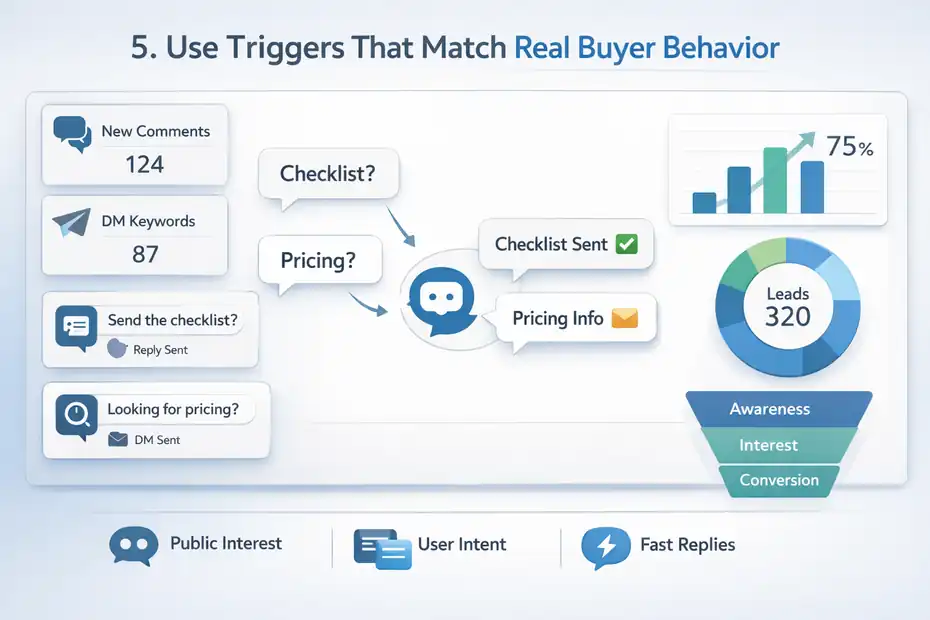
A flow is only useful if people actually enter it. Triggers are what pull users into the conversation, and the best ones are tied to real behavior, not random automation ideas.
This is where ManyChat can produce fast wins when used carefully.
Start With Comment And DM Triggers For Fast Results
If I had to choose the fastest entry point for most brands, I would start with Instagram comment automation and DM keywords. These are powerful because they match actions users already take naturally. No extra training is needed on the customer side.
Here is why they work:
- Comments signal public interest: Someone comments on content because they are curious.
- DM keywords show intent: A user is actively asking for help, details, or access.
- Both reduce friction: The conversation starts where the user already is.
For example, a creator can post “Comment ‘checklist’ and I’ll send it to you.” When someone comments, ManyChat sends a DM automatically. That creates a bridge from public engagement to private conversion. For lead generation, that is gold.
DM keywords work well for evergreen demand. If someone sends “pricing,” “menu,” “book,” “course,” or “help,” the bot can instantly route them. That saves time and catches intent in the moment.
A simple rule I use is this: Tie triggers to behavior you are already seeing manually. If customers already comment “link?” or DM “how much?” you do not need to invent a trigger. You already have one. ManyChat just helps you respond faster and more consistently.
Match Trigger Type To The Stage Of Intent
Not every trigger belongs in every campaign. One of the most common mistakes is using the wrong trigger for the wrong level of buyer readiness. A top-of-funnel user needs a lighter ask than someone already comparing offers.
Think of triggers in three intent levels:
- Low intent: Content engagement, Story reactions, simple comments.
- Mid intent: DM keywords, FAQ requests, lead magnet requests.
- High intent: Pricing replies, booking requests, product-specific inquiries.
When you match trigger type to intent, your bot feels more natural. A low-intent trigger should not lead to an aggressive sales pitch. A high-intent trigger should not bury the user under educational steps they did not ask for.
Imagine someone reacts to your Instagram Story about a product launch. That is a gentle signal. A good automation might ask whether they want the details, a demo, or the waitlist. Now imagine someone DMs “buy now.” That person needs a fast route to the offer, not a nurture sequence.
This matters because response quality affects conversion rate. From what I have seen, ManyChat performs best when the first bot action mirrors the energy of the user’s first action. Meet the person where they are. That sounds simple, but it is one of the most practical chatbot marketing principles you can use.
Turn Conversations Into Leads And Sales
This is where chatbot marketing stops being a novelty and starts becoming a revenue channel. ManyChat should not just create engagement.
It should help you capture useful information and move people toward meaningful action.
Capture Lead Data Without Killing Momentum
The biggest mistake in lead capture is asking for too much too early. People will give you information, but only if the value is clear and the timing makes sense. If your bot asks for full contact details before delivering anything useful, drop-off will rise quickly.
A better approach is progressive capture. Give value first, then ask for the minimum detail needed for the next step.
A simple sequence looks like this:
- User asks for resource or offer.
- Bot confirms and delivers part of the value.
- Bot asks for one useful detail.
- Bot continues the experience based on that response.
For example, if a user wants a free skincare routine guide, send the quick overview first, then ask whether they want the full version by email. That feels more natural than demanding the email immediately.
You should also explain why you are asking. “What email should I send it to?” works better than just “Enter email.” Clarity reduces resistance.
For sales-oriented flows, lead capture can happen through multiple micro-steps: product preference, budget range, location, appointment type, or timeline. Each step gives you more context and helps segment future outreach.
I believe this is one of the smartest ways to use ManyChat for chatbot marketing. Instead of collecting random leads, you collect structured leads with intent signals attached. Those leads are easier to close because you already know something about what they want.
Guide People To One Clear Conversion Action
Every flow needs a destination. That destination should be obvious to you and obvious to the user. If a chatbot gives five possible next steps, people often choose none. If it gives one strong path and one backup option, conversions usually improve.
Your conversion action could be:
- Book a call
- Claim an offer
- Visit a product page
- Complete a checkout
- Apply for a service
- Reply with purchase intent
The key is to keep that action aligned with the conversation that came before it. If the bot just helped someone compare services, the next step might be booking a call. If it helped them choose a product, the next step should probably be a product page or cart link.
A useful tactic is to make the CTA feel like a natural continuation, not a sudden ask. Instead of “Click here to buy,” try “Based on what you chose, this is the best fit for you.” That framing feels more helpful and less pushy.
Imagine a dog training business using ManyChat on Instagram. After asking whether the problem is barking, leash pulling, or recall, the bot can recommend the matching training package and invite the user to book the right session. That is direct, relevant, and much more persuasive than a generic homepage link.
Optimize Your Bot So It Keeps Improving
Once the bot is live, the real work begins. This is where you stop guessing and start refining.
ManyChat becomes more valuable over time when you treat flows like conversion assets that can be improved, not one-time setups.
Track The Metrics That Actually Matter
It is easy to get distracted by vanity numbers like total contacts or message sends. Those can be useful, but they do not tell you whether your chatbot marketing is working. Focus on metrics tied to movement and outcomes.
The most useful performance metrics usually include:
- Trigger rate: How many people enter the flow.
- Open or reply rate: How many continue after the first message.
- Completion rate: How many finish the intended sequence.
- Lead capture rate: How many provide required details.
- Click-through rate: How many tap your CTA.
- Conversion rate: How many book, buy, or complete the target action.
If a flow gets strong entry volume but weak completion, your middle steps may be too long or unclear. If clicks are strong but conversions are weak, the problem may be on the landing page, not inside ManyChat.
A practical example: Let’s say 500 people enter a DM flow, 300 click your product link, but only 12 buy. That might sound like a bot issue, but the bigger problem may be product page relevance, price shock, or checkout friction.
That is why I suggest auditing the whole path, not just the messages. ManyChat is part of the conversion system, not the entire system. When you look at it this way, optimization gets smarter and more honest.
Improve Results With Small Tests, Not Full Rebuilds
You do not need to rebuild an underperforming bot from scratch every time results dip. In most cases, small changes create the biggest gains. I usually start with the first message, the first question, and the CTA wording.
Test these areas first:
- Opening line: Is it clear why the user got the message?
- Question order: Are you asking for the easiest response first?
- Button wording: Does it sound obvious and low-friction?
- Flow length: Can one step be removed?
- CTA framing: Does it feel helpful and relevant?
Even a minor shift can matter. Changing “Learn More” to “See The Best Option For You” often improves clicks because it feels more specific. Replacing an open-ended text prompt with a quick reply can improve completion because it reduces effort.
A realistic scenario: A salon uses ManyChat to book consultations. The original flow asks three questions before offering the booking link. After shortening it to one service-selection question and then showing the booking button, appointments rise. Same audience, less friction.
That is the optimization mindset I recommend. Let the data show you where people hesitate, then fix the hesitation. Simple wins stack fast.
Avoid The Mistakes That Make Bots Feel Spammy
A chatbot can save time and create revenue, but it can also annoy people if it is built poorly.
This section matters because trust is fragile in messaging environments. One clumsy bot experience can make a brand feel impersonal very quickly.
Do Not Over-Automate The Conversation
The goal is not to automate everything. The goal is to automate the repeatable parts well and hand off the sensitive or complex parts when needed. Some businesses try to force every conversation through rigid automation, and the result feels frustrating.
Here are the common over-automation mistakes:
- Too many steps before value
- No option to talk to a human
- Generic replies to specific questions
- Repeated follow-ups with no behavior change
- Forcing all users into the same flow
ManyChat works best when it handles the first layer of interaction, not every possible situation forever. For example, order issues, emotional complaints, and unusual support questions often need a person. Your bot should recognize those moments and route them properly.
I suggest including escape routes in important flows. A simple “Need human help?” button can protect the customer experience and prevent frustration from turning into churn.
When I review weak chatbot campaigns, this is often the core problem. The business got excited about automation efficiency and forgot the conversation still belongs to a real person with real urgency. Automation should reduce friction, not trap the user in a loop.
Respect Timing, Relevance, And Platform Experience
A message can be technically correct and still feel wrong if the timing or context is off. Messaging platforms are intimate spaces. People notice when brands over-message, interrupt, or push too hard.
The three filters I recommend are:
- Timing: Is this message arriving at a sensible moment?
- Relevance: Does it connect to the user’s action or interest?
- Experience: Does it fit how people naturally use this platform?
For example, an Instagram user who replied to a Story may welcome a short DM follow-up. They may not welcome a long multi-message sales sequence immediately after. A WhatsApp user asking for store hours probably wants speed, not a promotional script.
This is where restraint becomes a strategy. Just because ManyChat lets you send more does not mean you should. In my experience, tighter and more relevant flows outperform louder ones. Good chatbot marketing feels timely and useful, not hyperactive.
If you remember only one thing from this section, make it this: every automation should feel like a helpful continuation of the user’s last action. That one principle keeps a bot aligned with real human behavior.
Scale ManyChat Into A Bigger Marketing System
Once your first use case is working, you can expand ManyChat into a larger system.
This is where businesses often start seeing compounding returns because each new flow builds on contact data, audience behavior, and proven conversion paths.
Expand From One Winning Flow To A Funnel Ecosystem
After your first successful flow, resist the urge to launch ten more at once. Scale in layers. Start with adjacent flows that support the same customer journey. That keeps your account organized and your analytics easier to read.
A smart expansion path might look like this:
- Lead magnet delivery flow
- Qualification flow
- Sales follow-up flow
- FAQ support flow
- Re-engagement flow
These flows should connect logically. Someone who downloads a guide can later receive a message asking what they need help with. Someone who clicked a product but did not buy can receive a relevant reminder. Someone who completed a purchase can move into onboarding or upsell education.
This is where tags and custom fields start paying off. Because you stored behavior data earlier, you can personalize later steps instead of restarting the conversation from zero.
Imagine an online course creator using ManyChat. One flow delivers a free lesson, another asks what skill level the user is at, another recommends the right paid offer, and another re-engages users who showed interest but never enrolled. That is no longer just a chatbot. It is a lightweight conversation funnel ecosystem.
Use ManyChat As A Bridge Between Content And Conversion
One of the most practical advanced strategies is using ManyChat to connect high-performing content with high-intent conversion paths. This works especially well on Instagram where content creates attention but DMs often create action.
Think about your best-performing content categories:
- Tutorials
- Product demos
- Myth-busting posts
- Before-and-after content
- Testimonials
- FAQ Reels
Each one can become an entry point into a targeted conversation. A Reel about “3 reasons your email list is not growing” can trigger a checklist DM flow. A customer testimonial can trigger a consultation flow. A product demo can trigger a personalized recommendation flow.
This matters because content alone often creates interest without capturing it. ManyChat gives you a way to turn passive engagement into active next steps.
I believe this is where real wins happen for a lot of brands. You stop treating social content and conversions as separate activities. Your content creates curiosity, your chatbot captures intent, and your follow-up turns that intent into measurable business action.
That is a much stronger system than posting and hoping people click the bio link.
Build A Simple Real-Wins Strategy You Can Sustain
You do not need a perfect bot, a giant automation map, or a full agency setup to get results.
You need a clear use case, a clean first flow, and a habit of refining what the data shows. That is the sustainable path.
A Practical 30-Day ManyChat Action Plan
If you want a realistic way to get started, here is the approach I would use over the next 30 days. It is focused enough to execute without getting overwhelmed.
- Week 1: Choose one use case, map the conversation, connect your main channel, and set up tags and fields.
- Week 2: Build one short flow with one trigger and one clear CTA.
- Week 3: Launch it through content, monitor replies, and fix obvious friction points.
- Week 4: Review metrics, improve the opener and CTA, then add one follow-up or one adjacent flow.
This kind of rollout works because it keeps your attention on actual behavior. You are not building a fantasy system. You are watching how real people respond and improving from there.
A lot of people overcomplicate chatbot marketing because they assume scale comes from complexity. Usually, it comes from clarity and repetition. One flow that consistently books calls or captures leads is worth much more than five flows nobody finishes.
The Real Goal Is Better Conversations At Scale
When people ask how to use ManyChat for chatbot marketing, I think they are often asking a deeper question: how do I stay responsive without burning out my team or losing leads? That is the real problem ManyChat helps solve.
The strongest chatbot systems do not replace good marketing. They amplify it. They make your messaging faster, your lead capture cleaner, and your follow-up more relevant. They also help you show up consistently when a customer is most interested, which is often the moment that matters most.
My advice is simple: Start with one conversation your business already has every day. Turn that into one useful flow. Track what happens. Improve it. Then expand only after the first version proves itself.
That is how you create real wins with ManyChat. Not by chasing automation for its own sake, but by building better customer journeys one step at a time.
FAQ
What is ManyChat used for in chatbot marketing?
ManyChat is used to automate conversations across platforms like Instagram and Messenger to capture leads, answer questions, and guide users toward actions like booking, buying, or subscribing. It helps businesses respond instantly while organizing customer interactions into structured, conversion-focused flows.
How do beginners start using ManyChat for chatbot marketing?
Beginners should start by choosing one clear goal, such as lead generation or booking calls. Then map a simple conversation, connect one platform like Instagram, and build a short flow with a clear next step. Keeping the first setup simple helps avoid confusion and improves early results.
Does ManyChat help increase sales or just engagement?
ManyChat can increase both engagement and sales when used correctly. By responding instantly, qualifying leads, and guiding users toward a specific action, it reduces friction in the buying process. Many businesses see improved conversions because conversations happen at the moment of highest interest.
What are the best triggers to use in ManyChat?
The most effective triggers are based on real user behavior, such as Instagram comments, DM keywords, or story replies. These triggers work well because they match natural actions users already take, allowing the chatbot to respond instantly and move the conversation forward.
How can I improve results with ManyChat automation?
Improving results comes from tracking key metrics like completion rate and conversions, then refining small elements such as opening messages, questions, and CTAs. Shorter flows, clearer wording, and better timing often lead to higher engagement and stronger performance over time.

I’m Juxhin, the voice behind The Justifiable.
I’ve spent 6+ years building blogs, managing affiliate campaigns, and testing the messy world of online business. Here, I cut the fluff and share the strategies that actually move the needle — so you can build income that’s sustainable, not speculative.
Related posts:
 SurveyMonkey Real User Experience For Lead Generation: What To Expect
 How to Get More Leads: 5 Proven Strategies to Boost Sales Now
 AI-Powered Ad Creative: Smarter Ads, Better ROI!
 Constant Contact Pricing: Which Plan Is Right for You?
 Aweber Email Automation Examples: Templates & Pro Insights
 ManyChat Bot Benefits No One Talks About