
Table of Contents
Some links on The Justifiable are affiliate links, meaning we may earn a small commission at no extra cost to you. Read full disclaimer.
How to use Hello Bar for lead generation starts with a simple idea: turn more of your existing traffic into email subscribers and qualified prospects without making your site feel pushy. I’ve seen a lot of brands overcomplicate this.
The truth is, Hello Bar works best when your offer, timing, and targeting line up with what the visitor is already trying to do.
In this guide, I’ll walk you through the full process—from setup and campaign strategy to testing, tracking, and scaling—so you can use Hello Bar like a pro instead of just adding another popup and hoping for the best.
Understand What Hello Bar Is Really Good At
Hello Bar is an onsite conversion tool built for capturing leads, promoting offers, and nudging visitors toward action with bars, modals, sliders, alerts, and other display formats.
The company says it is trusted by more than 600,000 websites, offers direct integrations with common email and CRM tools, and positions itself as a way to convert more visitors into leads, subscribers, and buyers.
What Hello Bar Does Best For Lead Generation
If you strip away the marketing language, Hello Bar solves one core problem: most visitors leave without raising their hand. A good Hello Bar campaign gives them a low-friction next step before that happens.
I think this is where many people misuse the platform. They treat it like a generic popup builder, but it is more useful as a conversion layer that sits on top of your existing pages. You are not rebuilding your funnel. You are adding strategic entry points into it.
Here is the practical advantage. Instead of relying only on your homepage form or footer signup, you can place the right message in front of the right person at the right moment.
That matters because popup benchmarks remain strong. Wisepops reported an average popup conversion rate of 4.82%, while its email capture popup analysis showed a 3.75% average across large ecommerce clients.
Unbounce also reported a 6.6% median landing page conversion rate across industries, which gives you a useful benchmark for comparing popup-assisted traffic with dedicated opt-in pages.
For many sites, that means Hello Bar is not the whole lead generation system. It is the capture mechanism that helps your content, service pages, product pages, or landing pages work harder.
When Hello Bar Makes Sense And When It Does Not
Hello Bar makes the most sense when you already have traffic but not enough conversions. That could be blog traffic, homepage traffic, product page traffic, or even paid traffic landing on educational pages.
Imagine you run a small SaaS company. Your blog gets 20,000 visits a month, but your newsletter signup box in the footer converts at barely 0.4%.
Adding a generic popup might improve that a little, but adding a targeted content upgrade on blog posts, an exit popup on pricing pages, and a welcome bar for demo signups can change the entire math of the funnel.
I would not rely on Hello Bar alone if your real problem is traffic quality, weak positioning, or a bad offer. A popup cannot rescue a site that has nothing compelling to say.
The better way to think about it is this: Hello Bar amplifies an offer that already makes sense. It does not invent demand. That is why the best campaigns pair the tool with a real lead magnet, newsletter promise, consultation offer, discount, waitlist, quiz, or demo angle.
As Hello Bar’s own materials emphasize, the platform supports multiple placements, integrations, and testing options, but the conversion lift depends on matching message and context.
Define The Right Lead Generation Goal Before You Build Anything
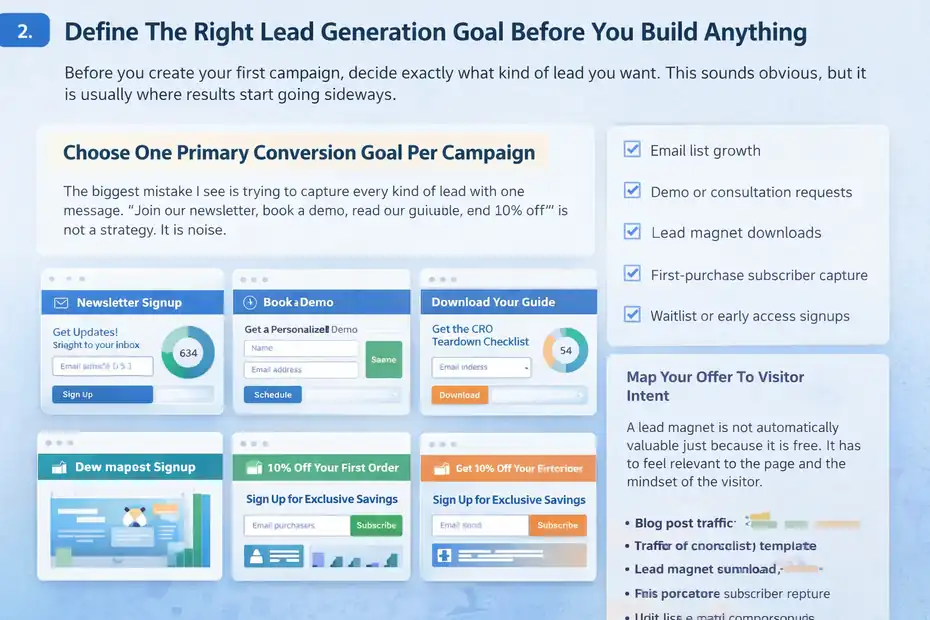
Before you create your first campaign, decide exactly what kind of lead you want. This sounds obvious, but it is usually where results start going sideways.
Choose One Primary Conversion Goal Per Campaign
The biggest mistake I see is trying to capture every kind of lead with one message. “Join our newsletter, book a demo, read our guide, and get 10% off” is not a strategy. It is noise.
Each Hello Bar campaign should have one job. Usually that means one of these:
- Email list growth for content or newsletter subscribers
- Demo or consultation requests for high-ticket offers
- Lead magnet downloads like checklists, templates, or guides
- First-purchase subscriber capture for ecommerce
- Waitlist or early-access signups for product launches
This matters because the visitor’s intent changes by page type. A blog visitor may want a checklist. A pricing-page visitor may be closer to a demo. A product-page visitor may respond better to first-order savings or shipping incentives.
In my experience, campaign performance improves the moment you stop asking a cold visitor to take a “big” action too early. Start with the smallest commitment that still moves them into your funnel. Then let your email or sales follow-up do the heavy lifting.
Hello Bar supports contact capture and integration into email workflows, which makes it effective for moving leads from onsite conversion into nurturing sequences rather than treating the popup itself as the entire funnel.
Map Your Offer To Visitor Intent
A lead magnet is not automatically valuable just because it is free. It has to feel relevant to the page and the mindset of the visitor.
Let me break it down in a practical way:
- Blog post traffic: Offer a checklist, template, cheat sheet, webinar replay, or short email series tied to that topic.
- Service page traffic: Offer a consultation, audit, estimate, or comparison guide.
- Ecommerce traffic: Offer a first-order discount, free shipping, restock alert, quiz result, or VIP list signup.
- SaaS traffic: Offer a demo, free trial reminder, ROI calculator, or use-case guide.
Here is a realistic scenario. If someone is reading an article about conversion rate optimization, a popup offering “weekly marketing tips” is too broad. A better angle is “Get the 12-point CRO teardown checklist.” Same traffic, same platform, much better intent match.
This is also where you protect lead quality. The more specific your offer, the more likely you are to attract subscribers who actually want what comes next.
Hello Bar’s placement options and segmentation features are useful here because they let you align campaigns to specific pages or situations instead of blasting the same message sitewide.
Set Up Hello Bar The Smart Way
This is the part most tutorials rush through. I don’t think they should. Good setup decisions make optimization easier later.
Pick The Plan That Matches Your Traffic And Testing Needs
Hello Bar offers a free Starter plan and paid tiers including Growth at $29 per month, Premium at $49 per month, and Elite at $99 per month when billed annually, with higher tiers increasing view limits and feature access.
The pricing page also lists a free Starter option with 5,000 lifetime views and paid plans with unlimited popups and subscribers, while the support docs explain overage billing on paid plans once view thresholds are exceeded.
Here is my honest take. If you are only testing the platform on a lower-traffic site, start lean. But if you already have meaningful traffic and want to run multiple campaigns or A/B tests, the free tier becomes limiting quickly.
A simple way to choose:
- Starter: Best for learning the platform on a very small site.
- Growth: Best for early-stage businesses validating one or two core lead capture campaigns.
- Premium: Better if your site gets enough traffic to support ongoing testing and multiple page-specific campaigns.
- Elite: Usually makes sense for larger sites or teams with bigger traffic volumes and broader campaign coverage.
I suggest checking your monthly sessions in analytics before choosing. If your site traffic is near the plan limits, budget for overages or move up sooner. Nothing is more annoying than making decisions from incomplete data because your campaign views capped out.
Connect Your Email Platform Before Launching Campaigns
Do not build campaigns first and “figure out the email part later.” That creates messy lead handling, duplicate exports, and delays in follow-up.
Hello Bar’s integration library includes website platforms, email tools, CRMs, automation tools, and Zapier, and the company highlights direct connections with platforms such as HubSpot, Klaviyo, and MailerLite.
The strategic reason to connect your email platform early is simple: speed matters after signup. If a person downloads a lead magnet or joins your list, they should enter the right email flow immediately.
A basic welcome sequence might look like this:
- Email 1: Deliver the promised asset
- Email 2: Set expectations and introduce your expertise
- Email 3: Share a proof-driven tip or case study
- Email 4: Present the next offer, such as a demo, product, or consultation
That sequence is where lead generation becomes revenue generation. The popup gets the lead. The follow-up builds trust and demand.
I believe this is the real pro move with Hello Bar. Treat the campaign as the first step of a system, not a standalone tactic.
Choose The Best Hello Bar Format For Each Funnel Stage
After setup, the next decision is format. This matters more than people think because format changes how interruptive, visible, and persuasive your campaign feels.
Use Bars For Low-Friction Offers And Sitewide Visibility
The original Hello Bar format still has a place. A top bar or bottom bar is less disruptive than a modal and works well for broad offers that do not require a hard stop.
Use bars when you want to promote:
- Newsletter signup
- Free shipping threshold
- Webinar registration
- Launch announcement
- Limited-time content offer
Bars are especially useful on content-heavy sites because they stay visible without taking over the screen. I like them for awareness-stage traffic where you want steady exposure rather than an aggressive conversion play.
For example, a finance blog might use a bar that says, “Get The Weekly Market Brief In 5 Minutes.” That fits the content experience. A full-screen takeover would probably feel like overkill.
Hello Bar specifically supports bars, modals, sliders, corner units, full-page takeovers, and related placements, giving you flexibility to match user experience to funnel stage.
Use Modals, Sliders, And Exit Popups For Higher Intent Moments
Modals and sliders tend to work better when the visitor has shown stronger intent. That could mean they scrolled deeply, stayed on the page longer, reached the pricing page, or signaled exit intent.
This is where you can be more direct.
A popup on a pricing page might offer:
- A free strategy call
- A comparison checklist
- A case study bundle
- A coupon or shipping offer for first-time buyers
Exit-intent campaigns are especially useful when you want one last chance to capture value before the visitor leaves.
Hello Bar’s recent guidance also emphasizes frequency controls and suppression rules so dismissed or converted users are not repeatedly shown the same message in the same session.
That is important because lead generation should not come at the expense of trust. If your popup fires every time a person blinks, you might capture a few extra emails and still hurt the brand.
From what I’ve seen, the pro approach is restraint. Use bars for broad visibility, sliders for mid-intent prompts, and modals or exit popups for high-intent situations where a stronger interruption is justified.
Build A Lead Capture Offer People Actually Want
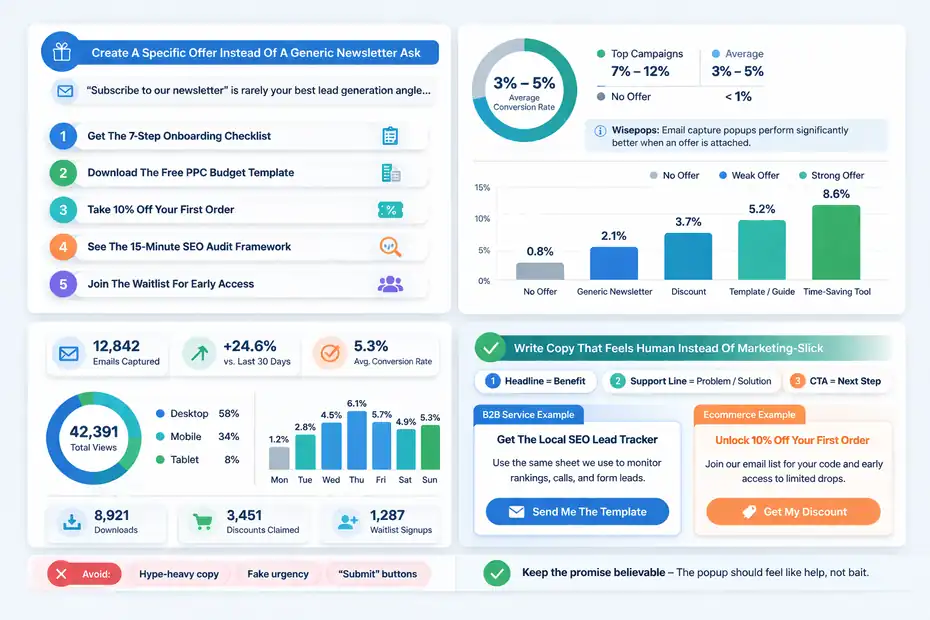
This is the heart of the article. Most Hello Bar campaigns underperform because the offer is weak, not because the tool is wrong.
Create A Specific Offer Instead Of A Generic Newsletter Ask
“Subscribe to our newsletter” is rarely your best lead generation angle unless you already have strong brand demand. Most visitors do not wake up hoping to receive another newsletter.
A stronger offer is concrete and outcome-driven. Think in terms of what the person gets, how fast they get it, and why it helps.
Here are stronger examples:
- Get The 7-Step Onboarding Checklist
- Download The Free PPC Budget Template
- Take 10% Off Your First Order
- See The 15-Minute SEO Audit Framework
- Join The Waitlist For Early Access
Wisepops found that email capture popup performance differed significantly depending on whether there was an offer attached, and Hello Bar’s own guidance notes that well-structured lead capture popups often convert in the 3% to 5% range, with stronger campaigns performing well above that.
I recommend choosing an offer that saves time, reduces risk, or promises a quick win. Those three motives outperform vague “stay updated” language almost every time.
Write Copy That Feels Human Instead Of Marketing-Slick
Good popup copy is short, specific, and friction-aware. You do not need cleverness. You need clarity.
A simple structure that works:
- Headline: Name the benefit
- Support line: Explain who it is for or what problem it solves
- CTA: Tell them exactly what happens next
Example for a B2B service:
- Headline: Get The Local SEO Lead Tracker
- Support line: Use the same sheet we use to monitor rankings, calls, and form leads.
- CTA: Send Me The Template
Example for ecommerce:
- Headline: Unlock 10% Off Your First Order
- Support line: Join our email list for your code and early access to limited drops.
- CTA: Get My Discount
What I would avoid: hype-heavy copy, fake urgency, or CTA buttons like “Submit.” Nobody wants to click “Submit.” It sounds like paperwork.
Keep the promise believable. The popup should feel like help, not bait.
Target The Right People At The Right Time
Once your offer is solid, targeting becomes the lever that separates average campaigns from high-performing ones.
Match Trigger Timing To User Behavior
Timing is everything with onsite lead generation. Show the campaign too early and you interrupt curiosity. Show it too late and the visitor is already gone.
A few trigger ideas that usually work better than instant load:
- Time delay for homepage or broad traffic
- Scroll depth for blog posts
- Exit intent for pricing or cart pages
- Click-triggered popup for buttons or content upgrades
- Page-specific display on high-intent URLs
I think too many sites default to a five-second popup because that is easy, not because it is effective.
Imagine a visitor lands on a long article from Google. They are still deciding whether your content is worth trusting. If a modal appears instantly, you are asking before you have earned the ask. But if a content upgrade appears after 50% scroll, the message feels timely.
Hello Bar’s own best-practice content stresses timing, mobile considerations, segmentation, and testing as the difference between helpful campaigns and annoying ones.
Segment By Page Type, Traffic Source, And Funnel Stage
This is where you start using Hello Bar like a pro instead of a beginner.
Rather than one universal campaign, create segments such as:
- Blog readers: Offer educational lead magnets
- Pricing-page visitors: Offer consultation or objections-handling assets
- Product viewers: Offer discount, shipping, or stock alerts
- Returning visitors: Offer stronger conversion intent
- Paid traffic: Match the campaign to ad promise and landing page theme
Why does this matter? Because visitor context changes what feels relevant.
A paid visitor landing on a “best CRM for contractors” article may respond to a buyer’s guide. A returning user checking pricing may respond to “Book A 15-Minute Setup Call.” Same business, very different intent.
This is also where suppression becomes important. If someone already converted, stop showing the same opt-in. If they closed the popup, back off. Hello Bar’s frequency and suppression controls are designed for exactly that kind of session management.
More impressions do not always mean more leads. Better impressions do.
Track Performance Like A Marketer, Not Just A Popup User
Once campaigns are live, resist the urge to judge them only by raw signup count. Good lead generation measurement goes deeper.
Watch The Metrics That Actually Tell You What Is Working
At minimum, track:
- View rate: How often the campaign appears
- Click-through rate: How often people engage
- Conversion rate: How often viewers become leads
- Lead quality: How many leads become customers or qualified opportunities
- Revenue contribution: What those leads are worth downstream
Popup benchmarks give you context, but your own funnel data matters more. A popup converting at 7% sounds great until you learn those leads never buy.
Another popup converting at 2.8% might quietly outperform because those subscribers book calls and spend money.
Hello Bar also publishes guidance on calculating lead conversion rates, which is useful if you want to connect top-of-funnel capture to deeper funnel outcomes rather than treating every email equally.
I strongly suggest tagging leads by campaign source in your email platform or CRM. That lets you compare not just quantity, but quality.
Use Simple Reporting Loops To Improve Campaigns Faster
You do not need a giant dashboard to optimize Hello Bar. A weekly review is enough for most teams.
Ask these questions:
- Which campaign has the highest conversion rate?
- Which campaign generates the best downstream lead quality?
- Which pages produce the most views but weak conversions?
- Which device type performs worse?
- Which offer has the best balance between volume and intent?
Here is a simple example. Suppose your discount popup on product pages converts at 8%, but your educational guide on blog posts converts at 4%.
On the surface, the discount wins. But if the guide leads to better email engagement and higher-margin purchases later, you might scale both for different reasons.
That is the kind of judgment that separates real lead generation from vanity metrics.
Optimize Hello Bar Campaigns With A/B Testing
This is the stage where most of the gains happen. Your first version is usually not your best version.
Test One Variable At A Time
Hello Bar offers built-in A/B testing, and its support documentation explains that the platform can automatically run test variations and show performance results. The company also highlights A/B testing as a core optimization feature across its lead generation and popup workflows.
The smartest way to use that feature is to test one variable at a time. Otherwise, you never know what caused the result.
Good first tests include:
- Headline
- Offer
- CTA text
- Trigger timing
- Form field count
- Format type
- Color contrast
- Mobile-specific wording
I usually start with the biggest leverage points first: offer, headline, and timing. Design tweaks can help, but they rarely rescue a weak value proposition.
For example, testing “Get 10% Off” versus “Unlock 10% Off Your First Order” may change performance a little. Testing “10% Off” versus “Free Shipping On Your First Order” may change performance a lot more depending on your audience.
Know What Good Improvement Looks Like
Not every test needs to double conversions. Small lifts compound when traffic is steady.
Say your site gets 30,000 monthly visits and a popup converts at 3.5%. If testing raises that to 4.5%, that is a 28.6% relative lift in captured leads from the same traffic. Over a year, that becomes meaningful.
Hello Bar’s own testing resources focus on elements like headlines, form fields, and message presentation because these small changes can materially affect outcomes over time.
I recommend keeping a simple testing log. Write down the hypothesis, change made, result, and what you learned. Otherwise, teams repeat the same weak ideas every quarter.
Avoid The Mistakes That Kill Lead Generation Results
A lot of Hello Bar problems are self-inflicted. The tool gets blamed for strategy mistakes it did not create.
Common Mistakes I See All The Time
Here are the biggest ones:
- Showing the same campaign on every page
- Offering something too generic
- Triggering too early
- Asking for too much information upfront
- Ignoring mobile experience
- Never suppressing campaigns after conversion
- Focusing on signup volume without measuring quality
- Running no follow-up automation after capture
The mobile issue is especially important. A campaign that feels acceptable on desktop can feel overwhelming on a phone. And because popups can affect user experience, restraint matters even more on smaller screens.
Another mistake is form friction. If you only need an email, ask for an email. Do not request first name, company size, phone number, job title, and favorite breakfast cereal unless you truly need that data.
I believe simple forms win more often because they respect the moment. You can always enrich data later.
Troubleshoot Underperforming Campaigns Methodically
If your campaign is weak, do not redesign everything at once. Work in order:
- Check the offer. Is it genuinely useful?
- Check timing. Is it too early or too late?
- Check targeting. Is it shown on the right pages?
- Check copy. Is the value obvious?
- Check follow-up. Are leads getting the promised asset fast?
- Check traffic quality. Are the right people even arriving?
This is the same framework I use when a client says, “Our popup isn’t converting.” Usually the answer is not “change the color.” It is “you are asking cold blog readers to book a sales call.”
Start with intent. That is almost always the hidden issue.
Scale What Works Without Turning Your Site Into A Popup Circus
Once you have one or two winners, scaling is the fun part. It is also where many teams ruin a good thing.
Build A Small Portfolio Of Campaigns By Funnel Stage
A mature Hello Bar setup usually includes several campaigns, but each has a distinct job.
A balanced example might look like this:
- Homepage bar: Newsletter or core lead magnet
- Blog post popup: Topic-specific content upgrade
- Pricing-page exit popup: Consultation or objection-handling asset
- Product-page slider: Discount or shipping incentive
- Returning visitor message: Demo, trial, or stronger CTA
That approach lets you capture different kinds of intent without repeating yourself.
I recommend building slowly. Get one campaign working, then add the next. Too many teams launch six campaigns at once and create optimization chaos. When everything is live, it becomes hard to tell what is helping and what is hurting.
Use Hello Bar As Part Of A Larger Conversion System
This is the final pro mindset shift. Hello Bar should connect to your broader conversion engine:
- Analytics to measure page and campaign performance
- Email platform to deliver and nurture
- CRM to qualify and route leads
- Landing pages to convert higher-intent traffic
- Sales or customer success follow-up for qualified prospects
Hello Bar can capture leads efficiently, but the real leverage comes from what happens after the opt-in. That is why integrations matter so much. The platform’s direct connections and Zapier support make it easier to move subscribers into the next stage of your funnel automatically.
If I were setting this up from scratch today, I would focus on this sequence: one strong offer, one targeted campaign, one fast follow-up flow, one tracking loop, and one ongoing test at a time. That is how you use Hello Bar for lead generation like a pro—by building a system, not just a popup.
FAQ
What is Hello Bar and how does it help with lead generation?
Hello Bar is a conversion tool that displays popups, bars, or sliders on your website to capture visitor emails or actions. It helps with lead generation by turning passive visitors into subscribers through targeted messages, timing triggers, and relevant offers.
How do you use Hello Bar for lead generation effectively?
To use Hello Bar for lead generation effectively, you need a clear offer, strong timing, and targeted placement. Focus on matching your message to user intent, such as offering a guide on blog posts or a discount on product pages, then test and optimize continuously.
What type of offers work best with Hello Bar?
The best offers are specific and valuable, like checklists, templates, discounts, or free consultations. Visitors respond better to clear outcomes rather than generic newsletter signups, so your offer should solve a problem quickly or provide immediate value.
Does Hello Bar affect website user experience?
Hello Bar can affect user experience if overused or poorly timed. When implemented correctly with proper targeting, frequency control, and mobile optimization, it enhances engagement without disrupting browsing or causing frustration.
How can you improve Hello Bar conversion rates?
You can improve conversion rates by testing headlines, offers, timing, and design. Focus on relevance, keep forms simple, and align campaigns with visitor intent. Even small improvements can significantly increase lead volume over time.

I’m Juxhin, the voice behind The Justifiable.
I’ve spent 6+ years building blogs, managing affiliate campaigns, and testing the messy world of online business. Here, I cut the fluff and share the strategies that actually move the needle — so you can build income that’s sustainable, not speculative.
Related posts:
 How to Build an Email Marketing List: Paid & Free
 The Top 10 Email Marketing Tools to Enhance Your Campaigns
 Lead Generation Magic: 6 Steps to Double Your Sales
 B2C Email Marketing Best Practices You Can’t Afford to Ignore
 SurveyMonkey Honest Review For Bloggers Collecting Emails: Smart Or Risky?
 Should I Use SurveyMonkey For Lead Generation: Does It Convert?